

Global Maritime Fuel Tanker Insurance Market Research Report: Size, Share, Trends & Forecast (2026-2032)
By Coverage Type (Hull & Machinery Insurance, Protection & Indemnity (P&I) Insurance, Cargo Insurance, Liability Insurance, War Risk Insurance, Loss of Hire Insurance, Pollution / ... Environmental Liability Insurance), By Fuel Tanker Type (Crude Oil Tankers, Refined Product Tankers, LNG Tankers, LPG Tankers, Chemical / Liquid Fuel Tankers, Bunker Fuel Tankers), By Tanker Size (Small Tankers (10,000 – 40,000 DWT), Medium Range Tankers (41,000 – 55,000 DWT), Large Range Tankers (56,000 – 160,000 DWT), Very Large Crude Carriers (VLCC) – (200,000 – 320,000 DWT), Ultra Large Crude Carriers (ULCC)), By Policy Type (Voyage Insurance, Time-Based Insurance, Fleet Insurance, Comprehensive Marine Insurance), By End User (Oil & Gas Companies, Marine Shipping Companies, Fuel Trading Companies, Logistics & Transport Operators), and others Read more
- ICT & Electronics
- Mar 2026
- Pages 490
- Report Format: PDF, Excel, PPT
Global Maritime Fuel Tanker Insurance Market
Projected 8.41% CAGR from 2026 to 2032
Study Period
2026-2032
Market Size (2026)
USD 8.5 Billion
Market Size (2032)
USD 13.8 Billion
Largest Region
Asia-Pacific
Projected CAGR
8.41%
Leading Segments
By End User: Oil & Gas Companies
Global Maritime Fuel Tanker Insurance Market Report Key Takeaways:
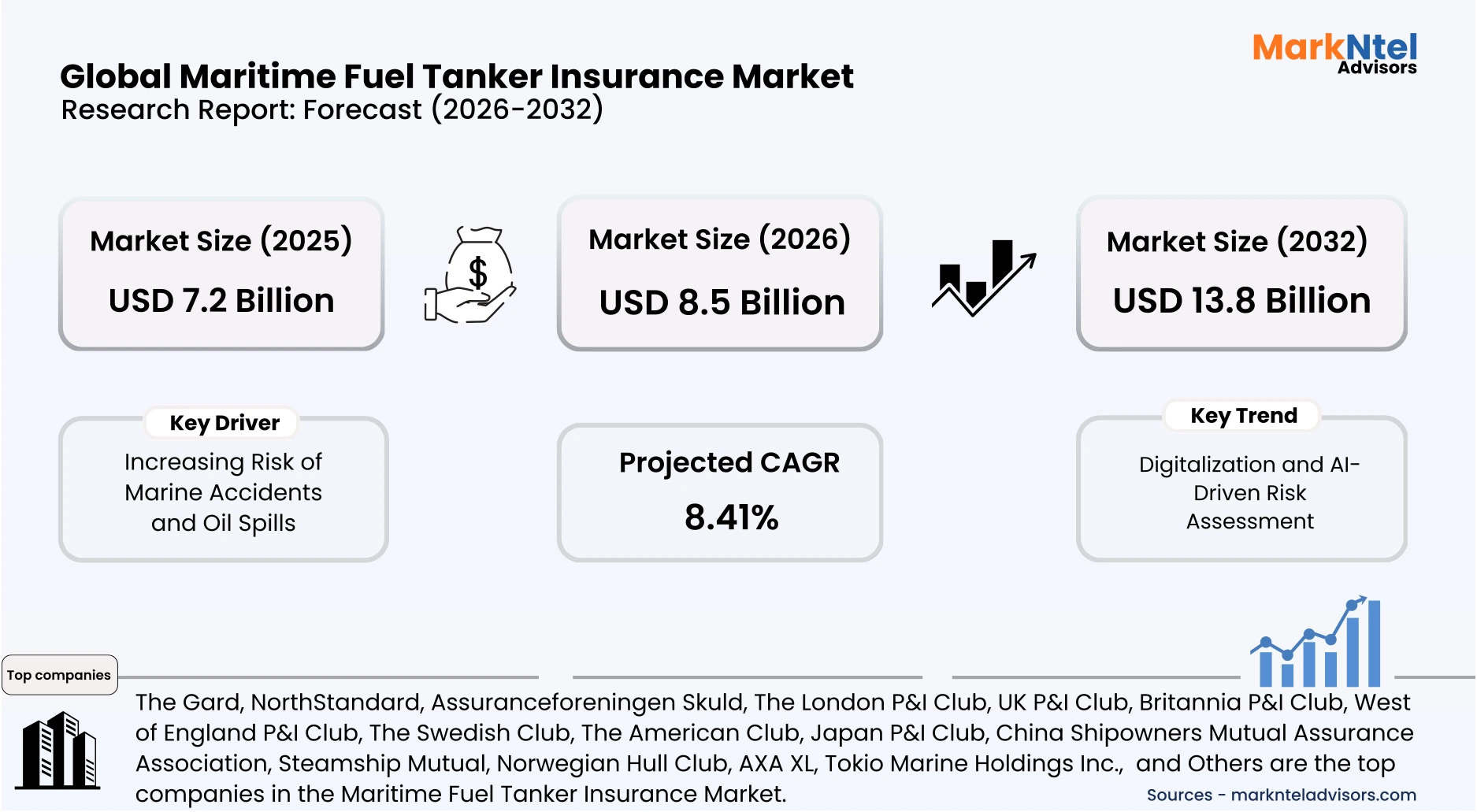
- The Global Maritime Fuel Tanker Insurance market size was valued at USD 7.2 billion in 2025 and is projected to grow from USD 8.5 billion in 2026 to USD 13.8 billion by 2032, exhibiting a CAGR of 8.41% during the forecast period.
- Asia-Pacific holds the largest market share of about 39% in the Global Maritime Fuel Tanker Insurance Market in 2026.
- By fuel tanker type, the Crude Oil Tankers segment represented a significant share of about 34% in the Global Maritime Fuel Tanker Insurance Market in 2026.
- By end user, the marine shipping companies segment represented a significant share of about 48% in the Global Maritime Fuel Tanker Insurance Market in 2026.
- Leading maritime fuel tanker companies in the Global Market are Gard, NorthStandard, Assuranceforeningen Skuld, The London P&I Club, UK P&I Club, Britannia P&I Club, West of England P&I Club, The Swedish Club, The American Club, Japan P&I Club, China Shipowners Mutual Assurance Association, Steamship Mutual, Norwegian Hull Club, AXA XL, Tokio Marine Holdings Inc., Allianz Global Corporate & Specialty, Zurich Insurance Group, Munich Re, Swiss Re, Hannover Re, Lloyd's of London, and Others.
Market Insights & Analysis: Global Maritime Fuel Tanker Insurance Market (2026-32):
The Global Maritime Fuel Tanker Insurance Market size was valued at approximately USD 7.2 billion in 2025 and is projected to grow from USD 8.5 billion in 2026 to USD 13.8 billion by 2032. Along with this, the market is estimated to grow at a CAGR of around 8.41% during the forecast period, i.e., 2026-32.
The Global Maritime Fuel Tanker Insurance Market is witnessing steady growth, primarily driven by the increasing risk of marine accidents and oil spills, which underscores the critical need for comprehensive insurance coverage. Tanker operations involve transporting large volumes of hazardous fuels across congested international shipping routes, where collisions, groundings, and fires can result in catastrophic environmental and financial losses. For instance, in March 2025, the container ship MV Solong collided with the oil tanker MV Stena Immaculate in the North Sea near the UK coast. The tanker, carrying significant volumes of aviation fuel, suffered explosions and fuel leakage, highlighting the growing necessity for tanker liability and pollution insurance .
Similarly, in March 2026, a tanker explosion near Kuwait’s port waters raised oil spill risks amid heightened geopolitical tensions, emphasizing how conflicts and attacks on oil vessels further increase insurance exposure .
A key trend complementing market growth is the digitalization of marine insurance platforms, which enhances risk management, policy issuance, and claims handling. In 2025, Singapore War Risks Mutual launched a platform offering real-time vessel tracking and automated premium updates, while Insurwave utilized blockchain to manage over 1,000 vessels through smart contracts . These initiatives streamline underwriting, accelerate claims processing, and improve transparency across maritime insurance operations.
Looking ahead, future investments and public-private initiatives are expected to further boost market demand. In 2026, the U.S. International Development Finance Corporation (DFC) announced a USD 20 billion maritime reinsurance facility to support oil and cargo vessels operating in high-risk routes, including the Strait of Hormuz. This facility will cover hull, machinery, and cargo losses, aiming to restore confidence in global tanker shipping and stabilize energy trade flows .
Overall, the combination of heightened accident and spill risks, rising geopolitical tensions, technological adoption in digital insurance platforms, and large-scale reinsurance investments underscores a robust outlook for the Maritime Fuel Tanker Insurance Market. These factors collectively enhance risk mitigation, streamline operations, and create opportunities for insurers to expand coverage offerings, positioning the market for sustained growth in the coming years.
Global Maritime Fuel Tanker Insurance Market Recent Developments:
- 2025: AXA XL partnered with U.S. Marine Insurance Group (USMIG) to expand Shipper’s Interest insurance, providing enhanced coverage for cargo, hull, and logistics risks. The initiative supports domestic and international supply chains, including fuel tanker operations, improving protection against loss, damage, and liability.
- 2026: India’s Directorate General of Shipping granted a temporary extension allowing Sberbank Insurance, Ugoria, and ASTK (among others) to continue offering P&I cover for vessels entering Indian ports until March 20, 2026. This ensured uninterrupted insurance support for tankers amid regulatory transitions and heightened scrutiny.
Global Maritime Fuel Tanker Insurance Market Scope:
| Category | Segments |
|---|---|
| By Coverage Type | (Hull & Machinery Insurance, Protection & Indemnity (P&I) Insurance, Cargo Insurance, Liability Insurance, War Risk Insurance, Loss of Hire Insurance, Pollution / Environmental Liability Insurance), |
| By Fuel Tanker Type | (Crude Oil Tankers, Refined Product Tankers, LNG Tankers, LPG Tankers, Chemical / Liquid Fuel Tankers, Bunker Fuel Tankers), |
| By Tanker Size | (Small Tankers (10,000 – 40,000 DWT), Medium Range Tankers (41,000 – 55,000 DWT), Large Range Tankers (56,000 – 160,000 DWT), Very Large Crude Carriers (VLCC) – (200,000 – 320,000 DWT), Ultra Large Crude Carriers (ULCC)), |
| By Policy Type | (Voyage Insurance, Time-Based Insurance, Fleet Insurance, Comprehensive Marine Insurance), |
| By End User | (Oil & Gas Companies, Marine Shipping Companies, Fuel Trading Companies, Logistics & Transport Operators), |
Global Maritime Fuel Tanker Insurance Market Driver:
Increasing Risk of Marine Accidents and Oil Spills
The escalating risk of marine accidents and oil spills is a key driver for the Maritime Fuel Tanker Insurance Market. Tankers carrying hazardous cargo navigate congested international shipping routes, exposing them to collisions, groundings, fires, and mechanical failures. Such incidents not only cause severe environmental damage but also lead to substantial financial liabilities for vessel operators, making comprehensive insurance coverage essential.
According to the International Tanker Owners Pollution Federation (ITOPF), a total of 10 tanker oil spills exceeding 7 tonnes were recorded worldwide in 2024, including six large spills of more than 700 tonnes. Similar levels of accidents persisted in 2025, with three large spills and three medium spills, underscoring the ongoing risk faced by tanker operators .
Recent events highlight the magnitude of these threats. In December 2024, two Russian oil tankers, Volgoneft-212 and Volgoneft-239, were caught in a severe storm near the Kerch Strait. One vessel broke apart while carrying thousands of tonnes of heavy fuel oil, causing a major spill and threatening the Black Sea ecosystem.
In May 2025, the Liberia-flagged container ship MSC Elsa-3 sank off the Kerala coast in the Arabian Sea, releasing fuel and hazardous cargo, raising concerns over oil contamination, marine biodiversity, and the livelihoods of local fishing communities.
Looking ahead, investments in offshore energy transport, stricter environmental regulations, and enhanced monitoring systems beyond 2025 will increase the need for insurance policies covering pollution liability and accident-related losses.
Given the high financial stakes and environmental consequences of marine accidents, rising risks of oil spills will continue to push tanker operators toward comprehensive insurance, thereby driving robust growth in the Maritime Fuel Tanker Insurance Market.
Global Maritime Fuel Tanker Insurance Market Trend:
Digitalization and AI-Driven Risk Assessment
A key trend in the Maritime Fuel Tanker Insurance Market is the digitalization of marine insurance platforms, which is transforming policy issuance, underwriting, and claims management. Traditionally reliant on manual, paper-based processes, marine insurance is increasingly adopting digital tools, enabling real-time data access, faster processing, and improved transparency.
Technologies such as cloud computing, IoT, and AI-driven analytics allow insurers to monitor vessel locations, cargo types, and operational risks dynamically. This data-driven approach enhances risk assessment, reduces errors, and facilitates accurate premium calculations. Public-private collaborations are also accelerating digital adoption, standardizing insurance documentation, and improving operational efficiency.
For example, in 2025, Shory partnered with Dubai’s Ports, Customs and Free Zone Corporation (PCFC) to launch a fully digital marine insurance service via the Smart DMA app. Ship owners can now buy, compare, and receive policies entirely online, streamlining underwriting and claims processes while minimizing administrative delays .
The shift toward digital platforms is enabling insurers to operate more efficiently, provide faster services, and make data-driven decisions. This digital transformation is expected to accelerate the growth of the Maritime Fuel Tanker Insurance Market in the coming years.
Global Maritime Fuel Tanker Insurance Market Opportunity:
Expansion of Green Fuel Transportation
The global push toward decarbonization in the shipping industry is creating a significant opportunity for the Maritime Fuel Tanker Insurance Market. International shipping currently contributes approximately 3% of global greenhouse gas emissions, prompting regulatory frameworks established by the International Maritime Organization (IMO) to reduce emissions intensity by 40% by 2030 and achieve net‑zero by 2050. This regulatory momentum is accelerating the adoption of alternative marine fuels such as LNG, green methanol, and green ammonia as cleaner replacements for conventional heavy fuel oil.
Governments and port authorities are actively supporting this transition by investing in green bunkering infrastructure. For instance, Hong Kong’s maritime authority plans to supply over 200,000 tonnes of green marine fuels annually by 2030, supported by incentive schemes that encourage sustainable fuel adoption.
As shipping fleets increasingly adopt dual-fuel and zero-emission engines, insurers have the opportunity to develop specialized insurance policies for green fuel tankers. These policies address unique risk profiles, including fuel storage hazards, handling protocols, and emissions-related liabilities, ensuring comprehensive coverage for emerging operational challenges.
Overall, the combined effect of regulatory pressure, infrastructure investment, and growing adoption of alternative fuels is driving a strong demand for tailored insurance solutions. This trend positions maritime fuel tanker insurers to capitalize on the expanding green fuel market, fostering innovation and growth in the sector.
Global Maritime Fuel Tanker Insurance Market Challenge:
High Claim Costs from Major Oil Spill Incidents
One of the most significant challenges facing the Maritime Fuel Tanker Insurance Market is the extremely high financial burden resulting from large oil spill incidents. When a tanker accident leads to a fuel spill, insurers can face multi‑million to multi‑billion‑dollar claims covering cleanup costs, environmental remediation, compensation, and legal liabilities. These large payouts can strain underwriters’ capital and complicate pricing and risk assessment.
For example, in December 2024, the Black Sea oil spill is a stark example. Two aging Russian tankers, Volgoneft‑212 and Volgoneft‑239, sank in the Kerch Strait, releasing heavy fuel oil into the marine environment. The Russian government’s environmental watchdog estimated environmental damage at around USD 1 billion, with tanker owners facing potential liability contributions of USD 583 million and USD 415 million, respectively. Cleanup efforts have involved extensive removal of oil‑contaminated materials and pollution mitigation along coastal areas.
Such catastrophic events illustrate how oil spill liabilities can exceed initial estimates and include long‑term environmental and economic impacts. For insurers, these high claim costs increase uncertainty in underwriting marine fuel tanker policies, demanding larger reserves and more robust risk mitigation strategies. The scale and unpredictability of such losses can also push insurers to increase premiums or tighten coverage terms to protect balance sheets.
Overall, the large claim costs associated with major oil spills present a persistent challenge for the maritime fuel tanker insurance sector, affecting profitability, risk modelling, and coverage affordability, particularly as severe weather and aging fleets continue to elevate accident risks.
Global Maritime Fuel Tanker Insurance Market (2026-32) Segmentation Analysis:
The Global Maritime Fuel Tanker Insurance Market study of MarkNtel Advisors evaluates & highlights the major trends and influencing factors in each segment. It includes predictions for the period 2026–32 at the global level. Based on the analysis, the market has been further classified as;
Based on Fuel Tanker Type:
-
- Crude Oil Tankers
- Refined Product Tankers
- LNG Tankers
- LPG Tankers
- Chemical / Liquid Fuel Tankers
- Bunker Fuel Tankers
The Crude Oil Tankers segment leads the Maritime Fuel Tanker Insurance Market with a 34% share, driven by the high global demand for crude oil transportation. Crude oil tankers are critical for moving large volumes of unrefined petroleum from production hubs in the Middle East, Africa, and Asia to refineries worldwide. Their operations involve long-haul voyages through high-traffic and sometimes geopolitically sensitive maritime routes, exposing them to risks such as collisions, groundings, oil spills, and piracy. Insurance coverage, including hull & machinery, cargo, and pollution liability, is essential to mitigate these financial and environmental risks. The size and value of cargo carried by crude oil tankers are higher than those of other fuel types, resulting in increased insurance premiums and specialized policies. Additionally, the ongoing expansion of global crude production and new trade routes in the Asia-Pacific and the Middle East further sustains the demand for insurance coverage tailored to crude oil tankers, making this segment the market leader.
Based on End User:
-
- Oil & Gas Companies
- Marine Shipping Companies
- Fuel Trading Companies
- Logistics & Transport Operators
The Marine Shipping Companies segment dominates the Maritime Fuel Tanker Insurance Market with a 48% share, reflecting their central role in global fuel transportation. These companies operate large fleets of tankers, transporting crude oil, refined products, LNG, and LPG across international shipping lanes. Their exposure to operational hazards, including mechanical failures, collisions, weather-related accidents, and oil spills, creates a high demand for comprehensive insurance coverage such as hull & machinery, P&I, cargo, and pollution liability policies. Insurance ensures protection against both financial losses and regulatory penalties, which can be substantial given the value of the cargo and environmental liabilities involved. The dominance of marine shipping companies is also supported by fleet expansion, increasing vessel sizes, and the adoption of advanced technologies, including dual-fuel engines and automated navigation systems, which require specialized insurance solutions. Consequently, marine shipping companies remain the largest end-user segment, driving growth in the maritime fuel tanker insurance market.
Global Maritime Fuel Tanker Insurance Market (2026-32): Regional Projection
The Asia-Pacific region dominates the Global Maritime Fuel Tanker Insurance Market, accounting for 39% of the market size. This is due to its strategic position as a hub for global shipping and fuel trade. Countries such as China, Japan, South Korea, Singapore, and India operate some of the busiest ports and largest tanker fleets, handling vast volumes of crude oil, LNG, and refined petroleum products. The high density of maritime traffic in the region increases exposure to risks such as collisions, groundings, fuel spills, and operational hazards, driving demand for comprehensive insurance solutions that cover cargo, hull, liability, and environmental damage.
For example, the Port of Singapore, the world’s largest marine fuel bunkering hub, handled 56.77 million tonnes of marine fuel in 2025, including LNG and biofuels. The high volume of vessel traffic and fuel shipments creates substantial risk exposure, making maritime fuel tanker insurance essential to safeguard operators against financial losses from accidents, spills, and regulatory liabilities .
Additionally, the Asia-Pacific region benefits from strong regulatory frameworks, investments in port infrastructure, and a growing focus on green fuel adoption, further reinforcing the need for specialized insurance policies.
The combination of heavy shipping activity, significant fuel transport volumes, and stringent regulations makes Asia-Pacific the leading and most critical market for maritime fuel tanker insurance.
Gain a Competitive Edge with Our Global Maritime Fuel Tanker Insurance Market Report:
- Global Maritime Fuel Tanker Insurance Market Report by MarkNtel Advisors provides a detailed & thorough analysis of market size & share, growth rate, competitive landscape, and key players. This comprehensive analysis helps businesses gain a holistic understanding of the market dynamics & make informed decisions.
- This report also highlights current market trends & future projections, allowing businesses to identify emerging opportunities & potential challenges. By understanding market forecasts, companies can align their strategies & stay ahead of the competition.
- Global Maritime Fuel Tanker Insurance Market Report aids in assessing & mitigating risks associated with entering or operating in the market. By understanding market dynamics, regulatory frameworks, and potential challenges, businesses can develop strategies to minimize risks & optimize their operations.
*Reports Delivery Format - Market research studies from MarkNtel Advisors are offered in PDF, Excel and PowerPoint formats. Within 24 hours of the payment being successfully received, the report will be sent to your email address.
Frequently Asked Questions
- Market Segmentation
- Introduction
- Product Definition
- Research Process
- Assumptions
- Executive Summary
- Global Maritime Fuel Tanker Insurance Market Policies, Regulations, and Product Standards
- Global Maritime Fuel Tanker Insurance Market Trends & Developments
- Global Maritime Fuel Tanker Insurance Market Dynamics
- Growth Factors
- Challenges
- Global Maritime Fuel Tanker Insurance Market Hotspot & Opportunities
- Global Maritime Fuel Tanker Insurance Market Outlook, 2022-2032F
- Market Size & Outlook
- By Revenues (USD Million)
- Market Share & Analysis
- By Coverage Type- Market Size & Forecast 2022-2032, USD Million
- Hull & Machinery Insurance
- Protection & Indemnity (P&I) Insurance
- Cargo Insurance
- Liability Insurance
- War Risk Insurance
- Loss of Hire Insurance
- Pollution / Environmental Liability Insurance
- By Fuel Tanker Type- Market Size & Forecast 2022-2032, USD Million
- Crude Oil Tankers
- Refined Product Tankers
- LNG Tankers
- LPG Tankers
- Chemical / Liquid Fuel Tankers
- Bunker Fuel Tankers
- By Tanker Size- Market Size & Forecast 2022-2032, USD Million
- Small Tankers (10,000 – 40,000 DWT)
- Medium Range Tankers (41,000 – 55,000 DWT)
- Large Range Tankers (56,000 – 160,000 DWT)
- Very Large Crude Carriers (VLCC) – (200,000 – 320,000 DWT)
- Ultra Large Crude Carriers (ULCC)- (320,000 – 550,000 DWT)
- By Policy Type- Market Size & Forecast 2022-2032, USD Million
- Voyage Insurance
- Time-Based Insurance
- Fleet Insurance
- Comprehensive Marine Insurance
- By End User- Market Size & Forecast 2022-2032, USD Million
- Oil & Gas Companies
- Marine Shipping Companies
- Fuel Trading Companies
- Logistics & Transport Operators
- By Region
- North America
- South America
- Europe
- The Middle East & Africa
- Asia-Pacific
- By Company
- Competition Characteristics
- Market Share & Analysis
- By Coverage Type- Market Size & Forecast 2022-2032, USD Million
- Market Size & Outlook
- North America Maritime Fuel Tanker Insurance Market Outlook, 2022-2032F
- Market Size & Outlook
- By Revenues (USD Million)
- Market Share & Analysis
- By Coverage Type- Market Size & Forecast 2022-2032, USD Million
- By Fuel Tanker Type- Market Size & Forecast 2022-2032, USD Million
- By Tanker Size- Market Size & Forecast 2022-2032, USD Million
- By Policy Type- Market Size & Forecast 2022-2032, USD Million
- By End User- Market Size & Forecast 2022-2032, USD Million
- By Country
- The US
- Canada
- Mexico
- Rest of North America
- The US Maritime Fuel Tanker Insurance Market Outlook, 2022-2032F
- Market Size & Outlook
- By Revenues (USD Million)
- Market Share & Analysis
- By Coverage Type- Market Size & Forecast 2022-2032, USD Million
- By Fuel Tanker Type- Market Size & Forecast 2022-2032, USD Million
- By Tanker Size- Market Size & Forecast 2022-2032, USD Million
- By Policy Type- Market Size & Forecast 2022-2032, USD Million
- By End User- Market Size & Forecast 2022-2032, USD Million
- Market Size & Outlook
- Canada Maritime Fuel Tanker Insurance Market Outlook, 2022-2032F
- Market Size & Outlook
- By Revenues (USD Million)
- Market Share & Analysis
- By Coverage Type- Market Size & Forecast 2022-2032, USD Million
- By Fuel Tanker Type- Market Size & Forecast 2022-2032, USD Million
- By Tanker Size- Market Size & Forecast 2022-2032, USD Million
- By Policy Type- Market Size & Forecast 2022-2032, USD Million
- By End User- Market Size & Forecast 2022-2032, USD Million
- Market Size & Outlook
- Mexico Maritime Fuel Tanker Insurance Market Outlook, 2022-2032F
- Market Size & Outlook
- By Revenues (USD Million)
- Market Share & Analysis
- By Coverage Type- Market Size & Forecast 2022-2032, USD Million
- By Fuel Tanker Type- Market Size & Forecast 2022-2032, USD Million
- By Tanker Size- Market Size & Forecast 2022-2032, USD Million
- By Policy Type- Market Size & Forecast 2022-2032, USD Million
- By End User- Market Size & Forecast 2022-2032, USD Million
- Market Size & Outlook
- Market Size & Outlook
- South America Maritime Fuel Tanker Insurance Market Outlook, 2022-2032F
- Market Size & Outlook
- By Revenues (USD Million)
- Market Share & Analysis
- By Coverage Type- Market Size & Forecast 2022-2032, USD Million
- By Fuel Tanker Type- Market Size & Forecast 2022-2032, USD Million
- By Tanker Size- Market Size & Forecast 2022-2032, USD Million
- By Policy Type- Market Size & Forecast 2022-2032, USD Million
- By End User- Market Size & Forecast 2022-2032, USD Million
- By Country
- Brazil
- Argentina
- Chile
- Colombia
- Peru
- Rest of South America
- Brazil Maritime Fuel Tanker Insurance Market Outlook, 2022-2032F
- Market Size & Outlook
- By Revenues (USD Million)
- Market Share & Analysis
- By Coverage Type- Market Size & Forecast 2022-2032, USD Million
- By Fuel Tanker Type- Market Size & Forecast 2022-2032, USD Million
- By Tanker Size- Market Size & Forecast 2022-2032, USD Million
- By Policy Type- Market Size & Forecast 2022-2032, USD Million
- By End User- Market Size & Forecast 2022-2032, USD Million
- Market Size & Outlook
- Argentina Maritime Fuel Tanker Insurance Market Outlook, 2022-2032F
- Market Size & Outlook
- By Revenues (USD Million)
- Market Share & Analysis
- By Coverage Type- Market Size & Forecast 2022-2032, USD Million
- By Fuel Tanker Type- Market Size & Forecast 2022-2032, USD Million
- By Tanker Size- Market Size & Forecast 2022-2032, USD Million
- By Policy Type- Market Size & Forecast 2022-2032, USD Million
- By End User- Market Size & Forecast 2022-2032, USD Million
- Market Size & Outlook
- Chile Maritime Fuel Tanker Insurance Market Outlook, 2022-2032F
- Market Size & Outlook
- By Revenues (USD Million)
- Market Share & Analysis
- By Coverage Type- Market Size & Forecast 2022-2032, USD Million
- By Fuel Tanker Type- Market Size & Forecast 2022-2032, USD Million
- By Tanker Size- Market Size & Forecast 2022-2032, USD Million
- By Policy Type- Market Size & Forecast 2022-2032, USD Million
- By End User- Market Size & Forecast 2022-2032, USD Million
- Market Size & Outlook
- Colombia Maritime Fuel Tanker Insurance Market Outlook, 2022-2032F
- Market Size & Outlook
- By Revenues (USD Million)
- Market Share & Analysis
- By Coverage Type- Market Size & Forecast 2022-2032, USD Million
- By Fuel Tanker Type- Market Size & Forecast 2022-2032, USD Million
- By Tanker Size- Market Size & Forecast 2022-2032, USD Million
- By Policy Type- Market Size & Forecast 2022-2032, USD Million
- By End User- Market Size & Forecast 2022-2032, USD Million
- Market Size & Outlook
- Peru Maritime Fuel Tanker Insurance Market Outlook, 2022-2032F
- Market Size & Outlook
- By Revenues (USD Million)
- Market Share & Analysis
- By Coverage Type- Market Size & Forecast 2022-2032, USD Million
- By Fuel Tanker Type- Market Size & Forecast 2022-2032, USD Million
- By Tanker Size- Market Size & Forecast 2022-2032, USD Million
- By Policy Type- Market Size & Forecast 2022-2032, USD Million
- By End User- Market Size & Forecast 2022-2032, USD Million
- Market Size & Outlook
- Market Size & Outlook
- Europe Maritime Fuel Tanker Insurance Market Outlook, 2022-2032F
- Market Size & Outlook
- By Revenues (USD Million)
- Market Share & Analysis
- By Coverage Type- Market Size & Forecast 2022-2032, USD Million
- By Fuel Tanker Type- Market Size & Forecast 2022-2032, USD Million
- By Tanker Size- Market Size & Forecast 2022-2032, USD Million
- By Policy Type- Market Size & Forecast 2022-2032, USD Million
- By End User- Market Size & Forecast 2022-2032, USD Million
- By Country
- The UK
- Germany
- France
- Italy
- Spain
- Netherlands
- Belgium
- Switzerland
- Sweden
- Austria
- Portugal
- Poland
- Rest of Europe
- The UK Maritime Fuel Tanker Insurance Market Outlook, 2022-2032F
- Market Size & Outlook
- By Revenues (USD Million)
- Market Share & Analysis
- By Coverage Type- Market Size & Forecast 2022-2032, USD Million
- By Fuel Tanker Type- Market Size & Forecast 2022-2032, USD Million
- By Tanker Size- Market Size & Forecast 2022-2032, USD Million
- By Policy Type- Market Size & Forecast 2022-2032, USD Million
- By End User- Market Size & Forecast 2022-2032, USD Million
- Market Size & Outlook
- Germany Maritime Fuel Tanker Insurance Market Outlook, 2022-2032F
- Market Size & Outlook
- By Revenues (USD Million)
- Market Share & Analysis
- By Coverage Type- Market Size & Forecast 2022-2032, USD Million
- By Fuel Tanker Type- Market Size & Forecast 2022-2032, USD Million
- By Tanker Size- Market Size & Forecast 2022-2032, USD Million
- By Policy Type- Market Size & Forecast 2022-2032, USD Million
- By End User- Market Size & Forecast 2022-2032, USD Million
- Market Size & Outlook
- France Maritime Fuel Tanker Insurance Market Outlook, 2022-2032F
- Market Size & Outlook
- By Revenues (USD Million)
- Market Share & Analysis
- By Coverage Type- Market Size & Forecast 2022-2032, USD Million
- By Fuel Tanker Type- Market Size & Forecast 2022-2032, USD Million
- By Tanker Size- Market Size & Forecast 2022-2032, USD Million
- By Policy Type- Market Size & Forecast 2022-2032, USD Million
- By End User- Market Size & Forecast 2022-2032, USD Million
- Market Size & Outlook
- Italy Maritime Fuel Tanker Insurance Market Outlook, 2022-2032F
- Market Size & Outlook
- By Revenues (USD Million)
- Market Share & Analysis
- By Coverage Type- Market Size & Forecast 2022-2032, USD Million
- By Fuel Tanker Type- Market Size & Forecast 2022-2032, USD Million
- By Tanker Size- Market Size & Forecast 2022-2032, USD Million
- By Policy Type- Market Size & Forecast 2022-2032, USD Million
- By End User- Market Size & Forecast 2022-2032, USD Million
- Market Size & Outlook
- Spain Maritime Fuel Tanker Insurance Market Outlook, 2022-2032F
- Market Size & Outlook
- By Revenues (USD Million)
- Market Share & Analysis
- By Coverage Type- Market Size & Forecast 2022-2032, USD Million
- By Fuel Tanker Type- Market Size & Forecast 2022-2032, USD Million
- By Tanker Size- Market Size & Forecast 2022-2032, USD Million
- By Policy Type- Market Size & Forecast 2022-2032, USD Million
- By End User- Market Size & Forecast 2022-2032, USD Million
- Market Size & Outlook
- Netherlands Maritime Fuel Tanker Insurance Market Outlook, 2022-2032F
- Market Size & Outlook
- By Revenues (USD Million)
- Market Share & Analysis
- By Coverage Type- Market Size & Forecast 2022-2032, USD Million
- By Fuel Tanker Type- Market Size & Forecast 2022-2032, USD Million
- By Tanker Size- Market Size & Forecast 2022-2032, USD Million
- By Policy Type- Market Size & Forecast 2022-2032, USD Million
- By End User- Market Size & Forecast 2022-2032, USD Million
- Market Size & Outlook
- Belgium Maritime Fuel Tanker Insurance Market Outlook, 2022-2032F
- Market Size & Outlook
- By Revenues (USD Million)
- Market Share & Analysis
- By Coverage Type- Market Size & Forecast 2022-2032, USD Million
- By Fuel Tanker Type- Market Size & Forecast 2022-2032, USD Million
- By Tanker Size- Market Size & Forecast 2022-2032, USD Million
- By Policy Type- Market Size & Forecast 2022-2032, USD Million
- By End User- Market Size & Forecast 2022-2032, USD Million
- Market Size & Outlook
- Switzerland Maritime Fuel Tanker Insurance Market Outlook, 2022-2032F
- Market Size & Outlook
- By Revenues (USD Million)
- Market Share & Analysis
- By Coverage Type- Market Size & Forecast 2022-2032, USD Million
- By Fuel Tanker Type- Market Size & Forecast 2022-2032, USD Million
- By Tanker Size- Market Size & Forecast 2022-2032, USD Million
- By Policy Type- Market Size & Forecast 2022-2032, USD Million
- By End User- Market Size & Forecast 2022-2032, USD Million
- Market Size & Outlook
- Sweden Maritime Fuel Tanker Insurance Market Outlook, 2022-2032F
- Market Size & Outlook
- By Revenues (USD Million)
- Market Share & Analysis
- By Coverage Type- Market Size & Forecast 2022-2032, USD Million
- By Fuel Tanker Type- Market Size & Forecast 2022-2032, USD Million
- By Tanker Size- Market Size & Forecast 2022-2032, USD Million
- By Policy Type- Market Size & Forecast 2022-2032, USD Million
- By End User- Market Size & Forecast 2022-2032, USD Million
- Market Size & Outlook
- Austria Maritime Fuel Tanker Insurance Market Outlook, 2022-2032F
- Market Size & Outlook
- By Revenues (USD Million)
- Market Share & Analysis
- By Coverage Type- Market Size & Forecast 2022-2032, USD Million
- By Fuel Tanker Type- Market Size & Forecast 2022-2032, USD Million
- By Tanker Size- Market Size & Forecast 2022-2032, USD Million
- By Policy Type- Market Size & Forecast 2022-2032, USD Million
- By End User- Market Size & Forecast 2022-2032, USD Million
- Market Size & Outlook
- Portugal Maritime Fuel Tanker Insurance Market Outlook, 2022-2032F
- Market Size & Outlook
- By Revenues (USD Million)
- Market Share & Analysis
- By Coverage Type- Market Size & Forecast 2022-2032, USD Million
- By Fuel Tanker Type- Market Size & Forecast 2022-2032, USD Million
- By Tanker Size- Market Size & Forecast 2022-2032, USD Million
- By Policy Type- Market Size & Forecast 2022-2032, USD Million
- By End User- Market Size & Forecast 2022-2032, USD Million
- Market Size & Outlook
- Poland Maritime Fuel Tanker Insurance Market Outlook, 2022-2032F
- Market Size & Outlook
- By Revenues (USD Million)
- Market Share & Analysis
- By Coverage Type- Market Size & Forecast 2022-2032, USD Million
- By Fuel Tanker Type- Market Size & Forecast 2022-2032, USD Million
- By Tanker Size- Market Size & Forecast 2022-2032, USD Million
- By Policy Type- Market Size & Forecast 2022-2032, USD Million
- By End User- Market Size & Forecast 2022-2032, USD Million
- Market Size & Outlook
- Market Size & Outlook
- The Middle East & Africa Maritime Fuel Tanker Insurance Market Outlook, 2022-2032F
- Market Size & Outlook
- By Revenues (USD Million)
- Market Share & Analysis
- By Coverage Type- Market Size & Forecast 2022-2032, USD Million
- By Fuel Tanker Type- Market Size & Forecast 2022-2032, USD Million
- By Tanker Size- Market Size & Forecast 2022-2032, USD Million
- By Policy Type- Market Size & Forecast 2022-2032, USD Million
- By End User- Market Size & Forecast 2022-2032, USD Million
- By Country
- Saudi Arabia
- UAE
- South Africa
- Israel
- Egypt
- Nigeria
- Rest of Middle East & Africa
- Saudi Arabia Maritime Fuel Tanker Insurance Market Outlook, 2022-2032F
- Market Size & Outlook
- By Revenues (USD Million)
- Market Share & Analysis
- By Coverage Type- Market Size & Forecast 2022-2032, USD Million
- By Fuel Tanker Type- Market Size & Forecast 2022-2032, USD Million
- By Tanker Size- Market Size & Forecast 2022-2032, USD Million
- By Policy Type- Market Size & Forecast 2022-2032, USD Million
- By End User- Market Size & Forecast 2022-2032, USD Million
- Market Size & Outlook
- UAE Maritime Fuel Tanker Insurance Market Outlook, 2022-2032F
- Market Size & Outlook
- By Revenues (USD Million)
- Market Share & Analysis
- By Coverage Type- Market Size & Forecast 2022-2032, USD Million
- By Fuel Tanker Type- Market Size & Forecast 2022-2032, USD Million
- By Tanker Size- Market Size & Forecast 2022-2032, USD Million
- By Policy Type- Market Size & Forecast 2022-2032, USD Million
- By End User- Market Size & Forecast 2022-2032, USD Million
- Market Size & Outlook
- South Africa Maritime Fuel Tanker Insurance Market Outlook, 2022-2032F
- Market Size & Outlook
- By Revenues (USD Million)
- Market Share & Analysis
- By Coverage Type- Market Size & Forecast 2022-2032, USD Million
- By Fuel Tanker Type- Market Size & Forecast 2022-2032, USD Million
- By Tanker Size- Market Size & Forecast 2022-2032, USD Million
- By Policy Type- Market Size & Forecast 2022-2032, USD Million
- By End User- Market Size & Forecast 2022-2032, USD Million
- Market Size & Outlook
- Israel Maritime Fuel Tanker Insurance Market Outlook, 2022-2032F
- Market Size & Outlook
- By Revenues (USD Million)
- Market Share & Analysis
- By Coverage Type- Market Size & Forecast 2022-2032, USD Million
- By Fuel Tanker Type- Market Size & Forecast 2022-2032, USD Million
- By Tanker Size- Market Size & Forecast 2022-2032, USD Million
- By Policy Type- Market Size & Forecast 2022-2032, USD Million
- By End User- Market Size & Forecast 2022-2032, USD Million
- Market Size & Outlook
- Egypt Maritime Fuel Tanker Insurance Market Outlook, 2022-2032F
- Market Size & Outlook
- By Revenues (USD Million)
- Market Share & Analysis
- By Coverage Type- Market Size & Forecast 2022-2032, USD Million
- By Fuel Tanker Type- Market Size & Forecast 2022-2032, USD Million
- By Tanker Size- Market Size & Forecast 2022-2032, USD Million
- By Policy Type- Market Size & Forecast 2022-2032, USD Million
- By End User- Market Size & Forecast 2022-2032, USD Million
- Market Size & Outlook
- Nigeria Maritime Fuel Tanker Insurance Market Outlook, 2022-2032F
- Market Size & Outlook
- By Revenues (USD Million)
- Market Share & Analysis
- By Coverage Type- Market Size & Forecast 2022-2032, USD Million
- By Fuel Tanker Type- Market Size & Forecast 2022-2032, USD Million
- By Tanker Size- Market Size & Forecast 2022-2032, USD Million
- By Policy Type- Market Size & Forecast 2022-2032, USD Million
- By End User- Market Size & Forecast 2022-2032, USD Million
- Market Size & Outlook
- Market Size & Outlook
- Asia-Pacific Maritime Fuel Tanker Insurance Market Outlook, 2022-2032F
- Market Size & Outlook
- By Revenues (USD Million)
- Market Share & Analysis
- By Coverage Type- Market Size & Forecast 2022-2032, USD Million
- By Fuel Tanker Type- Market Size & Forecast 2022-2032, USD Million
- By Tanker Size- Market Size & Forecast 2022-2032, USD Million
- By Policy Type- Market Size & Forecast 2022-2032, USD Million
- By End User- Market Size & Forecast 2022-2032, USD Million
- By Country
- China
- Japan
- India
- South Korea
- Australia
- New Zealand
- Rest of Asia-Pacific
- China Maritime Fuel Tanker Insurance Market Outlook, 2022-2032F
- Market Size & Outlook
- By Revenues (USD Million)
- Market Share & Analysis
- By Coverage Type- Market Size & Forecast 2022-2032, USD Million
- By Fuel Tanker Type- Market Size & Forecast 2022-2032, USD Million
- By Tanker Size- Market Size & Forecast 2022-2032, USD Million
- By Policy Type- Market Size & Forecast 2022-2032, USD Million
- By End User- Market Size & Forecast 2022-2032, USD Million
- Market Size & Outlook
- Japan Maritime Fuel Tanker Insurance Market Outlook, 2022-2032F
- Market Size & Outlook
- By Revenues (USD Million)
- Market Share & Analysis
- By Coverage Type- Market Size & Forecast 2022-2032, USD Million
- By Fuel Tanker Type- Market Size & Forecast 2022-2032, USD Million
- By Tanker Size- Market Size & Forecast 2022-2032, USD Million
- By Policy Type- Market Size & Forecast 2022-2032, USD Million
- By End User- Market Size & Forecast 2022-2032, USD Million
- Market Size & Outlook
- India Maritime Fuel Tanker Insurance Market Outlook, 2022-2032F
- Market Size & Outlook
- By Revenues (USD Million)
- Market Share & Analysis
- By Coverage Type- Market Size & Forecast 2022-2032, USD Million
- By Fuel Tanker Type- Market Size & Forecast 2022-2032, USD Million
- By Tanker Size- Market Size & Forecast 2022-2032, USD Million
- By Policy Type- Market Size & Forecast 2022-2032, USD Million
- By End User- Market Size & Forecast 2022-2032, USD Million
- Market Size & Outlook
- South Korea Maritime Fuel Tanker Insurance Market Outlook, 2022-2032F
- Market Size & Outlook
- By Revenues (USD Million)
- Market Share & Analysis
- By Coverage Type- Market Size & Forecast 2022-2032, USD Million
- By Fuel Tanker Type- Market Size & Forecast 2022-2032, USD Million
- By Tanker Size- Market Size & Forecast 2022-2032, USD Million
- By Policy Type- Market Size & Forecast 2022-2032, USD Million
- By End User- Market Size & Forecast 2022-2032, USD Million
- Market Size & Outlook
- Australia Maritime Fuel Tanker Insurance Market Outlook, 2022-2032F
- Market Size & Outlook
- By Revenues (USD Million)
- Market Share & Analysis
- By Coverage Type- Market Size & Forecast 2022-2032, USD Million
- By Fuel Tanker Type- Market Size & Forecast 2022-2032, USD Million
- By Tanker Size- Market Size & Forecast 2022-2032, USD Million
- By Policy Type- Market Size & Forecast 2022-2032, USD Million
- By End User- Market Size & Forecast 2022-2032, USD Million
- Market Size & Outlook
- New Zealand Maritime Fuel Tanker Insurance Market Outlook, 2022-2032F
- Market Size & Outlook
- By Revenues (USD Million)
- Market Share & Analysis
- By Coverage Type- Market Size & Forecast 2022-2032, USD Million
- By Fuel Tanker Type- Market Size & Forecast 2022-2032, USD Million
- By Tanker Size- Market Size & Forecast 2022-2032, USD Million
- By Policy Type- Market Size & Forecast 2022-2032, USD Million
- By End User- Market Size & Forecast 2022-2032, USD Million
- Market Size & Outlook
- Market Size & Outlook
- Global Maritime Fuel Tanker Insurance Market Key Strategic Imperatives for Success & Growth
- Competitive Outlook
- Company Profiles
- Gard
- Business Description
- Product Portfolio
- Collaborations & Alliances
- Recent Developments
- Financial Details
- Others
- NorthStandard
- Business Description
- Product Portfolio
- Collaborations & Alliances
- Recent Developments
- Financial Details
- Others
- Assuranceforeningen Skuld
- Business Description
- Product Portfolio
- Collaborations & Alliances
- Recent Developments
- Financial Details
- Others
- The London P&I Club
- Business Description
- Product Portfolio
- Collaborations & Alliances
- Recent Developments
- Financial Details
- Others
- UK P&I Club
- Business Description
- Product Portfolio
- Collaborations & Alliances
- Recent Developments
- Financial Details
- Others
- Britannia P&I Club
- Business Description
- Product Portfolio
- Collaborations & Alliances
- Recent Developments
- Financial Details
- Others
- West of England P&I Club
- Business Description
- Product Portfolio
- Collaborations & Alliances
- Recent Developments
- Financial Details
- Others
- The Swedish Club
- Business Description
- Product Portfolio
- Collaborations & Alliances
- Recent Developments
- Financial Details
- Others
- The American Club
- Business Description
- Product Portfolio
- Collaborations & Alliances
- Recent Developments
- Financial Details
- Others
- Japan P&I Club
- Business Description
- Product Portfolio
- Collaborations & Alliances
- Recent Developments
- Financial Details
- Others
- China Shipowners Mutual Assurance Association
- Business Description
- Product Portfolio
- Collaborations & Alliances
- Recent Developments
- Financial Details
- Others
- Steamship Mutual
- Business Description
- Product Portfolio
- Collaborations & Alliances
- Recent Developments
- Financial Details
- Others
- Norwegian Hull Club
- Business Description
- Product Portfolio
- Collaborations & Alliances
- Recent Developments
- Financial Details
- Others
- AXA XL
- Business Description
- Product Portfolio
- Collaborations & Alliances
- Recent Developments
- Financial Details
- Others
- Tokio Marine Holdings Inc.
- Business Description
- Product Portfolio
- Collaborations & Alliances
- Recent Developments
- Financial Details
- Others
- Allianz Global Corporate & Specialty
- Business Description
- Product Portfolio
- Collaborations & Alliances
- Recent Developments
- Financial Details
- Others
- Zurich Insurance Group
- Business Description
- Product Portfolio
- Collaborations & Alliances
- Recent Developments
- Financial Details
- Others
- Munich Re
- Business Description
- Product Portfolio
- Collaborations & Alliances
- Recent Developments
- Financial Details
- Others
- Swiss Re
- Business Description
- Product Portfolio
- Collaborations & Alliances
- Recent Developments
- Financial Details
- Others
- Hannover Re
- Business Description
- Product Portfolio
- Collaborations & Alliances
- Recent Developments
- Financial Details
- Others
- Lloyd's of London
- Business Description
- Product Portfolio
- Collaborations & Alliances
- Recent Developments
- Financial Details
- Others
- Gard
- Company Profiles
- Disclaimer
MarkNtel Advisors follows a robust and iterative research methodology designed to ensure maximum accuracy and minimize deviation in market estimates and forecasts. Our approach combines both bottom-up and top-down techniques to effectively segment and quantify various aspects of the market. A consistent feature across all our research reports is data triangulation, which examines the market from three distinct perspectives to validate findings. Key components of our research process include:
1. Scope & Research Design At the outset, MarkNtel Advisors define the research objectives and formulate pertinent questions. This phase involves determining the type of research—qualitative or quantitative—and designing a methodology that outlines data collection methods, target demographics, and analytical tools. They also establish timelines and budgets to ensure the research aligns with client goals.
2. Sample Selection and Data Collection In this stage, the firm identifies the target audience and determines the appropriate sample size to ensure representativeness. They employ various sampling methods, such as random or stratified sampling, based on the research objectives. Data collection is carried out using tools like surveys, interviews, and observations, ensuring the gathered data is reliable and relevant.
3. Data Analysis and Validation Once data is collected, MarkNtel Advisors undertake a rigorous analysis process. This includes cleaning the data to remove inconsistencies, employing statistical software for quantitative analysis, and thematic analysis for qualitative data. Validation steps are taken to ensure the accuracy and reliability of the findings, minimizing biases and errors.

4. Data Forecast and FinalizationThe final phase involves forecasting future market trends based on the analyzed data. MarkNtel Advisors utilize predictive modeling and time series analysis to anticipate market behaviors. The insights are then compiled into comprehensive reports, featuring visual aids like charts and graphs, and include strategic recommendations to inform client decision-making
We offer flexible licensing options to cater to varying organizational needs. Choose the pricing pack that best suits your requirements:
Buy Now Inquire Before Buying
 Request Customization
 Talk to our Consultant







