

Mexico Managed Security Services Market Research Report: Forecast (2026-2032)
Mexico Managed Security Services Market - By Service Type (Managed Security Monitoring, Managed Threat Detection & Response (MTDR), Managed Firewall & Network Security, Managed Ris ... k & Compliance, Managed Identity & Access Management (IAM), Managed Endpoint Security, Managed Cloud Security Services, Managed Application Security, Managed Identity and Data Protection Services, Managed Security Operations Center (SOC), Other Managed Security Services), By Type (Fully Managed Security Services, Co-managed Security Services), By Deployment Model (On-Premises, Cloud), By Organization Size (Large Enterprises, Small & Medium Enterprises (SMEs), By Technology (Artificial Intelligence / Machine Learning (AI/ML) Based Solutions, Behavioral Analytics & UEBA, Encryption & Tokenization Services, Threat Intelligence Platforms, Security Automation & Orchestration (SOAR), Network Security Technologies, Others), By Service Provider (IT Service Providers, Managed Security Specialist, Telecom Service Provider), By Pricing Model (Subscription-Based Services (SaaS), Usage / Consumption-Based Pricing, Per-User / Per-Device Pricing, Fixed / Project-Based Pricing), By End-User (BFSI (Banking, Financial Services & Insurance), IT & Telecom, Retail & E-commerce, Healthcare & Lifesciences, Manufacturing & Industrial, Energy & Utilities, Government & Defense, Education, Transport & Logistics, Hospitality & Travel, Others), and others Read more
- ICT & Electronics
- Jan 2026
- Pages 135
- Report Format: PDF, Excel, PPT
Mexico Managed Security Services Market
Projected 14.27% CAGR from 2026 to 2032
Study Period
2026-2032
Market Size (2025)
USD 388 Million
Market Size (2032)
USD 987 Million
Base Year
2025
Projected CAGR
14.27%
Leading Segments
By Service Type: Managed Identity & Data Protection Services
Mexico Managed Security Services Market Report Key Takeaways:
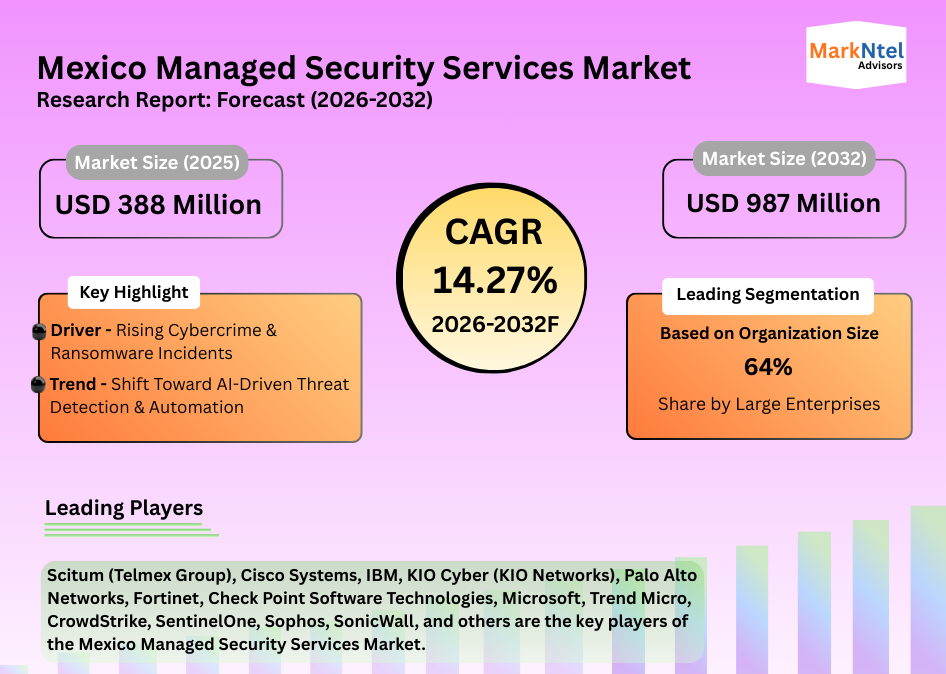
- The Mexico Managed Security Services Market size was valued at around USD 388 million in 2025 and is projected to reach USD 987 million by 2032. The estimated CAGR from 2026 to 2032 is around 14.27%, indicating strong growth.
- By Service Type, the managed identity and data protection services segment represented 27% of the Mexico Managed Security Services Market size in 2025.
- By Organization Size, the large enterprises hold a 64% share of the Mexico Managed Security Services Market in 2025.
- By End User, the BFSI represented 33% of the Mexico Managed Security Services Market size in 2025.
- The leading managed security services companies in Mexico are Scitum (Telmex Group), Cisco Systems, IBM, KIO Cyber (KIO Networks), Palo Alto Networks, Fortinet, Check Point Software Technologies, Microsoft, Trend Micro, CrowdStrike, SentinelOne, Sophos, SonicWall, and others.
Market Insights & Analysis: Mexico Managed Security Services Market (2026-2032):
The Mexico Managed Security Services Market size was valued at around USD 388 million in 2025 and is projected to reach by 2032. Along with this, the market is estimated to grow at a CAGR of around 14.27% during the forecast period, i.e., 2026-32.
The Mexico Managed Security Services Market is experiencing rapid growth, driven by supported by the escalating incidence of cybercrime and ransomware attacks, alongside a growing shift toward AI-driven threat detection and security automation.
Mexico’s enterprise risk environment is intensifying, with organizations facing about 42.4 million malware intrusion attempts in 2024, nearly 116,000 per day. These attacks often precede ransomware, credential theft, and lateral movement, increasing detection complexity and strengthening the need for 24/7 monitoring and intelligence-driven response delivered through managed security service providers.
Despite strengthened enforcement measures, Mexico accounted for approximately 15.9% of all ransomware attacks in Latin America during the first half of 2025, highlighting the sustained concentration of adversarial activity and reinforcing the strategic imperative for scalable, externally managed defense architectures.
Sector-level demand remains particularly strong within BFSI, which represented 33% of the market in 2025, driven by stringent regulatory compliance requirements, high transaction-security exposure, and increasing reliance on identity- and data-centric protection models.
Market growth is further accelerated by the rapid shift toward AI-enabled security automation and analytics-driven SOC operations. Platforms such as Palo Alto Networks’ Cortex XSIAM exemplify the integration of AI-driven telemetry correlation, automated alert enrichment, and accelerated response orchestration, enhancing the operational efficiency of managed detection and response (MDR) models across cloud, identity, network, and endpoint domains.
From a policy standpoint, the National Cybersecurity Plan 2025–2030 establishes a unified cybersecurity framework aimed at strengthening national defense capabilities. The strategy includes the development of a federated National Cybersecurity Operations Center (SESOC) to enable continuous monitoring and incident response, alongside a National Incident Response Center and a national inventory of critical infrastructure to support risk-prioritized protection. The plan further emphasizes the deployment of AI- and machine-learning-based threat detection, as well as the establishment of an advanced cyber-range training and simulation environment between 2027 and 2030. Collectively, these initiatives are expected to increase reliance on specialized security services and technical expertise across the country.
Parallel survey insights indicate that 86% of organizations in Mexico plan to increase cybersecurity investment through 2026, with prioritization areas closely aligned to MSS domains, including cloud security, identity management, and advanced threat analytics.
Overall, the Mexico Managed Security Services market outlook remains strongly positive, supported by escalating threat intensity, expanding digital-risk exposure, rapid AI-driven operational transformation, and government-led modernization initiatives collectively reinforcing long-term dependence on managed security partners and strengthening market growth prospects beyond 2025.
Mexico Managed Security Services Market Recent Developments:
- June 2025: Cloudflare and TD SYNNEX expanded their partnership to strengthen managed security services across Latin America, with Mexico positioned as a core growth market. The alliance enables MSSPs to deliver unified, cloud-native security offerings spanning Zero Trust, SASE, and network protection, helping organizations streamline deployment, lower operational complexity, and enhance defense against increasingly advanced cyber threats.
- November 2025: ShieldForce formed a partnership with AccuKnox and DeepRoot Technologies to advance the adoption of AI-enabled, Zero-Trust-based managed security solutions across Mexico and Latin America. The initiative centers on integrating modern architectures such as Cloud Native Application Protection Platform (CNAPP) into Managed Security Services (MSS) portfolios, enabling MSSPs to strengthen cloud-native protection through unified threat monitoring, rapid incident response, and continuous trust validation for evolving enterprise security needs.
Mexico Managed Security Services Market Scope:
| Category | Segments |
|---|---|
| By Service Type | Managed Security Monitoring, Managed Threat Detection & Response (MTDR), Managed Firewall & Network Security, Managed Risk & Compliance, Managed Identity & Access Management (IAM), Managed Endpoint Security, Managed Cloud Security Services, Managed Application Security, Managed Identity and Data Protection Services, Managed Security Operations Center (SOC), Other Managed Security Services |
| By Type | Fully Managed Security Services, Co-managed Security Services |
| By Deployment Model | On-Premises, Cloud |
| By Organization Size | Large Enterprises, Small & Medium Enterprises (SMEs) |
| By Technology | Artificial Intelligence / Machine Learning (AI/ML) Based Solutions, Behavioral Analytics & UEBA, Encryption & Tokenization Services, Threat Intelligence Platforms, Security Automation & Orchestration (SOAR), Network Security Technologies, Others |
| By Service Provider | IT Service Providers, Managed Security Specialist, Telecom Service Provider |
| By Pricing Model | Subscription-Based Services (SaaS), Usage / Consumption-Based Pricing, Per-User / Per-Device Pricing, Fixed / Project-Based Pricing |
| By End-User | BFSI (Banking, Financial Services & Insurance), IT & Telecom, Retail & E-commerce, Healthcare & Lifesciences, Manufacturing & Industrial, Energy & Utilities, Government & Defense, Education, Transport & Logistics, Hospitality & Travel, Others), and others |
Mexico Managed Security Services Market Drivers:
Rising Cybercrime & Ransomware Incidents
Mexico’s cybersecurity threat environment continues to intensify, reinforcing the strategic importance of Managed Security Services (MSS) across enterprises and public-sector institutions. In the first half of 2024, the country registered over 31 billion cyberattack attempts, with ransomware emerging as a leading threat. Average losses per incident reached up to USD 155,000, reflecting escalating remediation costs and growing operational disruption risks.
Between August 2024 and July 2025, Mexico registered approximately 237,000 ransomware attack attempts, making it the second-most targeted country in Latin America. Industrial, retail, and government entities were among the most affected, reflecting adversaries’ increasing focus on sectors with high-value digital assets. The scale and sophistication of these attacks exceed the capabilities of many in-house security teams, accelerating migration toward specialized, externally managed security operations.
The broader economic impact is equally substantial. Data from the National Public Security System (SESNSP) indicates that cyber-extortion and related digital crimes generate annual losses exceeding USD 7.34 billion, affecting productivity and national competitiveness.
In parallel, Mexico’s National Cybersecurity Plan and the forthcoming General Cybersecurity Law introduce structured risk-management mandates and incident-reporting obligations, further strengthening the role of MSS providers in ensuring regulatory compliance and operational resilience.
The sharp rise in ransomware incidents, escalating financial exposure, and evolving regulatory requirements are collectively driving sustained growth in Mexico’s Managed Security Services market, as organizations seek continuous, expert-led cyber defense capabilities.
Mexico Managed Security Services Market Trends:
Shift Toward AI-Driven Threat Detection & Automation
Mexico is witnessing a rapid shift toward AI-driven and automated cybersecurity operations, as enterprises respond to the increasing speed, sophistication, and volume of cyber threats. Organizations are progressively integrating AI across functions such as threat detection, incident response, and preventive monitoring to enhance resilience and operational efficiency.
The 2025 Cisco Cybersecurity Readiness Index indicates that 87% of Mexican companies now leverage AI for threat intelligence and 90% apply it in threat detection, although only 32% have fully automated defense workflows, reflecting a growing yet evolving transition toward mature AI-enabled security automation.
Industry insights presented at the 2025 Mexico Cybersecurity Summit highlight real-world adoption, where organizations deploying AI-assisted monitoring and automated triage playbooks have reduced incident-response cycles from hours to seconds. This capability is becoming particularly valuable in Managed Security Services environments, where scale, speed, and round-the-clock operations are critical to mitigating ransomware, phishing, and advanced persistent threats.
Technology providers such as Cisco are reinforcing this trend by embedding AI across their security portfolios to automate analytics, orchestrate responses, and streamline complex SOC workflows. These solutions help security teams analyze large-scale telemetry, accelerate detection of emerging attack patterns, and minimize manual investigation burdens.
Overall, AI-driven automation is emerging as a strategic enabler in Mexico’s cybersecurity landscape, strengthening proactive defense capabilities, improving response precision, and positioning managed security providers as key partners in building adaptive, intelligence-led security ecosystems beyond 2025.
Mexico Managed Security Services Market Challenges:
Limited Financial Capacity of SMEs Limiting Market Expansion
Budgetary constraints among small and medium-sized enterprises (SMEs) in Mexico continue to impede the broader adoption of managed security services and limit cybersecurity maturity, restricting investment in advanced defenses, skilled security resources, and continuous monitoring capabilities.
A substantial proportion of small firms operate without dedicated security funding, with approximately 47% of businesses with fewer than 50 employees reporting no formal cybersecurity budget, while nearly half allocate less than USD 1,500 per month to security activities. These expenditure levels remain insufficient to address increasingly complex threat environments and the rising incidence of ransomware, credential theft, and service disruption.
Furthermore, around 95% of cybersecurity incidents affecting SMEs lead to financial losses between USD 826 and USD 653,587, covering remediation, downtime, legal exposure, and data recovery costs that frequently exceed the financial resilience of smaller firms.
The recovery burden further intensifies risk, as about 50% of affected SMEs require at least 24 hours to restore IT operations, resulting in operational disruption and reputational damage.
With constrained budgets and limited security staff, many SMEs are unable to invest in advanced monitoring and managed response capabilities. Persistent financial limitations among SMEs restrict investment in managed security services, constraining security modernization efforts and moderating overall market expansion in Mexico.
Mexico Managed Security Services Market (2026-32) Segmentation Analysis:
The Mexico Managed Security Services Market Report and Forecast 2026-2032 offers a detailed analysis of the market based on the following segments:
Based on Service Type:
- Managed Security Monitoring
- Managed Threat Detection & Response (MTDR)
- Managed Firewall & Network Security
- Managed Risk & Compliance
- Managed Identity & Access Management (IAM)
- Managed Endpoint Security
- Managed Cloud Security Services
- Managed Application Security
- Managed Identity and Data Protection Services
- Managed Security Operations Center (SOC)
- Other Managed Security Services
The managed identity and data protection services segment holds the top spot in the Mexico Managed Security Services Market, with a market share of around 27%. This dominance is driven by the growing priority placed on safeguarding identities, privileged credentials, and sensitive data across hybrid and cloud environments.
As organizations accelerate digitalization, remote work, and cloud adoption, identity has become the primary control boundary for security. Enterprises increasingly rely on managed IAM, multifactor authentication, privileged access management, and data-loss prevention services to mitigate risks of account compromise, insider threats, and unauthorized data movement.
This segment’s leadership is further reinforced by regulatory and governance requirements related to data privacy, auditability, and access accountability, which encourage organizations, particularly in BFSI, government, and critical services, to outsource identity governance to specialist MSS providers.
The expansion of zero-trust architectures, coupled with rising cases of credential-based attacks and ransomware entry via compromised accounts, continues to strengthen demand for identity-centric protection delivered as a managed service.
Based on Organization Size:
- Large Enterprises
- Small & Medium Enterprises (SMEs)
The large enterprises category leads the Mexico Managed Security Services Industry, accounting for 64% of market share, primarily due to their broader attack surface, complex IT environments, and higher regulatory exposure.
These organizations typically operate multi-cloud infrastructures, distributed networks, and mission-critical systems, making continuous monitoring, incident response, and threat-intelligence-driven security operations essential.
The financial and reputational stakes associated with cyber incidents are significantly higher for large enterprises, driving stronger reliance on MSS providers to support 24/7 SOC operations, advanced detection analytics, and compliance-aligned security controls.
Additionally, sectors such as banking, telecommunications, manufacturing, and government institutions prioritize outsourced security capabilities to address skills shortages, reduce operational risk, and optimize cybersecurity spending through service-based delivery models.
The increasing adoption of zero-trust architectures, identity-centric security, and automation-enabled threat detection further reinforces demand among large enterprises, positioning them as the dominant customer group within the managed security services landscape in Mexico.
Mexico Managed Security Services Market (2026-32): Regional Projection
The Mexico Managed Security Services Market is dominated by the North region, supported by its concentration of large enterprises, export-oriented industries, and technologically advanced manufacturing ecosystems.
Key states such as Nuevo León, Coahuila, Chihuahua, and Tamaulipas host automotive, electronics, logistics, and industrial facilities that operate highly connected, multi-site digital infrastructures. These environments are characterized by elevated exposure to ransomware, operational technology (OT) vulnerabilities, and supply-chain cyber risks, reinforcing the need for outsourced threat monitoring, incident response, and identity-centric security management.
The region also demonstrates comparatively higher rates of cloud adoption, IT modernization, and compliance-driven governance, prompting organizations to engage managed security providers for 24/7 SOC support and advanced analytics-based detection.
In addition, strong cross-border trade linkages encourage alignment with international cybersecurity standards and vendor ecosystems, further accelerating MSS adoption among industrial enterprises and corporate entities across Northern Mexico.
Gain a Competitive Edge with Our Mexico Managed Security Services Market Report
- Mexico Managed Security Services Market Report by MarkNtel Advisors provides a detailed & thorough analysis of market size & share, growth rate, competitive landscape, and key players. This comprehensive analysis helps businesses gain a holistic understanding of the market dynamics & make informed decisions.
- This report also highlights current market trends & future projections, allowing businesses to identify emerging opportunities & potential challenges. By understanding market forecasts, companies can align their strategies & stay ahead of the competition.
- Mexico Managed Security Services Market Report aids in assessing & mitigating risks associated with entering or operating in the market. By understanding market dynamics, regulatory frameworks, and potential challenges, businesses can develop strategies to minimize risks & optimize their operations.
*Reports Delivery Format - Market research studies from MarkNtel Advisors are offered in PDF, Excel and PowerPoint formats. Within 24 hours of the payment being successfully received, the report will be sent to your email address.
Frequently Asked Questions
- Market Segmentation
- Introduction
- Product Definition
- Research Process
- Assumptions
- Executive Summary
- Mexico Managed Security Services Market Policies, Regulations, and Product Standards
- Mexico Managed Security Services Market Trends & Developments
- Mexico Managed Security Services Market Dynamics
- Growth Drivers
- Challenges
- Mexico Managed Security Services Market Hotspot & Opportunities
- Mexico Managed Security Services Market Outlook, 2022-2032
- Market Size & Outlook
- By Revenues (USD Million)
- Market Share & Outlook
- By Service Type – Market Size & Forecast 2022-2032, USD Million
- Managed Security Monitoring
- Managed Threat Detection & Response (MTDR)
- Managed Firewall & Network Security
- Managed Risk & Compliance
- Managed Identity & Access Management (IAM)
- Managed Endpoint Security
- Managed Cloud Security Services
- Managed Application Security
- Managed Identity and Data Protection Services
- Managed Security Operations Center (SOC)
- Other Managed Security Services
- By Type – Market Size & Forecast 2022-2032, USD Million
- Fully Managed Security Services
- Co-managed Security Services
- By Deployment Model – Market Size & Forecast 2022-2032, USD Million
- On-Premises
- Cloud
- By Organization Size – Market Size & Forecast 2022-2032, USD Million
- Large Enterprises
- Small & Medium Enterprises (SMEs)
- By Technology – Market Size & Forecast 2022-2032, USD Million
- Artificial Intelligence / Machine Learning (AI/ML) Based Solutions
- Behavioral Analytics & UEBA
- Encryption & Tokenization Services
- Threat Intelligence Platforms
- Security Automation & Orchestration (SOAR)
- Network Security Technologies
- Others
- By Service Provider – Market Size & Forecast 2022-2032, USD Million
- IT Service Providers
- Managed Security Specialist
- Telecom Service Provider
- By Pricing Model – Market Size & Forecast 2022-2032, USD Million
- Subscription-Based Services (SaaS)
- Usage / Consumption-Based Pricing
- Per-User / Per-Device Pricing
- Fixed / Project-Based Pricing
- By End-User – Market Size & Forecast 2022-2032, USD Million
- BFSI (Banking, Financial Services & Insurance)
- IT & Telecom
- Retail & E-commerce
- Healthcare & Lifesciences
- Manufacturing & Industrial
- Energy & Utilities
- Government & Defense
- Education
- Transport & Logistics
- Hospitality & Travel
- Others
- By Region
- North
- South
- West
- East
- By Company
- Company Revenue Shares
- Competitor Characteristics
- By Service Type – Market Size & Forecast 2022-2032, USD Million
- Market Size & Outlook
- Mexico On-Premise Managed Security Services Market Outlook, 2022-2032
- Market Size & Outlook
- By Revenues (USD Million)
- Market Share & Outlook
- By Service Type – Market Size & Forecast 2022-2032, USD Million
- By Type – Market Size & Forecast 2022-2032, USD Million
- By Organization Size – Market Size & Forecast 2022-2032, USD Million
- By Technology – Market Size & Forecast 2022-2032, USD Million
- By Service Provider – Market Size & Forecast 2022-2032, USD Million
- By Pricing Model – Market Size & Forecast 2022-2032, USD Million
- By End-User – Market Size & Forecast 2022-2032, USD Million
- By Region
- Market Size & Outlook
- Mexico Cloud Managed Security Services Market Outlook, 2022-2032
- Market Size & Outlook
- By Revenues (USD Million)
- Market Share & Outlook
- By Service Type – Market Size & Forecast 2022-2032, USD Million
- By Type – Market Size & Forecast 2022-2032, USD Million
- By Organization Size – Market Size & Forecast 2022-2032, USD Million
- By Technology – Market Size & Forecast 2022-2032, USD Million
- By Service Provider – Market Size & Forecast 2022-2032, USD Million
- By Pricing Model – Market Size & Forecast 2022-2032, USD Million
- By End-User – Market Size & Forecast 2022-2032, USD Million
- By Region
- Market Size & Outlook
- Mexico Managed Security Services Market Key Strategic Imperatives for Success & Growth
- Competition Outlook
- Company Profiles
- Scitum (Telmex Group)
- Business Description
- Product Portfolio
- Strategic Alliances or Partnerships
- Recent Developments
- Financial Details
- Others
- Cisco Systems
- Business Description
- Product Portfolio
- Strategic Alliances or Partnerships
- Recent Developments
- Financial Details
- Others
- IBM
- Business Description
- Product Portfolio
- Strategic Alliances or Partnerships
- Recent Developments
- Financial Details
- Others
- KIO Cyber (KIO Networks)
- Business Description
- Product Portfolio
- Strategic Alliances or Partnerships
- Recent Developments
- Financial Details
- Others
- Palo Alto Networks
- Business Description
- Product Portfolio
- Strategic Alliances or Partnerships
- Recent Developments
- Financial Details
- Others
- Fortinet
- Business Description
- Product Portfolio
- Strategic Alliances or Partnerships
- Recent Developments
- Financial Details
- Others
- Check Point Software Technologies
- Business Description
- Product Portfolio
- Strategic Alliances or Partnerships
- Recent Developments
- Financial Details
- Others
- Microsoft
- Business Description
- Product Portfolio
- Strategic Alliances or Partnerships
- Recent Developments
- Financial Details
- Others
- Trend Micro
- Business Description
- Product Portfolio
- Strategic Alliances or Partnerships
- Recent Developments
- Financial Details
- Others
- CrowdStrike
- Business Description
- Product Portfolio
- Strategic Alliances or Partnerships
- Recent Developments
- Financial Details
- Others
- SentinelOne
- Business Description
- Product Portfolio
- Strategic Alliances or Partnerships
- Recent Developments
- Financial Details
- Others
- Sophos
- Business Description
- Product Portfolio
- Strategic Alliances or Partnerships
- Recent Developments
- Financial Details
- Others
- SonicWall
- Business Description
- Product Portfolio
- Strategic Alliances or Partnerships
- Recent Developments
- Financial Details
- Others
- Others
- Scitum (Telmex Group)
- Company Profiles
- Disclaimer
MarkNtel Advisors follows a robust and iterative research methodology designed to ensure maximum accuracy and minimize deviation in market estimates and forecasts. Our approach combines both bottom-up and top-down techniques to effectively segment and quantify various aspects of the market. A consistent feature across all our research reports is data triangulation, which examines the market from three distinct perspectives to validate findings. Key components of our research process include:
1. Scope & Research Design At the outset, MarkNtel Advisors define the research objectives and formulate pertinent questions. This phase involves determining the type of research—qualitative or quantitative—and designing a methodology that outlines data collection methods, target demographics, and analytical tools. They also establish timelines and budgets to ensure the research aligns with client goals.
2. Sample Selection and Data Collection In this stage, the firm identifies the target audience and determines the appropriate sample size to ensure representativeness. They employ various sampling methods, such as random or stratified sampling, based on the research objectives. Data collection is carried out using tools like surveys, interviews, and observations, ensuring the gathered data is reliable and relevant.
3. Data Analysis and Validation Once data is collected, MarkNtel Advisors undertake a rigorous analysis process. This includes cleaning the data to remove inconsistencies, employing statistical software for quantitative analysis, and thematic analysis for qualitative data. Validation steps are taken to ensure the accuracy and reliability of the findings, minimizing biases and errors.

4. Data Forecast and FinalizationThe final phase involves forecasting future market trends based on the analyzed data. MarkNtel Advisors utilize predictive modeling and time series analysis to anticipate market behaviors. The insights are then compiled into comprehensive reports, featuring visual aids like charts and graphs, and include strategic recommendations to inform client decision-making
We offer flexible licensing options to cater to varying organizational needs. Choose the pricing pack that best suits your requirements:
Buy Now Inquire Before Buying
 Request Customization
 Talk to our Consultant







