

UAE Edge Computing Market Research Report: Forecast (2026-2032)
UAE Edge Computing Market - By Component Hardware, (Edge gateways & edge servers, Ruggedized edge nodes & micro data centers, IoT sensors & controllers, Storage devices, Others), S ... oftware (Edge orchestration platforms, Edge analytics software, Edge data management & databases, Others), Services (Consulting & Advisory Services, Deployment & Integration, Edge Security & Compliance Services, Others), By Deployment Model (On-Premise, On-Cloud), By Technology (Edge AI / Edge Machine Learning, IoT & IIoT Edge Processing, MEC (Multi-Access Edge Computing), 5G-Enabled Edge Computing, Distributed Cloud & Micro-Cloud, Blockchain at the Edge, Digital Twins at Edge, Others), By Organization Size (Large Enterprises, Small & Medium Enterprises (SMEs), By Application (Remote Asset Monitoring, Predictive Maintenance, Content Delivery / Local Caching, AR/VR & Spatial Computing, Energy Management & Smart Grids, Robotics & Edge-AI Processing, Others), By End User (Manufacturing & Industrial, Telecom & IT, Energy & Utilities, Retail & E-Commerce, Banking, Financial Services & Insurance (BFSI), Government & Defense, Media & Entertainment, Oil & Gas / Mining, Others), and others Read more
- ICT & Electronics
- Jan 2026
- Pages 135
- Report Format: PDF, Excel, PPT
UAE Edge Computing Market
Projected 11.97% CAGR from 2026 to 2032
Study Period
2026-2032
Market Size (2025)
USD 97 Million
Market Size (2032)
USD 214 Million
Base Year
2025
Projected CAGR
11.97%
Leading Segments
By Component: Hardware
UAE Edge Computing Market Report Key Takeaways:
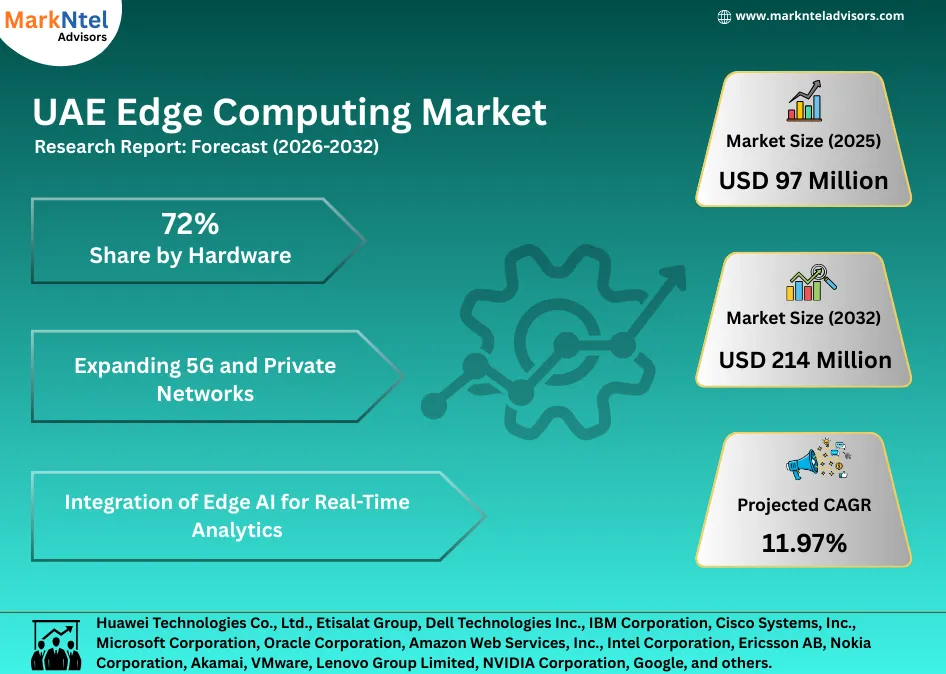
- The UAE Edge Computing Market size was valued at around USD 97 million in 2025 and is projected to reach USD 214 million by 2032. The estimated CAGR from 2026 to 2032 is around 11.97%, indicating strong growth.
- By component, the hardware segment represented 72% of the UAE Edge Computing Market size in 2025.
- By end user, the IT & Telecom represented 34% of the UAE Edge Computing Market size in 2025.
- By City, Dubai leads the UAE Edge Computing Market with a dominant 65% share in 2025.
- The major edge computing companies in the UAE are Huawei Technologies Co., Ltd., Etisalat Group, Dell Technologies Inc., IBM Corporation, Cisco Systems, Inc., Microsoft Corporation, Oracle Corporation, Amazon Web Services, Inc., Intel Corporation, Ericsson AB, Nokia Corporation, Akamai, VMware, Lenovo Group Limited, NVIDIA Corporation, Google, and others.
Market Insights & Analysis: UAE Edge Computing Market (2026-2032):
The UAE Edge Computing Market size was valued at around USD 97 million in 2025 and is projected to reach USD 214 million by 2032. Along with this, the market is estimated to grow at a CAGR of around 11.97% during the forecast period, i.e., 2026-32.
The UAE Edge Computing Market is experiencing rapid growth, driven by the accelerated rollout of 5G and private network infrastructures, coupled with the expanding integration of edge-AI-driven real-time analytics across critical enterprise and public-sector environments.
The UAE had achieved over 95% 5G population coverage by 2024, ranking among the world’s most comprehensively connected nations. This extensive high-capacity network layer provides the ultra-low-latency and high-bandwidth foundation required to support distributed compute environments across sectors such as aviation, logistics, healthcare, smart urban infrastructure, and security operations.
A major structural growth enabler is the expansion of large-scale private 5G and mission-critical industrial networks. For instance, in July 2024, ADNOC and e& announced development of the energy sector’s largest private 5G network, spanning approximately 11,000 sq km across onshore and offshore assets. Expected to be operational in 2025, the network is projected to create around USD 1.5 billion in value through automation, real-time monitoring, and AI-driven decision intelligence, all of which depend on edge-centric processing architectures.
The market outlook is further reinforced by the growing integration of edge AI for real-time analytics. For example, in 2025, EDGE Group’s FADA division introduced TACTICA, an advanced AI platform designed to process multi-source intelligence data, including satellite imagery and sensor streams, to generate near-instant situational awareness for defense, infrastructure, and security environments. Leveraging the UAE-developed Falcon LLM, the platform illustrates how edge-enabled inference reduces cloud dependency while strengthening responsiveness in mission-critical operations.
Looking ahead, the UAE is making forward-looking investments in post-5G innovation that will further accelerate edge-computing maturity. For instance, in late 2025, e& UAE, Khalifa University, and Zayed University established the UAE 6G Innovation Hub, creating national federated testbeds for 5G/6G research and edge-application development.
In parallel, e& successfully trialed 6 GHz and 600 MHz spectrum bands, achieving speeds of up to 10 Gbps and extended wide-area coverage, key milestones toward 5.5G / 5G-Advanced evolution and high-density IoT environments.
At the national level, the TDRA has launched a national 6G initiative to develop a comprehensive ecosystem by uniting government, academia, and industry partners. By integrating AI, quantum, and satellite technologies, the initiative aims to enable ultra-low-latency, high-capacity connectivity, a critical enabler for advanced edge computing applications.
Through coordinated infrastructure investment, innovation-driven partnerships, and strategic policy alignment, the UAE is advancing one of the region’s most mature edge-computing ecosystems, positioning the market for sustained, technology-led expansion through and beyond 2030.
UAE Edge Computing Market Recent Developments:
- May 2025: Kerno, a UAE-based enterprise IT manufacturer, unveiled its first production-ready OKAM and UQLEAD server lines at the Make It in the Emirates 2025 exhibition. Designed for enterprise, AI, and edge computing workloads, these locally manufactured servers strengthen the UAE’s digital infrastructure capabilities and support regional technology sovereignty.
- May 2025: Qualcomm Technologies and e& announced a strategic collaboration to accelerate the deployment of 5G-enabled edge AI solutions in the UAE. The partnership focuses on developing industrial edge gateways, intelligent IoT devices, and real-time computing platforms that process data locally, improving latency, resilience, and security while supporting nationwide digital-infrastructure modernization and advanced industry applications.
UAE Edge Computing Market Scope:
| Category | Segments |
|---|---|
| By Component | Hardware, (Edge gateways & edge servers, Ruggedized edge nodes & micro data centers, IoT sensors & controllers, Storage devices, Others), Software (Edge orchestration platforms, Edge analytics software, Edge data management & databases, Others), Services (Consulting & Advisory Services, Deployment & Integration, Edge Security & Compliance Services, Others |
| By Deployment Model | On-Premise, On-Cloud |
| By Technology | Edge AI / Edge Machine Learning, IoT & IIoT Edge Processing, MEC (Multi-Access Edge Computing), 5G-Enabled Edge Computing, Distributed Cloud & Micro-Cloud, Blockchain at the Edge, Digital Twins at Edge, Others |
| By Organization Size | Large Enterprises, Small & Medium Enterprises (SMEs), By Application (Remote Asset Monitoring, Predictive Maintenance, Content Delivery / Local Caching, AR/VR & Spatial Computing, Energy Management & Smart Grids, Robotics & Edge-AI Processing, Others |
| By End User | Manufacturing & Industrial, Telecom & IT, Energy & Utilities, Retail & E-Commerce, Banking, Financial Services & Insurance (BFSI), Government & Defense, Media & Entertainment, Oil & Gas / Mining, Others), and others |
UAE Edge Computing Market Drivers:
Expanding 5G and Private Networks
The comprehensive deployment of 5G connectivity and private network infrastructures in the United Arab Emirates is a pivotal driver for the adoption and scaling of edge computing technologies.
By 2025, leading telecommunications operators e& UAE and du have implemented standalone 5G (5G SA) networks alongside 5G-Advanced services, delivering the ultra-low latency and high throughput essential for real-time data processing and edge-based AI workloads. Notably, du’s 5G+ network achieves up to 2 times faster speeds and substantial latency reductions relative to previous 5G generations, enabling applications such as autonomous logistics and smart urban systems.
In 2025, e& UAE introduced 5G network slicing and RedCap technologies on its 5G SA platform to support differentiated industrial use cases, including advanced manufacturing and autonomous systems, thereby enhancing network reliability for edge workloads.
Private 5G trials conducted by ZTE and e& UAE have achieved uplink speeds of up to 2.04 Gbps, demonstrating the viability of enterprise-grade networks for edge computing in sectors such as industrial automation and smart surveillance.
Looking ahead, UAE regulators and industry stakeholders are advancing 6G research and testing, with the intent to further extend connectivity performance and support increasingly sophisticated edge architectures.
The rapid expansion of 5G and private networks is delivering the ultra-low latency and high-bandwidth connectivity needed for real-time, distributed computing, accelerating edge computing adoption across government and enterprise ecosystems, and positioning the market for sustained growth beyond 2025.
UAE Edge Computing Market Trends:
Integration of Edge AI for Real-Time Analytics
The UAE is undergoing a structural transformation marked by deeper integration of edge AI for real-time analytics, supported by rapid AI deployment across government, industrial, and enterprise ecosystems to enhance operational intelligence, automation, and data-driven decision-making.
By the end of 2025, government reports indicate that 97% of federal and local entities had deployed AI tools, reinforcing the need to process mission-critical data at the network edge, where ultra-low latency, security, and immediacy of insights are essential, a development that directly strengthens demand for edge-AI-enabled computing architectures.
This transition is underpinned by expanding digital and data center infrastructure. For instance, in 2025, operators increased capital allocation toward AI-ready compute environments as du recorded capital expenditure of USD 148 million to enhance distributed processing capabilities and support low-latency AI inference workloads, which are intrinsically aligned with edge environments and near-device analytics.
Innovation partnerships are further accelerating the trend. For example, at GITEX Global 2025, e& UAE and Intel announced an AI Centre of Excellence to co-develop edge-optimized AI solutions and real-time inference models for mobility, public services, and industrial use cases. The UAE also unveiled AI-powered patrol vehicles delivering real-time visual analytics at the edge to enhance public safety responsiveness.
The UAE’s coordinated investments in AI infrastructure, distributed computing, and applied edge intelligence are firmly embedding edge AI-driven real-time analytics as a defining market trend, positioning the ecosystem for sustained technological and commercial expansion beyond 2025.
UAE Edge Computing Market Challenges:
High Capital Investment and Deployment Complexity
A major constraint in the UAE Edge Computing Market is the high capital intensity and technical complexity required to deploy distributed computing and next-generation network infrastructure.
Edge computing rollouts depend on parallel investment in data centers, connectivity, cloud platforms, and AI-ready processing environments, resulting in substantial upfront expenditure for operators and enterprises.
In the first half of 2025, UAE telecom providers e& and du increased their combined capital investment to USD 648 million to accelerate infrastructure expansion across 5G networks, data centers, and digital platforms, highlighting the financial scale required to enable edge-ready environments.
At the same time, edge and AI-driven architectures require high-density compute and specialized hardware, further elevating cost pressures. For example, the development of large-scale AI and edge-processing facilities such as the Stargate UAE AI campus (Phase I: 200 MW) involves the procurement of advanced GPU systems, where a single high-end unit may cost around USD 30,000, with deployments often requiring thousands of units to support real-time inference and analytics at the edge.
These high capital requirements and deployment complexities can slow ecosystem expansion, restrict enterprise participation, and delay large-scale commercialization of edge computing solutions in the UAE.
UAE Edge Computing Market (2026-32) Segmentation Analysis:
The UAE Edge Computing Market Report and Forecast 2026-2032 offers a detailed analysis of the market based on the following segments:
Based on Component:
- Hardware
- Edge gateways & edge servers
- Ruggedized edge nodes & micro data centers
- IoT sensors & controllers
- Storage devices
- Others
- Software
- Edge orchestration platforms
- Edge analytics software
- Edge data management & databases
- Others
- Services
- Consulting & Advisory Services
- Deployment & Integration
- Edge Security & Compliance Services
- Others
The hardware segment now holds the top spot in the UAE Edge Computing Market Share, accounting for 72% of the market, primarily due to the capital-intensive nature of building distributed compute infrastructure and the foundational role of physical systems in enabling edge deployments.
Edge gateways, ruggedized edge nodes, micro data centers, GPUs, storage devices, and IoT controllers represent the core investment layer required to support real-time processing, low-latency analytics, and localized data handling across industries such as manufacturing, logistics, utilities, public safety, and smart city operations.
The UAE’s accelerated rollout of 5G, AI-ready data centers, autonomous mobility systems, and smart infrastructure further amplifies demand for high-performance hardware capable of supporting AI inference, computer vision, and mission-critical operational workloads at the network edge. Enterprises and government entities continue prioritizing spending on computer, networking, and sensor hardware to modernize operational technology environments before scaling advanced software and orchestration platforms.
Additionally, many edge use cases in the UAE, including surveillance, industrial automation, retail analytics, and transport monitoring, rely on large fleets of cameras, controllers, and field devices, reinforcing hardware as the dominant cost and revenue contributor. As organizations expand distributed architectures and real-time processing capabilities, hardware remains the primary enabler and investment driver within the component landscape.
Based on End User:
- Manufacturing & Industrial
- Telecom & IT
- Energy & Utilities
- Retail & E-Commerce
- Banking, Financial Services & Insurance (BFSI)
- Government & Defense
- Media & Entertainment
- Oil & Gas / Mining
- Others
The IT & Telecom category leads the UAE Edge Computing Industry, accounting for 34% of market share, primarily due to its central role in enabling nationwide digital connectivity, 5G infrastructure expansion, and cloud–edge integration initiatives.
Telecom operators such as e& and du are major investors and early adopters of edge architectures, deploying multi-access edge computing (MEC), private 5G networks, network virtualization, and distributed cloud nodes to support low-latency data processing for enterprises, IoT ecosystems, and mission-critical applications.
The sector’s rapid transition toward 5G-Advanced, AI-driven network management, and edge-hosted service delivery models further accelerates demand for localized compute resources. Additionally, IT service providers and cloud platforms are increasingly integrating edge analytics, orchestration software, and hybrid cloud frameworks to support real-time workloads across smart cities, cybersecurity, content delivery, and enterprise automation.
This strong alignment with national digital transformation priorities, coupled with sustained capital investments and large-scale infrastructure modernization programs, reinforces the dominant market position of the IT & Telecom segment compared with other end-user industries.
UAE Edge Computing Market (2026-32): Regional Projection
The UAE Edge Computing Market is dominated by the Dubai, which holds a commanding 65% share, due to its highly advanced digital infrastructure, mature enterprise ecosystem, and strong concentration of technology-driven industries.
The emirate hosts a dense network of data centers, smart-city platforms, cloud providers, and edge-enabled applications across aviation, finance, logistics, retail, and tourism, collectively driving sustained demand for low-latency connectivity and real-time data processing.
Pro-innovation government initiatives, including smart governance programs, AI adoption frameworks, paperless service delivery, and competitive free-zone incentives, accelerate the deployment of next-generation ICT and attract multinational technology firms as well as digital-first startups.
Dubai’s strategic role as a regional trade and connectivity hub further strengthens use cases in e-commerce fulfillment, transport optimization, and cross-border digital services. High enterprise digital maturity, consistent capital inflows, and continuous infrastructure upgrades spanning fiber backbones, cloud interconnects, and 5G-enabled architectures enable rapid scaling of edge-centric solutions relative to other emirates.
Complementing these strengths, Dubai’s leadership in smart infrastructure is internationally recognized, ranking 4th globally and 1st in the Arab region in the IMD Smart City Index 2025, underscoring its robust connectivity, integrated data ecosystems, and innovation-driven urban infrastructure.
Gain a Competitive Edge with Our UAE Edge Computing Market Report:
- UAE Edge Computing Market Report by MarkNtel Advisors provides a detailed & thorough analysis of market size & share, growth rate, competitive landscape, and key players. This comprehensive analysis helps businesses gain a holistic understanding of the market dynamics & make informed decisions.
- This report also highlights current market trends & future projections, allowing businesses to identify emerging opportunities & potential challenges. By understanding market forecasts, companies can align their strategies & stay ahead of the competition.
- UAE Edge Computing Market Report aids in assessing & mitigating risks associated with entering or operating in the market. By understanding market dynamics, regulatory frameworks, and potential challenges, businesses can develop strategies to minimize risks & optimize their operations.
*Reports Delivery Format - Market research studies from MarkNtel Advisors are offered in PDF, Excel and PowerPoint formats. Within 24 hours of the payment being successfully received, the report will be sent to your email address.
Frequently Asked Questions
- Market Segmentation
- Introduction
- Product Definition
- Research Process
- Assumptions
- Executive Summary
- UAE Edge Computing Market Policies, Regulations, and Product Standards
- UAE Edge Computing Market Trends & Developments
- UAE Edge Computing Market Dynamics
- Growth Drivers
- Challenges
- UAE Edge Computing Market Hotspot & Opportunities
- UAE Edge Computing Market Outlook, 2022-2032
- Market Size & Outlook
- By Revenues (USD Million)
- Market Share & Outlook
- By Component – Market Size & Forecast 2022-2032, USD Million
- Hardware
- Edge gateways & edge servers
- Ruggedized edge nodes & micro data centers
- IoT sensors & controllers
- Storage devices
- Others
- Software
- Edge orchestration platforms
- Edge analytics software
- Edge data management & databases
- Others
- Services
- Consulting & Advisory Services
- Deployment & Integration
- Edge Security & Compliance Services
- Others
- Hardware
- By Deployment Model – Market Size & Forecast 2022-2032, USD Million
- On-Premise
- On-Cloud
- By Technology – Market Size & Forecast 2022-2032, USD Million
- Edge AI / Edge Machine Learning
- IoT & IIoT Edge Processing
- MEC (Multi-Access Edge Computing)
- 5G-Enabled Edge Computing
- Distributed Cloud & Micro-Cloud
- Blockchain at the Edge
- Digital Twins at Edge
- Others
- By Organization Size – Market Size & Forecast 2022-2032, USD Million
- Large Enterprises
- Small & Medium Enterprises (SMEs)
- By Application – Market Size & Forecast 2022-2032, USD Million
- Remote Asset Monitoring
- Predictive Maintenance
- Content Delivery / Local Caching
- AR/VR & Spatial Computing
- Energy Management & Smart Grids
- Robotics & Edge-AI Processing
- Others
- By End User – Market Size & Forecast 2022-2032, USD Million
- Manufacturing & Industrial
- Telecom & IT
- Energy & Utilities
- Retail & E-Commerce
- Banking, Financial Services & Insurance (BFSI)
- Government & Defense
- Media & Entertainment
- Oil & Gas / Mining
- Others
- By Component – Market Size & Forecast 2022-2032, USD Million
- By Region
- Abu Dhabi & Al Ain
- Dubai
- Sharjah & Northern Emirates
- By Company
- Company Revenue Shares
- Competitor Characteristics
- Market Size & Outlook
- UAE Hardware Edge Computing Market Outlook, 2022-2032
- Market Size & Outlook
- By Revenues (USD Million)
- By Volume (Million Units)
- Market Share & Outlook
- By Deployment Model – Market Size & Forecast 2022-2032, USD Million
- By Technology – Market Size & Forecast 2022-2032, USD Million
- By Organization Size – Market Size & Forecast 2022-2032, USD Million
- By Application – Market Size & Forecast 2022-2032, USD Million
- By End User – Market Size & Forecast 2022-2032, USD Million
- By Region
- Market Size & Outlook
- UAE Software Edge Computing Market Outlook, 2022-2032
- Market Size & Outlook
- By Revenues (USD Million)
- By Volume (Million Units)
- Market Share & Outlook
- By Deployment Model – Market Size & Forecast 2022-2032, USD Million
- By Technology – Market Size & Forecast 2022-2032, USD Million
- By Organization Size – Market Size & Forecast 2022-2032, USD Million
- By Application – Market Size & Forecast 2022-2032, USD Million
- By End User – Market Size & Forecast 2022-2032, USD Million
- By Region
- Market Size & Outlook
- UAE Services Edge Computing Market Outlook, 2022-2032
- Market Size & Outlook
- By Revenues (USD Million)
- By Volume (Million Units)
- Market Share & Outlook
- By Deployment Model – Market Size & Forecast 2022-2032, USD Million
- By Technology – Market Size & Forecast 2022-2032, USD Million
- By Organization Size – Market Size & Forecast 2022-2032, USD Million
- By Application – Market Size & Forecast 2022-2032, USD Million
- By End User – Market Size & Forecast 2022-2032, USD Million
- By Region
- Market Size & Outlook
- UAE Edge Computing Market Key Strategic Imperatives for Success & Growth
- Competition Outlook
- Company Profiles
- Huawei Technologies Co., Ltd.
- Business Description
- Product Portfolio
- Strategic Alliances or Partnerships
- Recent Developments
- Financial Details
- Others
- etisalat group
- Business Description
- Product Portfolio
- Strategic Alliances or Partnerships
- Recent Developments
- Financial Details
- Others
- Dell Technologies Inc.
- Business Description
- Product Portfolio
- Strategic Alliances or Partnerships
- Recent Developments
- Financial Details
- Others
- IBM Corporation
- Business Description
- Product Portfolio
- Strategic Alliances or Partnerships
- Recent Developments
- Financial Details
- Others
- Cisco Systems, Inc.
- Business Description
- Product Portfolio
- Strategic Alliances or Partnerships
- Recent Developments
- Financial Details
- Others
- Microsoft Corporation
- Business Description
- Product Portfolio
- Strategic Alliances or Partnerships
- Recent Developments
- Financial Details
- Others
- Oracle Corporation
- Business Description
- Product Portfolio
- Strategic Alliances or Partnerships
- Recent Developments
- Financial Details
- Others
- Amazon Web Services, Inc.
- Business Description
- Product Portfolio
- Strategic Alliances or Partnerships
- Recent Developments
- Financial Details
- Others
- Intel Corporation
- Business Description
- Product Portfolio
- Strategic Alliances or Partnerships
- Recent Developments
- Financial Details
- Others
- Ericsson AB
- Business Description
- Product Portfolio
- Strategic Alliances or Partnerships
- Recent Developments
- Financial Details
- Others
- Nokia Corporation
- Business Description
- Product Portfolio
- Strategic Alliances or Partnerships
- Recent Developments
- Financial Details
- Others
- Akamai
- Business Description
- Product Portfolio
- Strategic Alliances or Partnerships
- Recent Developments
- Financial Details
- Others
- Vmware
- Business Description
- Product Portfolio
- Strategic Alliances or Partnerships
- Recent Developments
- Financial Details
- Others
- Lenovo Group Limited
- Business Description
- Product Portfolio
- Strategic Alliances or Partnerships
- Recent Developments
- Financial Details
- Others
- NVIDIA Corporation
- Business Description
- Product Portfolio
- Strategic Alliances or Partnerships
- Recent Developments
- Financial Details
- Others
- Google
- Business Description
- Product Portfolio
- Strategic Alliances or Partnerships
- Recent Developments
- Financial Details
- Others
- Others
- Huawei Technologies Co., Ltd.
- Company Profiles
- Disclaimer
MarkNtel Advisors follows a robust and iterative research methodology designed to ensure maximum accuracy and minimize deviation in market estimates and forecasts. Our approach combines both bottom-up and top-down techniques to effectively segment and quantify various aspects of the market. A consistent feature across all our research reports is data triangulation, which examines the market from three distinct perspectives to validate findings. Key components of our research process include:
1. Scope & Research Design At the outset, MarkNtel Advisors define the research objectives and formulate pertinent questions. This phase involves determining the type of research—qualitative or quantitative—and designing a methodology that outlines data collection methods, target demographics, and analytical tools. They also establish timelines and budgets to ensure the research aligns with client goals.
2. Sample Selection and Data Collection In this stage, the firm identifies the target audience and determines the appropriate sample size to ensure representativeness. They employ various sampling methods, such as random or stratified sampling, based on the research objectives. Data collection is carried out using tools like surveys, interviews, and observations, ensuring the gathered data is reliable and relevant.
3. Data Analysis and Validation Once data is collected, MarkNtel Advisors undertake a rigorous analysis process. This includes cleaning the data to remove inconsistencies, employing statistical software for quantitative analysis, and thematic analysis for qualitative data. Validation steps are taken to ensure the accuracy and reliability of the findings, minimizing biases and errors.

4. Data Forecast and FinalizationThe final phase involves forecasting future market trends based on the analyzed data. MarkNtel Advisors utilize predictive modeling and time series analysis to anticipate market behaviors. The insights are then compiled into comprehensive reports, featuring visual aids like charts and graphs, and include strategic recommendations to inform client decision-making
We offer flexible licensing options to cater to varying organizational needs. Choose the pricing pack that best suits your requirements:
Buy Now Inquire Before Buying
 Request Customization
 Talk to our Consultant







