

Japan Ready Meals Market Research Report: Growth Drivers & Forecast (2026-2032)
By Product Type (Dried Ready Meals, Shelf Stable Ready Meals, Chilled Ready Meals, Frozen Ready Meals, Others), By Distribution Channel (Supermarkets/Hypermarkets, Convenience Stor ... es, Online Retail, Specialty Stores, Foodservice/HoReCa), By End-User (Household, Commercial), and others Read more
- Food & Beverages
- Feb 2026
- Pages 165
- Report Format: PDF, Excel, PPT
Japan Ready Meals Market
Projected 5.61% CAGR from 2026 to 2032
Study Period
2026-2032
Market Size (2026)
USD 16.92 Billion
Market Size (2032)
USD 23.47 Billion
Base Year
2025
Projected CAGR
5.61%
Leading Segments
By Product type: Chilled Ready Meals
Japan Ready Meals Market Report Key Takeaways:
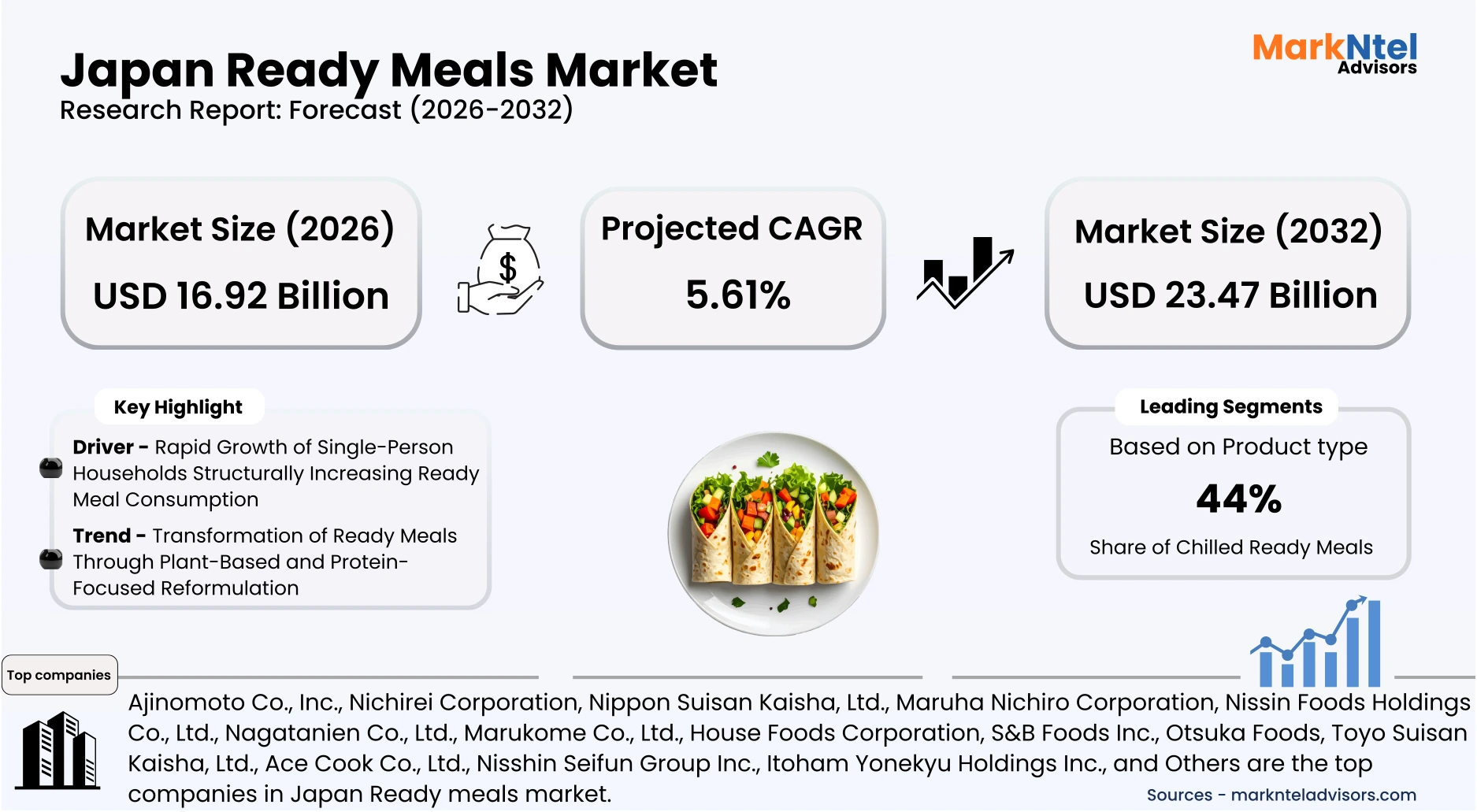
- The Japan Ready Meals market size was valued at USD 15.63 billion in 2025 and is projected to grow from USD 16.92 billion in 2026 to USD 23.47 billion by 2032, exhibiting a CAGR of 5.61% during the forecast period.
- Tokyo is the leading region by a significant share of 41% in 2026.
- By Product type, the Chilled ready meals segment represented a significant share of about 44% in the Japan Ready Meals Market in 2026.
- By Distribution Channel, the Convenience stores segment presented a significant share of about 31% in the Japan Ready Meals Market in 2026.
- Leading Ready Meals Companies in the Japan Market are Ajinomoto Co., Inc., Nichirei Corporation, Nippon Suisan Kaisha, Ltd., Maruha Nichiro Corporation, Nissin Foods Holdings Co., Ltd., Nagatanien Co., Ltd., Marukome Co., Ltd., House Foods Corporation, S&B Foods Inc., Otsuka Foods, Toyo Suisan Kaisha, Ltd., Ace Cook Co., Ltd., Nisshin Seifun Group Inc., Itoham Yonekyu Holdings Inc., NH Foods Ltd., Meiji Holdings Co., Ltd., Ezaki Glico Co., Ltd., Marudai Food Co., Ltd., Hanamaruki Co., Ltd., Hikari Miso Co., Ltd., MCC Food Products Co., Ltd., Delsole Corporation and Others.
Market Insights & Analysis: Japan Ready Meals Market (2026-32):
The Japan Ready Meals market size was valued at USD 15.63 billion in 2025 and is projected to grow from USD 16.92 billion in 2026 to USD 23.47 billion by 2032, exhibiting a CAGR of 5.61% during the forecast period, i.e., 2026-32.
Japan’s ready meals market has exhibited a sustained expansion driven by evolving consumer behaviors and structural socio-economic shifts. In 2024, the market for packaged ready‑to‑eat and convenience foods constituted a major segment of domestic food expenditure, with consumers increasingly substituting traditional home-prepared meals for prepared options that reduce preparation time while maintaining quality and variety.
Urban professionals and time-constrained households in major metropolitan regions like Tokyo and Osaka have been key contributors to this trend, reflecting a broader cultural shift toward convenience food adoption. Demographic changes have significantly shaped demand patterns, as Japan’s population continues to age rapidly. Official government data shows that individuals aged 65 or older comprised approximately 29.4% of the total population in 2025, creating distinct nutritional and consumption behaviors favoring easily accessible, nutritionally balanced options suitable for seniors.
Demographic pressures have also encouraged product diversification to address households where cooking frequency has declined due to smaller family sizes and rising participation in the workforce, particularly among women.
Policy and regulatory frameworks in 2025–2026 have further influenced market growth. The enactment of Japan’s Food System Act established mechanisms to support sustainable supply chains and fair pricing for food producers and processors, including financing and tax incentives for food business operators that innovate in convenience and prepared meals.
At the same time, national efforts to reduce food loss and waste under the Act on Promotion of Food Loss and Waste Reduction have encouraged manufacturers to adopt packaging and supply strategies that extend shelf life, indirectly benefiting the ready meals segment.
Looking ahead, the ready meals market is poised for continued expansion as technological enhancements in food processing and packaging bolster consumer confidence, and as lifestyle shifts sustain demand across residential and institutional end-user segments.
Japan Ready Meals Market Scope:
| Category | Segments |
|---|---|
| By Product Type | (Dried Ready Meals, Shelf Stable Ready Meals, Chilled Ready Meals, Frozen Ready Meals, Others), |
| By Distribution Channel | (Supermarkets/Hypermarkets, Convenience Stores, Online Retail, Specialty Stores, Foodservice/HoReCa), |
| By End-User | (Household, Commercial), |
Japan Ready Meals Market Driver:
Rapid Growth of Single-Person Households Structurally Increasing Ready Meal Consumption
The central structural driver of Japan’s ready meals market is the continued expansion of single-person households, which has intensified over recent years. Japan’s official statistics confirm a high prevalence of single-person households. According to government data, single-person households accounted for 34.0% of all households . This demonstrates a structural demographic trend toward smaller households. This demographic pattern has been reinforced by delayed marriage trends and increased urban migration among younger working populations. As a result, household meal preparation economies of scale have diminished, increasing reliance on individually portioned ready-to-eat products.
The measurable impact of this shift is visible across metropolitan prefectures such as Tokyo and Osaka, where compact housing and long commuting times further constrain daily cooking practices. The Ministry of Internal Affairs and Communications reported in 2025 that per-household food expenditure patterns increasingly favor prepared dishes and delicatessen items compared to raw ingredients. Retail chains have responded by expanding chilled and microwaveable meal assortments tailored to one-person consumption formats. This geographic concentration of single residents directly increases transaction frequency and steady replenishment demand, particularly through supermarkets and convenience stores.
Unlike short-term promotional spikes, the growth in single-person households represents a durable demographic transformation that structurally raises per-capita demand for ready meals. Because each household requires full meal solutions regardless of size, fragmentation of households increases aggregate unit consumption across the economy. Government population projections through 2030 indicate continued elevation in one-person household ratios, sustaining recurring demand cycles. Consequently, this driver materially expands market volume by increasing the number of consumption units required nationwide rather than merely affecting pricing dynamics.
Japan Ready Meals Market Trend:
Transformation of Ready Meals Through Plant-Based and Protein-Focused Reformulation
A significant structural trend reshaping Japan’s ready meals market is the rapid expansion of plant-based and protein-enriched product lines. This shift has accelerated in recent years due to heightened public health focus and sustainability commitments under Japan’s 2025 Green Food System Strategy updates issued by the Ministry of Agriculture, Forestry, and Fisheries. Government guidance promoting diversified protein sources and reduced environmental impact in food systems has encouraged manufacturers to reformulate prepared meals. Concurrently, national nutrition surveys released by the Ministry of Health, Labor and Welfare in 2025 indicate increasing consumer awareness of balanced protein intake, particularly among aging populations.
This transition is altering value chain dynamics, compelling food processors to invest in alternative protein sourcing, soy-based formulations, and fortified meal development. A study published in the Journal of Health, Population and Nutrition explores associations between plant protein intake and health outcomes in Japan’s aging population, underscoring why protein -rich options are gaining prominence. Retailers are reallocating shelf space to meat-alternative bento boxes and high-protein microwaveable dishes, reflecting measurable consumer uptake. These adjustments demonstrate operational transformation rather than temporary promotional experimentation.
The trend is expected to persist because it aligns with long-term demographic aging and sustainability policy objectives. Institutional buyers, including corporate cafeterias and healthcare facilities, are incorporating plant-forward menu options to meet nutrition guidelines and emissions reduction targets. As regulatory emphasis on food system resilience continues into 2026, demand for protein-diversified ready meals is likely to remain embedded in procurement standards. A 2024 industry release highlights increasing Japanese consumer recognition of plant-based and alternative protein foods, with many respondents citing health, environmental, and nutrition motivations for consideration.
Japan Ready Meals Market Opportunity:
Premiumization of Frozen and Chilled Ready Meals
A significant structural opportunity exists in the premiumization of frozen and chilled ready meals, particularly health-conscious formats such as low-sodium and organic options. Japan’s Ministry of Health, Labour and Welfare continues to emphasize salt reduction under national nutrition guidelines updated in 2025, reinforcing consumer demand for reformulated products. Simultaneously, the Ministry of Agriculture, Forestry, and Fisheries supports organic agriculture expansion through its Organic Vision 2030 framework, encouraging certified ingredient sourcing. These policy signals create favorable conditions for new entrants offering differentiated , health-aligned ready meals.
This opportunity translates into tangible demand through Japan’s dense convenience store ecosystem, where chilled and frozen foods account for a significant share of daily meal purchases. Major convenience operators have expanded premium private-label ranges in 2025, emphasizing freshness, ingredient transparency, and functional nutrition benefits. Consumers increasingly seek restaurant-quality bento and microwaveable dishes that combine convenience with perceived quality improvements. The shift toward higher-value offerings increases average basket sizes and encourages repeat purchasing across urban working populations.
New and emerging players are particularly well-positioned because premium health niches require agility in sourcing and formulation rather than mass-scale production alone. Smaller firms can partner with regional organic producers or specialize in reduced-sodium processing technologies to differentiate effectively. Consequently, premium chilled and frozen health-oriented meals represent a scalable and structurally supported growth avenue.
Japan Ready Meals Market Challenge:
Labor Shortage in Food Processing and Retail Operations
A fundamental structural constraint affecting Japan’s ready meals market is the persistent labor shortage in food manufacturing and retail distribution. According to Japan’s Ministry of Health, Labour and Welfare, the effective job-openings-to-applicants ratio in food manufacturing and service sectors remained above 1.2 in 2025, indicating more vacancies than available workers. Japan’s aging population and declining workforce participation among younger cohorts have intensified recruitment challenges. This imbalance directly affects prepared meal production, packaging operations, and in-store food preparation at convenience outlets.
The labor constraint has measurable operational implications, particularly in temperature-controlled processing lines that require skilled staff for quality control and safety compliance. The 2025 White Paper on Small and Medium Enterprises, published by Japan’s Small and Medium Enterprise Agency, confirms that structural labor shortages are a serious challenge affecting SMEs’ capacity to maintain full operations, including production constraints caused by difficulty securing workers. These staffing gaps limit production capacity for smaller food processors and similar manufacturers.
This challenge materially restricts market expansion because ready meals rely on high-frequency replenishment and strict food safety protocols.
Japan Ready Meals Market (2026-2032) Segmentation Analysis:
The Japan Ready Meals Market study of MarkNtel Advisors evaluates and highlights the major trends and influencing factors in each segment. It includes predictions for the period 2026–32 at the country level. Based on the analysis, the market has been further classified as follows:
Based on Product type:
- Dried Ready Meals
- Shelf Stable Ready Meals
- Chilled Ready Meals
- Frozen Ready Meals
- Others
Chilled ready meals hold the leading position in Japan’s ready-to-eat meals market, capturing the largest share, around 44%, due to high urban demand for fresh, convenient meals. The concentration of single- and two-person households in metropolitan areas like Tokyo has fueled daily consumption of chilled bento, salads, and side dishes, supporting consistent volume growth. Retailers prioritize chilled offerings to attract repeat buyers seeking freshness, variety, and balanced nutrition, driving continuous product innovation.
Government initiatives promoting food safety, labelling standards, and nutritional transparency further enhance consumer trust, indirectly supporting chilled meal consumption. Policy incentives, such as reduced taxes for fresh packaged foods and adherence to HACCP standards , encourage manufacturers to expand chilled production lines, strengthening the segment’s market penetration. The national Food Labelling Standards require clear and accurate labelling of ingredients, allergens, nutritional information, and shelf‑life for processed and packaged foods, including chilled ready meals. This legal requirement promotes transparency, helping consumers make safer, informed choices.
End-user characteristics, including preference for ready-to-eat yet fresh-feeling meals and willingness to pay premium prices for quality, reinforce sustained demand. Seasonal and regional flavor variations also cater to local consumer preferences, maintaining repeat consumption. Continuous marketing campaigns highlighting convenience, health, and freshness further consolidate the segment’s dominance, making chilled ready meals the backbone of Japan’s RTE landscape.
Based on Distribution Channels:
- Supermarkets/Hypermarkets
- Convenience Stores
- Online Retail
- Specialty Stores
- Foodservice/HoReCa
Convenience stores (konbini) are the leading distribution channel in Japan’s ready meals market with a 31% share, driven by extensive urban penetration and high daily foot traffic. Chains such as 7-Eleven, Lawson, and FamilyMart maintain dense networks in cities like Tokyo and Osaka, ensuring rapid product turnover and daily freshness, which appeals strongly to busy professionals and single households . The strategic location of stores near offices and residential areas ensures constant accessibility, supporting sustained segment dominance.
Policy frameworks encouraging food safety compliance and standardized packaging allow convenience stores to maintain a high level of consumer trust. Investment flows into advanced cold-chain infrastructure, shelf management systems, and automated inventory solutions enable efficient stocking of chilled and frozen ready meals, minimizing waste and enhancing profitability. Retailers also leverage loyalty programs and digital apps to influence purchase behavior, directly linking technology adoption to higher consumption rates.
End-user behavior in Japan demonstrates a preference for quick, on-the-go meals without compromising quality, creating consistent demand for convenience store offerings. Product innovation, including limited-edition and seasonal meals, strengthens brand engagement and repeat purchases. Combined with strong marketing campaigns, these factors ensure that convenience stores continue to dominate the RTE market , maintaining a stable lead over supermarkets and online channels.
Japan Ready Meals Market (2026-32) Regional Analysis:
The Kanto region, encompassing Tokyo and neighboring prefectures, is the largest economic and population center in Japan. A Family Income and Expenditure Survey breakdown showed that Tokyo ranked high in consumption expenditure of ready-to-eat foods (e.g., prepared meals), close behind top prefectures like Fukui and Toyama. High urbanization, higher average disposable incomes, and extensive daily commuter flows create concentrated demand for convenience meals like bento, onigiri, and ready meals. Tokyo’s dense labor market ecosystem, with high numbers of office workers, students, and commuters, creates repeated daily purchasing behavior for ready meals at convenience stores and supermarkets. This aligns with strong convenience-oriented consumption patterns typical of metropolitan lifestyles.
Tokyo’s market performance is deeply tied to its varied and intensive demand for ready meals. Urban consumers often lack kitchen space and time to cook, leading to frequent purchases of quick meals on the go, particularly among young professionals and daily commuters. Tokyo also has one of the highest densities of convenience stores per capita in Japan, making ready meals highly accessible across neighborhoods.
Tokyo’s modern retail infrastructure with supermarkets, department store food halls, stations with ekiben (prepared lunch boxes), and convenience stores constantly refreshes ready meal inventories multiple times per day to meet demand. These operational efficiencies support high turnover and freshness, which consumers value.
Gain a Competitive Edge with Our Japan Ready Meals Market Report:
- The Japan Ready Meals Market Report by MarkNtel Advisors provides a detailed & thorough analysis of market size & share, growth rate, competitive landscape, and key players. This comprehensive analysis helps businesses gain a holistic understanding of the market dynamics & make informed decisions.
- This report also highlights current market trends & future projections, allowing businesses to identify emerging opportunities & potential challenges. By understanding market forecasts, companies can align their strategies & stay ahead of the competition.
- The Japan Ready Meals Market Report aids in assessing & mitigating risks associated with entering or operating in the market. By understanding market dynamics, regulatory frameworks, and potential challenges, businesses can develop strategies to minimize risks & optimize their operations.
*Reports Delivery Format - Market research studies from MarkNtel Advisors are offered in PDF, Excel and PowerPoint formats. Within 24 hours of the payment being successfully received, the report will be sent to your email address.
Frequently Asked Questions
- Market Segmentation
- Introduction
- Product Definition
- Research Process
- Assumptions
- Executive Summary
- Japan Ready Meals Market Policies, Regulations, and Product Standards
- Japan Ready Meals Market Trends & Developments
- Japan Ready Meals Market Dynamics
- Growth Factors
- Challenges
- Japan Ready Meals Market Hotspot & Opportunities
- Japan Ready Meals Market Outlook, 2022-2032F
- Market Size & Outlook
- By Revenues (USD Million)
- By Volume (Million Tons)
- Market Share & Outlook
- By Product Type- Market Size & Forecast 2022-2032, USD Million & Million Tons
- Dried Ready Meals
- Shelf Stable Ready Meals
- Chilled Ready Meals
- Frozen Ready Meals
- Others
- By Distribution Channel- Market Size & Forecast 2022-2032, USD Million & Million Tons
- Supermarkets/Hypermarkets
- Convenience Stores
- Online Retail
- Specialty Stores
- Foodservice/HoReCa
- By End-User- Market Size & Forecast 2022-2032, USD Million & Million Tons
- Household
- Commercial
- By Region- Market Size & Forecast 2022-2032, USD Million & Million Tons
- Tokyo
- Osaka
- Nagoya
- Fukuoka
- Sapporo
- Sendai
- Hiroshima
- Naha
- Kitakyushu
- Kumamoto
- By Company
- Competition Characteristics
- Market Share & Analysis
- By Product Type- Market Size & Forecast 2022-2032, USD Million & Million Tons
- Market Size & Outlook
- Japan Dried Ready Meals Market Outlook, 2022-2032
- Market Size & Outlook
- By Revenues (USD Million)
- By Volume (Million Tons)
- Market Share & Outlook
- By Distribution Channel- Market Size & Forecast 2022-2032, USD Million & Million Tons
- By End-User- Market Size & Forecast 2022-2032, USD Million & Million Tons
- By Region- Market Size & Forecast 2022-2032, USD Million & Million Tons
- Market Size & Outlook
- Japan Shelf Stable Ready Meals Market Outlook, 2022-2032
- Market Size & Outlook
- By Revenues (USD Million)
- By Volume (Million Tons)
- Market Share & Outlook
- By Distribution Channel- Market Size & Forecast 2022-2032, USD Million & Million Tons
- By End-User- Market Size & Forecast 2022-2032, USD Million & Million Tons
- By Region- Market Size & Forecast 2022-2032, USD Million & Million Tons
- Market Size & Outlook
- Japan Chilled Ready Meals Market Outlook, 2022-2032
- Market Size & Outlook
- By Revenues (USD Million)
- By Volume (Million Tons)
- Market Share & Outlook
- By Distribution Channel- Market Size & Forecast 2022-2032, USD Million & Million Tons
- By End-User- Market Size & Forecast 2022-2032, USD Million & Million Tons
- By Region- Market Size & Forecast 2022-2032, USD Million & Million Tons
- Market Size & Outlook
- Japan Frozen Ready Meals Market Outlook, 2022-2032
- Market Size & Outlook
- By Revenues (USD Million)
- By Volume (Million Tons)
- Market Share & Outlook
- By Distribution Channel- Market Size & Forecast 2022-2032, USD Million & Million Tons
- By End-User- Market Size & Forecast 2022-2032, USD Million & Million Tons
- By Region- Market Size & Forecast 2022-2032, USD Million & Million Tons
- Market Size & Outlook
- Japan Ready Meals Market Key Strategic Imperatives for Success & Growth
- Competitive Outlook
- Company Profiles
- Ajinomoto Co., Inc.
- Business Description
- Product Portfolio
- Collaborations & Alliances
- Recent Developments
- Financial Details
- Others
- Nichirei Corporation
- Business Description
- Product Portfolio
- Collaborations & Alliances
- Recent Developments
- Financial Details
- Others
- Nippon Suisan Kaisha, Ltd.
- Business Description
- Product Portfolio
- Collaborations & Alliances
- Recent Developments
- Financial Details
- Others
- Maruha Nichiro Corporation
- Business Description
- Product Portfolio
- Collaborations & Alliances
- Recent Developments
- Financial Details
- Others
- Nissin Foods Holdings Co., Ltd.
- Business Description
- Product Portfolio
- Collaborations & Alliances
- Recent Developments
- Financial Details
- Others
- Nagatanien Co., Ltd.
- Business Description
- Product Portfolio
- Collaborations & Alliances
- Recent Developments
- Financial Details
- Others
- Marukome Co., Ltd.
- Business Description
- Product Portfolio
- Collaborations & Alliances
- Recent Developments
- Financial Details
- Others
- House Foods Corporation
- Business Description
- Product Portfolio
- Collaborations & Alliances
- Recent Developments
- Financial Details
- Others
- S&B Foods Inc.
- Business Description
- Product Portfolio
- Collaborations & Alliances
- Recent Developments
- Financial Details
- Others
- Otsuka Foods
- Business Description
- Product Portfolio
- Collaborations & Alliances
- Recent Developments
- Financial Details
- Others
- Toyo Suisan Kaisha, Ltd.
- Business Description
- Product Portfolio
- Collaborations & Alliances
- Recent Developments
- Financial Details
- Others
- Ace Cook Co., Ltd.
- Business Description
- Product Portfolio
- Collaborations & Alliances
- Recent Developments
- Financial Details
- Others
- Nisshin Seifun Group Inc.
- Business Description
- Product Portfolio
- Collaborations & Alliances
- Recent Developments
- Financial Details
- Others
- Itoham Yonekyu Holdings Inc.
- Business Description
- Product Portfolio
- Collaborations & Alliances
- Recent Developments
- Financial Details
- Others
- NH Foods Ltd.
- Business Description
- Product Portfolio
- Collaborations & Alliances
- Recent Developments
- Financial Details
- Others
- Meiji Holdings Co., Ltd.
- Business Description
- Product Portfolio
- Collaborations & Alliances
- Recent Developments
- Financial Details
- Others
- Ezaki Glico Co., Ltd.
- Business Description
- Product Portfolio
- Collaborations & Alliances
- Recent Developments
- Financial Details
- Others
- Marudai Food Co., Ltd.
- Business Description
- Product Portfolio
- Collaborations & Alliances
- Recent Developments
- Financial Details
- Others
- Hanamaruki Co., Ltd.
- Business Description
- Product Portfolio
- Collaborations & Alliances
- Recent Developments
- Financial Details
- Others
- Hikari Miso Co., Ltd.
- Business Description
- Product Portfolio
- Collaborations & Alliances
- Recent Developments
- Financial Details
- Others
- MCC Food Products Co., Ltd.
- Business Description
- Product Portfolio
- Collaborations & Alliances
- Recent Developments
- Financial Details
- Others
- Delsole Corporation
- Business Description
- Product Portfolio
- Collaborations & Alliances
- Recent Developments
- Financial Details
- Others
- Ajinomoto Co., Inc.
- Company Profiles
- Disclaimer
MarkNtel Advisors follows a robust and iterative research methodology designed to ensure maximum accuracy and minimize deviation in market estimates and forecasts. Our approach combines both bottom-up and top-down techniques to effectively segment and quantify various aspects of the market. A consistent feature across all our research reports is data triangulation, which examines the market from three distinct perspectives to validate findings. Key components of our research process include:
1. Scope & Research Design At the outset, MarkNtel Advisors define the research objectives and formulate pertinent questions. This phase involves determining the type of research—qualitative or quantitative—and designing a methodology that outlines data collection methods, target demographics, and analytical tools. They also establish timelines and budgets to ensure the research aligns with client goals.
2. Sample Selection and Data Collection In this stage, the firm identifies the target audience and determines the appropriate sample size to ensure representativeness. They employ various sampling methods, such as random or stratified sampling, based on the research objectives. Data collection is carried out using tools like surveys, interviews, and observations, ensuring the gathered data is reliable and relevant.
3. Data Analysis and Validation Once data is collected, MarkNtel Advisors undertake a rigorous analysis process. This includes cleaning the data to remove inconsistencies, employing statistical software for quantitative analysis, and thematic analysis for qualitative data. Validation steps are taken to ensure the accuracy and reliability of the findings, minimizing biases and errors.

4. Data Forecast and FinalizationThe final phase involves forecasting future market trends based on the analyzed data. MarkNtel Advisors utilize predictive modeling and time series analysis to anticipate market behaviors. The insights are then compiled into comprehensive reports, featuring visual aids like charts and graphs, and include strategic recommendations to inform client decision-making
We offer flexible licensing options to cater to varying organizational needs. Choose the pricing pack that best suits your requirements:
Buy Now Inquire Before Buying
 Request Customization
 Talk to our Consultant







