

Japan Green Hydrogen Market Research Report: Forecast (2026-2032)
By Technology (Alkaline Electrolysis, Proton Exchange Membrane (PEM) Electrolysis, Solid Oxide Electrolysis (SOEC), Anion Exchange Membrane (AEM) Electrolysis), By Energy Source (S ... olar, Wind, Hybrid, Other Renewable Sources), By End-use Industry (Refining & Petrochemicals, Fertilizers & Ammonia, Steel & Heavy Industry, Mobility & Transportation, Power & Utilities, Chemicals & Other Industrial Users), and others Read more
- Energy
- Jul 2026
- Pages 145
- Report Format: PDF, Excel, PPT
Japan Green Hydrogen Market
Projected 35.3% CAGR from 2026 to 2032
Study Period
2026-2032
Market Size (2026)
USD 140 Million
Market Size (2032)
USD 860 Million
Base Year
2025
Projected CAGR
35.3%
Leading Segments
By Technology Type: Alkaline Electrolysis
Japan Green Hydrogen Market Key Takeaways
- The Japan green hydrogen market was valued at USD 110 million in 2025 and is projected to grow from USD 140 million in 2026 to USD 860 million by 2032, registering a CAGR of 35.3% during 2026–2032.
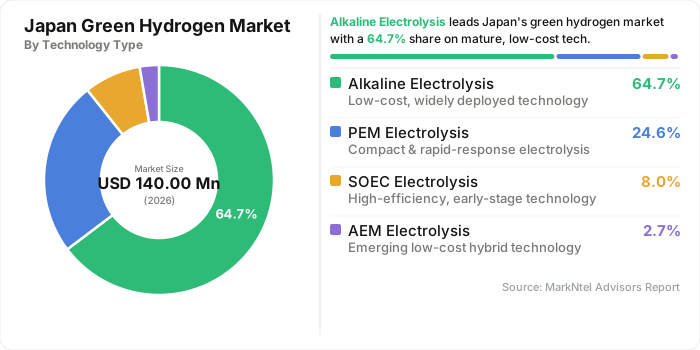
- Alkaline electrolysis is the leading technology segment, accounting for an estimated 64.7% market share in 2026.
- Refining & petrochemicals remains the dominant end-use industry, contributing approximately 36.4% of the market in 2026.
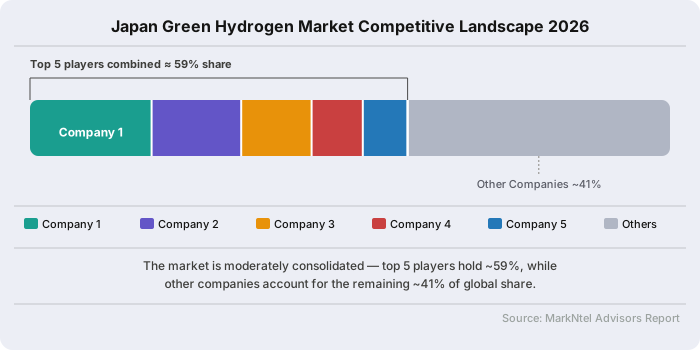
- The top five companies collectively account for an estimated 59% market share in 2026, indicating a moderately consolidated competitive landscape.
Japan Green Hydrogen Market Size & Outlook
The green hydrogen market in Japan was valued at USD 110 million in 2025 and is projected to reach USD 140 million in 2026 and USD 860 million by 2032, expanding at a CAGR of 35.3% during 2026–2032.
Market growth is driven by Japan's commitment to industrial decarbonization, increasing deployment of renewable-powered electrolysis systems, and expanding hydrogen utilization across refining, power generation, mobility, and heavy industries. Growing investments in green hydrogen production, hydrogen infrastructure, and advanced electrolyzer technologies continue to strengthen the country's hydrogen value chain while supporting its long-term carbon neutrality objectives.
Japan's industrial sector remains the primary demand center for green hydrogen as energy-intensive industries accelerate their transition toward low-carbon manufacturing. According to the Ministry of Economy, Trade and Industry (METI), the steel industry accounts for approximately 14% of Japan's domestic CO₂ emissions, driving investments in hydrogen-based direct reduction technologies and other low-carbon production methods. At the same time, refiners and chemical manufacturers are expanding the use of renewable hydrogen to replace conventional fossil-derived hydrogen, supporting industrial decarbonization and creating sustained demand for clean hydrogen solutions and industrial hydrogen applications.
The market is also benefiting from continuous advancements in hydrogen production technologies and supply chain development. Japanese companies are expanding commercial alkaline electrolyzer manufacturing, hydrogen storage infrastructure, and integrated production facilities to improve efficiency and lower production costs. Simultaneously, investments in hydrogen import terminals, transportation networks, and renewable-powered electrolysis projects are enhancing supply security and accelerating commercialization. These developments continue to strengthen Japan's electrolyzer manufacturing capabilities while improving the competitiveness of its domestic hydrogen ecosystem.
Furthermore, Japan is reinforcing its position as a regional hydrogen hub through international collaboration and strategic clean energy partnerships. According to Japan's Ministry of Foreign Affairs (MOFA), the Asia Zero Emission Community (AZEC) has expanded cooperation among partner countries to accelerate hydrogen, ammonia, and other decarbonization initiatives across the Asia-Pacific region. These collaborative efforts are strengthening cross-border hydrogen value chains, enhancing long-term supply resilience, and creating new opportunities for technology providers and infrastructure developers, positioning Japan at the forefront of the regional hydrogen economy and clean energy transition.
Japan Green Hydrogen Market Key Indicators
- As per the Ministry of Economy, Trade and Industry (METI, 2025), Japan has allocated approximately USD 19.2 billion under the Hydrogen Society Promotion Act to support low-carbon hydrogen through a 15-year Contract-for-Difference (CfD) mechanism. The latest application round concluded on 31 March 2025, strengthening investment certainty for domestic electrolysis projects and international hydrogen and ammonia supply chains.
- According to METI's Sector-Specific Investment Strategy (2024), approximately USD 46.7 billion has been earmarked for the hydrogen and battery storage sector over the next decade, supported by GX Economy Transition Bond issuances totaling USD 23.3 billion across FY2023–FY2025. This dedicated capital allocation is accelerating electrolyzer deployment while reinforcing Japan's clean energy industrial competitiveness.
- According to the Ministry of Economy, Trade and Industry (METI, 2024), only hydrogen and hydrogen-derived fuels with a lifecycle carbon intensity of 3.4 kg CO₂e/kg H₂ or below qualify for financial support under Japan's hydrogen subsidy framework. This nationally defined certification threshold is strengthening supply chain transparency while accelerating investment in green hydrogen production and low-carbon hydrogen projects.
- As per Kawasaki Heavy Industries and Japan Suiso Energy (2025–2026), Japan is developing a 40,000 m³ liquefied hydrogen carrier together with a 50,000 m³ receiving terminal at Ogishima, Kawasaki City, representing a 32-fold increase in transport capacity compared with the Suiso Frontier demonstration vessel. The project significantly advances Japan's large-scale liquid hydrogen import infrastructure and long-term hydrogen supply security.
Japan Green Hydrogen Market Scope
| Category | Segments |
|---|---|
| By Technology | Alkaline Electrolysis, Proton Exchange Membrane (PEM) Electrolysis, Solid Oxide Electrolysis (SOEC), Anion Exchange Membrane (AEM) Electrolysis |
| By Energy Source | Solar, Wind, Hybrid, Other Renewable Sources |
| By End-use Industry | Refining & Petrochemicals, Fertilizers & Ammonia, Steel & Heavy Industry, Mobility & Transportation, Power & Utilities, Chemicals & Other Industrial Users |
Japan Green Hydrogen Market Growth Drivers
Growing Hydrogen Transportation Ecosystem Accelerates Green Hydrogen Demand
Japan's expanding hydrogen mobility sector continues to strengthen demand for green hydrogen infrastructure as fuel cell electric vehicles (FCEVs), hydrogen-powered buses, and long-haul fuel cell trucks gain greater policy support under the country's carbon neutrality agenda. According to the Ministry of Economy, Trade and Industry (METI, 2025), Japan has designated four priority hydrogen supply hub regions to integrate hydrogen production, transportation, refueling, and commercial vehicle deployment, while national and local governments continue reducing hydrogen fuel costs through subsidies for hydrogen station operators.
The transportation sector further supports market expansion through dedicated incentives for commercial hydrogen mobility. According to the International Energy Agency (IEA, 2025), Japan has introduced a approximately USD 4.8/kg subsidy covering nearly 75% of the price difference between hydrogen and diesel for fuel cell trucks and buses operating across priority regions, improving operating economics for heavy-duty transport. These measures accelerate the adoption of hydrogen-powered transportation, expand fuel cell mobility, and stimulate long-term demand for domestically produced renewable hydrogen.
Recent Trend
Expansion of Ammonia-to-Hydrogen Value Chains
Japan is rapidly commercializing ammonia-based hydrogen supply chains to strengthen long-term energy security and decarbonize power generation and heavy industries. According to JERA (2025), the company reached the final investment decision (FID) with CF Industries Holdings and Mitsui & Co. to develop the Blue Point low-carbon ammonia project in Louisiana, which is designed to produce approximately 1.4 million tonnes of low-carbon ammonia annually upon commencement of operations. The project establishes an integrated value chain spanning production, shipping, and end-use, reinforcing green ammonia infrastructure and Japan's evolving hydrogen import ecosystem.
The trend is further reinforced through commercial deployment within Japan's power sector. According to JERA (2024), the company successfully completed the world's first 20% ammonia co-firing demonstration at a large commercial coal-fired power station at the Hekinan Thermal Power Station in collaboration with IHI Corporation, confirming operational performance while reducing sulfur oxide emissions by approximately 20% without increasing nitrogen oxide emissions. The successful demonstration is accelerating investments in ammonia cracking technology, utility-scale ammonia utilization, and integrated hydrogen carrier infrastructure, strengthening Japan's transition toward a commercial hydrogen economy.
Japan Green Hydrogen Market Opportunities and Challenges
High Green Hydrogen Production Costs Create Opportunities for Electrolyzer Innovation
The high cost of producing green hydrogen continues to challenge large-scale commercialization in Japan due to the capital-intensive nature of electrolysis and the significant consumption of renewable electricity. According to the International Energy Agency (IEA, Global Hydrogen Review 2025), producing 1 kg of hydrogen through electrolysis requires approximately 50–55 kWh of electricity and around 9 litres of water, making electricity the dominant contributor to production costs. These high operating requirements reduce cost competitiveness against conventional hydrogen and fossil-based fuels, particularly for energy-intensive industries, thereby slowing broader adoption of green hydrogen production and renewable fuel technologies.
The growing need to improve production economics is simultaneously creating significant opportunities for advanced electrolyzer technologies and domestic manufacturing. In May 2024, Asahi Kasei Corporation announced the construction of a manufacturing facility in Kawasaki, Japan, for assembling large-scale alkaline water electrolyzer systems, supporting increasing demand from domestic and international hydrogen projects. The new facility strengthens Japan's electrolyzer supply chain while enabling faster commercialization of high-capacity systems, creating long-term growth opportunities for electrolyzer manufacturing and the country's expanding clean hydrogen ecosystem.
Segmentation Insights
Commercial Maturity Drives Alkaline Electrolysis Leadership
Alkaline Electrolysis is estimated to account for 64.7% of the Japan green hydrogen industry by technology in 2026, making it the dominant segment due to its commercial maturity, lower capital cost, and suitability for utility-scale hydrogen production. The technology is widely deployed across large renewable hydrogen projects owing to its operational reliability and established manufacturing base.
According to Asahi Kasei Corporation (2024), its 3.2 MW multi-module Aqualyzer™ alkaline water electrolysis system, comprising four 0.8 MW modules, commenced operation at its Kawasaki demonstration facility in March 2024, while the company continues advancing commercialization of 100 MW-class modular alkaline electrolyzer systems. These developments strengthen Japan's alkaline electrolysis technology landscape and support the expansion of industrial hydrogen production.
The segment continues to benefit from increasing industrial investment and international commercialization initiatives. In 2025, Asahi Kasei, Gentari, and JGC Corporation signed a joint feasibility agreement to develop a 60 MW-class alkaline water electrolysis project in Malaysia, utilizing Asahi Kasei's Aqualyzer™ technology for large-scale renewable hydrogen production. The project demonstrates the growing global adoption of Japanese alkaline electrolysis technology while validating its scalability for utility-scale applications.
Continued deployment of commercial alkaline systems and expanding export opportunities are reinforcing the technology's leadership, supporting the growth of Japan's electrolyzer manufacturing industry and broader green hydrogen value chain. Based on Technology Type, the India green hydrogen industry is segmented into:
- Alkaline Electrolysis
- Proton Exchange Membrane (PEM) Electrolysis
- Solid Oxide Electrolysis (SOEC)
- Anion Exchange Membrane (AEM) Electrolysis
Refining & Petrochemicals Applications Anchor Green Hydrogen Demand
Refining & petrochemicals Positions as the largest end-use segment are estimated to account for 36.4% of the Japan green hydrogen industry in 2026, making the segment the largest consumer of green hydrogen as refiners increasingly replace fossil-derived hydrogen with low-carbon alternatives to decarbonize refining operations and chemical feedstocks. Hydrogen remains essential for hydrocracking, hydrotreating, and desulfurization processes, while growing regulatory emphasis on industrial emissions continues to accelerate demand for low-carbon refining, green hydrogen applications, and sustainable petrochemical production.
According to ENEOS Corporation (2025), the company has commenced construction of a demonstration facility at its Yokohama Refinery to produce green hydrogen using a 2 MW-class water electrolyzer, supporting decarbonization of refinery operations and evaluating commercial deployment across its refining network.
The segment continues to gain momentum through strategic investments by Japan's leading energy companies. In 2024, Idemitsu Kosan Co., Ltd. and HIF Global signed an agreement to jointly evaluate the development of e-Fuels and green hydrogen supply chains, integrating renewable hydrogen into future refining and synthetic fuel production.
The collaboration expands commercial opportunities for hydrogen utilization within Japan's refining sector while strengthening industrial decarbonization initiatives. These investments reinforce the leadership of the refining industry, supporting long-term growth of the industrial hydrogen market and Japan's evolving clean refinery ecosystem. Based on the end-user segment, the industry is segmented into:
- Refining & Petrochemicals
- Fertilizers & Ammonia
- Steel & Heavy Industry
- Mobility & Transportation
- Power & Utilities
- Chemicals & Other Industrial Users
Japan Green Hydrogen Market Competitive Analysis
The top five companies are estimated to account for 59% of the Japan green hydrogen industry in 2026, reflecting a moderately consolidated competitive landscape led by integrated energy, industrial gas, and engineering companies. Iwatani Corporation leads the market through its hydrogen supply and refueling infrastructure, followed by ENEOS Corporation, Kawasaki Heavy Industries, Ltd., Mitsubishi Heavy Industries, Ltd., and Asahi Kasei Corporation, all supported by extensive hydrogen production, transportation, electrolyzer, and infrastructure capabilities.
Leading Companies in the Japan Green Hydrogen Industry
- Iwatani Corporation
- ENEOS Corporation
- Kawasaki Heavy Industries, Ltd.
- Mitsubishi Heavy Industries, Ltd.
- Asahi Kasei Corporation
- Chiyoda Corporation
- IHI Corporation
- JGC Holdings Corporation
- Air Liquide Japan G.K.
- Taiyo Nippon Sanso Corporation
Japan Green Hydrogen Industry News and Recent Developments
May 2024: Asahi Kasei Launches Multi-Module Hydrogen Pilot Plant to Accelerate Commercial Electrolyzer Deployment
Asahi Kasei officially commenced operation of its multi-module alkaline water electrolysis pilot plant in Kawasaki, featuring four 0.8 MW Aqualyzer™ modules designed as a stepping stone toward commercial 100 MW-class electrolyzer systems. The facility enables validation of large-scale hydrogen production under fluctuating renewable power conditions and supports commercialization of next-generation electrolysis technologies.
Impact Analysis: The project strengthens Japan's domestic electrolyzer manufacturing capabilities while accelerating the commercialization of utility-scale green hydrogen production. The demonstration improves technology readiness, supports supply chain localization, and reinforces Japan's competitiveness in the global hydrogen equipment market.
October 2024: ITOCHU, HIF Asia Pacific, JFE Steel, and MOL Partner to Develop Green Hydrogen-Based E-Fuels Supply Chain
ITOCHU Corporation, HIF Asia Pacific, JFE Steel Corporation, and Mitsui O.S.K. Lines (MOL) signed a Memorandum of Understanding (MoU) to jointly conduct a comprehensive feasibility study for establishing an international green hydrogen-based e-fuels supply chain. The study evaluates CO₂ capture in Japan, maritime transportation to Australia, e-fuel production using green hydrogen, and the development of an export-oriented supply chain connecting Australia and Japan.
Impact Analysis: The collaboration strengthens Japan's long-term hydrogen import strategy by integrating green hydrogen with synthetic fuel production and cross-border CO₂ utilization. It is expected to accelerate commercial deployment of e-fuels, enhance international hydrogen value chains, and create new opportunities for industrial decarbonization and low-carbon maritime fuel adoption.
Frequently Asked Questions
- Market Segmentation
- Introduction
- Product Definition
- Research Process
- Assumptions
- Executive Summary
- Japan Green Hydrogen Market Production Trend, 2022-2032
- Japan Green Hydrogen Production (Thousand Tons) Trend By Technology Type
- Alkaline Electrolysis
- Proton Exchange Membrane (PEM) Electrolysis
- Solid Oxide Electrolysis (SOEC)
- Anion Exchange Membrane (AEM) Electrolysis
- Company-Wise Production Plants and Statistics
- Installed Production Capacity
- Actual Production
- Planned Production Target
- Japan Green Hydrogen Production (Thousand Tons) Trend By Technology Type
- Japan Green Hydrogen Market Pricing Analysis, By Type of Product, 2022-2032
- Japan Green Hydrogen Market Pricing Trend (USD Million) 2022-2032
- Japan Green Hydrogen Trend (USD Million) By Technology Type
- Alkaline Electrolysis
- Proton Exchange Membrane (PEM) Electrolysis
- Solid Oxide Electrolysis (SOEC)
- Anion Exchange Membrane (AEM) Electrolysis
- Japan Green Hydrogen Market Policies, Regulations, and Product Standards
- Japan Green Hydrogen Market Trends & Developments
- Japan Green Hydrogen Market Dynamics
- Growth Factors
- Challenges
- Japan Green Hydrogen Market Hotspot & Opportunities
- Japan Green Hydrogen Market Outlook, 2022-2032
- Market Size & Outlook
- By Revenues (USD Million)
- By Volume (Thousand Tons)
- Market Segmentation & Outlook
- By Technology- Market Size & Forecast 2022-2032, USD Million & Thousand Tons
- Alkaline Electrolysis
- Proton Exchange Membrane (PEM) Electrolysis
- Solid Oxide Electrolysis (SOEC)
- Anion Exchange Membrane (AEM) Electrolysis
- By Energy Source- Market Size & Forecast 2022-2032, USD Million & Thousand Tons
- Solar
- Wind
- Hybrid
- Other Renewable Sources
- By End-use Industry- Market Size & Forecast 2022-2032, USD Million & Thousand Tons
- Refining & Petrochemicals
- Fertilizers & Ammonia
- Steel & Heavy Industry
- Mobility & Transportation
- Power & Utilities
- Chemicals & Other Industrial Users
- By Region- Market Size & Forecast 2022-2032, USD Million & Thousand Tons
- North Japan
- West Japan
- South Japan
- East Japan
- By Company
- Competition Characteristics
- Market Share & Analysis
- By Technology- Market Size & Forecast 2022-2032, USD Million & Thousand Tons
- Market Size & Outlook
- Japan Solar Power Green Hydrogen Market Outlook, 2022-2032
- Market Size & Outlook
- By Revenues (USD Million)
- Market Segmentation & Outlook
- By Technology- Market Size & Forecast 2022-2032, USD Million & Thousand Tons
- By End-use Industry- Market Size & Forecast 2022-2032, USD Million & Thousand Tons
- By Region- Market Size & Forecast 2022-2032, USD Million & Thousand Tons
- Market Size & Outlook
- Japan Wind Power Green Hydrogen Market Outlook, 2022-2032
- Market Size & Outlook
- By Revenues (USD Million)
- Market Segmentation & Outlook
- By Technology- Market Size & Forecast 2022-2032, USD Million & Thousand Tons
- By End-use Industry- Market Size & Forecast 2022-2032, USD Million & Thousand Tons
- By Region- Market Size & Forecast 2022-2032, USD Million & Thousand Tons
- Market Size & Outlook
- Japan Hybrid Power Green Hydrogen Market Outlook, 2022-2032
- Market Size & Outlook
- By Revenues (USD Million)
- Market Segmentation & Outlook
- By Technology- Market Size & Forecast 2022-2032, USD Million & Thousand Tons
- By End-use Industry- Market Size & Forecast 2022-2032, USD Million & Thousand Tons
- By Region- Market Size & Forecast 2022-2032, USD Million & Thousand Tons
- Market Size & Outlook
- Japan Green Hydrogen Market Key Strategic Imperatives for Success & Growth
- Competitive Outlook
- Company Profiles
- Iwatani Corporation
- Business Description
- Product Portfolio
- Collaborations & Alliances
- Recent Developments
- Financial Details
- Others
- ENEOS Corporation
- Business Description
- Product Portfolio
- Collaborations & Alliances
- Recent Developments
- Financial Details
- Others
- Kawasaki Heavy Industries, Ltd.
- Business Description
- Product Portfolio
- Collaborations & Alliances
- Recent Developments
- Financial Details
- Others
- Mitsubishi Heavy Industries, Ltd.
- Business Description
- Product Portfolio
- Collaborations & Alliances
- Recent Developments
- Financial Details
- Others
- Asahi Kasei Corporation
- Business Description
- Product Portfolio
- Collaborations & Alliances
- Recent Developments
- Financial Details
- Others
- Chiyoda Corporation
- Business Description
- Product Portfolio
- Collaborations & Alliances
- Recent Developments
- Financial Details
- Others
- IHI Corporation
- Business Description
- Product Portfolio
- Collaborations & Alliances
- Recent Developments
- Financial Details
- Others
- JGC Holdings Corporation
- Business Description
- Product Portfolio
- Collaborations & Alliances
- Recent Developments
- Financial Details
- Others
- Air Liquide Japan G.K.
- Business Description
- Product Portfolio
- Collaborations & Alliances
- Recent Developments
- Financial Details
- Others
- Taiyo Nippon Sanso Corporation
- Business Description
- Product Portfolio
- Collaborations & Alliances
- Recent Developments
- Financial Details
- Others
- Iwatani Corporation
- Company Profiles
- Disclaimer
MarkNtel Advisors follows a robust and iterative research methodology designed to ensure maximum accuracy and minimize deviation in market estimates and forecasts. Our approach combines both bottom-up and top-down techniques to effectively segment and quantify various aspects of the market. A consistent feature across all our research reports is data triangulation, which examines the market from three distinct perspectives to validate findings. Key components of our research process include:
1. Scope & Research Design At the outset, MarkNtel Advisors define the research objectives and formulate pertinent questions. This phase involves determining the type of research—qualitative or quantitative—and designing a methodology that outlines data collection methods, target demographics, and analytical tools. They also establish timelines and budgets to ensure the research aligns with client goals.
2. Sample Selection and Data Collection In this stage, the firm identifies the target audience and determines the appropriate sample size to ensure representativeness. They employ various sampling methods, such as random or stratified sampling, based on the research objectives. Data collection is carried out using tools like surveys, interviews, and observations, ensuring the gathered data is reliable and relevant.
3. Data Analysis and Validation Once data is collected, MarkNtel Advisors undertake a rigorous analysis process. This includes cleaning the data to remove inconsistencies, employing statistical software for quantitative analysis, and thematic analysis for qualitative data. Validation steps are taken to ensure the accuracy and reliability of the findings, minimizing biases and errors.

4. Data Forecast and FinalizationThe final phase involves forecasting future market trends based on the analyzed data. MarkNtel Advisors utilize predictive modeling and time series analysis to anticipate market behaviors. The insights are then compiled into comprehensive reports, featuring visual aids like charts and graphs, and include strategic recommendations to inform client decision-making
We offer flexible licensing options to cater to varying organizational needs. Choose the pricing pack that best suits your requirements:
Buy Now Inquire Before Buying
 Request Customization
 Talk to our Consultant







