

Japan Blockchain Fintech Market Research Report: Trends & Forecast (2026-2032)
By Technology Type (Private Blockchain, Public Blockchain), By Application (Payments & Money Transfer, Smart Contracts, Lending & Credit, Digital Identity Verification, Fraud Detec ... tion & Risk Management, Trade Finance, Compliance & KYC, Clearing & Settlement, Others), By Provider (Application & Solution Providers, Middleware Providers, Infrastructure & Protocol Providers), By Organization Size (Small & Medium Enterprises (SMEs), Large Enterprises), By Deployment Mode (Cloud, On-Premise), By End User (Banks, Fintech Companies, Insurance Companies, Investment Firms, Government & Regulators, Others), and others Read more
- ICT & Electronics
- Mar 2026
- Pages 160
- Report Format: PDF, Excel, PPT
Japan Blockchain Fintech Market
Projected 8.20% CAGR from 2026 to 2032
Study Period
2026-2032
Market Size (2026)
USD 480 Million
Market Size (2032)
USD 770 Million
Base Year
2025
Projected CAGR
8.20%
Leading Segments
By End User: Banks
Japan Blockchain Fintech Market Report Key Takeaways:
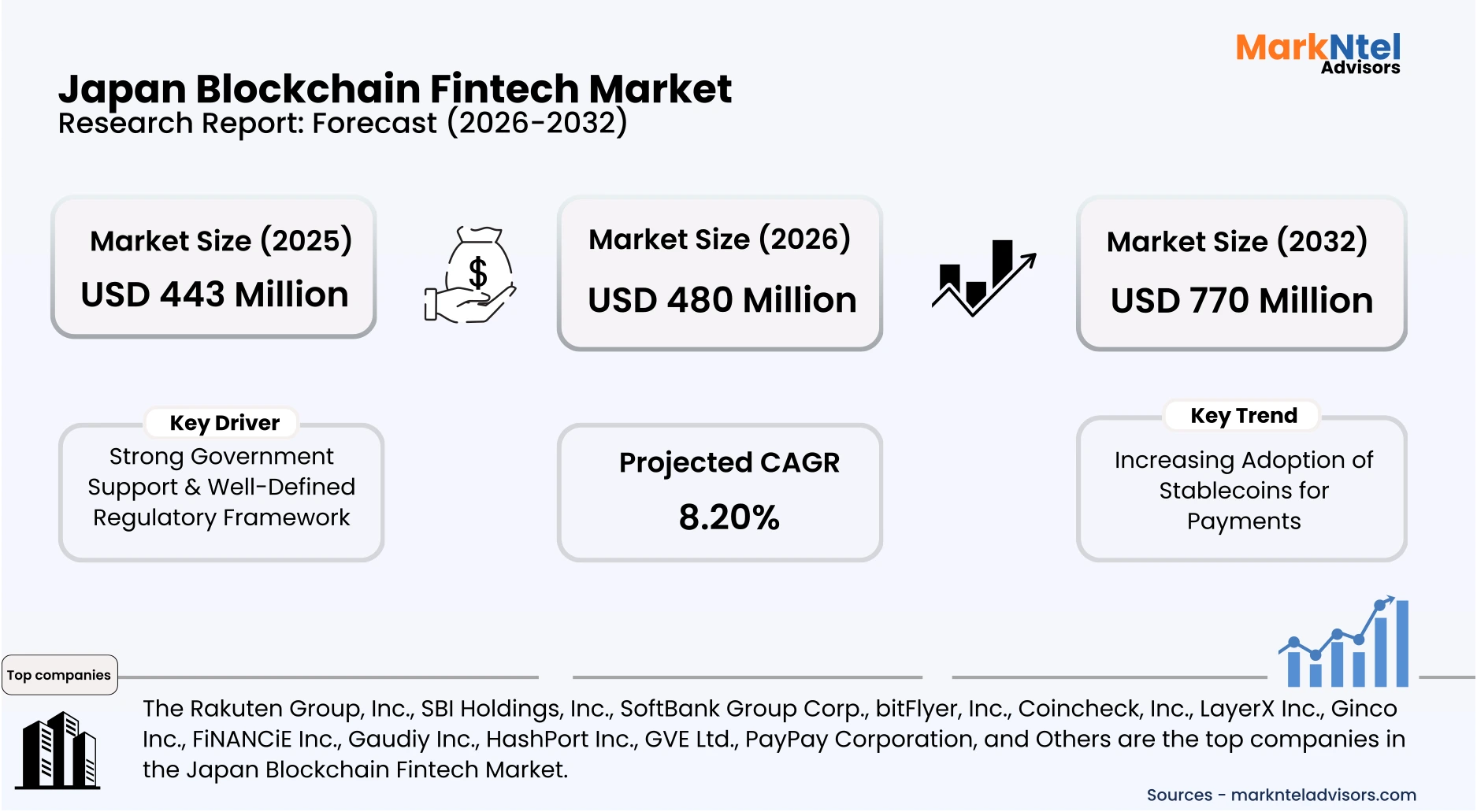
- The Japan Blockchain Fintech Market size was valued at USD 443 million in 2025 and is projected to grow from USD 480 million in 2026 to USD 770 million by 2032, exhibiting a CAGR of 8.20% during 2026-32.
- By provider, the application & solution providers segment represented a significant share of about 48% in the Japan Blockchain Fintech Market in 2026.
- By end user, the banks captured a significant share of about 51% in the Japan Blockchain Fintech Market in 2026.
- Leading Blockchain Fintech companies in Japan are Rakuten Group, Inc., SBI Holdings, Inc., SoftBank Group Corp., bitFlyer, Inc., Coincheck, Inc., LayerX Inc., Ginco Inc., FiNANCiE Inc., Gaudiy Inc., HashPort Inc., GVE Ltd., PayPay Corporation, and Others.
Market Insights & Analysis: Japan Blockchain Fintech Market (2026-32):
The Japan Blockchain Fintech Market size was valued at USD 443 million in 2025 and is projected to grow from USD 480 million in 2026 to USD 770 million by 2032. Along with this, the market is estimated to grow at a CAGR of around 8.20% during the forecast period, i.e., 2026-32.
The Japan Blockchain Fintech Market is poised for robust growth, primarily driven by strong government support and clear regulatory frameworks for digital assets and blockchain-based financial services. The Financial Services Agency (FSA) has established comprehensive regulations that recognize crypto assets under the Payment Services Act, mandate licensing for exchanges, and set operational standards for fintech platforms. This regulatory clarity has fostered investor confidence, institutional participation, and innovation, making Japan one of the most supportive environments for blockchain fintech adoption globally.
Regional dynamics show that Eastern Japan, particularly Tokyo, leads blockchain fintech development due to a combination of regulatory support and innovation infrastructure. In 2025, FINOLAB, a government-endorsed fintech innovation hub in Tokyo, hosted over 800 fintech professionals, 57 startups, and 31 corporate partners working on solutions spanning blockchain payment platforms, digital asset services, and decentralized finance (DeFi) applications. This concentration of talent, capital, and expertise enables faster experimentation, adoption, and scaling of blockchain-enabled financial services.
Institutional adoption of blockchain is further accelerating. In late 2025, Japan’s three largest banks, Mitsubishi UFJ Financial Group, Sumitomo Mitsui Financial Group, and Mizuho Financial Group, received FSA approval to jointly issue and pilot stablecoins for domestic and cross-border payments. The pilot focuses on low-cost blockchain settlements and corporate payments while ensuring regulatory compliance, marking the first coordinated stablecoin initiative by major Japanese banks and signaling growing institutional trust in blockchain-based financial systems .
Private sector innovation also contributes to market expansion. In 2025, SBI Holdings, Inc. partnered with Web3 firm Startale to launch the JPYSC stablecoin, a regulated yen-based digital token designed for DeFi, Web3 applications, and cross-border payments. This initiative demonstrates how regulated digital currencies are enabling blockchain-powered financial services beyond traditional banking.
Looking ahead, future investments and infrastructure development will further drive growth. In September 2025, Japan Post Bank announced plans to introduce a blockchain-based digital yen (DCJPY) by the end of fiscal 2026, fully backed 1:1 by fiat yen and developed with DeCurret DCP. DCJPY will allow depositors to convert traditional yen into digital currency for instant, transparent transactions, including digital securities and other blockchain assets, expanding the usability of digital financial products .
Overall, with regulatory clarity, government-backed innovation hubs, active institutional participation, and ambitious digital currency initiatives, Japan’s blockchain fintech ecosystem is set to grow substantially beyond 2025. Adoption of stablecoins, tokenized assets, and digital currencies will enhance efficiency, reduce transaction costs, and strengthen Japan’s position as a global leader in blockchain-enabled financial services.
Japan Blockchain Fintech Market Recent Developments:
- 2025: A Japanese startup introduced JPYC, the world’s first stablecoin pegged to the Japanese yen and backed by domestic savings and Japanese government bonds. The company plans to issue nearly USD 66 billion worth of tokens over three years to support low-cost blockchain payments and global digital transactions.
- 2025: Coincheck, Inc. announced the launch of Dogecoin (DOGE) trading on its cryptocurrency exchange platform in Japan. The integration expanded the range of blockchain-based digital assets available to investors and strengthened the company’s position in Japan’s growing fintech and crypto trading ecosystem.
Japan Blockchain Fintech Market Scope:
| Category | Segments |
|---|---|
| By Technology Type | (Private Blockchain, Public Blockchain), |
| By Application | (Payments & Money Transfer, Smart Contracts, Lending & Credit, Digital Identity Verification, Fraud Detection & Risk Management, Trade Finance, Compliance & KYC, Clearing & Settlement, Others), |
| By Provider | (Application & Solution Providers, Middleware Providers, Infrastructure & Protocol Providers), |
| By Organization Size | (Small & Medium Enterprises (SMEs), Large Enterprises), |
| By Deployment Mode | (Cloud, On-Premise), |
| By End User | (Banks, Fintech Companies, Insurance Companies, Investment Firms, Government & Regulators, Others), |
Japan Blockchain Fintech Market Driver:
Strong Government Support & Well-Defined Regulatory Framework
Government support and regulatory clarity are major factors accelerating the growth of the Japan Blockchain Fintech Market. Japan was among the first countries to create a formal legal framework for crypto assets and blockchain-based financial services through the Financial Services Agency (FSA). Under the Payment Services Act, cryptocurrency exchanges must register with the regulator and comply with strict security, reporting, and anti-money-laundering requirements. As a result, 29 crypto-asset exchange service providers were officially registered in Japan by 2023, operating under regulatory supervision and strengthening investor protection in the digital asset ecosystem .
Government-supported fintech innovation zones are also accelerating blockchain adoption across regions. Southern Japan, particularly Fukuoka, is emerging as a fintech startup hub due to government incentives. By 2025, the Financial Services Agency reported that Fukuoka’s International Financial Center initiative attracted more than 35 financial and fintech firms, promoting blockchain innovation and digital financial services development .
Beyond 2025, Japan is strengthening blockchain-enabled financial infrastructure through digital currency research led by the Bank of Japan. The central bank launched a CBDC pilot program in 2023, following proof-of-concept experiments that began in April 2021, to evaluate the technical feasibility of a digital yen and improve future digital payment systems.
Clear regulatory frameworks and government-led fintech initiatives are strengthening confidence in blockchain financial systems in Japan. Continued policy support, regional fintech hubs, and CBDC development will accelerate innovation and drive long-term expansion of blockchain fintech services in the country.
Japan Blockchain Fintech Market Trend:
Increasing Adoption of Stablecoins for Payments
The increasing adoption of stablecoins for payments is a prominent trend shaping the Japan Blockchain Fintech Market in 2025, as blockchain‑enabled digital currencies gain regulatory backing and real‑world utility. In March 2025, SBI VC Trade, a cryptocurrency exchange subsidiary of SBI Holdings, Inc., secured regulatory approval under Japan’s stablecoin framework and became the first Japanese platform to support the USD‑pegged stablecoin USDC, paving the way for regulated blockchain‑based payment services and digital asset transfers in the country . This development enables Japanese users and institutions to conduct low‑cost, compliant payments and cross‑border transactions using a globally recognized stablecoin.
Later in October 2025, JPYC Inc. launched the world’s first yen‑pegged stablecoin, fully backed by domestic savings and Japanese government bonds, with plans to issue up to USD 66 billion (10 trillion yen) over three years. The coin is designed to support fast, low‑fee blockchain payments both domestically and internationally, demonstrating how stablecoins are transitioning from theoretical assets to practical payment tools within regulated frameworks .
These initiatives reflect Japan’s broader shift toward stablecoin‑based payment solutions, aligning fintech innovation with regulatory compliance and enhancing financial infrastructure for blockchain transactions.
Overall, the uptake of stablecoins for payments is expanding Japan’s blockchain fintech capabilities by enabling reliable, regulated digital currency transactions, which is expected to drive further integration of blockchain payment systems across financial services.
Japan Blockchain Fintech Market Opportunity:
Expansion of Blockchain‑Based Cross‑Border Payments and Remittances
The expansion of blockchain‑based cross‑border payments and remittances offers a significant growth opportunity for the Japan Blockchain Fintech Market, as existing international transfer systems remain slow, costly, and inefficient. Japanese financial institutions and technology partners are exploring blockchain‑enabled settlement systems that can dramatically reduce transaction times and fees while improving transparency and availability.
A notable initiative in 2025 was the strategic collaboration between SBI Shinsei Bank, Partior Pte. Ltd., and DeCurret DCP Inc., which signed a memorandum of understanding to begin full‑scale exploration of multi‑currency tokenized deposit solutions for cross‑border remittances. This project leverages Partior’s global settlement network, already used by major international banks, to potentially enable real‑time cross‑border clearing between the Japanese yen and other major currencies using distributed ledger technology (DLT). Such tokenized deposits aim to provide 24/7 transparent settlement and faster transaction execution compared with traditional correspondent banking systems.
Beyond domestic initiatives, Japan is participating in cross‑border blockchain remittance trials with neighboring economies. For example, a technical verification under the Korea‑Japan stablecoin remittance pilot demonstrated converting KRW into a stablecoin, executing blockchain transfers, and re‑converting into JPY, highlighting how digital assets can streamline cross‑border remittance processes.
As Japan’s financial ecosystem embraces blockchain‑based settlement solutions and participates in international trials, cross‑border payments and remittances using tokenized assets represent a practical opportunity to reduce costs, accelerate settlement times, and expand the reach of fintech services globally.
Japan Blockchain Fintech Market Challenge:
Increasing Risk of Fraud & Cybersecurity and Fraud Risks
Cybersecurity and fraud risks remain a significant challenge for the Japan Blockchain Fintech Market, as the expansion of digital asset services exposes platforms and users to heightened security threats. Japan’s Financial Services Agency (FSA) has repeatedly flagged the need for enhanced protective measures after notable attacks and evolving threats to blockchain and fintech infrastructure. In June 2024, the Tokyo‑based crypto platform DMM Bitcoin suffered a major security breach, resulting in the theft of USD 312 million worth of Bitcoin from customer accounts, highlighting the persistent vulnerability of even regulated exchanges to cyberattacks. This incident underscored the necessity for stronger operational safeguards and asset protection standards to prevent future losses.
In response to rising cyber threats, the FSA introduced mandatory cybersecurity self‑assessments for registered crypto exchanges beginning in the 2026 fiscal year (April, 2026). Under the new framework, exchanges must regularly evaluate security domains, identify vulnerabilities, and report results to regulators. The policy also includes coordinated penetration testing and cooperation with ethical hackers to proactively address weaknesses before malicious actors can exploit them.
Despite regulatory oversight and improved security protocols, unauthorized access and fraud remain problematic. Data from Japan’s FSA shows that cases of unauthorized account access and fraudulent trading surged dramatically in early 2025, with thousands of compromised accounts and millions of dollars in illicit transactions, eroding user trust in digital financial platforms.
Overall, persistent cybersecurity threats, including large‑scale hacks and fraudulent activity, continue to challenge Japan’s blockchain fintech ecosystem. Strengthening security infrastructure, risk‑assessment frameworks, and exchange safeguards is crucial to improving investor confidence and sustaining market growth.
Japan Blockchain Fintech Market (2026-32) Segmentation Analysis:
The Japan Blockchain Fintech Market study of MarkNtel Advisors evaluates & highlights the major trends and influencing factors in each segment. It includes predictions for the period 2026–32 at the country level. Based on the analysis, the market has been further classified as;
Based on Provider:
- Application & Solution Providers
- Middleware Providers
- Infrastructure & Protocol Providers
Application and solution providers lead the provider segment with 48% market share, as they deliver the blockchain software and platforms that enable financial institutions to implement innovative fintech services. These providers develop applications for payments, lending, trade finance, fraud detection, and digital identity verification, translating complex blockchain protocols into usable solutions for banks, fintech companies, and insurance firms. Japanese companies such as LayerX Inc., HashPort Inc., and FiNANCiE Inc. offer modular solutions that integrate seamlessly with existing IT infrastructure, reducing deployment time and enhancing scalability. Their services include middleware, smart contracts, and security modules that help institutions comply with regulations while adopting decentralized systems.
As financial organizations continue to modernize operations and explore blockchain for efficiency, application and solution providers become indispensable, supporting end-to-end implementation and creating recurring revenue streams through subscriptions, licensing, and consulting, thereby driving sustained growth in the Japan Blockchain Fintech Market.
Based on End User:
- Banks
- Fintech Companies
- Insurance Companies
- Investment Firms
- Government & Regulators
- Others
The banks (banking sector) dominate the Japan Blockchain Fintech Market, accounting for 51% of the end-user share. Banks are increasingly adopting blockchain technology to enhance operational efficiency, reduce transaction costs, and strengthen security in both domestic and cross-border payments. For instance, major Japanese banks such as Mitsubishi UFJ Financial Group, Sumitomo Mitsui Banking Corporation, and Mizuho Financial Group are actively piloting stablecoins and blockchain-based settlement systems for corporate and interbank transfers. These initiatives enable faster, transparent, and low-cost transactions, reducing dependency on traditional correspondent banking networks.
Additionally, regulatory support from the Financial Services Agency (FSA) has encouraged banks to experiment with distributed ledger technology (DLT), improving compliance and risk management in areas like KYC and trade finance. The strong financial backing, institutional trust, and integration capabilities position banks as the primary adopters of blockchain solutions in Japan, driving market growth and paving the way for broader fintech adoption across other sectors.
Japan Blockchain Fintech Market (2026-32): Regional Projection
The Japan Blockchain Fintech Market is dominated by Eastern Japan, particularly Tokyo, due to its concentration of financial institutions, regulatory support, and innovation infrastructure. Tokyo hosts major banks such as Mitsubishi UFJ Financial Group, Sumitomo Mitsui Banking Corporation, and Mizuho Financial Group, which are actively piloting stablecoins and blockchain-based payment systems. Regulatory backing from the Financial Services Agency (FSA) ensures compliance and investor confidence, fostering rapid adoption of blockchain fintech solutions.
Innovation hubs like FINOLAB further accelerate growth by providing incubation for over 57 startups, 31 corporate partners, and 800 fintech professionals working on applications ranging from payments and digital assets to decentralized finance (DeFi). The availability of talent, access to capital, and proximity to global financial markets enable Tokyo to lead blockchain fintech initiatives, test innovative digital currencies, and scale blockchain-enabled financial services. Consequently, Eastern Japan remains the strategic hub driving both institutional adoption and private sector innovation.
Gain a Competitive Edge with Our Japan Blockchain Fintech Market Report:
- Japan Blockchain Fintech Market Report by MarkNtel Advisors provides a detailed & thorough analysis of market size & share, growth rate, competitive landscape, and key players. This comprehensive analysis helps businesses gain a holistic understanding of the market dynamics & make informed decisions.
- This report also highlights current market trends & future projections, allowing businesses to identify emerging opportunities & potential challenges. By understanding market forecasts, companies can align their strategies & stay ahead of the competition.
- Japan Blockchain Fintech Market Report aids in assessing & mitigating risks associated with entering or operating in the market. By understanding market dynamics, regulatory frameworks, and potential challenges, businesses can develop strategies to minimize risks & optimize their operations.
*Reports Delivery Format - Market research studies from MarkNtel Advisors are offered in PDF, Excel and PowerPoint formats. Within 24 hours of the payment being successfully received, the report will be sent to your email address.
Frequently Asked Questions
- Market Segmentation
- Introduction
- Product Definition
- Research Process
- Assumptions
- Executive Summary
- Japan Blockchain Fintech Market Policies, Regulations, and Product Standards
- Japan Blockchain Fintech Market Trends & Developments
- Japan Blockchain Fintech Market Dynamics
- Growth Factors
- Challenges
- Japan Blockchain Fintech Market Hotspot & Opportunities
- Japan Blockchain Fintech Market Outlook, 2022-2032F
- Market Size & Outlook
- By Revenues (USD Million)
- Market Share & Outlook
- By Technology Type- Market Size & Forecast 2022-2032, USD Million
- Private Blockchain
- Public Blockchain
- By Application- Market Size & Forecast 2022-2032, USD Million
- Payments & Money Transfer
- Smart Contracts
- Lending & Credit
- Digital Identity Verification
- Fraud Detection & Risk Management
- Trade Finance
- Compliance & KYC
- Clearing & Settlement
- Others
- By Provider- Market Size & Forecast 2022-2032, USD Million
- Application & Solution Providers
- Middleware Providers
- Infrastructure & Protocol Providers
- By Organization Size- Market Size & Forecast 2022-2032, USD Million
- Small & Medium Enterprises (SMEs)
- Large Enterprises
- By Deployment Mode- Market Size & Forecast 2022-2032, USD Million
- Cloud
- On-Premise
- By End User- Market Size & Forecast 2022-2032, USD Million
- Banks
- Fintech Companies
- Insurance Companies
- Investment Firms
- Government & Regulators
- Others
- By Region- Market Size & Forecast 2022-2032, USD Million
- North
- East
- West
- South
- By Company
- Competition Characteristics
- Market Share & Analysis
- By Technology Type- Market Size & Forecast 2022-2032, USD Million
- Market Size & Outlook
- Japan Private Blockchain Market Outlook, 2022-2032
- Market Size & Outlook
- By Revenues (USD Million)
- Market Share & Outlook
- By Application- Market Size & Forecast 2022-2032, USD Million
- By Provider- Market Size & Forecast 2022-2032, USD Million
- By Organization Size- Market Size & Forecast 2022-2032, USD Million
- By Deployment Mode- Market Size & Forecast 2022-2032, USD Million
- By End User- Market Size & Forecast 2022-2032, USD Million
- By Region- Market Size & Forecast 2022-2032, USD Million
- Market Size & Outlook
- Japan Public Blockchain Market Outlook, 2022-2032
- Market Size & Outlook
- By Revenues (USD Million)
- Market Share & Outlook
- By Application- Market Size & Forecast 2022-2032, USD Million
- By Provider- Market Size & Forecast 2022-2032, USD Million
- By Organization Size- Market Size & Forecast 2022-2032, USD Million
- By Deployment Mode- Market Size & Forecast 2022-2032, USD Million
- By End User- Market Size & Forecast 2022-2032, USD Million
- By Region- Market Size & Forecast 2022-2032, USD Million
- Market Size & Outlook
- Japan Blockchain Fintech Market Key Strategic Imperatives for Success & Growth
- Competitive Outlook
- Company Profiles
- Rakuten Group, Inc.
- Business Description
- Product Portfolio
- Collaborations & Alliances
- Recent Developments
- Financial Details
- Others
- SBI Holdings, Inc.
- Business Description
- Product Portfolio
- Collaborations & Alliances
- Recent Developments
- Financial Details
- Others
- SoftBank Group Corp.
- Business Description
- Product Portfolio
- Collaborations & Alliances
- Recent Developments
- Financial Details
- Others
- bitFlyer, Inc.
- Business Description
- Product Portfolio
- Collaborations & Alliances
- Recent Developments
- Financial Details
- Others
- Coincheck, Inc.
- Business Description
- Product Portfolio
- Collaborations & Alliances
- Recent Developments
- Financial Details
- Others
- LayerX Inc.
- Business Description
- Product Portfolio
- Collaborations & Alliances
- Recent Developments
- Financial Details
- Others
- Ginco Inc.
- Business Description
- Product Portfolio
- Collaborations & Alliances
- Recent Developments
- Financial Details
- Others
- FiNANCiE Inc.
- Business Description
- Product Portfolio
- Collaborations & Alliances
- Recent Developments
- Financial Details
- Others
- Gaudiy Inc.
- Business Description
- Product Portfolio
- Collaborations & Alliances
- Recent Developments
- Financial Details
- Others
- HashPort Inc.
- Business Description
- Product Portfolio
- Collaborations & Alliances
- Recent Developments
- Financial Details
- Others
- GVE Ltd.
- Business Description
- Product Portfolio
- Collaborations & Alliances
- Recent Developments
- Financial Details
- Others
- PayPay Corporation
- Business Description
- Product Portfolio
- Collaborations & Alliances
- Recent Developments
- Financial Details
- Others
- Rakuten Group, Inc.
- Company Profiles
- Disclaimer
MarkNtel Advisors follows a robust and iterative research methodology designed to ensure maximum accuracy and minimize deviation in market estimates and forecasts. Our approach combines both bottom-up and top-down techniques to effectively segment and quantify various aspects of the market. A consistent feature across all our research reports is data triangulation, which examines the market from three distinct perspectives to validate findings. Key components of our research process include:
1. Scope & Research Design At the outset, MarkNtel Advisors define the research objectives and formulate pertinent questions. This phase involves determining the type of research—qualitative or quantitative—and designing a methodology that outlines data collection methods, target demographics, and analytical tools. They also establish timelines and budgets to ensure the research aligns with client goals.
2. Sample Selection and Data Collection In this stage, the firm identifies the target audience and determines the appropriate sample size to ensure representativeness. They employ various sampling methods, such as random or stratified sampling, based on the research objectives. Data collection is carried out using tools like surveys, interviews, and observations, ensuring the gathered data is reliable and relevant.
3. Data Analysis and Validation Once data is collected, MarkNtel Advisors undertake a rigorous analysis process. This includes cleaning the data to remove inconsistencies, employing statistical software for quantitative analysis, and thematic analysis for qualitative data. Validation steps are taken to ensure the accuracy and reliability of the findings, minimizing biases and errors.

4. Data Forecast and FinalizationThe final phase involves forecasting future market trends based on the analyzed data. MarkNtel Advisors utilize predictive modeling and time series analysis to anticipate market behaviors. The insights are then compiled into comprehensive reports, featuring visual aids like charts and graphs, and include strategic recommendations to inform client decision-making
We offer flexible licensing options to cater to varying organizational needs. Choose the pricing pack that best suits your requirements:
Buy Now Inquire Before Buying
 Request Customization
 Talk to our Consultant







