Indonesia Ice Cream Market Research Report: Trends & Forecast (2026-2032)
By Type (Impulse Ice Cream, Unpackaged Ice Cream, Take-Home Ice Cream), By Flavor (Chocolate, Mango, Vanilla, Strawberry, Butterscotch, Others), By Format (Cup, Stick, Cone, Brick) ... , By Composition (Dairy Ice Cream, Plant-based Ice Cream), By Positioning (Mass Market Ice Cream, Artisanal Ice Cream), By Trade Type (HoReCa, Invidual Consumers), By Sales Channel (Grocery Retailers, Hypermarkets/Supermarkets, Brand Owned Outlets, Ice Cream Carts, Online, Convenience Stores, Others), By Region (Java, Sumatra, Kalimantan, Sulawesi), and others Read more
- Food & Beverages
- Feb 2026
- Pages 135
- Report Format: PDF, Excel, PPT
Indonesia Ice Cream Market
Projected 5.29% CAGR from 2026 to 2032
Study Period
2026-2032
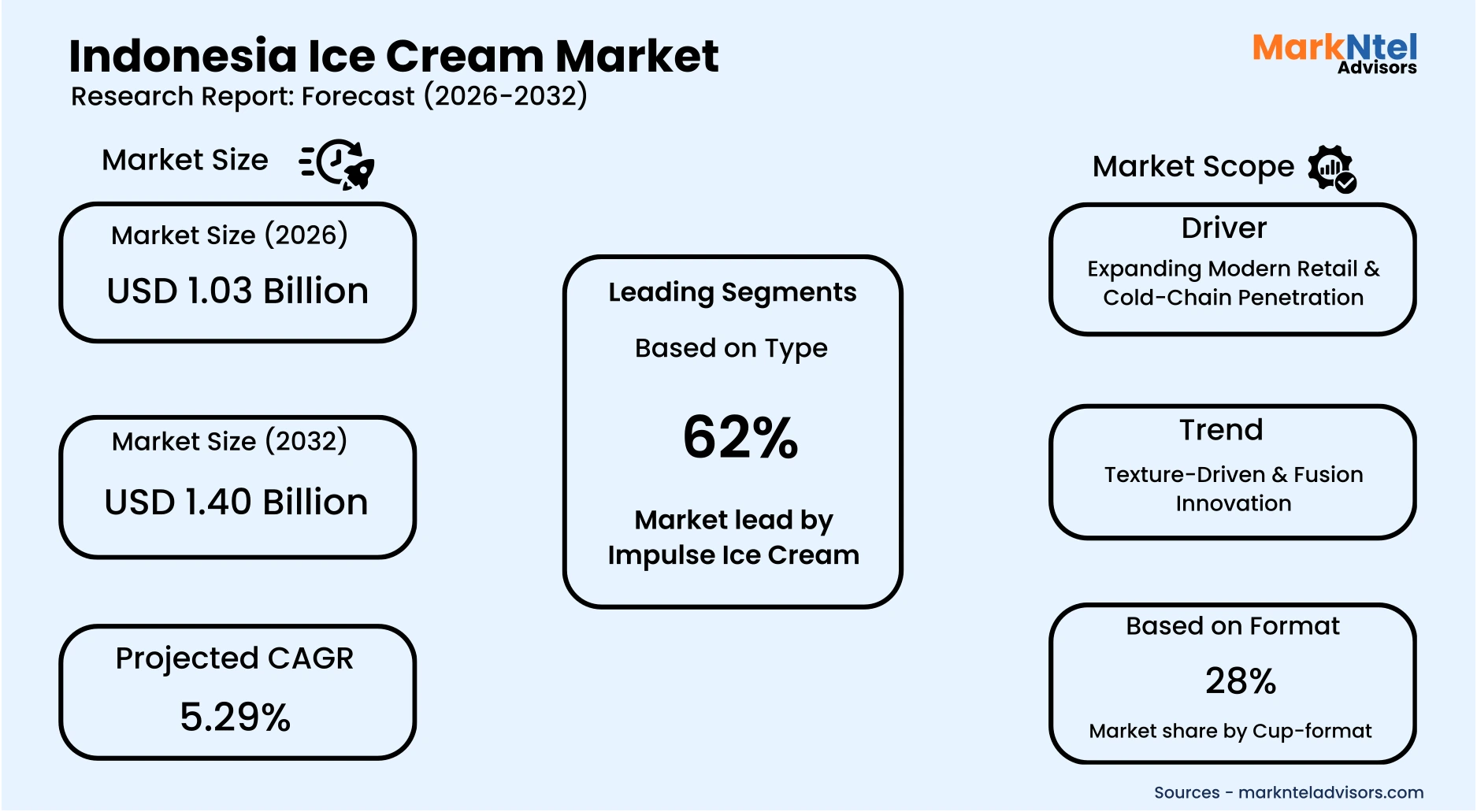
Market Size (2026)
USD 1.03 Billion
Market Size (2032)
USD 1.40 Billion
Base Year
2025
Projected CAGR
5.29%
Leading Segments
By Type: Impulse Ice Cream
Indonesia Ice Cream Market Report Key Takeaways:
- Market size was valued at around USD 0.98 billion in 2025 and is projected to grow from USD 1.03 billion in 2026 to USD 1.40 billion by 2032, exhibiting a CAGR of 5.29% during the forecast period.
- By type, the Impulse Ice Cream segment represented a significant share of about 62% in the Indonesia Ice Cream Market in 2026.
- By Format, the Cups segment presented a significant share of about 28% in the Indonesia Ice Cream Market in 2026.
- Leading Ice Cream Companies in the Indonesia Market are Magnum, Campina Ice Cream Industry Tbk PT, Glico Indonesia PT, Diamond Cold Storage PT, Unilever, Aice Group Holdings Pte Ltd, Kapal Api Group, Indofood Sukses Makmur Tbk PT, Bright Dairy & Food Co., Ltd., Haagen-Dazs, and others.
Market Insights & Analysis: Indonesia Ice Cream Market (2026-32):
The Indonesia Ice Cream Market size was valued at approximately USD 0.98 billion in 2025 and is projected to grow from USD 1.03 billion in 2026 to USD 1.40 billion by 2032. Along with this, the market is estimated to grow at a CAGR of around 5.29% during the forecast period, i.e., 2026-32.
Indonesia’s Ice Cream Market remains structurally positive, supported by demographic strength, retail penetration, and urban income expansion. With a population exceeding 280 million and more than 70 million individuals aged 15–34, Indonesia maintains one of the largest youth-driven consumer bases in Southeast Asia. This demographic profile supports high-frequency snacking behavior, particularly in single-serve frozen desserts.
Additionally, retail infrastructure will remain a central growth enabler. Indonesia operates more than 46,000 convenience stores nationwide, with continued expansion across tier-two cities in Sumatra and Sulawesi. Increased freezer penetration in these locations structurally strengthens impulse conversion rates.
However, supply-side dynamics will shape medium-term cost stability. Domestic fresh milk production remains below 30% of total dairy requirements, creating reliance on imported milk powder. For instance, in 2025, the government initiated dairy herd expansion, including the import of over 1,300 dairy cows, aimed at gradually reducing this structural deficit. If sustained, this initiative could improve raw material security and stabilize production margins by the latter part of the forecast period, i.e., 2026- 2032.
Moreover, Unilever historically held a major market value share, though lower-priced competitors such as Aice continue gaining penetration through aggressive distribution strategies. As a result, the outlook suggests sustained volume expansion driven by impulse retail growth, while value growth will increasingly depend on premium format innovation and operational efficiency rather than price increases alone.
Indonesia Ice Cream Market Recent Developments:
- 2024 : Unilever Indonesia Tbk PT signed an agreement to sell its ice cream business, including Magnum, to PT The Magnum Ice Cream Indonesia for approximately USD 443 million, as part of Unilever’s global ice cream business separation strategy.
- 2024 : Aice Group introduced Aice Histeria Peach in Indonesia, launching it in Jakarta in conjunction with International Women’s Day celebrations.
Indonesia Ice Cream Market Scope:
| Category | Segments |
|---|---|
| By Type | (Impulse Ice Cream, Unpackaged Ice Cream, Take-Home Ice Cream), |
| By Flavor | (Chocolate, Mango, Vanilla, Strawberry, Butterscotch, Others), |
| By Format | (Cup, Stick, Cone, Brick), |
| By Composition | (Dairy Ice Cream, Plant-based Ice Cream), |
| By Positioning | (Mass Market Ice Cream, Artisanal Ice Cream), |
| By Trade Type | (HoReCa, Invidual Consumers), |
| By Sales Channel | (Grocery Retailers, Hypermarkets/Supermarkets, Brand Owned Outlets, Ice Cream Carts, Online, Convenience Stores, Others), |
Indonesia Ice Cream Market Driver:
Expanding Modern Retail & Cold-Chain Penetration
Indonesia’s ice cream consumption is structurally supported by the climate, but it is modern retail expansion that converts demand into actual transactions. Java alone accounts for approximately 56% of Indonesia’s population (2024), creating high urban retail density and strong outlet-level turnover. This concentration has enabled the rapid growth of convenience chains such as Indomaret and Alfamart, which together operate over tens of thousands of outlets nationwide.
Because ice cream is highly impulse-driven and temperature-sensitive, freezer visibility directly influences purchase frequency. As modern trade outlets expand into tier-two cities across Sumatra and Sulawesi, freezer penetration increases, shortening consumer decision cycles and reinforcing single-serve purchases.
Additionally, Indonesia’s cold-chain logistics sector has grown alongside retail, with documented expansion in refrigerated warehousing and transport infrastructure during 2023–2024. Improved cold storage reduces spoilage risk and enables broader inter-island distribution. Thus, dense retail networks increase accessibility, while stronger cold-chain systems ensure supply continuity. Together, these structural improvements directly explain why impulse formats dominate Indonesia’s ice cream market and are expected to remain the primary growth engine through 2032.
Indonesia Ice Cream Market Trend:
Texture-Driven & Fusion Innovation
The market growth is actively transforming due to product innovation and different flavor fusions. For instance, in January 2026, Glico WINGS introduced Frostbite Potabee in Jakarta, combining vanilla ice cream with real potato chip toppings to create a sweet-and-savory fusion. This move reflects a broader strategy of sensory differentiation, moving beyond traditional flavors toward bold texture contrasts aimed at Gen-Z consumers.
Similarly, in 2025, Aice Group launched Crispy Balls Cookies n’ Cream, embedding coated chocolate crispy balls into layered ice cream for enhanced crunch . Additionally, Aice expanded into mochi ice cream with eight SKUs, scaling a Japanese-inspired format into Indonesia’s mass retail channel in 2025. Earlier, in 2024, Aice collaborated with the Ministry of Tourism’s Wonderful Indonesia campaign to launch a mung-bean-flavored product, integrating local culinary heritage into modern formats. Such product innovations are actively transforming the Indonesia Ice Cream Market.
Indonesia Ice Cream Market Opportunity:
Improved Trade Agreements Offering Lucrative Growth Opportunities
To address the structural reliance on imported dairy inputs vulnerability, trade policy and supply-side expansion are moving in parallel. The Indonesia–Australia Comprehensive Economic Partnership Agreement (IA-CEPA) provides tariff-free or preferential access to 98–99% of Australian exports to Indonesia, including dairy and livestock. As Australia is a primary supplier of milk powders and dairy cattle, IA-CEPA lowers landed input costs and improves procurement predictability for Indonesian ice cream processors.
Simultaneously, Indonesia imported 1,383 dairy cows from Australia in 2026 under a broader USD 3 billion national dairy development program aimed at expanding domestic milk output and reducing reliance on imported milk powders. This upstream herd expansion strengthens long-term local supply while maintaining short-term import stability. Together, preferential trade access, herd expansion, and regional integration create a connected supply strategy, reducing input volatility, broadening supplier options, and enhancing raw-material security. This structural strengthening of the dairy value chain directly supports scalable, cost-efficient growth for Indonesia’s ice cream sector through 2032.
Indonesia Ice Cream Market Challenge:
Raw Material Dependency and Dairy Supply Constraints
Indonesia’s dairy industry faces a structural supply gap that directly impacts cost stability. According to Statistics Indonesia (BPS) 2024 data, national fresh milk production remains under 1 million tons annually, while total dairy processing demand exceeds 4 million tons of milk equivalent. For instance, domestic farms meet only about 20–25% of industry requirements, forcing reliance on imported skim milk powder and whey for roughly three-quarters of inputs. Additionally, average milk productivity stands at around 12–15 liters per cow per day, significantly below major exporters such as New Zealand and Australia, where yields exceed 20–25 liters, reinforcing long-term import dependence.
This reliance tightly links domestic production costs to global dairy prices and currency movements. Because most dairy commodities are priced in US dollars, rupiah depreciation directly increases input costs. Similarly, global price spikes immediately compress margins, particularly in price-sensitive consumer segments where retail prices cannot rise proportionately.
Regulatory compliance further adds structural pressure. Products must meet labeling and additive standards under Badan Pengawas Obat dan Makanan (BPOM), while halal certification through Majelis Ulama Indonesia is mandatory. Consequently, import dependency, currency volatility, and compliance costs collectively create sustained margin pressure, disproportionately affecting smaller regional manufacturers.
Indonesia Ice Cream Market (2026-32) Segmentation Analysis:
The Indonesia Ice Cream Market study of MarkNtel Advisors evaluates & highlights the major trends and influencing factors in each segment. It includes predictions for the period 2026–32 at the Indonesia level. Based on the analysis, the market has been further classified as;
Based on Type:
- Impulse Ice Cream
- Single Portion Dairy Ice Cream
- Single Portion Water Ice Cream
- Unpackaged Ice Cream
- Take-Home Ice Cream
- Bulk Dairy Ice Cream
- Ice Cream Desserts
Impulse ice cream dominates over take-home and unpackaged formats in Indonesia with a market share of about 62% because consumer affordability, product availability, and corporate SKU strategies are aligned toward small-serve purchases. Large ice-cream manufacturers have responded with dedicated impulse SKU launches. In its 2024 Annual Report, Unilever Indonesia highlighted expanded rollouts of Wall’s cup and stick variants tailored for convenience stores and neighbourhood kiosks, supporting frequent, small purchases.
Similarly, as per the Campina Ice Cream Industry (2024), new single-serve, affordable cup formats are being marketed through minimarkets and modern trade outlets. AICE Group, active across Southeast Asia, including Indonesia, continued distribution of low-priced single-serve stick and cup variants in 2024 as part of its aggressive impulse strategy. Meanwhile, Badan Pengawas Obat dan Makanan regulations on hygiene and labeling favor sealed products over unpackaged street ice cream, further reinforcing impulse formats.
Based on Format:
- Cup
- Stick
- Cone
- Brick
- Others (Sandwich, Tub, etc.)
Cup-format ice cream maintains strong dominance in Indonesia with a market share of about 28% primarily because it aligns with consumer lifestyle patterns, retail structure, and climate conditions. Indonesia’s hot and humid weather supports year-round ice cream consumption, and sealed cup packaging provides better hygiene protection compared to open formats like cones. This is particularly important in densely populated urban areas where food safety awareness continues to rise. Cups also offer portion control, making them suitable for children and young adults who prefer affordable, single-serve treats.
Additionally, Indonesia’s expanding modern retail network strengthens the position of cup formats. In 2024–2025, leading manufacturers intensified their focus on cup-format ice cream to strengthen their presence in Indonesia’s impulse segment. For instance, Unilever Indonesia continued expanding Wall’s single-serve cup variants across convenience and modern retail channels, reflecting its strategy to target frequent purchases. Similarly, Aice Group Holdings also strengthened mass-market cup offerings across minimarkets during 2024–25, supported by wide retail penetration. These expansions indicate sustained dominance of cup formats within Indonesia’s growing ice cream industry.
Gain a Competitive Edge with Our Indonesia Ice Cream Market Report:
- Indonesia Ice Cream Market Report by MarkNtel Advisors provides a detailed & thorough analysis of market size & share, growth rate, competitive landscape, and key players. This comprehensive analysis helps businesses gain a holistic understanding of the market dynamics & make informed decisions.
- This report also highlights current market trends & future projections, allowing businesses to identify emerging opportunities & potential challenges. By understanding market forecasts, companies can align their strategies & stay ahead of the competition.
- Indonesia Ice Cream Market Report aids in assessing & mitigating risks associated with entering or operating in the market. By understanding market dynamics, regulatory frameworks, and potential challenges, businesses can develop strategies to minimize risks & optimize their operations.
*Reports Delivery Format - Market research studies from MarkNtel Advisors are offered in PDF, Excel and PowerPoint formats. Within 24 hours of the payment being successfully received, the report will be sent to your email address.
Frequently Asked Questions
- Market Segmentation
- Introduction
- Product Definition
- Research Process
- Assumptions
- Executive Summary
- Indonesia Ice Cream Market Policies, Regulations, Product Standards
- Indonesia Ice Cream Market Supply Chain Analysis
- Indonesia Ice Cream Market Pricing Analysis
- SKU Wise Price Points
- Average Increase/Decrease in Price Per ML
- Indonesia Ice Cream Market Trends & Developments
- Indonesia Ice Cream Market Dynamics
- Growth Drivers
- Challenges
- Indonesia Ice Cream Market Hotspot & Opportunities
- Indonesia Ice Cream Market Outlook, 2022-2032F
- Market Size & Analysis
- By Revenues (USD Million)
- By Volume (Million Liters)
- Market Segmentation & Analysis
- By Type
- Impulse Ice Cream
- Single Portion Dairy Ice Cream
- Single Portion Water Ice Cream
- Unpackaged Ice Cream
- Take-Home Ice Cream
- Bulk Dairy Ice Cream
- Ice Cream Desserts
- Impulse Ice Cream
- By Flavor
- Chocolate
- Mango
- Vanilla
- Strawberry
- Butterscotch
- Others
- By Format
- Cup
- Stick
- Cone
- Brick
- Others (Sandwich, Tub, etc.)
- By Composition
- Dairy Ice Cream
- Plant-based Ice Cream
- By Positioning
- Mass Market Ice Cream
- Artisanal Ice Cream
- By Trade Type
- HoReCa
- Invidual Consumers
- By Sales Channel
- Grocery Retailers
- Hypermarkets/Supermarkets
- Brand Owned Outlets
- Ice Cream Carts
- Online
- Convenience Stores
- Others
- By Region
- Java
- Sumatra
- Kalimantan
- Sulawesi
- By Competitors
- Company Revenue Shares
- Competitor Characteristics
- By Type
- Market Size & Analysis
- Indonesia Impulse Ice Cream Market Outlook, 2022-2032F
- Market Size & Analysis
- By Revenues (USD Million)
- By Volume (Million Liters)
- Market Segmentation & Analysis
- By Flavor
- By Format
- By Composition
- By Positioning
- By Trade Type
- By Sales Channel
- Market Size & Analysis
- Indonesia Unpackaged Ice Cream Market Outlook, 2022-2032F
- Market Size & Analysis
- By Revenues (USD Million)
- By Volume (Million Liters)
- Market Segmentation & Analysis
- By Flavor
- By Format
- By Composition
- By Positioning
- By Trade Type
- By Sales Channel
- Market Size & Analysis
- Indonesia Take-Home Ice Cream Market Outlook, 2022-2032F
- Market Size & Analysis
- By Revenues (USD Million)
- By Volume (Million Liters)
- Market Segmentation & Analysis
- By Flavor
- By Format
- By Composition
- By Positioning
- By Trade Type
- By Sales Channel
- Market Size & Analysis
- Indonesia Ice Cream Market Key Strategic Imperatives for Success & Growth
- Competition Outlook
- Company Profiles
- Magnum
- Business Description
- Type Portfolio
- Strategic Alliances or Partnerships
- Recent Developments
- Financial Details
- Others
- Campina Ice Cream Industry Tbk PT
- Business Description
- Type Portfolio
- Strategic Alliances or Partnerships
- Recent Developments
- Financial Details
- Others
- Glico Indonesia PT
- Business Description
- Type Portfolio
- Strategic Alliances or Partnerships
- Recent Developments
- Financial Details
- Others
- Diamond Cold Storage PT
- Business Description
- Type Portfolio
- Strategic Alliances or Partnerships
- Recent Developments
- Financial Details
- Others
- Unilever
- Business Description
- Type Portfolio
- Strategic Alliances or Partnerships
- Recent Developments
- Financial Details
- Others
- Aice Group Holdings Pte Ltd
- Business Description
- Type Portfolio
- Strategic Alliances or Partnerships
- Recent Developments
- Financial Details
- Others
- Kapal Api Group
- Business Description
- Type Portfolio
- Strategic Alliances or Partnerships
- Recent Developments
- Financial Details
- Others
- Indofood Sukses Makmur Tbk PT
- Business Description
- Type Portfolio
- Strategic Alliances or Partnerships
- Recent Developments
- Financial Details
- Others
- Bright Dairy & Food Co., Ltd.
- Business Description
- Type Portfolio
- Strategic Alliances or Partnerships
- Recent Developments
- Financial Details
- Others
- Haagen-Dazs
- Business Description
- Type Portfolio
- Strategic Alliances or Partnerships
- Recent Developments
- Financial Details
- Others
- Others
- Magnum
- Company Profiles
- Disclaimer
MarkNtel Advisors follows a robust and iterative research methodology designed to ensure maximum accuracy and minimize deviation in market estimates and forecasts. Our approach combines both bottom-up and top-down techniques to effectively segment and quantify various aspects of the market. A consistent feature across all our research reports is data triangulation, which examines the market from three distinct perspectives to validate findings. Key components of our research process include:
1. Scope & Research Design At the outset, MarkNtel Advisors define the research objectives and formulate pertinent questions. This phase involves determining the type of research—qualitative or quantitative—and designing a methodology that outlines data collection methods, target demographics, and analytical tools. They also establish timelines and budgets to ensure the research aligns with client goals.
2. Sample Selection and Data Collection In this stage, the firm identifies the target audience and determines the appropriate sample size to ensure representativeness. They employ various sampling methods, such as random or stratified sampling, based on the research objectives. Data collection is carried out using tools like surveys, interviews, and observations, ensuring the gathered data is reliable and relevant.
3. Data Analysis and Validation Once data is collected, MarkNtel Advisors undertake a rigorous analysis process. This includes cleaning the data to remove inconsistencies, employing statistical software for quantitative analysis, and thematic analysis for qualitative data. Validation steps are taken to ensure the accuracy and reliability of the findings, minimizing biases and errors.

4. Data Forecast and FinalizationThe final phase involves forecasting future market trends based on the analyzed data. MarkNtel Advisors utilize predictive modeling and time series analysis to anticipate market behaviors. The insights are then compiled into comprehensive reports, featuring visual aids like charts and graphs, and include strategic recommendations to inform client decision-making
We offer flexible licensing options to cater to varying organizational needs. Choose the pricing pack that best suits your requirements:
Buy Now Inquire Before Buying
 Request Customization
 Talk to our Consultant