

Indonesia Facility Management Market Research Report Forecast: (2026-2032)
By Type (Hard, Soft, Risk, Administrative), By Operating Model (In-house, Outsourced), By Service Delivery (Integrated, Bundled, Single Service), By Enterprise Size (Large, Mid-Siz ... e, Small), By End User (Commercial, Residential, Government, Retail, Education, Healthcare, Hospitality, Others), and others Read more
- Buildings, Construction, Metals & Mining
- Jul 2026
- Pages 140
- Report Format: PDF, Excel, PPT
Indonesia Facility Management Market
Projected 5.45% CAGR from 2026 to 2032
Study Period
2026-2032
Market Size (2026)
USD 16.21 Billion
Market Size (2032)
USD 22.29 Billion
Base Year
2025
Projected CAGR
5.45%
Leading Segments
By Type: Hard
Indonesia Facility Management Market Key Takeaways
- Indonesia facility management market size was valued at around USD 15.18 billion in 2025 and is projected to grow from USD 16.21 billion in 2026 to USD 22.29 billion by 2032.
- The industry is projected to witness steady growth at a CAGR of around 5.45% during the forecast period, i.e., 2026-32.
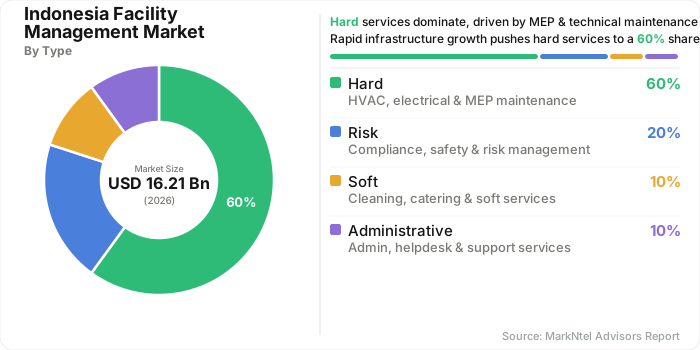
- By type, hard facility management dominated the market with approximately 60% share in 2026.
- By service delivery, integrated facility management dominated the market with approximately 55% share in 2026.
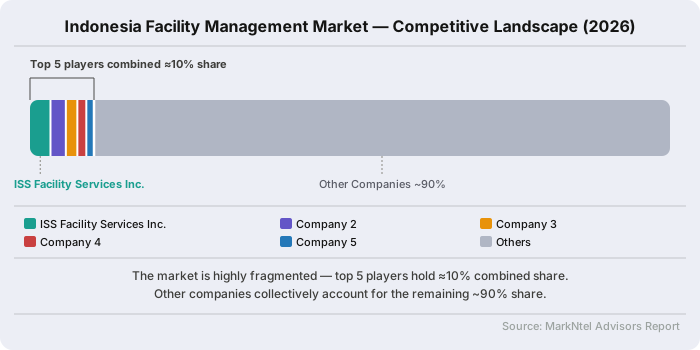
- The industry is highly fragmented, with top five players collectively account for approximately 10% market share.
Indonesia Facility Management Market Size and Outlook
The facility management market size in Indonesia was valued at USD 15.18 billion in 2025 and is projected to grow from USD 16.21 billion in 2026 to USD 22.29 billion by 2032. Along with this, the market is estimated to grow at a CAGR of around 5.45% during the forecast period, i.e., 2026-32.
Indonesia's outlook for administrative facility management is increasingly shaped by the country's expanding formal business base and the digitalization of regulatory compliance, both of which are lifting demand for reception, records, procurement-support, and workplace-administration services within commercial buildings. The Ministry of Investment/BKPM reported that Q3 2025 investment realization reached USD 24.8 billion, generating 696,478 new direct jobs a 7.1% increase over the same period the prior year. Domestic investment alone contributed USD 14.1 billion, or 56.9% of the total, reflecting a broadening base of locally incorporated enterprises that require office space, front-desk operations, and administrative building support as they scale.
This growth is reinforced by regulatory expansion of the Online Single Submission (OSS) system, which BKPM Regulation No. 5 of 2025 extended from 16 to 22 licensed business sectors, while existing business identification numbers (NIB) issued before November 2025 must complete migration to OSS v.1.2 by 31 May 2026. Each newly licensed entity entering the formal economy becomes a prospective tenant requiring mailroom, visitor-management, document-handling, and administrative coordination services functions increasingly outsourced rather than built in-house as compliance obligations grow more complex.
Through 2032, Administrative Facility Management is expected to benefit directly from this formalization wave, particularly as compliance-heavy sectors newly absorbed into risk-based licensing generate additional administrative building requirements. Providers that pair traditional office-support services with digital record-keeping and licensing-document coordination stand to capture disproportionate share as Indonesia's investment realization and business registration base continue to expand under its risk-based regulatory framework.
Indonesia Facility Management Market Key Indicators
- Indonesia’s construction sector contributed 9.83% to GDP in 2025 (BPS), reflecting sustained infrastructure, commercial, and industrial building activity. This expansion continuously increases newly built assets such as offices, hospitals, and industrial facilities, directly raising long-term demand for maintenance, cleaning, energy management, and integrated facility management services nationwide.
- Manufacturing remains a major contributor to GDP with 5.68% quarterly growth in 2025 (BPS). Expansion of industrial production facilities increases demand for specialized FM services such as HVAC maintenance, industrial cleaning, fire safety systems, and energy optimization, strengthening long-term industrial FM contracts.
- Indonesia recorded 5.12% GDP growth in Q2 2025 (BPS). Stable macroeconomic growth increases occupancy in commercial offices, retail centers, and mixed-use developments. This supports higher outsourcing of facility operations, including cleaning, front-office services, and building maintenance.
- Indonesia’s infrastructure-led Gross Fixed Capital Formation reached USD 110.7 billion in 2025 (CEIC/BPS data source). Large-scale public infrastructure, such as roads, ports, and airports, requires long-term operation and maintenance, creating sustained demand for integrated FM and lifecycle asset management services.
- Gross Fixed Capital Formation grew sharply in 2025, reaching over USD 52.4 billion in Q1 2026 (BPS). Rising capital investment increases the number of operational assets across sectors, pushing organizations toward outsourced FM models to reduce operational complexity and improve efficiency.
Indonesia Facility Management Market Scope
| Category | Segments |
|---|---|
| By Type | Hard, Soft, Risk, Administrative |
| By Operating Model | In-house, Outsourced |
| By Service Delivery | Integrated, Bundled, Single Service |
| By Enterprise Size | Large, Mid-Size, Small |
| By End User | Commercial, Residential, Government, Retail, Education, Healthcare, Hospitality, Others |
Indonesia Facility Management Market Growth Drivers
Accelerating Infrastructure Modernization and Sustainable Asset Management Fueling Facility Management Demand
Indonesia's facility management market is being propelled by sustained infrastructure expansion, increasing demand for integrated asset management, and the adoption of sustainable building operations. The Government of Indonesia's 2025–2029 National Medium-Term Development Plan (RPJMN) prioritizes transport, public buildings, water infrastructure, industrial estates, and urban services to strengthen economic competitiveness, significantly expanding the portfolio of assets requiring long-term operation and maintenance.
As a complementary initiative, the Infrastructure Project Facilitation Office (IPFO) was established in 2025 to accelerate private investment in infrastructure projects across sectors, including transportation, water, waste management, and clean energy, further increasing opportunities for integrated facility management throughout the asset lifecycle. Reflecting this market shift, OCS Group Indonesia engaged with Indonesia's National Council for Special Economic Zones (SEZ) in April 2025 to support sustainable facilities management through ESG frameworks and advanced operational solutions for emerging industrial and commercial zones. The convergence of government-led infrastructure development, expanding special economic zones, and rising sustainability requirements is driving demand for technically advanced, technology-enabled, and integrated facility management services across commercial, industrial, and public-sector facilities.
Recent Trends
Smart, Sustainable, and Integrated Services Redefining Indonesia's Facility Management Landscape
Indonesia's facility management market is evolving through digitalization, sustainability, integrated outsourcing, and expansion across strategic infrastructure. The 2025 Global State of Facilities Management Report found that 84% of organizations identified rising operating costs as their primary FM challenge, accelerating investment in AI-enabled maintenance, workplace analytics, and integrated service delivery to improve operational efficiency. As an example, OCS Group Indonesia launched its 2025 Sustainability Report in June 2026, introducing its Regenerative FM approach that integrates carbon management, energy optimization, waste reduction, and ESG-driven facility services, reflecting the growing emphasis on sustainable building operations.
Simultaneously, Indonesia's continued investment in public infrastructure under the Ministry of Public Works is expanding the asset base requiring long-term operation and maintenance services, supporting demand for integrated FM contracts across transport, government, and commercial facilities. Another notable trend is the growing adoption of comprehensive outsourced solutions, with providers such as PT Patra Jasa strengthening integrated offerings spanning engineering, security, housekeeping, parking, and asset management, enabling clients to consolidate multiple services under a single operational framework.
Indonesia Facility Management Market Opportunities and Challenges
Rising Statutory Wage Costs Pressuring Labour-Intensive FM Contracts, Opening the Path to Workforce-Efficiency Innovation
Indonesia's facility management industry faces a cost challenge as the Ministry of Manpower's revised wage formula pushes 2026 provincial minimum wages sharply higher. Under Government Regulation No. 49 of 2025, the wage-adjustment coefficient (alpha) rose to 0.5–0.9 from 0.1–0.3 previously, driving increases of 2.73% to 9.08% across 36 provinces. Jakarta's minimum wage climbed 6.17% to Rp5,729,876 monthly, with Bekasi recording even steeper gains, directly raising payroll costs for FM providers whose cleaning, security, and technical labour remain manpower-intensive, squeezing margins on thin-priced contracts.
This pressure is simultaneously creating opportunity: providers shifting toward automation, IoT-based workforce scheduling, and multi-skilled labour deployment can offset rising statutory costs while sustaining service quality. Companies re-engineering labour models around this wage trajectory are better positioned to protect margins and differentiate through cost-efficient, technology-enabled delivery as regulatory wage pressure continues through 2032. Providers that embed compliance monitoring alongside automation into standard offerings will likely gain a durable competitive edge, particularly among multinational occupiers seeking predictable, regulation-proof facility operating costs nationwide
Segmentation Insights
Hard Facility Management Segment with 60% Market Share, to Remain the Leading Segment Backed by Growing Commercial and Public Infrastructure Development
Hard Facility Management is expected to remain the largest segment in the Indonesia facility management market, accounting for an estimated 60% of total market revenue. The segment's leadership is supported by the growing stock of commercial buildings, industrial facilities, healthcare institutions, airports, and public infrastructure that require continuous maintenance of HVAC systems, electrical installations, plumbing networks, building automation systems, and other critical assets. Compared with soft facility management services, hard FM is indispensable for maintaining asset functionality, regulatory compliance, and operational continuity.
The segment is further reinforced by Indonesia's continued infrastructure development. The Government of Indonesia allocated approximately USD 24.8 billion for infrastructure development under the 2025 State Budget (APBN), covering transportation networks, public buildings, water infrastructure, and industrial facilities. These long-life assets require ongoing technical maintenance throughout their operational lifecycle, directly increasing demand for hard facility management services. Based on type, the market is segmented into:
- Hard
- Soft
- Risk
- Administrative
Integrated Facility Management, with 55% Market Share, Will Remain the Leading Service Delivery Model
Integrated Facility Management is projected to remain the leading service delivery model in Indonesia, accounting for an estimated 55% of the market. Organizations increasingly prefer integrated contracts that combine technical maintenance, cleaning, security, workplace management, and energy management under a single service provider, improving operational efficiency while reducing administrative complexity. This model is particularly prevalent among commercial buildings, industrial parks, hospitals, airports, and government facilities. Growing demand for standardized service quality, regulatory compliance, and technology-enabled asset management further accelerates the transition toward integrated facility management solutions.
Supporting this trend, Statistics Indonesia (BPS) reported that the construction sector contributed 9.84% of Indonesia's GDP in 2025, reflecting sustained expansion in commercial and institutional building development. As the number and complexity of built assets continue to increase, owners are increasingly adopting integrated facility management to streamline operations, improve asset performance, and optimize lifecycle costs through centralized service delivery. This trend is expected to further strengthen the adoption of integrated outsourcing models, enabling enhanced asset reliability, operational efficiency, and cost optimization. Based on service delivery, the market is segmented into:
- Integrated
- Bundled
- Single Service
Indonesia Facility Management Market Competitive Analysis
The Indonesia facility management industry is highly fragmented, with competition among multinational integrated facility management providers and established domestic service companies. The top five companies ISS Facility Services Inc., JLL Inc., CBRE Indonesia, OCS Group Indonesia, and PT Shield-On Service Tbk (ALSOK Group) collectively account for approximately 10% of the market. Competitive differentiation is driven by integrated service capabilities, nationwide operational coverage, digital facility management technologies, ESG-focused solutions, and long-term contracts across commercial, industrial, healthcare, and public-sector facilities.
Key Companies in the Indonesia Facility Management Market
- ISS Facility Services Inc.
- JLL Inc.
- CBRE Indonesia
- OCS Group Indonesia (formerly ATALIAN Global Services Indonesia)
- PT Shield-On Service Tbk (ALSOK Group)
- PT Patra Jasa
- PT Spektra Solusindo
- Sodexo
- Colliers Facility Management Services
- Leads Property Services Indonesia
Indonesia Facility Management Industry News and Recent Developments
February 2026: OCS Group Indonesia Publishes 2025 Sustainability Report
OCS Group Indonesia released its 2025 Sustainability Report, outlining its Regenerative FM strategy focused on energy efficiency, waste reduction, carbon management, and responsible workplace operations. The report highlights the company's expanded environmental, social, and governance (ESG)-driven facility management solutions across commercial, industrial, healthcare, and public-sector facilities in Indonesia.
Impact Analysis: The initiative demonstrates the increasing integration of sustainability into facility management services, as building owners seek partners capable of improving operational efficiency while supporting ESG compliance. The development is expected to accelerate demand for energy management, waste optimization, and environmental monitoring services within Indonesia's facility management market.
November 2025: JLL Receives Asia-Pacific Facility Management Company of the Year Recognition
JLL was recognized as the 2025 Asia-Pacific Facility Management Company of the Year by Frost & Sullivan for its leadership in AI-enabled facility management, predictive maintenance, workplace experience, and sustainability-driven building operations. The recognition reflects JLL's continued investment in digital technologies across its integrated facility management portfolio.
Impact Analysis: The recognition highlights the growing adoption of artificial intelligence and predictive maintenance technologies within the facility management industry. As Indonesian organizations increasingly modernize building operations, demand for digitally enabled integrated facility management services is expected to strengthen across commercial and industrial facilities.
April 2026: PT Shield-On Service Tbk Completes Merger with ALSOK BASS Indonesia
PT Shield-On Service Tbk completed its merger with PT ALSOK BASS Indonesia Security Services, strengthening its integrated security and facility management capabilities. The merger expands the company's service portfolio by combining advanced security technologies with technical maintenance and workplace support solutions for commercial, industrial, and public-sector clients.
Impact Analysis: The merger reflects the ongoing consolidation within Indonesia's facility management industry, enabling providers to deliver broader integrated service offerings under a single contract. The strengthened operational capabilities are expected to improve service efficiency while increasing competition among large integrated facility management providers.
September 2025: PT Patra Jasa Expands Integrated Facility Management Services
PT Patra Jasa expanded its integrated facility management operations by enhancing engineering maintenance, housekeeping, security, parking management, and asset management services across commercial buildings, government facilities, hospitality properties, and industrial assets. The expansion supports the company's strategy to provide comprehensive outsourced building management solutions.
Impact Analysis: The expansion reflects growing demand for bundled facility management contracts as organizations seek to improve operational efficiency and reduce administrative complexity. The development is expected to strengthen the adoption of integrated facility management services across Indonesia's commercial real estate and public infrastructure sectors.
October 2025: Sodexo Strengthens Digital Workplace and Integrated FM Solutions in Asia
Sodexo expanded its digital workplace management capabilities across the Asia-Pacific region by enhancing technology-enabled integrated facility management services, including smart workplace platforms, predictive maintenance, and employee experience solutions. The initiative supports multinational clients operating large commercial and industrial facilities, including those in Indonesia.
Impact Analysis: The expansion underscores the increasing role of digital technologies in facility management, enabling service providers to improve operational visibility, optimize maintenance planning, and enhance workplace productivity. The development is expected to encourage wider adoption of smart facility management solutions among Indonesian enterprises.
Frequently Asked Questions
- Market Segmentation
- Introduction
- Product Definition
- Research Process
- Assumptions
- Executive Summary
- Indonesia Facility Management Market Porter’s Five Forces Analysis
- Indonesia Facility Management Market Policies, Regulations, and Product Standards
- Indonesia Facility Management Market Trends & Developments
- Indonesia Facility Management Market Dynamics
- Growth Factors
- Challenges
- Indonesia Facility Management Market Hotspot & Opportunities
- Indonesia Facility Management Market Outlook, 2022-2032
- Market Size & Outlook
- By Revenues (USD Million)
- Market Segmentation & Outlook
- By Type- Market Size & Forecast 2022-2032, USD Million
- Hard
- Soft
- Risk
- Administrative
- By Operating Model- Market Size & Forecast 2022-2032, USD Million
- In-house
- Outsourced
- By Service Delivery- Market Size & Forecast 2022-2032, USD Million
- Integrated
- Bundled
- Single Service
- By Enterprise Size- Market Size & Forecast 2022-2032, USD Million
- Large
- Mid-Size
- Small
- By End User- Market Size & Forecast 2022-2032, USD Million
- Commercial
- Residential
- Government
- Retail
- Education
- Healthcare
- Hospitality
- Others
- By region - Market Size & Forecast 2022-2032, USD Million
- North Sumatra
- West Java
- Central Java
- East Java
- By Company
- Competition Characteristics
- Market Share & Analysis
- By Type- Market Size & Forecast 2022-2032, USD Million
- Market Size & Outlook
- Indonesia Hard Facility Management Market Outlook, 2022-2032
- Market Size & Outlook
- By Revenues (USD Million)
- Market Segmentation & Outlook
- By Operating Model- Market Size & Forecast 2022-2032, USD Million
- By Service Delivery- Market Size & Forecast 2022-2032, USD Million
- By Enterprise Size- Market Size & Forecast 2022-2032, USD Million
- By End User- Market Size & Forecast 2022-2032, USD Million
- By region - Market Size & Forecast 2022-2032, USD Million
- Market Size & Outlook
- Indonesia Soft Facility Management Market Outlook, 2022-2032
- Market Size & Outlook
- By Revenues (USD Million)
- Market Segmentation & Outlook
- By Operating Model- Market Size & Forecast 2022-2032, USD Million
- By Service Delivery- Market Size & Forecast 2022-2032, USD Million
- By Enterprise Size- Market Size & Forecast 2022-2032, USD Million
- By End User- Market Size & Forecast 2022-2032, USD Million
- By region - Market Size & Forecast 2022-2032, USD Million
- Market Size & Outlook
- Indonesia Risk Facility Management Market Outlook, 2022-2032
- Market Size & Outlook
- By Revenues (USD Million)
- Market Segmentation & Outlook
- By Operating Model- Market Size & Forecast 2022-2032, USD Million
- By Service Delivery- Market Size & Forecast 2022-2032, USD Million
- By Enterprise Size- Market Size & Forecast 2022-2032, USD Million
- By End User- Market Size & Forecast 2022-2032, USD Million
- By region - Market Size & Forecast 2022-2032, USD Million
- Market Size & Outlook
- Indonesia Administrative Facility Management Market Outlook, 2022-2032
- Market Size & Outlook
- By Revenues (USD Million)
- Market Segmentation & Outlook
- By Operating Model- Market Size & Forecast 2022-2032, USD Million
- By Service Delivery- Market Size & Forecast 2022-2032, USD Million
- By Enterprise Size- Market Size & Forecast 2022-2032, USD Million
- By End User- Market Size & Forecast 2022-2032, USD Million
- By region - Market Size & Forecast 2022-2032, USD Million
- Market Size & Outlook
- Indonesia Facility Management Market Key Strategic Imperatives for Success & Growth
- Competitive Outlook
- Company Profiles
- ISS Facility Services Inc.
- Business Description
- Product Portfolio
- Collaborations & Alliances
- Recent Developments
- Financial Details
- Others
- JLL Inc.
- Business Description
- Product Portfolio
- Collaborations & Alliances
- Recent Developments
- Financial Details
- Others
- CBRE Indonesia
- Business Description
- Product Portfolio
- Collaborations & Alliances
- Recent Developments
- Financial Details
- Others
- OCS Group Indonesia (formerly ATALIAN Global Services Indonesia)
- Business Description
- Product Portfolio
- Collaborations & Alliances
- Recent Developments
- Financial Details
- Others
- PT Shield-On Service Tbk (ALSOK Group)
- Business Description
- Product Portfolio
- Collaborations & Alliances
- Recent Developments
- Financial Details
- Others
- PT Patra Jasa
- Business Description
- Product Portfolio
- Collaborations & Alliances
- Recent Developments
- Financial Details
- Others
- PT Spektra Solusindo
- Business Description
- Product Portfolio
- Collaborations & Alliances
- Recent Developments
- Financial Details
- Others
- Sodexo
- Business Description
- Product Portfolio
- Collaborations & Alliances
- Recent Developments
- Financial Details
- Others
- Colliers Facility Management Services
- Business Description
- Product Portfolio
- Collaborations & Alliances
- Recent Developments
- Financial Details
- Others
- Leads Property Services Indonesia
- Business Description
- Product Portfolio
- Collaborations & Alliances
- Recent Developments
- Financial Details
- Others
- Others
- ISS Facility Services Inc.
- Company Profiles
- Disclaimer
MarkNtel Advisors follows a robust and iterative research methodology designed to ensure maximum accuracy and minimize deviation in market estimates and forecasts. Our approach combines both bottom-up and top-down techniques to effectively segment and quantify various aspects of the market. A consistent feature across all our research reports is data triangulation, which examines the market from three distinct perspectives to validate findings. Key components of our research process include:
1. Scope & Research Design At the outset, MarkNtel Advisors define the research objectives and formulate pertinent questions. This phase involves determining the type of research—qualitative or quantitative—and designing a methodology that outlines data collection methods, target demographics, and analytical tools. They also establish timelines and budgets to ensure the research aligns with client goals.
2. Sample Selection and Data Collection In this stage, the firm identifies the target audience and determines the appropriate sample size to ensure representativeness. They employ various sampling methods, such as random or stratified sampling, based on the research objectives. Data collection is carried out using tools like surveys, interviews, and observations, ensuring the gathered data is reliable and relevant.
3. Data Analysis and Validation Once data is collected, MarkNtel Advisors undertake a rigorous analysis process. This includes cleaning the data to remove inconsistencies, employing statistical software for quantitative analysis, and thematic analysis for qualitative data. Validation steps are taken to ensure the accuracy and reliability of the findings, minimizing biases and errors.

4. Data Forecast and FinalizationThe final phase involves forecasting future market trends based on the analyzed data. MarkNtel Advisors utilize predictive modeling and time series analysis to anticipate market behaviors. The insights are then compiled into comprehensive reports, featuring visual aids like charts and graphs, and include strategic recommendations to inform client decision-making
We offer flexible licensing options to cater to varying organizational needs. Choose the pricing pack that best suits your requirements:
Buy Now Inquire Before Buying
 Request Customization
 Talk to our Consultant







