

India Tire Market Research Report: Forecast (2026-2032)
By Tire Type (Radial, Bias), By Vehicle Type (Two-Wheeler, Three-Wheeler, Passenger Car, Light Commercial Vehicle (LCV), Medium & Heavy Commercial Vehicle (MHCV), Off-the-Road Vehi ... cle (OTR)), By Demand Type (OEM, Replacement), By Season (Summer Tires, All-Season Tires), By Sales Channel (Direct Sales, Dealer/Distributor, Online Platform), By Tire Size (Tire Size 1, Tire Size 2, Tire Size 3, Tire Size 4, Tire Size 5), By Price Category (Economy, Mid-Range, Premium), and others Read more
- Tire
- Aug 2026
- Pages 145
- Report Format: PDF, Excel, PPT
India Tire Market
Projected 8.08% CAGR from 2026 to 2032
Study Period
2026-2032
Market Size (2026)
USD 13.98 Billion
Market Size (2032)
USD 22.28 Billion
Base Year
2025
Projected CAGR
8.08%
Leading Segments
By Tire Type: Radial
India Tire Market Key Takeaways
- The India tire market size was valued at around USD 12.22 billion in 2025 and is projected to grow from USD 13.98 billion in 2026 to USD 22.28 billion by 2032.
- The industry is projected to witness steady growth at a CAGR of around 8.08% during 2026-2032.
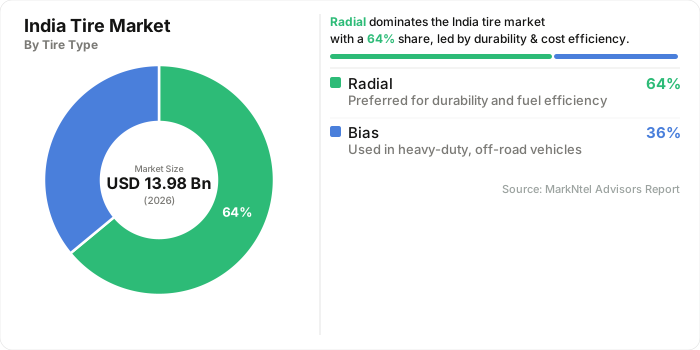
- By tire type, radial tires are expected to dominate the industry, accounting for approximately 64% market share in 2025.
- By demand type, the replacement segment is anticipated to hold nearly 58% of the industry share in 2026.
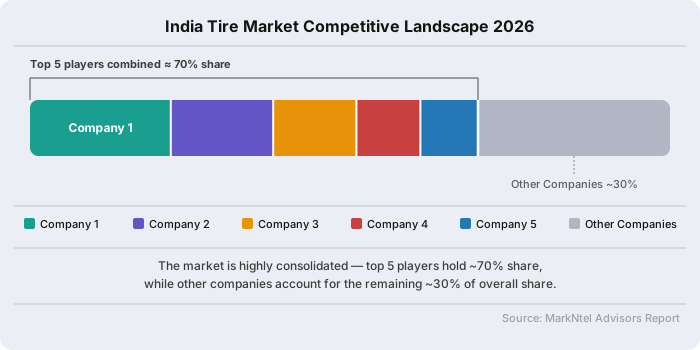
- The industry is moderately consolidated, with the top five players collectively accounting for approximately 70% market share.
India Tire Market Size and Outlook
The tire market in India was valued at USD 12.22 billion in 2025 and is projected to increase to USD 13.98 billion in 2026, reaching USD 22.28 billion by 2032 at a CAGR of 8.08% during 2026–2032. Market growth is supported by the continued expansion of India’s automotive manufacturing, vehicle exports, and road infrastructure, which collectively strengthen both OEM and replacement tire demand. Automobile exports reached 6.33 million units in 2025, including 4.94 million two-wheelers, generating substantial tire requirements for export-oriented vehicle production.
At the same time, India’s national highway network expanded to 146,342 km by FY2025, improving road connectivity and supporting higher vehicle utilization and intercity movement. Greater vehicle production and exports are strengthening OEM tire consumption, while expanding road networks and increasing vehicle usage are accelerating tire wear and replacement demand. Together, these developments are creating sustained growth opportunities across India’s OEM and aftermarket tire segments.
India Tire Market Key Indicators
- India had over 390 million registered motor vehicles on the VAHAN portal as of 2025, according to the Ministry of Road Transport & Highways (MoRTH). A larger on-road vehicle parc increases recurring demand for replacement tires across passenger vehicles, two-wheelers, commercial vehicles, and agricultural equipment, supporting sustained growth of the India tire market.
- India produced 43 million vehicles during FY2024–25, according to the Society of Indian Automobile Manufacturers (SIAM). Higher vehicle production directly increases OEM tire demand while expanding the future replacement tire market as newly sold vehicles enter long-term operation.
- The Ministry of Road Transport & Highways was allocated approximately USD 33.5 billion in the Union Budget 2025–26 for highway development. Expansion of highways and road networks increases vehicle utilization and freight movement, resulting in higher tire wear and stronger OEM and replacement tire demand.
- India transported more than 1,600 million tonnes of freight by road annually, according to the National Transport Development Policy Committee (Government of India). Rising road freight activity increases commercial vehicle tire consumption, particularly for truck and bus radial tires operating under high-mileage conditions.
- India produced approximately 857,000 tonnes of natural rubber during 2024–25, according to the Rubber Board of India. Stable domestic natural rubber availability supports tire manufacturing, improves raw material security, and reduces dependence on imported rubber for tire producers.
India Exported 54 Million Tires Worth USD 3.1 Billion in 2025, Generating a USD 2.88 Billion Trade Surplus
Strong export orientation: India exported approximately 54 million tires worth USD 3.1 billion in 2025, compared with imports of around 1.8 million tires valued at USD 223 million, based on HS 4011 trade data. Exports were therefore approximately 30× higher than imports by volume and 14× higher by value, generating a tire trade surplus of nearly USD 2.88 billion. This confirms India’s position as a structurally export-oriented tire manufacturing base.
Export momentum: Export volumes increased from approximately 46 million units in 2023 to 54 million units in 2025, representing a 17.4% increase, while export value rose from USD 2.7 billion to USD 3.1 billion, indicating sustained overseas demand. The performance is consistent with ATMA data showing India’s tire exports reached USD 2.93 billion in FY2025, up 9% year-on-year.
Diversified export markets: The United States remained India's largest destination in 2025, accounting for approximately USD 489 million, or 15.8% of total tire export value. Germany, Brazil, and the UAE followed with approximately USD 195 million, USD 133 million, and USD 126 million, respectively. Collectively, these four markets represented about 30% of export value, demonstrating meaningful geographic diversification.
Import contraction: Tire imports declined from approximately 2.1 million units in 2023 to 1.8 million units in 2025, a 14.3% reduction, while import value decreased from USD 310 million to USD 223 million, a 28.1% decline. This suggests that imports are increasingly serving specific product or price requirements rather than indicating structural dependence on overseas supply.
Asian sourcing remains important: Thailand was India's largest tire import source in 2025 at approximately USD 52 million, followed by China at USD 44 million and Japan at USD 39 million. Together, these three countries supplied approximately 61% of India's tire imports by value, reflecting the importance of established Asian tire-manufacturing hubs in supplementing domestic supply.
Overall assessment: India’s tire trade structure remains strongly export-led, with exports expanding while imports contract. The combination of a USD 2.88 billion trade surplus, 54 million-unit export volume, and exports to more than 170 countries demonstrates the competitiveness and global reach of Indian tire manufacturers. However, continued dependence on imported natural rubber remains a supply-chain consideration, with approximately 40% of the industry's natural-rubber requirement met through imports.
India Tire Market Scope
| Category | Segments |
|---|---|
| By Tire Type | Radial, Bias |
| By Vehicle Type | Two-Wheeler, Three-Wheeler, Passenger Car, Light Commercial Vehicle (LCV), Medium & Heavy Commercial Vehicle (MHCV), Off-the-Road Vehicle (OTR |
| By Demand Type | OEM, Replacement |
| By Season | Summer Tires, All-Season Tires |
| By Sales Channel | Direct Sales, Dealer/Distributor, Online Platform |
| By Tire Size | Tire Size 1, Tire Size 2, Tire Size 3, Tire Size 4, Tire Size 5 |
| By Price Category | Economy, Mid-Range, Premium |
India Tire Market Growth Drivers
Expanding Road Freight and Logistics Activities Driving Demand for Commercial Vehicle Tires
The rapid expansion of India's road freight and logistics sector is emerging as a major growth driver for the tire market, generating sustained demand for truck and bus tires across both OEM and replacement channels. Rising industrial production, e-commerce penetration, infrastructure development, and interstate freight movement are increasing commercial vehicle utilization, resulting in higher tire replacement frequency and greater demand for durable, fuel-efficient tire solutions. As logistics operators focus on reducing operating costs and maximizing fleet uptime, manufacturers are investing in technologically advanced commercial vehicle tires that offer improved mileage, retreadability, and performance under diverse operating conditions.
Supporting this trend, Apollo Tyres launched the EnduRace RA premium truck-bus radial tire in April 2025, specifically designed for long-haul commercial transportation. The new tire incorporates advanced tread technology to improve mileage, durability, and fuel efficiency while addressing the evolving requirements of India's logistics and freight sector. The product introduction highlights manufacturers' increasing focus on developing specialized commercial vehicle tire solutions aligned with the country's expanding transportation ecosystem. As freight transportation volumes continue to grow, demand for high-performance commercial vehicle tires is expected to remain a key contributor to the long-term growth of the India tire market.
Recent Trends
Sustainability is Reshaping Manufacturing Strategies Across the India Tire Industry
Sustainability is becoming a defining trend in the India tire industry as manufacturers increasingly integrate renewable energy, resource-efficient production processes, and low-carbon technologies into their manufacturing operations. Environmental stewardship is evolving beyond regulatory compliance to become a strategic priority that enhances operational efficiency, lowers production costs, and strengthens competitiveness in both domestic and export markets. As global automotive manufacturers place greater emphasis on sustainable sourcing, tire companies are accelerating investments in green manufacturing to align with evolving customer expectations and long-term environmental objectives.
Reflecting this industry transformation, CEAT Ltd. partnered with CleanMax in January 2025 to develop 59 MW of hybrid wind and solar power capacity for its manufacturing facilities. The renewable energy initiative is expected to significantly increase the use of clean electricity while reducing carbon emissions associated with tire production. The development illustrates how sustainability investments are becoming an integral component of corporate growth strategies rather than standalone environmental initiatives. As more manufacturers adopt renewable energy and energy-efficient production technologies, sustainable manufacturing is expected to become a key differentiator shaping the future competitiveness of the India tire market.
India Tire Market Opportunities and Challenges
Natural Rubber Cost Pressure Driving Material-Efficient Tire Manufacturing
India’s tire manufacturers face increasing raw-material exposure as natural-rubber prices remain elevated. The Rubber Board reported USD 294.40 on July 28, 2026, increasing the cost base for rubber-intensive tire production. Meanwhile, India imported 399,535 tonnes of natural rubber between April 2025 and January 2026, highlighting continued dependence on external supply for meeting domestic requirements.
This supply and cost pressure is encouraging manufacturers to reduce reliance on virgin natural rubber through reclaimed rubber, optimized compounds and material-efficient tire construction. Rubber Board data shows reclaimed-rubber consumption reached 146,800 tonnes during April 2025–January 2026, including 63,612 tonnes consumed by auto-tire manufacturers, compared with 55,564 tonnes during the corresponding period of 2024–25. The increase demonstrates growing integration of reclaimed materials into India’s tire manufacturing ecosystem. For manufacturers, greater adoption of reclaimed rubber and advanced compounding can moderate virgin-material requirements, improve cost efficiency, and support durable tire formulations. This is creating scope for localized rubber processing, higher-mileage products and technologically advanced compounds that can strengthen supply resilience while addressing persistent raw-material cost pressures.
Segmentation Insights
Holding an Estimated 64% Market Share, Radial Tires Continue to Lead the India Tire Market
The radial tire segment is estimated to account for approximately 64% of the India tire industry in 2026, supported by increasing production of passenger cars, utility vehicles, and commercial vehicles equipped with radial tires as standard fitment. Compared with bias tires, radial tires offer lower rolling resistance, improved fuel efficiency, enhanced road grip, better heat dissipation, and longer service life, making them the preferred choice for both vehicle manufacturers and fleet operators. According to the Society of Indian Automobile Manufacturers (SIAM), India produced over 28 million vehicles during FY2024–25, reflecting continued expansion of the domestic automotive industry and creating sustained demand for advanced radial tire technologies.
The transition toward premium and technologically advanced tires are further reinforced by manufacturers investing in localized production. As an example, Michelin India announced the rollout of its first Made-in-India Primacy 5 premium passenger car radial tire from its Chennai manufacturing facility in September 2025, with commercial availability beginning in 2026. The launch demonstrates growing localization of premium radial tire manufacturing while improving product availability and strengthening India's capability to serve both domestic and export markets. These developments are expected to further reinforce the dominance of radial tires throughout the forecast period. Based on the tire type, the market is further bifurcated into:
- Radial
- Bias
Replacement Demand Accounts for an Estimated 58% Market Share, Driven by India's Expanding Vehicle Parc
The replacement segment is estimated to account for approximately 58% of the India tire industry in 2026, primarily supported by the country's large and continuously expanding vehicle parc. Unlike OEM demand, which depends on new vehicle production, replacement demand remains relatively stable because tires require periodic replacement based on mileage, operating conditions, and normal wear. According to the Ministry of Road Transport and Highways (VAHAN Dashboard), India has more than 390 million registered motor vehicles, creating a substantial installed base that consistently generates aftermarket tire demand across passenger cars, two-wheelers, commercial vehicles, and agricultural equipment.
Manufacturers are increasingly focusing on premium replacement products and customer awareness to strengthen their aftermarket presence. Supporting this trend, Bridgestone India launched its nationwide "Feel the Bridgestone Difference" campaign in May 2025, highlighting the performance advantages of premium replacement tires, including improved safety, braking efficiency, durability, and fuel economy. Such initiatives reflect the industry's strategic emphasis on enhancing customer engagement and encouraging timely tire replacement. Combined with India's growing vehicle ownership and increasing annual vehicle utilization, these factors are expected to maintain the replacement segment's dominant position during the forecast period. Based on the demand type, the market is further segmented into:
- OEM
- Replacement
India Tire Industry Remains Highly Consolidated
The India tire market remains highly consolidated, with the top five manufacturers MRF Ltd., Apollo Tyres Ltd., CEAT Ltd., JK Tyre & Industries Ltd., and Balkrishna Industries Ltd. (BKT) collectively accounting for approximately 70% of the market. Competition is driven by manufacturing capacity, OEM partnerships, replacement network strength, technological innovation, product portfolio breadth, and export capabilities, while multinational brands compete primarily in premium and specialty tire segments.
Key Companies in the India Tire Market
- MRF Ltd.
- Apollo Tyres Ltd.
- CEAT Ltd.
- JK Tyre & Industries Ltd.
- Balkrishna Industries Ltd. (BKT)
- TVS Srichakra Ltd.
- Bridgestone India Pvt. Ltd.
- Michelin India Pvt. Ltd.
- Continental India Pvt. Ltd.
- Goodyear India Ltd.
- Others
India Tire Industry News and Recent Developments
September 2025: Michelin Rolls Out First Made-in-India Primacy 5 Premium Passenger Car Tire
Michelin commenced commercial production of its first Made-in-India premium passenger car tire, Primacy 5, at its Chennai manufacturing facility. The tire is designed for premium passenger cars and SUVs, offering improved wet braking, longer tread life, lower rolling resistance, and enhanced driving comfort. Michelin also confirmed that the locally manufactured Primacy 5 will be commercially available across India from Q2 2026, with additional models including the Pilot Sport 5 and LTX Trail ST to follow.
Impact Analysis: The launch strengthens domestic premium tire manufacturing while reducing reliance on imports for high-end passenger vehicle tires. Local production enables faster product availability, enhances supply chain resilience, and supports the growing demand for premium tires driven by India's expanding SUV and luxury passenger vehicle segments.
September 2025: Michelin Rolls Out First Made-in-India Primacy 5 Premium Passenger Car Tire
Michelin commenced commercial production of its first Made-in-India premium passenger car tire, Primacy 5, at its Chennai manufacturing facility. The tire is designed for premium passenger cars and SUVs, offering improved wet braking, longer tread life, lower rolling resistance, and enhanced driving comfort. Michelin also confirmed that the locally manufactured Primacy 5 will be commercially available across India from Q2 2026, with additional models including the Pilot Sport 5 and LTX Trail ST to follow.
Impact Analysis: The launch strengthens domestic premium tire manufacturing while reducing reliance on imports for high-end passenger vehicle tires. Local production enables faster product availability, enhances supply chain resilience, and supports the growing demand for premium tires driven by India's expanding SUV and luxury passenger vehicle segments.
Frequently Asked Questions
- Market Segmentation
- Introduction
- Product Definition
- Research Process
- Assumptions
- Executive Summary
- India Tire Market Production (Thousand Units) Trend 2022-2032
- Company-Wise Production Plants and Statistics
- List of all the Manufacturing Plants
- Installed Capacity in (Units or Tons)
- Actual Production Capacity
- Type of Tires Produced
- New Plants & Plant Closure Details
- Others
- . Planned Production Target
- List of all the Manufacturing Plants
- Company-Wise Production Plants and Statistics
- India Tire Market Pricing Analysis 2022-2032
- India Tire Market Pricing Trend (USD/Units) 2022-2032
- By Type of Tires (USD/Units)
- Three-Wheeler
- Two-Wheelers
- Passenger Car
- Light Commercial Vehicle (LCV)
- Medium & Heavy Commercial Vehicle (MHCV)
- Off-the-Road Vehicle (OTR)
- Competitor-Wise Price Benchmarking
- Historical Price YoY Increase by Brands
- By Type of Tires (USD/Units)
- India Tire Market Pricing Trend (USD/Units) 2022-2032
- India Tire Market Import & Export Trend Analysis 2022-25
- India Tire Market Policies, Regulations, and Product Standards
- India Tire Market Trends & Developments
- India Tire Market Dynamics
- Growth Factors
- Challenges
- India Tire Market Hotspot & Opportunities
- India Tire Market Outlook, 2022-2032
- Market Size & Outlook
- By Revenues (USD Million)
- By Unit Sold (Thousand Units)
- Market Segmentation & Outlook
- By Tire Type- Market Size & Forecast 2022-2032, USD Million & Thousand Units
- Radial
- Bias
- By Vehicle Type- Market Size & Forecast 2022-2032, USD Million & Thousand Units
- Two-Wheeler
- Three-Wheeler
- Passenger Car
- Light Commercial Vehicle (LCV)
- Medium & Heavy Commercial Vehicle (MHCV)
- Off-the-Road Vehicle (OTR)
- By Demand Type- Market Size & Forecast 2022-2032, USD Million & Thousand Units
- OEM
- Replacement
- By Season- Market Size & Forecast 2022-2032, USD Million & Thousand Units
- Summer Tires
- All-Season Tires
- By Sales Channel- Market Size & Forecast 2022-2032, USD Million & Thousand Units
- Direct Sales
- Dealer/Distributor
- Online Platform
- By Tire Size- Market Size & Forecast 2022-2032, USD Million & Thousand Units
- Tire Size 1
- Tire Size 2
- Tire Size 3
- Tire Size 4
- Tire Size 5
- By Price Category- Market Size & Forecast 2022-2032, USD Million & Thousand Units
- Economy
- Mid-Range
- Premium
- By Region- Market Size & Forecast 2022-2032, USD Million & Thousand Units
- East
- Bihar
- Orissa
- Jharkhand
- West Bengal
- Chhattisgarh
- North-Eastern States
- West
- Rajasthan
- Gujarat
- Goa
- Maharashtra
- Madhya Pradesh
- North
- Jammu & Kashmir
- Punjab
- Uttar Pradesh
- Uttarakhand
- Haryana
- Himachal Pradesh
- South
- Andhra Pradesh
- Karnataka
- Kerala
- Tamil Nadu
- Telangana
- East
- By Company
- Competition Characteristics
- Market Share & Analysis
- By Tire Type- Market Size & Forecast 2022-2032, USD Million & Thousand Units
- Market Size & Outlook
- India Radial Tire Market Outlook, 2022-2032
- Market Size & Outlook
- By Revenues (USD Million)
- By Unit Sold (Thousand Units)
- Market Segmentation & Outlook
- By Vehicle Type- Market Size & Forecast 2022-2032, USD Million & Thousand Units
- By Demand Type- Market Size & Forecast 2022-2032, USD Million & Thousand Units
- By Season- Market Size & Forecast 2022-2032, USD Million & Thousand Units
- By Sales Channel- Market Size & Forecast 2022-2032, USD Million & Thousand Units
- By Tire Size- Market Size & Forecast 2022-2032, USD Million & Thousand Units
- By Price Category- Market Size & Forecast 2022-2032, USD Million & Thousand Units
- By region- Market Size & Forecast 2022-2032, USD Million & Thousand Units
- Market Size & Outlook
- India Bias Tire Market Outlook, 2022-2032
- Market Size & Outlook
- By Revenues (USD Million)
- By Unit Sold (Thousand Units)
- Market Segmentation & Outlook
- By Vehicle Type- Market Size & Forecast 2022-2032, USD Million & Thousand Units
- By Demand Type- Market Size & Forecast 2022-2032, USD Million & Thousand Units
- By Season- Market Size & Forecast 2022-2032, USD Million & Thousand Units
- By Sales Channel- Market Size & Forecast 2022-2032, USD Million & Thousand Units
- By Tire Size- Market Size & Forecast 2022-2032, USD Million & Thousand Units
- By Price Category- Market Size & Forecast 2022-2032, USD Million & Thousand Units
- By region- Market Size & Forecast 2022-2032, USD Million & Thousand Units
- Market Size & Outlook
- India Tire Market Key Strategic Imperatives for Success & Growth
- Competitive Outlook
- Company Profiles
- Goodyear India Ltd.
- Business Description
- Product Portfolio
- Collaborations & Alliances
- Recent Developments
- Financial Details
- Others
- MRF Ltd.
- Business Description
- Product Portfolio
- Collaborations & Alliances
- Recent Developments
- Financial Details
- Others
- Apollo Tyres Ltd.
- Business Description
- Product Portfolio
- Collaborations & Alliances
- Recent Developments
- Financial Details
- Others
- CEAT Ltd.
- Business Description
- Product Portfolio
- Collaborations & Alliances
- Recent Developments
- Financial Details
- Others
- JK Tyre & Industries Ltd.
- Business Description
- Product Portfolio
- Collaborations & Alliances
- Recent Developments
- Financial Details
- Others
- Balkrishna Industries Ltd. (BKT)
- Business Description
- Product Portfolio
- Collaborations & Alliances
- Recent Developments
- Financial Details
- Others
- TVS Srichakra Ltd.
- Business Description
- Product Portfolio
- Collaborations & Alliances
- Recent Developments
- Financial Details
- Others
- Bridgestone India Pvt. Ltd.
- Business Description
- Product Portfolio
- Collaborations & Alliances
- Recent Developments
- Financial Details
- Others
- Michelin India Pvt. Ltd.
- Business Description
- Product Portfolio
- Collaborations & Alliances
- Recent Developments
- Financial Details
- Others
- Continental India Pvt. Ltd.
- Business Description
- Product Portfolio
- Collaborations & Alliances
- Recent Developments
- Financial Details
- Others
- Others
- Goodyear India Ltd.
- Company Profiles
- Disclaimer
MarkNtel Advisors follows a robust and iterative research methodology designed to ensure maximum accuracy and minimize deviation in market estimates and forecasts. Our approach combines both bottom-up and top-down techniques to effectively segment and quantify various aspects of the market. A consistent feature across all our research reports is data triangulation, which examines the market from three distinct perspectives to validate findings. Key components of our research process include:
1. Scope & Research Design At the outset, MarkNtel Advisors define the research objectives and formulate pertinent questions. This phase involves determining the type of research—qualitative or quantitative—and designing a methodology that outlines data collection methods, target demographics, and analytical tools. They also establish timelines and budgets to ensure the research aligns with client goals.
2. Sample Selection and Data Collection In this stage, the firm identifies the target audience and determines the appropriate sample size to ensure representativeness. They employ various sampling methods, such as random or stratified sampling, based on the research objectives. Data collection is carried out using tools like surveys, interviews, and observations, ensuring the gathered data is reliable and relevant.
3. Data Analysis and Validation Once data is collected, MarkNtel Advisors undertake a rigorous analysis process. This includes cleaning the data to remove inconsistencies, employing statistical software for quantitative analysis, and thematic analysis for qualitative data. Validation steps are taken to ensure the accuracy and reliability of the findings, minimizing biases and errors.

4. Data Forecast and FinalizationThe final phase involves forecasting future market trends based on the analyzed data. MarkNtel Advisors utilize predictive modeling and time series analysis to anticipate market behaviors. The insights are then compiled into comprehensive reports, featuring visual aids like charts and graphs, and include strategic recommendations to inform client decision-making
We offer flexible licensing options to cater to varying organizational needs. Choose the pricing pack that best suits your requirements:
Buy Now Inquire Before Buying
 Request Customization
 Talk to our Consultant







