India Solar Pumps Market Research Report :Forecast (2026-2032)
India Solar Pumps Market - By Type (Submersible Pumps, Surface Pumps), By Operation (AC Pump, DC Pump), By Power Rating (Upto 5 HP, 5.1 HP to 10 HP, 10.1 HP to 15 HP, 15.1 HP to 20 ... HP, Above 20 HP), By End User (Agriculture, Industrial, Residential, and others Read more
- Environment
- Dec 2025
- Pages 180
- Report Format: PDF, Excel, PPT
India Solar Pumps Market
Projected 7.03% CAGR from 2026 to 2032
Study Period
2026-2032
Market Size (2026)
USD 165 Million
Market Size (2032)
USD 248 Million
Base Year
2025
Projected CAGR
7.03%
Leading Segments
By End User: Agriculture
India Solar Pump Market Key Takeaways:
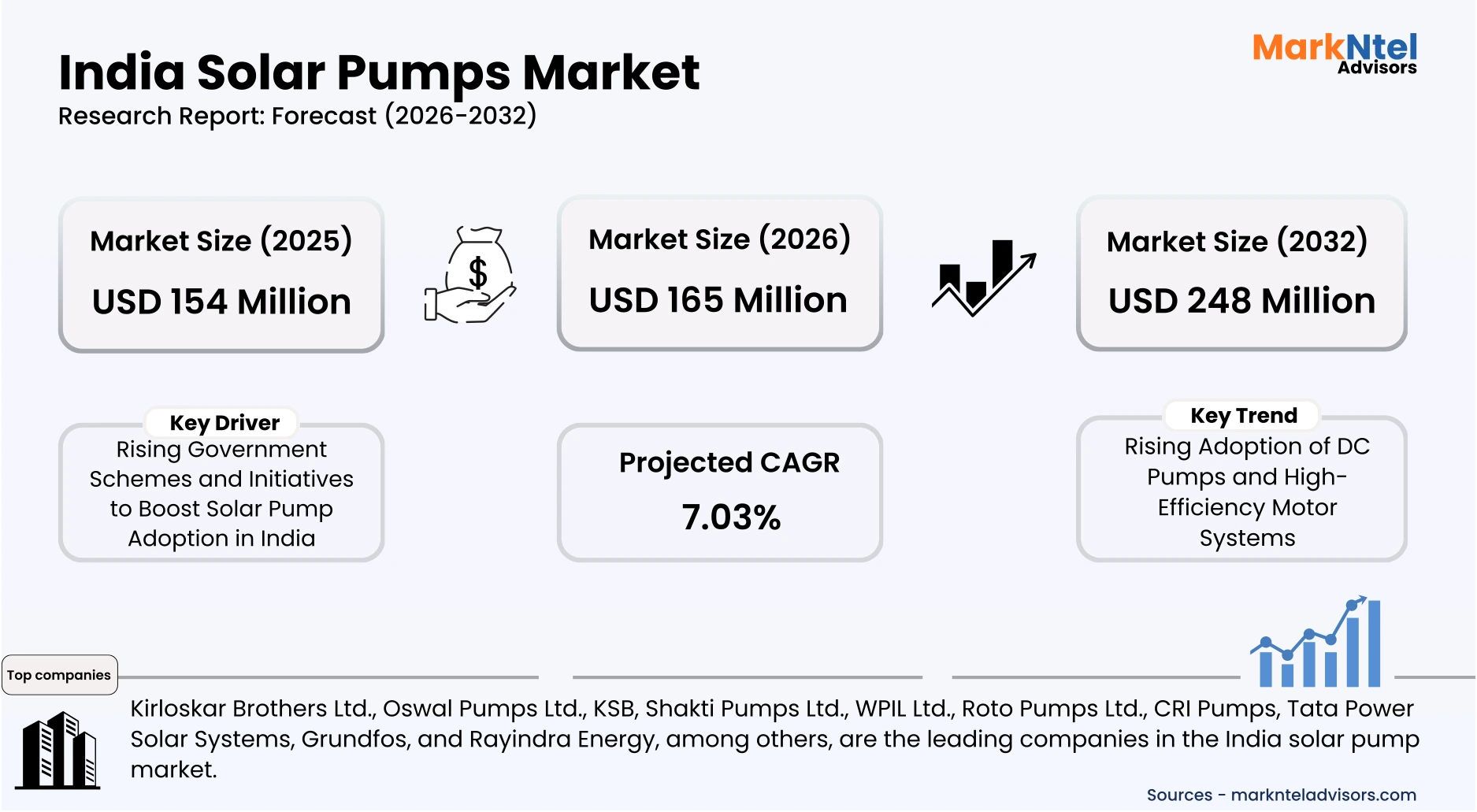
- The India Solar Pump Market was valued at USD 154 million in 2025 and is projected to grow from USD 165 million in 2026 to USD 248 million by 2032.
- Along with this, the market is estimated to grow at a CAGR of around 7.03% during the forecast period, i.e., 2026-32.
- The agriculture sector dominated the market in 2026, accounting for more than 90% of total installations.
- Submersible solar pumps held a leading position, representing approximately 95% of the overall market share in 2026.
- Key government programs driving market growth include the PM-KUSUM Scheme, Jal Jeevan Mission, and the Haryana Solar Water Pumping Programme, among others.
- Prominent market participants comprise Kirloskar Brothers Ltd., Oswal Pumps Ltd., KSB, Shakti Pumps Ltd., WPIL Ltd., Roto Pumps Ltd., CRI Pumps, Tata Power Solar Systems, Grundfos, and Rayindra Energy, among others.
Market Insights & Analysis: India Solar Pump Market (2026-32):
The India Solar Pump Market size was valued at USD 154 million in 2025 and is projected to grow from USD 165 million to USD 248 million by 2032. Along with this, the market is estimated to grow at a CAGR of around 7.03% during the forecast period, i.e., 2026-32.
The substantial growth in India solar pump market is primarily driven by strong policy backing alongside rising agricultural demand. Escalating diesel and grid electricity costs, coupled with a consistent decline in solar module prices, are significantly improving the cost economics of solar pumps. Consequently, flagship initiatives such as PM-KUSUM, which offer subsidies of nearly 60%, have accelerated large-scale installation and solarization of irrigation pumps across the country.
Moreover, this momentum closely aligns with India’s pressing need for efficient irrigation systems amid declining groundwater levels and increasing water stress. States such as Rajasthan and Gujarat, characterized by high solar irradiance and recurrent drought conditions, are witnessing rapid adoption as solar pumps enable reliable water access without recurring fuel expenses. Additionally, limited grid availability and frequent power outages in rural regions further strengthen the case for off-grid solar pumping solutions, ensuring uninterrupted irrigation during critical cropping cycles.
Furthermore, ongoing technological advancements, including high-efficiency photovoltaic modules, intelligent inverters, and IoT-enabled pump controllers, are enhancing system performance, reliability, and lifespan. At the same time, declining PV and battery costs, supported by domestic manufacturing under the “Make in India” initiative, are improving affordability. Increasing private-sector participation and public–private partnerships are also easing deployment challenges. Collectively, reduced diesel consumption, lower carbon emissions, and fiscal incentives such as the GST reduction on solar equipment in 2025 reinforce sustained market expansion over the forecast period.
India Solar Pump Market Scope:
| Category | Segments |
|---|---|
| By Type | Submersible Pumps, Surface Pumps), |
| By Operation | AC Pump, DC Pump), |
| By Power Rating | Upto 5 HP, 5.1 HP to 10 HP, 10.1 HP to 15 HP, 15.1 HP to 20 HP, Above 20 HP), |
| By End User | Agriculture, Industrial, Residential, and others |
India Solar Pump Market Driver:
Rising Government Schemes and Initiatives to Boost Solar Pump Adoption in India
The rapid expansion of India’s solar pump market is being decisively driven by a multi-layered government policy ecosystem, where central and state schemes collectively lower adoption barriers and institutionalize solar irrigation as part of long-term agricultural reform. At the core of this driver is the PM-KUSUM Scheme, which targets 34,800 MW of solar capacity by March 2026 with USD 3,834 Million (₹34,422 crores) in Central Financial Assistance, directly supporting stand-alone pumps, grid-connected pumps, and feeder solarization. Additionally, the scheme covers the installation of 14 lakh stand-alone solar agricultural pumps, directly replacing diesel and unreliable grid-powered pumps, coupled with solarisation of 35 lakh grid-connected agricultural pumps, including feeder-level solarization, enabling surplus power export and grid stability.
Beyond PM-KUSUM, several state-specific schemes are significantly amplifying on-ground adoption:
- Magel Tyala Saur Krushi Pump Yojana (Maharashtra), focused on the rapid deployment of solar pumps for farmers lacking reliable grid access.
- Mukhyamantri Saur Krushi Pump Yojana (Madhya Pradesh), offering high subsidy support to small and marginal farmers.
- State Horticulture Solar Pump Subsidy Programs in Karnataka and other states, targeting orchard and high-value crop irrigation.
- State subsidy top-up mechanisms in Uttar Pradesh, Rajasthan, and Gujarat, which complement central funding to further reduce farmer contribution.
Together, these schemes create predictable demand pipelines, strong fiscal backing, and accelerated rural penetration, making government initiatives the single most influential growth driver in India’s solar pump market.
India Solar Pump Market Opportunity:
Expansion of Solar Pumps as a Tool for Groundwater Governance
The most promising forward-looking opportunity for the Indian solar pump market lies in its integration with groundwater governance and irrigation efficiency frameworks. India faces a critical challenge of groundwater depletion, particularly in high-irrigation states, where unrestricted pump usage has led to aquifer stress. Solar pumps, when paired with flow meters, IoT monitoring, and time-based controls, present an opportunity to regulate water extraction without restricting farmer access to energy. Policymakers increasingly recognize that energy-based regulation is more enforceable than water-based controls. Future programs are expected to link solar pump deployment with micro-irrigation, crop diversification incentives, and usage-based export compensation mechanisms. This positions solar pumps as an enabler of sustainable agriculture rather than a driver of over-extraction. For the market, this opens long-term demand beyond replacement cycles, including retrofitting existing pumps, upgrading control systems, and expanding solar pumping into horticulture and water-stressed regions. As groundwater-linked policy frameworks mature, solar pumps are likely to become institutional infrastructure assets, unlocking sustained growth well beyond current subsidy-driven demand.
India Solar Pump Market Challenge:
Fragmented After-Sales Infrastructure and Long-Term System Reliability
The most significant constraint restricting the India solar pump market is the lack of robust, standardized after-sales and maintenance ecosystems, particularly in remote agrarian regions. Solar pumps operate in harsh conditions, exposure to dust, high temperatures, voltage fluctuations, and inconsistent water tables, making long-term reliability critical for farmer confidence. However, many installations suffer from inadequate commissioning, poor-quality balance-of-system components, and delayed service response due to fragmented vendor networks. This leads to system downtime, reduced discharge efficiency, and eventual disillusionment among end users. Solar systems require periodic inverter calibration, panel cleaning, and controller diagnostics, services that are often unavailable at the village level. Additionally, the absence of performance-linked warranties and weak enforcement of service-level agreements further exacerbate reliability concerns. For government buyers, non-performing assets increase fiscal risk, while for farmers, system failure directly impacts crop cycles. Therefore, this operational fragility would continue to limit adoption velocity and long-term trust in solar pump solutions across India.
India Solar Pump Market Trend:
Rising Adoption of DC Pumps and High-Efficiency Motor Systems: The market is witnessing a strong shift toward DC solar pumps and high-efficiency BLDC motors, particularly for small and marginal farms. These systems reduce panel requirements, improve discharge efficiency under low irradiance, and lower overall system costs. Manufacturers are increasingly optimizing pump designs for Indian agro-climatic conditions, accelerating penetration in regions with fragmented landholdings. For instance:
- 2024: Shakti Pumps (India) Ltd. has been empanelled by MSEDCL to supply and install 25,000 off-grid DC solar water pumping systems worth USD 84.3 Million (INR 754.30 crore) under the Magel Tyala Saur Krushi Pump Scheme in Maharashtra.
Integration of Solar Pumps with Smart Monitoring and IoT Controls: Another key trend is the integration of remote monitoring, smart controllers, and usage analytics into solar pump systems. Governments and implementing agencies are deploying telemetry-enabled pumps to track runtime, energy generation, and water discharge. This trend supports performance-based payments, predictive maintenance, and groundwater governance, making solar pumps more acceptable to policymakers and utilities.
Expansion Beyond Field Crops into Horticulture and Allied Farming: Solar pump adoption is expanding rapidly into horticulture, orchards, fisheries, and drip-irrigated farming, driven by higher water efficiency needs and better farmer economics. State horticulture departments are increasingly using solar pumps as a backbone for micro-irrigation programs, broadening the addressable market beyond traditional cereal-growing regions.
India Solar Pump Market (2026-32): Segmentation Analysis
The India Solar Pump Market study of MarkNtel Advisors evaluates & highlights the major trends & influencing factors in each segment & includes predictions for the period 2026–2032 at the global, regional, and national levels. Based on the analysis, the market has been further classified as:
Based on End User:
- Agriculture
- Industrial
- Residential
Agriculture dominates the end-user segmentation in the water pump market, holding nearly 98% of total installations in 2025, driven by extensive irrigation needs in water-scarce regions like India and MENA. Key growth factors include government initiatives such as India's Jal Jeevan Mission, which expanded rural water coverage to over 80% of households, and solar pump subsidies targeting 2 million additional units by 2028 to enhance sustainable farming. Rising agricultural mechanization, with nearly 50% of irrigated land now using advanced systems, further boosts demand for efficient pumps in crop irrigation and livestock watering.
Based on Type:
- Submersible Pumps
- Surface
Submersible solar pumps dominate the India solar pump industry, holding approximately 95% market share due to their superior efficiency in extracting water from deep borewells and wells common in groundwater-dependent agricultural areas. Their design allows submersion below water levels, minimizing priming issues, enabling consistent flow, and requiring less energy for fluid movement through shorter paths. Moreover, advancements in waterproof motors, higher flow rates, and remote monitoring further enhance reliability for deep applications amid depleting water tables.
India Solar Pump Market (2026-32): Regional Projection
Geographically, the India Solar Pump Market expands across:
- East India
- North India
- West India
- South India
- North-East India
North India leads the Indian solar pump industry, driven primarily by Rajasthan and Uttar Pradesh, with Rajasthan alone recording installations exceeding 85,000 solar pumps as of late 2024, alongside substantial deployments across Uttar Pradesh. The region benefits from exceptionally high solar irradiance levels of 6–7 kWh/m²/day and more than 325 sunny days annually, enabling optimal energy generation and consistent pump performance. Severe water scarcity in arid and semi-arid zones, coupled with rapidly depleting groundwater aquifers, necessitates deep borewell extraction, where solar pumps offer a reliable and energy-efficient lifting solution. Moreover, extreme temperatures and prolonged dry spells further accelerate adoption, as farmers seek dependable, year-round irrigation systems to sustain intensive agricultural activity across vast arable lands amid increasingly erratic rainfall patterns.
India Solar Pump Industry Recent Development:
- October 2024: KLK Ventures launched a digital platform revolutionizing farming in Jammu and Kashmir with sustainable solar water pumps, streamlining applications, offering end-to-end support from site surveys to installation, and ensuring robust post-installation services for affordable renewable irrigation.
- April 2024: ABB unveiled the ACQ80 solar drive solution, boosting efficiency in solar-powered water pumping for agriculture and industry through MPPT optimization, dual AC/DC inputs, and protective features like dry-run detection to lower costs and emissions.
Gain a Competitive Edge with Our India Solar Pump Market Report
- India Solar Pump Market Report by MarkNtel Advisors provides a detailed & thorough analysis of market size & share, growth rate, competitive landscape, and key players. This comprehensive analysis helps businesses gain a holistic understanding of the market dynamics & make informed decisions.
- This report also highlights current market trends & future projections, allowing businesses to identify emerging opportunities & potential challenges. By understanding market forecasts, companies can align their strategies & stay ahead of the competition.
- India Solar Pump Market Report aids in assessing & mitigating risks associated with entering or operating in the market. By understanding market dynamics, regulatory frameworks, and potential challenges, businesses can develop strategies to minimize risks & optimize their operations.
*Reports Delivery Format - Market research studies from MarkNtel Advisors are offered in PDF, Excel and PowerPoint formats. Within 24 hours of the payment being successfully received, the report will be sent to your email address.
Frequently Asked Questions
- Market Segmentation
- Introduction
- Product Definition
- Research Process
- Assumptions
- Executive Summary
- India Solar Pump Supply Chain Analysis
- India Solar Pump Import-Export Analysis
- India Solar Pump Market Trends & Insights
- India Solar Pump Market Dynamics
- Drivers
- Challenges
- India Solar Pump Market Hotspot & Opportunities
- India Solar Pump Market Policies & Regulations
- India Solar Pump Market Outlook, 2022-32F
- Market Size & Analysis
- By Revenues (USD Million)
- Market Segmentation & Analysis
- By Type
- Submersible Pumps- Market Size & Forecast 2022-2032, USD Million
- Surface Pumps- Market Size & Forecast 2022-2032, USD Million
- By Operation
- AC Pump- Market Size & Forecast 2022-2032, USD Million
- DC Pump- Market Size & Forecast 2022-2032, USD Million
- By Power Rating
- Upto 5 HP- Market Size & Forecast 2022-2032, USD Million
- 5.1 HP to 10 HP- Market Size & Forecast 2022-2032, USD Million
- 10.1 HP to 15 HP- Market Size & Forecast 2022-2032, USD Million
- 15.1 HP to 20 HP- Market Size & Forecast 2022-2032, USD Million
- Above 20 HP- Market Size & Forecast 2022-2032, USD Million
- By End User
- Agriculture- Market Size & Forecast 2022-2032, USD Million
- Industrial- Market Size & Forecast 2022-2032, USD Million
- Residential- Market Size & Forecast 2022-2032, USD Million
- By Region
- East India
- North India
- West India
- South India
- By Company
- Competition Characteristics
- Market Share of Leading Companies
- By Type
- Market Size & Analysis
- India Submersible Solar Pumps Market Outlook, 2026-32
- Market Size & Analysis
- By Revenues (USD Million)
- Market Segmentation & Analysis
- By Power Rating- Market Size & Forecast 2022-2032, USD Million
- By End User- Market Size & Forecast 2022-2032, USD Million
- By Operation- Market Size & Forecast 2022-2032, USD Million
- By Region- Market Size & Forecast 2022-2032, USD Million
- Market Size & Analysis
- India Surface Solar Pumps Market Outlook, 2026-32
- Market Size & Analysis
- By Revenues (USD Million)
- Market Segmentation & Analysis
- By Power Rating- Market Size & Forecast 2022-2032, USD Million
- By Operation- Market Size & Forecast 2022-2032, USD Million
- By End User- Market Size & Forecast 2022-2032, USD Million
- By Region- Market Size & Forecast 2022-2032, USD Million
- Market Size & Analysis
- India Solar Market Key Strategic Imperatives for Growth & Success
- Competition Outlook
- Company Profiles
- Kirloskar Brothers Ltd
- Business Description
- Product Segments
- Strategic Alliances or Partnerships
- Recent Developments
- Financial Details
- Others
- Oswal Pumps Ltd
- Business Description
- Product Segments
- Strategic Alliances or Partnerships
- Recent Developments
- Financial Details
- Others
- KSB
- Business Description
- Product Segments
- Strategic Alliances or Partnerships
- Recent Developments
- Financial Details
- Others
- Shakti Pumps (India) Ltd
- Business Description
- Product Segments
- Strategic Alliances or Partnerships
- Recent Developments
- Financial Details
- Others
- WPIL Ltd
- Business Description
- Product Segments
- Strategic Alliances or Partnerships
- Recent Developments
- Financial Details
- Others
- Roto Pumps Ltd
- Business Description
- Product Segments
- Strategic Alliances or Partnerships
- Recent Developments
- Financial Details
- Others
- CRI Pumps
- Business Description
- Product Segments
- Strategic Alliances or Partnerships
- Recent Developments
- Financial Details
- Others
- Tata Power Solar Systems
- Business Description
- Product Segments
- Strategic Alliances or Partnerships
- Recent Developments
- Financial Details
- Others
- Grundfos
- Business Description
- Product Segments
- Strategic Alliances or Partnerships
- Recent Developments
- Financial Details
- Others
- Ravindra Energy
- Business Description
- Product Segments
- Strategic Alliances or Partnerships
- Recent Developments
- Financial Details
- Others
- Others
- Kirloskar Brothers Ltd
- Company Profiles
- Disclaimer
MarkNtel Advisors follows a robust and iterative research methodology designed to ensure maximum accuracy and minimize deviation in market estimates and forecasts. Our approach combines both bottom-up and top-down techniques to effectively segment and quantify various aspects of the market. A consistent feature across all our research reports is data triangulation, which examines the market from three distinct perspectives to validate findings. Key components of our research process include:
1. Scope & Research Design At the outset, MarkNtel Advisors define the research objectives and formulate pertinent questions. This phase involves determining the type of research—qualitative or quantitative—and designing a methodology that outlines data collection methods, target demographics, and analytical tools. They also establish timelines and budgets to ensure the research aligns with client goals.
2. Sample Selection and Data Collection In this stage, the firm identifies the target audience and determines the appropriate sample size to ensure representativeness. They employ various sampling methods, such as random or stratified sampling, based on the research objectives. Data collection is carried out using tools like surveys, interviews, and observations, ensuring the gathered data is reliable and relevant.
3. Data Analysis and Validation Once data is collected, MarkNtel Advisors undertake a rigorous analysis process. This includes cleaning the data to remove inconsistencies, employing statistical software for quantitative analysis, and thematic analysis for qualitative data. Validation steps are taken to ensure the accuracy and reliability of the findings, minimizing biases and errors.

4. Data Forecast and FinalizationThe final phase involves forecasting future market trends based on the analyzed data. MarkNtel Advisors utilize predictive modeling and time series analysis to anticipate market behaviors. The insights are then compiled into comprehensive reports, featuring visual aids like charts and graphs, and include strategic recommendations to inform client decision-making
We offer flexible licensing options to cater to varying organizational needs. Choose the pricing pack that best suits your requirements:
Buy Now Inquire Before Buying
 Request Customization
 Talk to our Consultant