India Media & Entertainment Market Research Report: Forecast (2026-2032)
By Type (Print Media, Digital Media, Streaming Media), By Revenue (Advertisement, Subscription, Others), By Language (Hindi, Kannada, Telugu, Tamil, Marathi, Malayalam, Gujarati, O ... thers), By End-User (Residential, Commercial), and others Read more
- ICT & Electronics
- Sep 2026
- Pages 145
- Report Format: PDF, Excel, PPT
India Media & Entertainment Market
Projected 8.14% CAGR from 2026 to 2032
Study Period
2026-2032
Market Size (2026)
USD 33.32 Billion
Market Size (2032)
USD 53.29 Billion
Base Year
2025
Projected CAGR
8.14%
Leading Segments
By Type: Digital media
India Media & Entertainment Market Key Takeaways
- The India media & entertainment market was valued at USD 31.21 billion in 2025 and is projected to reach USD 33.32 billion in 2026, before expanding to USD 53.29 billion by 2032.
- The industry is projected to witness steady growth at a CAGR of 8.14% during 2026–2032.
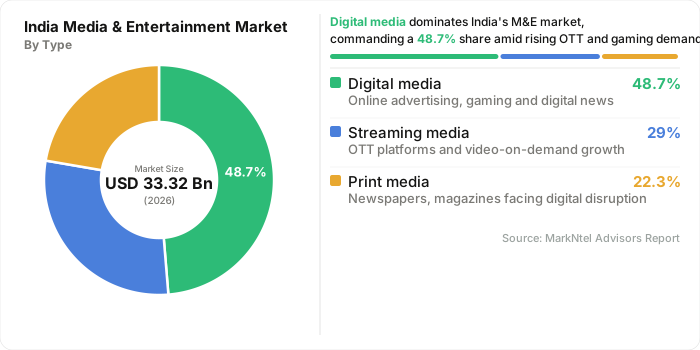
- Digital media is expected to dominate the market, accounting for approximately 48.7% share in 2026.
- By revenue, the advertisement segment is anticipated to account for nearly 61.4% of the market in 2026.
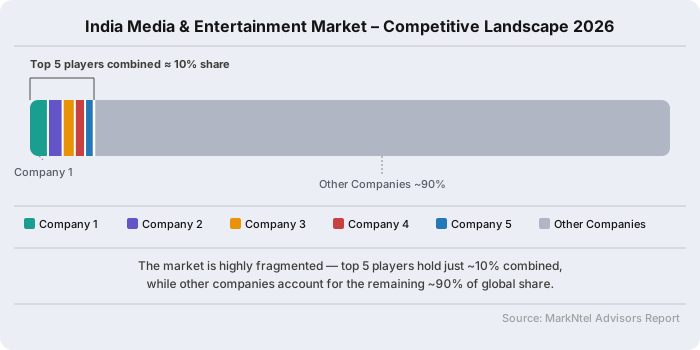
- The market remains highly fragmented, with the top five companies collectively accounting for approximately 10% of the market.
India Media & Entertainment Market Size and Outlook
The media & entertainment market in India was valued at USD 31.21 billion in 2025 and is projected to reach USD 33.32 billion in 2026, before expanding to USD 53.29 billion by 2032, registering a CAGR of 8.14% during 2026–2032. India is among the largest digital video markets globally, supported by over 750+ million internet users and 500+ million online video viewers, making it a major growth hub for streaming platforms. Expansion is driven by the convergence of traditional and digital media across OTT, gaming, music, sports, and creator content. Over 50+ OTT platforms operate in India, aided by low data costs and rising smartphone penetration. Regional-language content dominates consumption, while IPL and connected TV adoption further accelerate monetization and engagement across audiences.
India Media & Entertainment Market Key Indicators
- Internet advertising revenue in India is projected to reach USD 14.3 billion by 2030, compared with approximately USD 7.3 billion in 2025, representing a 13.9% CAGR. The rapid increase in digital advertising reflects the continued migration of advertiser budgets toward search, social media, online video, e-commerce and other measurable digital channels. This shift increases monetization opportunities for OTT platforms, digital publishers, social-media companies, and online content creators, thereby positively influencing the India M&E market.
- India recorded approximately 216.5 million OTT subscriptions in 2025, making it the third-largest OTT subscription market globally. The scale of paid OTT adoption demonstrates the continuing transition from conventional television consumption toward on-demand digital video. Higher OTT penetration stimulates demand for original programming, regional-language content, sports, films and web series while creating additional subscription, advertising and licensing revenues for M&E companies.
- India’s OTT streaming revenue is projected to increase from approximately USD 2.28 billion in 2024 to USD 3.48 billion by 2029. Growth in regional content, subscription-based models and investment by global streaming platforms is expanding the commercial value of online video. This parallel growth in the streaming ecosystem supports greater content commissioning, digital distribution and monetization, thereby strengthening the overall M&E market.
- India’s social-media user base reached approximately 500 million in 2025, while users spent around 731 billion hours on social media during the year, representing 5% growth. Increasing social-media engagement expands the audience available for short-form video, creator content, music, branded entertainment, and digital advertising. Consequently, higher user engagement increases content consumption and provides additional distribution and monetization channels for media companies.
- India had approximately 40 million weekly active connected TV connections in 2025, up from 30 million in 2024, representing roughly 33% growth. Rising connected-TV penetration is strengthening the convergence between television and OTT platforms and enabling advertisers to combine large-screen reach with digital targeting. Connected-TV advertising revenue also increased approximately 42% in 2025, demonstrating the direct monetization impact of this infrastructure expansion on the M&E ecosystem.
- India’s film segment generated approximately USD 2.18 billion in 2025, with more than 1,900 films released during the year. The theatrical segment also recorded 16% growth, while 37 films generated more than USD 10.7 million each at the box office. Strong theatrical performance supports film production, distribution, music, advertising and subsequent OTT licensing, creating positive spillover effects across multiple segments of the M&E market.
- India’s organized live-events segment grew 44% in 2025, supported by ticketed concerts, large public events, weddings, government events and religious gatherings. The rapid expansion of live entertainment increases demand for music, sports, event broadcasting, sponsorships, ticketing, and digital content generated around live experiences. This makes experiential entertainment an increasingly important parallel growth driver for India’s M&E market.
India Media & Entertainment Market Scope
| Category | Segments |
|---|---|
| By Type | Print Media, Digital Media, Streaming Media |
| By Revenue | Advertisement, Subscription, Others |
| By Language | Hindi, Kannada, Telugu, Tamil, Marathi, Malayalam, Gujarati, Others |
| By End-User | Residential, Commercial |
India Media & Entertainment Market Growth Drivers
Expansion of Connected TV Ecosystem and Premium Home Entertainment Driving Media & Entertainment Demand in India
The rapid adoption of connected TVs (CTV) and premium home entertainment devices has become a significant growth driver for the India media & entertainment market. Rising household broadband penetration, affordable smart televisions, and growing demand for high-quality streaming experiences are encouraging consumers to shift from conventional television viewing to internet-enabled entertainment. According to the Telecom Regulatory Authority of India (TRAI), India had over 969 million broadband subscribers in 2025, while expanding fiber broadband and 5G infrastructure continue to improve high-definition and ultra-high-definition content delivery. These developments have increased consumption of OTT services, live sports, premium movies, and multilingual content on larger screens, prompting media companies to optimize content for connected television platforms and strengthen digital distribution strategies.
Supporting this transition, Sony India launched the BRAVIA 2 II television series in May 2025, featuring Google TV, Dolby Atmos, Dolby Vision, and SONY PICTURES CORE, which provides access to Sony Pictures' premium movie library in near Blu-ray quality. The product launch reflects increasing investment in integrated hardware and content ecosystems that enhance premium viewing experiences and encourage greater consumption of digital entertainment. As more consumers adopt connected television devices, broadcasters and OTT providers are expected to benefit from higher viewer engagement, stronger subscription growth, and increased advertising opportunities, reinforcing the long-term expansion of India's media and entertainment market.
Recent Trends
Generative AI and AI-Powered Personalization Reshaping India's Media & Entertainment Market
Generative Artificial Intelligence (GenAI) has emerged as a major technology trend in the India media & entertainment industry, enabling media companies to enhance content creation, multilingual localization, audience personalization, and advertising efficiency. Its adoption is expanding across the media value chain, with AI integrated into script development, video editing, dubbing, recommendation engines, metadata generation, and content moderation. These applications are reducing production timelines, lowering costs, and improving content quality while boosting viewer engagement and retention. During WAVES 2025, the Ministry of Information & Broadcasting highlighted that AI, interactivity, and personalization are reshaping India's OTT ecosystem, enabling platforms to deliver highly customized content based on user behavior and preferences. This is helping broadcasters and OTT players improve retention, optimize content investments, and enhance monetization through data-driven insights and predictive analytics.
The commercialization of AI-enabled production further reflects the shift toward intelligent and scalable content ecosystems. For instance, Zee Entertainment-backed Bullet launched "Trinetra AI" in June 2026, an end-to-end AI filmmaking and content intelligence platform for micro-drama creators and studios. The platform integrates AI across ideation, scripting, production, editing, distribution, and analytics, improving efficiency and reducing time-to-market. Such developments highlight growing investment in AI-driven tools that enable scalable content creation, cost-efficient localization, and personalized viewing experiences. Overall, AI is emerging as a key structural trend shaping the future of India’s media and entertainment industry, driving innovation and competitive differentiation.
India Media & Entertainment Market Opportunities and Challenges
Digital Piracy and Unauthorized Content Distribution Leading to Greater Adoption of Secure Content Protection Technologies
Digital piracy remains a major challenge for India’s media and entertainment industry, significantly affecting Hindi films, regional cinema (Tamil, Telugu, Malayalam), OTT platforms such as JioCinema, Netflix India, and Amazon Prime Video, and live sports broadcasters holding IPL and ICC rights. According to the Ministry of Information & Broadcasting, the Cinematograph (Amendment) Act, 2023, enforced in 2025, introduced strict anti-piracy measures, including penalties of up to 3% of a film’s audited production cost and imprisonment for illegal recording and distribution. Despite stronger enforcement and industry coordination, piracy persists through Telegram channels, illegal streaming sites, and camcording, especially during major releases and live sporting events.
In response, the industry is accelerating adoption of advanced content protection technologies such as digital rights management (DRM), forensic watermarking, and AI-based piracy detection systems. Broadcasters are deploying real-time watermarking for IPL coverage and monitoring illegal distribution across social media and streaming platforms. OTT providers are also optimizing multi-DRM systems for India’s mobile-first, low-bandwidth audience. For example, Amazon Prime Video introduced AI-powered “Recap” in 2025, enhancing engagement within a secure ecosystem. As investments in premium Indian originals and sports rights grow, content security is becoming a key competitive differentiator.
Segmentation Insights
Digital Media Holding Approximately 48.7% Market Share in the India Media & Entertainment Market
Digital media has emerged as the leading segment in the India media & entertainment market, driven by rising smartphone penetration, affordable mobile broadband, and increasing consumption of on-demand entertainment. According to the Telecom Regulatory Authority of India (TRAI), India had over 1.16 billion wireless subscribers and more than 969 million broadband subscribers in 2025, creating one of the world's largest digital content audiences. Consumers are increasingly shifting toward OTT platforms, digital news, online music, gaming, and short-form video due to greater convenience, personalized recommendations, multilingual content, and seamless accessibility across smartphones and connected TVs. The continued rollout of 5G services is further improving streaming quality and audience engagement, reinforcing digital media's leadership within the industry.
Supporting this trend, Zee Entertainment unveiled its transformation into a "Content & Technology Powerhouse" in May 2025, introducing a new strategic vision focused on AI-enabled content creation, digital distribution, audience analytics, and technology-led monetization. The initiative reflects the industry's growing investment in intelligent content delivery and personalized consumer experiences, strengthening the long-term growth outlook for digital media across India. Based on the type, the market is further segmented into:
- Digital media
- Print media
- Streaming media
Advertisement Holding Approximately 61.4% Market Share in the India Media & Entertainment Market
Advertisement remains the largest revenue contributor to the India media & entertainment industry as brands increasingly prioritize digital-first campaigns, live sports sponsorships, connected television, and OTT platforms to engage India's expanding online audience. The rapid growth in internet penetration, video streaming, regional-language programming, and data-driven marketing has enabled advertisers to execute highly targeted campaigns with measurable outcomes. Large-scale sporting events and premium entertainment content continue to attract significant advertising investments due to their extensive nationwide reach, high viewer engagement, and ability to deliver personalized advertising experiences across television and digital platforms.
Reflecting this evolution, JioStar launched MegaBlast in April 2025, India's first integrated one-day advertising solution across television and digital platforms. According to the company, the solution enables brands to reach 365 million viewers and deliver approximately 4.5 billion advertising impressions through synchronized campaigns. The launch highlights the industry's growing focus on omnichannel advertising, advanced audience targeting, and integrated media planning, further reinforcing advertisement as the dominant revenue stream within India's media and entertainment ecosystem. Based on the revenue type, the market is further bifurcated into:
- Advertisement
- Subscription
- Others
India Media & Entertainment Market Competitive Analysis
The India media & entertainment market remains highly fragmented, with the top five companies, JioStar, Amazon Prime Video, Netflix, Sony Pictures Networks India, and Zee Entertainment Enterprises Ltd., collectively accounting for approximately 10% of the market.
Key Companies in the India Media & Entertainment Market
- JioStar
- Amazon Prime Video
- Netflix
- Sony Pictures Networks India
- Zee Entertainment Enterprises Ltd.
- PVR INOX Ltd.
- Times Group (Bennett, Coleman & Co. Ltd. - BCCL)
- Sun TV Network Ltd.
- Saregama India Ltd.
- Network18 Media & Investments Ltd.
- Others
India Media & Entertainment Industry News and Recent Developments
February 2025: JioStar Launches JioHotstar, India's Unified OTT Streaming Platform
In February 2025, JioStar officially launched JioHotstar, integrating JioCinema and Disney+ Hotstar into a single streaming platform. The service combines movies, television entertainment, live sports, international programming, and original content under one ecosystem. The platform was introduced with nearly 300,000 hours of content, supporting multiple Indian languages and advanced AI-powered content recommendations.
Impact Analysis: The launch significantly reshaped India's OTT landscape by creating one of the country's largest digital entertainment platforms. A unified content library enhances user engagement, improves subscription retention, strengthens advertising opportunities, and accelerates digital media consumption. The platform also intensifies competition among OTT providers while supporting the industry's shift toward integrated streaming ecosystems.
July 2026: JioStar Acquires Exclusive India Broadcasting Rights for The Hundred 2026
In July 2026, JioStar secured the exclusive linear television and digital streaming rights for The Hundred 2026 cricket tournament in India. Under the agreement, all 68 men's and women's matches will be broadcast through the Star Sports Network and streamed on JioHotstar. The acquisition strengthens JioStar's premium sports portfolio and reinforces its leadership in live sports broadcasting following the integration of Reliance and Disney's media assets.
Impact Analysis: The acquisition enhances competition in India's sports media landscape by expanding premium international cricket content on a single integrated platform. Exclusive rights strengthen subscriber acquisition, advertising revenues, and audience engagement while increasing the strategic importance of digital streaming in India's media and entertainment ecosystem. The development also intensifies competition among broadcasters for premium global sports rights.
Frequently Asked Questions
- Market Segmentation
- Introduction
- Product Definition
- Research Process
- Assumptions
- Executive Summary
- India Media & Entertainment Market Policies, Regulations, and Product Standards
- India Media & Entertainment Market Trends & Developments
- India Media & Entertainment Market Dynamics
- Growth Factors
- Challenges
- India Media & Entertainment Market Hotspot & Opportunities
- India Media & Entertainment Market Outlook, 2022-2032
- Market Size & Outlook
- By Revenues (USD Million)
- Market Segmentation & Outlook
- By Type- Market Size & Forecast 2022-2032, USD Million
- Print Media
- Digital Media
- Streaming Media
- By Revenue- Market Size & Forecast 2022-2032, USD Million
- Advertisement
- Subscription
- Others
- By Language- Market Size & Forecast 2022-2032, USD Million
- Hindi
- Kannada
- Telugu
- Tamil
- Marathi
- Malayalam
- Gujarati
- Others
- By End-User- Market Size & Forecast 2022-2032, USD Million
- Residential
- Commercial
- By Region- Market Size & Forecast 2022-2032, USD Million
- North
- New Delhi
- Punjab
- Haryana
- Uttarakhand
- Uttar Pradesh
- Madhya Pradesh
- Others
- South
- Tamil Nadu
- Andhra Pradesh
- Karnataka
- Telangana
- Kerala
- Others
- East
- Assam
- Meghalaya
- West Bengal
- Jharkhand
- Odisha
- Chhattisgarh
- Bihar
- Others
- West
- Rajasthan
- Gujarat
- Maharashtra
- Others
- North
- By Company
- Competition Characteristics
- Market Share & Analysis
- By Type- Market Size & Forecast 2022-2032, USD Million
- Market Size & Outlook
- India Print Media Market Outlook, 2022-2032
- Market Size & Outlook
- By Revenues (USD Million)
- Market Segmentation & Outlook
- By Revenue- Market Size & Forecast 2022-2032, USD Million
- By Language- Market Size & Forecast 2022-2032, USD Million
- By End-User- Market Size & Forecast 2022-2032, USD Million
- By Region- Market Size & Forecast 2022-2032, USD Million
- Market Size & Outlook
- India Digital Media Market Outlook, 2022-2032
- Market Size & Outlook
- By Revenues (USD Million)
- Market Segmentation & Outlook
- By Revenue- Market Size & Forecast 2022-2032, USD Million
- By Language- Market Size & Forecast 2022-2032, USD Million
- By End-User- Market Size & Forecast 2022-2032, USD Million
- By Region- Market Size & Forecast 2022-2032, USD Million
- Market Size & Outlook
- India Streaming Media Market Outlook, 2022-2032
- Market Size & Outlook
- By Revenues (USD Million)
- Market Segmentation & Outlook
- By Revenue- Market Size & Forecast 2022-2032, USD Million
- By Language- Market Size & Forecast 2022-2032, USD Million
- By End-User- Market Size & Forecast 2022-2032, USD Million
- By Region- Market Size & Forecast 2022-2032, USD Million
- Market Size & Outlook
- India Media & Entertainment Market Key Strategic Imperatives for Success & Growth
- Competitive Outlook
- Company Profiles
- JioStar
- Business Description
- Product Portfolio
- Collaborations & Alliances
- Recent Developments
- Financial Details
- Others
- Amazon Prime Video
- Business Description
- Product Portfolio
- Collaborations & Alliances
- Recent Developments
- Financial Details
- Others
- Netflix
- Business Description
- Product Portfolio
- Collaborations & Alliances
- Recent Developments
- Financial Details
- Others
- Sony Pictures Networks India
- Business Description
- Product Portfolio
- Collaborations & Alliances
- Recent Developments
- Financial Details
- Others
- Zee Entertainment Enterprises Ltd.
- Business Description
- Product Portfolio
- Collaborations & Alliances
- Recent Developments
- Financial Details
- Others
- PVR INOX Ltd.
- Business Description
- Product Portfolio
- Collaborations & Alliances
- Recent Developments
- Financial Details
- Others
- Times Group (BCCL)
- Business Description
- Product Portfolio
- Collaborations & Alliances
- Recent Developments
- Financial Details
- Others
- Sun TV Network Ltd.
- Business Description
- Product Portfolio
- Collaborations & Alliances
- Recent Developments
- Financial Details
- Others
- Saregama India Ltd.
- Business Description
- Product Portfolio
- Collaborations & Alliances
- Recent Developments
- Financial Details
- Others
- Network18 Media & Investments Ltd.
- Business Description
- Product Portfolio
- Collaborations & Alliances
- Recent Developments
- Financial Details
- Others
- Others
- JioStar
- Company Profiles
- Disclaimer
MarkNtel Advisors follows a robust and iterative research methodology designed to ensure maximum accuracy and minimize deviation in market estimates and forecasts. Our approach combines both bottom-up and top-down techniques to effectively segment and quantify various aspects of the market. A consistent feature across all our research reports is data triangulation, which examines the market from three distinct perspectives to validate findings. Key components of our research process include:
1. Scope & Research Design At the outset, MarkNtel Advisors define the research objectives and formulate pertinent questions. This phase involves determining the type of research—qualitative or quantitative—and designing a methodology that outlines data collection methods, target demographics, and analytical tools. They also establish timelines and budgets to ensure the research aligns with client goals.
2. Sample Selection and Data Collection In this stage, the firm identifies the target audience and determines the appropriate sample size to ensure representativeness. They employ various sampling methods, such as random or stratified sampling, based on the research objectives. Data collection is carried out using tools like surveys, interviews, and observations, ensuring the gathered data is reliable and relevant.
3. Data Analysis and Validation Once data is collected, MarkNtel Advisors undertake a rigorous analysis process. This includes cleaning the data to remove inconsistencies, employing statistical software for quantitative analysis, and thematic analysis for qualitative data. Validation steps are taken to ensure the accuracy and reliability of the findings, minimizing biases and errors.

4. Data Forecast and FinalizationThe final phase involves forecasting future market trends based on the analyzed data. MarkNtel Advisors utilize predictive modeling and time series analysis to anticipate market behaviors. The insights are then compiled into comprehensive reports, featuring visual aids like charts and graphs, and include strategic recommendations to inform client decision-making
We offer flexible licensing options to cater to varying organizational needs. Choose the pricing pack that best suits your requirements:
Buy Now Inquire Before Buying
 Request Customization
 Talk to our Consultant