

India Maritime Cargo Insurance Market Research Report: Size, Share, Trends & Forecast (2026-2032)
By Type of Coverage (All Risk Coverage, Named Perils Coverage, Total Loss Only Coverage), By Policy type (Single Transit Policy, Open Cover Policy, Annual Policy), By Cargo Type (C ... ontainerized Cargo, Bulk Cargo, Liquid Cargo, Breakbulk Cargo), By Commodity (Industrial Goods, Consumer Goods, Agricultural Product, Oil & Gas, Chemicals & Petrochemicals, Metals & Minerals, Automotive & Machinery, Others), By Trading Lane (India -Middle East & Gulf, India, India -Europe, India -North America, India -Africa), and others Read more
- ICT & Electronics
- Mar 2026
- Pages 130
- Report Format: PDF, Excel, PPT
India Maritime Cargo Insurance Market
Projected 5.21% CAGR from 2026 to 2032
Study Period
2026-2032
Market Size (2026)
USD 2.89 Billion
Market Size (2032)
USD 3.92 Billion
Base Year
2025
Projected CAGR
5.21%
Leading Segments
By Cargo Type: Containerized Cargo
India Maritime Cargo Insurance Market Report Key Takeaways:
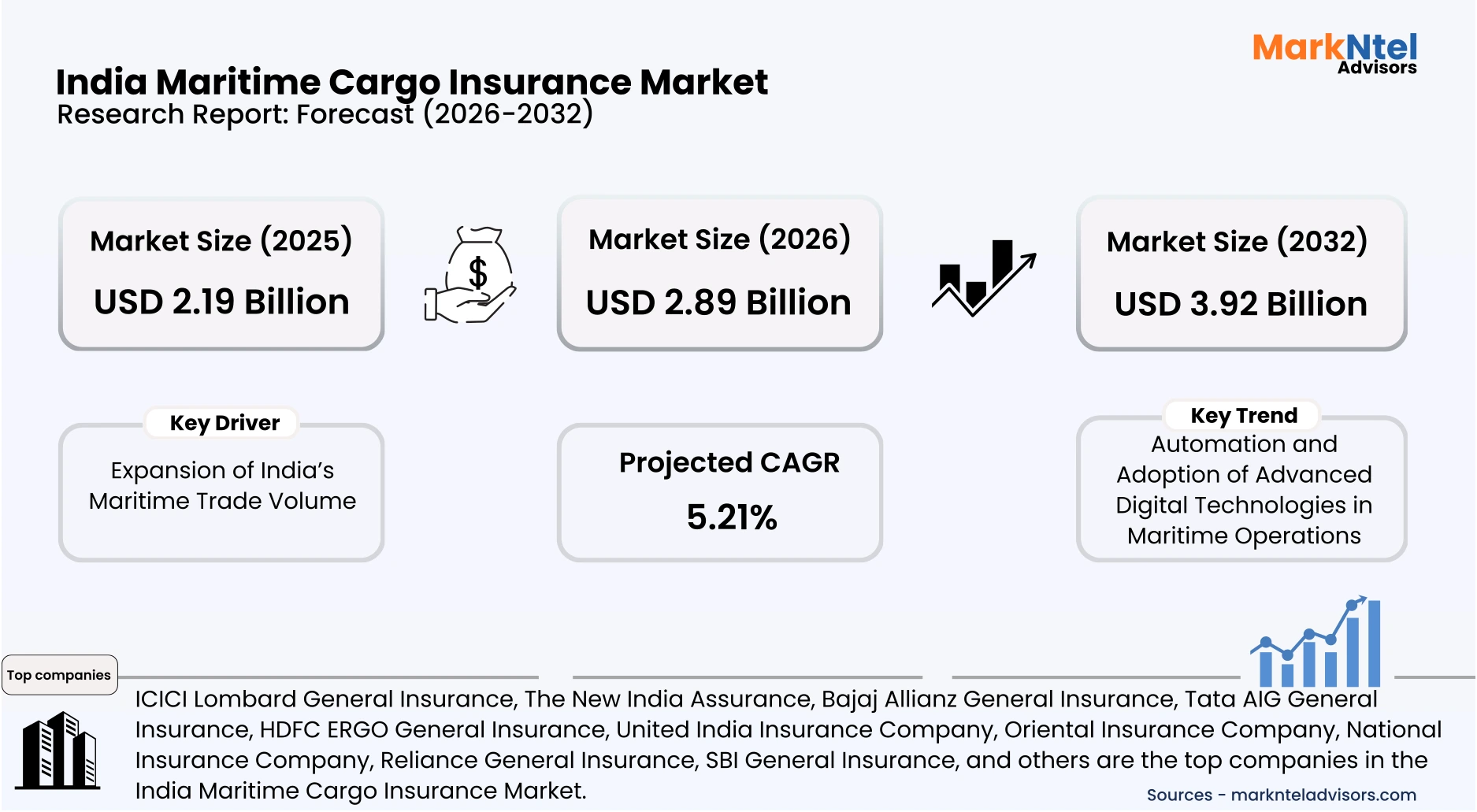
- The India Maritime Cargo Insurance market size was valued at USD 2.19 billion in 2025 and is projected to grow from USD 2.89 billion in 2026 to USD 3.92 billion by 2032, exhibiting a CAGR of 5.21% during the forecast period.
- Maharashtra is the leading region with a significant share of 30% in 2026.
- By Coverage type, the all-risk coverage segment represented a significant share of about 60% in the India Maritime Cargo Insurance Market in 2026.
- By Cargo type, the containerized cargo segment presented a significant share of about 50% in the India Maritime Cargo Insurance Market in 2026.
- Leading Maritime Cargo Insurance companies in India are ICICI Lombard General Insurance, The New India Assurance, Bajaj Allianz General Insurance, Tata AIG General Insurance, HDFC ERGO General Insurance, United India Insurance Company, Oriental Insurance Company, National Insurance Company, Reliance General Insurance, SBI General Insurance, and Others.
Market Insights & Analysis: India Maritime Cargo Insurance Market (2026-32):
The India Maritime Cargo Insurance market size was valued at USD 2.19 billion in 2025 and is projected to grow from USD 2.89 billion in 2026 to USD 3.92 billion by 2032, exhibiting a CAGR of 5.21% during the forecast period, i.e., 2026-32.
India’s maritime cargo insurance market has evolved alongside the nation’s expanding seaborne trade, which is projected to increase container volumes to approximately 380 million tonnes in FY26, reflecting an 8 % expansion driven by stronger port handling capacities and hinterland connectivity improvements that support trade flows via sea routes. The rising value of cargo and diversified trade lanes underpin demand for reliable risk coverage, particularly for commercial exporters and importers navigating complex international logistics. End‑user segments such as industrial manufacturers and commercial distributors increasingly rely on maritime insurance to safeguard high‑value shipments against physical loss, damage, and logistical disruptions, reinforcing sustained market scaling. India’s gross premiums from marine cargo insurance have grown commensurately with rising cargo valuations and insurance participation across diverse sectors.
Regulatory and legislative shifts in 2025 have modernized risk governance within India’s maritime transport ecosystem, with the Indian Parliament enacting the Carriage of Goods by Sea Act, 2025, which clarifies carrier liability and cargo rights, thus indirectly supporting transparent cargo insurance obligations among stakeholders in supply chains. Complementing this, the Directorate General of Shipping mandated strict verification processes for Protection & Indemnity (P&I) insurance certificates under Merchant Shipping Notice No. 05 of 2025, enhancing compliance and risk mitigation for vessels and cargo operators entering Indian waters. These regulatory frameworks bolster market confidence by tightening risk controls and aligning domestic practices with international maritime insurance norms.
Infrastructure and trade facilitation policies such as the PM GatiShakti National Master Plan and the Unified Logistics Interface Platform (ULIP) have boosted multimodal integration, reducing transit times and cost inefficiencies that historically elevated uninsured risks in cargo movement. For maritime insurers, more predictable logistical flows and digitized declarations translate into enhanced underwriting accuracy and streamlined policy issuance. Additionally, Indian ports’ modernization—spanning berth expansions and deeper drafts has catalyzed greater cargo throughput, providing insurers with broader exposure to diversified cargo types beyond traditional bulk shipments.
Market prospects are bolstered by strategic risk management developments, including interim extensions for select foreign P&I insurers to maintain liability cover for vessels at Indian ports, pending India’s plan to establish a domestic P&I club by 2026. This transition aims to reduce reliance on external risk pools and stimulate localized insurance capacity. Coupled with expanding maritime trade corridors and ongoing growth in global exports, the cargo insurance segment is positioned for continued demand, driven by robust end‑user reliance on comprehensive coverage, evolving national legal structures, and strong infrastructure‑led trade momentum.
Impact of Iran-Israel War on India's Maritime Cargo Insurance Market:
The ongoing tensions between Iran and Israel have increased geopolitical risks across key maritime trade routes such as the Strait of Hormuz and the Red Sea, which are critical corridors for India’s trade with the Middle East and Europe. As a result, marine insurers in India have raised war-risk premiums and reassessed their underwriting exposure for cargo shipments passing through these high-risk zones.
Marine cargo insurance premiums for shipments passing through conflict-affected zones have increased by 15–30%, with insurers charging an additional 0.10–0.15% of cargo value to cover war-related risks such as missile attacks, hijacking, piracy, and strikes. For Indian exporters, especially those trading with Middle Eastern markets, this increase has significantly raised the cost of maritime logistics and insurance coverage. The conflict has also affected specific Indian export sectors. For instance, shipments of basmati rice from Punjab and Haryana to Iran and other Middle Eastern countries have been delayed due to higher freight and insurance costs linked to the conflict. Exporters have slowed new deals as shipping insurance and logistics costs surged amid the tensions. Since Iran and Gulf countries are major buyers of Indian basmati rice, the disruption has highlighted how geopolitical conflicts can directly affect marine insurance demand and trade flows.
Consequently, the evolving geopolitical landscape is expanding premium pools, attracting new insurance participants, and strengthening the overall growth outlook of India’s marine cargo insurance market.
India Maritime Cargo Insurance Market Scope:
| Category | Segments |
|---|---|
| By Type of Coverage | (All Risk Coverage, Named Perils Coverage, Total Loss Only Coverage), |
| By Policy type | (Single Transit Policy, Open Cover Policy, Annual Policy), |
| By Cargo Type | (Containerized Cargo, Bulk Cargo, Liquid Cargo, Breakbulk Cargo), |
| By Commodity | (Industrial Goods, Consumer Goods, Agricultural Product, Oil & Gas, Chemicals & Petrochemicals, Metals & Minerals, Automotive & Machinery, Others), |
| By Trading Lane | (India -Middle East & Gulf, India, India -Europe, India -North America, India -Africa), |
India Maritime Cargo Insurance Market Driver:
Expansion of India’s Maritime Trade Volume
India’s maritime trade network has become a structural driver for the maritime cargo insurance market, rooted in the expanding scale of seaborne cargo flows that directly increase demand for coverage of goods in transit. Nearly 95 % of India’s trade by volume is carried via sea routes, according to official government data, highlighting the central role of maritime logistics in the national economy, and this extensive reliance on maritime transport underpins the necessity for cargo risk protection. This sustained expansion reflects deeper integration into global supply chains rather than a cyclical or short‑term trade fluctuation.
Over recent years, India’s ports have consistently handled growing levels of cargo, with major Indian ports reporting 855 million tonnes of cargo in FY 2024–25, up from prior years, underscoring elevated throughput across export and import segments. This rising trend in physical cargo volume directly feeds into increased requirements for marine insurance, as larger cargo consignments and higher values of goods exported and imported translate into more insured units and higher aggregate insured sums. Insurance demand is thus structurally linked to trade volume growth rather than to transient pricing shifts or risk hedging alone.
The intensification of maritime trade has also diversified the end‑user base, driving cargo insurance uptake, spanning industrial exporters, agricultural commodity traders, and commercial importers who depend on robust sea freight logistics. Export‑oriented sectors contribute to a material increase in annual cargo transported, thereby expanding the overall addressable market for maritime cargo insurance services. This ongoing expansion in cargo volumes generates direct incremental demand for coverage rather than merely affecting premium rates, because each additional metric tonne of cargo in transit represents a new unit of risk that requires indemnification.
In geographic terms, India’s enhanced connectivity with markets across Asia, Africa, and Europe through maritime routes has broadened the market’s scope. The surge in container and bulk shipments handled annually strengthens the structural link between trade volume growth and insurance adoption, reflecting a sustained elevation in the market size and insurance penetration tied to actual cargo movements.
India Maritime Cargo Insurance Market Trend:
Automation and Adoption of Advanced Digital Technologies in Maritime Operations
Automation and the adoption of advanced digital technologies are emerging as a significant structural trend influencing the maritime cargo insurance ecosystem. India’s maritime sector is increasingly integrating smart port technologies, automated cargo handling systems, and digital logistics platforms to improve operational efficiency and cargo visibility. The Ministry of Ports, Shipping, and Waterways has emphasized technology-led port modernization under national maritime development strategies, encouraging ports to adopt intelligent systems that streamline vessel traffic management, cargo tracking, and documentation processes across shipping networks.
The increasing use of automation is transforming operational practices throughout the maritime value chain. Automated container handling, electronic documentation, and integrated logistics management systems allow shipping operators and port authorities to reduce manual intervention and minimize operational errors. For example, one of India’s major insurers offers marine cargo insurance. The company partnered with Skit.ai to deploy an AI-powered digital voice agent that helps customers track insurance claims and improve operational efficiency. ICICI Lombard has also migrated its core systems to the cloud and introduced multiple digital innovations, such as automated customer service tools and app-based claim processing to streamline insurance operations.
These advancements also influence maritime cargo insurance by enabling insurers to access real-time shipment data, monitor cargo movement more accurately, and evaluate risk exposure more efficiently, leading to more responsive underwriting and faster claims management processes.
This trend is expected to persist as technology adoption becomes central to improving supply chain resilience and trade efficiency. Automation reduces operational delays, enhances cargo safety, and strengthens compliance monitoring, which collectively support more reliable maritime logistics. As shipping companies, ports, and insurers continue integrating advanced technologies into their operations, the maritime cargo insurance market is likely to evolve toward data-driven risk assessment, digital policy administration, and more transparent cargo monitoring frameworks, shaping long-term industry practices.
India Maritime Cargo Insurance Market Opportunity:
Emergence of India’s Domestic Protection and Indemnity (P&I) Insurance Ecosystem
India’s plan to establish a domestic Protection and Indemnity (P&I) insurance ecosystem presents a significant opportunity for new entrants in the maritime insurance sector. The Insurance Regulatory and Development Authority of India and maritime authorities have been evaluating frameworks to develop an Indian P&I facility that can provide liability cover for shipowners and cargo operations within the country. This initiative has gained urgency as India seeks to reduce dependence on foreign P&I clubs that traditionally dominate global marine liability insurance.
The opportunity exists because India currently depends on foreign marine insurers in the International Group of P&I Clubs based in London, which insures over 90% of global ocean-going tonnage. According to the Ministry of Ports, Shipping, and Waterways, policymakers are exploring mechanisms to create a domestic P&I structure that can serve the country’s growing fleet and maritime trade requirements. As regulatory frameworks evolve to support local capacity, demand for marine liability and cargo-related insurance solutions is expected to expand within the domestic insurance market.
This structural transition favors new and emerging insurers because it opens a previously concentrated market segment where competition has historically been limited. Smaller insurance firms and specialized marine insurers can collaborate with shipping companies, logistics operators, and reinsurers to develop localized risk coverage products. By participating in India’s emerging maritime insurance ecosystem, new entrants can gain early positioning in a market that is gradually shifting toward greater domestic underwriting capacity and localized insurance services. For example, the International Financial Services Centres Authority has asked the Finance Ministry to issue a notification under the Insurance Act for enabling mutual insurance in a move that will pave the way for setting up maritime Protection and Indemnity (P&I) insurance in the Gujarat International Finance Tec-City.
India Maritime Cargo Insurance Market Challenge:
Rising Cybersecurity Risks in Maritime and Insurance Systems
A critical challenge emerging in the India maritime cargo insurance market is the growing exposure of maritime logistics and insurance systems to cyber threats. Ports, shipping companies, and insurers increasingly rely on digital platforms for cargo tracking, documentation, and claims processing, which expands the potential attack surface for cybercriminals. The International Maritime Organization has emphasized the importance of integrating cyber risk management into maritime safety frameworks, as digitalization across shipping and port operations increases vulnerability to system intrusions and data breaches.
Recent cyber incidents in global shipping have demonstrated the operational and financial impact of such threats on maritime trade. For example, cyberattacks on shipping and logistics networks have disrupted port operations, delayed cargo deliveries, and caused substantial financial losses to logistics providers and insurers. The Jawaharlal Nehru Port Authority Cybersecurity Incident, India’s largest container port, faced a cyberattack on its IT infrastructure, which disrupted the port’s container terminal systems and temporarily affected cargo handling operations. The incident highlighted vulnerabilities in digital port management systems that are increasingly used for cargo tracking, vessel scheduling, and logistics coordination.
This challenge materially affects the marine insurance market because cyber risks are complex and difficult to quantify within traditional underwriting models. Insurers must invest in advanced risk assessment capabilities and cybersecurity expertise to evaluate digital threats associated with shipping operations. The uncertainty surrounding cyber risk exposure can raise compliance costs, complicate policy design, and slow the development of comprehensive marine insurance products, thereby constraining market growth and operational scalability.
India Maritime Cargo Insurance Market (2026-32) Segmentation Analysis:
The India Maritime Cargo Insurance Market study of MarkNtel Advisors evaluates & highlights the major trends and influencing factors in each segment. It includes predictions for the period 2026–32 at the country level. Based on the analysis, the market has been further classified as:
Based on Type of Coverage:
- All Risk Coverage
- Named Perils Coverage
- Total Loss Only Coverage
All Risk Coverage holds the dominant position in the India marine cargo insurance market with a market share of 60% due to its comprehensive protection against a wide range of transit-related risks. As India’s international trade volumes continue to expand, exporters and importers increasingly prefer policies that provide broad protection against theft, damage, mishandling, and natural hazards during transportation. The growing movement of high-value goods such as engineering products, electronics, chemicals, and pharmaceuticals has further strengthened demand for all-risk policies.
Government initiatives supporting trade expansion and logistics modernization also reinforce this segment’s leadership. Programs aimed at improving port infrastructure, container terminals, and multimodal logistics corridors have increased cargo movement through maritime routes. As shipment volumes rise, businesses are prioritizing risk mitigation strategies, which encourages the adoption of comprehensive insurance coverage rather than limited-risk policies .
Additionally, financial institutions and trade financing mechanisms frequently require broader insurance protection for secured shipments. Companies transporting high-value, fragile, or sensitive goods often choose All Risk coverage because it protects shipment s against multiple transit risks and uncertainties. Banks providing export credit or trade financing often recommend or mandate all-risk coverage to reduce financial exposure. Combined with the rising participation of manufacturing exporters and logistics companies in global supply chains, this requirement continues to sustain the dominance of all-risk coverage within the marine cargo insurance landscape.
Based on Cargo Type:
- Containerized Cargo
- Bulk Cargo
- Liquid Cargo
- Breakbulk Cargo
Containerized cargo represents the leading segment in India’s marine cargo insurance market with a market share of 50%, primarily driven by the widespread adoption of containerized shipping in international trade. Manufactured goods, consumer electronics, machinery, and pharmaceuticals are predominantly transported through containers due to improved cargo protection, efficient handling, and standardized logistics operations. This shift toward containerization has increased the volume of insured shipments within this category.
India’s growing export-oriented manufacturing sector also contributes significantly to this segment’s dominance. Engineering goods, automotive components, textiles, and processed food products are largely exported in containerized form. India’s largest container port, Jawaharlal Nehru Port, handled 92.12 million tonnes of cargo in FY2024-25, of which about 91.16% was containerized cargo, showing the dominance of container shipments in port operations. As these industries expand production and strengthen their participation in global supply chains, demand for insurance coverage for containerized cargo continues to rise.
Furthermore, substantial investments in port infrastructure and container handling capacity have reinforced the importance of this segment. Major ports such as Jawaharlal Nehru Port, Mundra Port, and Chennai Port handle a large share of the country’s container traffic. Container handling at India’s major ports has been growing rapidly, with container traffic rising around 11% year-on-year, driven by manufacturing exports and increasing international trade volumes. Enhanced logistics efficiency, increasing container throughput, and rising maritime trade volumes collectively sustain the leading position of containerized cargo within the marine cargo insurance market.
India Maritime Cargo Insurance Market (2026-32) Regional Analysis:
Maharashtra emerges as the most dominant regional market within India with a market share of 30% due to its concentration of maritime infrastructure, strong industrial base, and policy-driven logistics ecosystem. Maharashtra hosts some of India’s most important maritime gateways, including Jawaharlal Nehru Port and Mumbai Port, which together form a major logistics hub on India’s western coast. Jawaharlal Nehru Port is the country’s largest container-handling port and has a capacity of around 7.4 million TEUs, with expansion plans to significantly increase throughput in the coming years. Between April and August 2024, the port handled 37.42 million metric tonnes of cargo, reflecting a 6.2% year-on-year growth, driven primarily by export growth and increased container traffic. The concentration of high cargo volumes directly increases demand for marine cargo insurance because every export and import shipment requires risk protection against damage, theft, or loss during transit.
Government-backed maritime development initiatives have significantly strengthened Maharashtra’s logistics infrastructure. For example, the Vadhvan Port project, valued at approximately ₹76,220 crore, is being developed to become one of the world’s largest ports, dramatically expanding container capacity and enhancing India’s international trade connectivity.
In addition, maritime investment commitments worth about USD 6,075 million were announced in Maharashtra during India Maritime Week 2025, including USD 5,090 million from Adani Ports and Special Economic Zone to expand port and logistics infrastructure in the state. These large-scale infrastructure investments strengthen logistics efficiency and expand cargo throughput capacity, which in turn increases the volume of shipments requiring insurance coverage.
Maharashtra’s dominance in the market is driven by its strategic maritime infrastructure, high cargo volumes, strong industrial base, and continuous government investment in port development. Major container ports, large-scale maritime infrastructure projects, and a concentration of export-oriented industries collectively generate high shipment volumes, making the state a key hub for marine cargo insurance demand in India.
Gain a Competitive Edge with Our India Maritime Cargo Insurance Market Report:
- The India Maritime Cargo Insurance Market Report by MarkNtel Advisors provides a detailed & thorough analysis of market size & share, growth rate, competitive landscape, and key players. This comprehensive analysis helps businesses gain a holistic understanding of the market dynamics & make informed decisions.
- This report also highlights current market trends & future projections, allowing businesses to identify emerging opportunities & potential challenges. By understanding market forecasts, companies can align their strategies & stay ahead of the competition.
- The India Maritime Cargo Insurance Market Report aids in assessing & mitigating risks associated with entering or operating in the market. By understanding market dynamics, regulatory frameworks, and potential challenges, businesses can develop strategies to minimise risks & optimize their operations.
*Reports Delivery Format - Market research studies from MarkNtel Advisors are offered in PDF, Excel and PowerPoint formats. Within 24 hours of the payment being successfully received, the report will be sent to your email address.
Frequently Asked Questions
- Market Segmentation
- Introduction
- Product Definition
- Research Process
- Assumptions
- Executive Summary
- India Maritime Cargo Insurance Market Policies, Regulations, and Product Standards
- India Maritime Cargo Insurance Market Trends & Developments
- India Maritime Cargo Insurance Market Dynamics
- Growth Factors
- Challenges
- India Maritime Cargo Insurance Market Hotspot & Opportunities
- India Maritime Cargo Insurance Market Outlook, 2022-2032F
- Market Size & Outlook
- By Revenues (USD Million)
- Market Share & Outlook
- By Type of Coverage- Market Size & Forecast 2022-2032, USD Million
- All Risk Coverage
- Named Perils Coverage
- Total Loss Only Coverage
- By Policy type- Market Size & Forecast 2022-2032, USD Million
- Single Transit Policy
- Open Cover Policy
- Annual Policy
- By Cargo Type- Market Size & Forecast 2022-2032, USD Million
- Containerized Cargo
- Bulk Cargo
- Liquid Cargo
- Breakbulk Cargo
- By Commodity- Market Size & Forecast 2022-2032, USD Million
- Industrial Goods
- Consumer Goods
- Agricultural Product
- Oil & Gas
- Chemicals & Petrochemicals
- Metals & Minerals
- Automotive & Machinery
- Others
- By Trading Lane- Market Size & Forecast 2022-2032, USD Million
- India -Middle East & Gulf
- India - Southeast Asia
- India -Europe
- India -North America
- India -Africa
- By Region- Market Size & Forecast 2022-2032, USD Million
- North
- National Capital Region (Delhi NCR)
- Uttar Pradesh
- Punjab
- Rajasthan
- South
- Karnataka
- Tamil Nadu
- Kerala
- East
- West Bengal
- Odisha
- West
- Maharashtra
- Gujarat
- Madhya Pradesh
- North
- By Company
- Competition Characteristics
- Market Share & Analysis
- By Type of Coverage- Market Size & Forecast 2022-2032, USD Million
- Market Size & Outlook
- India Containerized Cargo Market Outlook, 2022-2032
- Market Size & Outlook
- By Revenues (USD Million)
- Market Share & Outlook
- By Policy type- Market Size & Forecast 2022-2032, USD Million
- By Cargo Type- Market Size & Forecast 2022-2032, USD Million
- By Commodity- Market Size & Forecast 2022-2032, USD Million
- By Trading Lane- Market Size & Forecast 2022-2032, USD Million
- By Region- Market Size & Forecast 2022-2032, USD Million
- Market Size & Outlook
- India Bulk Cargo Market Outlook, 2022-2032
- Market Size & Outlook
- By Revenues (USD Million)
- Market Share & Outlook
- By Policy type- Market Size & Forecast 2022-2032, USD Million
- By Cargo Type- Market Size & Forecast 2022-2032, USD Million
- By Commodity- Market Size & Forecast 2022-2032, USD Million
- By Trading Lane- Market Size & Forecast 2022-2032, USD Million
- By Region- Market Size & Forecast 2022-2032, USD Million
- Market Size & Outlook
- India Liquid Cargo Market Outlook, 2022-2032
- Market Size & Outlook
- By Revenues (USD Million)
- Market Share & Outlook
- By Policy type- Market Size & Forecast 2022-2032, USD Million
- By Cargo Type- Market Size & Forecast 2022-2032, USD Million
- By Commodity- Market Size & Forecast 2022-2032, USD Million
- By Trading Lane- Market Size & Forecast 2022-2032, USD Million
- By Region- Market Size & Forecast 2022-2032, USD Million
- Market Size & Outlook
- India Breakbulk Cargo Market Outlook, 2022-2032
- Market Size & Outlook
- By Revenues (USD Million)
- Market Share & Outlook
- By Policy type- Market Size & Forecast 2022-2032, USD Million
- By Cargo Type- Market Size & Forecast 2022-2032, USD Million
- By Commodity- Market Size & Forecast 2022-2032, USD Million
- By Trading Lane- Market Size & Forecast 2022-2032, USD Million
- By Region- Market Size & Forecast 2022-2032, USD Million
- Market Size & Outlook
- India Maritime Cargo Insurance Market Key Strategic Imperatives for Success & Growth
- Competitive Outlook
- Company Profiles
- ICICI Lombard General Insurance
- Business Description
- Product Portfolio
- Collaborations & Alliances
- Recent Developments
- Financial Details
- Others
- The New India Assurance
- Business Description
- Product Portfolio
- Collaborations & Alliances
- Recent Developments
- Financial Details
- Others
- Bajaj Allianz General Insurance
- Business Description
- Product Portfolio
- Collaborations & Alliances
- Recent Developments
- Financial Details
- Others
- Tata AIG General Insurance
- Business Description
- Product Portfolio
- Collaborations & Alliances
- Recent Developments
- Financial Details
- Others
- HDFC ERGO General Insurance
- Business Description
- Product Portfolio
- Collaborations & Alliances
- Recent Developments
- Financial Details
- Others
- United India Insurance Company
- Business Description
- Product Portfolio
- Collaborations & Alliances
- Recent Developments
- Financial Details
- Others
- Oriental Insurance Company
- Business Description
- Product Portfolio
- Collaborations & Alliances
- Recent Developments
- Financial Details
- Others
- National Insurance Company
- Business Description
- Product Portfolio
- Collaborations & Alliances
- Recent Developments
- Financial Details
- Others
- Reliance General Insurance
- Business Description
- Product Portfolio
- Collaborations & Alliances
- Recent Developments
- Financial Details
- Others
- SBI General Insurance
- Business Description
- Product Portfolio
- Collaborations & Alliances
- Recent Developments
- Financial Details
- Others
- ICICI Lombard General Insurance
- Company Profiles
- Disclaimer
MarkNtel Advisors follows a robust and iterative research methodology designed to ensure maximum accuracy and minimize deviation in market estimates and forecasts. Our approach combines both bottom-up and top-down techniques to effectively segment and quantify various aspects of the market. A consistent feature across all our research reports is data triangulation, which examines the market from three distinct perspectives to validate findings. Key components of our research process include:
1. Scope & Research Design At the outset, MarkNtel Advisors define the research objectives and formulate pertinent questions. This phase involves determining the type of research—qualitative or quantitative—and designing a methodology that outlines data collection methods, target demographics, and analytical tools. They also establish timelines and budgets to ensure the research aligns with client goals.
2. Sample Selection and Data Collection In this stage, the firm identifies the target audience and determines the appropriate sample size to ensure representativeness. They employ various sampling methods, such as random or stratified sampling, based on the research objectives. Data collection is carried out using tools like surveys, interviews, and observations, ensuring the gathered data is reliable and relevant.
3. Data Analysis and Validation Once data is collected, MarkNtel Advisors undertake a rigorous analysis process. This includes cleaning the data to remove inconsistencies, employing statistical software for quantitative analysis, and thematic analysis for qualitative data. Validation steps are taken to ensure the accuracy and reliability of the findings, minimizing biases and errors.

4. Data Forecast and FinalizationThe final phase involves forecasting future market trends based on the analyzed data. MarkNtel Advisors utilize predictive modeling and time series analysis to anticipate market behaviors. The insights are then compiled into comprehensive reports, featuring visual aids like charts and graphs, and include strategic recommendations to inform client decision-making
We offer flexible licensing options to cater to varying organizational needs. Choose the pricing pack that best suits your requirements:
Buy Now Inquire Before Buying
 Request Customization
 Talk to our Consultant







