

India Building Insulation Materials Market Research Report: Forecast (2026-2032)
By Material Type (Fiberglass, Mineral Wool, Cellulose, Polyurethane Foam, Polystyrene, Polyisocyanurate, Others), By Application (Roof/Ceiling Insulation, Floor Insulation, Wall In ... sulation, Window Insulation), By End User (Residential, Non-Residential, Commercial Buildings, Offices, Educational Institutions, Others), and others Read more
- Buildings, Construction, Metals & Mining
- Jun 2026
- Pages 140
- Report Format: PDF, Excel, PPT
India Building Insulation Materials Market
Projected 4% CAGR from 2026 to 2032
Study Period
2026-2032
Market Size (2026)
USD 3.14 Billion
Market Size (2032)
USD 3.98 Billion
Base Year
2025
Projected CAGR
4%
Leading Segments
By Material Type: Fiberglass
India Building Insulation Materials Market Key Takeaways
- The India Building Insulation Materials Market was valued at approximately USD 3.14 billion in 2026 and is projected to reach nearly USD 3.98 billion by 2032
- The market is growing at a CAGR of around 4% during 2026-2032.
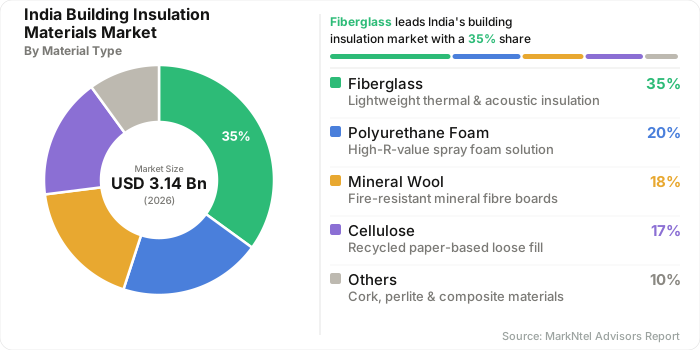
- By material type, Fiberglass accounts for the largest market share of 35% in 2026.
- By application, Roof/Ceiling Insulation is anticipated to hold the dominant share of 30% of the total market in 2026.
- North India commands the leading position in the market with an estimated 33% share in 2026.
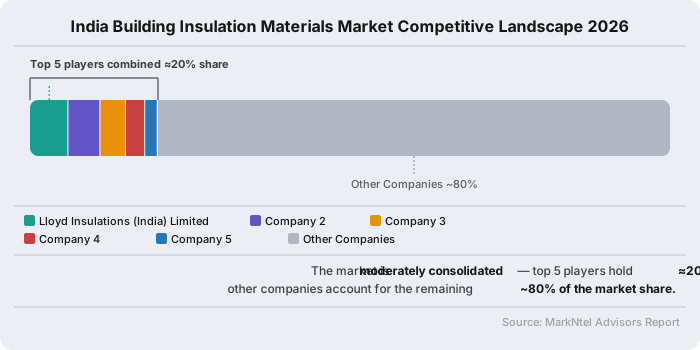
- The industry remains moderately fragmented, with the top five companies collectively accounting for nearly 20% of the market revenue.
India Building Insulation Materials Market Size & Outlook
The India building insulation materials industry was valued at USD 2.96 billion in 2025 and is currently valued at approximately USD 3.14 billion in 2026 and is projected to reach nearly USD 3.98 billion by 2032, growing at a CAGR of around 4.0% during 2026-2032. Market growth is being supported by rising construction activity, increasing energy-efficiency requirements, and growing awareness regarding thermal comfort and sustainable building practices across residential, commercial, industrial, and institutional sectors.
India's expanding infrastructure landscape is creating substantial demand for insulation materials. Government-led initiatives such as the Smart Cities Mission, Housing for All, industrial corridor developments, urban transformation projects, business parks, and special economic zones are driving construction activity nationwide. Simultaneously, rising FDI inflows and industrial expansion are generating demand for manufacturing facilities, warehouses, commercial offices, and logistics infrastructure, further supporting insulation material adoption.
Growing urbanization and demographic expansion are also contributing to market growth. According to the United Nations, India's urban population is projected to reach nearly 675 million by 2035, significantly increasing demand for housing, retail spaces, offices, healthcare facilities, and other commercial buildings. Rising disposable incomes and improving living standards are further encouraging consumers to prefer energy-efficient and sustainable buildings, prompting developers to incorporate advanced insulation solutions into new construction projects.
Furthermore, India's rapidly rising cooling demand is emerging as a major catalyst for insulation adoption. The country's cooling demand is projected to more than double by 2035, while air-conditioner ownership remains limited to nearly 20% of households, indicating significant future growth potential. As cooling-related electricity consumption continues to rise, building owners are increasingly investing in insulation systems to reduce energy costs, improve thermal performance, and enhance occupant comfort.
Regulatory support is further strengthening market prospects. The energy conservation building code mandates performance standards for building envelopes, HVAC systems, and energy-efficient infrastructure, with ECBC-compliant buildings delivering nearly 20% higher energy efficiency than conventional structures. In addition, the expansion of eco-niwas samhita into residential buildings and the implementation of more than 100 ECBC-aligned projects across 24 states are accelerating the adoption of insulation materials across India's building sector.
India Building Insulation Materials Market Key Indicators
- India’s construction sector contributes around 9% of the national GDP, employs more than 51 million people, and is projected to reach a valuation of nearly USD 1.4 trillion. The continued expansion of residential, commercial, and industrial construction directly increases the demand for thermal and acoustic insulation materials used in walls, roofs, floors, and building envelopes to improve energy efficiency and occupant comfort. Consequently, growth in construction activity remains a primary indicator supporting the expansion of the building insulation materials market.
- As of 2025, more than 1.19 crore houses have been sanctioned under PMAY-Urban, while PMAY-Urban 2.0 aims to construct an additional 1 crore houses over the next five years. Simultaneously, PMAY-Gramin has sanctioned approximately 3.85 crore rural houses. The large-scale development of residential housing creates substantial demand for insulation products, particularly as developers increasingly adopt energy-efficient construction practices to reduce cooling loads and enhance building performance.
- India’s National Infrastructure Pipeline (NIP) involves investments of approximately USD 1.5 trillion across transportation, urban infrastructure, energy, and social infrastructure projects. Additionally, the government allocated about USD 133 billion in capital expenditure for FY2025. Large-scale infrastructure projects such as airports, metro stations, commercial complexes, hospitals, and educational institutions increasingly incorporate insulation systems to meet energy efficiency and sustainability requirements, supporting market demand.
- More than 1.38 lakh real estate projects are registered under RERA across India, indicating sustained development of residential and commercial buildings. The growing stock of offices, retail centers, mixed-use developments, and hospitality infrastructure is driving the adoption of insulation materials for HVAC efficiency, indoor thermal comfort, and noise reduction. This trend significantly contributes to the growth trajectory of the building insulation materials market.
India Building Insulation Materials Market Scope
| Category | Segments |
|---|---|
| By Material Type | Fiberglass, Mineral Wool, Cellulose, Polyurethane Foam, Polystyrene, Polyisocyanurate, Others |
| By Application | Roof/Ceiling Insulation, Floor Insulation, Wall Insulation, Window Insulation |
| By End User | Residential, Non-Residential, Commercial Buildings, Offices, Educational Institutions, Others |
India Building Insulation Materials Market Growth Drivers
Expanding Green Building Ecosystem Driving Demand for Energy-Efficient Insulation Solutions
India's rapidly expanding green building ecosystem is emerging as a key driver for the building insulation materials industry. As the country accelerates infrastructure development and urban expansion, increasing emphasis is being placed on reducing the environmental impact and operational energy consumption of buildings. Consequently, developers are increasingly incorporating insulation materials into building envelopes to improve thermal performance, reduce cooling requirements, and lower energy costs.
The trend is further supported by the rapid adoption of green building certifications such as IGBC, LEED, EDGE, and GRIHA, which prioritize high-performance building envelopes and thermal efficiency. These certification frameworks encourage the use of roof, wall, and facade insulation materials to enhance energy savings and occupant comfort. In addition, multiple state-level incentives promoting sustainable construction and green infrastructure are encouraging wider adoption of energy-efficient building materials across the country.
Furthermore, India's building stock is expected to more than double over the next two decades, creating substantial opportunities for insulation manufacturers. Green building practices are no longer limited to premium commercial projects and are increasingly being adopted across residential, institutional, and mixed-use developments. Coupled with growing investor preference for sustainable real estate assets and the government's focus on environmentally responsible infrastructure development, the demand for advanced insulation materials is expected to witness sustained growth during the forecast period.
Recent Trends
Shift Toward Energy-Efficient Commercial Buildings
India's commercial construction sector is emerging as a significant demand centre for building insulation materials, driven by the rapid development of office complexes and industrial buildings. The momentum remained strong with office leasing across major cities surpassing 21 million sq. ft. in Q1 2026, reflecting continued additions to India's Grade-A commercial building stock. As developers increasingly focus on delivering high-performance assets with superior occupant comfort and lower operating costs, insulation systems are becoming an integral component of modern commercial building design.
The trend is particularly evident across industrial and logistics infrastructure. Industrial and warehousing leasing reached approximately 11 million sq. ft. in Q1 2026. Unlike conventional structures, modern warehouses, logistics parks, and industrial facilities increasingly incorporate insulated roofing systems, wall panels, and sandwich panel solutions to enhance thermal performance and improve indoor operating conditions. Similarly, India's rapidly expanding data centre industry is generating demand for advanced building envelope solutions that support temperature management and facility efficiency.
As commercial buildings become larger, more technologically advanced, and operationally intensive, developers are placing greater emphasis on roof insulation, wall insulation, facade systems, and high-performance construction materials. This shift is accelerating the adoption of fiberglass, rock wool, polyurethane foam, and insulated panel systems, making commercial infrastructure expansion an increasingly important growth avenue for the India building insulation materials market.
India Building Insulation Materials Market Opportunities & Challenges
Traditional Construction Practices Restricting Insulation Adoption, While Modern Building Technologies Create New Growth Avenues
Despite increasing emphasis on energy-efficient buildings, the penetration of advanced insulation materials across India's construction sector remains constrained by the continued dominance of conventional building practices. A significant share of residential, small commercial, and regional construction projects still relies on traditional brick-and-mortar methods, where insulation is often perceived as a discretionary component rather than an integral element of building design.
The challenge is particularly evident across Tier-II and Tier-III cities, where awareness regarding building envelope optimization and lifecycle cost savings remains relatively limited. In many projects, building materials are selected primarily based on initial procurement costs, resulting in lower utilization of high-performance insulation products such as fiberglass, rock wool, polyurethane foam, and extruded polystyrene. This has created a noticeable gap between the growing availability of advanced insulation technologies and their actual incorporation into mainstream construction activity.
However, the gradual transformation of India's construction ecosystem is creating substantial opportunities for market participants. The increasing adoption of pre-engineered buildings, insulated sandwich panels, modular construction techniques, and modern facade systems is driving a shift toward performance-oriented construction practices. These solutions are gaining traction across warehouses, logistics parks, manufacturing facilities, data centres, cold storage infrastructure, and large commercial developments, where thermal efficiency, durability, and faster project execution have become key considerations.
Furthermore, India's expanding industrial and commercial infrastructure pipeline is accelerating the use of integrated insulation systems during the design stage itself. Modern warehouses increasingly utilize insulated roofing and wall panel systems, while data centres, industrial facilities, and institutional buildings are incorporating advanced building envelope solutions to enhance operational performance and environmental control. Developers are progressively transition from conventional construction towards the adoption of advanced insulation materials. Thus, industry is expected to witness significant expansion across the country.
Segmentation Insights
Fiberglass Maintains Leadership Amid Growing Demand for Cost-Effective Thermal Insulation Solutions
Fiberglass accounted for an estimated 35% share of the India building insulation materials industry, making it the leading material segment. Its dominance is primarily attributed to its favourable combination of thermal insulation performance, fire resistance, acoustic properties, and cost-effectiveness compared to several alternative insulation materials. The material has witnessed widespread adoption across residential, commercial, industrial, and institutional construction projects due to its versatility and ease of installation.
Fiberglass insulation is increasingly being incorporated into roofs, ceilings, walls, and HVAC systems across offices, warehouses, healthcare facilities, educational institutions, and manufacturing plants. The segment is also benefiting from growing demand for energy-efficient building envelopes and rising implementation of thermal-performance standards across new construction projects. As developers continue prioritizing lifecycle performance, thermal comfort, and compliance with evolving building regulations, fiberglass is expected to maintain its leadership position throughout the forecast period. The market is bifurcated into the following sub-segments:
- Fiberglass
- Mineral Wool
- Cellulose
- Polyurethane Foam
- Polystyrene
- Polyisocyanurate
- Others
Roof & Ceiling Insulation Emerging as the Primary Application Across Modern Building Construction
Roof and ceiling insulation held an estimated 30% share of the India building insulation materials industry, emerging as the largest application segment. The dominance of this segment is largely driven by India's climatic conditions, where roofs remain the primary point of solar heat gain across residential, commercial, and industrial buildings. As a result, developers increasingly prioritize roof insulation systems to improve thermal performance and enhance indoor comfort.
The segment has gained significant traction across commercial offices, logistics parks, warehouses, manufacturing facilities, data centres, healthcare infrastructure, and premium residential projects. The growing adoption of metal roofing systems, pre-engineered buildings (PEBs), and insulated roofing panels has further strengthened demand. In addition, rising focus on building envelope optimization and long-term operational efficiency is encouraging developers to integrate roof insulation at the design stage itself. These factors are expected to support the segment's continued leadership during the forecast period. The market is bifurcated into the following sub-segments:
- Roof/Ceiling Insulation
- Floor Insulation
- Wall Insulation
- Window Insulation
India Building Insulation Materials Market Competitive Analysis
The India Building Insulation Materials Market remains moderately fragmented, with Saint-Gobain India Pvt. Ltd., Knauf India Pvt. Ltd., Roxul-Rockwool Insulation India Private Limited, Lloyd Insulations India Limited, and Neo Thermal Insulation India Pvt. Ltd. representing some of the most commercially influential participants. The top five companies collectively accounted for approximately 20% of the India Building Insulation Materials Market in 2026.
Major Building Insulation Materials Companies in India
- Lloyd Insulations India Limited
- Neo Thermal Insulation India Pvt. Ltd.
- Roxul-Rockwool Insulation India Private Limited
- National Industrial Co.
- Knauf India Pvt. Ltd.
- Saint-Gobain India Pvt. Ltd.
- Huntsman Advanced Materials (India) Pvt. Ltd.
- Duratuf Products Pvt. Ltd.
India Building Insulation Materials Market News and Recent Developments
2025: Saint-Gobain Commenced Construction of New Mineral Wool Insulation Manufacturing Line in India
Saint-Gobain began construction of a new mineral wool insulation production line at its Oragadam facility in Chennai, Tamil Nadu. The expansion is aimed at increasing domestic manufacturing capacity to address rising demand for thermal and acoustic insulation products across commercial buildings, industrial facilities, warehouses, and infrastructure projects in India.
Impact Analysis: The expansion is expected to strengthen the availability of domestically manufactured insulation materials and reduce reliance on imports for high-performance building insulation products. The development aligns with growing demand for energy-efficient construction materials driven by commercial real estate expansion, industrial infrastructure development, and green building adoption. It also reflects increasing manufacturer confidence in the long-term growth prospects of India's building insulation materials industry.
2025: EPACK Prefab Technologies Inaugurated New Sandwich Panel Manufacturing Facility in Andhra Pradesh
EPACK Prefab Technologies inaugurated a new manufacturing facility near Tirupati, Andhra Pradesh, dedicated to the production of insulated sandwich panels and prefabricated building solutions. The facility is intended to cater to increasing demand from warehouses, logistics parks, industrial facilities, cold storage infrastructure, and commercial construction projects across Southern India.
Impact Analysis: The development is expected to accelerate the adoption of insulated panel systems and modern building envelope technologies within India's construction sector. The expansion supports the growing transition toward pre-engineered buildings, modular construction techniques, and thermally efficient infrastructure. It also highlights the increasing role of advanced construction materials in improving energy efficiency, reducing project execution timelines, and enhancing operational performance across industrial and commercial developments.
Frequently Asked Questions
- Market Segmentation
- Introduction
- Product Definition
- Research Process
- Assumptions
- Executive Summary
- India Building Insulation Materials Market Policies, Regulations, and Product Standards
- India Building Insulation Materials (Thousand Tons) Trend 2022-2032
- India Building Insulation Materials (Thousand Tons) Trend by Type of Material
- Fiberglass
- Mineral Wool
- Cellulose
- Polyurethane Foam
- Polystyrene
- Polyisocyanurate
- Others
- India Building Insulation Materials (Thousand Tons) Trend by Type of Material
- India Building Insulation Materials Market Trends & Developments
- India Building Insulation Materials Market Dynamics
- Growth Factors
- Challenges
- India Building Insulation Materials Market Hotspot & Opportunities
- India Building Insulation Materials Market Outlook, 2022-2032F
- Market Size & Outlook
- By Revenues (USD Million)
- By Quantity Sold (Thousand Tons)
- Market Share & Outlook
- By Material Type- Market Size & Forecast 2022-2032, USD Million & Thousand Tons
- Fiberglass
- Mineral Wool
- Cellulose
- Polyurethane Foam
- Polystyrene
- Polyisocyanurate
- Others
- By Application- Market Size & Forecast 2022-2032, USD Million & Thousand Tons
- Roof/Ceiling Insulation
- Floor Insulation
- Wall Insulation
- Window Insulation
- By End User- Market Size & Forecast 2022-2032, USD Million & Thousand Tons
- Residential
- Non-Residential
- Commercial Buildings
- Offices
- Educational Institutions
- Others
- By Region- Market Size & Forecast 2022-2032, USD Million & Thousand Tons
- North
- South
- East
- West
- By Company
- Competition Characteristics
- Market Share & Analysis
- By Material Type- Market Size & Forecast 2022-2032, USD Million & Thousand Tons
- Market Size & Outlook
- India Fiberglass Insulation Market Outlook, 2022-2032
- Market Size & Outlook
- By Revenues (USD Million)
- By Quantity Sold (Thousand Tons)
- Market Share & Outlook
- By Application- Market Size & Forecast 2022-2032, USD Million & Thousand Tons
- By End User- Market Size & Forecast 2022-2032, USD Million & Thousand Tons
- By Region- Market Size & Forecast 2022-2032, USD Million & Thousand Tons
- Market Size & Outlook
- India Mineral Wool Insulation Market Outlook, 2022-2032
- Market Size & Outlook
- By Revenues (USD Million)
- By Quantity Sold (Thousand Tons)
- Market Share & Outlook
- By Application- Market Size & Forecast 2022-2032, USD Million & Thousand Tons
- By End User- Market Size & Forecast 2022-2032, USD Million & Thousand Tons
- By Region- Market Size & Forecast 2022-2032, USD Million & Thousand Tons
- Market Size & Outlook
- India Cellulose Insulation Market Outlook, 2022-2032
- Market Size & Outlook
- By Revenues (USD Million)
- By Quantity Sold (Thousand Tons)
- Market Share & Outlook
- By Application- Market Size & Forecast 2022-2032, USD Million & Thousand Tons
- By End User- Market Size & Forecast 2022-2032, USD Million & Thousand Tons
- By Region- Market Size & Forecast 2022-2032, USD Million & Thousand Tons
- Market Size & Outlook
- India Polyurethane Foam Insulation Market Outlook, 2022-2032
- Market Size & Outlook
- By Revenues (USD Million)
- By Quantity Sold (Thousand Tons)
- Market Share & Outlook
- By Application- Market Size & Forecast 2022-2032, USD Million & Thousand Tons
- By End User- Market Size & Forecast 2022-2032, USD Million & Thousand Tons
- By Region- Market Size & Forecast 2022-2032, USD Million & Thousand Tons
- Market Size & Outlook
- India Polystyrene Insulation Market Outlook, 2022-2032
- Market Size & Outlook
- By Revenues (USD Million)
- By Quantity Sold (Thousand Tons)
- Market Share & Outlook
- By Application- Market Size & Forecast 2022-2032, USD Million & Thousand Tons
- By End User- Market Size & Forecast 2022-2032, USD Million & Thousand Tons
- By Region- Market Size & Forecast 2022-2032, USD Million & Thousand Tons
- Market Size & Outlook
- India Polyisocyanurate Insulation Market Outlook, 2022-2032
- Market Size & Outlook
- By Revenues (USD Million)
- By Quantity Sold (Thousand Tons)
- Market Share & Outlook
- By Application- Market Size & Forecast 2022-2032, USD Million & Thousand Tons
- By End User- Market Size & Forecast 2022-2032, USD Million & Thousand Tons
- By Region- Market Size & Forecast 2022-2032, USD Million & Thousand Tons
- Market Size & Outlook
- India Building Insulation Materials Market Key Strategic Imperatives for Success & Growth
- Competitive Outlook
- Company Profiles
- Lloyd Insulations India Limited
- Business Description
- Product Portfolio
- Collaborations & Alliances
- Recent Developments
- Financial Details
- Others
- Neo Thermal Insulation India Pvt Ltd.
- Business Description
- Product Portfolio
- Collaborations & Alliances
- Recent Developments
- Financial Details
- Others
- Roxul-Rockwool Insulation India Private Limited
- Business Description
- Product Portfolio
- Collaborations & Alliances
- Recent Developments
- Financial Details
- Others
- National Industrial Co.
- Business Description
- Product Portfolio
- Collaborations & Alliances
- Recent Developments
- Financial Details
- Others
- Knauf India Pvt Ltd.
- Business Description
- Product Portfolio
- Collaborations & Alliances
- Recent Developments
- Financial Details
- Others
- Saint-Gobain India Pvt Ltd.
- Business Description
- Product Portfolio
- Collaborations & Alliances
- Recent Developments
- Financial Details
- Others
- Huntsman Advanced Materials (India) Pvt Ltd.
- Business Description
- Product Portfolio
- Collaborations & Alliances
- Recent Developments
- Financial Details
- Others
- Duratuf Products Pvt Ltd.
- Business Description
- Product Portfolio
- Collaborations & Alliances
- Recent Developments
- Financial Details
- Others
- Lloyd Insulations India Limited
- Company Profiles
- Disclaimer
MarkNtel Advisors follows a robust and iterative research methodology designed to ensure maximum accuracy and minimize deviation in market estimates and forecasts. Our approach combines both bottom-up and top-down techniques to effectively segment and quantify various aspects of the market. A consistent feature across all our research reports is data triangulation, which examines the market from three distinct perspectives to validate findings. Key components of our research process include:
1. Scope & Research Design At the outset, MarkNtel Advisors define the research objectives and formulate pertinent questions. This phase involves determining the type of research—qualitative or quantitative—and designing a methodology that outlines data collection methods, target demographics, and analytical tools. They also establish timelines and budgets to ensure the research aligns with client goals.
2. Sample Selection and Data Collection In this stage, the firm identifies the target audience and determines the appropriate sample size to ensure representativeness. They employ various sampling methods, such as random or stratified sampling, based on the research objectives. Data collection is carried out using tools like surveys, interviews, and observations, ensuring the gathered data is reliable and relevant.
3. Data Analysis and Validation Once data is collected, MarkNtel Advisors undertake a rigorous analysis process. This includes cleaning the data to remove inconsistencies, employing statistical software for quantitative analysis, and thematic analysis for qualitative data. Validation steps are taken to ensure the accuracy and reliability of the findings, minimizing biases and errors.

4. Data Forecast and FinalizationThe final phase involves forecasting future market trends based on the analyzed data. MarkNtel Advisors utilize predictive modeling and time series analysis to anticipate market behaviors. The insights are then compiled into comprehensive reports, featuring visual aids like charts and graphs, and include strategic recommendations to inform client decision-making
We offer flexible licensing options to cater to varying organizational needs. Choose the pricing pack that best suits your requirements:
Buy Now Inquire Before Buying
 Request Customization
 Talk to our Consultant







