India Automotive Dashboard Camera Market Research Report: Trends, Forecast & Opportunities (2026-2032)
By Power Source (Individual Battery-Powered, Vehicle Battery-Powered), By Resolution (1080p, 1296p, 1440p, 2160p), By Connectivity (Wi-Fi, Bluetooth, 4G, Wired), By Field of View ( ... 120 Degrees, 140 Degrees, 160 Degrees, 170 Degrees), By Number of Cameras (Single, Dual, Quad), By Storage Capacity (16GB, 32GB, 64GB, 128GB), By Features (Night vision, GPS tracking, Motion detection, Parking mode), By Vehicle Type (Passenger Vehicles, Commercial Vehicles), and others Read more
- Automotive
- Aug 2026
- Pages 140
- Report Format: PDF, Excel, PPT
India Automotive Dashboard Camera Market
Projected 20.9% CAGR from 2026 to 2032
Study Period
2026-2032
Market Size (2026)
USD 154.8 Million
Market Size (2032)
USD 482 Million
Base Year
2025
Projected CAGR
20.9%
Leading Segments
By Vehicle Type: Passenger Vehicles
India Automotive Dashboard Camera Market Key Takeaways
- The India automotive dashboard camera market is estimated at USD 154.8 million in 2026 from USD 128 million in 2025, and projected to reach USD 482 million by 2032, expanding at a 9% CAGR.
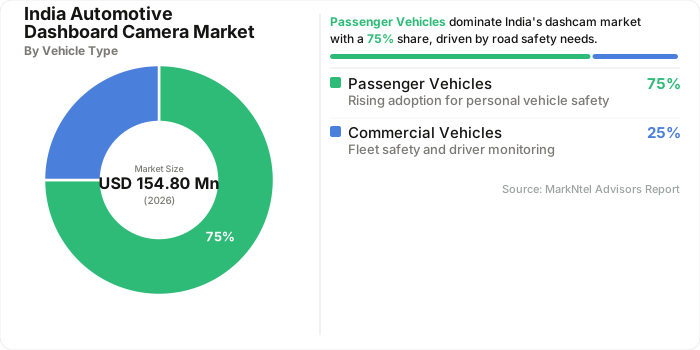
- Passenger cars are expected to dominate the vehicle-type segment, accounting for approximately 75% market share in 2026.
- By power source, battery-powered dashcams are anticipated to hold approximately 88% market share in 2026.
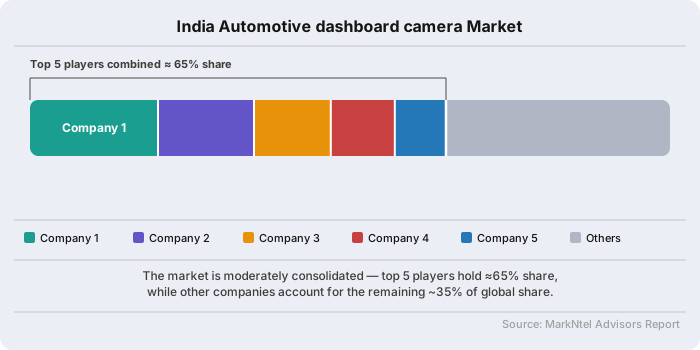
- The market is moderately fragmented, with top 5 companies estimated to account for approximately 65% market share in 2026.
India Automotive Dashboard Camera Market Size and Outlook
The India automotive dashboard camera market is estimated at USD 154.8 million in 2026 and is projected to reach USD 482 million by 2032, registering a 20.9% CAGR during 2026–2032. Market growth is being supported by rising highway usage, increasing vehicle connectivity, and the broader digitalization of road travel. As of June 2026, more than 7.7 million FASTag Annual Passes had facilitated approximately 630 million National Highway transactions, while over 98% of toll collections were processed electronically.
In parallel, the Ministry of Road Transport and Highways (MoRTH) has established frameworks enabling access to FASTag transaction data and vehicle images captured through ANPR/CCTV systems for real-time monitoring and enforcement. The increasing integration of digital vehicle identification, transaction records, and visual evidence is strengthening the ecosystem for connected dashboard cameras, particularly devices equipped with GPS, cloud connectivity, multi-camera recording, and incident documentation capabilities.
India Automotive Dashboard Camera Market Key Indicators
- India has a large installed vehicle base that provides a substantial addressable market for automotive dashboard cameras. Government data indicate approximately 246.4 million active vehicles registered on the Vahan system. This sizeable vehicle parc creates significant opportunities for aftermarket dashcam penetration, replacement demand, and adoption of safety and security-oriented vehicle accessories.
- India's road infrastructure is expanding rapidly, with the National Highway network reaching 146,560 kilometers as of December 2025, while access-controlled expressways reached approximately 3,052 kilometers. The expansion of high-speed and long-distance road corridors is increasing highway travel and strengthening the need for continuous driving records, accident documentation, and vehicle security, supporting demand for dashboard cameras.
- India recorded approximately 2.3 million electric vehicle sales in 2025, accounting for around 8% of new vehicle registrations. Rising EV penetration is expanding the technology-oriented vehicle base and creating additional opportunities for connected automotive accessories, including GPS-enabled, Wi-Fi-connected, cloud-enabled, and remotely monitored dashboard cameras.
- Under the PM E-DRIVE scheme, 2.212 million EV sales had been supported as of January 27, 2026, including approximately 1.919 million electric two-wheelers and 293,000 electric three-wheelers. The rapid expansion of electric mobility, particularly across two- and three-wheelers, is increasing the potential addressable base for compact connected camera systems used for vehicle security, remote monitoring, and incident recording.
- India's passenger-vehicle manufacturing and sales volumes further support the expansion of the dashboard camera customer base. The country produced approximately 5.38 million passenger vehicles in 2025, while domestic sales reached around 4.49 million units, according to government-reported SIAM data. High annual vehicle production and sales continuously add new vehicles to the addressable market for both OEM-installed and aftermarket dashboard cameras.
- Government initiatives are also strengthening India's automotive electronics ecosystem. The Automotive Mission Plan 2047 and the Production Linked Incentive (PLI) scheme for automobile and auto-component manufacturing are promoting advanced automotive technologies and greater domestic manufacturing capabilities. Increasing localization of automotive electronics can strengthen the domestic supply chain for cameras, sensors, connectivity modules, and other components used in connected dashboard-camera systems.
India Automotive Dashboard Camera Market Scope
| Category | Segments |
|---|---|
| By Power Source | Individual Battery-Powered, Vehicle Battery-Powered |
| By Resolution | 1080p, 1296p, 1440p, 2160p |
| By Connectivity | Wi-Fi, Bluetooth, 4G, Wired |
| By Field of View | 120 Degrees, 140 Degrees, 160 Degrees, 170 Degrees |
| By Number of Cameras | Single, Dual, Quad |
| By Storage Capacity | 16GB, 32GB, 64GB, 128GB |
| By Features | Night vision, GPS tracking, Motion detection, Parking mode |
| By Vehicle Type | Passenger Vehicles, Commercial Vehicles |
India Automotive Dashboard Camera Market Growth Drivers
Growing Recognition of Video Evidence in Accident Disputes Strengthening Dashcam Value
Growing recognition of electronic and video evidence in accident-related disputes is strengthening the practical value proposition of automotive dashboard cameras in India. The Supreme Court of India has dealt with motor-accident matters where the availability of CCTV footage was relevant to establishing whether a particular vehicle was involved in an accident. In a December 2024 judgment, the Court specifically noted that CCTV footage could have been investigated or produced to establish the circumstances of an accident, demonstrating the evidentiary relevance of recorded visual information in motor-accident proceedings.
This relevance is becoming stronger as India's judicial system expands its use of electronic evidence. In April 2026, the Supreme Court's eCommittee and Department of Justice held a national conference that specifically addressed electronic evidence, digital evidence management, and standardised rules for preserving electronic records.
For dashcam manufacturers, this creates a clear product opportunity. Features such as GPS coordinates, timestamps, G-sensors, automatic incident locking, loop recording and cloud/4G connectivity improve the ability to preserve and retrieve footage following an accident. Consequently, consumers can increasingly view dashcams not simply as recording devices, but as on-road evidence and incident-documentation tools for accident disputes, insurance discussions, and legal proceedings.
Recent Trends
Triple-Channel Dashcams with Sony STARVIS 2 and Wi-Fi 6 Gaining Traction
The automotive dashboard camera indstry is increasingly shifting toward triple-channel recording, advanced image sensors, and high-speed wireless connectivity. New-generation dashcams combine front, rear, and cabin cameras to provide broader incident coverage, while Sony STARVIS 2 sensors improve low-light performance and image clarity. Wi-Fi 6 enables faster transfer of large 4K video files between dashcams and smartphones, improving access to recorded footage following accidents or other incidents.
A relevant example is Crossbeats’ RoadEye DC04, which combines 4K three-channel recording, a Sony STARVIS 2 IMX675 sensor, GPS, and Wi-Fi 6 connectivity. Crossbeats commercially markets the model, demonstrating that this technology has progressed from product development to commercial availability.
The development is significant because consumers increasingly seek comprehensive incident documentation rather than front-facing recording alone. Triple-camera configurations can capture road conditions ahead, rear traffic, and cabin activity, while higher-resolution sensors strengthen footage quality in challenging lighting conditions. Consequently, manufacturers are integrating multi-camera architectures, advanced imaging sensors, and faster connectivity to differentiate products and encourage consumers to upgrade from conventional single-channel Full-HD dashcams.
India Automotive Dashboard Camera Market Opportunities and Challenges
Import Dependence and Component Costs Leading to Domestic Dashcam Manufacturing
India’s dashboard camera market remains exposed to imported hardware, particularly image sensors, processors, memory and camera modules. This creates cost and supply risks for brands selling imported products. The contrast is visible within the same market: NEXDIGITRON identifies several 70mai models sold in India as manufactured in China, while its own Prime Plus and ACE 3 models are listed with India as the country of origin and NEX DIGITRONIX LLP as manufacturer.
This supply-chain dependence is simultaneously creating room for domestic dashcam manufacturing and product localization. NEXDIGITRON describes itself as an Indian dashcam brand operating since 2019 and currently offers 2K, 4K dual-channel and 3-channel dashcams, demonstrating that local players are moving beyond basic front-camera products. Its Prime Plus 3-channel model records 2.5K front, Full-HD rear, and Full-HD cabin footage, while the company also develops its own India-origin ACE series. This creates a direct opportunity for Indian manufacturers to reduce import exposure while developing dashcams tailored to local vehicle use, pricing, and installation requirements.
Segmentation Insights
Passenger Vehicles Expected to Hold Approximately 75% Market Share in 2026
Passenger vehicles are expected to dominate India’s automotive dashboard camera market, supported by the country’s expanding passenger-vehicle base and increasing consumer interest in safety, incident recording, parking surveillance, and connected accessories. According to the Society of Indian Automobile Manufacturers (SIAM), passenger-vehicle domestic sales reached a record 46.43 lakh units in FY2025-26, registering 7.9% year-on-year growth.
The large passenger-car base creates a substantial aftermarket opportunity because dashcams are predominantly purchased and installed after vehicle delivery. Leading brands, including Qubo, 70mai and DDPAI, increasingly offer products with dual-channel recording, GPS, ADAS, night vision and parking-monitoring capabilities, aligning with the requirements of private vehicle owners. Qubo's current portfolio includes multi-camera configurations covering front, rear, and cabin views, while its N Series supports parking surveillance through direct vehicle-battery connection.
Commercial vehicles remain an important secondary demand segment, particularly among logistics, fleet and ride-hailing operators seeking incident documentation and driver monitoring. However, the substantially larger passenger-vehicle base and stronger consumer aftermarket adoption position passenger cars as the leading vehicle category. Based on vehicle type, the market is further bifurcated into:
- Passenger Vehicles
- Commercial vehicles
Vehicle Battery-Powered Segment Expected to Hold Approximately 88% Market Share in 2026
Vehicle battery-powered dashcams are expected to dominate India’s automotive dashboard camera industry, supported by their suitability for continuous recording, parking surveillance, and extended vehicle operation. Most mainstream dashboard cameras receive power through a vehicle’s USB port, 12V socket, or hardwired electrical system, allowing manufacturers to support longer recording periods without relying entirely on limited-capacity internal batteries.
Current product configurations reinforce this preference. Qubo’s N Series can be connected directly to the vehicle battery through a hardwiring kit, enabling parking surveillance after the ignition is switched off. Qubo also uses supercapacitor-based power storage in its dashcam portfolio, providing short-term backup while improving resistance to repeated heat exposure.
Vehicle-powered systems also provide greater flexibility for integrating GPS, Wi-Fi, high-resolution recording, multiple cameras, and parking-mode functionality. This is particularly relevant in India, where vehicles can experience high cabin temperatures when parked outdoors for extended periods. Individual battery-powered models remain relevant for basic and portable applications but have comparatively limited suitability for continuous automotive use. Consequently, vehicle battery-powered systems are expected to remain the preferred configuration among aftermarket buyers, fleet operators, and consumers seeking advanced surveillance capabilities. Based on the power source type, the market is further bifurcated into:
- Individual battery–powered
- Vehicle battery-powered
India Automotive Dashboard Camera Market Competitive Analysis
The India automotive dashboard camera market is moderately fragmented. The top five leading companies, Qubo, 70mai, DDPAI, Thinkware, and CP PLUS (CarKam), are estimated to collectively account for approximately 65% market share in 2026, with Qubo and 70mai leading through strong retail and e-commerce penetration, followed by DDPAI, Thinkware, and CP PLUS.
Key Companies in the India Automotive Dashboard Camera Market
- Qubo (Hero Electronix Pvt. Ltd.)
- 70mai
- DDPAI
- Thinkware
- CP PLUS (CarKam)
- NEXDIGITRON
- Garmin Ltd.
- Blaupunkt India / BPIN Pvt. Ltd.
- Philips GoSure
- IROAD
India Automotive Dashboard Camera Industry News and Recent Developments
May 2026: 70mai Launches 4K A810 Lite With Optional 4G Connectivity
70mai announced the 4K A810 Lite in May 2026, combining 4K recording, a compact form factor and optional 4G connectivity. The product is positioned around remote access, connected parking monitoring and improved video clarity, extending the company's product portfolio beyond conventional offline recording systems.
Impact Analysis: The launch reinforces the shift toward connected dashcams in which the camera becomes a remote vehicle-monitoring device rather than simply a local recording accessory. 4G functionality can enable remote footage access, alerts and parking surveillance, creating additional value for premium passenger vehicles and fleet applications.
Frequently Asked Questions
- Market Segmentation
- Introduction
- Product Definition
- Research Process
- Assumptions
- Executive Summary
- India Automotive Dashboard Camera Production (Thousand units) Trend 2022-2032
- India Automotive Dashboard Camera Market Supply Chain Analysis
- India Automotive Dashboard Camera Market Import & Export Data Analysis
- India Automotive Dashboard Camera Market Policies, Regulations, and Product Standards
- India Automotive Dashboard Camera Market Trends & Developments
- India Automotive Dashboard Camera Market Dynamics
- Growth Factors
- Challenges
- India Automotive Dashboard Camera Market Hotspot & Opportunities
- India Automotive Dashboard Camera Market Outlook, 2022-2032
- Market Size & Outlook
- By Revenues (USD Million)
- By Unit Sold (Thousand Units)
- Market Segmentation & Outlook
- By Power Source- Market Size & Forecast 2022-2032, USD Million & Thousand Units
- Individual Battery-Powered
- Vehicle Battery-Powered
- By Resolution- Market Size & Forecast 2022-2032, USD Million & Thousand Units
- 1080p
- 1296p
- 1440p
- 2160p
- By Connectivity- Market Size & Forecast 2022-2032, USD Million & Thousand Units
- Wi-Fi
- Bluetooth
- 4G
- Wired
- By Field of View- Market Size & Forecast 2022-2032, USD Million & Thousand Units
- 120 Degrees
- 140 Degrees
- 160 Degrees
- 170 Degrees
- By Number of Cameras - Market Size & Forecast 2022-2032, USD Million & Thousand Units
- Single
- Dual
- Quad
- By Storage Capacity- Market Size & Forecast 2022-2032, USD Million & Thousand Units
- 16GB
- 32GB
- 64GB
- 128GB
- By Features- Market Size & Forecast 2022-2032, USD Million & Thousand Units
- Night vision
- GPS tracking
- Motion detection
- Parking mode
- By Vehicle Type- Market Size & Forecast 2022-2032, USD Million & Thousand Units
- Passenger Vehicles
- Commercial Vehicles
- By Region - Market Size & Forecast 2022-2032, USD Million & Thousand Units
- North
- South
- East
- West
- By Company
- Competition Characteristics
- Market Share & Analysis
- By Power Source- Market Size & Forecast 2022-2032, USD Million & Thousand Units
- Market Size & Outlook
- India 120 Degrees Automotive Dashboard Camera Market Outlook, 2022-2032
- Market Size & Outlook
- By Revenues (USD Million)
- By Unit Sold (Thousand Units)
- Market Segmentation & Outlook
- By Resolution- Market Size & Forecast 2022-2032, USD Million & Thousand Units
- By Connectivity- Market Size & Forecast 2022-2032, USD Million & Thousand Units
- By Field of View- Market Size & Forecast 2022-2032, USD Million & Thousand Units
- By Number of Cameras - Market Size & Forecast 2022-2032, USD Million & Thousand Units
- By Storage Capacity- Market Size & Forecast 2022-2032, USD Million & Thousand Units
- By Features- Market Size & Forecast 2022-2032, USD Million & Thousand Units
- By Vehicle Type- Market Size & Forecast 2022-2032, USD Million & Thousand Units
- By Region - Market Size & Forecast 2022-2032, USD Million & Thousand Units
- Market Size & Outlook
- India 140 Degrees Automotive Dashboard Camera Market Outlook, 2022-2032
- Market Size & Outlook
- By Revenues (USD Million)
- By Unit Sold (Thousand Units)
- Market Segmentation & Outlook
- By Resolution- Market Size & Forecast 2022-2032, USD Million & Thousand Units
- By Connectivity- Market Size & Forecast 2022-2032, USD Million & Thousand Units
- By Field of View- Market Size & Forecast 2022-2032, USD Million & Thousand Units
- By Number of Cameras - Market Size & Forecast 2022-2032, USD Million & Thousand Units
- By Storage Capacity- Market Size & Forecast 2022-2032, USD Million & Thousand Units
- By Features- Market Size & Forecast 2022-2032, USD Million & Thousand Units
- By Vehicle Type- Market Size & Forecast 2022-2032, USD Million & Thousand Units
- By Region - Market Size & Forecast 2022-2032, USD Million & Thousand Units
- Market Size & Outlook
- India 160 Degrees Automotive Dashboard Camera Market Outlook, 2022-2032
- Market Size & Outlook
- By Revenues (USD Million)
- By Unit Sold (Thousand Units)
- Market Segmentation & Outlook
- By Resolution- Market Size & Forecast 2022-2032, USD Million & Thousand Units
- By Connectivity- Market Size & Forecast 2022-2032, USD Million & Thousand Units
- By Field of View- Market Size & Forecast 2022-2032, USD Million & Thousand Units
- By Number of Cameras - Market Size & Forecast 2022-2032, USD Million & Thousand Units
- By Storage Capacity- Market Size & Forecast 2022-2032, USD Million & Thousand Units
- By Features- Market Size & Forecast 2022-2032, USD Million & Thousand Units
- By Vehicle Type- Market Size & Forecast 2022-2032, USD Million & Thousand Units
- By Region - Market Size & Forecast 2022-2032, USD Million & Thousand Units
- Market Size & Outlook
- India 170 Degrees Automotive Dashboard Camera Market Outlook, 2022-2032
- Market Size & Outlook
- By Revenues (USD Million)
- By Unit Sold (Thousand Units)
- Market Segmentation & Outlook
- By Resolution- Market Size & Forecast 2022-2032, USD Million & Thousand Units
- By Connectivity- Market Size & Forecast 2022-2032, USD Million & Thousand Units
- By Field of View- Market Size & Forecast 2022-2032, USD Million & Thousand Units
- By Number of Cameras - Market Size & Forecast 2022-2032, USD Million & Thousand Units
- By Storage Capacity- Market Size & Forecast 2022-2032, USD Million & Thousand Units
- By Features- Market Size & Forecast 2022-2032, USD Million & Thousand Units
- By Vehicle Type- Market Size & Forecast 2022-2032, USD Million & Thousand Units
- By Region - Market Size & Forecast 2022-2032, USD Million & Thousand Units
- Market Size & Outlook
- India Automotive Dashboard Camera Market Key Strategic Imperatives for Success & Growth
- Competitive Outlook
- Company Profiles
- Qubo (Hero Electronix Pvt. Ltd.)
- Business Description
- Product Portfolio
- Collaborations & Alliances
- Recent Developments
- Financial Details
- Others
- 70mai
- Business Description
- Product Portfolio
- Collaborations & Alliances
- Recent Developments
- Financial Details
- Others
- DDPAI
- Business Description
- Product Portfolio
- Collaborations & Alliances
- Recent Developments
- Financial Details
- Others
- Thinkware
- Business Description
- Product Portfolio
- Collaborations & Alliances
- Recent Developments
- Financial Details
- Others
- CP PLUS (CarKam)
- Business Description
- Product Portfolio
- Collaborations & Alliances
- Recent Developments
- Financial Details
- Others
- NEXDIGITRON
- Business Description
- Product Portfolio
- Collaborations & Alliances
- Recent Developments
- Financial Details
- Others
- Garmin Ltd.
- Business Description
- Product Portfolio
- Collaborations & Alliances
- Recent Developments
- Financial Details
- Others
- Blaupunkt India / BPIN Pvt. Ltd.
- Business Description
- Product Portfolio
- Collaborations & Alliances
- Recent Developments
- Financial Details
- Others
- Philips GoSure
- Business Description
- Product Portfolio
- Collaborations & Alliances
- Recent Developments
- Financial Details
- Others
- IROAD
- Business Description
- Product Portfolio
- Collaborations & Alliances
- Recent Developments
- Financial Details
- Others
- Others
- Qubo (Hero Electronix Pvt. Ltd.)
- Company Profiles
- Disclaimer
MarkNtel Advisors follows a robust and iterative research methodology designed to ensure maximum accuracy and minimize deviation in market estimates and forecasts. Our approach combines both bottom-up and top-down techniques to effectively segment and quantify various aspects of the market. A consistent feature across all our research reports is data triangulation, which examines the market from three distinct perspectives to validate findings. Key components of our research process include:
1. Scope & Research Design At the outset, MarkNtel Advisors define the research objectives and formulate pertinent questions. This phase involves determining the type of research—qualitative or quantitative—and designing a methodology that outlines data collection methods, target demographics, and analytical tools. They also establish timelines and budgets to ensure the research aligns with client goals.
2. Sample Selection and Data Collection In this stage, the firm identifies the target audience and determines the appropriate sample size to ensure representativeness. They employ various sampling methods, such as random or stratified sampling, based on the research objectives. Data collection is carried out using tools like surveys, interviews, and observations, ensuring the gathered data is reliable and relevant.
3. Data Analysis and Validation Once data is collected, MarkNtel Advisors undertake a rigorous analysis process. This includes cleaning the data to remove inconsistencies, employing statistical software for quantitative analysis, and thematic analysis for qualitative data. Validation steps are taken to ensure the accuracy and reliability of the findings, minimizing biases and errors.

4. Data Forecast and FinalizationThe final phase involves forecasting future market trends based on the analyzed data. MarkNtel Advisors utilize predictive modeling and time series analysis to anticipate market behaviors. The insights are then compiled into comprehensive reports, featuring visual aids like charts and graphs, and include strategic recommendations to inform client decision-making
We offer flexible licensing options to cater to varying organizational needs. Choose the pricing pack that best suits your requirements:
Buy Now Inquire Before Buying
 Request Customization
 Talk to our Consultant