

Ghana Domestic Water Pump Market Research Report: Forecast (2026-2032)
By Pump Type: Centrifugal Pump (Overhung Pump (Vertical Inline, Horizontal End Suction), Split Case Pump (Single/Two Stage, Multistage), Vertical Pump (Turbine (Solid handling, Non ... solid handling), Axial, Mixed Flow), Submersible Pump (Solid Handling, Non-solid Handling)), Positive Displacement Pump (Diaphragm Pump, Piston Pump, Progressive Cavity Pump, Peristaltic Pump) By Operation: Electrical, Hydraulic, Air Driven By Distribution Channel: Distributors & Dealers, Direct Sales, Retail Stores & Hardware Shops, Online Channels By Application: Ground water Intake, Wastewater Outlet, Water Pressure Boosting, Rain Water Harvesting, Hot Water Recirculation, Heating), and others Read more
- Environment
- Apr 2026
- Pages 98
- Report Format: PDF, Excel, PPT
Ghana Domestic Water Pump Market
Projected 7.20% CAGR from 2026 to 2032
Study Period
2026-2032
Market Size (2026)
USD 9.54 Million
Market Size (2032)
USD 14.48 Million
Base Year
2025
Projected CAGR
7.20%
Leading Segments
By pump type: Centrifugal Pumps
Ghana Domestic Water Pump Market Key Takeaways
- The Ghana Domestic Water Pump Market was valued at USD 9.15 million in 2025 and is projected to reach USD 14.48 million by 2032, growing from USD 9.54 million in 2026 at a CAGR of 7.20% during the forecast period.
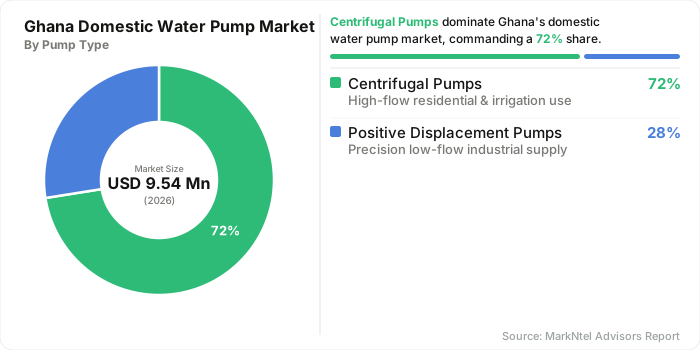
- Centrifugal pumps dominate the market, accounting for approximately 72% of the total market share, driven by their widespread use in household water transfer and pressure boosting applications.
- Groundwater intake remains the leading application segment, contributing nearly 53% of the market share in 2026, supported by increasing reliance on boreholes and wells for domestic water supply.
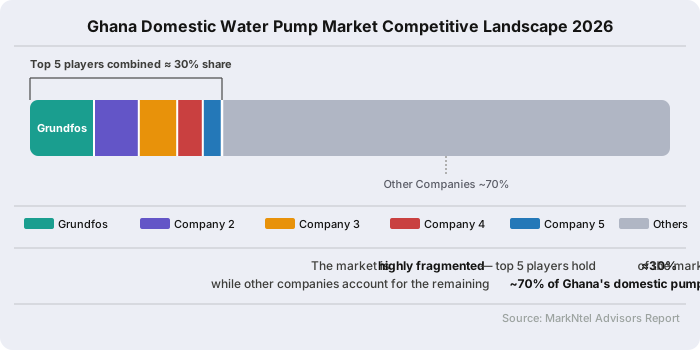
- The market exhibits a highly fragmented competitive landscape, with the top five players collectively holding around 30% of the total market share, indicating the presence of numerous regional and international participants.
Ghana Domestic Water Pump Market Size and Outlook
The Ghana Domestic Water Pump market size was estimated at USD 9.15 million in 2025, the market is projected to expand steadily, reaching USD 9.54 million in 2026 and further reaching to USD 14.48 million by 2032, registering a CAGR of around 7.20% between 2026 and 2032.
With the rising water scarcity and rising dependence on groundwater sources the demand for domestic water pump across Ghana flourishes significantly. Additionally, the growing adoption of smart and automated pumping solutions is enhancing efficiency and reliability, further strengthening long-term demand across residential applications.
The industry is poised for sustained expansion, supported by structural gaps in water accessibility and the gradual transformation of household water management practices, as of 2024, only about 43% of the population has access to safely managed drinking water services, highlighting significant deficiencies in reliable household supply systems. This gap continues to push demand for residential water pumping systems, particularly in areas where centralized infrastructure remains underdeveloped.
While overall access to water has gradually increased, consistency of supply continues to be a critical issue, as by 2026, only about 44% of the population is able to obtain clean water reliably, with availability in rural areas falling to nearly 34%, reflecting uneven distribution and service challenges. This inconsistency in supply is driving households to increasingly depend on water pumps for boreholes in Ghana, ensuring independent and continuous access to water.
Infrastructure inefficiencies further intensify this dependence, as the modern treatment facilities in regions such as Wa are operating at only 34–37% of their installed capacity, largely due to limited distribution networks and affordability constraints. As a result, even households located near pipeline infrastructure are adopting home water pressure systems and groundwater-based solutions to secure reliable supply.
Additionally, national data reflects persistent water stress levels, with indices remaining around 1900 through 2025, indicating ongoing pressure on freshwater resources . This situation is reinforcing the need for decentralized water pumping solutions that allow households to manage water sourcing independently while addressing fluctuations in supply quality and availability.
Alongside these structural drivers, technological advancement is reshaping demand patterns. Increasing adoption of automated and sensor-based pumping technologies is improving efficiency and reliability. Integration of smart monitoring systems and pressure control mechanisms is reducing water wastage and enabling consistent performance, particularly in regions facing irregular municipal supply and infrastructure limitations.
Furthermore, planned public spending is set to play a crucial role in advancing the sector, with budget allocations projected to rise from about USD 50.9 million in 2024 to nearly USD 81.2 million by 2027 outlined by Ministry of Sanitation and Water Resources. This increased funding will enable expanded drilling activities, installation of manual pumping units, and upgrades to existing regional supply infrastructure, improving water accessibility across both urban and rural communities.
Persistent supply gaps, infrastructure limitations, and rising water stress are expected to sustain long-term demand for household pumping systems. Coupled with increasing technological adoption and government-backed investments, the domestic water pump in Ghana is set to experience stable and resilient growth in the coming years.
Ghana Domestic Water Pump Market Key Indicators
- A significant mismatch between water production and consumption continues to shape demand patterns, for example, the Ghana Water Limited reported average output of 950,995 m³/day in June 2024 against demand of 1,129,361 m³/day, leaving a shortfall of nearly 178,000 m³/day. This deficit is accelerating reliance on water pump systems and water pumping solutions among households lacking consistent piped supply.
- Population growth continues to act as a key indicator of Ghana Domestic Water Pump demand, as per the United Nations Population Division, Ghana’s population is expected to reach around 35.1 million by 2025, with the urban population close to 21.1 million . This expanding and youthful demographic is increasing the requirement for residential water pumping systems and home water pressure systems to meet rising household water needs.
- The Government of Ghana allocated over USD 50 million to the Ministry of Works and Housing in 2024, marking a 26.58% increase year-on-year shows that public investment is reinforcing infrastructure expansion and equipment demand. A large share targets mechanized boreholes and urban upgrades, directly boosting procurement of submersible water pumps and small-scale water pumping solutions for newly developed and rehabilitated systems.
Ghana Domestic Water Pump Market Scope:
| Category | Segments |
|---|---|
| By Pump Type | Centrifugal Pump (Overhung Pump (Vertical Inline, Horizontal End Suction), Split Case Pump (Single/Two Stage, Multistage), Vertical Pump (Turbine (Solid handling, Nonsolid handling), Axial, Mixed Flow), Submersible Pump (Solid Handling, Non-solid Handling)), Positive Displacement Pump (Diaphragm Pump, Piston Pump, Progressive Cavity Pump, Peristaltic Pump) |
| By Operation | Electrical, Hydraulic, Air Driven |
| By Distribution Channel | Distributors & Dealers, Direct Sales, Retail Stores & Hardware Shops, Online Channels |
| By Application | Ground water Intake, Wastewater Outlet, Water Pressure Boosting, Rain Water Harvesting, Hot Water Recirculation, Heating |
Ghana Domestic Water Pump Market Growth Drivers
Rising Water Scarcity and Groundwater Dependence
The Ghana domestic water pump industry is increasingly impacted by the declining quality of surface water, which is restricting access to safe and reliable water sources. Estimates from the Water Resources Commission indicate that nearly 60% of water bodies in the country are contaminated, largely due to illegal mining activities and industrial pollution . As a result, the reduced availability of clean surface water is pushing households to depend more on alternative sources such as boreholes and wells.
As surface water becomes increasingly unreliable, groundwater extraction is accelerating across both urban and rural regions. Households are actively investing in water pumps for boreholes in Ghana and submersible water pumps to secure consistent access to potable water. This is particularly evident in northern Ghana, where water scarcity is more severe, as approximately 12.3% of the population in these regions still lacks access to even basic water services, reinforcing dependence on decentralized water sourcing systems.
The growing reliance on groundwater is reshaping household water infrastructure, with increasing demand for efficient and durable water pumping solutions capable of supporting deeper extraction and continuous usage. This structural shift is expected to persist as pollution challenges remain unresolved and water demand continues to rise.
Declining surface water quality and regional access disparities are accelerating groundwater dependence. This transition is expected to drive sustained demand for household pumping systems, strengthening long-term growth prospects across the market.
Recent Trends
Adoption of Smart and Intelligent Pump Systems
The Ghana Domestic Water Pump Market is witnessing a gradual transition toward smart and automated pumping solutions, supported by evolving water management practices in the country. Utilities such as Ghana Water Limited have highlighted the risks associated with conventional booster pumps, particularly in urban centers like Accra, where uncontrolled usage disrupts pressure balance. This has encouraged households to adopt water pump systems with automatic pressure control and sensor-based operation to ensure efficient and safe water flow.
At the infrastructure level, projects under the Greater Accra Metropolitan Area initiative, funded by the World Bank with investments exceeding USD 150 million, are introducing digital monitoring and pressure management technologies. These developments are pushing demand for energy-efficient water pumps that can operate effectively under variable supply conditions and integrate with modern control mechanisms.
Additionally, updates from Ghana News Agency in 2025 indicate the increasing rollout of smart meters and leak detection systems in cities like Accra and Kumasi. This is encouraging the adoption of pumps equipped with automation features such as dry-run protection and intelligent switching, particularly in areas facing irregular municipal supply.
The shift toward intelligent and responsive pumping solutions is strengthening household water reliability. As digital water infrastructure expands, adoption of advanced systems is expected to accelerate steadily.
Ghana Domestic Water Pump Market Opportunities and Challenges
Power Supply Constraints Accelerating Solar Pump Adoption
Unreliable electricity supply continues to be a major constraint in the Ghana Domestic Water Pump industry, significantly affecting the efficiency of water pump systems used in households. Frequent power outages and voltage fluctuations disrupt urban water distribution networks, leading utilities such as Ghana Water Limited to caution against the overuse of inline booster pumps that further burden already fragile systems. As a result, many households increasingly depend on alternative water access methods, exposing underlying inefficiencies in electricity-dependent infrastructure .
At the same time, this challenge is creating strong growth avenues for solar water pumps in Ghana and other off-grid technologies, as the programs supported by the International Solar Alliance are advancing solar-powered irrigation and water supply solutions, helping reduce reliance on unreliable grid electricity. These initiatives are accelerating the deployment of submersible water pumps combined with solar systems, especially in rural and peri-urban areas where electrification remains limited.
Ongoing power instability is fundamentally transforming household water access patterns, encouraging a shift toward more independent and reliable solutions. As renewable technologies become more affordable and scalable, adoption is expected to rise steadily across underserved regions. This transition will enhance water accessibility while strengthening long-term resilience in domestic water supply systems.
Segmentation Insights
Widespread Adoption of Centrifugal Pumps in Domestic Water Pump Industry
Centrifugal pumps account for nearly 72% of total revenue within the Ghana Domestic Water Pump sector, supported by their strong alignment with everyday household water requirements and flexibility across different residential environments. Their ability to deliver steady water flow makes them highly suitable for uses such as filling storage tanks, small-scale irrigation, and routine domestic water movement.
Within this segment, vertical and split case pumps are increasingly being adopted in larger homes and localized community systems, where higher discharge capacity and stable performance are essential. Submersible types also see strong usage in groundwater-based applications, particularly in areas where water needs to be lifted from deeper underground sources.
One of the major reasons behind their widespread adoption is ease of use. These pumps are relatively simple to install and maintain compared to more complex alternatives, allowing households to operate them without requiring advanced technical knowledge. Their integration with booster pumps for homes and water circulation systems further supports improved pressure management and consistent internal water distribution.
In addition, the availability of multiple product variants across different price ranges makes them accessible to a wide consumer base. As more households turn toward independent water sourcing and storage, centrifugal pumps continue to dominate due to their reliability, cost-effectiveness, and seamless fit within residential water setups. Based on pump type, the market is divided into the following categories:
- Centrifugal Pumps
- Overhung Pumps
- Split Case Pumps
- Vertical Pumps
- Submersible Pumps
- Positive Displacement Pumps
- Diaphragm Pumps
- Piston Pumps
- Progressive Cavity Pumps
- Peristaltic Pumps
Groundwater Intake leads the application landscape
Groundwater intake holds the dominant position with nearly 53% share in the Ghana Domestic Water Pump Market, largely driven by the country’s rising reliance on underground water sources for daily household use. Unreliable municipal supply and increasing strain on surface water bodies have made boreholes and wells the most trusted and consistent water sources, especially across peri-urban and rural regions.
This leadership is further supported by the extensive use of submersible pumping systems, which are engineered to efficiently extract water from deeper aquifers. Households favor these systems due to their ability to provide steady water output throughout the year, irrespective of seasonal fluctuations. Moreover, the growing adoption of domestic irrigation pumps in Ghana is expanding groundwater usage beyond drinking needs to include small-scale household farming activities.
Another key advantage lies in the minimal infrastructure dependency compared to centralized supply networks. Groundwater-based solutions enable households to function independently, making them highly suitable for areas with inconsistent public water distribution. The rising use of fluid transfer pumps for private water access further reflects the increasing shift toward self-sufficient water arrangements.
Overall, ongoing pressure on surface water resources, coupled with population growth and infrastructure limitations, is expected to maintain the strong position of groundwater intake, reinforcing its importance in household-level water management systems. The study covers the following key application areas:
- Ground water Intake
- Wastewater Outlet
- Water Pressure Boosting
- Rain Water Harvesting
- Hot Water Recirculation
- Heating
Ghana Domestic Water Pump Market Competitive Analysis
The Ghana Domestic Water Pump landscape is characterized by a highly fragmented structure, with both international manufacturers and regional distributors serving a broad range of residential and small-scale water requirements. The market consists of a blend of global brands and local suppliers offering products such as centrifugal and positive displacement pumps designed for household applications. Key players, including Grundfos, Wilo SE, Xylem Inc., KSB SE & Co., and DAB Pumps, collectively hold around 30% of the total market share.
Major Domestic Water Pump Companies in Ghana
- HTC Waterpumps
- Grundfos
- Sulzer Pump
- Xylem Inc.
- KSB SE & Co.
- Wilo SE
- Pumptech Limited
- Aquatec Services Limited
- DAB Pumps
- LORENTZ GmbH
- Others
Ghana Domestic Water Pump Industry News and Recent Developments:
December 2025: Republic Bank Breaks Ground on Clean Water Projects Across Three Regions
Republic Bank Ghana initiated construction of mechanised boreholes across Northern, Upper East, and Volta regions under its CSR program. Each project integrates electric and solar-powered pumping systems to ensure reliable water access. The initiative targets underserved communities, improving sanitation, education, and public health outcomes while addressing persistent water scarcity challenges.
Impact Analysis: This development highlights increasing private-sector participation in decentralized water infrastructure, directly supporting growth in the Ghana Domestic Water Pump Market. The deployment of mechanised boreholes with solar-powered pumping systems strengthens demand for submersible and energy-efficient pumps, particularly in off-grid areas. It also reflects a shift toward sustainable, small-scale water pumping solutions, accelerating adoption across rural households. Such initiatives reinforce long-term expansion of the Ghana domestic water pump industry through rising investments in reliable water supply systems.
February 2025: GWCL Procures Pumping Equipment for Kpeve Water Supply Station
Ghana Water Limited procured two new pumping units for the Kpeve Water Supply Station in the Volta Region to address persistent water shortages in Ho and nearby areas. The existing pumps, installed in 1993, had repeatedly failed due to increasing population pressure. The new units were scheduled for installation shortly after arrival to restore stable supply.
Impact Analysis: This development highlights growing replacement demand for aging centrifugal pumping systems across Ghana’s water infrastructure. Increasing urban population and system breakdowns are accelerating investments in modern pump equipment. The reliance on emergency measures such as boreholes and tankers during outages further underlines the need for reliable domestic water pumping solutions, indirectly boosting the Ghana Domestic Water Pump Market. It also signals future procurement cycles, strengthening long-term demand within the Ghana domestic water pump industry.
Frequently Asked Questions
- Market Segmentation
- Introduction
- Product Definition
- Research Process
- Assumptions
- Executive Summary
- Ghana Domestic Water Pump Import-Export Analysis
- Ghana Domestic Water Pump Market Trends & Developments
- Ghana Domestic Water Pump Market Dynamics
- Growth Drivers
- Challenges
- Ghana Domestic Water Pump Market Policies, Regulations & Product Standards
- Ghana Domestic Water Pump Market Hotspot & Opportunities
- Ghana Domestic Water Pump Market Outlook, 2022-2032F
- Market Size & Analysis
- By Revenues (USD Million)
- Market Share & Analysis
- By Pump Type- (USD Million)
- Centrifugal Pumps
- Overhung Pumps
- Vertical Inline
- Horizontal End Suction
- Split Case Pumps
- Single/Two Stage
- Multistage
- Vertical Pumps
- Turbine
- Solid Handling
- Non-solid Handling
- Axial
- Mixed Flow
- Turbine
- Submersible Pumps
- Solid Handling
- Non-solid Handling
- Overhung Pumps
- Positive Displacement Pumps
- Diaphragm Pumps
- Piston Pumps
- Progressive Cavity Pumps
- Peristaltic Pumps
- Centrifugal Pumps
- By Operation- (USD Million)
- Electrical
- Hydraulic
- Air Driven
- By Distribution Channel- (USD Million)
- Distributors & Dealers
- Direct Sales
- Retail Stores & Hardware Shops
- Online Channels
- By Application- (USD Million)
- Ground water Intake
- Wastewater Outlet
- Water Pressure Boosting
- Rain Water Harvesting
- Hot Water Recirculation
- Heating
- By Companies
- Competition Characteristics
- Market Share and Analysis
- By Pump Type- (USD Million)
- Market Size & Analysis
- Ghana Domestic Centrifugal Water Pump Market Outlook, 2022-2032F
- Market Size & Analysis
- By Revenues (USD Million)
- Market Share & Analysis
- By Pump Type- (USD Million)
- By Operation- (USD Million)
- By Distribution Channel- (USD Million)
- By Application- (USD Million)
- Market Size & Analysis
- Ghana Domestic Positive Displacement Water Pump Market Outlook, 2022-2032F
- Market Size & Analysis
- By Revenues (USD Million)
- Market Share & Analysis
- By Pump Type- (USD Million)
- By Operation- (USD Million)
- By Distribution Channel- (USD Million)
- By Application- (USD Million)
- Market Size & Analysis
- Ghana Domestic Water Pump Market Key Strategic Imperatives for Success & Growth
- Competition Benchmarking
- Company Profiles
- HTC Waterpumps
- Business Description
- Product Portfolio
- Strategic Alliances or Partnerships
- Recent Developments
- Financial Details
- Others
- Grundfos
- Business Description
- Product Portfolio
- Strategic Alliances or Partnerships
- Recent Developments
- Financial Details
- Others
- Sulzer Pump
- Business Description
- Product Portfolio
- Strategic Alliances or Partnerships
- Recent Developments
- Financial Details
- Others
- Xylem Inc.
- Business Description
- Product Portfolio
- Strategic Alliances or Partnerships
- Recent Developments
- Financial Details
- Others
- KSB SE & Co.
- Business Description
- Product Portfolio
- Strategic Alliances or Partnerships
- Recent Developments
- Financial Details
- Others
- Wilo SE
- Business Description
- Product Portfolio
- Strategic Alliances or Partnerships
- Recent Developments
- Financial Details
- Others
- Pumptech Limited
- Business Description
- Product Portfolio
- Strategic Alliances or Partnerships
- Recent Developments
- Financial Details
- Others
- Aquatec Services Limited
- Business Description
- Product Portfolio
- Strategic Alliances or Partnerships
- Recent Developments
- Financial Details
- Others
- DAB Pumps
- Business Description
- Product Portfolio
- Strategic Alliances or Partnerships
- Recent Developments
- Financial Details
- Others
- LORENTZ GmbH
- Business Description
- Product Portfolio
- Strategic Alliances or Partnerships
- Recent Developments
- Financial Details
- Others
- Others
- HTC Waterpumps
- Company Profiles
- Disclaimer
MarkNtel Advisors follows a robust and iterative research methodology designed to ensure maximum accuracy and minimize deviation in market estimates and forecasts. Our approach combines both bottom-up and top-down techniques to effectively segment and quantify various aspects of the market. A consistent feature across all our research reports is data triangulation, which examines the market from three distinct perspectives to validate findings. Key components of our research process include:
1. Scope & Research Design At the outset, MarkNtel Advisors define the research objectives and formulate pertinent questions. This phase involves determining the type of research—qualitative or quantitative—and designing a methodology that outlines data collection methods, target demographics, and analytical tools. They also establish timelines and budgets to ensure the research aligns with client goals.
2. Sample Selection and Data Collection In this stage, the firm identifies the target audience and determines the appropriate sample size to ensure representativeness. They employ various sampling methods, such as random or stratified sampling, based on the research objectives. Data collection is carried out using tools like surveys, interviews, and observations, ensuring the gathered data is reliable and relevant.
3. Data Analysis and Validation Once data is collected, MarkNtel Advisors undertake a rigorous analysis process. This includes cleaning the data to remove inconsistencies, employing statistical software for quantitative analysis, and thematic analysis for qualitative data. Validation steps are taken to ensure the accuracy and reliability of the findings, minimizing biases and errors.

4. Data Forecast and FinalizationThe final phase involves forecasting future market trends based on the analyzed data. MarkNtel Advisors utilize predictive modeling and time series analysis to anticipate market behaviors. The insights are then compiled into comprehensive reports, featuring visual aids like charts and graphs, and include strategic recommendations to inform client decision-making
We offer flexible licensing options to cater to varying organizational needs. Choose the pricing pack that best suits your requirements:
Buy Now Inquire Before Buying
 Request Customization
 Talk to our Consultant







