Germany Armored Vehicles Market Research Report: Growth Drivers & Forecast (2026-2032)
By Type (Conventional Armored Vehicles, Electric Armored Vehicles), By Mobility (Wheeled Armored Vehicles, Tracked Armored Vehicles), By Platform (Combat Vehicles, Combat Support V ... ehicles, Unmanned Armored Ground Vehicles (UGVs)), By System (Engines, Drive Systems, Ballistic Armors, Turret Drives, Fire Control Systems, Armaments, Others), By Mode of Operation (Manned Armored Vehicles, Unmanned Armored Vehicles), By Point of Sale (OEM, Retrofit), and others Read more
- Aerospace & Defense
- Feb 2026
- Pages 140
- Report Format: PDF, Excel, PPT
Germany Armored Vehicles Market
Projected 8.26% CAGR from 2026 to 2032
Study Period
2026-2032
Market Size (2026)
USD 1.23 Billion
Market Size (2032)
USD 1.98 Billion
Base Year
2025
Projected CAGR
8.26%
Leading Segments
By Platform: Combat Vehicles
Germany Armored Vehicles Market Report Key Takeaways:
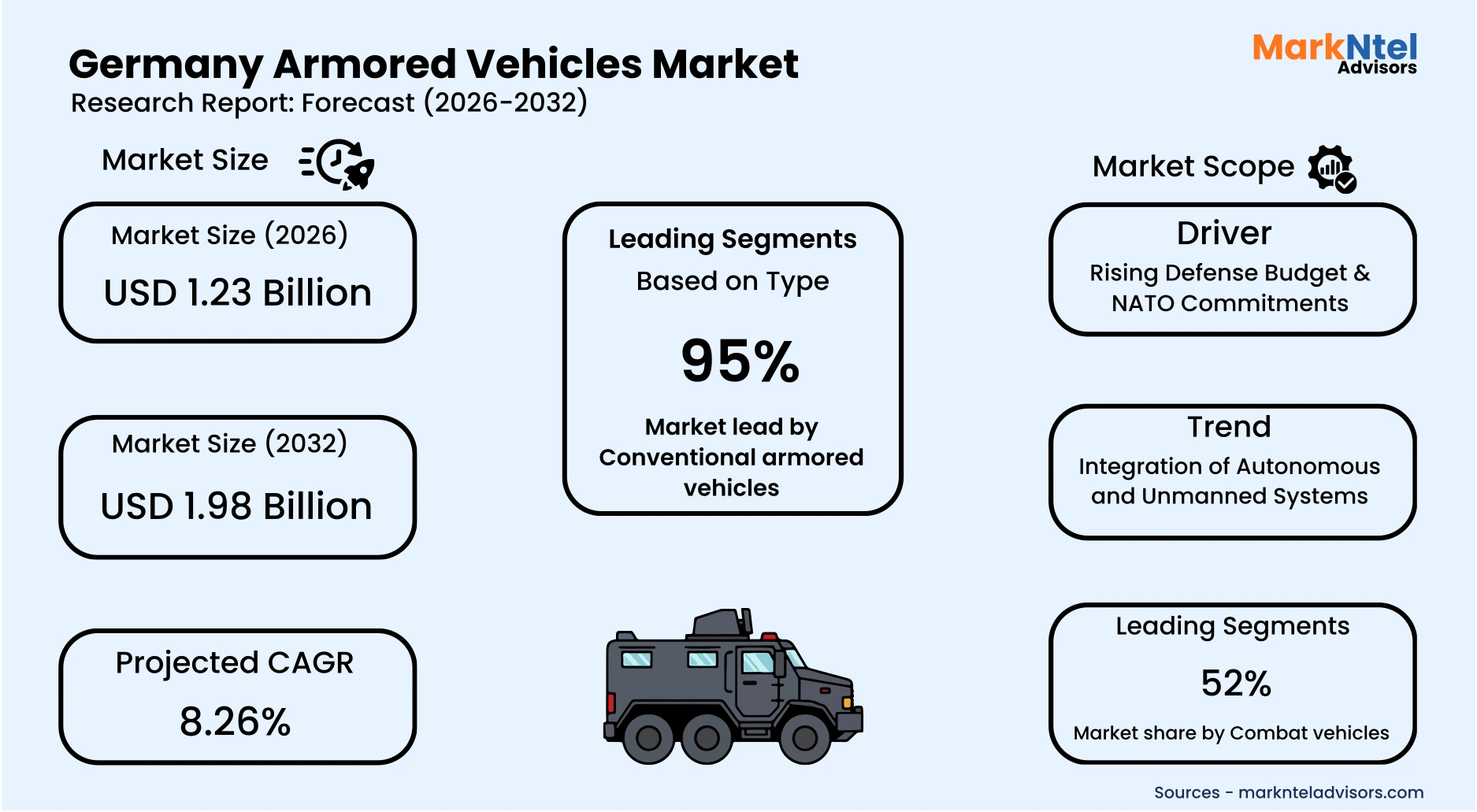
- The Germany Armored Vehicles Market size was valued at USD 1.01 billion in 2025 and is projected to grow from USD 1.23 billion in 2026 to USD 1.98 billion by 2032, exhibiting a CAGR of 8.26% during the forecast period.
- By type, the conventional armoured vehicles segment represented a significant share of about 95% in the Germany Armored Vehicles Market in 2026.
- By platform, the combat vehicles segment presented a significant share of about 52% in the Germany Armored Vehicles Market in 2026.
- Leading Armored Vehicles companies in Germany are Rheinmetall AG, ARTEC GmbH, General Dynamics European Land Systems, Patria Group, KNDS, Iveco Defence Vehicles, BAE Systems, FFG (Flensburger Fahrzeugbau Gesellschaft), Nexter Systems, Alpha Armouring Panzerung GmbH, and Others.
Market Insights & Analysis: Germany Armored Vehicles Market (2026-32):
The Germany Armored Vehicles Market size was valued at around USD 1.01 billion in 2025 and is projected to grow from USD 1.23 billion in 2026 to USD 1.98 billion by 2032. Along with this, the market is estimated to grow at a CAGR of around 8.26% during the forecast period, i.e., 2026-32.
The Germany armored vehicles market is experiencing steady expansion, primarily supported by increasing defense expenditures and long-term military modernization initiatives aimed at strengthening national security and alliance commitments. The government of Germany continues to prioritize capability enhancement programs for the Bundeswehr, reflecting the country’s strategic role within NATO. Rising geopolitical tensions and evolving warfare requirements are encouraging investments in advanced armored mobility platforms, firepower systems, and digital battlefield technologies, creating a favorable environment for sustained procurement growth.
Recent procurement activities highlight this momentum. In December 2025, ARTEC secured a contract worth approximately USD 1.3 billion for the initial batch of 84 RCH155 remote-controlled wheeled howitzers for the German Armed Forces. The platform integrates armored protection, high mobility, and advanced artillery capabilities, demonstrating Germany’s commitment to next-generation land combat systems and reinforcing domestic manufacturing demand across the defense supply chain. Such contracts provide long-term revenue visibility for industry participants while supporting technological advancement in armored vehicle platforms.
In addition to domestic procurement, Germany’s international defense commitments are also influencing market growth. In August 2025, the country announced a USD 500 million NATO-aligned military assistance package for Ukraine under the Prioritized Ukraine Requirements List (PURL) initiative. This move reflects Germany’s expanding defense responsibilities and procurement acceleration, indirectly stimulating production capacity and innovation across the armored vehicle sector. Continued participation in multinational defense initiatives is expected to further strengthen industrial output and supply chain resilience over the coming years.
Technological evolution is another defining factor shaping the market outlook. The growing integration of artificial intelligence, robotics, and autonomous capabilities into armored platforms is transforming battlefield operations and procurement priorities. For example, Rheinmetall AG demonstrated its Mission Master SP2 autonomous unmanned ground vehicle during NATO REPMUS/Dynamic Messenger exercises, performing complex reconnaissance operations with advanced sensors and drone integration. Such developments illustrate the shift toward unmanned and semi-autonomous systems designed to enhance operational efficiency while reducing personnel risk, signaling a major transition toward next-generation armored warfare technologies.
Looking ahead, sustained defense funding, modernization requirements, and technological innovation are expected to drive continued demand for armored platforms across combat and support applications. Industrial investments, collaborative programs, and export opportunities will further strengthen Germany’s position within the European defense ecosystem.
Overall, rising defense commitments combined with rapid technological advancements are expected to accelerate procurement cycles and innovation. These factors will collectively support long-term growth and strategic expansion of the Germany armored vehicles market.
Germany Armored Vehicles Market Recent Developments:
- 2025: KNDS rolled out the new Leopard 2A8 main battle tank for Germany and Norway, marking the first newly built German MBT platform in decades. The program supports European joint procurement, with deliveries starting in 2026. The project value runs into several billion USD.
- 2025: Rheinmetall announced the Skyranger 35 air-defense system mounted on Leopard 1 armored chassis under a contract valued in the hundreds of millions of USDs. The mobile platform enhances short-range air defense against drones and aerial threats .
Germany Armored Vehicles Market Scope:
| Category | Segments |
|---|---|
| By Type | (Conventional Armored Vehicles, Electric Armored Vehicles), |
| By Mobility | (Wheeled Armored Vehicles, Tracked Armored Vehicles), |
| By Platform | (Combat Vehicles, Combat Support Vehicles, Unmanned Armored Ground Vehicles (UGVs)), |
| By System | (Engines, Drive Systems, Ballistic Armors, Turret Drives, Fire Control Systems, Armaments, Others), |
| By Mode of Operation | (Manned Armored Vehicles, Unmanned Armored Vehicles), |
| By Point of Sale | (OEM, Retrofit), |
Germany Armored Vehicles Market Driver:
Rising Defense Budget & NATO Commitments
The steady increase in defense spending by Germany, aligned with NATO capability targets, is a major growth driver for the armored vehicles market. The government allocated about USD 101 billion for defense in 2025, representing roughly 2.4% of GDP, with total military-related spending reaching about USD 111 billion when Ukraine support is included. Long-term plans indicate a sharp rise to nearly USD 190 billion annually by 2029 to meet NATO targets of around 3.5% of GDP .
Germany is also implementing one of Europe’s largest rearmament programs, committing approximately USD 761 billion in military spending over five years, enabled by fiscal reforms and borrowing of about USD 469 billion to strengthen armed forces modernization . This funding directly supports procurement of next-generation armored platforms, including negotiations for 6,000–7,000 combat vehicles to expand brigade readiness and improve NATO interoperability .
Future investment plans further reinforce demand. Government fiscal projections show defense expenditure rising to around USD 89 billion in 2026, with spending potentially reaching 3.5% of GDP by 2029, alongside troop expansion and sustained annual security assistance programs . These initiatives will require continuous procurement, maintenance, and fleet upgrades of armored vehicles beyond 2025.
Overall, rising defense allocations and NATO commitments ensure sustained procurement pipelines and modernization programs. This financial certainty will significantly accelerate armored vehicle demand, strengthening long-term market growth in Germany.
Germany Armored Vehicles Market Trend:
Integration of Autonomous and Unmanned Systems
The integration of autonomous and unmanned technologies is emerging as a major trend in the Germany armored vehicles market, driven by the need to enhance battlefield safety, operational efficiency, and mission flexibility. The German Federal Armed Forces (Bundeswehr) is increasingly adopting unmanned ground vehicles (UGVs) for high-risk missions such as explosive ordnance disposal, reconnaissance, and logistics support. In March 2025, the Bundeswehr awarded a contract to supply 41 Telemax HT300 unmanned ground vehicles, with deliveries scheduled from summer 2025 through 2027, demonstrating long-term institutional commitment to robotic land systems integration .
Additionally, domestic defense companies are investing heavily in autonomy software and AI-enabled vehicle technologies. For instance, Rheinmetall announced investments to accelerate deployment of its PATH Autonomous Kit, designed to integrate autonomous navigation capabilities into both crewed and uncrewed military platforms, supported by new autonomy centers in Europe .
Germany’s broader defense innovation strategy also emphasizes robotics and AI-driven warfare capabilities. Government-supported defense startups developing autonomous systems have gained significant funding momentum as the country prioritizes next-generation military technologies amid evolving security threats in Europe.
Overall, the increasing deployment of autonomous systems across logistics, combat support, and surveillance roles reflects a structural shift toward network-centric and human-machine integrated warfare, strengthening future demand for advanced armored vehicle platforms.
Germany Armored Vehicles Market Opportunity:
Next-Generation Combat Vehicle Programs
Next-generation combat vehicle programs present a significant growth opportunity for the Germany armored vehicles market, driven by long-term modernization plans and multinational defense collaborations. A key initiative is the Main Ground Combat System (MGCS), a joint program between Germany and France designed to replace legacy Leopard 2 tanks with an advanced networked combat platform by around 2040. The program is expected to integrate manned tanks, unmanned vehicles, artificial intelligence, and advanced sensors into a single combat ecosystem, creating sustained demand for next-generation armored technologies.
Financially, large procurement commitments further strengthen this opportunity. In 2025, Germany planned to acquire 424 wheeled armored vehicles worth approximately USD 8.11 billion, with deliveries scheduled from 2027 to 2031 and options for additional orders that could significantly increase total contract value . This demonstrates strong pipeline visibility for manufacturers and suppliers across vehicle platforms, subsystems, and modernization solutions.
Future defense expansion plans also support long-term growth. Germany intends to procure between 3,000 and 5,000 new wheeled armored vehicles by 2037 with an investment of about USD 8.7 billion, aligning with broader force expansion objectives through the mid-2030s. Such programs create sustained opportunities for domestic production, technology partnerships, and export potential.
Overall, next-generation combat programs ensure multi-year procurement cycles and technology upgrades, strengthening industrial demand. These initiatives will significantly accelerate armored vehicle innovation and market expansion in the coming decades.
Germany Armored Vehicles Market Challenge:
High Development & Procurement Costs
One of the major challenges affecting the armored vehicles market in Germany is the exceptionally high cost associated with advanced platform development, procurement, and lifecycle maintenance. Modern armored vehicles integrate sophisticated electronics, protection systems, and digital battlefield technologies, significantly increasing unit costs and program risks. For example, Germany’s planned procurement of up to 3,000 Boxer armored vehicles is estimated at USD 10.9 billion, highlighting the substantial financial burden associated with large-scale fleet modernization programs .
Similarly, procurement programs for infantry fighting vehicles also involve multi-billion-dollar commitments. Germany approved major defense contracts in 2025 that included approximately USD 4.2 billion for Puma infantry fighting vehicles, demonstrating the high capital intensity of land systems modernization.
Beyond acquisition costs, development complexity often results in delays, technical modifications, and cost escalations, increasing total ownership expenses for governments. Long procurement cycles also create budgeting pressures, particularly when defense spending must compete with social and economic priorities. Moreover, integration of next-generation technologies such as active protection systems, autonomous capabilities, and hybrid propulsion further raises research and testing expenditures.
Overall, high procurement and development costs can slow acquisition timelines and limit fleet expansion. However, sustained government funding commitments and modernization priorities ensure continued market demand despite these financial constraints.
Germany Armored Vehicles Market (2026-32) Segmentation Analysis:
The Germany Armored Vehicles Market study of MarkNtel Advisors evaluates & highlights the major trends and influencing factors in each segment. It includes predictions for the period 2026–32 at the global level. Based on the analysis, the market has been further classified as;
Based on Type:
-
- Conventional Armored Vehicles
- Electric Armored Vehicles
Conventional armored vehicles account for nearly 95% share of the market, reflecting the continued reliance on diesel-powered and mechanically driven military platforms. Despite growing interest in hybrid and electric propulsion technologies, conventional systems remain dominant due to proven battlefield reliability, established supply chains, and compatibility with existing military infrastructure. Defense forces prioritize operational readiness and logistical efficiency, both of which are currently better supported by conventional propulsion technologies compared to emerging electric alternatives.
Furthermore, electric armored vehicles are still in early development stages, facing limitations related to battery weight, energy density, charging infrastructure, and combat endurance requirements. Germany’s procurement programs largely focus on upgrading conventional fleets with improved armor protection, digital systems, and fuel-efficient engines rather than replacing them entirely. Cost considerations also play a major role, as transitioning to electric platforms would require significant infrastructure investment. Consequently, conventional armored vehicles continue to lead the market and are expected to remain dominant in the near term.
Based on Platform:
- Combat Vehicles
- Combat Support Vehicles
- Unmanned Armored Ground Vehicles (UGVs)
Combat vehicles dominate the Germany armored vehicles market with approximately 52% share, primarily due to the country’s ongoing military modernization programs and NATO commitments. Main battle tanks, infantry fighting vehicles, and armored personnel carriers remain essential for frontline combat readiness, territorial defense, and rapid deployment capabilities. Germany continues to invest heavily in upgrading legacy platforms and procuring next-generation combat systems to enhance firepower, survivability, and network-centric warfare integration.
In addition, geopolitical tensions in Europe have accelerated defense budgets, creating sustained demand for advanced combat platforms compared to support vehicles. Combat vehicles also attract higher unit costs due to complex weapon systems, advanced armor technologies, and electronic integration, which further strengthen their market share. Collaborative European defense programs and export opportunities contribute to segment growth, positioning combat vehicles as the primary focus area for manufacturers and defense authorities. As modernization initiatives continue through the decade, this segment is expected to maintain its leadership position within the market.
Germany Armored Vehicles Market (2026-32): Regional Projection
The Germany armored vehicles market is dominated by the North Rhine-Westphalia and Lower Saxony regions. These areas dominate the industry due to the strong presence of defense manufacturing facilities, testing grounds, and logistics infrastructure supporting armored vehicle production and maintenance activities. The regions benefit from proximity to military bases, industrial suppliers, and transportation networks, which improve supply chain efficiency and reduce production timelines.
A key example is the armored vehicle testing and production activities in Unterlüß, Lower Saxony, which serves as one of Germany’s major defense technology centers for land systems development and evaluation. The concentration of specialized engineering capabilities, workforce expertise, and government-supported defense infrastructure in these regions strengthens their leadership position in the national armored vehicles market. Additionally, ongoing modernization programs and procurement initiatives further increase industrial activity in northern and western Germany, ensuring sustained regional dominance over other parts of the country throughout the forecast period.
Gain a Competitive Edge with Our Germany Armored Vehicles Market Report:
- Germany Armored Vehicles Market Report by MarkNtel Advisors provides a detailed & thorough analysis of market size & share, growth rate, competitive landscape, and key players. This comprehensive analysis helps businesses gain a holistic understanding of the market dynamics & make informed decisions.
- This report also highlights current market trends & future projections, allowing businesses to identify emerging opportunities & potential challenges. By understanding market forecasts, companies can align their strategies & stay ahead of the competition.
- Germany Armored Vehicles Market Report aids in assessing & mitigating risks associated with entering or operating in the market. By understanding market dynamics, regulatory frameworks, and potential challenges, businesses can develop strategies to minimize risks & optimize their operations.
*Reports Delivery Format - Market research studies from MarkNtel Advisors are offered in PDF, Excel and PowerPoint formats. Within 24 hours of the payment being successfully received, the report will be sent to your email address.
Frequently Asked Questions
- Market Segmentation
- Introduction
- Product Definition
- Research Process
- Assumptions
- Executive Summary
- Germany Armored Vehicles Market Policies, Regulations, and Product Standards
- Germany Armored Vehicles Market Trends & Developments
- Germany Armored Vehicles Market Dynamics
- Growth Factors
- Challenges
- Germany Armored Vehicles Market Hotspot & Opportunities
- Germany Armored Vehicles Market Outlook, 2022-2032F
- Market Size & Outlook
- By Revenues (USD Million)
- Market Share & Outlook
- By Type- Market Size & Forecast 2022-2032, USD Million
- Conventional Armored Vehicles
- Electric Armored Vehicles
- By Mobility- Market Size & Forecast 2022-2032, USD Million
- Wheeled Armored Vehicles
- Tracked Armored Vehicles
- By Platform- Market Size & Forecast 2022-2032, USD Million
- Combat Vehicles
- Combat Support Vehicles
- Unmanned Armored Ground Vehicles (UGVs)
- By System- Market Size & Forecast 2022-2032, USD Million
- Engines
- Drive Systems
- Ballistic Armors
- Turret Drives
- Fire Control Systems
- Armaments
- Others
- By Mode of Operation - Market Size & Forecast 2022-2032, USD Million
- Manned Armored Vehicles
- Unmanned Armored Vehicles
- By Point of Sale- Market Size & Forecast 2022-2032, USD Million
- OEM
- Retrofit
- By Region - Market Size & Forecast 2022-2032, USD Million
- North
- South
- East
- West
- By Company
- Competition Characteristics
- Market Share & Analysis
- By Type- Market Size & Forecast 2022-2032, USD Million
- Market Size & Outlook
- Germany Conventional Armored Vehicles Market Outlook, 2022-2032
- Market Size & Outlook
- By Revenues (USD Million)
- Market Share & Outlook
- By Mobility- Market Size & Forecast 2022-2032, USD Million
- By Platform- Market Size & Forecast 2022-2032, USD Million
- By System- Market Size & Forecast 2022-2032, USD Million
- By Mode of Operation - Market Size & Forecast 2022-2032, USD Million
- By Point of Sale- Market Size & Forecast 2022-2032, USD Million
- By Region - Market Size & Forecast 2022-2032, USD Million
- Market Size & Outlook
- Germany Electric Armored Vehicles Market Outlook, 2022-2032
- Market Size & Outlook
- By Revenues (USD Million)
- Market Share & Outlook
- By Mobility- Market Size & Forecast 2022-2032, USD Million
- By Platform- Market Size & Forecast 2022-2032, USD Million
- By System- Market Size & Forecast 2022-2032, USD Million
- By Mode of Operation - Market Size & Forecast 2022-2032, USD Million
- By Point of Sale- Market Size & Forecast 2022-2032, USD Million
- By Region - Market Size & Forecast 2022-2032, USD Million
- Market Size & Outlook
- Germany Armored Vehicles Market Key Strategic Imperatives for Success & Growth
- Competitive Outlook
- Company Profiles
- Rheinmetall AG
- Business Description
- Product Portfolio
- Collaborations & Alliances
- Recent Developments
- Financial Details
- Others
- ARTEC GmbH
- Business Description
- Product Portfolio
- Collaborations & Alliances
- Recent Developments
- Financial Details
- Others
- General Dynamics European Land Systems
- Business Description
- Product Portfolio
- Collaborations & Alliances
- Recent Developments
- Financial Details
- Others
- Patria Group
- Business Description
- Product Portfolio
- Collaborations & Alliances
- Recent Developments
- Financial Details
- Others
- KNDS
- Business Description
- Product Portfolio
- Collaborations & Alliances
- Recent Developments
- Financial Details
- Others
- Iveco Defence Vehicles
- Business Description
- Product Portfolio
- Collaborations & Alliances
- Recent Developments
- Financial Details
- Others
- BAE Systems
- Business Description
- Product Portfolio
- Collaborations & Alliances
- Recent Developments
- Financial Details
- Others
- FFG (Flensburger Fahrzeugbau Gesellschaft)
- Business Description
- Product Portfolio
- Collaborations & Alliances
- Recent Developments
- Financial Details
- Others
- Nexter Systems
- Business Description
- Product Portfolio
- Collaborations & Alliances
- Recent Developments
- Financial Details
- Others
- Alpha Armouring Panzerung GmbH
- Business Description
- Product Portfolio
- Collaborations & Alliances
- Recent Developments
- Financial Details
- Others
- Rheinmetall AG
- Company Profiles
- Disclaimer
MarkNtel Advisors follows a robust and iterative research methodology designed to ensure maximum accuracy and minimize deviation in market estimates and forecasts. Our approach combines both bottom-up and top-down techniques to effectively segment and quantify various aspects of the market. A consistent feature across all our research reports is data triangulation, which examines the market from three distinct perspectives to validate findings. Key components of our research process include:
1. Scope & Research Design At the outset, MarkNtel Advisors define the research objectives and formulate pertinent questions. This phase involves determining the type of research—qualitative or quantitative—and designing a methodology that outlines data collection methods, target demographics, and analytical tools. They also establish timelines and budgets to ensure the research aligns with client goals.
2. Sample Selection and Data Collection In this stage, the firm identifies the target audience and determines the appropriate sample size to ensure representativeness. They employ various sampling methods, such as random or stratified sampling, based on the research objectives. Data collection is carried out using tools like surveys, interviews, and observations, ensuring the gathered data is reliable and relevant.
3. Data Analysis and Validation Once data is collected, MarkNtel Advisors undertake a rigorous analysis process. This includes cleaning the data to remove inconsistencies, employing statistical software for quantitative analysis, and thematic analysis for qualitative data. Validation steps are taken to ensure the accuracy and reliability of the findings, minimizing biases and errors.

4. Data Forecast and FinalizationThe final phase involves forecasting future market trends based on the analyzed data. MarkNtel Advisors utilize predictive modeling and time series analysis to anticipate market behaviors. The insights are then compiled into comprehensive reports, featuring visual aids like charts and graphs, and include strategic recommendations to inform client decision-making
We offer flexible licensing options to cater to varying organizational needs. Choose the pricing pack that best suits your requirements:
Buy Now Inquire Before Buying
 Request Customization
 Talk to our Consultant