

GCC Smart Parking Systems Market Research Report: Growth Drivers & Forecast (2026-2032)
By Component (Hardware, Software, Services), By Technology (IoT-Based Systems, AI-Based Systems, Cloud-Based Systems), By Application (Commercial, Government, Transport / Transit), ... By Solution (On-Street Parking, Off-Street Parking, Parking Garages, Parking Lots), and others Read more
- Automotive
- Mar 2026
- Pages 155
- Report Format: PDF, Excel, PPT
GCC Smart Parking Systems Market
Projected 5.5% CAGR from 2026 to 2032
Study Period
2026-2032
Market Size (2026)
USD 269 Million
Market Size (2032)
USD 371 Million
Base Year
2025
Projected CAGR
5.5%
Leading Segments
By End User: Commercial Buildings
GCC Smart Parking Systems Market Report Key Takeaways:
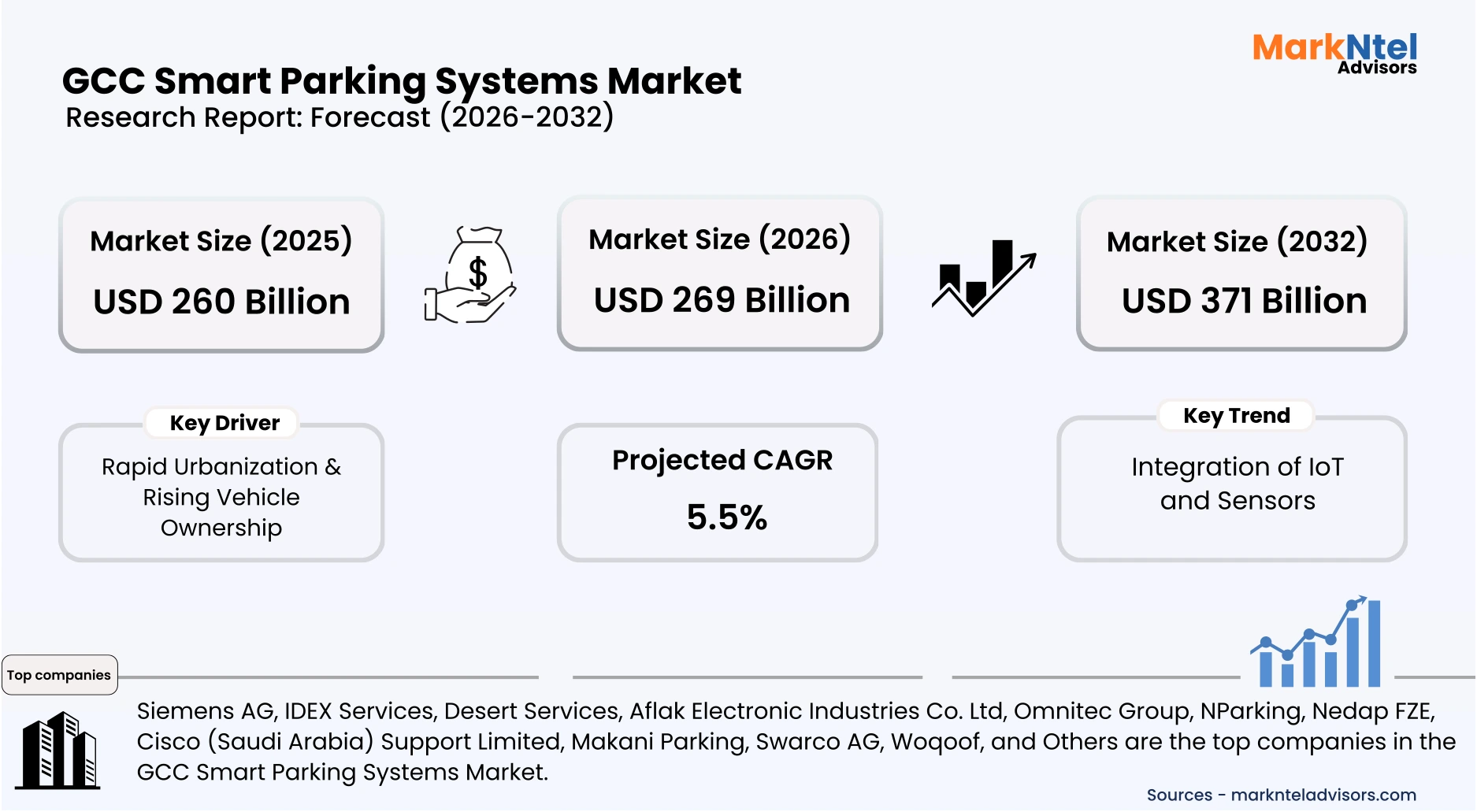
- Market size was valued at around USD 260 million in 2025 and is projected to grow USD 269 million in 2026 to USD 371 million by 2032. The estimated CAGR from 2026 to 2032 is around 5.5%, indicating strong growth.
- The UAE holds the largest market share of about 42% in the GCC Smart Parking Systems Market in 2026.
- By component, the hardware segment represented a significant share of about 32% in the GCC Smart Parking Systems Market in 2026.
- By application, the commercial segment presented a significant share of about 47% in the GCC Smart Parking Systems Market in 2026.
- Leading Smart Parking Systems companies in the GCC Market are Siemens AG, IDEX Services, Desert Services, Aflak Electronic Industries Co. Ltd, Omnitec Group, NParking, Nedap FZE, Cisco (Saudi Arabia) Support Limited, Makani Parking, Swarco AG, Woqoof, and Others.
Market Insights & Analysis: GCC Smart Parking Systems Market (2026-32):
The GCC Smart Parking Systems Market size was valued at around USD 260 million in 2025 and is projected to grow USD 269 million in 2026 to USD 371 million by 2032. Along with this, the market is estimated to grow at a CAGR of around 5.5% during the forecast period, i.e., 2026-32.
The GCC smart parking systems market is primarily driven by rapid urbanization and rising vehicle ownership in major cities, which has significantly increased the demand for parking spaces and highlighted the need for technology-driven solutions. Urban centers such as Dubai, Riyadh, and Doha are experiencing tremendous vehicle growth, creating congestion and inefficiencies in traditional parking infrastructure. For instance, Dubai’s registered vehicles reached approximately 4.56 million by mid‑2025, marking an addition of nearly 390,000 cars in a single year, a 9.35 % increase from 2024. During peak daytime hours, around 3.5 million vehicles operate on Dubai’s roads, underscoring the urgent need for efficient parking management systems to optimize urban mobility .
A significant trend shaping the market is the integration of IoT sensors and AI-powered analytics into smart parking systems. This technology enables real-time monitoring, predictive space allocation, and data-driven urban traffic management. In Doha, Qatar, the Smart Qatar (TASMU) Program has installed around 3,300 IoT-enabled parking sensors across key districts such as West Bay, Corniche, and Central Doha, monitoring over 18,000 parking spaces . These systems provide drivers with real-time parking availability information and digital guidance, reducing search times and alleviating congestion in busy urban areas.
Looking ahead, future investments in the GCC smart parking market are expected to further accelerate growth. In December 2024, Dubai’s Parkin Company PJSC signed a strategic MoU with Saudi BATIC Investment to expand smart city parking solutions across Saudi Arabia. This partnership focuses on deploying advanced digital parking technologies, real-time data analytics, and infrastructure enhancements, aligned with Saudi Vision 2030, to support sustainable urban mobility and improve city-wide traffic efficiency.
The convergence of rising vehicle ownership, urbanization, and advanced technology adoption is creating a high-growth environment for smart parking providers in the GCC. With governments actively promoting smart city initiatives, integrating IoT, AI, and EV-ready infrastructure, the market is positioned for sustained expansion over the next decade. These developments not only optimize parking and reduce congestion but also contribute to enhanced urban sustainability, smarter traffic management, and improved quality of life for residents across GCC cities.
GCC Smart Parking Systems Market Recent Developments:
- 2025: DP World partnered with Parkin Company PJSC to install a smart parking system at Dubai’s Al Aweer Central Fruit & Vegetable Market. This automated, license plate recognition‑based solution manages 2,500 vehicle spaces and 500 truck bays, cutting congestion and improving logistics efficiency.
- 2025: Parkonic, Salik Company PJSC, and Dubai Holding launched the region’s first autonomous, AI‑enabled parking covering 36,000 spaces. The system offers ticketless, barrier‑free entry with automatic, cashless billing, aligning with Dubai’s Smart City 2030 vision.
GCC Smart Parking Systems Market Scope:
| Category | Segments |
|---|---|
| By Component | (Hardware, Software, Services), |
| By Technology | (IoT-Based Systems, AI-Based Systems, Cloud-Based Systems), |
| By Application | (Commercial, Government, Transport / Transit), |
| By Solution | (On-Street Parking, Off-Street Parking, Parking Garages, Parking Lots), |
GCC Smart Parking Systems Market Driver:
Rapid Urbanization & Rising Vehicle Ownership
The GCC (Gulf Cooperation Council) region is experiencing significant urban growth, with its total population rising rapidly in recent decades and urbanization continuing to intensify. Between 1995 and 2023, the GCC population more than doubled from about 26.2 million to around 57.6 million, with urbanization rates exceeding 80 % in countries like Saudi Arabia and the UAE, and projected to reach approximately 95.1 % by 2050. This increasing concentration of people in cities puts immense pressure on existing transport infrastructure.
Concurrently, vehicle ownership is surging. The UAE recorded nearly 318,981 new vehicle registrations in 2024, marking a 15.7 % annual increase, while Saudi Arabia surpassed 1 million new vehicle registrations for the first time, indicating a rapid rise in personal mobility demand .
As urban populations swell and more residents own cars, traditional parking facilities struggle to meet demand. Congested roads and limited parking spaces in major cities like Dubai, Riyadh, Doha, and Abu Dhabi underscore the need for intelligent, technology‑driven parking management systems. GCC governments are responding with extensive urban master plans that prioritize smart mobility, reducing congestion and enhancing quality of life.
Looking beyond 2025, major initiatives such as metro expansions, transit‑oriented developments, and smart city frameworks across GCC capitals will further elevate urban mobility needs. These trends will continue to amplify demand for smart parking technologies, as efficient parking solutions become integral to sustainable city planning.
Overall, accelerating urbanization and surging vehicle ownership in the GCC are creating acute parking pressures, making smart parking systems essential to modern urban infrastructure, a trend expected to fuel market growth well into the next decade.
GCC Smart Parking Systems Market Trend:
Integration of IoT and Sensors
In the GCC, cities are rapidly deploying IoT‑enabled smart parking technologies that rely on sensors and connected systems to optimize urban mobility. For example, Dubai’s Roads & Transport Authority (RTA) has installed over 2,030 smart parking sensors and 70 digital cameras across Al Rigga, World Trade Centre, and Sheikh Zayed Road parking zones. These sensors detect vehicle presence and provide real‑time parking availability information via the RTA mobile app and street signboards, reducing search times by up to 30% for drivers .
Similarly, Qatar’s Smart Parking service, launched under the Smart Qatar (TASMU) Program, integrates IoT sensors to monitor and share availability data for more than 28,000 parking spaces in Doha’s key commercial and urban zones such as Corniche, West Bay, and Souq Waqif . This system provides drivers with real‑time guidance to open spaces and supports efficient space utilization.
Governments in the region are now mandating sensor‑based smart parking solutions in urban developments to alleviate congestion, enhance urban experience, and align with broader smart city strategies. For instance, Qatar’s regulatory framework requires integration of IoT parking systems in new public developments to improve mobility and reduce environmental impact.
This trend reflects a fundamental shift toward data‑driven parking management where IoT sensors act as the backbone, enabling real‑time occupancy tracking, centralized monitoring, and automated guidance. Such deployments not only improve driver convenience but also help city planners optimize traffic flow, inform future urban transport decisions, and enhance sustainability objectives across GCC smart cities.
GCC Smart Parking Systems Market Opportunity
Integration with EV Charging Infrastructure
The growing adoption of electric vehicles (EVs) in the GCC presents a significant opportunity for smart parking systems to integrate charging infrastructure, transforming parking facilities into multi-functional mobility hubs. In the UAE, the Dubai Electricity and Water Authority (DEWA) has expanded its EV Green Charger network to over 1,270 public charging points by mid-2025, serving more than 40,600 electric vehicles. The UAE aims for electric and hybrid vehicles to account for 50% of all cars by 2050, highlighting the need for smart parking systems that can provide real-time charger availability, reservation, and payment solutions .
In Saudi Arabia, the Electric Vehicle Infrastructure Company (EVIQ), backed by the Public Investment Fund, plans to deploy over 5,000 fast chargers across more than 1,000 strategic locations by 2030. These chargers will be integrated with public and private parking spaces, supporting the Kingdom’s Vision 2030 sustainable mobility goals and enabling smarter urban transport networks .
By integrating EV charging with smart parking systems, operators can offer dynamic pricing, real-time monitoring, and enhanced user convenience, unlocking new revenue streams. Furthermore, such integration aligns with GCC smart city initiatives, reducing urban congestion and promoting sustainable mobility. As EV adoption accelerates, the demand for intelligent, EV-ready parking solutions will drive significant market growth across the region in the coming decade.
GCC Smart Parking Systems Market Challenge:
High initial deployment and infrastructure integration costs
A major challenge in the GCC smart parking systems market is the high initial capital investment and infrastructure integration costs required for deployment. Smart parking systems require the installation of IoT sensors, ANPR cameras, digital payment terminals, fiber connectivity, control centers, and cloud-based data platforms. These components must also be integrated with existing urban traffic management systems, increasing technical complexity and financial burden.
For example, Saudi Arabia’s NEOM smart city project, backed by the sovereign Public Investment Fund (PIF), is expected to require approximately USD 500 billion in total capital expenditure, according to official PIF documentation. While NEOM covers multiple infrastructure sectors, it illustrates the scale of funding necessary for integrated digital mobility and intelligent urban systems .
Similarly, large-scale transport infrastructure programs across GCC countries require multi-billion-dollar allocations, and incorporating smart parking into these frameworks demands additional system upgrades, interoperability solutions, and cybersecurity investments.
Beyond installation, municipalities must also fund recurring operational costs such as maintenance, software licensing, data hosting, and system calibration. For smaller GCC cities, these financial requirements can delay adoption timelines.
GCC Smart Parking Systems Market (2026-32) Segmentation Analysis:
The GCC Smart Parking Systems Market study of MarkNtel Advisors evaluates & highlights the major trends and influencing factors in each segment. It includes predictions for the period 2026–32 at the global level. Based on the analysis, the market has been further classified as;
Based on Component:
- Hardware
- Sensors
- Cameras
- Smart Meters
- Display Systems
- Software
- Parking Guidance Systems
- Analytics Solutions
- Services
- Consulting Services
- Engineering Services
- Maintenance Services
The hardware segment, representing approximately 32% of the market, dominates because smart parking infrastructure relies heavily on physical devices such as sensors, cameras, smart meters, and digital display systems. These components form the foundational layer of any smart parking ecosystem, enabling space detection, vehicle identification, occupancy monitoring, and user guidance.
Initial deployment of smart parking systems requires large-scale installation of IoT sensors, automated ticketing machines, barriers, and surveillance equipment. Compared to software and services, hardware involves higher upfront capital expenditure, contributing to its larger revenue share. Moreover, expanding urban infrastructure and new commercial developments across GCC countries require fresh hardware installations rather than simple software upgrades.
Even in retrofit projects, existing facilities must invest in sensor replacement, camera upgrades, and new smart meters to integrate with digital platforms. As cities expand and modernize transportation infrastructure, hardware demand remains strong, securing its leading market share.
Based on End User:
- Residential Buildings
- Commercial Buildings
- Industrial Facilities
- Government & Public Sector Projects
- Institutional Buildings
The commercial segment, accounting for approximately 47% of the GCC smart parking systems market, leads due to strong demand from shopping malls, mixed-use developments, airports, hospitals, hotels, and business districts. GCC cities such as Dubai, Riyadh, and Doha have rapidly expanded retail and hospitality infrastructure to support tourism and economic diversification initiatives. Commercial establishments prioritize smart parking to enhance customer experience, reduce vehicle search time, and optimize space utilization.
High vehicle density in urban business hubs increases parking turnover rates, making automated payment systems, real-time occupancy tracking, and digital guidance essential. Additionally, private commercial operators are often more willing than public authorities to invest in advanced systems because they directly benefit from revenue optimization, reduced leakage, and operational efficiency. Integration with mobile apps and digital payment platforms further strengthens adoption in commercial environments.
As GCC economies continue expanding non-oil sectors such as tourism, retail, and entertainment, demand from commercial facilities is expected to sustain this segment’s leadership position.
GCC Smart Parking Systems Market (2026-32): Regional Projection
The GCC Smart Parking Systems Market is dominated by the United Arab Emirates (UAE), with a market share of about 42%, particularly Dubai, due to its advanced smart city framework, strong regulatory support, and early adoption of intelligent transport technologies. Dubai has invested heavily in digital mobility infrastructure to manage high vehicle density and urban congestion. A key example is Parkin Company PJSC, Dubai’s largest paid public parking operator, which managed approximately 211,500 parking spaces by mid-2025, including about 188,700 public spaces. The company added nearly 11,700 new spaces within a year, reflecting the continuous expansion of structured and on-street smart parking systems across the emirate. This demonstrates large-scale deployment of digital monitoring, automated payments, and integrated enforcement technologies in a centralized model.
Strong public-private partnerships, rapid urban development, and proactive digital transformation policies continue to position the UAE as the leading smart parking market within the GCC region.
Gain a Competitive Edge with Our GCC Smart Parking Systems Market Report:
- GCC Smart Parking Systems Market Report by MarkNtel Advisors provides a detailed & thorough analysis of market size & share, growth rate, competitive landscape, and key players. This comprehensive analysis helps businesses gain a holistic understanding of the market dynamics & make informed decisions.
- This report also highlights current market trends & future projections, allowing businesses to identify emerging opportunities & potential challenges. By understanding market forecasts, companies can align their strategies & stay ahead of the competition.
- GCC Smart Parking Systems Market Report aids in assessing & mitigating risks associated with entering or operating in the market. By understanding market dynamics, regulatory frameworks, and potential challenges, businesses can develop strategies to minimize risks & optimize their operations.
*Reports Delivery Format - Market research studies from MarkNtel Advisors are offered in PDF, Excel and PowerPoint formats. Within 24 hours of the payment being successfully received, the report will be sent to your email address.
Frequently Asked Questions
- Market Segmentation
- Introduction
- Product Definition
- Research Process
- Assumptions
- Executive Summary
- GCC Smart Parking Systems Market Policies, Regulations, and Product Standards
- GCC Smart Parking Systems Market Supply Chain Analysis
- GCC Smart Parking Systems Market Trends & Developments
- GCC Smart Parking Systems Market Dynamics
- Growth Drivers
- Challenges
- GCC Smart Parking Systems Market Hotspot & Opportunities
- GCC Smart Parking Systems Market Outlook, 2022-2032
- Market Size & Outlook
- By Revenues (USD Million)
- Market Share & Outlook
- By Component- Market Size & Forecast 2022-2032F, USD Million
- Hardware
- Sensors
- Cameras
- Smart Meters
- Display Systems
- Software
- Parking Guidance Systems
- Analytics Solutions
- Services
- Consulting Services
- Engineering Services
- Maintenance Services
- Hardware
- By Technology - Market Size & Forecast 2022-2032F, USD Million
- IoT-Based Systems
- AI-Based Systems
- Cloud-Based Systems
- By Application- Market Size & Forecast 2022-2032F, USD Million
- Commercial
- Government
- Transport / Transit
- By Solution- Market Size & Forecast 2022-2032F, USD Million
- On-Street Parking
- Off-Street Parking
- Parking Garages
- Parking Lots
- By Country
- The UAE
- Saudi Arabia
- Qatar
- Kuwait
- Oman
- Bahrain
- Rest of GCC
- By Company
- Company Revenue Shares
- Competitor Characteristics
- By Component- Market Size & Forecast 2022-2032F, USD Million
- Market Size & Outlook
- The UAE Smart Parking Systems Market Outlook, 2022-2032
- Market Size & Analysis
- Market Share & Analysis
- By Component- Market Size & Forecast 2022-2032, USD Million
- By Technology- Market Size & Forecast 2022-2032, USD Million
- By Application- Market Size & Forecast 2022-2032, USD Million
- By Solution- Market Size & Forecast 2022-2032, USD Million
- Saudi Arabia Smart Parking Systems Market Outlook, 2022-2032
- Market Size & Analysis
- Market Revenues (USD Million)
- Market Share & Analysis
- By Component- Market Size & Forecast 2022-2032, USD Million
- By Technology- Market Size & Forecast 2022-2032, USD Million
- By Application- Market Size & Forecast 2022-2032, USD Million
- By Solution- Market Size & Forecast 2022-2032, USD Million
- Market Size & Analysis
- Qatar Smart Parking Systems Market Outlook, 2022-2032
- Market Size & Analysis
- Market Revenues (USD Million)
- Market Share & Analysis
- By Component- Market Size & Forecast 2022-2032, USD Million
- By Technology- Market Size & Forecast 2022-2032, USD Million
- By Application- Market Size & Forecast 2022-2032, USD Million
- By Solution- Market Size & Forecast 2022-2032, USD Million
- Market Size & Analysis
- Kuwait Smart Parking Systems Market Outlook, 2022-2032
- Market Size & Analysis
- Market Revenues (USD Million)
- Market Share & Analysis
- By Component- Market Size & Forecast 2022-2032, USD Million
- By Technology- Market Size & Forecast 2022-2032, USD Million
- By Application- Market Size & Forecast 2022-2032, USD Million
- By Solution- Market Size & Forecast 2022-2032, USD Million
- Market Size & Analysis
- Oman Smart Parking Systems Market Outlook, 2022-2032
- Market Size & Analysis
- Market Revenues (USD Million)
- Market Share & Analysis
- By Component- Market Size & Forecast 2022-2032, USD Million
- By Technology- Market Size & Forecast 2022-2032, USD Million
- By Application- Market Size & Forecast 2022-2032, USD Million
- By Solution- Market Size & Forecast 2022-2032, USD Million
- Market Size & Analysis
- Bahrain Smart Parking Systems Market Outlook, 2022-2032
- Market Size & Analysis
- Market Revenues (USD Million)
- Market Share & Analysis
- By Component- Market Size & Forecast 2022-2032, USD Million
- By Technology- Market Size & Forecast 2022-2032, USD Million
- By Application- Market Size & Forecast 2022-2032, USD Million
- By Solution- Market Size & Forecast 2022-2032, USD Million
- Market Size & Analysis
- GCC Smart Parking Systems Market Key Strategic Imperatives for Success & Growth
- Competition Outlook
- Company Profiles
- Siemens AG
- Business Description
- Product Portfolio
- Strategic Alliances or Partnerships
- Recent Developments
- Financial Details
- Others
- IDEX Services
- Business Description
- Product Portfolio
- Strategic Alliances or Partnerships
- Recent Developments
- Financial Details
- Others
- Desert Services
- Business Description
- Product Portfolio
- Strategic Alliances or Partnerships
- Recent Developments
- Financial Details
- Others
- Aflak Electronic Industries Co. Ltd
- Business Description
- Product Portfolio
- Strategic Alliances or Partnerships
- Recent Developments
- Financial Details
- Others
- Omnitec Group
- Business Description
- Product Portfolio
- Strategic Alliances or Partnerships
- Recent Developments
- Financial Details
- Others
- NParking
- Business Description
- Product Portfolio
- Strategic Alliances or Partnerships
- Recent Developments
- Financial Details
- Others
- Nedap FZE
- Business Description
- Product Portfolio
- Strategic Alliances or Partnerships
- Recent Developments
- Financial Details
- Others
- Cisco (Saudi Arabia) Support Limited
- Business Description
- Product Portfolio
- Strategic Alliances or Partnerships
- Recent Developments
- Financial Details
- Others
- Swarco AG
- Business Description
- Product Portfolio
- Strategic Alliances or Partnerships
- Recent Developments
- Financial Details
- Others
- Makani Parking
- Business Description
- Product Portfolio
- Strategic Alliances or Partnerships
- Recent Developments
- Financial Details
- Others
- Woqoof
- Business Description
- Product Portfolio
- Strategic Alliances or Partnerships
- Recent Developments
- Financial Details
- Others
- Others
- Siemens AG
- Company Profiles
- Disclaimer
MarkNtel Advisors follows a robust and iterative research methodology designed to ensure maximum accuracy and minimize deviation in market estimates and forecasts. Our approach combines both bottom-up and top-down techniques to effectively segment and quantify various aspects of the market. A consistent feature across all our research reports is data triangulation, which examines the market from three distinct perspectives to validate findings. Key components of our research process include:
1. Scope & Research Design At the outset, MarkNtel Advisors define the research objectives and formulate pertinent questions. This phase involves determining the type of research—qualitative or quantitative—and designing a methodology that outlines data collection methods, target demographics, and analytical tools. They also establish timelines and budgets to ensure the research aligns with client goals.
2. Sample Selection and Data Collection In this stage, the firm identifies the target audience and determines the appropriate sample size to ensure representativeness. They employ various sampling methods, such as random or stratified sampling, based on the research objectives. Data collection is carried out using tools like surveys, interviews, and observations, ensuring the gathered data is reliable and relevant.
3. Data Analysis and Validation Once data is collected, MarkNtel Advisors undertake a rigorous analysis process. This includes cleaning the data to remove inconsistencies, employing statistical software for quantitative analysis, and thematic analysis for qualitative data. Validation steps are taken to ensure the accuracy and reliability of the findings, minimizing biases and errors.

4. Data Forecast and FinalizationThe final phase involves forecasting future market trends based on the analyzed data. MarkNtel Advisors utilize predictive modeling and time series analysis to anticipate market behaviors. The insights are then compiled into comprehensive reports, featuring visual aids like charts and graphs, and include strategic recommendations to inform client decision-making
We offer flexible licensing options to cater to varying organizational needs. Choose the pricing pack that best suits your requirements:
Buy Now Inquire Before Buying
 Request Customization
 Talk to our Consultant







