

Europe Long-Range Weapons Market Research Report: Trends, Forecast & Opportunities (2026-2032)
By Weapon Type (Cruise Missiles, Ballistic Missiles, Long-Range Artillery Systems, Long-Range Rocket Systems, Hypersonic Weapons, Loitering Munitions), By Range Category (Short-Ran ... ge, Medium Range, Long-Range), By Guidance System (GPS/Satellite Guidance, Inertial Navigation Systems, Laser Guidance, Radar Guidance, Infrared Guidance, Multi-Mode / AI-Enabled Guidance), By Launch Platform (Air Launched, Land-Based, Naval, Submarine-Launched), By End User (Military & Defense Forces, Homeland & National Security Agencies, Other Government Agencies), and others Read more
- Aerospace & Defense
- Mar 2026
- Pages 235
- Report Format: PDF, Excel, PPT
Europe Long-Range Weapons Market
Projected 6.99% CAGR from 2026 to 2032
Study Period
2026-2032
Market Size (2026)
USD 4.0 Billion
Market Size (2032)
USD 6.0 Billion
Base Year
2025
Projected CAGR
6.99%
Leading Segments
By End User: Military & Defense Forces
Europe Long-Range Weapons Market Report Key Takeaways:
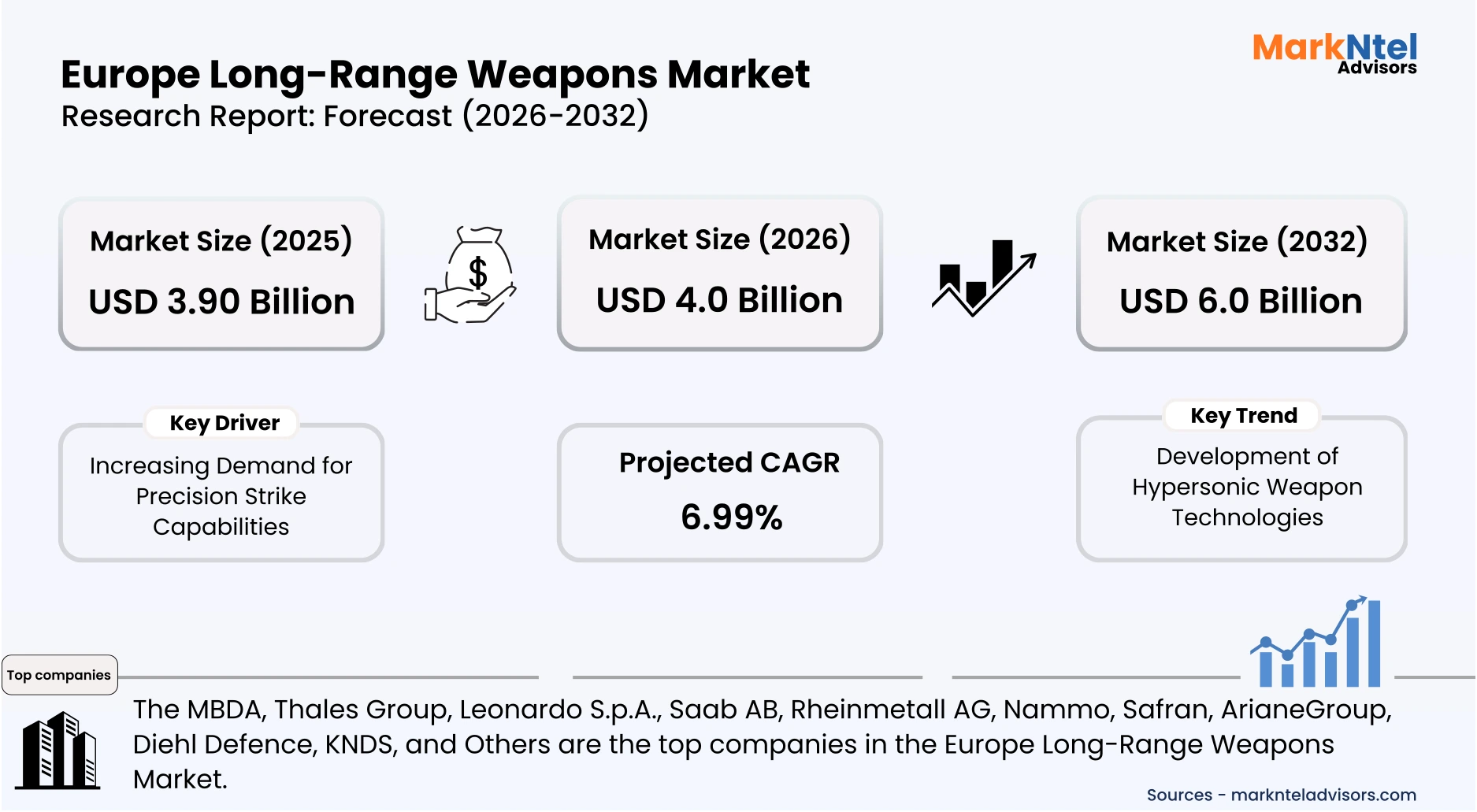
- The Europe Long-Range Weapons Market size was valued at USD 3.90 billion in 2025 and is projected to grow from USD 4.0 billion in 2026 to USD 6.0 billion by 2032, exhibiting a CAGR of 6.99% during the forecast period.
- Germany holds the largest market share of about 24% in the Europe Long-Range Weapons Market in 2026.
- By weapon type, the Cruise Missiles hold a significant share of about 67% in the Europe Long-Range Weapons Market in 2026.
- By end users, the Military & Defense Forces seized a significant share of about 90% in the Europe Long-Range Weapons Market in 2026.
- Leading long-range weapons companies in the European market are MBDA, Thales Group, Leonardo S.p.A., Saab AB, Rheinmetall AG, Nammo, Safran, ArianeGroup, Diehl Defence, KNDS, and Others.
Market Insights & Analysis: Europe Long-Range Weapons Market (2026-32):
The Europe Long-Range Weapons Market size was valued at around USD 3.90 billion in 2025 and is projected to grow from USD 4.0 billion in 2026 to USD 6.0 billion by 2032. Along with this, the market is estimated to grow at a CAGR of around 6.99% during the forecast period, i.e., 2026-32.
The Europe long-range weapons market is primarily driven by the increasing demand for precision strike capabilities to accurately engage high-value targets from long distances while minimizing collateral damage.
The Europe long‑range weapons market is poised for robust growth driven by evolving security dynamics, technological advancement, and expanding multinational defense collaboration. At its core, the market is being shaped by the growing demand for precision strike capabilities. Modern military operations increasingly require systems capable of engaging high‑value targets at extended ranges with minimal collateral damage. This demand is reflected in strategic defense investments adopted by European nations across the region.
France, for example, is actively strengthening its deep‑strike and deterrence capabilities through collaboration with European allies. The country is integrating strategic strike platforms with enhanced missile defense systems to address emerging regional threats and fortify collective security . Such partnerships underscore Europe’s commitment to interoperable capabilities capable of responding to complex threats.
Northern European nations have also increased their focus on precision long‑range systems. Denmark’s decision to field long‑range precision strike weapons as part of a substantial USD 9.2 billion air defense investment reflects broader NATO goals of achieving robust self‑defense by 2030 .
A key technology trend accelerating market growth is the rapid development and deployment of hypersonic weapons. Hypersonic systems offer extreme speed (typically above Mach 5), improved precision, and greater survivability against advanced air defenses. France is a leading player in this arena with programs such as the Air‑Sol Nucléaire de 4ᵉ Génération (ASN4G) missile and the V‑MaX hypersonic glide vehicle, which is expected to achieve Mach 6–7 speeds and ranges above 1,000 km, slated to replace the ASMP‑A by 2035 .
Looking ahead, collaborative defense initiatives will play a pivotal role in shaping the market. Under the European Long‑Range Strike Approach (ELSA), countries including Germany, the UK, France, Italy, Poland, Sweden, and the Netherlands are jointly developing advanced precision missiles with ranges up to 2,000 km. This cooperative framework aims to introduce next‑generation long‑range strike systems within the next decade, enhancing collective deterrence and force projection .
National modernization programs further reinforce this outlook. Germany plans to begin production of the upgraded Taurus NEO long‑range cruise missile by 2029, supported by a USD 483 million budget and the potential procurement of up to 600 missiles costing around USD 2.3 billion to augment its precision strike arsenal.
The Europe long‑range weapons market is entering a phase of sustained expansion. With strong demand for precision strike systems, rapid technological advancements, particularly in hypersonic capabilities, and deepening multinational collaboration, the market is expected to witness notable growth through the late 2020s and beyond. Strategic investments and coordinated defense planning across European nations will continue to underpin this trajectory.
Europe Long-Range Weapons Market Recent Developments:
- 2025: MBDA unveiled the Akeron MBT 120 gun-launched missile at the DSEI defense exhibition in London. The system allows main battle tanks to strike targets beyond line-of-sight using standard 120-mm cannons, enabling long-range precision engagement against armored vehicles and fortified positions.
Europe Long-Range Weapons Market Scope:
| Category | Segments |
|---|---|
| By Weapon Type | (Cruise Missiles, Ballistic Missiles, Long-Range Artillery Systems, Long-Range Rocket Systems, Hypersonic Weapons, Loitering Munitions), |
| By Range Category | (Short-Range, Medium Range, Long-Range), |
| By Guidance System | (GPS/Satellite Guidance, Inertial Navigation Systems, Laser Guidance, Radar Guidance, Infrared Guidance, Multi-Mode / AI-Enabled Guidance), |
| By Launch Platform | (Air Launched, Land-Based, Naval, Submarine-Launched), |
| By End User | (Military & Defense Forces, Homeland & National Security Agencies, Other Government Agencies), |
Europe Long-Range Weapons Market Driver:
Increasing Demand for Precision Strike Capabilities
The growing demand for precision strike capabilities is a key driver of the Europe long-range weapons market. Modern military operations increasingly require weapons that can accurately engage high-value targets from long distances while minimizing collateral damage. To meet this need, European governments are investing heavily in advanced missile and long-range strike systems equipped with GPS, radar, and multi-mode guidance technologies.
Rising geopolitical tensions across Europe have accelerated the deployment of precision-guided weapons. For instance, Germany approved approximately USD 483 million to develop the Taurus NEO cruise missile, capable of highly accurate strikes on strategic infrastructure such as bunkers, bridges, and airbases. Similarly, Spain is procuring Taurus KEPD 350 cruise missiles (~500 km range) and integrating precision weapons into aircraft and naval platforms, enhancing strike performance and interoperability with NATO forces .
European defense expenditure has been rising steadily to support these initiatives. According to the European Defence Agency (EDA), defense spending across EU member states reached USD 372 billion in 2024 and is projected to grow to nearly USD 425 billion in 2025. Overall, European military expenditure increased by 17% to about USD 693 billion in 2024, reflecting the urgent need for advanced missile capabilities . Looking ahead, NATO discussions indicate that defense budgets may reach USD 800 billion by 2030 to further strengthen military readiness and next-generation long-range strike systems .
Overall, the continuous focus on precision-guided long-range weapons, combined with sustained defense investments, ensures that demand for advanced missile systems will remain a significant growth driver for the Europe long-range weapons market.
Europe Long-Range Weapons Market Trend:
Development of Hypersonic Weapon Technologies
A key trend shaping the Europe long‑range weapons market is the accelerated development of hypersonic weapon technologies, driven by strategic defense priorities and heightened security concerns. Hypersonic weapons travel at speeds above Mach 5, combining extreme velocity with advanced maneuverability, making them difficult to detect or intercept and thus highly valuable for deep‑strike precision missions. European efforts are gaining traction; the UK government announced a commitment of over USD 500+ million in 2026 toward hypersonic and long‑range missile development in partnership with France, Germany, and Italy, enhancing capabilities beyond current Storm Shadow systems with next‑generation designs exceeding 2,000 km range .
Private and public sector initiatives are also emerging. German‑British startup Hypersonica successfully conducted a hypersonic test flight, achieving speeds above Mach 6 with a prototype range of over 300 km, and plans to deliver a sovereign European hypersonic strike capability by 2029 . Meanwhile, the European Defence Fund has earmarked significant funding, approximately 200 million euros, in its 2026 work programme specifically for hypersonic threat mitigation and advanced interception systems, underscoring Europe’s strategic focus on both offensive and defensive hypersonic technologies .
With substantial government investments, new technological breakthroughs, and multinational collaboration, the development of hypersonic weapon systems is rapidly advancing. This trend enhances Europe’s long‑range strike capabilities and drives future innovation, significantly bolstering market growth in the long‑range weapons sector.
Europe Long-Range Weapons Market Opportunity:
Growing Collaboration in European Defense Programs
The expanding collaboration among European nations in defense development presents a significant opportunity for the Europe long-range weapons market. Governments across the region are increasingly pursuing joint research, procurement, and development programs to reduce costs, strengthen military capabilities, and improve technological innovation. One major initiative supporting such cooperation is the European Defence Fund (EDF), which has a total budget of about USD 8 billion for 2021–2027 to finance collaborative defense research and capability development among EU member states.
In 2025, the European Commission allocated USD 1.15 billion through the EDF to fund joint defense research and development projects across Europe. These projects involve cross-border industrial consortia and focus on advanced technologies such as missile systems, autonomous platforms, and next-generation weapons, strengthening Europe’s collective defense innovation ecosystem .
Another example is the Future Cruise/Anti-Ship Weapon (FC/ASW) program, a multinational initiative launched by France and the United Kingdom, with Italy joining in 2023, to develop a next-generation missile family replacing systems such as Storm Shadow, Exocet, and Harpoon . The program involves shared funding, joint technology development, and collaborative testing among European defense industries.
Growing geopolitical challenges have encouraged European governments to strengthen joint defense manufacturing and procurement. These collaborative frameworks enable countries to pool financial resources, accelerate technological development, and reduce duplication in weapons programs.
Overall, as Europe increasingly prioritizes collective security and technological sovereignty, multinational defense partnerships are expected to expand. This growing collaboration will create substantial opportunities for joint development of advanced long-range weapons and significantly support market expansion in the coming years.
Europe Long-Range Weapons Market Challenge:
High Development and Procurement Costs
A significant challenge in the Europe long‑range weapons market is the substantial financial burden associated with developing and procuring advanced systems. European governments have sharply increased defense spending, but high costs still strain budgets and complicate procurement decisions. According to European Defence Agency (EDA) data, EU member states’ defense expenditure reached USD 402 billion in 2024, with investment spending, including research, development, and equipment procurement, rising sharply to USD 124 billion. Of this, equipment procurement accounted for more than 80% of total investment, illustrating the heavy cost burden placed on acquiring complex long‑range weapons systems. Procurement expenditure is projected to exceed USD 118 billion in 2025, highlighting accelerating costs in missile systems and related technologies .
Funding research and development (R&D) remains expensive; total defense R&D spending reached USD 15 billion in 2024, with projections of USD 20 billion in 2025, a significant share directed toward long‑range systems, hypersonic counters, and next‑generation capabilities . Such high investment requirements can limit smaller nations’ ability to participate in cutting‑edge programs and create procurement bottlenecks across Europe. Additionally, complex joint procurement initiatives aimed at reducing duplication still face challenges in harmonizing budgets and timelines among member states.
The escalating costs of development, R&D, and procurement pose a major challenge for Europe’s long‑range weapons market, requiring careful budget prioritization, collaborative funding mechanisms, and cost‑sharing strategies to sustain growth and capability enhancements.
Europe Long-Range Weapons Market (2026-32) Segmentation Analysis:
The Europe Long-Range Weapons Market study of MarkNtel Advisors evaluates & highlights the major trends and influencing factors in each segment. It includes predictions for the period 2026–32 at the regional level. Based on the analysis, the market has been further classified as;
Based on Weapon Type:
-
- Cruise Missiles
- Ballistic Missiles
- Long-Range Artillery Systems
- Long-Range Rocket Systems
- Hypersonic Weapons
- Loitering Munitions
Cruise missiles dominate the Europe long-range weapons market, accounting for nearly 67% of the segment. Their leadership is largely driven by their high precision, long operational range, and advanced guidance capabilities that allow accurate strikes on strategic targets. Unlike ballistic missiles, cruise missiles travel at lower altitudes and can maneuver during flight, making them harder to detect and intercept by enemy defense systems. European defense programs increasingly prioritize precision-guided strike systems to minimize collateral damage while maintaining strong deterrence capabilities.
In addition, cruise missiles can be deployed from multiple platforms such as aircraft, naval vessels, and land-based launchers, which increases their operational flexibility. Many European countries are also investing heavily in upgrading their missile arsenals and developing next-generation cruise missile technologies with improved stealth and navigation systems. These advantages make cruise missiles a preferred option for long-range strike missions, intelligence-driven operations, and modern network-centric warfare strategies across Europe’s evolving defense landscape.
Based on End User:
-
- Military & Defense Forces
- Homeland & National Security Agencies
- Other Government Agencies
Military and defense forces represent the largest end-user segment in the Europe long-range weapons market, holding around 90% of the total demand. National armed forces rely heavily on long-range weapons to strengthen strategic deterrence, enhance battlefield superiority, and protect national security interests. European governments are significantly increasing their defense budgets to modernize military capabilities and address evolving geopolitical challenges. Long-range weapons such as cruise missiles, rocket systems, and hypersonic technologies are critical for conducting deep-strike operations and maintaining operational advantage over potential threats. Defense forces also require these advanced weapon systems to support integrated combat operations across air, land, and naval platforms.
Furthermore, NATO defense initiatives and joint military programs across European countries continue to drive procurement and development of sophisticated long-range weapon technologies. Because of their direct responsibility for national defense and combat readiness, military and defense forces remain the primary buyers and operators of long-range weapon systems across Europe.
Europe Long-Range Weapons Market (2026-32): Regional Projection
The Europe long-range weapons market is dominated by Germany, accounting for 24% of the regional size. Germany’s leadership stems from its large defense budget, advanced industrial base, and strong focus on precision‑strike and next‑generation weapon systems. In 2024, German defense spending increased by 17% to about USD 70 billion, driven partly by investment in precision strike systems, long‑range missiles, and modern munitions to enhance national security and NATO interoperability .
Major German defense firms such as MBDA Germany, Rheinmetall AG, and Diehl Defence play key roles in developing and producing long‑range weapons, including cruise missiles and artillery systems. Collaborative R&D initiatives with other European nations further strengthen Germany’s technological leadership. The country’s strategic focus on modernizing its armed forces and investing in advanced weapon capabilities solidifies its position as the premier regional market in Europe’s long‑range weapons sector.
Gain a Competitive Edge with Our Europe Long-Range Weapons Market Report:
- Europe Long-Range Weapons Market Report by MarkNtel Advisors provides a detailed & thorough analysis of market size & share, growth rate, competitive landscape, and key players. This comprehensive analysis helps businesses gain a holistic understanding of the market dynamics & make informed decisions.
- This report also highlights current market trends & future projections, allowing businesses to identify emerging opportunities & potential challenges. By understanding market forecasts, companies can align their strategies & stay ahead of the competition.
- Europe Long-Range Weapons Market Report aids in assessing & mitigating risks associated with entering or operating in the market. By understanding market dynamics, regulatory frameworks, and potential challenges, businesses can develop strategies to minimize risks & optimize their operations.
*Reports Delivery Format - Market research studies from MarkNtel Advisors are offered in PDF, Excel and PowerPoint formats. Within 24 hours of the payment being successfully received, the report will be sent to your email address.
Frequently Asked Questions
- Market Segmentation
- Introduction
- Product Definition
- Research Process
- Assumptions
- Executive Summary
- Europe Long-Range Weapons Market Policies, Regulations, and Product Standards
- Europe Long-Range Weapons Market Trends & Developments
- Europe Long-Range Weapons Market Dynamics
- Growth Factors
- Challenges
- Europe Long-Range Weapons Market Hotspot & Opportunities
- Europe Long-Range Weapons Market Outlook, 2022-2032F
- Market Size & Outlook
- By Revenues (USD Million)
- Market Share & Analysis
- By Weapon Type- Market Size & Forecast 2022-2032, USD Million
- Cruise Missiles
- Ballistic Missiles
- Long-Range Artillery Systems
- Long-Range Rocket Systems
- Hypersonic Weapons
- Loitering Munitions
- By Range Category- Market Size & Forecast 2022-2032, USD Million
- Short-Range
- Medium Range
- Long-Range
- By Guidance System- Market Size & Forecast 2022-2032, USD Million
- GPS/Satellite Guidance
- Inertial Navigation Systems
- Laser Guidance
- Radar Guidance
- Infrared Guidance
- Multi-Mode / AI-Enabled Guidance
- By Launch Platform- Market Size & Forecast 2022-2032, USD Million
- Air Launched
- Land-Based
- Naval
- Submarine-Launched
- By End User- Market Size & Forecast 2022-2032, USD Million
- Military & Defense Forces
- Homeland & National Security Agencies
- Other Government Agencies
- By Country
- Germany
- The UK
- France
- Spain
- Italy
- Nordics
- Benelux
- Rest of Europe
- By Company
- Competition Characteristics
- Market Share & Analysis
- By Weapon Type- Market Size & Forecast 2022-2032, USD Million
- Market Size & Outlook
- Germany Long-Range Weapons Market Outlook, 2022-2032F
- Market Size & Outlook
- By Revenues (USD Million)
- Market Share & Analysis
- By Weapon Type- Market Size & Forecast 2022-2032, USD Million
- By Range Category- Market Size & Forecast 2022-2032, USD Million
- By Guidance System- Market Size & Forecast 2022-2032, USD Million
- By Launch Platform- Market Size & Forecast 2022-2032, USD Million
- By End User- Market Size & Forecast 2022-2032, USD Million
- Market Size & Outlook
- The UK Long-Range Weapons Market Outlook, 2022-2032F
- Market Size & Outlook
- By Revenues (USD Million)
- Market Share & Analysis
- By Weapon Type- Market Size & Forecast 2022-2032, USD Million
- By Range Category- Market Size & Forecast 2022-2032, USD Million
- By Guidance System- Market Size & Forecast 2022-2032, USD Million
- By Launch Platform- Market Size & Forecast 2022-2032, USD Million
- By End User- Market Size & Forecast 2022-2032, USD Million
- Market Size & Outlook
- France Long-Range Weapons Market Outlook, 2022-2032F
- Market Size & Outlook
- By Revenues (USD Million)
- Market Share & Analysis
- By Weapon Type- Market Size & Forecast 2022-2032, USD Million
- By Range Category- Market Size & Forecast 2022-2032, USD Million
- By Guidance System- Market Size & Forecast 2022-2032, USD Million
- By Launch Platform- Market Size & Forecast 2022-2032, USD Million
- By End User- Market Size & Forecast 2022-2032, USD Million
- Market Size & Outlook
- Spain Long-Range Weapons Market Outlook, 2022-2032F
- Market Size & Outlook
- By Revenues (USD Million)
- Market Share & Analysis
- By Weapon Type- Market Size & Forecast 2022-2032, USD Million
- By Range Category- Market Size & Forecast 2022-2032, USD Million
- By Guidance System- Market Size & Forecast 2022-2032, USD Million
- By Launch Platform- Market Size & Forecast 2022-2032, USD Million
- By End User- Market Size & Forecast 2022-2032, USD Million
- Market Size & Outlook
- Italy Long-Range Weapons Market Outlook, 2022-2032F
- Market Size & Outlook
- By Revenues (USD Million)
- Market Share & Analysis
- By Weapon Type- Market Size & Forecast 2022-2032, USD Million
- By Range Category- Market Size & Forecast 2022-2032, USD Million
- By Guidance System- Market Size & Forecast 2022-2032, USD Million
- By Launch Platform- Market Size & Forecast 2022-2032, USD Million
- By End User- Market Size & Forecast 2022-2032, USD Million
- Market Size & Outlook
- Nordics Long-Range Weapons Market Outlook, 2022-2032F
- Market Size & Outlook
- By Revenues (USD Million)
- Market Share & Analysis
- By Weapon Type- Market Size & Forecast 2022-2032, USD Million
- By Range Category- Market Size & Forecast 2022-2032, USD Million
- By Guidance System- Market Size & Forecast 2022-2032, USD Million
- By Launch Platform- Market Size & Forecast 2022-2032, USD Million
- By End User- Market Size & Forecast 2022-2032, USD Million
- Market Size & Outlook
- Benelux Long-Range Weapons Market Outlook, 2022-2032F
- Market Size & Outlook
- By Revenues (USD Million)
- Market Share & Analysis
- By Weapon Type- Market Size & Forecast 2022-2032, USD Million
- By Range Category- Market Size & Forecast 2022-2032, USD Million
- By Guidance System- Market Size & Forecast 2022-2032, USD Million
- By Launch Platform- Market Size & Forecast 2022-2032, USD Million
- By End User- Market Size & Forecast 2022-2032, USD Million
- Market Size & Outlook
- Europe Long-Range Weapons Market Key Strategic Imperatives for Success & Growth
- Competitive Outlook
- Company Profiles
- MBDA
- Business Description
- Product Portfolio
- Collaborations & Alliances
- Recent Developments
- Financial Details
- Others
- Thales Group
- Business Description
- Product Portfolio
- Collaborations & Alliances
- Recent Developments
- Financial Details
- Others
- Leonardo S.p.A.
- Business Description
- Product Portfolio
- Collaborations & Alliances
- Recent Developments
- Financial Details
- Others
- Saab AB
- Business Description
- Product Portfolio
- Collaborations & Alliances
- Recent Developments
- Financial Details
- Others
- Rheinmetall AG
- Business Description
- Product Portfolio
- Collaborations & Alliances
- Recent Developments
- Financial Details
- Others
- Nammo
- Business Description
- Product Portfolio
- Collaborations & Alliances
- Recent Developments
- Financial Details
- Others
- Safran
- Business Description
- Product Portfolio
- Collaborations & Alliances
- Recent Developments
- Financial Details
- Others
- ArianeGroup
- Business Description
- Product Portfolio
- Collaborations & Alliances
- Recent Developments
- Financial Details
- Others
- Diehl Defence
- Business Description
- Product Portfolio
- Collaborations & Alliances
- Recent Developments
- Financial Details
- Others
- KNDS
- Business Description
- Product Portfolio
- Collaborations & Alliances
- Recent Developments
- Financial Details
- Others
- Others
- Business Description
- Product Portfolio
- Collaborations & Alliances
- Recent Developments
- Financial Details
- Others
- MBDA
- Company Profiles
- Disclaimer
MarkNtel Advisors follows a robust and iterative research methodology designed to ensure maximum accuracy and minimize deviation in market estimates and forecasts. Our approach combines both bottom-up and top-down techniques to effectively segment and quantify various aspects of the market. A consistent feature across all our research reports is data triangulation, which examines the market from three distinct perspectives to validate findings. Key components of our research process include:
1. Scope & Research Design At the outset, MarkNtel Advisors define the research objectives and formulate pertinent questions. This phase involves determining the type of research—qualitative or quantitative—and designing a methodology that outlines data collection methods, target demographics, and analytical tools. They also establish timelines and budgets to ensure the research aligns with client goals.
2. Sample Selection and Data Collection In this stage, the firm identifies the target audience and determines the appropriate sample size to ensure representativeness. They employ various sampling methods, such as random or stratified sampling, based on the research objectives. Data collection is carried out using tools like surveys, interviews, and observations, ensuring the gathered data is reliable and relevant.
3. Data Analysis and Validation Once data is collected, MarkNtel Advisors undertake a rigorous analysis process. This includes cleaning the data to remove inconsistencies, employing statistical software for quantitative analysis, and thematic analysis for qualitative data. Validation steps are taken to ensure the accuracy and reliability of the findings, minimizing biases and errors.

4. Data Forecast and FinalizationThe final phase involves forecasting future market trends based on the analyzed data. MarkNtel Advisors utilize predictive modeling and time series analysis to anticipate market behaviors. The insights are then compiled into comprehensive reports, featuring visual aids like charts and graphs, and include strategic recommendations to inform client decision-making
We offer flexible licensing options to cater to varying organizational needs. Choose the pricing pack that best suits your requirements:
Buy Now Inquire Before Buying
 Request Customization
 Talk to our Consultant







