

Japan Construction Robots Market Research Report: Forecast (2026-2032)
Japan Construction Robots Market - By Application (Demolition, Bricklaying, 3D Printing, Concrete Structural Erection, Finishing Work, Doors and Windows Installation, Others), By T ... ype (Traditional Robot, Robotic Arm, Exoskeleton, Cartesian Robots, Other Robot Types), By Deployment Model (New Sales, Aftermarket), By Sales Type (Large Enterprises, Small & Medium-sized Enterprises (SMEs)), By End-User (Industrial, Residential, Commercial), and others Read more
- Buildings, Construction, Metals & Mining
- Feb 2026
- Pages 135
- Report Format: PDF, Excel, PPT
Japan Construction Robots Market
Projected 11.7% CAGR from 2026 to 2032
Study Period
2026-2032
Market Size (2025)
USD 64.41 Million
Market Size (2032)
USD 128.17 Million
Base Year
2025
Projected CAGR
11.7%
Leading Segments
By Type: Traditional Robot
Japan Construction Robots Market Report Key Takeaways:
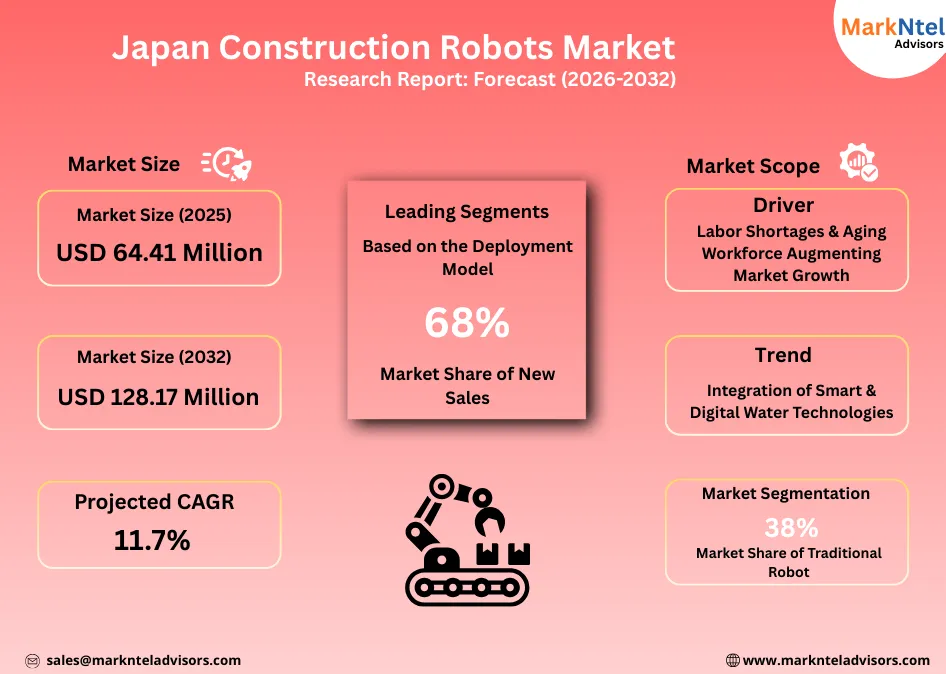
- The Japan Construction Robots Market size was valued at around USD 64.41 million in 2025 and is projected to reach USD 128.17 million by 2032. The estimated CAGR from 2026 to 2032 is around 11.7%, indicating strong growth.
- By Type, the traditional robot seized around 38% of the Japan Construction Robots Market size in 2025.
- By deployment model, the new sales segment represented 68% of the Japan Construction Robots Market size in 2025.
- The leading construction robot companies are Obayashi Corporation, Brokk, Husqvarna Group, Ken Robotech, Conjet AB, Takenaka Corporation, Taisei Corporation, Shimizu Corporation, Serendix Inc., and others.
Market Insights & Analysis: Japan Construction Robots Market (2026- 2032):
The Japan Construction Robots Market size was valued at around USD 64.41 million in 2025 and is projected to reach USD 128.17 million by 2032. Along with this, the market is estimated to grow at a CAGR of around 11.7% during the forecast period, i.e., 2026-32. The Japan Construction Robots Market Japan’s construction robots market is underpinned by persistent labor shortages, demographic shifts, and aggressive national automation strategies. As Japan’s working‑age population continues to decline, the construction sector faces acute workforce constraints, compelling the adoption of robotic automation to maintain productivity and ensure project continuity. Government initiatives such as MLIT’s “i‑Construction 2.0” emphasize construction site automation, data integration, and remote operation, aiming to achieve at least 30 % labor savings and improve productivity by 1.5× by 2040 through robotics, digital workflows, and ICT integration. This policy framework reflects long‑term planning to mitigate labor scarcity and boost construction efficiency.
In addition to domestic policy support, industry narratives report that automation, including robots for material handling, inspection, and repetitive tasks, offers productivity gains and helps companies adapt to workforce gaps. Construction sites are increasingly leveraging robotics to offset labor shortfalls and ensure the timely delivery of ageing infrastructure maintenance and new builds.
Furthermore, the convergence of robotics, AI, and digital construction ecosystems is expected to drive sustained market growth through 2032 as Japan seeks to modernize its construction supply chain, improve safety outcomes, and confront demographic headwinds with technology‑driven solutions.
Japan Construction Robots Market Recent Developments:
- January 2025: Japan’s MAX Co. showcased its Autonomous Mobile Tying Robot at World of Concrete 2025, demonstrating autonomous rebar tying with route planning and obstacle adaptation. This innovation addresses labor shortages and boosts on-site productivity .
- September 2025: Six Japanese firms, including Kudan and TAKENAKA, launched a collaborative R&D project to build an open software platform that enables diverse construction robots (for material transport, surveying, coating, etc.) to interoperate, reducing development costs and speeding adoption.
Japan Construction Robots Market Socpe:
| Category | Segments |
|---|---|
| By Application | Demolition, Bricklaying, 3D Printing, Concrete Structural Erection, Finishing Work, Doors and Windows Installation, Others |
| By Type | Traditional Robot, Robotic Arm, Exoskeleton, Cartesian Robots, Other Robot Types |
| By Deployment Model | New Sales, Aftermarket |
| By Sales Type | Large Enterprises, Small & Medium-sized Enterprises (SMEs) |
| By End-User | Industrial, Residential, Commercial |
Japan Construction Robots Market Driver:
Labor Shortages & Aging Workforce Augmenting Market Growth
Japan’s construction industry is facing an intensifying labor shortage driven by rapid population aging and a sustained decline in young workforce participation, creating a strong structural push toward construction robotics adoption. According to Japan’s Ministry of Internal Affairs and Communications (MIC) Labour Force Survey, construction employment declined by approximately 250,000 workers year-on-year in early 2025, even as overall national employment continued to rise. This indicates that construction is disproportionately affected by labor attrition compared to other sectors. Official data show that total construction employment fell to around 4.57 million workers in January 2025, reflecting ongoing workforce contraction rather than a cyclical slowdown .
Demographic pressures further amplify this challenge. Government statistics indicate that over one-third of construction workers are aged 55 and above, while workers under 30 account for barely 12%, raising concerns about skill continuity, site safety, and productivity. To mitigate these shortages, Japan’s government has announced structural labor reforms beyond 2025, including the launch of a new skills-based foreign worker framework from fiscal 2027, designed to supplement labor-intensive sectors such as construction .
As workforce availability tightens, contractors are increasingly turning to robots for material handling, rebar tying, inspection, and repetitive site tasks to maintain output and safety standards.
Overall, Persistent labor shortages and an aging workforce are transforming automation from an efficiency enhancer into a necessity, ensuring sustained demand for construction robots in Japan through the late 2020s and into the next decade
Japan Construction Robots Market Trend:
Integration of Smart & Digital Water Technologies
The integration of advanced robotics with digital systems encompassing AI, automation, remote operation, and data connectivity is rapidly reshaping Japan’s construction sector. For example, the Japanese government’s “i‑Construction 2.0” initiative, launched by the Ministry of Land, Infrastructure, Transport and Tourism (MLIT). This policy aims to transform construction operations through automation of construction, data integration, and automated management, targeting a 30 % reduction in required onsite labor and a 1.5× increase in productivity by 2040 . The strategy mainstreams technologies like AI‑enabled machinery, remote‑controlled equipment, and digital data coordination to handle complex tasks that previously required large crews.
Under i‑Construction 2.0, field trials including remote operation of automatic tunneling machines and AI‑enhanced monitoring systems are scheduled in 2025, underscoring practical adoption beyond pilot stages. The initiative builds on earlier ICT and BIM/CIM usage to create real‑time data flows across planning, execution, and inspection phases, allowing robots and autonomous systems to work in concert with human operators and digital models.
Further supporting this trend, the Japan Robot Award, co‑sponsored by MLIT and other ministries, recently recognized construction robots for excellence, including the “Tomorobo” rebar‑tying robot, reinforcing government endorsement of advanced robotic deployment.
Overall, integration of advanced robotics with AI and digital construction ecosystems underpinned by national policies is enabling autonomous operations, data‑driven decision‑making, and remote control, accelerating technological uptake across Japan’s construction landscape and strengthening the structural transformation toward smart, efficient sites.
Japan Construction Robots Market Challenge:
High Initial Investment Costs
One of the major challenges facing the Japan Construction Robots Market is the high initial investment cost required to adopt automation and robotics technologies. Japan’s construction industry, typically composed of many small and medium-sized enterprises (SMEs), finds it difficult to shoulder the substantial upfront expenses associated with purchasing advanced robotics equipment, upgrading existing machinery, and integrating automation systems into traditional workflows. According to an industry overview of automation and remote operation in Japanese construction machinery, acquiring and implementing these technologies requires significant capital, including the cost of automated machines, sensor systems, and communication infrastructure. For example, automation systems often demand millions of yen (equivalent to tens of thousands of USD) just for initial hardware and setup, placing a disproportionate burden on less-capitalized firms .
National reports also highlight that 68% of Japanese companies cite “high initial cost” as the most significant barrier to robotics adoption, markedly higher than the global average, underscoring how financial constraints limit deployment, particularly among smaller contractors . This cost barrier contributes to a widening adoption gap between larger firms with robust balance sheets and smaller firms that struggle to justify expensive investments.
While government subsidies and incentives exist to promote automation, the complexity of funding applications and limited awareness among SMEs mean many do not fully benefit. Until financial support becomes more accessible and upfront costs decrease through broader standardization and scalable solutions, high initial investment remains a critical impediment to widespread robot adoption in Japan’s construction sector.
Japan Construction Robots Market (2026-32) Segmentation Analysis:
The Japan Construction Robots Market Report and Forecast 2026-2032 offers a detailed analysis of the market based on the following segments:
Based on Type:
- Traditional Robot
- Robotic Arm
- Exoskeleton
- Cartesian Robots
- Other Robot Types
The traditional robot segment dominates the market, accounting for 38% of total construction robot deployments, due to its versatility, proven reliability, and adaptability across multiple construction tasks. These robots are widely used for bricklaying, demolition, concrete handling, and finishing work, providing consistent performance and reducing dependence on scarce skilled labor. Traditional robots are favored by both large enterprises and SMEs because they require lower upfront training and integration costs compared with more specialized systems like exoskeletons or 3D-printing robots.
Moreover, ongoing government initiatives such as MLIT’s i‑Construction 2.0 promote the adoption of automated machinery for routine and repetitive construction tasks, further reinforcing the market share of traditional robots. Their ability to integrate with existing construction workflows and support labor-saving goals makes them the preferred choice for contractors seeking immediate productivity gains.
Based on the Deployment Model:
- New Sales
- Aftermarket
The new sales deployment model leads with a 68% market share, reflecting strong demand for fresh robotic installations on construction sites rather than reliance on aftermarket upgrades. This trend is driven by labor shortages and aging workforce pressures, prompting companies to invest in fully automated systems to boost productivity, efficiency, and safety. New sales allow contractors to deploy state-of-the-art robotics with AI and IoT integration, optimizing tasks like material handling, inspection, and concrete placement. Government-backed programs and subsidies encourage initial adoption of new robots, ensuring that firms acquire cutting-edge, fully compatible machinery rather than retrofitting older systems. This explains why new sales account for the largest portion of market revenue.
Japan Construction Robots Market (2026-32): Regional Projection
The market for construction robots in Japan is dominated by urban metropolitan regions such as Tokyo, Osaka, Nagoya, and Yokohama. These regions account for the majority of demand due to high construction activity, dense infrastructure projects, and the presence of leading construction companies and technology innovators. Firms like Takenaka Corporation, Obayashi Corporation, and Shimizu Corporation have deployed advanced robotics for tasks including demolition, bricklaying, and concrete structural erection in these cities. Government initiatives, such as MLIT’s i‑Construction 2.0, have prioritized automation in urban infrastructure projects to address labor shortages and improve safety and efficiency.
Additionally, these metropolitan areas have the financial resources and technical expertise to adopt AI-enabled robotics, drones, and exoskeleton systems, accelerating adoption rates. The concentration of large-scale commercial, residential, and industrial projects makes these cities the primary drivers of Japan’s construction robots market, setting the pace for nationwide technological integration.
Gain a Competitive Edge with Our Japan Construction Robots Market Report:
- Japan Construction Robots Market Report by MarkNtel Advisors provides a detailed & thorough analysis of market size & share, growth rate, competitive landscape, and key players. This comprehensive analysis helps businesses gain a holistic understanding of the market dynamics & make informed decisions.
- This report also highlights current market trends & future projections, allowing businesses to identify emerging opportunities & potential challenges. By understanding market forecasts, companies can align their strategies & stay ahead of the competition.
- Japan Construction Robots Market Report aids in assessing & mitigating risks associated with entering or operating in the market. By understanding market dynamics, regulatory frameworks, and potential challenges, businesses can develop strategies to minimize risks & optimize their operations.
*Reports Delivery Format - Market research studies from MarkNtel Advisors are offered in PDF, Excel and PowerPoint formats. Within 24 hours of the payment being successfully received, the report will be sent to your email address.
Frequently Asked Questions
- Market Segmentation
- Introduction
- Product Definition
- Research Process
- Assumptions
- Executive Summary
- Japan Construction Robots Market Policies, Regulations, and Product Standards
- Japan Construction Robots Market Supply Chain Analysis
- Japan Construction Robots Market Trends & Developments
- Japan Construction Robots Market Dynamics
- Growth Drivers
- Challenges
- Japan Construction Robots Market Hotspot & Opportunities
- Japan Construction Robots Market Outlook, 2022-2032
- Market Size & Outlook
- By Revenues (USD Million)
- Market Share & Outlook
- By Application- Market Size & Forecast 2022-2032F, USD Million
- Demolition
- Bricklaying
- 3D Printing
- Concrete Structural Erection
- Finishing Work
- Doors and Windows Installation
- Others
- By Type- Market Size & Forecast 2022-2032F, USD Million
- Traditional Robot
- Robotic Arm
- Exoskeleton
- Cartesian Robots
- Other Robot Types
- By Deployment Model- Market Size & Forecast 2022-2032F, USD Million
- New Sales
- Aftermarket
- By Sales Type- Market Size & Forecast 2022-2032F, USD Million
- Large Enterprises
- Small & Medium-sized Enterprises (SMEs)
- By End-User- Market Size & Forecast 2022-2032F, USD Million
- Industrial
- Residential
- Commercial
- By Region
- North
- East
- West
- South
- By Company
- Company Revenue Shares
- Competitor Characteristics
- By Application- Market Size & Forecast 2022-2032F, USD Million
- Market Size & Outlook
- Japan Traditional Construction Robots Market Outlook, 2022-2032
- Market Size & Analysis
- Market Share & Analysis
- By Application- Market Size & Forecast 2022-2032, USD Million
- By Deployment Model- Market Size & Forecast 2022-2032, USD Million
- By Sales Type - Market Size & Forecast 2022-2032, USD Million
- By End User- Market Size & Forecast 2022-2032, USD Million
- Japan Robotic Arm Construction Robots Market Outlook, 2022-2032
- Market Size & Analysis
- Market Revenues (USD Million)
- Market Share & Analysis
- By Application- Market Size & Forecast 2022-2032, USD Million
- By Deployment Model- Market Size & Forecast 2022-2032, USD Million
- By Sales Type - Market Size & Forecast 2022-2032, USD Million
- By End User- Market Size & Forecast 2022-2032, USD Million
- Market Size & Analysis
- Japan Exoskeleton Construction Robots Market Outlook, 2022-2032
- Market Size & Analysis
- Market Revenues (USD Million)
- Market Share & Analysis
- By Application- Market Size & Forecast 2022-2032, USD Million
- By Deployment Model- Market Size & Forecast 2022-2032, USD Million
- By Sales Type - Market Size & Forecast 2022-2032, USD Million
- By End User- Market Size & Forecast 2022-2032, USD Million
- Market Size & Analysis
- Japan Cartesian Robots Construction Robots Market Outlook, 2022-2032
- Market Size & Analysis
- Market Revenues (USD Million)
- Market Share & Analysis
- By Application- Market Size & Forecast 2022-2032, USD Million
- By Deployment Model- Market Size & Forecast 2022-2032, USD Million
- By Sales Type - Market Size & Forecast 2022-2032, USD Million
- By End User- Market Size & Forecast 2022-2032, USD Million
- Market Size & Analysis
- Japan Construction Robots Market Key Strategic Imperatives for Success & Growth
- Competition Outlook
- Company Profiles
- Obayashi Corporation
- Business Description
- Product Portfolio
- Strategic Alliances or Partnerships
- Recent Developments
- Financial Details
- Others
- Brokk
- Business Description
- Product Portfolio
- Strategic Alliances or Partnerships
- Recent Developments
- Financial Details
- Others
- Husqvarna Group
- Business Description
- Product Portfolio
- Strategic Alliances or Partnerships
- Recent Developments
- Financial Details
- Others
- Ken Robotech
- Business Description
- Product Portfolio
- Strategic Alliances or Partnerships
- Recent Developments
- Financial Details
- Others
- Conjet AB
- Business Description
- Product Portfolio
- Strategic Alliances or Partnerships
- Recent Developments
- Financial Details
- Others
- Takenaka Corporation
- Business Description
- Product Portfolio
- Strategic Alliances or Partnerships
- Recent Developments
- Financial Details
- Others
- Taisei Corporation
- Business Description
- Product Portfolio
- Strategic Alliances or Partnerships
- Recent Developments
- Financial Details
- Others
- Shimizu Corporation
- Business Description
- Product Portfolio
- Strategic Alliances or Partnerships
- Recent Developments
- Financial Details
- Others
- Serendix Inc.
- Business Description
- Product Portfolio
- Strategic Alliances or Partnerships
- Recent Developments
- Financial Details
- Others
- Others
- Obayashi Corporation
- Company Profiles
- Disclaimer
MarkNtel Advisors follows a robust and iterative research methodology designed to ensure maximum accuracy and minimize deviation in market estimates and forecasts. Our approach combines both bottom-up and top-down techniques to effectively segment and quantify various aspects of the market. A consistent feature across all our research reports is data triangulation, which examines the market from three distinct perspectives to validate findings. Key components of our research process include:
1. Scope & Research Design At the outset, MarkNtel Advisors define the research objectives and formulate pertinent questions. This phase involves determining the type of research—qualitative or quantitative—and designing a methodology that outlines data collection methods, target demographics, and analytical tools. They also establish timelines and budgets to ensure the research aligns with client goals.
2. Sample Selection and Data Collection In this stage, the firm identifies the target audience and determines the appropriate sample size to ensure representativeness. They employ various sampling methods, such as random or stratified sampling, based on the research objectives. Data collection is carried out using tools like surveys, interviews, and observations, ensuring the gathered data is reliable and relevant.
3. Data Analysis and Validation Once data is collected, MarkNtel Advisors undertake a rigorous analysis process. This includes cleaning the data to remove inconsistencies, employing statistical software for quantitative analysis, and thematic analysis for qualitative data. Validation steps are taken to ensure the accuracy and reliability of the findings, minimizing biases and errors.

4. Data Forecast and FinalizationThe final phase involves forecasting future market trends based on the analyzed data. MarkNtel Advisors utilize predictive modeling and time series analysis to anticipate market behaviors. The insights are then compiled into comprehensive reports, featuring visual aids like charts and graphs, and include strategic recommendations to inform client decision-making
We offer flexible licensing options to cater to varying organizational needs. Choose the pricing pack that best suits your requirements:
Buy Now Inquire Before Buying
 Request Customization
 Talk to our Consultant







