

China Plant-Based Dairy Market Research Report Forecast : (2026-2032)
By Product Type (Plant-Based Milk, Plant-Based Cheese, Plant-Based Yoghurt), By Nature (Organic, Natural, Conventional), By End User (Individual Consumption, Food Processing Indust ... ries, Bakery & Confectionery, Snacks & Savouries, Ready Meals, HoReCa, Others), By Sales Channel (Offline, Online), and others Read more
- Food & Beverages
- Mar 2026
- Pages 170
- Report Format: PDF, Excel, PPT
China Plant-Based Dairy Market
Projected 6.96% CAGR from 2026 to 2032
Study Period
2026-2032
Market Size (2026)
USD 5.05 Billion
Market Size (2032)
USD 7.56 Billion
Base Year
2025
Projected CAGR
6.96%
Leading Segments
By Sales Channel: Offline
China Plant-Based Dairy Market Report Key Takeaways:
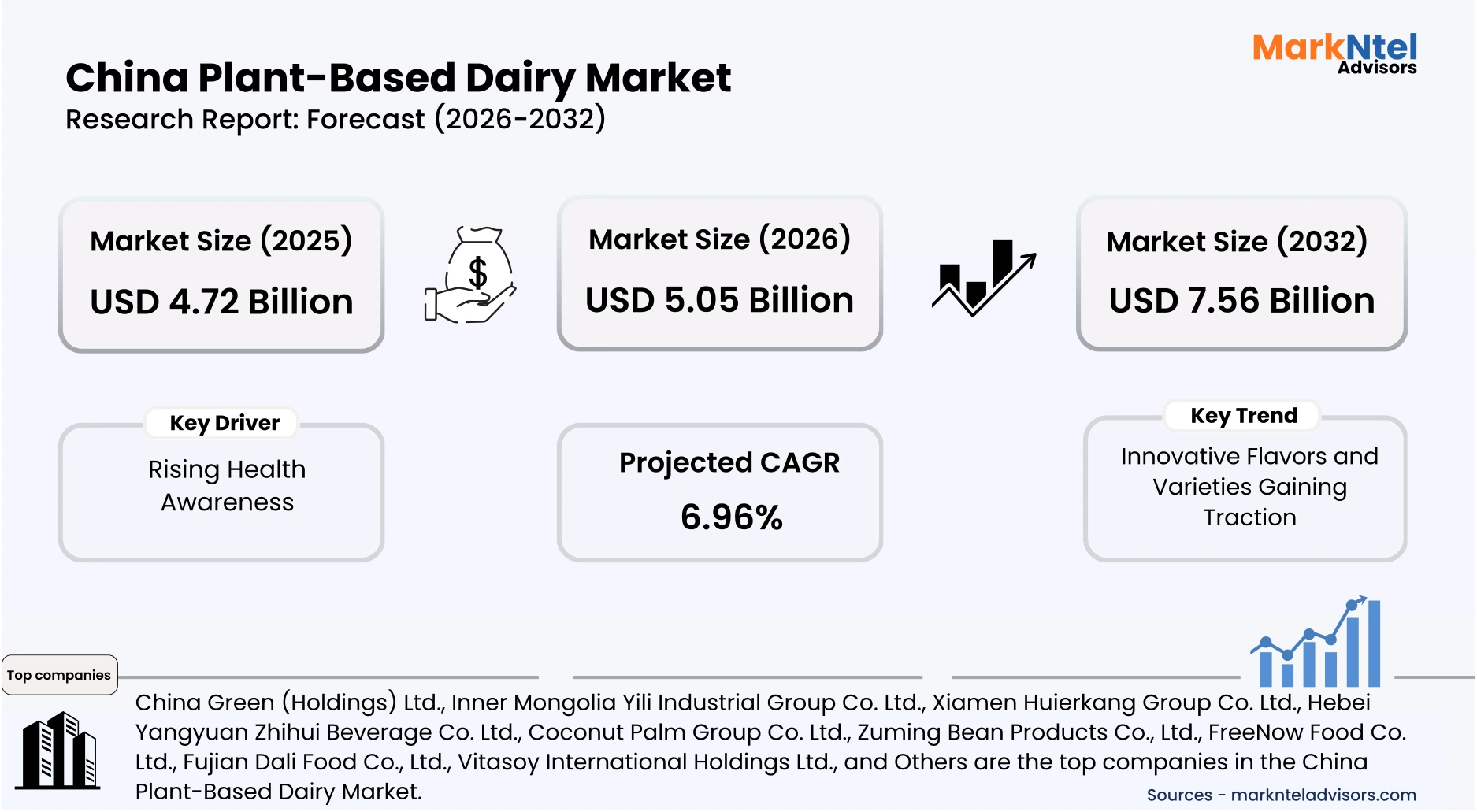
- The China Plant-Based Dairy market size was valued at USD 4.72 billion in 2025 and is projected to grow from USD 5.05 billion in 2026 to USD 7.56 billion by 2032, exhibiting a CAGR of 6.96% during the forecast period.
- By product type, the plant-based milk segment represented a significant share of about 95% in the China Plant-Based Dairy Market in 2026.
- By Sales Channel, the offline segment presented a significant share of about 85% in the China Plant-Based Dairy Market in 2026.
- Leading plant-based dairy companies in the country are China Green (Holdings) Ltd., Inner Mongolia Yili Industrial Group Co. Ltd., Xiamen Huierkang Group Co. Ltd., Hebei Yangyuan Zhihui Beverage Co. Ltd., Coconut Palm Group Co. Ltd., Zuming Bean Products Co., Ltd., FreeNow Food Co. Ltd., Fujian Dali Food Co., Ltd., Vitasoy International Holdings Ltd., and Others.
Market Insights & Analysis: China Plant-Based Dairy Market (2026-32):
The China Plant-Based Dairy Market size was valued at USD 4.72 billion in 2025 and is projected to grow from USD 5.05 billion in 2026 to USD 7.56 billion by 2032. Along with this, the market is estimated to grow at a CAGR of around 6.96% during the forecast period, i.e., 2026-32.
The China plant-based dairy market is poised for strong growth, driven primarily by rising health awareness and the increasing prevalence of lactose intolerance among Chinese consumers. Lactose intolerance, a condition in which the body cannot properly digest lactose (milk sugar), affects an estimated 65% of adults worldwide due to lactase enzyme deficiency, prompting consumers to seek lactose-free alternatives.
Plant-based dairy, including soy, oat, almond, and other alternative milks, provides essential nutrients such as protein and calcium without causing gastrointestinal discomfort, making it a preferred choice for health-conscious populations.
Scientific evidence further reinforces the benefits of plant-based diets. A meta-analysis involving over 2.2 million participants demonstrated that adherence to plant-rich diets significantly improves health outcomes, reducing the risk of type-2 diabetes by 18%, cardiovascular disease by 10%, and cancer by 9%, while lowering overall mortality risk by 16%. These findings highlight the long-term preventive health potential of plant-based nutrition, encouraging more consumers to incorporate such products into their daily diets.
While soymilk and coconut milk remain the most frequently purchased plant-based dairy products, the market is witnessing a rapid expansion in flavors and ingredient varieties. A 2025 survey of 1,052 Chinese consumers revealed strong interest in innovative plant milks derived from pistachio, sweet potato, quinoa, and chickpeas, beyond conventional soy and coconut. Many consumers now prefer nut-based and unconventional plant milks with added fiber, vitamins, or other functional ingredients, reflecting evolving preferences for both taste and nutritional value .
This diversification of products, coupled with rising health consciousness and widespread lactose intolerance, is likely to drive adoption across age groups and regions, particularly in urban centers with higher disposable incomes and exposure to global dietary trends. Manufacturers and retailers are responding with fortified formulations, blended plant-based milks, and functional beverages, strengthening the market’s growth trajectory.
Overall, the China plant-based dairy market is expected to continue expanding as consumer awareness of health benefits, lactose intolerance prevalence, and preference for diverse flavors converge. Strategic product innovation and nutritional fortification will be crucial in capturing new consumers, supporting both short-term growth and long-term market sustainability.
China Plant-Based Dairy Market Recent Developments:
- 2025: Tetra Pak introduced a sunflower protein ingredient designed for plant‑based and functional beverages, offering up to 50% protein, neutral flavor, and formulation flexibility. It can be used in plant‑based milks, yoghurts, and RTD drinks, helping manufacturers expand high‑protein alternatives for health‑focused consumers.
- 2025: Vitasoy International Holdings Ltd launched its upgraded VITASOY CALCI‑PLUS Hi‑Calcium Original Soya Milk and No Sugar Hi‑Calcium Soya Milk, focusing on higher calcium and lower sugar formulations to appeal to health‑focused consumers in Greater China. These products aim at boosting plant‑based category sales amid softer overall market conditions.
China Plant-Based Dairy Market Scope:
| Category | Segments |
|---|---|
| By Product Type | (Plant-Based Milk, Plant-Based Cheese, Plant-Based Yoghurt), |
| By Nature | (Organic, Natural, Conventional), |
| By End User | (Individual Consumption, Food Processing Industries, Bakery & Confectionery, Snacks & Savouries, Ready Meals, HoReCa, Others), |
| By Sales Channel | (Offline, Online), |
China Plant-Based Dairy Market Driver:
Rising Health Awareness
Rising health awareness among Chinese consumers is a key driver of the plant-based dairy market. Scientific research demonstrates multiple health advantages of plant-based milks, including lower cholesterol levels, anti-inflammatory effects, improved heart health, and enhanced gut microbiome diversity, primarily due to bioactive compounds in legumes (e.g., soy) and grains (e.g., oats). These benefits make plant-based dairy suitable for individuals aiming to reduce cardiovascular risks and improve digestive wellness.
Lactose intolerance, which affects approximately 85% of Chinese adults, further amplifies demand for plant-based alternatives. Naturally lactose-free options like soy, oat, and almond milk allow consumers to obtain essential nutrients, such as protein and calcium, without gastrointestinal discomfort .
Many plant-based beverages are also fortified with calcium and vitamins, helping them approach the micronutrient profile of dairy and supporting bone health. Beyond 2025, China’s Healthy China 2030 framework emphasizes preventive health and balanced diets, promoting nutrient-rich, lower-fat, and lactose-free alternatives. This initiative is expected to drive research funding, product innovation, and fortification investments, further strengthening the plant-based dairy sector.
In conclusion, growing health consciousness, supported by scientific evidence, lactose intolerance prevalence, and government-led nutrition policies, is creating a strong and sustainable market demand for plant-based dairy products in China.
China Plant-Based Dairy Market Trend:
Innovative Flavors and Varieties Gaining Traction
A prominent trend in China’s plant-based dairy market is the rapid diversification of product flavors and ingredient sources to meet evolving consumer preferences. While traditional plant milks such as coconut milk (61.2% purchase rate) and soy milk (53.9%) remain widely consumed, Chinese consumers are increasingly exploring innovative options derived from rice, quinoa, sweet potato, pistachio, and chickpeas, reflecting strong demand for a wider variety beyond conventional formats. Taste, nutritional value, and calorie content are key factors driving purchase decisions, with many consumers willing to pay a premium for beverages offering enhanced flavor and functional benefits .
This trend aligns with the global diversification of plant-based foods, including cereals, legumes, nuts, seeds, and pseudocereals, each contributing unique flavor profiles and nutritional characteristics that appeal to varied palates. Domestic Chinese producers and international brands are expanding their portfolios with multiple plant bases and blended formulations to satisfy health-conscious consumers seeking both taste and nutrition. Emerging products like rice milk, walnut yoghurt, and water chestnut milk further highlight ingredient innovation and broadened consumer choice .
The production of plant milk reached 8.7 million tons in 2019, and the market is projected to exceed USD 300 billion by 2025, indicating a strong growth trajectory .
Overall, the expansion of flavors and varieties, combined with product innovation and diversified ingredient sources, is driving adoption across demographic groups and consumption occasions, reinforcing plant-based dairy as a mainstream choice in China.
China Plant-Based Dairy Market Opportunity:
Collaborations with Foodservice Chains
Collaborations between plant-based dairy producers and foodservice chains present a significant opportunity for market growth in China. Major global and domestic operators are integrating plant-based dairy into their menus to appeal to health- and sustainability-conscious consumers. For example, Starbucks China partnered with Swedish oatmilk maker Oatly and Beyond Meat to introduce plant-based beverages and menu items across thousands of outlets, enabling customers to customize drinks with oat milk and enjoy plant-based lunch options alongside traditional offerings.
This strategy enhances product visibility and encourages consumer trial, particularly in urban centers where coffee culture and café visits are deeply ingrained. As of 2024, Oatly’s products were available in 60,000 retail stores and 32,200 coffee shops globally, including a substantial presence in over 11,000 coffee and tea shops in China, demonstrating how plant-based dairy is becoming normalized in daily consumption beyond retail shelves .
Scientific research indicates that experiential exposure in foodservice builds familiarity and comfort with non-dairy products, reducing barriers to regular purchase. By aligning with foodservice trends that prioritize customization, such as plant-based latte options, brands benefit from increased trial and adoption, ultimately boosting consumer acceptance and market penetration.
Overall, strategic partnerships with foodservice chains provide plant-based dairy brands a scalable platform to reach diverse consumers, deepen market presence, and accelerate adoption across China, making such collaborations a core opportunity for sustainable industry growth.
China Plant-Based Dairy Market Challenge:
High Production Cost Restricts Wider Adoption
A significant challenge in China’s plant-based dairy market is the high cost of production, which limits affordability and wider adoption. Plant-based dairy requires specialized processing, diverse raw materials, and fortification, all of which contribute to elevated production costs compared with conventional dairy. Ingredients such as oats, nuts, and other plant-based products often need importation or premium sourcing, increasing raw material expenses. Consequently, retail prices for plant-based milks typically range between USD 0.28 and 0.57, making them less accessible to price-sensitive consumers .
High production costs have also affected the financial performance of leading Chinese companies. In the first three quarters of 2025, Vitasoy, Six Walnuts, and Chengde Lulu all reported nearly 10% revenue declines. Notably, Yangyuan Beverage, the parent company of Six Walnuts, saw its total revenue fall to 6.058 billion yuan in 2024, down from its peak of 9.117 billion yuan in 2015, a decrease of one-third, while net profit nearly halved .
These financial pressures underscore the challenge of balancing high-quality production with cost efficiency. Without technological optimization, supply chain improvements, or potential policy support to reduce costs, plant-based dairy may struggle to compete with conventional dairy products, particularly in price-sensitive markets.
China Plant-Based Dairy Market (2026-32) Segmentation Analysis:
The China Plant-Based Dairy Market study of MarkNtel Advisors evaluates & highlights the major trends and influencing factors in each segment. It includes predictions for the period 2026–32 at the country level. Based on the analysis, the market has been further classified as;
Based on Product Type:
-
- Plant-Based Milk
- Soy
- Almond
- Oat
- Coconut
- Rice
- Blends
- Others
- Plant-Based Cheese
- Plant-Based Yoghurt
- Plant-Based Milk
Plant-based milk dominates the China plant-based dairy market with 95% share of the total market value. This segment’s leadership is primarily driven by rising health consciousness and increasing awareness of lactose intolerance among Chinese consumers. Unlike traditional dairy, plant-based milk offers easier digestibility, lower cholesterol, and reduced saturated fat content, aligning with the growing trend toward healthier lifestyles. Additionally, consumers are increasingly opting for alternatives such as soy, almond, oat, and coconut milk due to their nutritional benefits and functional versatility in beverages, cooking, and baking.
The expansion of retail availability, aggressive marketing campaigns by major brands like Vitasoy International Holdings Ltd and Inner Mongolia Yili Industrial Group Co Ltd, and the introduction of fortified, flavored, and organic variants further reinforce its popularity. Collectively, these factors contribute to the overwhelming preference for plant-based milk over other plant-based dairy products like cheese and yoghurt in China.
Based on Sales Channel:
-
- Offline
- Online
The offline sales channel leads the China plant-based dairy market with an estimated 85% share, driven by consumer shopping habits and retail infrastructure. Traditional supermarkets, hypermarkets, convenience stores, and local grocery chains remain the preferred choice for most consumers seeking plant-based dairy products. Shoppers value the ability to physically examine product quality, packaging, and freshness, especially for perishable items like milk and yoghurt alternatives.
Furthermore, strong brand visibility, promotional offers, and in-store sampling campaigns boost consumer confidence and encourage purchases through offline channels. Despite the rise of e-commerce platforms, which offer convenience and home delivery, the offline segment continues to dominate due to its accessibility, established distribution networks, and trust among middle-aged and older consumers. Leading companies such as China Green (Holdings) Ltd and Xiamen Huierkang Group Co Ltd heavily invest in offline presence to maintain brand loyalty and ensure wider market penetration.
China Plant-Based Dairy Market (2026-32): Regional Projection
The China Plant-Based Dairy Market is dominated by Tier-1 cities, particularly Beijing, Shanghai, Guangzhou, and Shenzhen. These metropolitan areas lead due to higher health awareness, higher disposable income, and exposure to global dietary trends, making consumers more receptive to plant-based dairy products. Retail chains, supermarkets, and cafés in these cities offer wide product availability, including soy, oat, almond, and blended plant milks. Furthermore, Tier-1 cities have a strong presence of foodservice chains and international cafés, enabling trial of plant-based dairy beverages such as oat lattes, fortified soymilk, and yogurt alternatives. Consumer preference for nutritionally fortified and functional foods is also higher in these regions, driven by lifestyle and wellness trends. Combined with extensive distribution networks, modern retail infrastructure, and promotional campaigns, these factors ensure Tier-1 cities dominate market sales and adoption, setting the pace for expansion into Tier-2 and Tier-3 cities across China.
Gain a Competitive Edge with Our China Plant-Based Dairy Market Report:
- China Plant-Based Dairy Market Report by MarkNtel Advisors provides a detailed & thorough analysis of market size & share, growth rate, competitive landscape, and key players. This comprehensive analysis helps businesses gain a holistic understanding of the market dynamics & make informed decisions.
- This report also highlights current market trends & future projections, allowing businesses to identify emerging opportunities & potential challenges. By understanding market forecasts, companies can align their strategies & stay ahead of the competition.
- China Plant-Based Dairy Market Report aids in assessing & mitigating risks associated with entering or operating in the market. By understanding market dynamics, regulatory frameworks, and potential challenges, businesses can develop strategies to minimize risks & optimize their operations.
*Reports Delivery Format - Market research studies from MarkNtel Advisors are offered in PDF, Excel and PowerPoint formats. Within 24 hours of the payment being successfully received, the report will be sent to your email address.
Frequently Asked Questions
- Market Segmentation
- Introduction
- Product Definition
- Research Process
- Assumptions
- Executive Summary
- China Plant-Based Dairy Market Policies, Regulations, and Product Standards
- China Plant-Based Dairy Market Trends & Developments
- China Plant-Based Dairy Market Dynamics
- Growth Factors
- Challenges
- China Plant-Based Dairy Market Hotspot & Opportunities
- China Plant-Based Dairy Market Outlook, 2022-2032F
- Market Size & Outlook
- By Revenues (USD Million)
- Market Share & Outlook
- By Product Type- Market Size & Forecast 2022-2032, USD Million
- Plant-Based Milk
- Soy
- Almond
- Oat
- Coconut
- Rice
- Blends
- Others
- Plant-Based Cheese
- Plant-Based Yoghurt
- Plant-Based Milk
- By Nature- Market Size & Forecast 2022-2032, USD Million
- Organic
- Natural
- Conventional
- By End User- Market Size & Forecast 2022-2032, USD Million
- Individual Consumption
- Food Processing Industries
- Bakery & Confectionery
- Snacks & Savouries
- Ready Meals
- HoReCa
- Others
- By Sales Channel- Market Size & Forecast 2022-2032, USD Million
- Offline
- Online
- By Region- Market Size & Forecast 2022-2032, USD Million
- East
- West
- North
- South
- By Company
- Competition Characteristics
- Market Share & Analysis
- By Product Type- Market Size & Forecast 2022-2032, USD Million
- Market Size & Outlook
- China Plant-Based Milk Market Outlook, 2022-2032
- Market Size & Outlook
- By Revenues (USD Million)
- Market Share & Outlook
- By Nature- Market Size & Forecast 2022-2032, USD Million
- By End User- Market Size & Forecast 2022-2032, USD Million
- By Sales Channel- Market Size & Forecast 2022-2032, USD Million
- By Region- Market Size & Forecast 2022-2032, USD Million
- Market Size & Outlook
- China Plant-Based Cheese Market Outlook, 2022-2032
- Market Size & Outlook
- By Revenues (USD Million)
- Market Share & Outlook
- By Nature- Market Size & Forecast 2022-2032, USD Million
- By End User- Market Size & Forecast 2022-2032, USD Million
- By Sales Channel- Market Size & Forecast 2022-2032, USD Million
- By Region- Market Size & Forecast 2022-2032, USD Million
- Market Size & Outlook
- China Plant-Based Yoghurt Market Outlook, 2022-2032
- Market Size & Outlook
- By Revenues (USD Million)
- Market Share & Outlook
- By Nature- Market Size & Forecast 2022-2032, USD Million
- By End User- Market Size & Forecast 2022-2032, USD Million
- By Sales Channel- Market Size & Forecast 2022-2032, USD Million
- By Region- Market Size & Forecast 2022-2032, USD Million
- Market Size & Outlook
- China Plant-Based Dairy Market Key Strategic Imperatives for Success & Growth
- Competitive Outlook
- Company Profiles
- China Green (Holdings) Ltd.
- Business Description
- Product Portfolio
- Collaborations & Alliances
- Recent Developments
- Financial Details
- Others
- Inner Mongolia Yili Industrial Group Co. Ltd.
- Business Description
- Product Portfolio
- Collaborations & Alliances
- Recent Developments
- Financial Details
- Others
- Xiamen Huierkang Group Co. Ltd.
- Business Description
- Product Portfolio
- Collaborations & Alliances
- Recent Developments
- Financial Details
- Others
- Hebei Yangyuan Zhihui Beverage Co. Ltd.
- Business Description
- Product Portfolio
- Collaborations & Alliances
- Recent Developments
- Financial Details
- Others
- Coconut Palm Group Co. Ltd.
- Business Description
- Product Portfolio
- Collaborations & Alliances
- Recent Developments
- Financial Details
- Others
- Zuming Bean Products Co., Ltd.
- Business Description
- Product Portfolio
- Collaborations & Alliances
- Recent Developments
- Financial Details
- Others
- FreeNow Food Co. Ltd.
- Business Description
- Product Portfolio
- Collaborations & Alliances
- Recent Developments
- Financial Details
- Others
- Fujian Dali Food Co., Ltd.
- Business Description
- Product Portfolio
- Collaborations & Alliances
- Recent Developments
- Financial Details
- Others
- Vitasoy International Holdings Ltd.
- Business Description
- Product Portfolio
- Collaborations & Alliances
- Recent Developments
- Financial Details
- Others
- Others
- Business Description
- Product Portfolio
- Collaborations & Alliances
- Recent Developments
- Financial Details
- Others
- China Green (Holdings) Ltd.
- Company Profiles
- Disclaimer
MarkNtel Advisors follows a robust and iterative research methodology designed to ensure maximum accuracy and minimize deviation in market estimates and forecasts. Our approach combines both bottom-up and top-down techniques to effectively segment and quantify various aspects of the market. A consistent feature across all our research reports is data triangulation, which examines the market from three distinct perspectives to validate findings. Key components of our research process include:
1. Scope & Research Design At the outset, MarkNtel Advisors define the research objectives and formulate pertinent questions. This phase involves determining the type of research—qualitative or quantitative—and designing a methodology that outlines data collection methods, target demographics, and analytical tools. They also establish timelines and budgets to ensure the research aligns with client goals.
2. Sample Selection and Data Collection In this stage, the firm identifies the target audience and determines the appropriate sample size to ensure representativeness. They employ various sampling methods, such as random or stratified sampling, based on the research objectives. Data collection is carried out using tools like surveys, interviews, and observations, ensuring the gathered data is reliable and relevant.
3. Data Analysis and Validation Once data is collected, MarkNtel Advisors undertake a rigorous analysis process. This includes cleaning the data to remove inconsistencies, employing statistical software for quantitative analysis, and thematic analysis for qualitative data. Validation steps are taken to ensure the accuracy and reliability of the findings, minimizing biases and errors.

4. Data Forecast and FinalizationThe final phase involves forecasting future market trends based on the analyzed data. MarkNtel Advisors utilize predictive modeling and time series analysis to anticipate market behaviors. The insights are then compiled into comprehensive reports, featuring visual aids like charts and graphs, and include strategic recommendations to inform client decision-making
We offer flexible licensing options to cater to varying organizational needs. Choose the pricing pack that best suits your requirements:
Buy Now Inquire Before Buying
 Request Customization
 Talk to our Consultant







