

Chile Smartphone Market Research Report: Forecast (2026-2032)
By Operating System (Android, iOS, Others), By Price Range (Low-range (Below USD 200), Mid-range (USD 200–500), Premium (Above USD 500)), By Screen Size (Below 5 Inches, 5 to 6 Inc ... hes, Above 6 Inches), By RAM Size (Below 4 GB, 4 GB – 8 GB, Above 8 GB), By Distribution Channel (Exclusive Brand Outlets, Retailers, Online), and others Read more
- FMCG
- May 2026
- Pages 145
- Report Format: PDF, Excel, PPT
Chile Smartphone Market
Projected 5.49% CAGR from 2026 to 2032
Study Period
2026-2032
Market Size (2026)
USD 2.99 Billion
Market Size (2032)
USD 4.12 Billion
Base Year
2025
Projected CAGR
5.49%
Leading Segments
By Operating System: Android
Chile Smartphone Market Key Takeaways
- The Chile Smartphone Market was valued at USD 2.8 billion in 2025 and is projected to grow from USD 2.99 billion in 2026 to USD 4.12 billion by 2032, exhibiting a CAGR of 5.49% during 2026–2032.
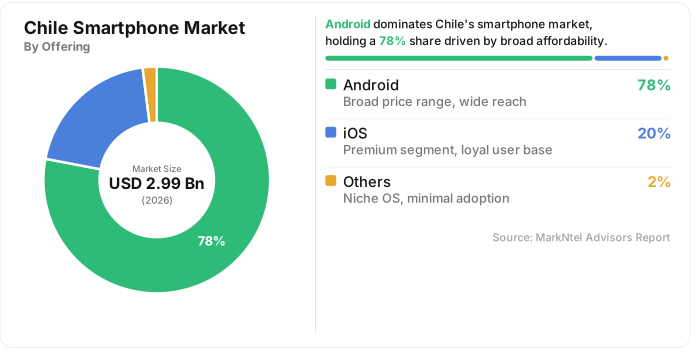
- By operating system, Android holds a significant share of approximately 78%.
- By screen size, the above 6-inch segment accounted for a significant share of around 86% in 2026.
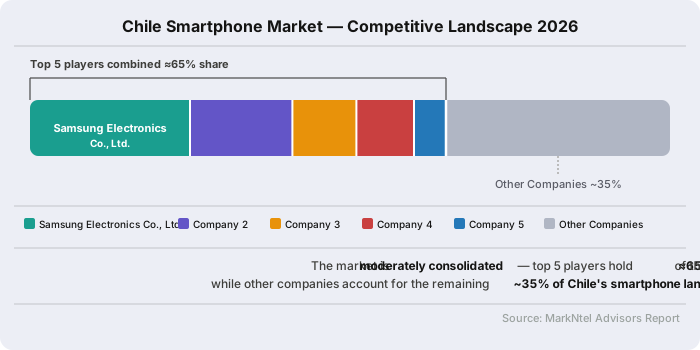
- The industry is moderately fragmented; however, the top five players collectively account for nearly 65% of the market share.
Chile Smartphone Market Size and Outlook
The Chile Smartphone Market is expected to grow at a CAGR of around 5.49% during the forecast period (2026–2032), driven by improving economic conditions, rising disposable incomes, and increasing consumer spending on advanced mobile devices.
A key structural driver is the rise in disposable income, which is enhancing purchasing power and enabling consumers to access a broader range of feature-rich smartphones. As household income levels improve, consumers are increasingly moving beyond basic devices and upgrading toward mid-range and premium smartphones that offer better performance, advanced cameras, and 5G connectivity.
This transition is reinforced by a well-defined pricing structure in the market. For instance, devices such as the Vivo V25 are priced in the range of USD 975–1,063, depending on configuration and retail channel. This tiered pricing environment reflects a clear upgrade pathway, where consumers gradually move across price segments based on income growth and availability of financing options such as installment-based payments and telecom-linked purchase plans.
A major accelerator of market expansion is the rapid adoption of 5G technology. By September 2025, SUBTEL confirmed that 5G accounted for nearly 40% of total mobile connections in Chile, with a strong 64% year-on-year growth rate, marking one of the fastest adoption cycles in the region. This rapid shift is increasing demand for 5G-enabled smartphones and shortening replacement cycles across income segments, as consumers upgrade devices to fully utilize high-speed connectivity.
Looking ahead, Chile’s telecom regulator SUBTEL has initiated a public consultation for a third 5G spectrum auction in the 3.5 GHz band, aimed at expanding network capacity and improving service quality. This forward-looking spectrum strategy is expected to support next-generation digital applications, strengthen network coverage, and further stimulate smartphone demand, particularly in mid-premium categories.
In conclusion, smartphone demand in Chile is positioned for sustained growth, with the market projected to expand from USD 2.99 billion in 2026 to USD 4.12 billion by 2032. This growth is driven by rising disposable income, structured pricing tiers, and rapid 5G expansion, which together are accelerating device upgrades, strengthening premium adoption, and supporting long-term market evolution toward a digitally advanced ecosystem.
Chile Smartphone Market Key Indicators
- According to SUBTEL, Chile has reached near-universal connectivity, with 96.5% of households having internet access in 2024, up significantly from 79.3% in 2016. This level of digital penetration embeds smartphones into everyday consumption patterns, as households increasingly rely on mobile devices for banking, entertainment, and communication, thereby sustaining consistent baseline demand for smartphones capable of supporting data-intensive applications.
- Chile’s telecom landscape reflects structural maturity, with 26.22 million mobile connections compared to a population of 20 million, translating to approximately 1.3 connections per person. This over-subscription trend highlights widespread multi-SIM usage and device duplication, indicating that future smartphone demand is primarily driven by replacement cycles and feature upgrades rather than first-time adoption.
- The acceleration of 5G adoption is significantly reshaping device demand dynamics. As per SUBTEL, 5G accounted for nearly 40% of total mobile connections by September 2025, supported by a strong 64% year-on-year growth rate. This rapid transition is rendering 4G-only devices obsolete, driving replacement demand particularly in the USD 200–500 mid-range segment, where most consumer upgrades are concentrated.
- The International Telecommunication Union (ITU) reports that 4G coverage reached 96% of the population, while 5G coverage expanded to 87% in 2024. This extensive network availability ensures that consumers can fully utilize advanced smartphone features, thereby encouraging faster adoption of 5G-enabled devices across all income segments.
- Macroeconomic conditions are also supporting smartphone affordability. According to the International Monetary Fund (IMF), Chile recorded 2.2% GDP growth in 2024, with projections of 2–2.5% in 2025. Simultaneously, the Central Bank reduced interest rates from 8.25% to 5.0%, lowering financing costs and improving accessibility of smartphones in the USD 300–600 range, particularly through installment-based purchasing models.
Chile Smartphone Market Scope
| Category | Segments |
|---|---|
| By Operating System | Android, iOS, Others |
| By Price Range | Low-range (Below USD 200), Mid-range (USD 200–500), Premium (Above USD 500 |
| By Screen Size | Below 5 Inches, 5 to 6 Inches, Above 6 Inches |
| By RAM Size | Below 4 GB, 4 GB – 8 GB, Above 8 GB |
| By Distribution Channel | Exclusive Brand Outlets, Retailers, Online |
Chile Smartphone Market Growth Drivers
Rising Disposable Income Supporting Smartphone Affordability
Rising disposable income is a key driver of the smartphone adoption rate in Chile, supported by steady macroeconomic improvement and strengthening household purchasing power. According to the World Bank, Chile’s GDP per capita reached approximately USD 14,579 in 2024, reflecting sustained income growth and improved economic stability. This is further reinforced by the Central Bank of Chile, which highlights rising wages and stabilizing inflation, strengthening real disposable income across urban populations.
This improving income structure is directly influencing demand for budget smartphones in Chile, particularly among first-time users and lower-income households. Entry-level devices remain highly relevant in sustaining base-level connectivity, ensuring continued penetration even in a mature market. As a result, the demand for affordable smartphones in Chile remains stable, supported by strong price sensitivity and high digital dependency.
At the same time, rising income levels are enabling gradual migration from budget to mid-range smartphones, expanding the overall smartphone adoption rate in Chile. Consumers are increasingly upgrading to devices with better performance, enhanced cameras, and 5G capability. Entry-level smartphones such as the Nokia C10, priced around USD 78, continue to play a critical role in maintaining accessibility for cost-conscious users.
Overall, rising disposable income is strengthening the demand for affordable smartphones in Chile while also accelerating upgrades, thereby improving the overall smartphone adoption rate and sustaining balanced market growth across segments.
Chile Smartphone Market Trends
Shift Toward Mid-to-Premium Smartphones
Chile smartphone industry is increasingly shifting toward mid-to-premium devices, supported by improving affordability and evolving consumer preferences. Structured pricing of flagship models is playing a key role in shaping this trend, with devices such as the iPhone 17, priced at approximately CLP 701,522, which positions it as a strong mid-to-high segment device. At the upper end, flagship models like the iPhone 17 Pro Max are priced around CLP 1,052,722, reflecting the growing willingness of consumers to invest in high-performance devices.
This pricing ladder is reshaping buying behavior, as consumers increasingly evaluate smartphones not only on cost but also on performance, ecosystem integration, camera quality, and 5G capability. As a result, demand is shifting away from entry-level devices toward premium models that offer longer lifecycle value and better upgrade justification.
The trend is further supported by Chile’s improving digital ecosystem, where higher data consumption, streaming, gaming, and AI-driven applications are increasing the need for more powerful devices. Financing options and installment-based purchase models are also making flagship devices more accessible, reducing upfront cost pressure and supporting premium adoption.
The shift toward mid-to-premium smartphones is strengthening in Chile, driven by structured pricing tiers and evolving digital usage needs. This is accelerating premium device penetration and redefining growth toward value-based smartphone consumption.
Chile Smartphone Market Opportunities and Challenges
Market Saturation and Slowing Device Growth Transitioning into 5G-Driven Upgrade and Digital Consumption Expansion Opportunity
Chile’s smartphone market is operating in a highly mature phase, where penetration has reached near-universal levels. According to SUBTEL, total internet connections (fixed and mobile) surpassed 135 per 100 inhabitants in 2025, while household internet access stood at around 96.5% in 2024, indicating minimal room for new user addition. Mobile penetration reaching nearly 139% of the population further confirms widespread multi-device ownership and a structurally saturated market, resulting in slower incremental demand and extended replacement cycles.
However, this saturation is not restricting market potential but is actively reshaping it toward upgrade-led growth. The rapid expansion of 5G adoption, where Chile reached approximately 8.2 million 5G users by mid-2025, reflects a strong migration from legacy networks to high-speed connectivity. This demonstrates that demand is increasingly driven by device upgrades rather than new user acquisition, as consumers seek improved performance for data-intensive services.
At the same time, Chile’s strong digital infrastructure, supported by high-speed fibre adoption and competitive mobile data pricing, is accelerating consumption of streaming, gaming, and cloud-based services. Additionally, early advancements in next-generation connectivity, including direct-to-device satellite integration initiatives, highlight the evolution toward a fully connected digital ecosystem.
While saturation limits new smartphone additions, it is accelerating a structural shift toward 5G-driven upgrades and high-intensity digital usage, unlocking long-term opportunities in premium devices and connected service ecosystems.
Segmentation Insights
Android Leading the Smartphone Market in Chile
Android dominates Chile’s smartphone segment, accounting for approximately 78% share of the overall operating system in the Chile Smartphone industry, due to its affordability, wide device availability, and strong integration across all price tiers. The open-source nature of Android allows multiple manufacturers such as Samsung, Xiaomi, and Motorola to offer devices across low, mid, and premium categories, making it accessible to a broad consumer base. This flexibility supports high penetration in price-sensitive segments, which remain significant in Chile despite increasing premiumisation trends.
Additionally, Android devices are closely aligned with Chile’s growing digital ecosystem, where mobile banking, e-commerce, and streaming applications are widely optimized for Android platforms. The availability of diverse models with varying RAM configurations and screen sizes further strengthens its dominance. Carrier partnerships and installment-based purchase models also make Android smartphones more financially accessible, reinforcing adoption across urban and semi-urban regions.
Overall, Android’s affordability, device diversity, and strong ecosystem compatibility ensure its continued leadership in Chile’s smartphone market, particularly in a mature environment where replacement demand dominates over first-time adoption. Based on operating system, the scope has been segmented into
- Android
- iOS
- Others
Above 6-Inch Smartphone leads the Screen Size Segment
The above 6-inch smartphone segment dominates Chile’s market with approximately 86% share, reflecting a strong consumer preference for larger display devices. This trend is driven by increasing digital consumption patterns, including video streaming, mobile gaming, and social media usage, where larger screens significantly enhance user experience. As smartphones become central to entertainment and productivity, consumers are prioritizing display size as a key purchase factor.
The shift toward larger screens is also supported by technological advancements, where manufacturers are able to offer slim, lightweight devices without compromising display size. Additionally, improvements in battery efficiency and processor performance allow larger smartphones to maintain usability without significant trade-offs.
Chile’s high smartphone adoption rate and growing data consumption further reinforce this preference, as users engage more with content-heavy applications. Larger screens also complement multitasking and mobile-first financial services, which are increasingly integrated into daily life.
Overall, the dominance of above 6-inch smartphones highlights a structural shift toward immersive digital experiences, positioning large-display devices as the standard configuration in Chile’s evolving smartphone market. The key screen size mapped in the study involves
- Below 5 Inches
- 5 to 6 Inches
- Above 6 Inches
Chile Smartphone Industry Competitive Analysis
The Chile smartphone market is moderately consolidated, with a mix of global and regional brands competing across entry-level, mid-range, and premium segments. The top five players, including Samsung Electronics, Apple Inc., Xiaomi Corporation, Lenovo Group Limited (Motorola), and Huawei Technologies, collectively account for approximately 65% of the total market share. This reflects a competitive landscape driven by strong brand positioning, diversified product portfolios, and intense competition across pricing tiers, with remaining share distributed among smaller and emerging brands.
Major Smart Phone Companies in Chile
- Samsung Electronics Co. Ltd.
- Apple Inc.
- Xiaomi Corporation
- Huawei Technologies Co., Ltd.
- Oppo Electronics
- Honor Device Co., Ltd.
- Lenovo Group Limited
- Realme
- Vivo Communication Technology
- Others
Chile Smartphone Industry News and Recent Developments:
September 2025: Motorola Mobility Partners with FIFA U-20 World Cup Chile 2025 as Official Smartphone Sponsor
Motorola Mobility partnered with the FIFA U-20 World Cup 2025 as the official smartphone sponsor. The company executed large-scale marketing campaigns, including stadium branding, digital promotions, and on-ground activations, to enhance brand visibility and directly engage Chilean consumers during the tournament.
Impact Analysis: This partnership strengthens Motorola’s brand positioning in Chile by targeting a young, digitally active audience. It enhances consumer awareness and supports market share growth through experiential marketing. Such event-based strategies also intensify competition, pushing rivals to adopt similar engagement-driven campaigns, while reinforcing the importance of sports sponsorships and localized branding in influencing smartphone purchase decisions.
Frequently Asked Questions
- Market Segmentation
- Introduction
- Product Definition
- Research Process
- Assumptions
- Executive Summary
- Chile Smartphone Market Policies, Regulations, and Product Standards
- Chile Smartphone Market Trends & Developments
- Chile Smartphone Market Dynamics
- Growth Factors
- Challenges
- Chile Smartphone Market Hotspot & Opportunities
- Chile Smartphone Market Outlook, 2022-2032F
- Market Size & Outlook
- By Revenues (USD Million)
- Market Share & Outlook
- By Operating System- Market Size & Forecast 2022-2032, USD Million
- Android
- iOS
- Others
- By Price Range- Market Size & Forecast 2022-2032, USD Million
- Low-range (Below USD 200)
- Mid-range (USD 200–500)
- Premium (Above USD 500)
- By Screen Size- Market Size & Forecast 2022-2032, USD Million
- Below 5 Inches
- 5 to 6 Inches
- Above 6 Inches
- By RAM Size- Market Size & Forecast 2022-2032, USD Million
- Below 4 GB
- 4 GB – 8 GB
- Above 8 GB
- By Distribution Channel- Market Size & Forecast 2022-2032, USD Million
- Exclusive Brand Outlets
- Retailers
- Online
- By Region- Market Size & Forecast 2022-2032, USD Million
- Far North
- Near North
- Central Chile
- South
- Far South
- By Company
- Competition Characteristics
- Market Share & Analysis
- By Operating System- Market Size & Forecast 2022-2032, USD Million
- Market Size & Outlook
- Chile Android Market Outlook, 2022-2032
- Market Size & Outlook
- By Revenues (USD Million)
- Market Share & Outlook
- By Price Range- Market Size & Forecast 2022-2032, USD Million
- By Screen Size- Market Size & Forecast 2022-2032, USD Million
- By RAM Size- Market Size & Forecast 2022-2032, USD Million
- By Distribution Channel- Market Size & Forecast 2022-2032, USD Million
- By Region- Market Size & Forecast 2022-2032, USD Million
- Market Size & Outlook
- Chile iOS Market Outlook, 2022-2032
- Market Size & Outlook
- By Revenues (USD Million)
- Market Share & Outlook
- By Price Range- Market Size & Forecast 2022-2032, USD Million
- By Screen Size- Market Size & Forecast 2022-2032, USD Million
- By RAM Size- Market Size & Forecast 2022-2032, USD Million
- By Distribution Channel- Market Size & Forecast 2022-2032, USD Million
- By Region- Market Size & Forecast 2022-2032, USD Million
- Market Size & Outlook
- Chile Smartphone Market Key Strategic Imperatives for Success & Growth
- Competitive Outlook
- Company Profiles
- Samsung Electronics Co. Ltd.
- Business Description
- Product Portfolio
- Collaborations & Alliances
- Recent Developments
- Financial Details
- Others
- Apple Inc.
- Business Description
- Product Portfolio
- Collaborations & Alliances
- Recent Developments
- Financial Details
- Others
- Xiaomi Corporation
- Business Description
- Product Portfolio
- Collaborations & Alliances
- Recent Developments
- Financial Details
- Others
- Huawei Technologies Co., Ltd.
- Business Description
- Product Portfolio
- Collaborations & Alliances
- Recent Developments
- Financial Details
- Others
- Oppo Electronics
- Business Description
- Product Portfolio
- Collaborations & Alliances
- Recent Developments
- Financial Details
- Others
- Honor Device Co., Ltd.
- Business Description
- Product Portfolio
- Collaborations & Alliances
- Recent Developments
- Financial Details
- Others
- Lenovo Group Limited
- Business Description
- Product Portfolio
- Collaborations & Alliances
- Recent Developments
- Financial Details
- Others
- Realme
- Business Description
- Product Portfolio
- Collaborations & Alliances
- Recent Developments
- Financial Details
- Others
- Vivo Communication Technology
- Business Description
- Product Portfolio
- Collaborations & Alliances
- Recent Developments
- Financial Details
- Others
- Others
- Business Description
- Product Portfolio
- Collaborations & Alliances
- Recent Developments
- Financial Details
- Others
- Samsung Electronics Co. Ltd.
- Company Profiles
- Disclaimer
MarkNtel Advisors follows a robust and iterative research methodology designed to ensure maximum accuracy and minimize deviation in market estimates and forecasts. Our approach combines both bottom-up and top-down techniques to effectively segment and quantify various aspects of the market. A consistent feature across all our research reports is data triangulation, which examines the market from three distinct perspectives to validate findings. Key components of our research process include:
1. Scope & Research Design At the outset, MarkNtel Advisors define the research objectives and formulate pertinent questions. This phase involves determining the type of research—qualitative or quantitative—and designing a methodology that outlines data collection methods, target demographics, and analytical tools. They also establish timelines and budgets to ensure the research aligns with client goals.
2. Sample Selection and Data Collection In this stage, the firm identifies the target audience and determines the appropriate sample size to ensure representativeness. They employ various sampling methods, such as random or stratified sampling, based on the research objectives. Data collection is carried out using tools like surveys, interviews, and observations, ensuring the gathered data is reliable and relevant.
3. Data Analysis and Validation Once data is collected, MarkNtel Advisors undertake a rigorous analysis process. This includes cleaning the data to remove inconsistencies, employing statistical software for quantitative analysis, and thematic analysis for qualitative data. Validation steps are taken to ensure the accuracy and reliability of the findings, minimizing biases and errors.

4. Data Forecast and FinalizationThe final phase involves forecasting future market trends based on the analyzed data. MarkNtel Advisors utilize predictive modeling and time series analysis to anticipate market behaviors. The insights are then compiled into comprehensive reports, featuring visual aids like charts and graphs, and include strategic recommendations to inform client decision-making
We offer flexible licensing options to cater to varying organizational needs. Choose the pricing pack that best suits your requirements:
Buy Now Inquire Before Buying
 Request Customization
 Talk to our Consultant







