

Brazil Diagnostic Labs Market Research Report: Trends, Forecast & Opportunities (2026-2032)
By Test Type (Pathology, Radiology & Imaging), By Pathology Test Type (Clinical Chemistry, Hematology, Immunology & Serology, Microbiology, Histopathology & Cytopathology, Molecula ... r Diagnostics, Genetic Testing), By Radiology Type (X-Ray, Ultrasound, CT Scan, MRI, Mammography, PET-CT, Nuclear Imaging, Others), By Service Delivery Mode (Walk-in Testing, Home Sample Collection, Mobile Diagnostic Units), By Disease Type (Infectious Diseases, Oncology, Diabetes & Endocrinology, Cardiology, Neurology, Nephrology, Gastroenterology, Gynecology & Obstetrics, Respiratory Disorders, Orthopedics, Others), By End-User (Hospitals, Physician Clinics, Independent Diagnostic Centers, Corporate & Preventive Health Programs, Government & Public Healthcare Institutions), and others Read more
- Healthcare
- Feb 2026
- Pages 130
- Report Format: PDF, Excel, PPT
Brazil Diagnostic Labs Market
Projected 8.8% CAGR from 2026 to 2032
Study Period
2026-2032
Market Size (2026)
USD 0.85 Billion
Market Size (2032)
USD 1.42 Billion
Base Year
2025
Projected CAGR
8.8%
Leading Segments
By End-User: Hospitals
Brazil Diagnostic Labs Market Report Key Takeaways:
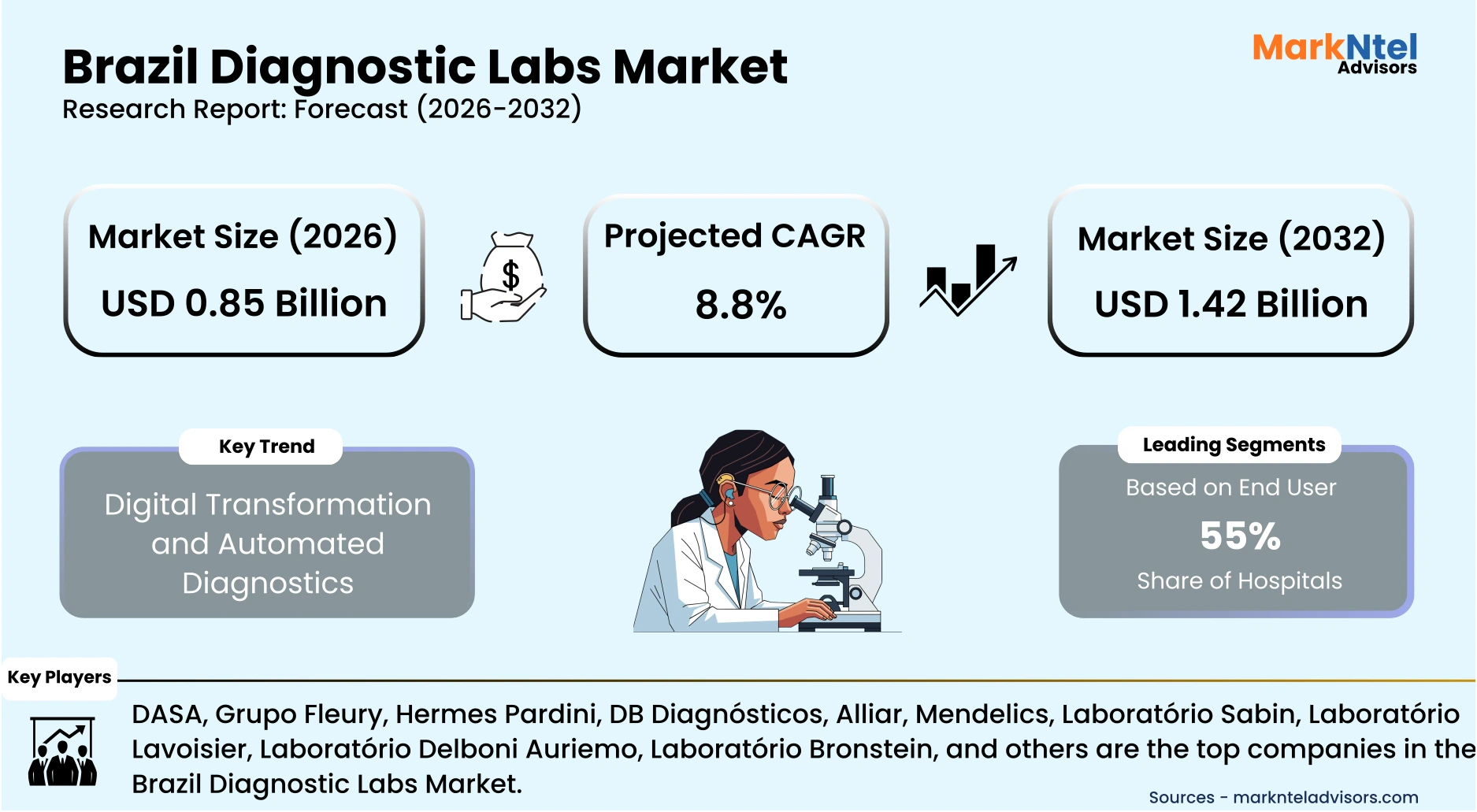
- Market size is estimated at USD 0.85 billion in 2026 and is projected to reach USD 1.42 billion by 2032. The estimated CAGR from 2026 to 2032 is around 8.8%, indicating strong growth.
- By Pathology Test Type, the Clinical Chemistry segment represented a significant share of about 36% in the Brazil Diagnostic Labs Market in 2026.
- By End-User, the Hospitals seized a significant share of about 55% in the Brazil Diagnostic Labs Market in 2026.
- Leading Diagnostic Labs Companies in the Brazil are DASA, Grupo Fleury, Hermes Pardini, DB Diagnósticos, Alliar, Mendelics, Laboratório Sabin, Laboratório Lavoisier, Laboratório Delboni Auriemo, Laboratório Bronstein, and others.
Market Insights & Analysis: Brazil Diagnostic Labs Market (2026-32):
The Brazil Diagnostic Labs Market size is estimated at USD 0.85 billion in 2026 and is projected to reach USD 1.42 billion by 2032. Along with this, the market is estimated to grow at a CAGR of around 8.8% during the forecast period, i.e., 2026-32.
Brazil’s diagnostic ecosystem is expanding alongside structural healthcare demand. According to the Brazilian Ministry of Health (2024), non-communicable diseases account for a major fraction of total mortality, with cardiovascular diseases alone contributing close to 30% of annual deaths . Additionally, as per the INCA, on average per year, breast cancer accounts for approximately 73,600 new cases in Brazil , significantly increasing pathology, histopathology, and molecular test volumes.
Additionally, public healthcare expenditure continues to underpin diagnostic volumes. Brazil’s federal allocation for the Unified Health System (SUS) was set at approximately USD42 billion in the 2024 Annual Budget Law (PLOA 2024) , marking a significant year-on-year increase and reinforcing financial capacity for hospital services, laboratory reimbursements, epidemiological surveillance, and nationwide diagnostic infrastructure. Meanwhile, ANS reported more than 51 million private health insurance beneficiaries in 2024 , representing nearly one-fourth of the population. This dual public-private structure ensures steady diagnostic volumes across hospital laboratories, independent centers, and corporate testing programs.
On the infrastructure side, Brazil maintains over 6,600 hospitals nationwide, many equipped with in-house laboratory facilities. In Addition, São Paulo alone accounts for nearly 30% of the country’s advanced healthcare infrastructure, making it the dominant diagnostic hub. Major networks such as DASA and Grupo Fleury have expanded automation programs between 2023 and 2025, incorporating high-throughput biochemistry analyzers and molecular platforms to increase daily processing capacity.
Moreover, regional expansion is further improving accessibility. Northeast states such as Bahia and Pernambuco are witnessing private laboratory network penetration growth due to rising insured populations and urbanization. Furthermore, individuals aged more than 60 now exceed 32 million , driving preventive screening panels and chronic disease monitoring, thereby sustaining recurring revenue streams for diagnostic operators.
Brazil Diagnostic Labs Market Recent Developments:
- 2025 : Sabin announced a goal to open 20 new diagnostic units, including its first 100% digital service location in Brasília, aimed at streamlined app-based exams and patient experience enhancements.
- 2025 : Grupo Fleury completed the acquisition of Laboratório de Análises Clínicas Confiance, Labclin, and Inda-Lab for USD25 million, expanding its diagnostic footprint in Campinas and surrounding areas.
Brazil Diagnostic Labs Market Scope:
| Category | Segments |
|---|---|
| By Test Type | (Pathology, Radiology & Imaging), |
| By Pathology Test Type | (Clinical Chemistry, Hematology, Immunology & Serology, Microbiology, Histopathology & Cytopathology, Molecular Diagnostics, Genetic Testing), |
| By Radiology Type | (X-Ray, Ultrasound, CT Scan, MRI, Mammography, PET-CT, Nuclear Imaging, Others), |
| By Service Delivery Mode | (Walk-in Testing, Home Sample Collection, Mobile Diagnostic Units), |
| By Disease Type | (Infectious Diseases, Oncology, Diabetes & Endocrinology, Cardiology, Neurology, Nephrology, Gastroenterology, Gynecology & Obstetrics, Respiratory Disorders, Orthopedics, Others), |
| By End-User | (Hospitals, Physician Clinics, Independent Diagnostic Centers, Corporate & Preventive Health Programs, Government & Public Healthcare Institutions), |
Brazil Diagnostic Labs Market Driver:
Rising Chronic Disease Prevalence Intensifying Recurring Diagnostic Volumes
Brazil’s diagnostic demand is increasingly shaped by the interconnected rise of metabolic and cardiovascular disorders. According to the Ministry of Health’s Vigitel 2023 data, 10.2% of adults have diabetes, 31.6% live with hypertension, and 22.4% are obese. These conditions rarely exist in isolation; instead, they reinforce one another through shared risk pathways. As obesity elevates diabetes and hypertension risks, and both accelerate vascular damage, patients transition from early-stage metabolic imbalance to long-term cardiovascular management, substantially increasing the frequency and complexity of laboratory monitoring.
This clinical progression translates directly into structured diagnostic consumption. Cardiovascular diseases account for over 400,000 deaths per year , reflecting the scale of advanced disease stages requiring cardiac biomarkers, lipid reassessments, coagulation testing, and inflammatory panels. Simultaneously, diabetes and hypertension are leading contributors to chronic kidney disease, and Brazil reports more than 157,000 patients undergoing dialysis, each requiring multiple laboratory assessments monthly. Thus, disease advancement expands not only patient numbers but also per-patient test intensity.
Consequently, Brazil’s diagnostic market benefits from both growing patient pools and expanding per-capita testing volumes, reinforcing sustained utilization growth across public and private networks.
Brazil Diagnostic Labs Market Trend:
Digital Transformation and Automated Diagnostics
Automation and AI adoption are becoming a defining operational trend in Brazil’s diagnostic laboratories, driven by rising test volumes and the need for faster turnaround times. Major networks are investing in high-throughput automated platforms to scale capacity without proportional workforce expansion. For instance, Grupo Fleury expanded automation in occupational and analytical chemistry testing in 2024, reporting that up to 90% of certain processing lines are automated, significantly improving speed and standardization.
Similarly, Hermes Pardini implemented one of Brazil’s largest automated core laboratory systems, capable of handling extremely high daily sample volumes through integrated robotic sample transportation and processing systems . These investments demonstrate a structural shift from manual workflows toward digitally integrated, automated laboratory ecosystems. These innovations are actively transforming the market growth.
Brazil Diagnostic Labs Market Opportunity:
Decentralized Diagnostic Expansion & Public Health Modernization
A major upcoming growth opportunity in Brazil’s diagnostic labs market lies in the modernization and decentralization of testing capacity beyond traditional metropolitan hubs. Under the Unified Health System (SUS), Brazil conducts billions of outpatient and hospital procedures annually through DATASUS, demonstrating the scale of laboratory dependency within public healthcare. However, high-complexity molecular and specialized pathology services remain heavily concentrated in Southeast Brazil. This geographic imbalance creates strong expansion potential in underserved North, Northeast, and Central-West states.
In parallel, Brazil operates over thousands of primary healthcare units under the Family Health Strategy, which generate structured referrals for screening and chronic disease monitoring. As referral intensity increases outside capital cities, laboratories establishing decentralized logistics networks and regional hubs can capture rising volumes while improving accessibility. This shift from metro-centric concentration toward distributed diagnostic infrastructure represents a scalable and sustainable growth opportunity across Brazil’s evolving healthcare system.
Brazil Diagnostic Labs Market Challenge:
Rising Cost Pressures Constraining Profitability
Rising cost pressures are a key challenge in Brazil’s diagnostic laboratory market, largely due to heavy dependence on imported medical technologies. According to Brazil’s Ministry of Development, Industry and Foreign Trade (MDIC), the country imported over USD6 billion worth of medical and hospital equipment in 2023 , underscoring reliance on foreign diagnostic platforms and reagents.
Because advanced PCR systems, immunoassay analyzers, and molecular consumables are mostly sourced internationally, laboratories are directly exposed to exchange rate volatility. For instance, in 2024, the Brazilian Real fluctuated significantly against the US Dollar, increasing procurement and reagent replenishment costs for high-complexity testing.
Moreover, regulatory and structural financial pressures compound this challenge. Imported devices must comply with ANVISA registration, customs clearance, and taxation requirements, adding both time and cost to capital investments. At the same time, inflation in Brazil averaged around 4–5% during 2023–2024 (IBGE), raising operational expenses such as electricity, logistics, and skilled labor, all critical for laboratories running energy-intensive and temperature-controlled systems.
Brazil Diagnostic Labs Market (2026-32) Segmentation Analysis:
The Brazil Diagnostic Labs Market study of MarkNtel Advisors evaluates & highlights the major trends and influencing factors in each segment. It includes predictions for the period 2026–32 at the country level. Based on the analysis, the market has been further classified as;
Based on Pathology Test Type:
- Clinical Chemistry
- Hematology
- Immunology & Serology
- Microbiology
- Histopathology & Cytopathology
- Molecular Diagnostics
- Genetic Testing
Clinical chemistry dominates Brazil’s Diagnostic Laboratory landscape primarily with a market share of about 36% because of the sheer volume of routine biochemical procedures performed annually, rather than disease prevalence alone. According to DATASUS outpatient production data (SIA/SUS), Brazil records hundreds of millions of laboratory procedures every year under the Unified Health System, and a significant share of these are routine clinical chemistry assays such as glucose, creatinine, urea, lipid profile, and liver enzyme tests. These exams form the backbone of primary care screening and hospital monitoring protocols.
Basic biochemical tests such as blood glucose and lipid panels are among the most frequently reimbursed procedures within SUS, generating extremely high annual procedural counts compared to specialized molecular or histopathology exams. Pre-operative screening protocols across Brazil’s public hospital network also require standardized chemistry panels before surgical admissions, further multiplying test volumes. The combination of institutionalized referral pathways, mandatory hospital screening, and recurring renal monitoring structurally positions clinical chemistry as the highest-volume and most operationally central segment in Brazil’s diagnostic market.
Based on End-User:
- Hospitals
- Physician Clinics
- Independent Diagnostic Centers
- Corporate & Preventive Health Programs
- Government & Public Healthcare Institutions
Hospitals dominate this market with a market share of about 55% because they concentrate the country’s most intensive and resource-dependent medical services. According to the National Registry of Health Establishments (CNES), Brazil has thousands of general and specialized hospitals, many equipped with in-house laboratories capable of handling emergency, inpatient, and complex diagnostic workflows. Unlike outpatient clinics, hospitals require continuous 24-hour laboratory support to manage acute admissions, trauma cases, obstetric care, and intensive care monitoring.
Moreover, hospitals also serve as referral centers for complex procedures such as organ transplantation, cardiovascular interventions, and high-risk maternity services. These services demand pre-procedure screening, intra-treatment monitoring, and post-treatment follow-up testing, all of which are laboratory-intensive. Because hospitals combine high patient turnover, case complexity, and continuous monitoring requirements, they generate significantly higher diagnostic volumes and revenue concentration compared to standalone diagnostic centers, reinforcing their structural dominance in Brazil’s laboratory market.
Gain a Competitive Edge with Our Brazil Diagnostic Labs Market Report:
- Brazil Diagnostic Labs Market Report by MarkNtel Advisors provides a detailed & thorough analysis of market size & share, growth rate, competitive landscape, and key players. This comprehensive analysis helps businesses gain a holistic understanding of the market dynamics & make informed decisions.
- This report also highlights current market trends & future projections, allowing businesses to identify emerging opportunities & potential challenges. By understanding market forecasts, companies can align their strategies & stay ahead of the competition.
- Brazil Diagnostic Labs Market Report aids in assessing & mitigating risks associated with entering or operating in the market. By understanding market dynamics, regulatory frameworks, and potential challenges, businesses can develop strategies to minimize risks & optimize their operations.
*Reports Delivery Format - Market research studies from MarkNtel Advisors are offered in PDF, Excel and PowerPoint formats. Within 24 hours of the payment being successfully received, the report will be sent to your email address.
Frequently Asked Questions
- Market Segmentation
- Introduction
- Product Definition
- Research Process
- Assumptions
- Executive Summary
- Brazil Diagnostic Labs Market Policies, Regulations, and Product Standards
- Brazil Diagnostic Labs Market Trends & Developments
- Brazil Diagnostic Labs Market Dynamics
- Growth Factors
- Challenges
- Brazil Diagnostic Labs Market Hotspot & Opportunities
- Brazil Diagnostic Labs Market Outlook, 2022-2032F
- Market Size & Outlook
- By Revenues (USD Million)
- Market Share & Outlook
- By Test Type- Market Size & Forecast 2022-2032, USD Million
- Pathology
- Radiology & Imaging
- By Pathology Test Type- Market Size & Forecast 2022-2032, USD Million
- Clinical Chemistry
- Hematology
- Immunology & Serology
- Microbiology
- Histopathology & Cytopathology
- Molecular Diagnostics
- Genetic Testing
- By Radiology Type- Market Size & Forecast 2022-2032, USD Million
- X-Ray
- Ultrasound
- CT Scan
- MRI
- Mammography
- PET-CT
- Nuclear Imaging
- Others
- By Service Delivery Mode- Market Size & Forecast 2022-2032, USD Million
- Walk-in Testing
- Home Sample Collection
- Mobile Diagnostic Units
- By Disease Type - Market Size & Forecast 2022-2032, USD Million
- Infectious Diseases
- Oncology
- Diabetes & Endocrinology
- Cardiology
- Neurology
- Nephrology
- Gastroenterology
- Gynecology & Obstetrics
- Respiratory Disorders
- Orthopedics
- Others
- By End-User- Market Size & Forecast 2022-2032, USD Million
- Hospitals
- Physician Clinics
- Independent Diagnostic Centers
- Corporate & Preventive Health Programs
- Government & Public Healthcare Institutions
- By Region- Market Size & Forecast 2022-2032, USD Million
- Southeast
- South
- Northeast
- Central
- West
- By Company
- Competition Characteristics
- Market Share & Analysis
- By Test Type- Market Size & Forecast 2022-2032, USD Million
- Market Size & Outlook
- Brazil Pathology Labs Market Outlook, 2022-2032
- Market Size & Outlook
- By Revenues (USD Million)
- Market Share & Outlook
- By Pathology Test Type- Market Size & Forecast 2022-2032, USD Million
- By Radiology Type- Market Size & Forecast 2022-2032, USD Million
- By Service Delivery Mode- Market Size & Forecast 2022-2032, USD Million
- By Disease Type - Market Size & Forecast 2022-2032, USD Million
- By End-User- Market Size & Forecast 2022-2032, USD Million
- By Region- Market Size & Forecast 2022-2032, USD Million
- Market Size & Outlook
- Brazil Radiology & Imaging Labs Market Outlook, 2022-2032
- Market Size & Outlook
- By Revenues (USD Million)
- Market Share & Outlook
- By Pathology Test Type- Market Size & Forecast 2022-2032, USD Million
- By Radiology Type- Market Size & Forecast 2022-2032, USD Million
- By Service Delivery Mode- Market Size & Forecast 2022-2032, USD Million
- By Disease Type - Market Size & Forecast 2022-2032, USD Million
- By End-User- Market Size & Forecast 2022-2032, USD Million
- By Region- Market Size & Forecast 2022-2032, USD Million
- Market Size & Outlook
- Brazil Diagnostic Labs Market Key Strategic Imperatives for Success & Growth
- Competitive Outlook
- Company Profiles
- DASA
- Business Description
- Product Portfolio
- Collaborations & Alliances
- Recent Developments
- Financial Details
- Others
- Grupo Fleury
- Business Description
- Product Portfolio
- Collaborations & Alliances
- Recent Developments
- Financial Details
- Others
- Hermes Pardini
- Business Description
- Product Portfolio
- Collaborations & Alliances
- Recent Developments
- Financial Details
- Others
- DB Diagnósticos
- Business Description
- Product Portfolio
- Collaborations & Alliances
- Recent Developments
- Financial Details
- Others
- Alliar
- Business Description
- Product Portfolio
- Collaborations & Alliances
- Recent Developments
- Financial Details
- Others
- Mendelics
- Business Description
- Product Portfolio
- Collaborations & Alliances
- Recent Developments
- Financial Details
- Others
- Laboratório Sabin
- Business Description
- Product Portfolio
- Collaborations & Alliances
- Recent Developments
- Financial Details
- Others
- Laboratório Lavoisier
- Business Description
- Product Portfolio
- Collaborations & Alliances
- Recent Developments
- Financial Details
- Others
- Laboratório Delboni Auriemo
- Business Description
- Product Portfolio
- Collaborations & Alliances
- Recent Developments
- Financial Details
- Others
- Laboratório Bronstein
- Business Description
- Product Portfolio
- Collaborations & Alliances
- Recent Developments
- Financial Details
- Others
- DASA
- Company Profiles
- Disclaimer
MarkNtel Advisors follows a robust and iterative research methodology designed to ensure maximum accuracy and minimize deviation in market estimates and forecasts. Our approach combines both bottom-up and top-down techniques to effectively segment and quantify various aspects of the market. A consistent feature across all our research reports is data triangulation, which examines the market from three distinct perspectives to validate findings. Key components of our research process include:
1. Scope & Research Design At the outset, MarkNtel Advisors define the research objectives and formulate pertinent questions. This phase involves determining the type of research—qualitative or quantitative—and designing a methodology that outlines data collection methods, target demographics, and analytical tools. They also establish timelines and budgets to ensure the research aligns with client goals.
2. Sample Selection and Data Collection In this stage, the firm identifies the target audience and determines the appropriate sample size to ensure representativeness. They employ various sampling methods, such as random or stratified sampling, based on the research objectives. Data collection is carried out using tools like surveys, interviews, and observations, ensuring the gathered data is reliable and relevant.
3. Data Analysis and Validation Once data is collected, MarkNtel Advisors undertake a rigorous analysis process. This includes cleaning the data to remove inconsistencies, employing statistical software for quantitative analysis, and thematic analysis for qualitative data. Validation steps are taken to ensure the accuracy and reliability of the findings, minimizing biases and errors.

4. Data Forecast and FinalizationThe final phase involves forecasting future market trends based on the analyzed data. MarkNtel Advisors utilize predictive modeling and time series analysis to anticipate market behaviors. The insights are then compiled into comprehensive reports, featuring visual aids like charts and graphs, and include strategic recommendations to inform client decision-making
We offer flexible licensing options to cater to varying organizational needs. Choose the pricing pack that best suits your requirements:
Buy Now Inquire Before Buying
 Request Customization
 Talk to our Consultant







