

Global Bird Repellent Market Research Report: Trends, Forecast & Opportunities (2026-2032)
By Type (Electronic Bird Repellents, Non-Electric Bird Repellents, Chemical Bird Repellents), By Form (Sprays, Gels and Pastes, Granules and Powders, Strips, Tapes, and Patches), B ... y Bird Species (Bird Repellent Market, Pigeons, Starlings, Crows, Geese, Seagulls), By End-Use (Agriculture and horticulture, Aviation, Architect and Construction, Food Processing, Gas and Oil Fields, Others), and others Read more
- Environment
- Mar 2026
- Pages 335
- Report Format: PDF, Excel, PPT
Global Bird Repellent Market
Projected 4.50% CAGR from 2026 to 2032
Study Period
2026-2032
Market Size (2026)
USD 430 Billion
Market Size (2032)
USD 560 Billion
Largest Region
North America
Projected CAGR
4.50%
Leading Segments
By End Use: Agriculture and Horticulture
Global Bird Repellent Market Report Key Takeaways:
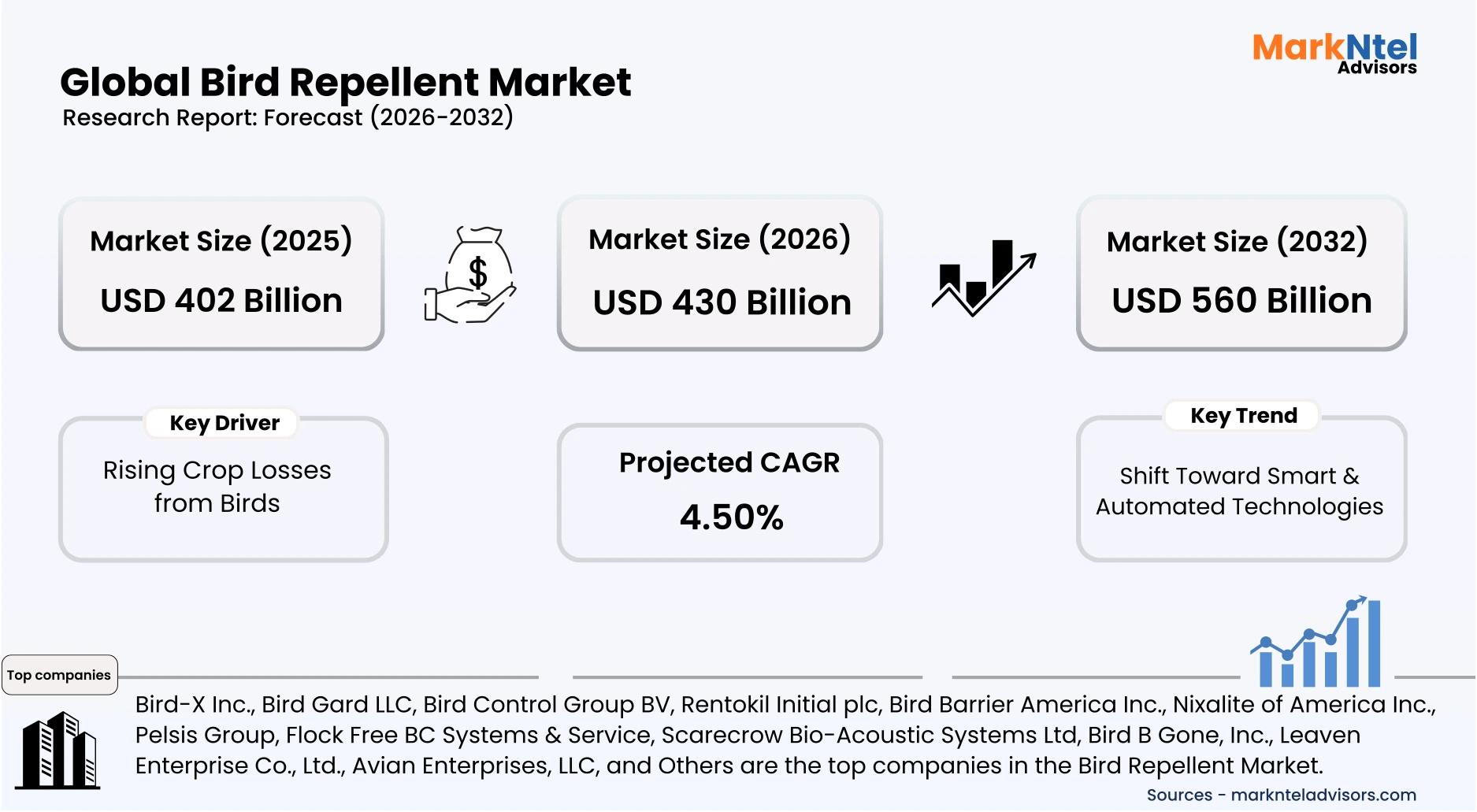
- The Global Bird Repellent market size was valued at USD 402 billion in 2025 and is projected to grow from USD 430 billion in 2026 to USD 560 billion by 2032, exhibiting a CAGR of 4.50% during the forecast period.
- North America holds the largest market share of about 35% in the Global Bird Repellent Market in 2026.
- By type, the chemical bird repellents segment represented a significant share of about 52% in the Global Bird Repellent Market in 2026.
- By end use, the agriculture and horticulture segment presented a significant share of about 50% in the Global Bird Repellent Market in 2026.
- Leading Bird Repellent companies in the Global Market are Bird-X Inc., Bird Gard LLC, Bird Control Group BV, Rentokil Initial plc, Bird Barrier America Inc., Nixalite of America Inc., Pelsis Group, Flock Free BC Systems & Service, Scarecrow Bio-Acoustic Systems Ltd, Bird B Gone, Inc., Leaven Enterprise Co., Ltd., Avian Enterprises, LLC, and Others.
Market Insights & Analysis: Global Bird Repellent Market (2026-32):
The Global Bird Repellent Market size is valued at approximately USD 402 billion in 2025 and is projected to grow from USD 430 billion in 2026 to USD 560 billion by 2032. Along with this, the market is estimated to grow at a CAGR of around 4.50% during the forecast period, i.e., 2026-32.
The global bird repellent market is primarily driven by rising crop losses and economic damage caused by bird infestations across agriculture, aviation, and infrastructure sectors. Birds such as starlings, blackbirds, and pigeons can destroy crops, damage property, and pose safety hazards, creating a strong demand for effective and preventive bird control solutions.
In India, key bird pests like rose-ringed parakeets and munias are reported to cause 10–45% crop damage in cereals such as bajra, sorghum, maize, and rice, significantly reducing yields and prompting farmers to adopt deterrent measures .
Similarly, in the United States, farmers experience annual losses of USD 15–50 million due to blackbirds consuming ripening corn, sunflowers, rice, and cherries. Starlings further damage fruit crops and contaminate feedlots, highlighting the economic burden of bird infestations and incentivizing investment in preventive repellent solutions .
Alongside economic pressures, the market is witnessing a significant shift toward smart, AI-enabled, and automated bird deterrent technologies. These systems provide continuous, humane, and real-time monitoring and control, reducing labor and improving efficiency compared with traditional methods. For instance, in 2025, Japan’s NTT e-Drone Technology trialed autonomous laser-equipped drones (BB102 model) to protect poultry farms from avian influenza. These drones use unpredictable red and green laser beams to disperse crows, pigeons, and other wild birds safely, with local governments supporting adoption through cost-sharing programs .
Furthermore, future investments in bird control technologies are expected to accelerate market growth. Governments and infrastructure authorities are investing heavily in advanced detection and deterrent systems. The U.S. Federal Aviation Administration (FAA) reports over USD 400 million invested in wildlife hazard mitigation projects, including bird detection systems and perimeter upgrades, supporting long-term adoption of automated solutions beyond 2025 .
Overall, with rising agricultural losses, economic damages, and regulatory support, the bird repellent market is poised for significant growth. The convergence of smart technologies, government-backed initiatives, and investment in automated deterrents ensures that both preventive and sustainable bird control solutions will play an increasingly vital role in protecting crops, infrastructure, and aviation safety worldwide.
Global Bird Repellent Market Recent Developments:
- 2025: Bird-X introduced an upgraded ledge exclusion barrier that’s more durable and easier to install, helping commercial and industrial sites prevent birds from roosting while maintaining architectural integrity.
- 2025: Avian Enterprises launched Avian Migrate®, a mist-applied repellent designed to help poultry producers deter wild birds carrying avian influenza, using visible deterrent dye technology without harming the environment .
Global Bird Repellent Market Scope:
| Category | Segments |
|---|---|
| By Type | (Electronic Bird Repellents, Non-Electric Bird Repellents, Chemical Bird Repellents), |
| By Form | (Sprays, Gels and Pastes, Granules and Powders, Strips, Tapes, and Patches), |
| By Bird Species | (Bird Repellent Market, Pigeons, Starlings, Crows, Geese, Seagulls), |
| By End-Use | (Agriculture and horticulture, Aviation, Architect and Construction, Food Processing, Gas and Oil Fields, Others), |
Global Bird Repellent Market Driver:
Rising Crop Losses from Birds
Crop losses caused by birds are a significant, well-documented driver of demand for bird repellent solutions. According to the United States Department of Agriculture (USDA) Animal and Plant Health Inspection Service, in the U.S. alone, European starlings, blackbirds, and crows inflict more than USD 150 million in direct annual damage to grain, fruit, and berry crops through feeding and contamination each year. For example, sunflower producers in the northern Great Plains lose approximately USD 4–7 million annually to blackbird feeding, while starlings and songbirds reduce fruit quality and marketability, costing fruit growers tens of millions more .
Government-supported agricultural research in India’s Central Arid Zone Research Institute found that common crop pests like rose-ringed parakeets and weaver birds cause 10 – 45% damage in crops such as cowpea, maize, bajra, and rice at vulnerable stages of growth, seriously reducing yields .
These losses not only hit farmer incomes but also push governments to prioritize crop protection programs. For instance, the USDA and state agricultural departments plan to increase funding for wildlife damage research and mitigation tools beyond 2025, including deployment of advanced deterrent systems and farmer training in integrated pest management.
Overall, persistent and quantifiable crop damage caused by bird species, backed by government data, increases the urgency for effective bird repellent solutions. As agriculture expands and governments enhance support for crop protection, this driver will continue to fuel bird repellent market growth in the coming years.
Global Bird Repellent Market Trend:
Shift Toward Smart & Automated Technologies
A key trend in the global bird repellent market is the adoption of smart and automated deterrent technologies that work continuously with minimal human intervention. These systems use advanced detection, machine learning, robotics, and laser technology to provide efficient, humane, and scalable bird control across large areas.
For example, the AVIX Autonomic Mark II is a fully automated laser bird deterrent system that projects green laser beams perceived as natural threats by birds, causing them to disperse. This system can be programmed, monitored remotely via mobile apps, and has been shown to reduce bird nuisance by over 70%, covering extensive areas without habituation .
Another example is BirdGuard360, an autonomous robotic bird repeller that patrols airport runways and agricultural perimeters. It uses AI-based real-time bird detection, directional sound waves, and lasers to repel birds, reducing risks such as bird strikes. The system’s autonomous patrol and repellent response improve safety and operational efficiency, which is crucial for sectors like aviation.
These technologies align with wildlife hazard mitigation priorities (e.g., the FAA’s focus on bird strike reduction) and support automated responses as part of standardized safety protocols. As governments and industry stakeholders emphasize continuous, data-driven bird deterrence, smart automated solutions will play an increasingly central role in the market.
Global Bird Repellent Market Opportunity:
Innovation in Biodegradable & Sustainable Products
A significant opportunity in the bird repellent market lies in the development of biodegradable and eco-friendly solutions that meet environmental regulations while protecting crops and infrastructure. Governments and regulatory bodies, such as the U.S. Environmental Protection Agency (EPA), promote safer alternatives to chemical repellents to reduce environmental impact. The EPA’s guidelines under the Federal Insecticide, Fungicide, and Rodenticide Act (FIFRA) encourage the adoption of low-toxicity repellents for wildlife management, steering manufacturers toward natural and non-toxic formulations.
For example, in 2025, Biocline Herbal Bird Repellent was introduced as a 100% eco-friendly, non-toxic spray for grains, fruits, and vegetables. The herbal bio-based formulation naturally deters birds without harming beneficial insects, soil, or water ecosystems, supporting sustainable farming practices in both organic and conventional agriculture. Farmers can easily apply the product across fields, reducing crop damage while maintaining biodiversity.
Furthermore, solar-powered sound deterrents like the Solar Bird Chase Super Sonic™ combine renewable energy with humane bird repelling methods, demonstrating how technology and sustainability can be integrated to reduce chemical usage in open-field applications .
Overall, innovation in biodegradable, non-toxic, and renewable-energy-based repellents not only aligns with environmental policies but also offers scalable, sustainable solutions. These eco-friendly products are likely to drive market growth as governments, farmers, and industries increasingly prioritize environmentally responsible bird control.
Global Bird Repellent Market Challenge:
High Cost of Advanced Systems
One of the key challenges restraining the bird repellent market is the high cost of advanced automated and smart deterrent systems, which limits adoption among small and medium-scale users. Sophisticated technologies such as AI-enabled laser systems, autonomous robots, and sensor-integrated deterrents offer superior efficiency and continuous operation, but they come with significant upfront investments. For instance, the AVIX Autonomic Mark II automated laser system costs approximately USD 13,104 per unit in 2025.
In contrast, traditional physical deterrents such as netting, spikes, or basic auditory devices typically range from USD 50 to a few hundred USD, highlighting a large price gap .
Moreover, advanced systems often require ongoing maintenance, including software updates, component servicing, and multiple units to cover large agricultural fields or airport perimeters, further raising the total cost of ownership. Government safety programs, such as FAA-recommended wildlife hazard management plans, support these technologies at airports; however, private farmers and smaller facilities face financial barriers. Consequently, cost-sensitive users continue to rely on lower-priced, less effective solutions, slowing market penetration and limiting broader adoption of technology-driven bird deterrents.
Overall, the high capital expenditure of smart systems remains a significant barrier, particularly for small-scale and budget-constrained users, restraining market growth despite technological advancements.
Global Bird Repellent Market (2026-32) Segmentation Analysis:
The Global Bird Repellent Market study of MarkNtel Advisors evaluates & highlights the major trends and influencing factors in each segment. It includes predictions for the period 2026–32 at the global level. Based on the analysis, the market has been further classified as;
Based on Type:
-
- Electronic Bird Repellents
- Laser bird repellents
- Sound/ultrasonic deterrents
- Radar bird control
- Shock tracks
- Drones & others
- Non-Electric Bird Repellents
- Bird Wire
- Spikes
- Gels and Taste Aversions
- Netting
- Others
- Chemical Bird Repellents
- Electronic Bird Repellents
Chemical bird repellents account for nearly 52% of the global bird repellent market, making them the dominant type segment. Their leadership is primarily driven by cost-effectiveness, ease of application, and broad-area coverage. Unlike electronic systems that require installation, electricity, or maintenance, chemical repellents such as sprays, gels, and granules can be applied quickly across farms, warehouses, rooftops, and open fields. These products work through taste aversion, odor deterrence, or mild sensory irritation, discouraging birds without causing harm. Farmers and facility managers prefer chemical solutions because they are scalable and suitable for large agricultural lands where electronic infrastructure may not be feasible.
In addition, continuous innovation in biodegradable and eco-friendly formulations has improved regulatory acceptance and environmental safety. Their flexibility across multiple bird species, including pigeons, crows, and starlings, further strengthens adoption. As a result, chemical repellents remain the most commercially viable and widely deployed solution worldwide.
Based on End Use:
- Agriculture and horticulture
- Aviation
- Architect and Construction
- Food Processing
- Gas and Oil Fields
- Others
Agriculture and horticulture contribute approximately 50% of the total bird repellent market demand, positioning it as the leading end-use segment. Crop damage caused by birds significantly affects yield quality and farmer income, especially in fruits, grains, vineyards, and vegetable farming. Birds often feed on seeds, seedlings, and ripening crops, leading to measurable financial losses each season. To mitigate this risk, farmers increasingly invest in preventive bird control measures rather than post-damage recovery. Both chemical and electronic repellents are widely used in farmlands to protect high-value crops.
Additionally, rising global food demand and shrinking arable land have intensified the need to maximize productivity per hectare. Governments in several regions also promote crop protection technologies to reduce wastage and improve food security. Because agriculture operates on large open spaces requiring scalable and affordable solutions, it naturally represents the largest revenue-generating end-use sector in the global bird repellent market.
Global Bird Repellent Market (2026-32): Regional Projection
The Global Bird Repellent Market is dominated by North America, accounting for approximately 35% of the total market size. This leadership is driven by advanced agricultural practices, high-value crop production, and stringent regulations on wildlife management. Farmers in the U.S. face significant losses from birds such as starlings, blackbirds, and crows, which damage fruits, grains, and vegetables. These economic pressures encourage widespread adoption of bird deterrent solutions, including netting, auditory devices, and automated systems.
In addition to agriculture, bird strikes in aviation are a major safety and financial concern. According to the U.S. Federal Aviation Administration (FAA), nearly 19,700 wildlife strike incidents were reported at U.S. airports in 2023, with the majority involving birds. This has prompted airports to adopt automated and humane bird control systems, such as laser deterrents, drones, and sensor-based technologies, to protect runways, aircraft, and passenger s.
The combination of government support, technological adoption, and the need to protect both crops and aviation infrastructure reinforces North America’s position as the leading market for bird repellent solutions. Investments in automated, eco-friendly, and AI-enabled systems ensure sustained market growth across agriculture, aviation, and urban infrastructure.
Gain a Competitive Edge with Our Global Bird Repellent Market Report:
- Global Bird Repellent Market Report by MarkNtel Advisors provides a detailed & thorough analysis of market size & share, growth rate, competitive landscape, and key players. This comprehensive analysis helps businesses gain a holistic understanding of the market dynamics & make informed decisions.
- This report also highlights current market trends & future projections, allowing businesses to identify emerging opportunities & potential challenges. By understanding market forecasts, companies can align their strategies & stay ahead of the competition.
- Global Bird Repellent Market Report aids in assessing & mitigating risks associated with entering or operating in the market. By understanding market dynamics, regulatory frameworks, and potential challenges, businesses can develop strategies to minimize risks & optimize their operations.
*Reports Delivery Format - Market research studies from MarkNtel Advisors are offered in PDF, Excel and PowerPoint formats. Within 24 hours of the payment being successfully received, the report will be sent to your email address.
Frequently Asked Questions
- Market Segmentation
- Introduction
- Product Definition
- Research Process
- Assumptions
- Executive Summary
- Global Bird Repellent Market Policies, Regulations, and Product Standards
- Global Bird Repellent Market Trends & Developments
- Global Bird Repellent Market Dynamics
- Growth Factors
- Challenges
- Global Bird Repellent Market Hotspot & Opportunities
- Global Bird Repellent Market Outlook, 2022-2032F
- Market Size & Outlook
- By Revenues (USD Million)
- Market Share & Analysis
- By Type- Market Size & Forecast 2022-2032, USD Million
- Electronic Bird Repellents
- Laser bird repellents
- Sound/Ultrasonic deterrents
- Radar Bird Control
- Shock Tracks
- Drones & others
- Non-Electric Bird Repellents
- Bird Wire
- Spikes
- Gels and Taste Aversions
- Netting
- Others
- Chemical Bird Repellents
- Electronic Bird Repellents
- By Form- Market Size & Forecast 2022-2032, USD Million
- Sprays
- Gels and Pastes
- Granules and Powders
- Strips, Tapes, and Patches
- By Bird Species- Market Size & Forecast 2022-2032, USD Million
- Bird Repellent Market
- Pigeons
- Starlings
- Crows
- Geese
- Seagulls
- By End-Use- Market Size & Forecast 2022-2032, USD Million
- Agriculture and horticulture
- Aviation
- Architect and Construction
- Food Processing
- Gas and Oil Fields
- Others
- By Region
- North America
- South America
- Europe
- The Middle East & Africa
- Asia-Pacific
- By Company
- Competition Characteristics
- Market Share & Analysis
- By Type- Market Size & Forecast 2022-2032, USD Million
- Market Size & Outlook
- North America Bird Repellent Market Outlook, 2022-2032F
- Market Size & Outlook
- By Revenues (USD Million)
- Market Share & Analysis
- By Type- Market Size & Forecast 2022-2032, USD Million
- By Form- Market Size & Forecast 2022-2032, USD Million
- By Bird Species- Market Size & Forecast 2022-2032, USD Million
- By End-Use- Market Size & Forecast 2022-2032, USD Million
- By Country
- The US
- Canada
- Mexico
- Rest of North America
- The US Bird Repellent Market Outlook, 2022-2032F
- Market Size & Outlook
- By Revenues (USD Million)
- Market Share & Analysis
- By Type- Market Size & Forecast 2022-2032, USD Million
- By Form- Market Size & Forecast 2022-2032, USD Million
- By Bird Species- Market Size & Forecast 2022-2032, USD Million
- By End-Use- Market Size & Forecast 2022-2032, USD Million
- Market Size & Outlook
- Canada Bird Repellent Market Outlook, 2022-2032F
- Market Size & Outlook
- By Revenues (USD Million)
- Market Share & Analysis
- By Type- Market Size & Forecast 2022-2032, USD Million
- By Form- Market Size & Forecast 2022-2032, USD Million
- By Bird Species- Market Size & Forecast 2022-2032, USD Million
- By End-Use- Market Size & Forecast 2022-2032, USD Million
- Market Size & Outlook
- Mexico Bird Repellent Market Outlook, 2022-2032F
- Market Size & Outlook
- By Revenues (USD Million)
- Market Share & Analysis
- By Type- Market Size & Forecast 2022-2032, USD Million
- By Form- Market Size & Forecast 2022-2032, USD Million
- By Bird Species- Market Size & Forecast 2022-2032, USD Million
- By End-Use- Market Size & Forecast 2022-2032, USD Million
- Market Size & Outlook
- Market Size & Outlook
- South America Bird Repellent Market Outlook, 2022-2032F
- Market Size & Outlook
- By Revenues (USD Million)
- Market Share & Analysis
- By Type- Market Size & Forecast 2022-2032, USD Million
- By Form- Market Size & Forecast 2022-2032, USD Million
- By Bird Species- Market Size & Forecast 2022-2032, USD Million
- By End-Use- Market Size & Forecast 2022-2032, USD Million
- By Country
- Brazil
- Argentina
- Chile
- Colombia
- Peru
- Rest of South America
- Brazil Bird Repellent Market Outlook, 2022-2032F
- Market Size & Outlook
- By Revenues (USD Million)
- Market Share & Analysis
- By Type- Market Size & Forecast 2022-2032, USD Million
- By Form- Market Size & Forecast 2022-2032, USD Million
- By Bird Species- Market Size & Forecast 2022-2032, USD Million
- By End-Use- Market Size & Forecast 2022-2032, USD Million
- Market Size & Outlook
- Argentina Bird Repellent Market Outlook, 2022-2032F
- Market Size & Outlook
- By Revenues (USD Million)
- Market Share & Analysis
- By Type- Market Size & Forecast 2022-2032, USD Million
- By Form- Market Size & Forecast 2022-2032, USD Million
- By Bird Species- Market Size & Forecast 2022-2032, USD Million
- By End-Use- Market Size & Forecast 2022-2032, USD Million
- Market Size & Outlook
- Chile Bird Repellent Market Outlook, 2022-2032F
- Market Size & Outlook
- By Revenues (USD Million)
- Market Share & Analysis
- By Type- Market Size & Forecast 2022-2032, USD Million
- By Form- Market Size & Forecast 2022-2032, USD Million
- By Bird Species- Market Size & Forecast 2022-2032, USD Million
- By End-Use- Market Size & Forecast 2022-2032, USD Million
- Market Size & Outlook
- Colombia Bird Repellent Market Outlook, 2022-2032F
- Market Size & Outlook
- By Revenues (USD Million)
- Market Share & Analysis
- By Type- Market Size & Forecast 2022-2032, USD Million
- By Form- Market Size & Forecast 2022-2032, USD Million
- By Bird Species- Market Size & Forecast 2022-2032, USD Million
- By End-Use- Market Size & Forecast 2022-2032, USD Million
- Market Size & Outlook
- Peru Bird Repellent Market Outlook, 2022-2032F
- Market Size & Outlook
- By Revenues (USD Million)
- Market Share & Analysis
- By Type- Market Size & Forecast 2022-2032, USD Million
- By Form- Market Size & Forecast 2022-2032, USD Million
- By Bird Species- Market Size & Forecast 2022-2032, USD Million
- By End-Use- Market Size & Forecast 2022-2032, USD Million
- Market Size & Outlook
- Market Size & Outlook
- Europe Bird Repellent Market Outlook, 2022-2032F
- Market Size & Outlook
- By Revenues (USD Million)
- Market Share & Analysis
- By Type- Market Size & Forecast 2022-2032, USD Million
- By Form- Market Size & Forecast 2022-2032, USD Million
- By Bird Species- Market Size & Forecast 2022-2032, USD Million
- By End-Use- Market Size & Forecast 2022-2032, USD Million
- By Country
- The UK
- Germany
- France
- Italy
- Spain
- Netherlands
- Belgium
- Switzerland
- Sweden
- Austria
- Portugal
- Poland
- Norway
- Ireland
- Greece
- Rest of Europe
- The UK Bird Repellent Market Outlook, 2022-2032F
- Market Size & Outlook
- By Revenues (USD Million)
- Market Share & Analysis
- By Type- Market Size & Forecast 2022-2032, USD Million
- By Form- Market Size & Forecast 2022-2032, USD Million
- By Bird Species- Market Size & Forecast 2022-2032, USD Million
- By End-Use- Market Size & Forecast 2022-2032, USD Million
- Market Size & Outlook
- Germany Bird Repellent Market Outlook, 2022-2032F
- Market Size & Outlook
- By Revenues (USD Million)
- Market Share & Analysis
- By Type- Market Size & Forecast 2022-2032, USD Million
- By Form- Market Size & Forecast 2022-2032, USD Million
- By Bird Species- Market Size & Forecast 2022-2032, USD Million
- By End-Use- Market Size & Forecast 2022-2032, USD Million
- Market Size & Outlook
- France Bird Repellent Market Outlook, 2022-2032F
- Market Size & Outlook
- By Revenues (USD Million)
- Market Share & Analysis
- By Type- Market Size & Forecast 2022-2032, USD Million
- By Form- Market Size & Forecast 2022-2032, USD Million
- By Bird Species- Market Size & Forecast 2022-2032, USD Million
- By End-Use- Market Size & Forecast 2022-2032, USD Million
- Market Size & Outlook
- Italy Bird Repellent Market Outlook, 2022-2032F
- Market Size & Outlook
- By Revenues (USD Million)
- Market Share & Analysis
- By Type- Market Size & Forecast 2022-2032, USD Million
- By Form- Market Size & Forecast 2022-2032, USD Million
- By Bird Species- Market Size & Forecast 2022-2032, USD Million
- By End-Use- Market Size & Forecast 2022-2032, USD Million
- Market Size & Outlook
- Spain Bird Repellent Market Outlook, 2022-2032F
- Market Size & Outlook
- By Revenues (USD Million)
- Market Share & Analysis
- By Type- Market Size & Forecast 2022-2032, USD Million
- By Form- Market Size & Forecast 2022-2032, USD Million
- By Bird Species- Market Size & Forecast 2022-2032, USD Million
- By End-Use- Market Size & Forecast 2022-2032, USD Million
- Market Size & Outlook
- Netherlands Bird Repellent Market Outlook, 2022-2032F
- Market Size & Outlook
- By Revenues (USD Million)
- Market Share & Analysis
- By Type- Market Size & Forecast 2022-2032, USD Million
- By Form- Market Size & Forecast 2022-2032, USD Million
- By Bird Species- Market Size & Forecast 2022-2032, USD Million
- By End-Use- Market Size & Forecast 2022-2032, USD Million
- Market Size & Outlook
- Belgium Bird Repellent Market Outlook, 2022-2032F
- Market Size & Outlook
- By Revenues (USD Million)
- Market Share & Analysis
- By Type- Market Size & Forecast 2022-2032, USD Million
- By Form- Market Size & Forecast 2022-2032, USD Million
- By Bird Species- Market Size & Forecast 2022-2032, USD Million
- By End-Use- Market Size & Forecast 2022-2032, USD Million
- Market Size & Outlook
- Switzerland Bird Repellent Market Outlook, 2022-2032F
- Market Size & Outlook
- By Revenues (USD Million)
- Market Share & Analysis
- By Type- Market Size & Forecast 2022-2032, USD Million
- By Form- Market Size & Forecast 2022-2032, USD Million
- By Bird Species- Market Size & Forecast 2022-2032, USD Million
- By End-Use- Market Size & Forecast 2022-2032, USD Million
- Market Size & Outlook
- Sweden Bird Repellent Market Outlook, 2022-2032F
- Market Size & Outlook
- By Revenues (USD Million)
- Market Share & Analysis
- By Type- Market Size & Forecast 2022-2032, USD Million
- By Form- Market Size & Forecast 2022-2032, USD Million
- By Bird Species- Market Size & Forecast 2022-2032, USD Million
- By End-Use- Market Size & Forecast 2022-2032, USD Million
- Market Size & Outlook
- Austria Bird Repellent Market Outlook, 2022-2032F
- Market Size & Outlook
- By Revenues (USD Million)
- Market Share & Analysis
- By Type- Market Size & Forecast 2022-2032, USD Million
- By Form- Market Size & Forecast 2022-2032, USD Million
- By Bird Species- Market Size & Forecast 2022-2032, USD Million
- By End-Use- Market Size & Forecast 2022-2032, USD Million
- Market Size & Outlook
- Portugal Bird Repellent Market Outlook, 2022-2032F
- Market Size & Outlook
- By Revenues (USD Million)
- Market Share & Analysis
- By Type- Market Size & Forecast 2022-2032, USD Million
- By Form- Market Size & Forecast 2022-2032, USD Million
- By Bird Species- Market Size & Forecast 2022-2032, USD Million
- By End-Use- Market Size & Forecast 2022-2032, USD Million
- Market Size & Outlook
- Poland Bird Repellent Market Outlook, 2022-2032F
- Market Size & Outlook
- By Revenues (USD Million)
- Market Share & Analysis
- By Type- Market Size & Forecast 2022-2032, USD Million
- By Form- Market Size & Forecast 2022-2032, USD Million
- By Bird Species- Market Size & Forecast 2022-2032, USD Million
- By End-Use- Market Size & Forecast 2022-2032, USD Million
- Market Size & Outlook
- Norway Bird Repellent Market Outlook, 2022-2032F
- Market Size & Outlook
- By Revenues (USD Million)
- Market Share & Analysis
- By Type- Market Size & Forecast 2022-2032, USD Million
- By Form- Market Size & Forecast 2022-2032, USD Million
- By Bird Species- Market Size & Forecast 2022-2032, USD Million
- By End-Use- Market Size & Forecast 2022-2032, USD Million
- Market Size & Outlook
- Ireland Bird Repellent Market Outlook, 2022-2032F
- Market Size & Outlook
- By Revenues (USD Million)
- Market Share & Analysis
- By Type- Market Size & Forecast 2022-2032, USD Million
- By Form- Market Size & Forecast 2022-2032, USD Million
- By Bird Species- Market Size & Forecast 2022-2032, USD Million
- By End-Use- Market Size & Forecast 2022-2032, USD Million
- Market Size & Outlook
- Greece Bird Repellent Market Outlook, 2022-2032F
- Market Size & Outlook
- By Revenues (USD Million)
- Market Share & Analysis
- By Type- Market Size & Forecast 2022-2032, USD Million
- By Form- Market Size & Forecast 2022-2032, USD Million
- By Bird Species- Market Size & Forecast 2022-2032, USD Million
- By End-Use- Market Size & Forecast 2022-2032, USD Million
- Market Size & Outlook
- Market Size & Outlook
- The Middle East & Africa Bird Repellent Market Outlook, 2022-2032F
- Market Size & Outlook
- By Revenues (USD Million)
- Market Share & Analysis
- By Type- Market Size & Forecast 2022-2032, USD Million
- By Form- Market Size & Forecast 2022-2032, USD Million
- By Bird Species- Market Size & Forecast 2022-2032, USD Million
- By End-Use- Market Size & Forecast 2022-2032, USD Million
- By Country
- Saudi Arabia
- UAE
- South Africa
- Israel
- Egypt
- Nigeria
- Rest of Middle East & Africa
- Saudi Arabia Bird Repellent Market Outlook, 2022-2032F
- Market Size & Outlook
- By Revenues (USD Million)
- Market Share & Analysis
- By Type- Market Size & Forecast 2022-2032, USD Million
- By Form- Market Size & Forecast 2022-2032, USD Million
- By Bird Species- Market Size & Forecast 2022-2032, USD Million
- By End-Use- Market Size & Forecast 2022-2032, USD Million
- Market Size & Outlook
- UAE Bird Repellent Market Outlook, 2022-2032F
- Market Size & Outlook
- By Revenues (USD Million)
- Market Share & Analysis
- By Type- Market Size & Forecast 2022-2032, USD Million
- By Form- Market Size & Forecast 2022-2032, USD Million
- By Bird Species- Market Size & Forecast 2022-2032, USD Million
- By End-Use- Market Size & Forecast 2022-2032, USD Million
- Market Size & Outlook
- South Africa Bird Repellent Market Outlook, 2022-2032F
- Market Size & Outlook
- By Revenues (USD Million)
- Market Share & Analysis
- By Type- Market Size & Forecast 2022-2032, USD Million
- By Form- Market Size & Forecast 2022-2032, USD Million
- By Bird Species- Market Size & Forecast 2022-2032, USD Million
- By End-Use- Market Size & Forecast 2022-2032, USD Million
- Market Size & Outlook
- Israel Bird Repellent Market Outlook, 2022-2032F
- Market Size & Outlook
- By Revenues (USD Million)
- Market Share & Analysis
- By Type- Market Size & Forecast 2022-2032, USD Million
- By Form- Market Size & Forecast 2022-2032, USD Million
- By Bird Species- Market Size & Forecast 2022-2032, USD Million
- By End-Use- Market Size & Forecast 2022-2032, USD Million
- Market Size & Outlook
- Egypt Bird Repellent Market Outlook, 2022-2032F
- Market Size & Outlook
- By Revenues (USD Million)
- Market Share & Analysis
- By Type- Market Size & Forecast 2022-2032, USD Million
- By Form- Market Size & Forecast 2022-2032, USD Million
- By Bird Species- Market Size & Forecast 2022-2032, USD Million
- By End-Use- Market Size & Forecast 2022-2032, USD Million
- Market Size & Outlook
- Nigeria Bird Repellent Market Outlook, 2022-2032F
- Market Size & Outlook
- By Revenues (USD Million)
- Market Share & Analysis
- By Type- Market Size & Forecast 2022-2032, USD Million
- By Form- Market Size & Forecast 2022-2032, USD Million
- By Bird Species- Market Size & Forecast 2022-2032, USD Million
- By End-Use- Market Size & Forecast 2022-2032, USD Million
- Market Size & Outlook
- Market Size & Outlook
- Asia-Pacific Bird Repellent Market Outlook, 2022-2032F
- Market Size & Outlook
- By Revenues (USD Million)
- Market Share & Analysis
- By Type- Market Size & Forecast 2022-2032, USD Million
- By Form- Market Size & Forecast 2022-2032, USD Million
- By Bird Species- Market Size & Forecast 2022-2032, USD Million
- By End-Use- Market Size & Forecast 2022-2032, USD Million
- By Country
- China
- Japan
- India
- South Korea
- Australia
- New Zealand
- Rest of Asia-Pacific
- China Bird Repellent Market Outlook, 2022-2032F
- Market Size & Outlook
- By Revenues (USD Million)
- Market Share & Analysis
- By Type- Market Size & Forecast 2022-2032, USD Million
- By Form- Market Size & Forecast 2022-2032, USD Million
- By Bird Species- Market Size & Forecast 2022-2032, USD Million
- By End-Use- Market Size & Forecast 2022-2032, USD Million
- Market Size & Outlook
- Japan Bird Repellent Market Outlook, 2022-2032F
- Market Size & Outlook
- By Revenues (USD Million)
- Market Share & Analysis
- By Type- Market Size & Forecast 2022-2032, USD Million
- By Form- Market Size & Forecast 2022-2032, USD Million
- By Bird Species- Market Size & Forecast 2022-2032, USD Million
- By End-Use- Market Size & Forecast 2022-2032, USD Million
- Market Size & Outlook
- India Bird Repellent Market Outlook, 2022-2032F
- Market Size & Outlook
- By Revenues (USD Million)
- Market Share & Analysis
- By Type- Market Size & Forecast 2022-2032, USD Million
- By Form- Market Size & Forecast 2022-2032, USD Million
- By Bird Species- Market Size & Forecast 2022-2032, USD Million
- By End-Use- Market Size & Forecast 2022-2032, USD Million
- Market Size & Outlook
- South Korea Bird Repellent Market Outlook, 2022-2032F
- Market Size & Outlook
- By Revenues (USD Million)
- Market Share & Analysis
- By Type- Market Size & Forecast 2022-2032, USD Million
- By Form- Market Size & Forecast 2022-2032, USD Million
- By Bird Species- Market Size & Forecast 2022-2032, USD Million
- By End-Use- Market Size & Forecast 2022-2032, USD Million
- Market Size & Outlook
- Australia Bird Repellent Market Outlook, 2022-2032F
- Market Size & Outlook
- By Revenues (USD Million)
- Market Share & Analysis
- By Type- Market Size & Forecast 2022-2032, USD Million
- By Form- Market Size & Forecast 2022-2032, USD Million
- By Bird Species- Market Size & Forecast 2022-2032, USD Million
- By End-Use- Market Size & Forecast 2022-2032, USD Million
- Market Size & Outlook
- New Zealand Bird Repellent Market Outlook, 2022-2032F
- Market Size & Outlook
- By Revenues (USD Million)
- Market Share & Analysis
- By Type- Market Size & Forecast 2022-2032, USD Million
- By Form- Market Size & Forecast 2022-2032, USD Million
- By Bird Species- Market Size & Forecast 2022-2032, USD Million
- By End-Use- Market Size & Forecast 2022-2032, USD Million
- Market Size & Outlook
- Market Size & Outlook
- Global Bird Repellent Market Key Strategic Imperatives for Success & Growth
- Competitive Outlook
- Company Profiles
- Bird-X Inc.
- Business Description
- Product Portfolio
- Collaborations & Alliances
- Recent Developments
- Financial Details
- Others
- Bird Gard LLC
- Business Description
- Product Portfolio
- Collaborations & Alliances
- Recent Developments
- Financial Details
- Others
- Bird Control Group BV
- Business Description
- Product Portfolio
- Collaborations & Alliances
- Recent Developments
- Financial Details
- Others
- Rentokil Initial plc
- Business Description
- Product Portfolio
- Collaborations & Alliances
- Recent Developments
- Financial Details
- Others
- Bird Barrier America Inc.
- Business Description
- Product Portfolio
- Collaborations & Alliances
- Recent Developments
- Financial Details
- Others
- Nixalite of America Inc.
- Business Description
- Product Portfolio
- Collaborations & Alliances
- Recent Developments
- Financial Details
- Others
- Pelsis Group
- Business Description
- Product Portfolio
- Collaborations & Alliances
- Recent Developments
- Financial Details
- Others
- Flock Free BC Systems & Service
- Business Description
- Product Portfolio
- Collaborations & Alliances
- Recent Developments
- Financial Details
- Others
- Scarecrow Bio-Acoustic Systems Ltd
- Business Description
- Product Portfolio
- Collaborations & Alliances
- Recent Developments
- Financial Details
- Others
- Bird B Gone, Inc.
- Business Description
- Product Portfolio
- Collaborations & Alliances
- Recent Developments
- Financial Details
- Others
- Leaven Enterprise Co., Ltd.
- Business Description
- Product Portfolio
- Collaborations & Alliances
- Recent Developments
- Financial Details
- Others
- Avian Enterprises, LLC
- Business Description
- Product Portfolio
- Collaborations & Alliances
- Recent Developments
- Financial Details
- Others
- Others
- Business Description
- Product Portfolio
- Collaborations & Alliances
- Recent Developments
- Financial Details
- Others
- Bird-X Inc.
- Company Profiles
- Disclaimer
MarkNtel Advisors follows a robust and iterative research methodology designed to ensure maximum accuracy and minimize deviation in market estimates and forecasts. Our approach combines both bottom-up and top-down techniques to effectively segment and quantify various aspects of the market. A consistent feature across all our research reports is data triangulation, which examines the market from three distinct perspectives to validate findings. Key components of our research process include:
1. Scope & Research Design At the outset, MarkNtel Advisors define the research objectives and formulate pertinent questions. This phase involves determining the type of research—qualitative or quantitative—and designing a methodology that outlines data collection methods, target demographics, and analytical tools. They also establish timelines and budgets to ensure the research aligns with client goals.
2. Sample Selection and Data Collection In this stage, the firm identifies the target audience and determines the appropriate sample size to ensure representativeness. They employ various sampling methods, such as random or stratified sampling, based on the research objectives. Data collection is carried out using tools like surveys, interviews, and observations, ensuring the gathered data is reliable and relevant.
3. Data Analysis and Validation Once data is collected, MarkNtel Advisors undertake a rigorous analysis process. This includes cleaning the data to remove inconsistencies, employing statistical software for quantitative analysis, and thematic analysis for qualitative data. Validation steps are taken to ensure the accuracy and reliability of the findings, minimizing biases and errors.

4. Data Forecast and FinalizationThe final phase involves forecasting future market trends based on the analyzed data. MarkNtel Advisors utilize predictive modeling and time series analysis to anticipate market behaviors. The insights are then compiled into comprehensive reports, featuring visual aids like charts and graphs, and include strategic recommendations to inform client decision-making
We offer flexible licensing options to cater to varying organizational needs. Choose the pricing pack that best suits your requirements:
Buy Now Inquire Before Buying
 Request Customization
 Talk to our Consultant







