

Global Bio-Based Ethoxylates Market Research Report: Size, Share, Trends & Forecast (2026-2032)
By Type (Fatty Alcohol Ethoxylates, Fatty Acid Ethoxylates, Glyceride Ethoxylates, Others), By Application (Detergents & Household Cleaning, Personal Care & Cosmetics, Agrochemical ... s, Industrial & Institutional Cleaning, Textiles, Others), and others Read more
- Chemicals
- Mar 2026
- Pages 460
- Report Format: PDF, Excel, PPT
Global Bio-Based Ethoxylates Market
Projected 19.74% CAGR from 2026 to 2032
Study Period
2026-2032
Market Size (2026)
USD 1.54 Billion
Market Size (2032)
USD 4.54 Billion
Largest Region
Asia–Pacific
Projected CAGR
19.74%
Leading Segments
By Application: Detergents & Household Cleaning
Global Bio-Based Ethoxylates Market Report Key Takeaways:
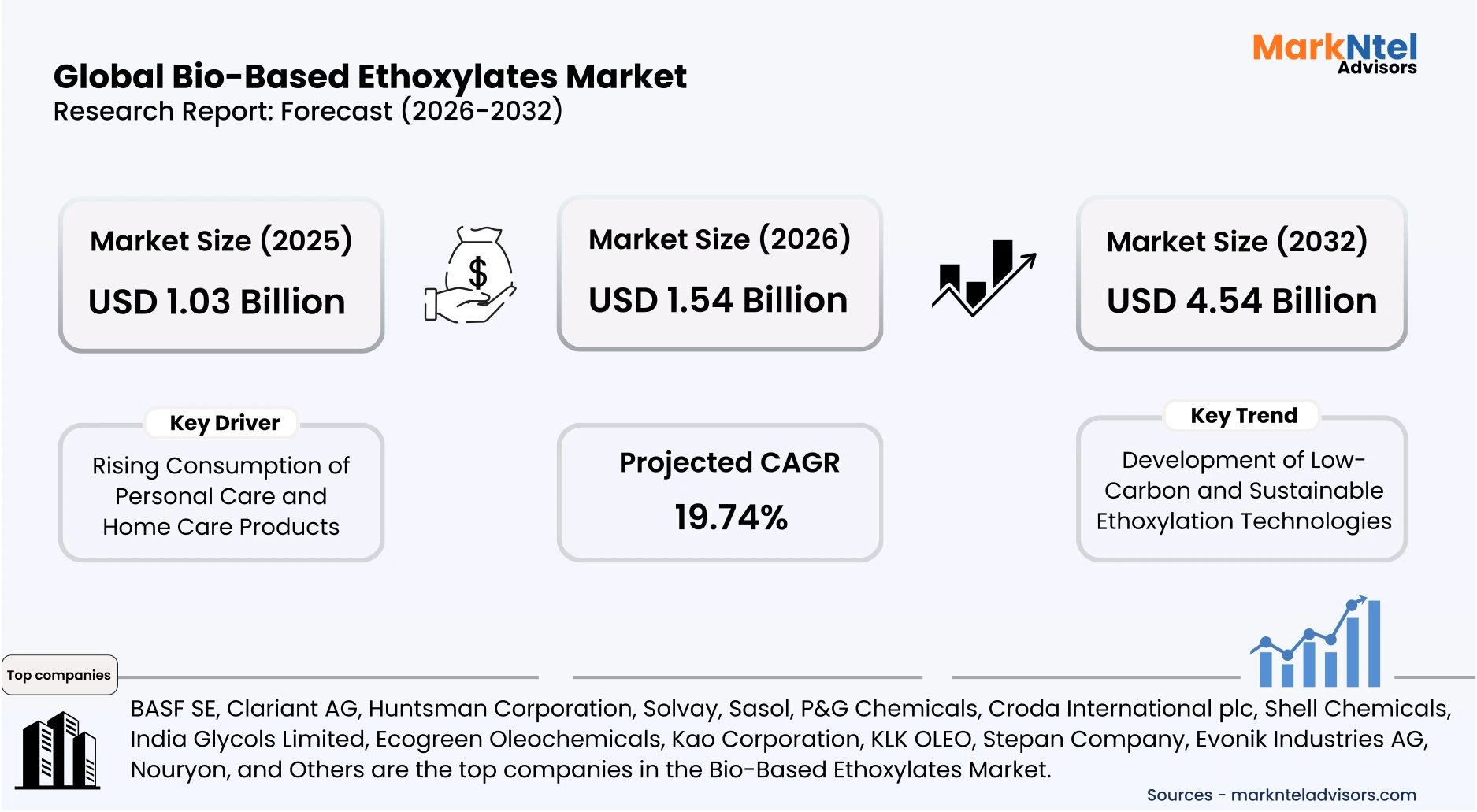
- The Global Bio-Based Ethoxylates Market size was valued at around USD 1.03 billion in 2025 and is projected to grow from USD 1.54 billion in 2026 to USD 4.54 billion by 2032, exhibiting a CAGR of 19.74% during the forecast period.
- Asia-Pacific holds the largest market share of about 36.62% in the Global Bio-Based Ethoxylates Market in 2026.
- By type, the Fatty Alcohol Ethoxylates segment represented a significant share of about 62% in the Global Bio-Based Ethoxylates Market in 2026.
- By application, the Detergents & Household Cleaning segment seized a significant share of about 47% in 2026.
- Leading bio-based Ethoxylates companies in the global market are BASF SE, Clariant AG, Huntsman Corporation, Solvay, Sasol, P&G Chemicals, Croda International plc, Shell Chemicals, India Glycols Limited, Ecogreen Oleochemicals, Kao Corporation, KLK OLEO, Stepan Company, Evonik Industries AG, Nouryon, and Others.
Market Insights & Analysis: Global Bio-Based Ethoxylates Market (2026-32):
The Global Bio-Based Ethoxylates Market size was valued at around USD 1.03 billion in 2025 and is projected to grow from USD 1.54 billion in 2026 to USD 4.54 billion by 2032, exhibiting a CAGR of 19.74% during the forecast period, i.e., 2026-32.
The Global Bio-Based Ethoxylates Market has expanded steadily as industries increasingly transition toward biodegradable surfactants derived from renewable raw materials used in cleaning, personal care, and agricultural formulations. Bio-based ethoxylates provide strong wetting, emulsifying, and dispersing properties while supporting environmental sustainability goals, making them suitable for high-volume detergent and sanitation applications. Residential households and commercial facilities remain major end users of cleaning formulations that rely on surfactants to remove oils, soils, and organic contaminants. As sustainability commitments strengthen across consumer goods manufacturers, demand for plant-derived surfactants has continued to increase across multiple industrial supply chains.
Public health priorities and hygiene initiatives have significantly reinforced global demand for cleaning products. According to the WHO–UNICEF Joint Monitoring Programme, approximately 1.6 billion people gained access to basic hygiene services between 2015 and 2024, raising global coverage from 66% to about 80%. However, around 1.7 billion people still lacked basic hygiene services in 2024, highlighting continued global demand for soap, detergents, and sanitation products. In 2025, the World Health Organization and UNICEF further strengthened hygiene awareness by launching global guidelines on hand hygiene in community settings, encouraging governments to expand hygiene infrastructure in households, schools, and healthcare institutions.
Regulatory frameworks promoting safer chemical ingredients are also shaping current market dynamics. The European Commission’s Chemicals Strategy for Sustainability encourages manufacturers to replace hazardous substances with safer and biodegradable alternatives in consumer and industrial formulations. These policies influence detergent, cosmetic, and agrochemical producers to adopt environmentally responsible surfactants that comply with stricter regulatory standards. As regulatory scrutiny on chemical safety increases globally, bio-based ethoxylates are gaining importance in household cleaning products, institutional sanitation formulations, and agricultural adjuvant systems that must meet evolving environmental compliance requirements.
Industry-led initiatives and corporate sustainability programs are further supporting supply chain expansion and technological innovation. Companies such as BASF and Clariant continue investing in plant-based surfactant technologies and expanding renewable ingredient portfolios for detergents and personal care formulations. Meanwhile, urban population growth and expanding commercial infrastructure are increasing sanitation and cleaning needs across residential, commercial, and institutional end users. Together, demographic expansion, regulatory support, and corporate innovation are expected to sustain long-term demand for bio-based ethoxylates globally.
Global Bio-Based Ethoxylates Market Recent Developments:
- 2025 : Sasol Limited introduced a bio-circular alcohol ethoxylate surfactant derived from insect oil (black soldier fly larvae). The innovation provides a renewable alternative to conventional petroleum-based surfactants for detergents and personal care formulations, supporting sustainability initiatives and reducing dependence on palm-based feedstocks.
- 2025 : Clariant AG announced the expansion of its Care Chemicals production facility at Daya Bay, China, investing about approximately USD 88 million. The project increases capacity for specialty surfactants and bio-based ingredients used in detergents, personal care products, and industrial cleaning formulations to support growing Asia-Pacific demand.
Global Bio-Based Ethoxylates Market Scope:
| Category | Segments |
|---|---|
| By Type | (Fatty Alcohol Ethoxylates, Fatty Acid Ethoxylates, Glyceride Ethoxylates, Others), |
| By Application | (Detergents & Household Cleaning, Personal Care & Cosmetics, Agrochemicals, Industrial & Institutional Cleaning, Textiles, Others), |
Global Bio-Based Ethoxylates Market Driver:
Rising Consumption of Personal Care and Home Care Products
The rising consumption of personal care and home care products has become a significant structural driver of the Global Bio-Based Ethoxylates Market, as these products depend heavily on surfactants for cleansing, emulsifying, and foaming functions. Bio-based ethoxylates derived from renewable fatty alcohols are widely used in shampoos, liquid soaps, laundry detergents, and dishwashing liquids. Increasing hygiene awareness and evolving grooming habits have encouraged more frequent use of these products. As consumer demand for everyday hygiene products continues to rise, manufacturers are increasing production volumes, directly expanding the demand for sustainable surfactant ingredients.
This demand expansion is supported by measurable consumer spending and product consumption data. According to the U.S. Bureau of Economic Analysis, personal consumption expenditures on personal care products in the United States reached approximately USD 412.7 billion in 2024, reflecting strong and sustained spending on hygiene and grooming items . Similarly, European institutions report high demand for cleaning products across the region. The Council of the European Union notes that detergents and cleaning agents are widely used daily across households, with the EU detergents sector valued at around USD 44.7 billion and supported by approximately 700 production sites, demonstrating the scale of manufacturing and consumption .
Regulatory initiatives and sustainability policies are further reinforcing demand growth for surfactant ingredients used in these products. The European Union’s updated Detergents and Surfactants Regulation, approved in 2025, promotes improved environmental performance and safer surfactant use in cleaning products. At the same time, governments worldwide continue to emphasize hygiene promotion and sustainable chemical production. As manufacturers expand the production of detergents, soaps, and cleaning formulations to meet growing consumer demand, the requirement for renewable and biodegradable surfactants such as bio-based ethoxylates is increasing substantially across global markets.
Global Bio-Based Ethoxylates Market Trend:
Development of Low-Carbon and Sustainable Ethoxylation Technologies
The development of low-carbon and sustainable ethoxylation technologies is emerging as a key structural trend in the Global Bio-Based Ethoxylates Market. Chemical manufacturers are increasingly adopting cleaner production methods and renewable feedstocks to reduce the environmental footprint of surfactant manufacturing. This transition has accelerated as governments and industries intensify efforts to meet climate targets and sustainability commitments. Bio-based ethoxylates derived from plant-based fatty alcohols offer biodegradable alternatives to petroleum-based surfactants while supporting environmentally responsible chemical production.
Technological innovation is transforming the surfactant value chain by introducing alternative raw materials and low-emission manufacturing processes. For instance, Econic Technologies introduced Recreaire carbonate ethoxylates, a new family of CO₂-based surfactants designed as sustainable alternatives to conventional fatty alcohol ethoxylates, capable of reducing global warming potential by up to 65%. Similarly, Zschimmer & Schwarz partnered with Viridi to accelerate the scale-up of surfactant technologies that utilize captured carbon dioxide as a renewable carbon source, enabling more sustainable surfactant production.
Further reinforcing this trend, Syensqo launched Rhodasurf® B7 UP, a bio-circular laureth-7 surfactant produced using upcycled ethylene oxide feedstocks at an ISCC PLUS-certified facility in the Netherlands. The product delivers more than 90% lower net CO₂ footprint compared with conventional petrochemical-based surfactants while maintaining identical performance in detergent and cleaning formulations. Such developments demonstrate how low-carbon ethoxylation technologies are reshaping production strategies and supporting the long-term evolution of sustainable surfactant markets.
Global Bio-Based Ethoxylates Market Opportunity:
Increasing Use of Bio-Based Surfactants in Agrochemical Formulations
The growing use of bio-based surfactants in agrochemical formulations represents a significant opportunity in the Global Bio-Based Ethoxylates Market. Crop protection products such as herbicides, insecticides, and fungicides require formulation additives that improve wetting, spreading, and penetration of active ingredients on plant surfaces. Bio-based ethoxylates derived from renewable fatty alcohols provide effective emulsification and dispersion properties while offering improved biodegradability. As agricultural producers seek efficient and environmentally safer formulation components, the adoption of renewable surfactants in agrochemical products is steadily increasing.
This opportunity is supported by the expanding use of crop protection chemicals worldwide. According to the Food and Agriculture Organization (FAO), global pesticide use in agriculture reached approximately 3.7 million tonnes of active ingredients, reflecting the increasing reliance on crop protection chemicals to improve agricultural productivity . Surfactants and adjuvants are critical formulation components that enhance the performance and stability of these agrochemicals. As pesticide production and usage expand to support rising global food demand, the need for high-performance and sustainable surfactant ingredients such as bio-based ethoxylates is also growing.
The opportunity is particularly favorable for emerging companies because agrochemical formulation additives allow innovation without requiring extremely large-scale manufacturing infrastructure. Many governments and agricultural stakeholders are promoting sustainable farming practices and environmentally responsible chemical inputs. This environment encourages the development of renewable surfactant technologies that improve pesticide efficiency while reducing environmental impact. As the agricultural sector continues to modernize and prioritize sustainable inputs, bio-based ethoxylates are positioned to gain greater adoption across agrochemical formulations.
Global Bio-Based Ethoxylates Market Challenge:
Price Volatility of Natural Feedstocks
Price volatility of natural feedstocks remains a critical structural challenge for the Global Bio-Based Ethoxylates Market because production depends heavily on vegetable oils such as palm oil and coconut oil. These raw materials are widely traded agricultural commodities whose prices fluctuate due to weather conditions, geopolitical developments, and export policies. Bio-based ethoxylates rely on fatty alcohols derived from these oils, meaning any supply instability directly influences production costs. As a result, manufacturers face difficulties maintaining stable pricing and long-term procurement strategies.
Recent commodity market disruptions illustrate the magnitude of this challenge. According to the World Bank Commodity Markets Outlook, global palm oil prices surged to more than USD 1,700 per metric ton in 2022 during supply shortages before declining significantly in subsequent years as production recovered . Similarly, export restrictions imposed by major producers such as Indonesia temporarily constrained global vegetable oil supply chains. For instance, Indonesia maintained its export ban on crude palm oil mill effluent and used cooking oil introduced in 2025 to secure feedstocks for domestic biofuel production, potentially tightening global feedstock supply. These fluctuations affect oleochemical producers that convert vegetable oils into fatty alcohols used for ethoxylation, creating uncertainty in raw material availability and pricing.
Such volatility directly impacts operational planning and investment decisions for surfactant manufacturers. Unstable feedstock costs can reduce profit margins, complicate long-term supply agreements, and discourage smaller companies from entering the market. Producers must also balance sustainability commitments with cost competitiveness when sourcing certified vegetable oils. Consequently, fluctuating agricultural commodity markets continue to limit the scalability and price stability of bio-based ethoxylate production across global chemical supply chains.
Global Bio-Based Ethoxylates Market (2026-32) Segmentation Analysis:
The Global Bio-Based Ethoxylates Market study of MarkNtel Advisors evaluates & highlights the major trends and influencing factors in each segment. It includes predictions for the period 2026–32 at the global level. Based on the analysis, the market has been further classified as;
Based on Type:
- Fatty Alcohol Ethoxylates
- Fatty Acid Ethoxylates
- Glyceride Ethoxylates
- Others
The fatty alcohol ethoxylates segment dominates the Global Bio-Based Ethoxylates Market, accounting for approximately 62% of total demand, primarily because these surfactants offer strong performance across a wide range of applications such as detergents, personal care products, agrochemicals, and industrial cleaning formulations. Fatty alcohol ethoxylates derived from renewable feedstocks like palm oil and coconut oil provide excellent wetting, emulsifying, and detergency properties while remaining biodegradable. Their ability to combine high cleaning efficiency with bio-based sourcing has made them a preferred alternative to petrochemical surfactants as industries increasingly shift toward sustainable chemical ingredients.
High demand from the household and industrial cleaning sectors further strengthens this dominance. Fatty alcohol ethoxylates are widely used as non-ionic surfactants in liquid detergents, dishwashing liquids, and surface cleaners because they perform effectively in hard-water conditions and across a wide temperature range. According to the American Cleaning Institute, about 74% of consumers have changed their cleaning habits to improve health, reflecting rising hygiene awareness that continues to support demand for cleaning formulations and surfactants used in household and industrial cleaning products. This growing emphasis on hygiene further increases the consumption of surfactant-based cleaning solutions globally.
In addition, well-established oleochemical supply chains support large-scale production of fatty alcohol ethoxylates. Major producers rely on vegetable-oil-derived fatty alcohols, particularly from palm and coconut oil, ensuring stable feedstock availability and cost-efficient manufacturing. Strong production capacity in regions with significant oleochemical industries, combined with the segment’s proven biodegradability and regulatory acceptance, allows fatty alcohol ethoxylates to maintain a competitive advantage over other bio-based ethoxylate types, reinforcing their leading market share globally.
Based on Application:
- Detergents & Household Cleaning
- Personal Care & Cosmetics
- Agrochemicals
- Industrial & Institutional Cleaning
- Textiles
- Others
The detergents and household cleaning segment dominates the Global Bio-Based Ethoxylates Market, accounting for approximately 47% of total demand, primarily because cleaning formulations require large volumes of surfactants to remove oils, dirt, and organic residues from fabrics and surfaces. Bio-based ethoxylates, especially fatty alcohol ethoxylates derived from renewable vegetable oils, provide strong wetting, emulsifying, and detergency performance while remaining readily biodegradable. These characteristics make them essential ingredients in liquid laundry detergents, dishwashing liquids, and multi-surface cleaners, where manufacturers are increasingly adopting bio-based surfactants to meet sustainability and environmental standards.
Large-scale detergent consumption across residential and institutional sectors further reinforces this dominance. According to the International Association for Soaps, Detergents and Maintenance Products (A.I.S.E.), detergents and cleaning products are used daily in households and professional facilities, making them one of the most widely consumed categories of chemical formulations worldwide . Continuous demand from households, hotels, hospitals, and commercial facilities sustains high production volumes of detergent formulations, directly increasing the consumption of surfactants such as bio-based ethoxylates.
Industrial production infrastructure also supports the leadership of this segment. Major chemical manufacturers maintain extensive surfactant production capacities to supply detergent manufacturers globally. The availability of renewable feedstocks such as palm kernel oil and coconut oil enables large-scale manufacturing of fatty alcohols used in ethoxylate production. Combined with the essential, everyday nature of cleaning products and the growing preference for biodegradable ingredients, these factors continue to position detergents and household cleaning as the largest application segment in the Global Bio-Based Ethoxylates Market.
Global Bio-Based Ethoxylates Market (2026-32): Regional Projection
The Asia–Pacific region dominates the Global Bio-Based Ethoxylates Market, accounting for approximately 36.62% of total demand, primarily because it hosts some of the world’s largest oleochemical production hubs supplying raw materials for bio-based surfactant manufacturing. Countries such as Indonesia and Malaysia are among the leading global producers of palm oil and palm kernel oil, which serve as key feedstocks for fatty alcohol production used in ethoxylate synthesis. According to the Food and Agriculture Organization (FAO), Southeast Asia accounts for the majority of global palm oil production, providing a strong raw-material base that supports large-scale manufacturing of bio-based surfactants across the region.
Rapid industrial expansion and investments in fatty alcohol production further strengthen regional leadership. For instance, in 2025, several Asian producers announced major capacity expansions, including new fatty alcohol plants by Wilmar International in Indonesia and Kuala Lumpur Kepong in Malaysia, aimed at supplying growing global demand from the detergent and personal care industries. Because fatty alcohols are essential intermediates for manufacturing bio-based ethoxylates, these investments reinforce Asia-Pacific’s position as a major supply center for surfactant raw materials.
Large consumer markets and expanding industrial activity also support strong regional demand. Asia–Pacific hosts more than half of the global population, and rising urbanization across countries such as China, India, and Indonesia continues to increase consumption of household cleaning products, personal care formulations, and industrial detergents. The combination of abundant feedstock availability, expanding oleochemical manufacturing capacity, and large consumer markets continues to position the Asia–Pacific as the leading regional market for bio-based ethoxylates.
Gain a Competitive Edge with Our Global Bio-Based Ethoxylates Market Report:
- Global Bio-Based Ethoxylates Market Report by MarkNtel Advisors provides a detailed & thorough analysis of market size & share, growth rate, competitive landscape, and key players. This comprehensive analysis helps businesses gain a holistic understanding of the market dynamics & make informed decisions.
- This report also highlights current market trends & future projections, allowing businesses to identify emerging opportunities & potential challenges. By understanding market forecasts, companies can align their strategies & stay ahead of the competition.
- Global Bio-Based Ethoxylates Market Report aids in assessing & mitigating risks associated with entering or operating in the market. By understanding market dynamics, regulatory frameworks, and potential challenges, businesses can develop strategies to minimize risks & optimize their operations.
*Reports Delivery Format - Market research studies from MarkNtel Advisors are offered in PDF, Excel and PowerPoint formats. Within 24 hours of the payment being successfully received, the report will be sent to your email address.
Frequently Asked Questions
- Market Segmentation
- Introduction
- Product Definition
- Research Process
- Assumptions
- Executive Summary
- Global Bio-Based Ethoxylates Market Policies, Regulations, and Product Standards
- Global Bio-Based Ethoxylates Market Trends & Developments
- Global Bio-Based Ethoxylates Market Dynamics
- Growth Factors
- Challenges
- Global Bio-Based Ethoxylates Market Hotspot & Opportunities
- Global Bio-Based Ethoxylates Market Outlook, 2022-2032F
- Market Size & Outlook
- By Revenues (USD Million)
- By Volume (Thousand Tons)
- Market Share & Analysis
- By Type- Market Size & Forecast 2022-2032, USD Million & Thousand Tons
- Fatty Alcohol Ethoxylates
- Fatty Acid Ethoxylates
- Glyceride Ethoxylates
- Others
- By Application- Market Size & Forecast 2022-2032, USD Million & Thousand Tons
- Detergents & Household Cleaning
- Personal Care & Cosmetics
- Agrochemicals
- Industrial & Institutional Cleaning
- Textiles
- Others
- By Region
- North America
- South America
- Europe
- The Middle East & Africa
- Asia Pacific
- By Company
- Competition Characteristics
- Market Share & Analysis
- By Type- Market Size & Forecast 2022-2032, USD Million & Thousand Tons
- Market Size & Outlook
- North America Bio-Based Ethoxylates Market Outlook, 2022-2032F
- Market Size & Outlook
- By Revenues (USD Million)
- By Volume (Thousand Tons)
- Market Share & Analysis
- By Type- Market Size & Forecast 2022-2032, USD Million & Thousand Tons
- By Application- Market Size & Forecast 2022-2032, USD Million & Thousand Tons
- By Country
- The US
- Canada
- Mexico
- Rest of North America
- The US Bio-Based Ethoxylates Market Outlook, 2022-2032F
- Market Size & Outlook
- By Revenues (USD Million)
- By Volume (Thousand Tons)
- Market Share & Analysis
- By Type- Market Size & Forecast 2022-2032, USD Million & Thousand Tons
- By Application- Market Size & Forecast 2022-2032, USD Million & Thousand Tons
- Market Size & Outlook
- Canada Bio-Based Ethoxylates Market Outlook, 2022-2032F
- Market Size & Outlook
- By Revenues (USD Million)
- By Volume (Thousand Tons)
- Market Share & Analysis
- By Type- Market Size & Forecast 2022-2032, USD Million & Thousand Tons
- By Application- Market Size & Forecast 2022-2032, USD Million & Thousand Tons
- Market Size & Outlook
- Mexico Bio-Based Ethoxylates Market Outlook, 2022-2032F
- Market Size & Outlook
- By Revenues (USD Million)
- By Volume (Thousand Tons)
- Market Share & Analysis
- By Type- Market Size & Forecast 2022-2032, USD Million & Thousand Tons
- By Application- Market Size & Forecast 2022-2032, USD Million & Thousand Tons
- Market Size & Outlook
- Market Size & Outlook
- South America Bio-Based Ethoxylates Market Outlook, 2022-2032F
- Market Size & Outlook
- By Revenues (USD Million)
- By Volume (Thousand Tons)
- Market Share & Analysis
- By Type- Market Size & Forecast 2022-2032, USD Million & Thousand Tons
- By Application- Market Size & Forecast 2022-2032, USD Million & Thousand Tons
- By Country
- Brazil
- Argentina
- Rest of South America
- Brazil Bio-Based Ethoxylates Market Outlook, 2022-2032F
- Market Size & Outlook
- By Revenues (USD Million)
- By Volume (Thousand Tons)
- Market Share & Analysis
- By Type- Market Size & Forecast 2022-2032, USD Million & Thousand Tons
- By Application- Market Size & Forecast 2022-2032, USD Million & Thousand Tons
- Market Size & Outlook
- Argentina Bio-Based Ethoxylates Market Outlook, 2022-2032F
- Market Size & Outlook
- By Revenues (USD Million)
- By Volume (Thousand Tons)
- Market Share & Analysis
- By Type- Market Size & Forecast 2022-2032, USD Million & Thousand Tons
- By Application- Market Size & Forecast 2022-2032, USD Million & Thousand Tons
- Market Size & Outlook
- Market Size & Outlook
- Europe Bio-Based Ethoxylates Market Outlook, 2022-2032F
- Market Size & Outlook
- By Revenues (USD Million)
- By Volume (Thousand Tons)
- Market Share & Analysis
- By Type- Market Size & Forecast 2022-2032, USD Million & Thousand Tons
- By Application- Market Size & Forecast 2022-2032, USD Million & Thousand Tons
- By Country
- The UK
- Germany
- France
- Italy
- Switzerland
- BENELUX
- Rest of Europe
- The UK Bio-Based Ethoxylates Market Outlook, 2022-2032F
- Market Size & Outlook
- By Revenues (USD Million)
- By Volume (Thousand Tons)
- Market Share & Analysis
- By Type- Market Size & Forecast 2022-2032, USD Million & Thousand Tons
- By Application- Market Size & Forecast 2022-2032, USD Million & Thousand Tons
- Market Size & Outlook
- Germany Bio-Based Ethoxylates Market Outlook, 2022-2032F
- Market Size & Outlook
- By Revenues (USD Million)
- By Volume (Thousand Tons)
- Market Share & Analysis
- By Type- Market Size & Forecast 2022-2032, USD Million & Thousand Tons
- By Application- Market Size & Forecast 2022-2032, USD Million & Thousand Tons
- Market Size & Outlook
- France Bio-Based Ethoxylates Market Outlook, 2022-2032F
- Market Size & Outlook
- By Revenues (USD Million)
- By Volume (Thousand Tons)
- Market Share & Analysis
- By Type- Market Size & Forecast 2022-2032, USD Million & Thousand Tons
- By Application- Market Size & Forecast 2022-2032, USD Million & Thousand Tons
- Market Size & Outlook
- Italy Bio-Based Ethoxylates Market Outlook, 2022-2032F
- Market Size & Outlook
- By Revenues (USD Million)
- By Volume (Thousand Tons)
- Market Share & Analysis
- By Type- Market Size & Forecast 2022-2032, USD Million & Thousand Tons
- By Application- Market Size & Forecast 2022-2032, USD Million & Thousand Tons
- Market Size & Outlook
- Switzerland Bio-Based Ethoxylates Market Outlook, 2022-2032F
- Market Size & Outlook
- By Revenues (USD Million)
- By Volume (Thousand Tons)
- Market Share & Analysis
- By Type- Market Size & Forecast 2022-2032, USD Million & Thousand Tons
- By Application- Market Size & Forecast 2022-2032, USD Million & Thousand Tons
- Market Size & Outlook
- BENELUX Bio-Based Ethoxylates Market Outlook, 2022-2032F
- Market Size & Outlook
- By Revenues (USD Million)
- By Volume (Thousand Tons)
- Market Share & Analysis
- By Type- Market Size & Forecast 2022-2032, USD Million & Thousand Tons
- By Application- Market Size & Forecast 2022-2032, USD Million & Thousand Tons
- Market Size & Outlook
- Market Size & Outlook
- The Middle East & Africa Bio-Based Ethoxylates Market Outlook, 2022-2032F
- Market Size & Outlook
- By Revenues (USD Million)
- By Volume (Thousand Tons)
- Market Share & Analysis
- By Type- Market Size & Forecast 2022-2032, USD Million & Thousand Tons
- By Application- Market Size & Forecast 2022-2032, USD Million & Thousand Tons
- By Country
- Saudi Arabia
- UAE
- Qatar
- Turkey
- Israel
- South Africa
- Egypt
- Rest of the Middle East & Africa
- Saudi Arabia Bio-Based Ethoxylates Market Outlook, 2022-2032F
- Market Size & Outlook
- By Revenues (USD Million)
- By Volume (Thousand Tons)
- Market Share & Analysis
- By Type- Market Size & Forecast 2022-2032, USD Million & Thousand Tons
- By Application- Market Size & Forecast 2022-2032, USD Million & Thousand Tons
- Market Size & Outlook
- UAE Bio-Based Ethoxylates Market Outlook, 2022-2032F
- Market Size & Outlook
- By Revenues (USD Million)
- By Volume (Thousand Tons)
- Market Share & Analysis
- By Type- Market Size & Forecast 2022-2032, USD Million & Thousand Tons
- By Application- Market Size & Forecast 2022-2032, USD Million & Thousand Tons
- Market Size & Outlook
- Qatar Bio-Based Ethoxylates Market Outlook, 2022-2032F
- Market Size & Outlook
- By Revenues (USD Million)
- By Volume (Thousand Tons)
- Market Share & Analysis
- By Type- Market Size & Forecast 2022-2032, USD Million & Thousand Tons
- By Application- Market Size & Forecast 2022-2032, USD Million & Thousand Tons
- Market Size & Outlook
- Turkey Bio-Based Ethoxylates Market Outlook, 2022-2032F
- Market Size & Outlook
- By Revenues (USD Million)
- By Volume (Thousand Tons)
- Market Share & Analysis
- By Type- Market Size & Forecast 2022-2032, USD Million & Thousand Tons
- By Application- Market Size & Forecast 2022-2032, USD Million & Thousand Tons
- Market Size & Outlook
- Israel Bio-Based Ethoxylates Market Outlook, 2022-2032F
- Market Size & Outlook
- By Revenues (USD Million)
- By Volume (Thousand Tons)
- Market Share & Analysis
- By Type- Market Size & Forecast 2022-2032, USD Million & Thousand Tons
- By Application- Market Size & Forecast 2022-2032, USD Million & Thousand Tons
- Market Size & Outlook
- South Africa Bio-Based Ethoxylates Market Outlook, 2022-2032F
- Market Size & Outlook
- By Revenues (USD Million)
- By Volume (Thousand Tons)
- Market Share & Analysis
- By Type- Market Size & Forecast 2022-2032, USD Million & Thousand Tons
- By Application- Market Size & Forecast 2022-2032, USD Million & Thousand Tons
- Market Size & Outlook
- Egypt Bio-Based Ethoxylates Market Outlook, 2022-2032F
- Market Size & Outlook
- By Revenues (USD Million)
- By Volume (Thousand Tons)
- Market Share & Analysis
- By Type- Market Size & Forecast 2022-2032, USD Million & Thousand Tons
- By Application- Market Size & Forecast 2022-2032, USD Million & Thousand Tons
- Market Size & Outlook
- Market Size & Outlook
- Asia Pacific Bio-Based Ethoxylates Market Outlook, 2022-2032F
- Market Size & Outlook
- By Revenues (USD Million)
- By Volume (Thousand Tons)
- Market Share & Analysis
- By Type- Market Size & Forecast 2022-2032, USD Million & Thousand Tons
- By Application- Market Size & Forecast 2022-2032, USD Million & Thousand Tons
- By Country
- China
- Japan
- India
- South Korea
- Indonesia
- Australia
- Singapore
- Vietnam
- Rest of Asia-Pacific
- China Bio-Based Ethoxylates Market Outlook, 2022-2032F
- Market Size & Outlook
- By Revenues (USD Million)
- By Volume (Thousand Tons)
- Market Share & Analysis
- By Type- Market Size & Forecast 2022-2032, USD Million & Thousand Tons
- By Application- Market Size & Forecast 2022-2032, USD Million & Thousand Tons
- Market Size & Outlook
- Japan Bio-Based Ethoxylates Market Outlook, 2022-2032F
- Market Size & Outlook
- By Revenues (USD Million)
- By Volume (Thousand Tons)
- Market Share & Analysis
- By Type- Market Size & Forecast 2022-2032, USD Million & Thousand Tons
- By Application- Market Size & Forecast 2022-2032, USD Million & Thousand Tons
- Market Size & Outlook
- India Bio-Based Ethoxylates Market Outlook, 2022-2032F
- Market Size & Outlook
- By Revenues (USD Million)
- By Volume (Thousand Tons)
- Market Share & Analysis
- By Type- Market Size & Forecast 2022-2032, USD Million & Thousand Tons
- By Application- Market Size & Forecast 2022-2032, USD Million & Thousand Tons
- Market Size & Outlook
- South Korea Bio-Based Ethoxylates Market Outlook, 2022-2032F
- Market Size & Outlook
- By Revenues (USD Million)
- By Volume (Thousand Tons)
- Market Share & Analysis
- By Type- Market Size & Forecast 2022-2032, USD Million & Thousand Tons
- By Application- Market Size & Forecast 2022-2032, USD Million & Thousand Tons
- Market Size & Outlook
- Indonesia Bio-Based Ethoxylates Market Outlook, 2022-2032F
- Market Size & Outlook
- By Revenues (USD Million)
- By Volume (Thousand Tons)
- Market Share & Analysis
- By Type- Market Size & Forecast 2022-2032, USD Million & Thousand Tons
- By Application- Market Size & Forecast 2022-2032, USD Million & Thousand Tons
- Market Size & Outlook
- Australia Bio-Based Ethoxylates Market Outlook, 2022-2032F
- Market Size & Outlook
- By Revenues (USD Million)
- By Volume (Thousand Tons)
- Market Share & Analysis
- By Type- Market Size & Forecast 2022-2032, USD Million & Thousand Tons
- By Application- Market Size & Forecast 2022-2032, USD Million & Thousand Tons
- Market Size & Outlook
- Singapore Bio-Based Ethoxylates Market Outlook, 2022-2032F
- Market Size & Outlook
- By Revenues (USD Million)
- By Volume (Thousand Tons)
- Market Share & Analysis
- By Type- Market Size & Forecast 2022-2032, USD Million & Thousand Tons
- By Application- Market Size & Forecast 2022-2032, USD Million & Thousand Tons
- Market Size & Outlook
- Vietnam Bio-Based Ethoxylates Market Outlook, 2022-2032F
- Market Size & Outlook
- By Revenues (USD Million)
- By Volume (Thousand Tons)
- Market Share & Analysis
- By Type- Market Size & Forecast 2022-2032, USD Million & Thousand Tons
- By Application- Market Size & Forecast 2022-2032, USD Million & Thousand Tons
- Market Size & Outlook
- Market Size & Outlook
- Global Bio-Based Ethoxylates Market Key Strategic Imperatives for Success & Growth
- Competitive Outlook
- Company Profiles
- BASF SE
- Business Description
- Product Portfolio
- Collaborations & Alliances
- Recent Developments
- Financial Details
- Others
- Clariant AG
- Business Description
- Product Portfolio
- Collaborations & Alliances
- Recent Developments
- Financial Details
- Others
- Huntsman Corporation
- Business Description
- Product Portfolio
- Collaborations & Alliances
- Recent Developments
- Financial Details
- Others
- Solvay
- Business Description
- Product Portfolio
- Collaborations & Alliances
- Recent Developments
- Financial Details
- Others
- Sasol
- Business Description
- Product Portfolio
- Collaborations & Alliances
- Recent Developments
- Financial Details
- Others
- P&G Chemicals
- Business Description
- Product Portfolio
- Collaborations & Alliances
- Recent Developments
- Financial Details
- Others
- Croda International plc
- Business Description
- Product Portfolio
- Collaborations & Alliances
- Recent Developments
- Financial Details
- Others
- Shell Chemicals
- Business Description
- Product Portfolio
- Collaborations & Alliances
- Recent Developments
- Financial Details
- Others
- India Glycols Limited
- Business Description
- Product Portfolio
- Collaborations & Alliances
- Recent Developments
- Financial Details
- Others
- Ecogreen Oleochemicals
- Business Description
- Product Portfolio
- Collaborations & Alliances
- Recent Developments
- Financial Details
- Others
- Kao Corporation
- Business Description
- Product Portfolio
- Collaborations & Alliances
- Recent Developments
- Financial Details
- Others
- KLK OLEO
- Business Description
- Product Portfolio
- Collaborations & Alliances
- Recent Developments
- Financial Details
- Others
- Stepan Company
- Business Description
- Product Portfolio
- Collaborations & Alliances
- Recent Developments
- Financial Details
- Others
- Evonik Industries AG
- Business Description
- Product Portfolio
- Collaborations & Alliances
- Recent Developments
- Financial Details
- Others
- Nouryon
- Business Description
- Product Portfolio
- Collaborations & Alliances
- Recent Developments
- Financial Details
- Others
- Others
- Business Description
- Product Portfolio
- Collaborations & Alliances
- Recent Developments
- Financial Details
- Others
- BASF SE
- Company Profiles
- Disclaimer
MarkNtel Advisors follows a robust and iterative research methodology designed to ensure maximum accuracy and minimize deviation in market estimates and forecasts. Our approach combines both bottom-up and top-down techniques to effectively segment and quantify various aspects of the market. A consistent feature across all our research reports is data triangulation, which examines the market from three distinct perspectives to validate findings. Key components of our research process include:
1. Scope & Research Design At the outset, MarkNtel Advisors define the research objectives and formulate pertinent questions. This phase involves determining the type of research—qualitative or quantitative—and designing a methodology that outlines data collection methods, target demographics, and analytical tools. They also establish timelines and budgets to ensure the research aligns with client goals.
2. Sample Selection and Data Collection In this stage, the firm identifies the target audience and determines the appropriate sample size to ensure representativeness. They employ various sampling methods, such as random or stratified sampling, based on the research objectives. Data collection is carried out using tools like surveys, interviews, and observations, ensuring the gathered data is reliable and relevant.
3. Data Analysis and Validation Once data is collected, MarkNtel Advisors undertake a rigorous analysis process. This includes cleaning the data to remove inconsistencies, employing statistical software for quantitative analysis, and thematic analysis for qualitative data. Validation steps are taken to ensure the accuracy and reliability of the findings, minimizing biases and errors.

4. Data Forecast and FinalizationThe final phase involves forecasting future market trends based on the analyzed data. MarkNtel Advisors utilize predictive modeling and time series analysis to anticipate market behaviors. The insights are then compiled into comprehensive reports, featuring visual aids like charts and graphs, and include strategic recommendations to inform client decision-making
We offer flexible licensing options to cater to varying organizational needs. Choose the pricing pack that best suits your requirements:
Buy Now Inquire Before Buying
 Request Customization
 Talk to our Consultant







