

Bangladesh Ice Cream Market Research Report: Trends & Forecast (2026-2032)
By Type (Impulse Ice Cream, Unpackaged Ice Cream, Take-Home Ice Cream), By Flavor (Chocolate, Mango, Vanilla, Strawberry, Butterscotch, Others), By Format (Cup, Stick, Cone, Brick) ... , By Composition (Dairy Ice Cream, Plant-based Ice Cream), By Positioning (Mass Market Ice Cream, Artisanal Ice Cream), By Trade Type (HoReCa, Invidual Consumers), By Sales Channel (Grocery Retailers, Hypermarkets/Supermarkets, Brand Owned Outlets, Ice Cream Carts, Online, Convenience Stores, Others), and others Read more
- Food & Beverages
- Feb 2026
- Pages 160
- Report Format: PDF, Excel, PPT
Bangladesh Ice Cream Market
Projected 9.09% CAGR from 2026 to 2032
Study Period
2026-2032
Market Size (2026-2032)
USD 150.54 Million
Market Size ()
USD 232 Million
Base Year
2025
Projected CAGR
9.09%
Leading Segments
By Format: Stick
Bangladesh Ice Cream Market Report Key Takeaways:
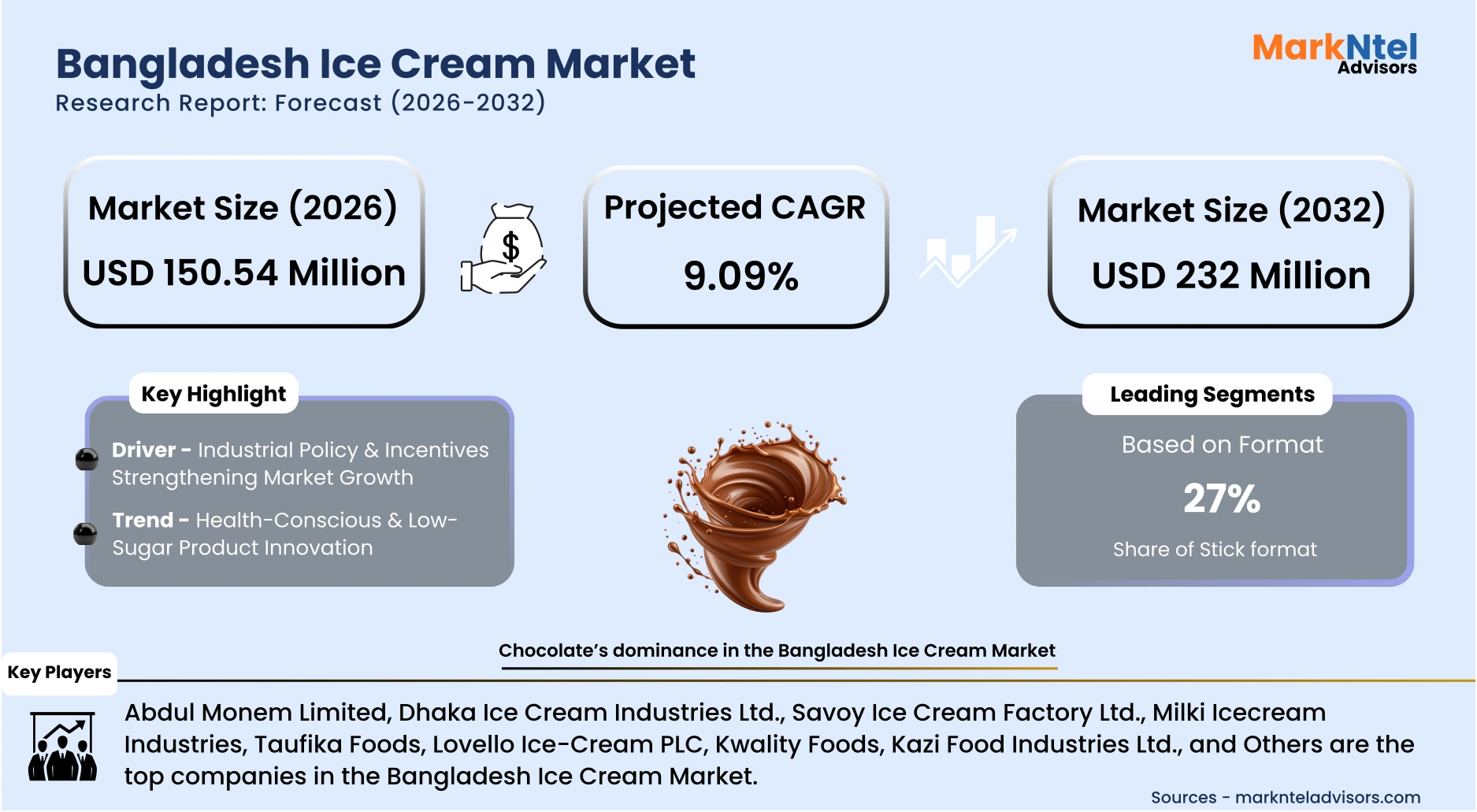
- Market size was valued at around USD 138 million in 2025 and is projected to grow from USD 150.54 million in 2026 to USD 232 million by 2032, exhibiting a CAGR of 9.09% during the forecast period.
- By Format, the Stick segment represented a significant share of about 27% in the Bangladesh Ice Cream Market in 2026.
- By Flavor, the Chocolate segment presented a significant share of about 32% in the Bangladesh Ice Cream Market in 2026.
- Leading Ice Cream Companies in the Bangladesh Market are Abdul Monem Limited, Dhaka Ice Cream Industries Ltd., Savoy Ice Cream Factory Ltd., Milki Icecream Industries, Taufika Foods, Lovello Ice-Cream PLC, Kwality Foods, Golden Harvest Agro Industries Ltd., Kazi Food Industries Ltd., and others.
Market Insights & Analysis: Bangladesh Ice Cream Market (2026-32):
The Bangladesh Ice Cream Market size was valued at approximately USD 138 million in 2025 and is projected to grow from USD 150.54 million in 2026 to USD 232 million by 2032. Along with this, the market is estimated to grow at a CAGR of around 9.09% during the forecast period, i.e., 2026-32.
The market trajectory reflects more than seasonal summer spikes, as it signals a structural shift toward organized and branded frozen dairy consumption across urban and semi-urban Bangladesh. According to the Bangladesh Bureau of Statistics, the urban population exceeded 41% in 2023, while per capita income crossed USD 2,700, directly strengthening discretionary food expenditure. As purchasing power rises alongside improved retail penetration, consumers are increasingly transitioning from unpackaged desserts to hygienic, impulse-driven ice cream formats.
This demand transition is no longer confined to Dhaka, but is spreading in a clearly multi-regional pattern. Chattogram’s tourism expansion and dense retail corridors are increasing branded freezer installations and boosting seasonal throughput. At the same time, Sylhet’s remittance-driven economy is amplifying consumption, as Bangladesh Bank reported remittance inflows exceeding USD 24 billion in 2024.
Additionally, when combined with improved highway connectivity across Khulna and Rajshahi, these income and infrastructure improvements are enabling distributors to extend reliable cold chain networks beyond metropolitan cores. As geographic demand widens, supply-side strategies are evolving in parallel to prevent bottlenecks. Abdul Monem Limited and Golden Harvest Agro Industries Ltd. have upgraded automated filling lines, enhanced blast freezing capacity, and expanded branded freezer deployment between 2023 and 2025.
Moreover, according to the Bangladesh Investment Development Authority, agro processing remains a prioritized investment sector, supporting capital allocation toward value-added dairy manufacturing. These coordinated investments ensure that rising consumption in secondary cities is matched with production efficiency and temperature-controlled distribution reliability.
Therefore, the market emerges from the convergence of three reinforcing forces, including income expansion, regional cold chain deepening, and manufacturing modernization. Simultaneously, organized retail expansion is improving premium SKU visibility, accelerating impulse buying behavior, and supporting portfolio diversification. Together, demographic momentum, infrastructure strengthening, and industrial capacity upgrades create a connected, resilient, and forward-looking growth ecosystem for the industry through 2032.
Bangladesh Ice Cream Market Recent Developments:
- 2024 : Lovello announced in September 2024 that it is building a second ice-cream factory in Valuka, Mymensingh, expected to raise capacity to 250,000 litres per day.
- 2025 : Savoy modernized branding and opened a flagship “Savoy Ice Cream Gallery” outlet in Banani, Dhaka, focusing on premium parlor experiences and curated seasonal launches to lift urban premium positioning.
Bangladesh Ice Cream Market Scope:
| Category | Segments |
|---|---|
| By Type | (Impulse Ice Cream, Unpackaged Ice Cream, Take-Home Ice Cream), |
| By Flavor | (Chocolate, Mango, Vanilla, Strawberry, Butterscotch, Others), |
| By Format | (Cup, Stick, Cone, Brick), |
| By Composition | (Dairy Ice Cream, Plant-based Ice Cream), |
| By Positioning | (Mass Market Ice Cream, Artisanal Ice Cream), |
| By Trade Type | (HoReCa, Invidual Consumers), |
| By Sales Channel | (Grocery Retailers, Hypermarkets/Supermarkets, Brand Owned Outlets, Ice Cream Carts, Online, Convenience Stores, Others), |
Bangladesh Ice Cream Market Driver:
Industrial Policy & Incentives Strengthening Market Growth
Government-backed industrial incentives are directly accelerating growth in the Bangladesh ice cream market by reducing the cost of expanding frozen dessert manufacturing capacity. The Bangladesh Investment Development Authority allows food-processing manufacturers to import capital machinery at concessional customs duty rates, with export-oriented units eligible for 1% customs duty on machinery imports. For ice cream producers, this directly reduces the cost of importing specialized equipment, such as continuous freezers, automated cup-and-stick filling lines, homogenizers, pasteurization units, and blast freezers, all of which are essential for scaling industrial ice cream production.
Additionally, ice cream manufacturing is capital- and refrigeration-intensive. Production requires temperature-controlled processing, rapid-freezing tunnels, and cold-storage facilities maintained at around –18°C to preserve texture and quality. Under the Finance Act 2024, VAT exemptions and duty concessions on specified industrial machinery and spare parts reduce upfront investment costs for refrigeration systems and cold-room installations. This lowers capital expenditure per production line and shortens payback periods for expansion projects.
Bangladesh Ice Cream Market Trend:
Health-Conscious & Low-Sugar Product Innovation
The evolution toward health-oriented ice cream in Bangladesh is directly linked to shifting public health realities and urban dietary awareness. According to the International Diabetes Federation (2024), Bangladesh has 13.9 million adults living with diabetes, positioning the country among the highest globally in diabetes prevalence , reinforcing nationwide awareness around sugar intake and calorie control. This epidemiological shift is gradually influencing consumer purchase behavior, particularly among middle-income urban households.
Additionally, as health awareness strengthens, manufacturers are recalibrating product strategies rather than relying solely on traditional high-sugar formats. For instance, Abdul Monem Limited (Igloo brand) expanded mini-stick and portion-controlled SKUs during 2023–2024 to align with calorie-moderation trends. Similarly, Lovello Ice-Cream PLC introduced premium dark-chocolate variants positioned as “intense flavor with smaller serving sizes,” targeting urban millennials. In 2024, Kazi Food Industries Ltd. expanded smaller-cup offerings under its Meena brand, indirectly addressing portion management. This indicates that instead of removing indulgence, brands are redesigning serving architecture to balance health perception with taste retention.
Bangladesh Ice Cream Market Opportunity:
Expansion of Modern Retail & Cold Chain Infrastructure
Bangladesh’s ice cream market is entering a structurally favorable phase as recent cold-chain infrastructure initiatives and electrification gains converge, directly enabling deeper penetration into tier-2 cities. According to the Power Division Bangladesh (2023), electricity access now exceeds 96%, ensuring reliable freezer operation across secondary urban centers. This stable grid supply reduces the risk of product spoilage and makes branded freezer deployment commercially viable beyond Dhaka and Chattogram.
Cold-chain investment momentum further strengthens this opportunity. In 2024, the United States supported a cold-chain feasibility study in Bangladesh aimed at expanding refrigerated logistics and storage capacity. This initiative is designed to attract private and foreign investment into temperature-controlled infrastructure, which can directly benefit frozen food and dairy distribution. Additionally, Bangladesh’s National Cooling Action Plan, supported by the United Nations Development Program, promotes energy-efficient refrigeration systems and structured cold storage expansion, lowering operational costs for freezer-based retailing.
Despite progress, Bangladesh has roughly 400 cold storage facilities with about 3 million metric tons of storage capacity , highlighting limited dedicated infrastructure for diversified frozen products. This infrastructure gap represents a direct opportunity for ice cream producers to partner in new refrigerated warehouses and reefer transport expansion projects.
Bangladesh Ice Cream Market Challenge:
Raw Milk Supply Deficit and Input Cost Pressure
Bangladesh’s ice cream manufacturers face structural vulnerability due to seasonal gaps in domestic milk supply, which increase reliance on imported milk powder. As per the World Bank’s WITS trade database (2024), Bangladesh imported about 66,798.4 metric tons of milk powder from New Zealand alone, making it the largest supplier. Additionally, imports were sourced from Singapore, the European Union, India, and Malaysia, reflecting concentrated supplier dependence. This concentration amplifies exposure to global dairy price cycles and freight rate fluctuations.
The cost burden extends beyond milk powder to other essential raw materials. Bangladesh imported approximately USD 26.4 million worth of cocoa and cocoa preparations in 2024 , reinforcing exposure to international commodity markets. Similarly, refined sugar - a critical input - remains sensitive to global supply trends and regional export policies. Packaging inputs such as laminated wrappers and food-grade plastics are also partly import-dependent, increasing landed costs through customs duties and supplementary taxes under the 2024–25 tariff schedule.
Collectively, seasonal domestic milk deficits, concentrated import sourcing from countries such as New Zealand and EU suppliers, global cocoa and sugar price exposure, tariff layers, energy hikes, and currency pressures create a cascading cost structure. This interconnected pressure reduces margin flexibility and forces manufacturers to either adjust retail prices or absorb higher per-liter production costs, challenging long-term profitability stability in the Bangladesh ice cream market.
Bangladesh Ice Cream Market (2026-32) Segmentation Analysis:
The Bangladesh Ice Cream Market study of MarkNtel Advisors evaluates & highlights the major trends and influencing factors in each segment. It includes predictions for the period 2026–32 at the country level. Based on the analysis, the market has been further classified as;
Based on Format:
- Cup
- Stick
- Cone
- Brick
- Others (Sandwich, Tub, etc.)
Stick format dominates this market with a market share of about 27% because the structure of consumption, production efficiency, and retail distribution is mutually reinforcing around single-serve products. For instance, 70% of total ice cream sales come from impulse formats such as stick format. This indicates that purchasing is largely occasion-based and immediate rather than planned household stocking. Within this impulse mix, sticks are typically the most affordable and easiest to consume without utensils, making them particularly suited to Bangladesh’s high-frequency, small-ticket buying behavior. Moreover, distribution infrastructure further strengthens the format. Bangladesh’s retail network remains dominated by small neighborhood grocery shops with limited freezer space. Compact stick products maximize SKU count per freezer and rotate faster, reducing retailer holding risk.
Thus, impulse-led demand drives production prioritization; production efficiency supports higher supply; and limited freezer capacity favors compact SKUs. This interconnected cycle sustains stick format dominance across Bangladesh’s ice cream market.
Based on Flavor:
- Chocolate
- Mango
- Vanilla
- Strawberry
- Butterscotch
- Others
Chocolate’s dominance in the Bangladesh Ice Cream Market, with a market share of about 32%, is increasingly reinforced by recent chocolate-focused product launches and portfolio expansions during 2025, demonstrating that manufacturers are strategically prioritizing this flavor for growth rather than treating it as a legacy offering.
Leading producers such as Abdul Monem Limited (Igloo brand) have continued expanding premium chocolate variants, including chocolate-coated sticks, chocolate ripple cups, and nut-infused chocolate cones across modern retail chains. Igloo’s portfolio prominently features chocolate hazelnut, chocolate fudge, and chocolate-coated impulse SKUs, reflecting a deliberate focus on indulgent chocolate innovation to drive repeat purchases.
Similarly, Kazi Food Industries Ltd. (Za’n Zee / Bellissimo) expanded distribution infrastructure in 2024, strengthening the reach of chocolate-coated sticks and premium chocolate tubs into secondary cities such as Khulna. Meanwhile, Savoy Ice Cream Factory Ltd. introduced layered chocolate cone variants targeting organized retail consumers.
These recent launches and capacity expansions show a clear production and marketing tilt toward chocolate. The alignment of consumer indulgence preference, premium SKU development, and expanded cold-chain distribution collectively consolidates chocolate’s structural dominance in Bangladesh’s ice cream market.
Gain a Competitive Edge with Our Bangladesh Ice Cream Market Report:
- Bangladesh Ice Cream Market Report by MarkNtel Advisors provides a detailed & thorough analysis of market size & share, growth rate, competitive landscape, and key players. This comprehensive analysis helps businesses gain a holistic understanding of the market dynamics & make informed decisions.
- This report also highlights current market trends & future projections, allowing businesses to identify emerging opportunities & potential challenges. By understanding market forecasts, companies can align their strategies & stay ahead of the competition.
- Bangladesh Ice Cream Market Report aids in assessing & mitigating risks associated with entering or operating in the market. By understanding market dynamics, regulatory frameworks, and potential challenges, businesses can develop strategies to minimize risks & optimize their operations.
*Reports Delivery Format - Market research studies from MarkNtel Advisors are offered in PDF, Excel and PowerPoint formats. Within 24 hours of the payment being successfully received, the report will be sent to your email address.
Frequently Asked Questions
- Market Segmentation
- Introduction
- Product Definition
- Research Process
- Assumptions
- Executive Summary
- Bangladesh Ice Cream Market Policies, Regulations, Product Standards
- Bangladesh Ice Cream Market Supply Chain Analysis
- Bangladesh Ice Cream Market Pricing Analysis
- SKU Wise Price Points
- Average Increase/Decrease in Price Per ML
- Bangladesh Ice Cream Market Trends & Developments
- Bangladesh Ice Cream Market Dynamics
- Growth Drivers
- Challenges
- Bangladesh Ice Cream Market Hotspot & Opportunities
- Bangladesh Ice Cream Market Outlook, 2022-2032F
- Market Size & Analysis
- By Revenues (USD Million)
- By Volume (Million Liters)
- Market Segmentation & Analysis
- By Type
- Impulse Ice Cream- Market Size & Forecast 2022-2032, Million Liters & USD Million
- Single Portion Dairy Ice Cream- Market Size & Forecast 2022-2032, Million Liters & USD Million
- Single Portion Water Ice Cream- Market Size & Forecast 2022-2032, Million Liters & USD Million
- Unpackaged Ice Cream- Market Size & Forecast 2022-2032, Million Liters & USD Million
- Take-Home Ice Cream- Market Size & Forecast 2022-2032, Million Liters & USD Million
- Bulk Dairy Ice Cream- Market Size & Forecast 2022-2032, Million Liters & USD Million
- Ice Cream Desserts- Market Size & Forecast 2022-2032, Million Liters & USD Million
- Impulse Ice Cream- Market Size & Forecast 2022-2032, Million Liters & USD Million
- By Flavor
- Chocolate- Market Size & Forecast 2022-2032, Million Liters & USD Million
- Mango- Market Size & Forecast 2022-2032, Million Liters & USD Million
- Vanilla- Market Size & Forecast 2022-2032, Million Liters & USD Million
- Strawberry- Market Size & Forecast 2022-2032, Million Liters & USD Million
- Butterscotch- Market Size & Forecast 2022-2032, Million Liters & USD Million
- Others- Market Size & Forecast 2022-2032, Million Liters & USD Million
- By Format
- Cup- Market Size & Forecast 2022-2032, Million Liters & USD Million
- Stick- Market Size & Forecast 2022-2032, Million Liters & USD Million
- Cone- Market Size & Forecast 2022-2032, Million Liters & USD Million
- Brick- Market Size & Forecast 2022-2032, Million Liters & USD Million
- Others (Sandwich, Tub, etc.) - Market Size & Forecast 2022-2032, Million Liters & USD Million
- By Composition
- Dairy Ice Cream- Market Size & Forecast 2022-2032, Million Liters & USD Million
- Plant-based Ice Cream- Market Size & Forecast 2022-2032, Million Liters & USD Million
- By Positioning
- Mass Market Ice Cream- Market Size & Forecast 2022-2032, Million Liters & USD Million
- Artisanal Ice Cream- Market Size & Forecast 2022-2032, Million Liters & USD Million
- By Trade Type
- HoReCa - Market Size & Forecast 2022-2032, Million Liters & USD Million
- Invidual Consumers - Market Size & Forecast 2022-2032, Million Liters & USD Million
- By Sales Channel
- Grocery Retailers- Market Size & Forecast 2022-2032, Million Liters & USD Million
- Hypermarkets/Supermarkets- Market Size & Forecast 2022-2032, Million Liters & USD Million
- Brand Owned Outlets- Market Size & Forecast 2022-2032, Million Liters & USD Million
- Ice Cream Carts- Market Size & Forecast 2022-2032, Million Liters & USD Million
- Online- Market Size & Forecast 2022-2032, Million Liters & USD Million
- Convenience Stores- Market Size & Forecast 2022-2032, Million Liters & USD Million
- Others- Market Size & Forecast 2022-2032, Million Liters & USD Million
- By Region
- Dhaka
- Chattogram
- Sylhet
- Khulna
- Rajshahi
- By Competitors
- Company Revenue Shares
- Competitor Characteristics
- By Type
- Market Size & Analysis
- Bangladesh Impulse Ice Cream Market Outlook, 2022-2032F
- Market Size & Analysis
- By Revenues (USD Million)
- By Volume (Million Liters)
- Market Segmentation & Analysis
- By Flavor- Market Size & Forecast 2022-2032, Million Liters & USD Million
- By Format- Market Size & Forecast 2022-2032, Million Liters & USD Million
- By Composition- Market Size & Forecast 2022-2032, Million Liters & USD Million
- By Positioning- Market Size & Forecast 2022-2032, Million Liters & USD Million
- By Trade Type- Market Size & Forecast 2022-2032, Million Liters & USD Million
- By Sales Channel- Market Size & Forecast 2022-2032, Million Liters & USD Million
- Market Size & Analysis
- Bangladesh Unpackaged Ice Cream Market Outlook, 2022-2032F
- Market Size & Analysis
- By Revenues (USD Million)
- By Volume (Million Liters)
- Market Segmentation & Analysis
- By Flavor- Market Size & Forecast 2022-2032, Million Liters & USD Million
- By Format- Market Size & Forecast 2022-2032, Million Liters & USD Million
- By Composition- Market Size & Forecast 2022-2032, Million Liters & USD Million
- By Positioning- Market Size & Forecast 2022-2032, Million Liters & USD Million
- By Trade Type- Market Size & Forecast 2022-2032, Million Liters & USD Million
- By Sales Channel- Market Size & Forecast 2022-2032, Million Liters & USD Million
- Market Size & Analysis
- Bangladesh Take-Home Ice Cream Market Outlook, 2022-2032F
- Market Size & Analysis
- By Revenues (USD Million)
- By Volume (Million Liters)
- Market Segmentation & Analysis
- By Flavor- Market Size & Forecast 2022-2032, Million Liters & USD Million
- By Format- Market Size & Forecast 2022-2032, Million Liters & USD Million
- By Composition- Market Size & Forecast 2022-2032, Million Liters & USD Million
- By Positioning- Market Size & Forecast 2022-2032, Million Liters & USD Million
- By Trade Type- Market Size & Forecast 2022-2032, Million Liters & USD Million
- By Sales Channel- Market Size & Forecast 2022-2032, Million Liters & USD Million
- Market Size & Analysis
- Bangladesh Ice Cream Market Key Strategic Imperatives for Success & Growth
- Competition Outlook
- Company Profiles
- Abdul Monem Limited
- Business Description
- Type Portfolio
- Strategic Alliances or Partnerships
- Recent Developments
- Financial Details
- Others
- Dhaka Ice Cream Industries Ltd.
- Business Description
- Type Portfolio
- Strategic Alliances or Partnerships
- Recent Developments
- Financial Details
- Others
- Savoy Ice Cream Factory Ltd.
- Business Description
- Type Portfolio
- Strategic Alliances or Partnerships
- Recent Developments
- Financial Details
- Others
- Milki Icecream Industries
- Business Description
- Type Portfolio
- Strategic Alliances or Partnerships
- Recent Developments
- Financial Details
- Others
- Taufika Foods and Lovello Ice-Cream PLC
- Business Description
- Type Portfolio
- Strategic Alliances or Partnerships
- Recent Developments
- Financial Details
- Others
- Kwality Foods
- Business Description
- Type Portfolio
- Strategic Alliances or Partnerships
- Recent Developments
- Financial Details
- Others
- Golden Harvest Agro Industries Ltd.
- Business Description
- Type Portfolio
- Strategic Alliances or Partnerships
- Recent Developments
- Financial Details
- Others
- Kazi Food Industries Ltd.
- Business Description
- Type Portfolio
- Strategic Alliances or Partnerships
- Recent Developments
- Financial Details
- Others
- Others
- Abdul Monem Limited
- Company Profiles
- Disclaimer
MarkNtel Advisors follows a robust and iterative research methodology designed to ensure maximum accuracy and minimize deviation in market estimates and forecasts. Our approach combines both bottom-up and top-down techniques to effectively segment and quantify various aspects of the market. A consistent feature across all our research reports is data triangulation, which examines the market from three distinct perspectives to validate findings. Key components of our research process include:
1. Scope & Research Design At the outset, MarkNtel Advisors define the research objectives and formulate pertinent questions. This phase involves determining the type of research—qualitative or quantitative—and designing a methodology that outlines data collection methods, target demographics, and analytical tools. They also establish timelines and budgets to ensure the research aligns with client goals.
2. Sample Selection and Data Collection In this stage, the firm identifies the target audience and determines the appropriate sample size to ensure representativeness. They employ various sampling methods, such as random or stratified sampling, based on the research objectives. Data collection is carried out using tools like surveys, interviews, and observations, ensuring the gathered data is reliable and relevant.
3. Data Analysis and Validation Once data is collected, MarkNtel Advisors undertake a rigorous analysis process. This includes cleaning the data to remove inconsistencies, employing statistical software for quantitative analysis, and thematic analysis for qualitative data. Validation steps are taken to ensure the accuracy and reliability of the findings, minimizing biases and errors.

4. Data Forecast and FinalizationThe final phase involves forecasting future market trends based on the analyzed data. MarkNtel Advisors utilize predictive modeling and time series analysis to anticipate market behaviors. The insights are then compiled into comprehensive reports, featuring visual aids like charts and graphs, and include strategic recommendations to inform client decision-making
We offer flexible licensing options to cater to varying organizational needs. Choose the pricing pack that best suits your requirements:
Buy Now Inquire Before Buying
 Request Customization
 Talk to our Consultant







