

Global Bacillus Thuringiensis Market Research Report: Trends, Forecast & Opportunities (2026-2032)
By Bt Strain (Others), By Formulation Type (Dry Formulations, Liquid Formulations), By Mode of Application (Foliar Spray, Soil Treatment, Seed Treatment, Drip Irrigation Delivery, ... Drone & Precision Spraying), By Crop Type (Grains and Cereals, Pulses and Oilseeds, Commercial Crops, Fruits and Vegetables, Others), By Farming System (Conventional Farming, Organic Farming, Integrated Pest Management (IPM), Precision Agriculture Systems), By End User (Agriculture, Public Health & Vector Control, Stored Grain Protection, Residential & Commercial Pest Control, Research Institutions, Biopesticide Manufacturers, Organic Food Producers), and others Read more
- Environment
- Feb 2026
- Pages 445
- Report Format: PDF, Excel, PPT
Global Bacillus Thuringiensis Market
Projected 19% CAGR from 2026 to 2032
Study Period
2026-2032
Market Size (2026)
USD 0.41 Billion
Market Size (2032)
USD 1.17 Billion
Largest Region
Asia-Pacific
Projected CAGR
19%
Leading Segments
By End User: Agriculture
Global Bacillus Thuringiensis Market Report Key Takeaways:
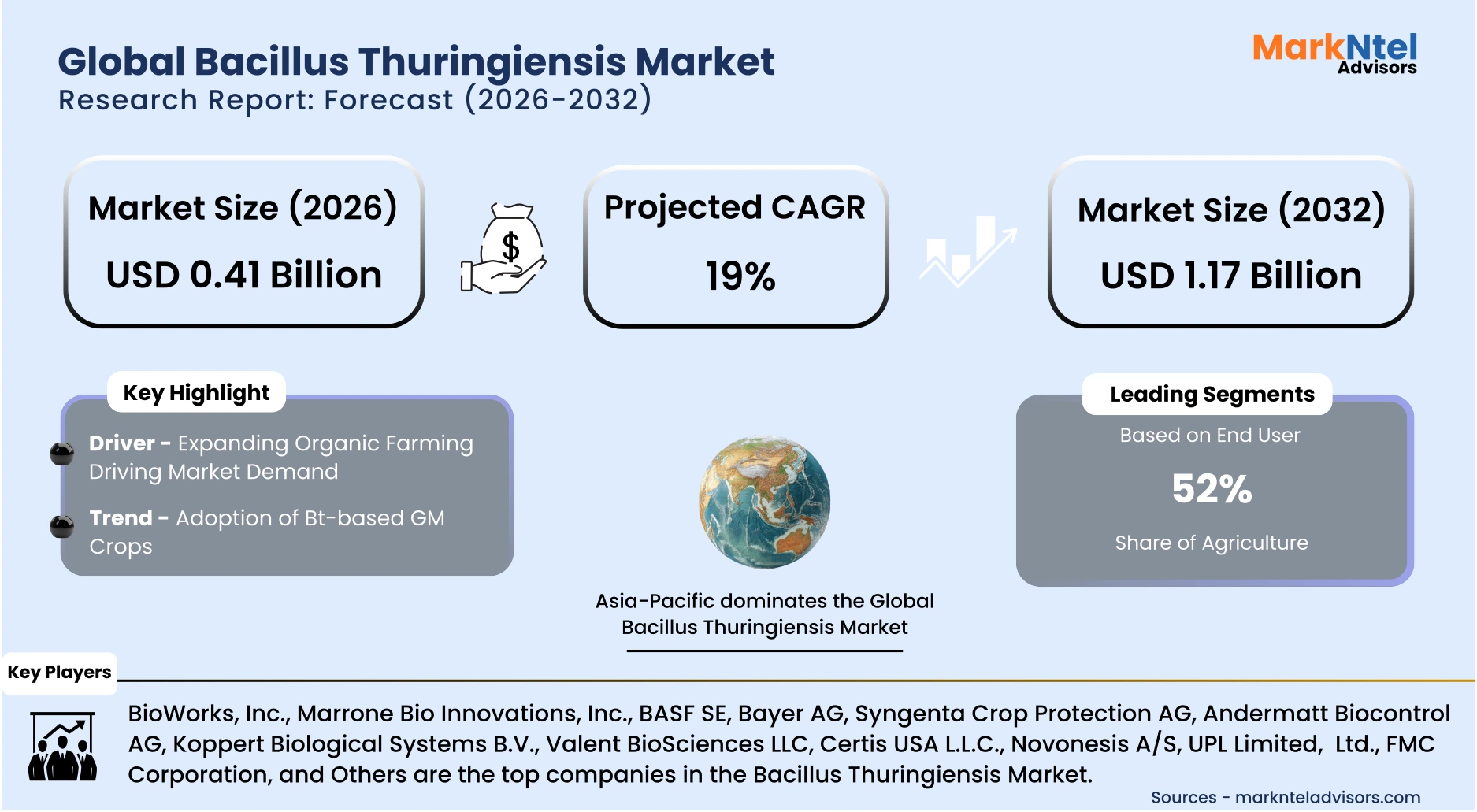
- The Global Bacillus Thuringiensis market size was valued at USD 0.37 billion in 2025 and is projected to grow from USD 0.41 billion in 2026 to USD 1.17 billion by 2032, exhibiting a CAGR of 19% during the forecast period.
- Asia-Pacific holds the largest market share of about 35% in the Global Bacillus Thuringiensis Market in 2026.
- By Bt strain, the Bt var. kurstaki segment represented a significant share of about 35% in the Global Bacillus Thuringiensis Market in 2026.
- By farming system, the integrated pest management (IPM) segment presented a significant share of about 32% in the Global Bacillus Thuringiensis Market in 2026.
- By end user, the agriculture segment presented a significant share of about 52% in the Global Bacillus Thuringiensis Market in 2026.
- Leading Bacillus Thuringiensis companies in the Global Market are BioWorks, Inc., Marrone Bio Innovations, Inc., BASF SE, Bayer AG, Syngenta Crop Protection AG, Andermatt Biocontrol AG, Koppert Biological Systems B.V., Valent BioSciences LLC, Certis USA L.L.C., Novonesis A/S, UPL Limited, Nufarm Limited, Isagro S.p.A., W. Neudorff GmbH KG, Camson Bio Technologies Limited, Sumitomo Chemical Co., Ltd., FMC Corporation, and Others.
Market Insights & Analysis: Global Bacillus Thuringiensis Market (2026-32):
The Global Bacillus Thuringiensis Market size was valued at USD 0.37 billion in 2025 and is projected to grow from USD 0.41 billion in 2026 to USD 1.17 billion by 2032. Along with this, the market is estimated to grow at a CAGR of around 19% during the forecast period, i.e., 2026-32.
The Global Bacillus Thuringiensis Market is projected to expand steadily, driven by the rapid expansion of organic farming practices worldwide and the increasing adoption of Bt-based genetically modified crops to enhance pest resistance and agricultural productivity.
One of the strongest growth pillars is the steady rise of organic farmland worldwide. By the end of 2023, global organic agricultural land reached 98.9 million hectares, reflecting a 2.6% annual increase and an addition of 2.5 million hectares within a single year. This expansion signals a structural shift toward farming systems that restrict synthetic pesticides and increasingly depend on biological pest control solutions such as Bt. Regional developments clearly highlight the widespread geographic momentum of this trend. Latin America recorded the largest annual increase, adding around 1 million hectares, demonstrating strong adoption in export-oriented agricultural economies.
Meanwhile, Africa recorded the fastest growth globally, expanding organic farmland by 24% to reach 3.4 million hectares, reflecting rising adoption in emerging markets where sustainable farming is gaining policy and institutional support .
Globally, Oceania dominates organic agriculture with 53.2 million hectares more than half of total global organic farmland driven largely by Australia. At the country level, India and Argentina rank among the world’s leading organic farming nations, highlighting adoption across both developed and developing agricultural economies. This widespread expansion significantly strengthens the demand for biological pest-control products.
In parallel, Bt-based genetically modified crops continue to reinforce market growth by demonstrating proven pest-control efficiency. The Asia-Pacific region remains a major hub for adoption, where genetically modified cotton usage has reached nearly 95% in certain markets. Such widespread adoption reflects farmers’ reliance on Bt traits to manage insect pests while reducing pesticide applications and production risks.
Government sustainability policies and long-term agricultural strategies are expected to accelerate the market beyond 2025. For example, the European Green Deal aims to convert 25% of agricultural land to organic farming by 2030, which will require rapid scaling of biological crop protection solutions.
Similarly, Thailand’s Organic Agriculture Action Plan 2023–2027 targets expanding organic farmland to 320,000 hectares and increasing Good Agricultural Practices-certified areas to 400,000 hectares by 2027, reinforcing Asia’s long-term commitment to sustainable agriculture .
Overall, the convergence of expanding organic farmland, strong adoption of Bt crops, and supportive global policy frameworks is creating a robust foundation for sustained Bt market growth. As sustainability becomes a central priority in global food systems, biological pest control solutions are expected to play an increasingly critical role in the future of agriculture.
Global Bacillus Thuringiensis Market Recent Developments:
- 2025: AZo Life Sciences highlighted the accelerating role of biopesticides in sustainable agriculture, driven by regulatory pressure on chemical pesticides and advancements in microbial formulations. The article emphasized growing global adoption, improved field efficacy, and rising investment in biological crop protection solutions, positioning Bt-based products as a key pillar of future pest management.
Global Bacillus Thuringiensis Market Scope:
| Category | Segments |
|---|---|
| By Bt Strain | (Others), |
| By Formulation Type | (Dry Formulations, Liquid Formulations), |
| By Mode of Application | (Foliar Spray, Soil Treatment, Seed Treatment, Drip Irrigation Delivery, Drone & Precision Spraying), |
| By Crop Type | (Grains and Cereals, Pulses and Oilseeds, Commercial Crops, Fruits and Vegetables, Others), |
| By Farming System | (Conventional Farming, Organic Farming, Integrated Pest Management (IPM), Precision Agriculture Systems), |
| By End User | (Agriculture, Public Health & Vector Control, Stored Grain Protection, Residential & Commercial Pest Control, Research Institutions, Biopesticide Manufacturers, Organic Food Producers), |
Global Bacillus Thuringiensis Market Driver:
Expanding Organic Farming Driving Market Demand
The accelerating expansion of organic agriculture across developed economies is emerging as a major driver of the global Bacillus thuringiensis (Bt) market, as organic production systems rely heavily on biological crop-protection tools.
According to the United States Department of Agriculture, U.S. organic retail sales reached USD 69.7 billion in 2023, underscoring strong and sustained consumer demand for pesticide-free food . This demand is being reinforced by public investment designed to remove barriers for farmers transitioning to organic production.
The U.S. government’s USD 300 million Organic Transition Initiative is a prominent example, supporting training, technical assistance, and certification efforts. In 2023 alone, the initiative funded 404 training events reaching more than 20,000 participants and supported 15,700 acres through 112 contracts, demonstrating concrete policy commitment to scaling organic agriculture .
Europe is witnessing a comparable shift. The European Union reported 17.7 million hectares of organic farmland, representing 10.9% of total agricultural land, highlighting the region’s rapid progress toward sustainable farming systems.
Strong consumer demand is reinforcing this expansion, with organic retail sales reaching USD 59 billion in 2023 . As organic certification restricts the use of synthetic pesticides, growers increasingly depend on microbial pest-control solutions such as Bt to maintain productivity and crop quality.
Overall, the convergence of rising consumer demand, supportive government funding, and expanding organic farmland is strengthening the foundation for Bt adoption. As organic agriculture continues to scale in major economies, the demand for biological pest-control solutions is expected to grow steadily, reinforcing long-term market expansion.
Global Bacillus Thuringiensis Market Trend:
Adoption of Bt-based GM Crops
The rapid expansion of genetically modified (GM) crops containing Bt traits is emerging as a major technology trend shaping the global Bacillus thuringiensis market. Governments and agricultural agencies increasingly support biotechnology-enabled crops to improve productivity, strengthen food security, and reduce dependence on synthetic insecticides. This policy alignment is accelerating the integration of Bt traits into large-scale agricultural systems worldwide.
Bt crops, particularly cotton and maize, continue to dominate global GM cultivation due to their proven ability to control destructive insect pests while reducing chemical pesticide applications. Among these crops, cotton demonstrates the strongest penetration of biotechnology. According to the International Service for the Acquisition of Agri-biotech Applications, approximately 76% of global cotton acreage is planted with genetically modified varieties, illustrating the deep adoption of Bt insect-resistant traits in pest-prone regions. This high adoption rate reflects farmer confidence in Bt technology to protect yields, reduce crop losses, and lower production costs.
The widespread use of Bt traits also aligns with sustainability goals, as reduced pesticide spraying lowers environmental impact and improves worker safety. Continued government support, public-sector research, and growing food demand are expected to drive further biotech crop expansion in the coming years.
Overall, the increasing global penetration of Bt-based GM crops reinforces long-term demand for Bacillus thuringiensis technologies. As biotechnology adoption expands across major agricultural regions, the Bt market is positioned for sustained growth driven by productivity, sustainability, and food-security priorities.
Global Bacillus Thuringiensis Market Opportunity:
Integration with Integrated Pest Management (IPM)
The global expansion of Integrated Pest Management (IPM) programs is creating a strong growth opportunity for Bacillus thuringiensis (Bt) based biopesticides, which play a central role in biological pest control strategies. IPM promotes the combined use of biological, cultural, and mechanical pest-control approaches to reduce reliance on synthetic pesticides, positioning Bt products as a key component of sustainable crop protection systems. By 2026, IPM-based farming systems are expected to account for a 32% share of Bt product demand, highlighting their growing importance in modern agriculture.
Government-backed programs are accelerating the adoption of IPM worldwide. The New York State Integrated Pest Management Program reported major outreach and research activity during the 2024–2025. The program reached over 18,000 stakeholders through 178 presentations and events and delivered nearly 76,000 hours of outreach, while contributing to 48 research and extension publications. Additionally, 13 grant applications secured USD 7.5 million in funding, demonstrating strong institutional support for sustainable pest management and biological solutions.
Beyond research initiatives, large-scale pest-control infrastructure is also expanding. In 2025, the United States Department of Agriculture announced a USD 21 million investment to expand sterile insect production in Mexico as part of a cross-border IPM strategy to combat screwworm pests.
Overall, the growing adoption of IPM frameworks, supported by funding, outreach, and infrastructure investments, is creating substantial opportunities for Bt-based biopesticides. As governments and institutions prioritize sustainable pest control, Bt solutions are expected to experience increasing demand and long-term market expansion.
Global Bacillus Thuringiensis Market Challenge:
Short Shelf Life & Environmental Sensitivity
A major challenge limiting the wider adoption of Bacillus thuringiensis (Bt) biopesticides is their short persistence and vulnerability to environmental conditions, which affects field performance, storage, and supply chains.
Recent scientific evidence from 2024–2025 confirms that Bt products degrade rapidly after application. Field research shows that 95%–99% of Bt spores can be lost within three days of field exposure, with pest mortality falling sharply from about 76% at initial application to nearly 12% within 72 hours, highlighting the rapid decline in effectiveness under real agricultural conditions.
Environmental variables such as rainfall, humidity, and high temperatures further accelerate degradation, particularly in tropical and subtropical regions where pest pressure is often highest. As a result, farmers must apply Bt formulations more frequently than synthetic pesticides, increasing labor, logistics, and operational costs. Storage also remains a challenge because microbial biopesticides are biologically active and require controlled conditions to maintain viability during distribution.
Rapid degradation and limited shelf life reduce reliability and increase application costs, slowing farmer adoption. Unless formulation stability improves significantly, these challenges will continue to restrain the large-scale growth of the Bt market.
Global Bacillus Thuringiensis Market (2026-32) Segmentation Analysis:
The Global Bacillus Thuringiensis Market study of MarkNtel Advisors evaluates & highlights the major trends and influencing factors in each segment. It includes predictions for the period 2026–32 at the global level. Based on the analysis, the market has been further classified as;
Based on Bt Strain:
- Bt var. kurstaki
- Bt var. israelensis
- Bt var. aizawai
- Bt var. tenebrionis
- Bt var. sotto
- Others
The Bt var. kurstaki segment dominates the Global Bacillus Thuringiensis market, accounting for approximately 35% market share, due to its broad efficacy against Lepidopteran pests, a pest group responsible for substantial yield losses in global agriculture.
Caterpillar species such as armyworms, bollworms, loopers, and moth larvae commonly affect high-value crops, including cotton, maize, fruits, vegetables, and forestry plantations. The ability of the strain to provide targeted pest control while remaining safe for beneficial insects, pollinators, and humans has positioned it as the most widely adopted Bt strain across both organic and conventional farming systems.
A key factor supporting its leadership is its long history of commercialization and extensive regulatory acceptance across major agricultural markets. Decades of field performance have built strong farmer confidence in this strain-based formulation, encouraging repeat usage and integration into routine crop protection programs. In addition, the strain aligns closely with Integrated Pest Management (IPM) practices, as it can be used alongside biological control agents and cultural practices without disrupting ecological balance.
Overall, the combination of proven efficacy, regulatory acceptance, farmer trust, and compatibility with sustainable farming practices reinforces Bt var. kurstaki as the dominant strain, supporting its continued leadership as biological crop protection adoption accelerates globally.
Based on End User:
- Agriculture
- Public Health & Vector Control
- Stored Grain Protection
- Residential & Commercial Pest Control
- Research Institutions
- Biopesticide Manufacturers
- Organic Food Producers
The agriculture segment dominates the Global Bacillus Thuringiensis market, accounting for about 52% share of the total market, primarily due to the scale of crop cultivation and the increasing need for sustainable pest-management solutions.
Modern farming systems are facing growing pressure to reduce chemical pesticide usage, manage insect resistance, and comply with stringent food safety regulations. Bt-based biopesticides provide a targeted and environmentally compatible solution, making them highly suitable for large-scale agricultural deployment.
High-value and staple crops such as cotton, maize, rice, fruits, and vegetables are particularly vulnerable to insect infestations that can cause significant yield losses and quality deterioration. Bt products help protect crop productivity while minimizing chemical residues, which is essential for maintaining export competitiveness and meeting consumer demand for safer food. The rising adoption of organic and residue-free farming practices further strengthens agricultural demand, as Bt formulations are among the few pest-control tools permitted under organic certification standards.
Additionally, increasing concerns regarding pesticide resistance and environmental sustainability are prompting governments and agricultural institutions to promote biological crop-protection strategies and integrated pest-management practices.
Overall, the extensive cultivated land area, recurring pest pressure, and regulatory support for safer agricultural inputs ensure that the agriculture sector will continue to dominate Bt product consumption and remain the primary driver of market growth.
Global Bacillus Thuringiensis Market (2026-32): Regional Projection
Asia-Pacific dominates the Global Bacillus Thuringiensis Market with an estimated 35% share, due to its vast agricultural landscape, rapidly expanding organic farming sector, and large base of smallholder farmers adopting biological pest-management solutions. The scale of organic production across the region is a major factor strengthening demand for Bt-based crop protection products.
In 2023, Asia accounted for more than 9.1 million hectares of organic agricultural land, managed by approximately 2.6 million producers, representing 59% of the world’s organic producers. This exceptionally high concentration of organic farmers significantly increases the reliance on biological pest-control tools that comply with organic certification standards.
At the country level, India leads the region with 4.5 million hectares of organic farmland and about 2.4 million producers, reflecting strong adoption among smallholder farming communities. China follows with 3.4 million hectares, demonstrating increasing institutional support for sustainable agriculture and eco-friendly crop protection practices .
Additional regional contributors further reinforce the Asia-Pacific’s leadership. Kazakhstan ranks third with 0.2 million hectares of organic land, while Timor-Leste records the highest organic area share at 9.2%, followed by Sri Lanka and India at 2.5% each . These figures indicate growing adoption across both emerging and developing agricultural economies.
Overall, the combination of large-scale agricultural activity, a dominant share of global organic producers, and expanding sustainable farming practices positions Asia-Pacific as the primary growth engine of the Bt market.
Gain a Competitive Edge with Our Global Bacillus Thuringiensis Market Report:
- Global Bacillus Thuringiensis Market Report by MarkNtel Advisors provides a detailed & thorough analysis of market size & share, growth rate, competitive landscape, and key players. This comprehensive analysis helps businesses gain a holistic understanding of the market dynamics & make informed decisions.
- This report also highlights current market trends & future projections, allowing businesses to identify emerging opportunities & potential challenges. By understanding market forecasts, companies can align their strategies & stay ahead of the competition.
- Global Bacillus Thuringiensis Market Report aids in assessing & mitigating risks associated with entering or operating in the market. By understanding market dynamics, regulatory frameworks, and potential challenges, businesses can develop strategies to minimize risks & optimize their operations.
*Reports Delivery Format - Market research studies from MarkNtel Advisors are offered in PDF, Excel and PowerPoint formats. Within 24 hours of the payment being successfully received, the report will be sent to your email address.
Frequently Asked Questions
- Market Segmentation
- Introduction
- Product Definition
- Research Process
- Assumptions
- Executive Summary
- Global Bacillus Thuringiensis Market Policies, Regulations, and Product Standards
- Global Bacillus Thuringiensis Market Trends & Developments
- Global Bacillus Thuringiensis Market Dynamics
- Growth Factors
- Challenges
- Global Bacillus Thuringiensis Market Hotspot & Opportunities
- Global Bacillus Thuringiensis Market Outlook, 2022-2032F
- Market Size & Outlook
- By Revenues (USD Million)
- Market Share & Analysis
- By Bt Strain- Market Size & Forecast 2022-2032, USD Million
- Bt var. kurstaki
- Bt var. israelensis
- Bt var. aizawai
- Bt var. tenebrionis
- Bt var. sotto
- Others
- By Formulation Type - Market Size & Forecast 2022-2032, USD Million
- Dry Formulations
- Powder
- Water-Dispersible Granules
- Pellets
- Liquid Formulations
- Suspension Concentrates
- Aqueous Suspensions
- Oil Dispersions
- Emulsifiable Concentrates
- Dry Formulations
- By Mode of Application- Market Size & Forecast 2022-2032, USD Million
- Foliar Spray
- Soil Treatment
- Seed Treatment
- Drip Irrigation Delivery
- Drone & Precision Spraying
- By Crop Type - Market Size & Forecast 2022-2032, USD Million
- Grains and Cereals
- Pulses and Oilseeds
- Commercial Crops
- Fruits and Vegetables
- Others
- By Farming System- Market Size & Forecast 2022-2032, USD Million
- Conventional Farming
- Organic Farming
- Integrated Pest Management (IPM)
- Precision Agriculture Systems
- By End User- Market Size & Forecast 2022-2032, USD Million
- Agriculture
- Public Health & Vector Control
- Stored Grain Protection
- Residential & Commercial Pest Control
- Research Institutions
- Biopesticide Manufacturers
- Organic Food Producers
- By Region
- North America
- South America
- Europe
- The Middle East & Africa
- Asia-Pacific
- By Company
- Competition Characteristics
- Market Share & Analysis
- By Bt Strain- Market Size & Forecast 2022-2032, USD Million
- Market Size & Outlook
- North America Bacillus Thuringiensis Market Outlook, 2022-2032F
- Market Size & Outlook
- By Revenues (USD Million)
- Market Share & Analysis
- By Bt Strain- Market Size & Forecast 2022-2032, USD Million
- By Formulation Type - Market Size & Forecast 2022-2032, USD Million
- By Mode of Application- Market Size & Forecast 2022-2032, USD Million
- By Crop Type - Market Size & Forecast 2022-2032, USD Million
- By Farming System- Market Size & Forecast 2022-2032, USD Million
- By End User- Market Size & Forecast 2022-2032, USD Million
- By Country
- The US
- Canada
- Mexico
- Rest of North America
- The US Bacillus Thuringiensis Market Outlook, 2022-2032F
- Market Size & Outlook
- By Revenues (USD Million)
- Market Share & Analysis
- By Bt Strain- Market Size & Forecast 2022-2032, USD Million
- By Formulation Type - Market Size & Forecast 2022-2032, USD Million
- By Mode of Application- Market Size & Forecast 2022-2032, USD Million
- By Crop Type - Market Size & Forecast 2022-2032, USD Million
- By Farming System- Market Size & Forecast 2022-2032, USD Million
- By End User- Market Size & Forecast 2022-2032, USD Million
- Market Size & Outlook
- Canada Bacillus Thuringiensis Market Outlook, 2022-2032F
- Market Size & Outlook
- By Revenues (USD Million)
- Market Share & Analysis
- By Bt Strain- Market Size & Forecast 2022-2032, USD Million
- By Formulation Type - Market Size & Forecast 2022-2032, USD Million
- By Mode of Application- Market Size & Forecast 2022-2032, USD Million
- By Crop Type - Market Size & Forecast 2022-2032, USD Million
- By Farming System- Market Size & Forecast 2022-2032, USD Million
- By End User- Market Size & Forecast 2022-2032, USD Million
- Market Size & Outlook
- Mexico Bacillus Thuringiensis Market Outlook, 2022-2032F
- Market Size & Outlook
- By Revenues (USD Million)
- Market Share & Analysis
- By Bt Strain- Market Size & Forecast 2022-2032, USD Million
- By Formulation Type - Market Size & Forecast 2022-2032, USD Million
- By Mode of Application- Market Size & Forecast 2022-2032, USD Million
- By Crop Type - Market Size & Forecast 2022-2032, USD Million
- By Farming System- Market Size & Forecast 2022-2032, USD Million
- By End User- Market Size & Forecast 2022-2032, USD Million
- Market Size & Outlook
- Market Size & Outlook
- South America Bacillus Thuringiensis Market Outlook, 2022-2032F
- Market Size & Outlook
- By Revenues (USD Million)
- Market Share & Analysis
- By Bt Strain- Market Size & Forecast 2022-2032, USD Million
- By Formulation Type - Market Size & Forecast 2022-2032, USD Million
- By Mode of Application- Market Size & Forecast 2022-2032, USD Million
- By Crop Type - Market Size & Forecast 2022-2032, USD Million
- By Farming System- Market Size & Forecast 2022-2032, USD Million
- By End User- Market Size & Forecast 2022-2032, USD Million
- By Country
- Brazil
- Argentina
- Rest of South America
- Brazil Bacillus Thuringiensis Market Outlook, 2022-2032F
- Market Size & Outlook
- By Revenues (USD Million)
- Market Share & Analysis
- By Bt Strain- Market Size & Forecast 2022-2032, USD Million
- By Formulation Type - Market Size & Forecast 2022-2032, USD Million
- By Mode of Application- Market Size & Forecast 2022-2032, USD Million
- By Crop Type - Market Size & Forecast 2022-2032, USD Million
- By Farming System- Market Size & Forecast 2022-2032, USD Million
- By End User- Market Size & Forecast 2022-2032, USD Million
- Market Size & Outlook
- Argentina Bacillus Thuringiensis Market Outlook, 2022-2032F
- Market Size & Outlook
- By Revenues (USD Million)
- Market Share & Analysis
- By Bt Strain- Market Size & Forecast 2022-2032, USD Million
- By Formulation Type - Market Size & Forecast 2022-2032, USD Million
- By Mode of Application- Market Size & Forecast 2022-2032, USD Million
- By Crop Type - Market Size & Forecast 2022-2032, USD Million
- By Farming System- Market Size & Forecast 2022-2032, USD Million
- By End User- Market Size & Forecast 2022-2032, USD Million
- Market Size & Outlook
- Market Size & Outlook
- Europe Bacillus Thuringiensis Market Outlook, 2022-2032F
- Market Size & Outlook
- By Revenues (USD Million)
- Market Share & Analysis
- By Bt Strain- Market Size & Forecast 2022-2032, USD Million
- By Formulation Type - Market Size & Forecast 2022-2032, USD Million
- By Mode of Application- Market Size & Forecast 2022-2032, USD Million
- By Crop Type - Market Size & Forecast 2022-2032, USD Million
- By Farming System- Market Size & Forecast 2022-2032, USD Million
- By End User- Market Size & Forecast 2022-2032, USD Million
- By Country
- The UK
- Germany
- France
- Italy
- Spain
- Rest of Europe
- The UK Bacillus Thuringiensis Market Outlook, 2022-2032F
- Market Size & Outlook
- By Revenues (USD Million)
- Market Share & Analysis
- By Bt Strain- Market Size & Forecast 2022-2032, USD Million
- By Formulation Type - Market Size & Forecast 2022-2032, USD Million
- By Mode of Application- Market Size & Forecast 2022-2032, USD Million
- By Crop Type - Market Size & Forecast 2022-2032, USD Million
- By Farming System- Market Size & Forecast 2022-2032, USD Million
- By End User- Market Size & Forecast 2022-2032, USD Million
- Market Size & Outlook
- Germany Bacillus Thuringiensis Market Outlook, 2022-2032F
- Market Size & Outlook
- By Revenues (USD Million)
- Market Share & Analysis
- By Bt Strain- Market Size & Forecast 2022-2032, USD Million
- By Formulation Type - Market Size & Forecast 2022-2032, USD Million
- By Mode of Application- Market Size & Forecast 2022-2032, USD Million
- By Crop Type - Market Size & Forecast 2022-2032, USD Million
- By Farming System- Market Size & Forecast 2022-2032, USD Million
- By End User- Market Size & Forecast 2022-2032, USD Million
- Market Size & Outlook
- France Bacillus Thuringiensis Market Outlook, 2022-2032F
- Market Size & Outlook
- By Revenues (USD Million)
- Market Share & Analysis
- By Bt Strain- Market Size & Forecast 2022-2032, USD Million
- By Formulation Type - Market Size & Forecast 2022-2032, USD Million
- By Mode of Application- Market Size & Forecast 2022-2032, USD Million
- By Crop Type - Market Size & Forecast 2022-2032, USD Million
- By Farming System- Market Size & Forecast 2022-2032, USD Million
- By End User- Market Size & Forecast 2022-2032, USD Million
- Market Size & Outlook
- Italy Bacillus Thuringiensis Market Outlook, 2022-2032F
- Market Size & Outlook
- By Revenues (USD Million)
- Market Share & Analysis
- By Bt Strain- Market Size & Forecast 2022-2032, USD Million
- By Formulation Type - Market Size & Forecast 2022-2032, USD Million
- By Mode of Application- Market Size & Forecast 2022-2032, USD Million
- By Crop Type - Market Size & Forecast 2022-2032, USD Million
- By Farming System- Market Size & Forecast 2022-2032, USD Million
- By End User- Market Size & Forecast 2022-2032, USD Million
- Market Size & Outlook
- Spain Bacillus Thuringiensis Market Outlook, 2022-2032F
- Market Size & Outlook
- By Revenues (USD Million)
- Market Share & Analysis
- By Bt Strain- Market Size & Forecast 2022-2032, USD Million
- By Formulation Type - Market Size & Forecast 2022-2032, USD Million
- By Mode of Application- Market Size & Forecast 2022-2032, USD Million
- By Crop Type - Market Size & Forecast 2022-2032, USD Million
- By Farming System- Market Size & Forecast 2022-2032, USD Million
- By End User- Market Size & Forecast 2022-2032, USD Million
- Market Size & Outlook
- Market Size & Outlook
- The Middle East & Africa Bacillus Thuringiensis Market Outlook, 2022-2032F
- Market Size & Outlook
- By Revenues (USD Million)
- Market Share & Analysis
- By Bt Strain- Market Size & Forecast 2022-2032, USD Million
- By Formulation Type - Market Size & Forecast 2022-2032, USD Million
- By Mode of Application- Market Size & Forecast 2022-2032, USD Million
- By Crop Type - Market Size & Forecast 2022-2032, USD Million
- By Farming System- Market Size & Forecast 2022-2032, USD Million
- By End User- Market Size & Forecast 2022-2032, USD Million
- By Country
- Saudi Arabia
- The UAE
- South Africa
- Egypt
- Rest of Middle East & Africa
- Saudi Arabia Bacillus Thuringiensis Market Outlook, 2022-2032F
- Market Size & Outlook
- By Revenues (USD Million)
- Market Share & Analysis
- By Bt Strain- Market Size & Forecast 2022-2032, USD Million
- By Formulation Type - Market Size & Forecast 2022-2032, USD Million
- By Mode of Application- Market Size & Forecast 2022-2032, USD Million
- By Crop Type - Market Size & Forecast 2022-2032, USD Million
- By Farming System- Market Size & Forecast 2022-2032, USD Million
- By End User- Market Size & Forecast 2022-2032, USD Million
- Market Size & Outlook
- The UAE Bacillus Thuringiensis Market Outlook, 2022-2032F
- Market Size & Outlook
- By Revenues (USD Million)
- Market Share & Analysis
- By Bt Strain- Market Size & Forecast 2022-2032, USD Million
- By Formulation Type - Market Size & Forecast 2022-2032, USD Million
- By Mode of Application- Market Size & Forecast 2022-2032, USD Million
- By Crop Type - Market Size & Forecast 2022-2032, USD Million
- By Farming System- Market Size & Forecast 2022-2032, USD Million
- By End User- Market Size & Forecast 2022-2032, USD Million
- Market Size & Outlook
- South Africa Bacillus Thuringiensis Market Outlook, 2022-2032F
- Market Size & Outlook
- By Revenues (USD Million)
- Market Share & Analysis
- By Bt Strain- Market Size & Forecast 2022-2032, USD Million
- By Formulation Type - Market Size & Forecast 2022-2032, USD Million
- By Mode of Application- Market Size & Forecast 2022-2032, USD Million
- By Crop Type - Market Size & Forecast 2022-2032, USD Million
- By Farming System- Market Size & Forecast 2022-2032, USD Million
- By End User- Market Size & Forecast 2022-2032, USD Million
- Market Size & Outlook
- Egypt Bacillus Thuringiensis Market Outlook, 2022-2032F
- Market Size & Outlook
- By Revenues (USD Million)
- Market Share & Analysis
- By Bt Strain- Market Size & Forecast 2022-2032, USD Million
- By Formulation Type - Market Size & Forecast 2022-2032, USD Million
- By Mode of Application- Market Size & Forecast 2022-2032, USD Million
- By Crop Type - Market Size & Forecast 2022-2032, USD Million
- By Farming System- Market Size & Forecast 2022-2032, USD Million
- By End User- Market Size & Forecast 2022-2032, USD Million
- Market Size & Outlook
- Market Size & Outlook
- Asia-Pacific Bacillus Thuringiensis Market Outlook, 2022-2032F
- Market Size & Outlook
- By Revenues (USD Million)
- Market Share & Analysis
- By Bt Strain- Market Size & Forecast 2022-2032, USD Million
- By Formulation Type - Market Size & Forecast 2022-2032, USD Million
- By Mode of Application- Market Size & Forecast 2022-2032, USD Million
- By Crop Type - Market Size & Forecast 2022-2032, USD Million
- By Farming System- Market Size & Forecast 2022-2032, USD Million
- By End User- Market Size & Forecast 2022-2032, USD Million
- By Country
- China
- Japan
- India
- South Korea
- Australia
- Rest of Asia-Pacific
- China Bacillus Thuringiensis Market Outlook, 2022-2032F
- Market Size & Outlook
- By Revenues (USD Million)
- Market Share & Analysis
- By Bt Strain- Market Size & Forecast 2022-2032, USD Million
- By Formulation Type - Market Size & Forecast 2022-2032, USD Million
- By Mode of Application- Market Size & Forecast 2022-2032, USD Million
- By Crop Type - Market Size & Forecast 2022-2032, USD Million
- By Farming System- Market Size & Forecast 2022-2032, USD Million
- By End User- Market Size & Forecast 2022-2032, USD Million
- Market Size & Outlook
- Japan Bacillus Thuringiensis Market Outlook, 2022-2032F
- Market Size & Outlook
- By Revenues (USD Million)
- Market Share & Analysis
- By Bt Strain- Market Size & Forecast 2022-2032, USD Million
- By Formulation Type - Market Size & Forecast 2022-2032, USD Million
- By Mode of Application- Market Size & Forecast 2022-2032, USD Million
- By Crop Type - Market Size & Forecast 2022-2032, USD Million
- By Farming System- Market Size & Forecast 2022-2032, USD Million
- By End User- Market Size & Forecast 2022-2032, USD Million
- Market Size & Outlook
- India Bacillus Thuringiensis Market Outlook, 2022-2032F
- Market Size & Outlook
- By Revenues (USD Million)
- Market Share & Analysis
- By Bt Strain- Market Size & Forecast 2022-2032, USD Million
- By Formulation Type - Market Size & Forecast 2022-2032, USD Million
- By Mode of Application- Market Size & Forecast 2022-2032, USD Million
- By Crop Type - Market Size & Forecast 2022-2032, USD Million
- By Farming System- Market Size & Forecast 2022-2032, USD Million
- By End User- Market Size & Forecast 2022-2032, USD Million
- Market Size & Outlook
- South Korea Bacillus Thuringiensis Market Outlook, 2022-2032F
- Market Size & Outlook
- By Revenues (USD Million)
- Market Share & Analysis
- By Bt Strain- Market Size & Forecast 2022-2032, USD Million
- By Formulation Type - Market Size & Forecast 2022-2032, USD Million
- By Mode of Application- Market Size & Forecast 2022-2032, USD Million
- By Crop Type - Market Size & Forecast 2022-2032, USD Million
- By Farming System- Market Size & Forecast 2022-2032, USD Million
- By End User- Market Size & Forecast 2022-2032, USD Million
- Market Size & Outlook
- Australia Bacillus Thuringiensis Market Outlook, 2022-2032F
- Market Size & Outlook
- By Revenues (USD Million)
- Market Share & Analysis
- By Bt Strain- Market Size & Forecast 2022-2032, USD Million
- By Formulation Type - Market Size & Forecast 2022-2032, USD Million
- By Mode of Application- Market Size & Forecast 2022-2032, USD Million
- By Crop Type - Market Size & Forecast 2022-2032, USD Million
- By Farming System- Market Size & Forecast 2022-2032, USD Million
- By End User- Market Size & Forecast 2022-2032, USD Million
- Market Size & Outlook
- Market Size & Outlook
- Global Bacillus Thuringiensis Market Key Strategic Imperatives for Success & Growth
- Competitive Outlook
- Company Profiles
- BioWorks, Inc.
- Business Description
- Product Portfolio
- Collaborations & Alliances
- Recent Developments
- Financial Details
- Others
- Marrone Bio Innovations, Inc.
- Business Description
- Product Portfolio
- Collaborations & Alliances
- Recent Developments
- Financial Details
- Others
- BASF SE
- Business Description
- Product Portfolio
- Collaborations & Alliances
- Recent Developments
- Financial Details
- Others
- Bayer AG
- Business Description
- Product Portfolio
- Collaborations & Alliances
- Recent Developments
- Financial Details
- Others
- Syngenta Crop Protection AG
- Business Description
- Product Portfolio
- Collaborations & Alliances
- Recent Developments
- Financial Details
- Others
- Andermatt Biocontrol AG
- Business Description
- Product Portfolio
- Collaborations & Alliances
- Recent Developments
- Financial Details
- Others
- Koppert Biological Systems B.V.
- Business Description
- Product Portfolio
- Collaborations & Alliances
- Recent Developments
- Financial Details
- Others
- Valent BioSciences LLC
- Business Description
- Product Portfolio
- Collaborations & Alliances
- Recent Developments
- Financial Details
- Others
- Certis USA L.L.C.
- Business Description
- Product Portfolio
- Collaborations & Alliances
- Recent Developments
- Financial Details
- Others
- Novonesis A/S
- Business Description
- Product Portfolio
- Collaborations & Alliances
- Recent Developments
- Financial Details
- Others
- UPL Limited
- Business Description
- Product Portfolio
- Collaborations & Alliances
- Recent Developments
- Financial Details
- Others
- Nufarm Limited
- Business Description
- Product Portfolio
- Collaborations & Alliances
- Recent Developments
- Financial Details
- Others
- Isagro S.p.A.
- Business Description
- Product Portfolio
- Collaborations & Alliances
- Recent Developments
- Financial Details
- Others
- W. Neudorff GmbH KG
- Business Description
- Product Portfolio
- Collaborations & Alliances
- Recent Developments
- Financial Details
- Others
- Camson Bio Technologies Limited
- Business Description
- Product Portfolio
- Collaborations & Alliances
- Recent Developments
- Financial Details
- Others
- Sumitomo Chemical Co., Ltd.
- Business Description
- Product Portfolio
- Collaborations & Alliances
- Recent Developments
- Financial Details
- Others
- FMC Corporation
- Business Description
- Product Portfolio
- Collaborations & Alliances
- Recent Developments
- Financial Details
- Others
- Others
- Business Description
- Product Portfolio
- Collaborations & Alliances
- Recent Developments
- Financial Details
- Others
- BioWorks, Inc.
- Company Profiles
- Disclaimer
MarkNtel Advisors follows a robust and iterative research methodology designed to ensure maximum accuracy and minimize deviation in market estimates and forecasts. Our approach combines both bottom-up and top-down techniques to effectively segment and quantify various aspects of the market. A consistent feature across all our research reports is data triangulation, which examines the market from three distinct perspectives to validate findings. Key components of our research process include:
1. Scope & Research Design At the outset, MarkNtel Advisors define the research objectives and formulate pertinent questions. This phase involves determining the type of research—qualitative or quantitative—and designing a methodology that outlines data collection methods, target demographics, and analytical tools. They also establish timelines and budgets to ensure the research aligns with client goals.
2. Sample Selection and Data Collection In this stage, the firm identifies the target audience and determines the appropriate sample size to ensure representativeness. They employ various sampling methods, such as random or stratified sampling, based on the research objectives. Data collection is carried out using tools like surveys, interviews, and observations, ensuring the gathered data is reliable and relevant.
3. Data Analysis and Validation Once data is collected, MarkNtel Advisors undertake a rigorous analysis process. This includes cleaning the data to remove inconsistencies, employing statistical software for quantitative analysis, and thematic analysis for qualitative data. Validation steps are taken to ensure the accuracy and reliability of the findings, minimizing biases and errors.

4. Data Forecast and FinalizationThe final phase involves forecasting future market trends based on the analyzed data. MarkNtel Advisors utilize predictive modeling and time series analysis to anticipate market behaviors. The insights are then compiled into comprehensive reports, featuring visual aids like charts and graphs, and include strategic recommendations to inform client decision-making
We offer flexible licensing options to cater to varying organizational needs. Choose the pricing pack that best suits your requirements:
Buy Now Inquire Before Buying
 Request Customization
 Talk to our Consultant







