

Australia Tire Market Research Report Forecast: (2026-2032)
By Type of Vehicle (Passenger Car, Light Commercial Vehicle, Medium and Heavy Commercial Vehicles, Off-the-Road (OTR), Two-Wheelers), By Demand Category (OEM, Aftermarket), By Type ... of Tire (Radial, Bias), By Sales Channel (Direct Sales, Exclusive Outlets & Multi-brand Stores, Online), By Season (All-Season, Summer, Winter), By Price Category (Budget, Mid-Range, Premium), By Tire Size (Tire Size 1, Tire Size 2, Tire Size 3, Tire Size 4, Tire Size 5) Read more
- Tire
- Jul 2026
- Pages 140
- Report Format: PDF, Excel, PPT
Australia Tire Market
Projected 8.07% CAGR from 2026 to 2032
Study Period
2026-2032
Market Size (2026)
USD 3.32 Billion
Market Size (2032)
USD 5.29 Billion
Base Year
2025
Projected CAGR
8.07%
Leading Segments
By Types Vehicle: Passenger Car
Australia Tire Market Key Takeaways
- Australia Tire market size was valued at around USD 3.02 billion in 2025 and is projected to grow from USD 3.32 billion in 2026 to USD 5.29 billion by 2032.
- The industry is projected to witness steady growth at a CAGR of 8.07 % during 2026-2032.
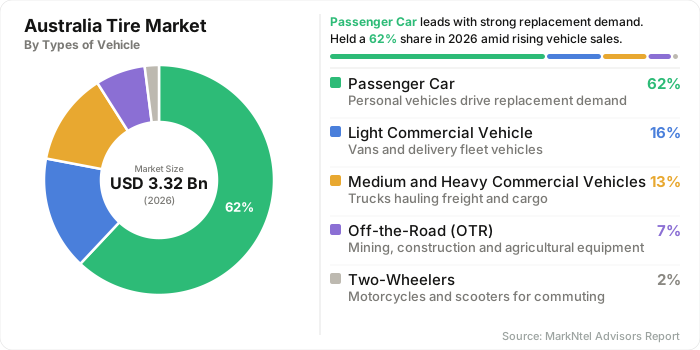
- Passenger Cars emerged as the leading vehicle segment, accounting for approximately 62% of the market share in 2026.
- By Type of Tire, radial tires dominated the market with approximately 95% share in 2026.
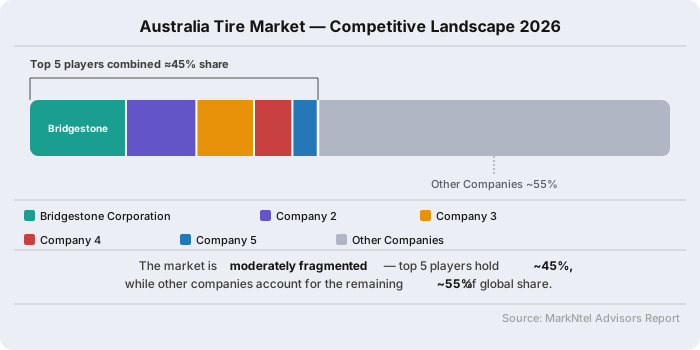
- The industry is moderately consolidated, with the top five leading players accounting for approximately 45% of the total market share.
Australia Tire Market Size and Outlook
At a CAGR of approximately 8.07% over 2026–2032, the Australia Tire market is expected to rise from USD 3.32 billion in 2026 to USD 5.29 billion by 2032, following a valuation of USD 3.02 billion in 2025.
Australia's expanding vehicle fleet, resilient automotive sales, and growing transportation activity continue to support steady tire demand across the country. The Federal Chamber of Automotive Industries (FCAI) reported continued strength in Australia's automotive market during 2025, while the increasing on-road vehicle population drives consistent replacement tire demand across passenger cars, light commercial vehicles, and heavy-duty fleets. These factors have strengthened the Australia tire industry, with residential vehicle owners and commercial sectors such as mining, agriculture, construction, and logistics contributing significantly to market growth.
Growing vehicle usage across urban and regional areas has further reinforced replacement tire demand. Australia's vast geography, extensive freight movement, and challenging operating conditions accelerate tire wear, requiring regular replacement to maintain safety and efficiency. Commercial fleets account for substantial tire consumption, while household vehicle ownership continues to support passenger tire sales. At the same time, ongoing investments in transport infrastructure and freight connectivity continue to increase vehicle utilization, supporting demand for durable radial tires and premium replacement products.
Alongside these demand drivers, supportive government policies are encouraging the adoption of cleaner vehicle technologies. Australia's New Vehicle Efficiency Standard (NVES), effective from January 2025, promotes the introduction of lower-emission passenger cars and light commercial vehicles. Initial 2025 regulatory results showed that 68% of regulated entities exceeded their emissions targets, increasing the availability of modern vehicles that require technologically advanced, fuel-efficient tires. This regulatory shift is expected to accelerate demand for specialized tires designed for hybrid and electric vehicles.
Responding to these evolving requirements, leading manufacturers continue to invest in product innovation and market expansion. Companies are introducing low-rolling-resistance tires, electric vehicle-compatible designs, digitally connected tire monitoring technologies, and sustainable tire technologies to improve durability and efficiency. Combined with expanding dealer networks, fleet management services, and digital retail platforms, these initiatives are expected to strengthen long-term market growth while supporting Australia's transition toward more advanced and environmentally responsible mobility.
Australia Tire Market Key Indicators
- Australia's new vehicle market recorded sales of 1,209,808 units in 2025, according to the Federal Chamber of Automotive Industries (FCAI), reflecting strong demand across passenger and commercial vehicles. The expanding vehicle fleet continues to drive demand for both OEM and replacement tires.
- Australia's registered road vehicle fleet exceeded 21 million vehicles as of January 2025, according to the Australian Bureau of Infrastructure and Transport Research Economics (BITRE). The expanding vehicle parc supports consistent replacement tire demand as vehicles require periodic tire replacement to maintain safety, performance, and operational efficiency.
- Articulated trucks reached 128,568 units and rigid trucks totaled 667,063 units in Australia as of January 2025, according to the Australian Bureau of Infrastructure and Transport Research Economics (BITRE), reflecting annual growth of 3.3% and 6.2%, respectively. The expanding commercial vehicle fleet continues to support demand for medium- and heavy-commercial vehicle tires.
Australia Tire Market Scope
| Category | Segments |
|---|---|
| By Type of Vehicle | Passenger Car, Light Commercial Vehicle, Medium and Heavy Commercial Vehicles, Off-the-Road (OTR), Two-Wheelers |
| By Demand Category | OEM, Aftermarket |
| By Type of Tire | Radial, Bias |
| By Sales Channel | Direct Sales, Exclusive Outlets & Multi-brand Stores, Online |
| By Season | All-Season, Summer, Winter |
| By Price Category | Budget, Mid-Range, Premium |
| By Tire Size | Tire Size 1, Tire Size 2, Tire Size 3, Tire Size 4, Tire Size 5 |
Australia Tire Market Growth Drivers
Expanding Vehicle Fleet and Road Freight Activities
An expanding vehicle fleet and longer vehicle ownership are reinforcing replacement tire demand across Australia's passenger and commercial vehicle segments. The average age of Australia's registered vehicles increased to 11.54 years in 2025 from 11.40 years in 2024, reflecting an aging vehicle fleet that requires more frequent tire replacement to maintain safety, performance, and fuel efficiency. In addition, increasing travel activity, urban commuting, and longer driving distances across the country's vast geography continue to accelerate tire wear.
Commercial transportation further strengthens market demand as freight activity continues to expand nationwide. According to the Bureau of Infrastructure and Transport Research Economics (BITRE), road transport carries approximately 75% of Australia's domestic non-bulk freight, making trucking the primary mode of freight movement. The continued growth of interstate logistics, freight transportation, and last-mile delivery services is increasing commercial vehicle utilization, creating sustained demand for durable replacement tires capable of supporting high-mileage operations.
Responding to these evolving requirements, manufacturers and distributors are expanding dealer networks, independent service centers, and digital retail platforms to improve product accessibility across Australia. Commercial fleet operators are also increasingly adopting fleet tire management solutions to extend tire life, reduce operating costs, and maximize vehicle uptime. Together, these developments are reinforcing replacement tire demand while fostering the adoption of advanced tire technologies across passenger and commercial vehicle segments.
Recent Trends
Rising Adoption of EV-Specific Tires
Growing electric vehicle adoption is accelerating demand for EV tire technology across Australia's automotive market. The Federal Chamber of Automotive Industries (FCAI) recorded 103,269 battery electric vehicle sales in 2025, representing 8.3% of total new vehicle sales, while plug-in hybrid vehicle sales reached 53,484 units, increasing 130.9% year-on-year. By May 2026, battery electric vehicles accounted for a record 20% of monthly new vehicle sales, steadily expanding the base of vehicles requiring specialized tire solutions.
As the electric vehicle fleet continues to grow, manufacturers are adapting tire designs to meet evolving performance requirements. Heavier battery packs require higher load-bearing capacity, while instant torque increases tread wear and extended driving range depends on low-rolling-resistance tires that improve energy efficiency. At the same time, quieter electric drivetrains have increased demand for enhanced ride comfort and lower tire noise, encouraging manufacturers to expand EV-focused product portfolios. Collectively, these developments are accelerating the adoption of premium replacement tires and advancing the evolution of Australia's tire market.
Australia Tire Market Opportunities and Challenges
Increasing End-of-Life Tire Waste Driving Circular and Sustainable Tire Solutions
Australia's rising volume of end-of-life tires is creating significant waste management challenges while accelerating the need for circular and sustainable tire solutions. According to Tyre Stewardship Australia, the country generated 537,000 tonnes of end-of-life tires in 2023–24, yet only 26% were genuinely reused or recycled, while approximately 40% were exported for energy recovery. Recovery rates remain particularly low for off-the-road (OTR) tires, with mining tires recording recovery rates below 5%. These challenges are increasing the importance of tire recycling solutions, supported by the implementation of the NSW Product Lifecycle Responsibility Act 2025 and the inclusion of tires on the Federal Minister's Priority List.
As governments and industry participants strengthen efforts to address these challenges, investment in circular tire management is gaining momentum. The growing emphasis on producer responsibility is encouraging tire recycling, crumb-rubber applications, domestic OTR tire processing, and retread tire technologies to extend tire life and reduce waste. Tyre Stewardship Australia reports that companies responsible for 47% of replacement tire imports and 99% of vehicle-fitted tire imports remain outside the voluntary stewardship scheme, highlighting considerable scope for broader industry participation. Consequently, suppliers investing in recyclable tire products and local recovery capabilities are well positioned to benefit from Australia's transition toward a more circular tire economy.
Segmentation Insights
Passenger Cars Anchor Australia's Tire Demand Through the Largest Personal-Use Vehicle Base
Australia's extensive passenger vehicle fleet positions the passenger car segment as the largest contributor to tire demand, accounting for an estimated 62% market share in 2026. The segment benefits from the country's large base of privately owned vehicles, including SUVs and passenger cars, which generate consistent demand for both original equipment and replacement passenger vehicle tires. According to the Federal Chamber of Automotive Industries (FCAI), the Toyota RAV4 was Australia's best-selling vehicle in 2025 with 51,947 units, while Toyota delivered 239,863 vehicles, representing 19.8% of total new vehicle sales, strengthening the long-term replacement tire pipeline.
The segment is further supported by evolving consumer preferences and vehicle usage patterns. Australians are increasingly opting for larger SUVs and crossover vehicles that require bigger and higher-specification tires, contributing to higher replacement value. At the same time, longer commuting distances, recreational travel, and extended vehicle ownership continue to increase tire replacement frequency. Together, these factors are expected to reinforce the passenger car segment's leading position across Australia's tire industry over the coming years. Based on types of vehicle, the market has been segmented into:
- Passenger Car
- Light Commercial Vehicle
- Medium and Heavy Commercial Vehicles
- Off-the-Road (OTR)
- Two-Wheelers
Radial Tires Command the Market as Standard Fitment Across Road and Off-Road Applications
Radial tires account for the largest share of Australia's tire market, representing 95% in 2026, as they have become the standard fitment across passenger cars, light commercial vehicles, and an increasing number of off-the-road applications. Their widespread adoption is supported by lower rolling resistance, improved fuel efficiency, superior heat dissipation, and longer tread life compared with bias tires, making them well suited to Australia's long-distance driving conditions and diverse climate. These performance advantages have further strengthened demand across both commercial vehicle tires and passenger vehicle applications.
The widespread adoption of radial tires continues to strengthen as vehicle technologies and operating requirements evolve. Electric vehicles increasingly rely on radial construction to maximize driving range, while commercial fleets and mining operators prefer radial tires for their durability, retreadability, and lower operating costs. Together with continued growth in electrification, freight transportation, and premium vehicle sales, these advantages are expected to strengthen the dominant position of radial tires across Australia's passenger, commercial, and off-road vehicle segments. Based on types of tire, the market is categorized into:
- Radial
- Bias
Australia Tire Market Competitive Analysis
Competition within the Australia tire market remains moderately consolidated. Key companies, including Bridgestone Corporation, Goodyear Tire & Rubber Company, Michelin Group, Continental AG, Pirelli & C. S.p.A., Yokohama Rubber Company Limited, Hankook Tire Co., Ltd., Toyo Tire & Rubber Company, BFGoodrich Australia, and Kumho Tire, collectively account for approximately 45% of the market, supported by strong distribution networks, established brands, and broad tire portfolios.
Key Players of Tire Market in Australia
- Bridgestone Corporation
- Goodyear Tire & Rubber Company
- Michelin Group
- Continental AG
- Pirelli & C. S.p.A.
- Yokohama Rubber Company Limited
- Hankook Tire Co., Ltd.
- Toyo Tire and Rubber Company
- BFGoodrich Australia
- Kumho Tire
- Others
Australia Tire Industry News and Recent Developments
March 2025: Bridgestone Launches Turanza 6 Premium Touring Tire in Australia
Bridgestone introduced the Turanza 6 in the Australian market, expanding its premium passenger tire portfolio with enhanced wet-weather braking, lower rolling resistance, improved driving comfort, and longer tread life. The product is designed to meet evolving consumer demand for high-performance and fuel-efficient replacement tires.
Impact Analysis: The launch reinforces the shift toward premium and technologically advanced replacement tires in Australia, supporting greater adoption of fuel-efficient tire technologies while strengthening competition in the passenger vehicle tire segment.
Frequently Asked Questions
- Market Segmentation
- Introduction
- Product Definition
- Research Process
- Assumptions
- Executive Summary
- Australia Tire Production (Thousand Units) Trend 2022-2032
- Australia Tire Production (Thousand Units) Trend, By Type of Tire
- Radial
- Bias
- Company-Wise Production Plants and Statistics
- Installed Production Capacity
- Actual Production
- Planned Production Target
- Australia Tire Production (Thousand Units) Trend, By Type of Tire
- Australia Tire Pricing Analysis (USD/Thousand Units) 2022-2032
- Australia Tire Pricing Trend (USD/Thousand Units), By Type of Tire 2022-2032
- Radial
- Bias
- Australia Tire Pricing Trend (USD/Thousand Units), By Type of Tire 2022-2032
- Australia Tire Market Supply Chain Analysis
- Australia Tire Market Import Export Landscape
- Australia Tire Market Policies, Regulations, and Product Standards
- Australia Tire Market Trends & Developments
- Australia Tire Market Dynamics
- Growth Factors
- Challenges
- Australia Tire Market Hotspot & Opportunities
- Australia Tire Market Outlook, 2022-2032F
- Market Size & Outlook
- By Revenues (USD Million)
- By Unit Sold (Thousand Units)
- Market Segmentation & Outlook
- By Type of Vehicle- Market Size & Forecast 2022-2032, USD Million
- Passenger Car
- Light Commercial Vehicle
- Medium and Heavy Commercial Vehicles
- Off-the-Road (OTR)
- Two-Wheelers
- By Demand Category- Market Size & Forecast 2022-2032, USD Million
- OEM
- Aftermarket
- By Type of Tire- Market Size & Forecast 2022-2032, USD Million
- Radial
- Bias
- By Sales Channel- Market Size & Forecast 2022-2032, USD Million
- Direct Sales
- Exclusive Outlets & Multi-brand Stores
- Online
- By Season- Market Size & Forecast 2022-2032, USD Million
- All-Season
- Summer
- Winter
- By Price Category- Market Size & Forecast 2022-2032, USD Million
- Budget
- Mid-Range
- Premium
- By Tire Size- Market Size & Forecast 2022-2032, USD Million
- Tire Size 1
- Tire Size 2
- Tire Size 3
- Tire Size 4
- Tire Size 5
- By Company
- Competition Characteristics
- Market Share & Analysis
- By Type of Vehicle- Market Size & Forecast 2022-2032, USD Million
- Market Size & Outlook
- Australia Passenger Car Tire Market Outlook, 2022-2032
- Market Size & Outlook
- By Revenues (USD Million)
- By Unit Sold (Thousand Units)
- Market Segmentation & Outlook
- By Types of Vehicle- Market Size & Forecast 2022-2032, USD Million
- Hatchback
- Sedan
- SUV
- By Demand Category- Market Size & Forecast 2022-2032, USD Million
- By Type of Tire- Market Size & Forecast 2022-2032, USD Million
- By Sales Channel- Market Size & Forecast 2022-2032, USD Million
- By Season- Market Size & Forecast 2022-2032, USD Million
- By Price Category- Market Size & Forecast 2022-2032, USD Million
- By Tire Size- Market Size & Forecast 2022-2032, USD Million
- By Types of Vehicle- Market Size & Forecast 2022-2032, USD Million
- Market Size & Outlook
- Australia Light Commercial Vehicle Tire Market Outlook, 2022-2032
- Market Size & Outlook
- By Revenues (USD Million)
- By Unit Sold (Thousand Units)
- Market Segmentation & Outlook
- Types of Vehicle- Market Size & Forecast 2022-2032, USD Million
- Light Trucks
- Light Buses
- Pick-up Trucks and Vans
- By Demand Category- Market Size & Forecast 2022-2032, USD Million
- By Type of Tire- Market Size & Forecast 2022-2032, USD Million
- By Sales Channel- Market Size & Forecast 2022-2032, USD Million
- By Season- Market Size & Forecast 2022-2032, USD Million
- By Price Category- Market Size & Forecast 2022-2032, USD Million
- By Tire Size- Market Size & Forecast 2022-2032, USD Million
- Types of Vehicle- Market Size & Forecast 2022-2032, USD Million
- Market Size & Outlook
- Australia Medium and Heavy Commercial Vehicles Tire Market Outlook, 2022-2032
- Market Size & Outlook
- By Revenues (USD Million)
- By Unit Sold (Thousand Units)
- Market Segmentation & Outlook
- Types of Vehicle- Market Size & Forecast 2022-2032, USD Million
- Buses
- Trucks
- By Demand Category- Market Size & Forecast 2022-2032, USD Million
- By Type of Tire- Market Size & Forecast 2022-2032, USD Million
- By Sales Channel- Market Size & Forecast 2022-2032, USD Million
- By Season- Market Size & Forecast 2022-2032, USD Million
- By Price Category- Market Size & Forecast 2022-2032, USD Million
- By Tire Size- Market Size & Forecast 2022-2032, USD Million
- Types of Vehicle- Market Size & Forecast 2022-2032, USD Million
- Market Size & Outlook
- Australia Off-the-Road (OTR) Tire Market Outlook, 2022-2032
- Market Size & Outlook
- By Revenues (USD Million)
- By Unit Sold (Thousand Units)
- Market Segmentation & Outlook
- Types of Vehicle- Market Size & Forecast 2022-2032, USD Million
- Earthmoving Equipment
- Agricultural Vehicles
- Material Handling Vehicles
- By Demand Category- Market Size & Forecast 2022-2032, USD Million
- By Type of Tire- Market Size & Forecast 2022-2032, USD Million
- By Sales Channel- Market Size & Forecast 2022-2032, USD Million
- By Season- Market Size & Forecast 2022-2032, USD Million
- By Price Category- Market Size & Forecast 2022-2032, USD Million
- By Tire Size- Market Size & Forecast 2022-2032, USD Million
- Types of Vehicle- Market Size & Forecast 2022-2032, USD Million
- Market Size & Outlook
- Australia Two-Wheelers Tire Market Outlook, 2022-2032
- Market Size & Outlook
- By Revenues (USD Million)
- By Unit Sold (Thousand Units)
- Market Segmentation & Outlook
- Types of Vehicle- Market Size & Forecast 2022-2032, USD Million
- Scooters and Mopeds
- Motorcycles
- By Demand Category- Market Size & Forecast 2022-2032, USD Million
- By Type of Tire- Market Size & Forecast 2022-2032, USD Million
- By Sales Channel- Market Size & Forecast 2022-2032, USD Million
- By Season- Market Size & Forecast 2022-2032, USD Million
- By Price Category- Market Size & Forecast 2022-2032, USD Million
- By Tire Size- Market Size & Forecast 2022-2032, USD Million
- Types of Vehicle- Market Size & Forecast 2022-2032, USD Million
- Market Size & Outlook
- Australia Tire Market Key Strategic Imperatives for Success & Growth
- Competitive Outlook
- Company Profiles
- Bridgestone Corporation
- Business Description
- Product Portfolio
- Collaborations & Alliances
- Recent Developments
- Financial Details
- Others
- Goodyear Tire & Rubber Company
- Business Description
- Product Portfolio
- Collaborations & Alliances
- Recent Developments
- Financial Details
- Others
- Michelin Group
- Business Description
- Product Portfolio
- Collaborations & Alliances
- Recent Developments
- Financial Details
- Others
- Continental AG
- Business Description
- Product Portfolio
- Collaborations & Alliances
- Recent Developments
- Financial Details
- Others
- Pirelli & C. S.p.A.
- Business Description
- Product Portfolio
- Collaborations & Alliances
- Recent Developments
- Financial Details
- Others
- Yokohama Rubber Company Limited
- Business Description
- Product Portfolio
- Collaborations & Alliances
- Recent Developments
- Financial Details
- Others
- Hankook Tire Co., Ltd.
- Business Description
- Product Portfolio
- Collaborations & Alliances
- Recent Developments
- Financial Details
- Others
- Toyo Tire and Rubber Company
- Business Description
- Product Portfolio
- Collaborations & Alliances
- Recent Developments
- Financial Details
- Others
- BFGoodrich Australia
- Business Description
- Product Portfolio
- Collaborations & Alliances
- Recent Developments
- Financial Details
- Others
- Kumho Tire
- Business Description
- Product Portfolio
- Collaborations & Alliances
- Recent Developments
- Financial Details
- Others
- Bridgestone Corporation
- Company Profiles
- Disclaimer
MarkNtel Advisors follows a robust and iterative research methodology designed to ensure maximum accuracy and minimize deviation in market estimates and forecasts. Our approach combines both bottom-up and top-down techniques to effectively segment and quantify various aspects of the market. A consistent feature across all our research reports is data triangulation, which examines the market from three distinct perspectives to validate findings. Key components of our research process include:
1. Scope & Research Design At the outset, MarkNtel Advisors define the research objectives and formulate pertinent questions. This phase involves determining the type of research—qualitative or quantitative—and designing a methodology that outlines data collection methods, target demographics, and analytical tools. They also establish timelines and budgets to ensure the research aligns with client goals.
2. Sample Selection and Data Collection In this stage, the firm identifies the target audience and determines the appropriate sample size to ensure representativeness. They employ various sampling methods, such as random or stratified sampling, based on the research objectives. Data collection is carried out using tools like surveys, interviews, and observations, ensuring the gathered data is reliable and relevant.
3. Data Analysis and Validation Once data is collected, MarkNtel Advisors undertake a rigorous analysis process. This includes cleaning the data to remove inconsistencies, employing statistical software for quantitative analysis, and thematic analysis for qualitative data. Validation steps are taken to ensure the accuracy and reliability of the findings, minimizing biases and errors.

4. Data Forecast and FinalizationThe final phase involves forecasting future market trends based on the analyzed data. MarkNtel Advisors utilize predictive modeling and time series analysis to anticipate market behaviors. The insights are then compiled into comprehensive reports, featuring visual aids like charts and graphs, and include strategic recommendations to inform client decision-making
We offer flexible licensing options to cater to varying organizational needs. Choose the pricing pack that best suits your requirements:
Buy Now Inquire Before Buying
 Request Customization
 Talk to our Consultant







