

Asia-Pacific Intelligent Transport System Market Research Report: Trends & Forecast (2026-2032)
By Component (Hardware, Software), By System Type (Advanced Traffic Management System (ATMS), Advanced Traveler Information System (ATIS), Advanced Public Transportation System (AP ... TS), Commercial Vehicle Operations (CVO)), By Transportation Mode (Roadways, Railways, Airways, Maritime), By Application (Traffic Management, Road Safety & Surveillance, Fleet Management & Asset Monitoring, Electronic Toll Collection, Public Transport Management, Parking Management), and others Read more
- Automotive
- Mar 2026
- Pages 230
- Report Format: PDF, Excel, PPT
Asia-Pacific Intelligent Transport System Market
Projected 10.76% CAGR from 2026 to 2032
Study Period
2026-2032
Market Size (2026)
USD 16.3 Billion
Market Size (2032)
USD 30.1 Billion
Base Year
2025
Projected CAGR
10.76%
Leading Segments
By System Type: Advanced Traffic Management System (ATMS)
Asia-Pacific Intelligent Transport System Market Report Key Takeaways:
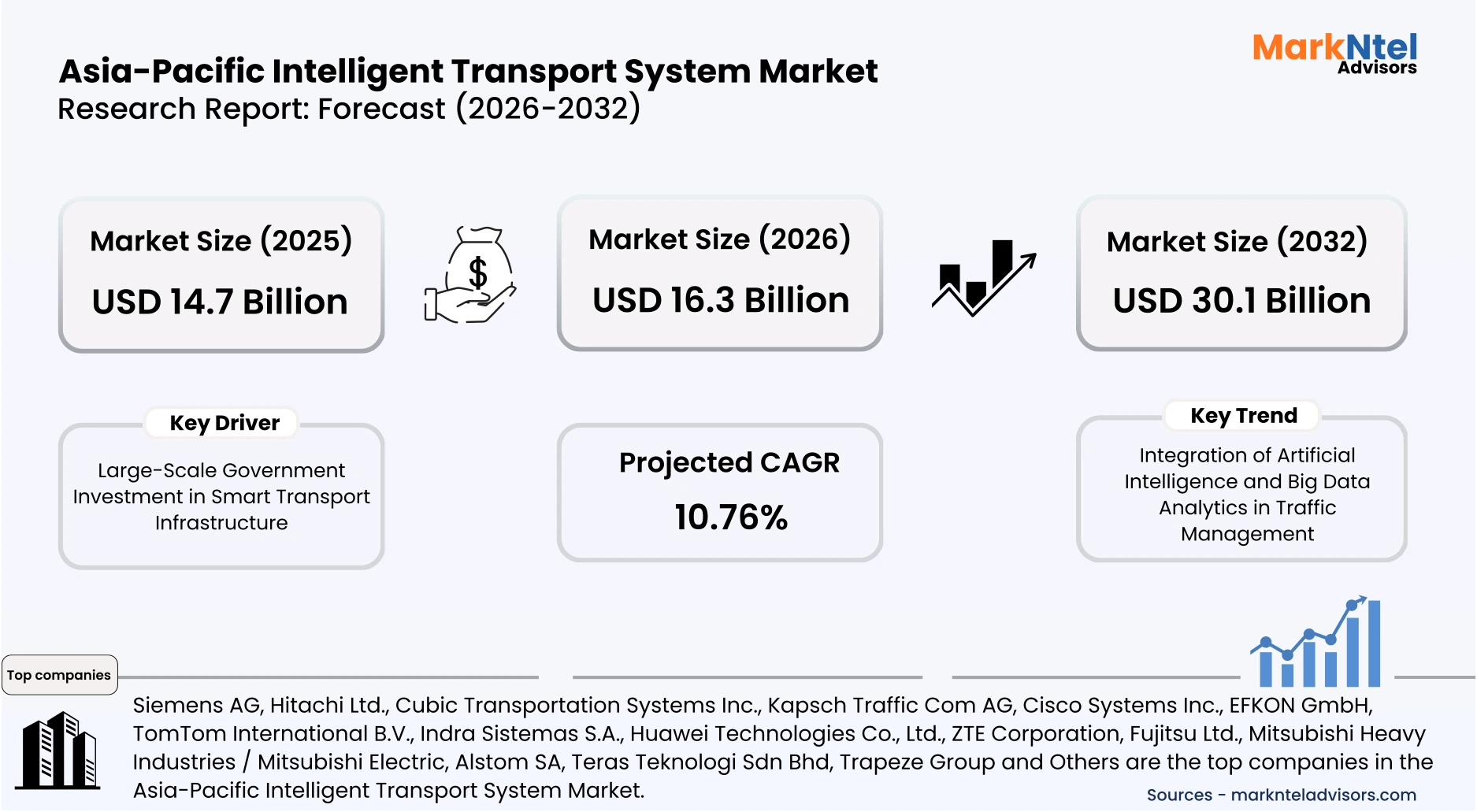
- The Asia-Pacific Intelligent Transport System Market size was valued at USD 14.7 billion in 2025 and is projected to grow from USD 16.3 billion in 2026 to USD 30.1 billion by 2032, exhibiting a CAGR of 10.76% during the forecast period.
- China is the leading country with a significant share of around 36% in 2026.
- By System Type, the Advanced Traffic Management System (ATMS) represented a significant share of about 55% in the Asia-Pacific Intelligent Transport System Market in 2026.
- By Component, the Hardware segment seized a significant share of about 47% in the Asia-Pacific Intelligent Transport System Market in 2026.
- Leading ITS companies in the Asia-Pacific are, Siemens AG, Hitachi Ltd., Cubic Transportation Systems Inc., Kapsch Traffic Com AG, Cisco Systems Inc., EFKON GmbH, TomTom International B.V., Indra Sistemas S.A., Huawei Technologies Co., Ltd., ZTE Corporation, Fujitsu Ltd., Mitsubishi Heavy Industries / Mitsubishi Electric, Alstom SA, Teras Teknologi Sdn Bhd, Trapeze Group and Others.
Market Insights & Analysis: Asia-Pacific Intelligent Transport System Market (2026-32):
The Asia-Pacific Intelligent Transport System Market size was valued at USD 14.7 billion in 2025 and is projected to grow from USD 16.3 billion in 2026 to USD 30.1 billion by 2032, exhibiting a CAGR of 10.76% during the forecast period, i.e., 2026-32.
Rapid urbanization and rising vehicle ownership are shaping transport modernization across the Asia Pacific. Governments are therefore deploying intelligent traffic control systems, smart signaling, and real-time monitoring technologies to improve efficiency and reduce congestion. These deployments have gradually expanded from major metropolitan areas to secondary cities, strengthening the long-term growth trajectory of the regional Intelligent Transport System (ITS) market.
Public infrastructure investment programs are also reinforcing ITS adoption across national transport networks. Japan’s Ministry of Land, Infrastructure, Transport and Tourism reported in 2025 that the country continues expanding its Smart Mobility initiatives under the Society 5.0 strategy, integrating AI-based traffic analytics and vehicle-to-infrastructure communication . Similarly, South Korea’s Ministry of Land, Infrastructure, and Transport has advanced the nationwide Cooperative Intelligent Transport Systems (C-ITS) deployment program to support connected and autonomous mobility. Such programs encourage technology integration across highways, urban corridors, and public transit systems, creating a stable policy environment that supports continued market expansion.
Demand from commercial and institutional transport operators is also accelerating technology deployment. For example, Singapore’s Land Transport Authority expanded its next-generation Electronic Road Pricing (ERP 2.0) system rollout in 2025, enabling satellite-based congestion pricing and real-time traffic monitoring. The initiative directly affects taxi fleets, logistics providers, and daily commuters by enabling dynamic road usage management and traffic optimization. Increasing reliance on real-time transport analytics among urban mobility operators is therefore strengthening the adoption of ITS hardware, software platforms, and communication infrastructure across the region.
Industry participation and technological innovation further reinforce the region’s ITS development outlook. In 2025, Toshiba Infrastructure Systems & Solutions introduced upgraded traffic management platforms designed to integrate AI-driven traffic prediction and sensor networks across metropolitan transport systems. Meanwhile, Chinese cities continue deploying large-scale urban digital traffic platforms aligned with national “new infrastructure” policies promoting smart city development. These initiatives demonstrate how coordinated government planning, expanding urban mobility demand, and ongoing private-sector innovation are collectively shaping a robust growth outlook for the Asia-Pacific Intelligent Transport System Market in the coming years.
Asia-Pacific Intelligent Transport System Market Scope:
| Category | Segments |
|---|---|
| By Component | (Hardware, Software), |
| By System Type | (Advanced Traffic Management System (ATMS), Advanced Traveler Information System (ATIS), Advanced Public Transportation System (APTS), Commercial Vehicle Operations (CVO)), |
| By Transportation Mode | (Roadways, Railways, Airways, Maritime), |
| By Application | (Traffic Management, Road Safety & Surveillance, Fleet Management & Asset Monitoring, Electronic Toll Collection, Public Transport Management, Parking Management), |
Asia-Pacific Intelligent Transport System Market Driver:
Large-Scale Government Investment in Smart Transport Infrastructure
Large-scale public investment in digital transport infrastructure has become the most influential driver in accelerating the Asia-Pacific Intelligent Transport System (ITS) Market. Governments across the region are allocating significant funding to modernize road networks, improve traffic safety, and deploy advanced mobility technologies. According to the reports, transport infrastructure spending in developing Asia continues to expand as countries prioritize intelligent traffic management and digital mobility systems. These investments directly create demand for traffic sensors, adaptive signal control, surveillance platforms, and integrated mobility software.
The driver has intensified as governments link transport modernization with economic productivity and urban sustainability objectives. In 2025, India’s Ministry of Road Transport and Highways expanded the Intelligent Traffic Management System implementation across national highway corridors under digital highway initiatives, deploying automated incident detection and real-time traffic monitoring technologies. Such programs require large volumes of ITS components, including cameras, communication networks, and centralized control systems. As a result, infrastructure-led deployment is generating large-scale procurement activity across public road authorities and urban transport agencies.
Growing policy emphasis on road safety and congestion mitigation further strengthens this demand. The World Health Organization reported in 2025 that the Asia Pacific region continues to account for a substantial share of global road traffic fatalities, prompting governments to integrate advanced monitoring and enforcement technologies. Automated speed detection, smart intersections, and digital traffic enforcement systems are therefore being deployed to improve compliance and accident response times. This regulatory push expands the installation base of ITS technologies across highways and metropolitan road networks, significantly increasing equipment demand and long-term system integration opportunities.
Asia-Pacific Intelligent Transport System Market Trend:
Integration of Artificial Intelligence and Big Data Analytics in Traffic Management
The integration of artificial intelligence (AI) and big data analytics into traffic management systems has emerged as a significant trend reshaping the Asia-Pacific Intelligent Transport System Market. Rapid digitalisation of urban infrastructure and the availability of large transport datasets have enabled authorities to deploy predictive traffic control platforms. According to the International Transport Forum (OECD), cities are increasingly using AI-driven analytics to optimise traffic signals, monitor congestion patterns, and improve incident response times. This technological shift is transforming traditional traffic management into data-driven mobility operations.
The trend has accelerated as governments incorporate digital technologies into broader smart city development strategies. In 2025, China’s Ministry of Transport expanded digital transport initiatives supporting AI-enabled traffic monitoring and integrated urban mobility platforms in several metropolitan regions. These deployments allow transport authorities to analyse real-time vehicle flows and dynamically adjust signal timings and road usage policies. As a result, technology providers are increasingly offering integrated platforms combining sensors, cameras, cloud computing, and analytics software rather than standalone ITS hardware.
The long-term persistence of this trend is reinforced by increasing data connectivity and institutional commitment to intelligent mobility systems. According to a 2025 World Bank report on digital infrastructure and mobility, data-driven transport management improves road capacity utilization and reduces congestion-related economic losses in rapidly urbanizing cities. Consequently, municipalities across the Asia-Pacific are prioritizing digital transport command centers and real-time analytics platforms. This structural shift toward AI-enabled decision-making is expected to significantly influence future ITS architecture and service delivery models.
Asia-Pacific Intelligent Transport System Market Opportunity:
Expansion of Smart Public Transport and Urban Mobility Platforms
The rapid expansion of smart public transport systems across the Asia-Pacific presents a significant opportunity for new entrants in the Intelligent Transport System market. Governments are increasingly integrating digital technologies into buses, metro networks, and multimodal mobility services to improve passenger experience and operational efficiency. In 2025, Australia’s Department of Infrastructure reported continued investments in intelligent public transport infrastructure, including real-time passenger information systems and integrated ticketing platforms. These initiatives require advanced data platforms, mobile applications, and digital service tools, creating new areas for technology providers.
This opportunity has emerged as urban transport authorities prioritize integrated mobility ecosystems that combine buses, rail systems, ride-hailing, and shared mobility services. For instance, Transport for Sydney expanded digital mobility services supporting trip planning and multimodal transport coordination through centralized platforms. Such programs generate demand for application development, passenger analytics , and cloud-based transport management software. As cities transition toward Mobility-as-a-Service frameworks, the need for scalable digital platforms and service integration technologies continues to expand across metropolitan transport networks.
The opportunity is particularly advantageous for new and emerging technology providers because connected mobility ecosystems rely heavily on software, communication protocols, and data analytics solutions. Smaller firms specializing in AI algorithms, cybersecurity, and edge computing can supply critical components within these digital transport platforms. Reuters reported in 2025 that several Asian cities are expanding connected vehicle testing programs as part of broader smart mobility strategies. This growing ecosystem allows new players to collaborate with automotive companies, telecom providers, and city authorities while scaling innovative ITS solutions.
Asia-Pacific Intelligent Transport System Market Challenge:
Data Security and Privacy Concerns
The increasing reliance on connected and intelligent transport systems has made data management, cybersecurity, and privacy a critical market challenge in the Asia Pacific. ITS platforms generate massive volumes of real-time traffic, vehicle, and commuter data, requiring advanced storage, analytics, and secure communication infrastructure. According to 2025 reports, cities deploying AI-enabled traffic monitoring and connected vehicle systems face significant challenges in safeguarding sensitive transport and user data against cyber threats.
These complexities impact market participants by increasing operational costs and slowing deployment timelines. For example, South Korea’s Ministry of Land, Infrastructure, and Transport highlighted the need for stringent data governance and encryption standards during its expansion of connected and autonomous vehicle trials in 2025. Without robust cybersecurity measures and compliance frameworks, transport authorities and ITS providers risk data breaches, system disruptions, and regulatory penalties, which deter private investment and reduce confidence in large-scale ITS implementation.
Consequently, these structural challenges materially restrict market growth and scalability. Small and emerging players often lack the technical capacity or capital to meet stringent data protection and cybersecurity requirements, limiting their participation. Furthermore, unresolved privacy concerns among commuters can delay technology adoption and reduce system utilization. As a result, while ITS deployment is increasing in metropolitan areas, broader regional expansion remains constrained by the need for secure, compliant, and reliable data management solutions.
Asia-Pacific Intelligent Transport System Market (2026-32) Segmentation Analysis:
The Asia-Pacific Intelligent Transport System study of MarkNtel Advisors evaluates & highlights the major trends and influencing factors in each segment. It includes predictions for the period 2026-32 at the regional level. Based on the analysis, the market has been further classified as;
Based on System Type:
- Advanced Traffic Management System (ATMS)
- Traffic Signal Control Systems
- Traffic Monitoring & Incident Detection
- Advanced Traveler Information System (ATIS)
- Real-Time Traffic Information
- Route Guidance Systems
- Advanced Public Transportation System (APTS)
- Smart Ticketing Systems
- Passenger Information Systems
- Commercial Vehicle Operations (CVO)
- Fleet Monitoring Systems
- Freight Management Systems
The Advanced Traffic Management System (ATMS) segment leads the Asia-Pacific ITS market with a market share of 55%, due to rapid urbanization and escalating traffic congestion in major cities. Governments across China, India, Japan, and Southeast Asia are investing heavily in centralized traffic control centers to optimize traffic flows, reduce travel time, and improve road safety. Indian cities are implementing AI-powered traffic monitoring systems with cameras, sensors, and real-time enforcement, which clearly shows policy-driven investment and operational demand.
Integration of traffic monitoring and incident detection systems enhances operational efficiency and safety, making ATMS essential for municipal and highway networks. Investment inflows from both public and private sectors are directed toward upgrading signal control systems, deploying AI-powered analytics, and connecting roadway infrastructure with V2I communication networks. Rising vehicle ownership, coupled with demand for real-time incident alerts and automated traffic management, further strengthens ATMS dominance.
End-user adoption, particularly by municipal transport authorities and highway operators, drives sustained growth of ATMS. The system’s ability to integrate seamlessly with other ITS solutions, such as ATIS and APTS, ensures comprehensive traffic optimization. Additionally, digital twin modelling, predictive analytics, and government-backed funding for intelligent transport pilot projects consolidate ATMS’s position as the market-leading system type through 2032.
Based on Component:
- Hardware
- Surveillance Cameras
- Sensors & Detectors
- Interface Boards
- Telecommunication Networks
- Others
- Software
- Traffic Management Software
- Data Analytics Platforms
- Mobility Management Software
- Others
Hardware is the leading component type in the Asia-Pacific ITS Industry, accounting for the largest share of 47% due to its foundational role in system deployment. Surveillance cameras, sensors, and telecommunication networks are essential for real-time data collection, signal control, and vehicle-to-infrastructure connectivity. Governments’ focus on smart city and highway modernization projects ensures continuous demand for advanced hardware solutions. For example, Indian authorities and companies are rolling out AI-based traffic monitoring systems with cameras and sensors along major expressways and urban areas to improve safety and mobility as part of smart infrastructure modernization .
Rising investments in AI-enabled cameras, roadside sensors, and IoT-based monitoring devices are driven by policies promoting road safety, congestion management, and environmental monitoring. Private infrastructure developers and municipal authorities prioritize hardware upgrades to meet growing urban mobility needs. The combination of public-private investment initiatives accelerates large-scale deployments across high-traffic corridors and expressways.
End-user demand for reliable, scalable, and interoperable hardware solutions underpins sustained market leadership. Hardware’s ability to support software platforms, analytics engines, and real-time applications makes it a strategic backbone of ITS networks. Continuous innovation in sensor accuracy, camera resolution, and communication bandwidth further reinforces hardware as the dominant component, ensuring it remains the preferred investment target and performance-critical element of ITS through 2032.
Asia-Pacific Intelligent Transport System Market (2026-32) Regional Analysis:
China’s leadership in the Asia-Pacific Intelligent Transport System (ITS) market, with a share of 36%, stems from its massive economic scale, deep infrastructure investment, and technological ecosystem. Over the past decade, China has pursued one of the world’s most intensive transportation modernization programs, integrating AI, IoT, 5G, and big data into its transport networks. The nation’s multi‑layered policy roadmap, such as the 2025–2030 guideline for an intelligent, integrated transport network, highlights strategic priorities in AI, digital infrastructure, and networked mobility, positioning ITS as a backbone of national urban and intercity transport modernization. These initiatives extend beyond urban areas to expressways, waterways, and multimodal logistics corridors, creating a large, connected national network requiring complex ITS solutions.
Structural and economic factors amplify China’s dominance: it is the world’s second-largest economy with extensive road infrastructure and high vehicle density. Government data show that more than 300 cities in China provide ride-hailing services with over 25 million daily orders, and shared micro‑mobility systems with millions of bikes deployed on a scale that creates intense demand for real-time traffic data and intelligent signal systems to manage congestion and safety.
On the end-user demand side, China’s urban populations and logistics networks provide a unique scale of ITS adoption. Congestion management, safety monitoring, intelligent tolling, and multimodal mobility systems are priorities for municipal authorities and provincial governments to improve efficiency and reduce emissions. Public-private collaborations involving major technology firms, e.g., Alibaba Cloud, Huawei, and Baidu, deploying adaptive ITS platforms in urban and regional corridors, demonstrate strong market pull from both public agencies and private logistics/transport operators.
Gain a Competitive Edge with Our Asia-Pacific Intelligent Transport System Market Report:
- The Asia-Pacific Intelligent Transport System Market Report by MarkNtel Advisors provides a detailed & thorough analysis of market size & share, growth rate, competitive landscape, and key players. This comprehensive analysis helps businesses gain a holistic understanding of the market dynamics & make informed decisions.
- This report also highlights current market trends & future projections, allowing businesses to identify emerging opportunities & potential challenges. By understanding market forecasts, companies can align their strategies & stay ahead of the competition.
- The Asia-Pacific Intelligent Transport System Market Report aids in assessing & mitigating risks associated with entering or operating in the market. By understanding market dynamics, regulatory frameworks, and potential challenges, businesses can develop strategies to minimize risks & optimize their operations.
*Reports Delivery Format - Market research studies from MarkNtel Advisors are offered in PDF, Excel and PowerPoint formats. Within 24 hours of the payment being successfully received, the report will be sent to your email address.
Frequently Asked Questions
- Market Segmentation
- Introduction
- Product Definition
- Research Process
- Assumptions
- Executive Summary
- Asia-Pacific Intelligent Transport System Market Policies, Regulations, and Product Standards
- Asia-Pacific Intelligent Transport System Market Trends & Developments
- Asia-Pacific Intelligent Transport System Market Dynamics
- Growth Factors
- Challenges
- Asia-Pacific Intelligent Transport System Market Hotspot & Opportunities
- Asia-Pacific Intelligent Transport System Market Outlook, 2022-2032F
- Market Size & Outlook
- By Revenues (USD Million)
- Market Share & Analysis
- By Component- Market Size & Forecast 2022-2032, USD Million
- Hardware
- Surveillance Cameras
- Sensors & Detectors
- Interface Boards
- Telecommunication Networks
- Others
- Software
- Traffic Management Software
- Data Analytics Platforms
- Mobility Management Software
- Others
- Hardware
- By System Type- Market Size & Forecast 2022-2032, USD Million
- Advanced Traffic Management System (ATMS)
- Traffic Signal Control Systems
- Traffic Monitoring & Incident Detection
- Advanced Traveler Information System (ATIS)
- Real-Time Traffic Information
- Route Guidance Systems
- Advanced Public Transportation System (APTS)
- Smart Ticketing Systems
- Passenger Information Systems
- Commercial Vehicle Operations (CVO)
- Fleet Monitoring Systems
- Freight Management Systems
- Advanced Traffic Management System (ATMS)
- By Transportation Mode- Market Size & Forecast 2022-2032, USD Million
- Roadways
- Railways
- Airways
- Maritime
- By Application- Market Size & Forecast 2022-2032, USD Million
- Traffic Management
- Road Safety & Surveillance
- Fleet Management & Asset Monitoring
- Electronic Toll Collection
- Public Transport Management
- Parking Management
- By Country
- China
- India
- Japan
- South Korea
- Australia
- Singapore
- Thailand
- Indonesia
- Malaysia
- Rest of Asia-Pacific
- By Company
- Competition Characteristics
- Market Share & Analysis
- By Component- Market Size & Forecast 2022-2032, USD Million
- Market Size & Outlook
- China Intelligent Transport System Market Outlook, 2022-2032F
- Market Size & Outlook
- By Revenues (USD Million)
- Market Share & Analysis
- By Component- Market Size & Forecast 2022-2032, USD Million
- By System Type- Market Size & Forecast 2022-2032, USD Million
- By Transportation Mode- Market Size & Forecast 2022-2032, USD Million
- By Application- Market Size & Forecast 2022-2032, USD Million
- Market Size & Outlook
- India Intelligent Transport System Market Outlook, 2022-2032F
- Market Size & Outlook
- By Revenues (USD Million)
- Market Share & Analysis
- By Component- Market Size & Forecast 2022-2032, USD Million
- By System Type- Market Size & Forecast 2022-2032, USD Million
- By Transportation Mode- Market Size & Forecast 2022-2032, USD Million
- By Application- Market Size & Forecast 2022-2032, USD Million
- Market Size & Outlook
- Japan Intelligent Transport System Market Outlook, 2022-2032F
- Market Size & Outlook
- By Revenues (USD Million)
- Market Share & Analysis
- By Component- Market Size & Forecast 2022-2032, USD Million
- By System Type- Market Size & Forecast 2022-2032, USD Million
- By Transportation Mode- Market Size & Forecast 2022-2032, USD Million
- By Application- Market Size & Forecast 2022-2032, USD Million
- Market Size & Outlook
- South Korea Intelligent Transport System Market Outlook, 2022-2032F
- Market Size & Outlook
- By Revenues (USD Million)
- Market Share & Analysis
- By Component- Market Size & Forecast 2022-2032, USD Million
- By System Type- Market Size & Forecast 2022-2032, USD Million
- By Transportation Mode- Market Size & Forecast 2022-2032, USD Million
- By Application- Market Size & Forecast 2022-2032, USD Million
- Market Size & Outlook
- Australia Intelligent Transport System Market Outlook, 2022-2032F
- Market Size & Outlook
- By Revenues (USD Million)
- Market Share & Analysis
- By Component- Market Size & Forecast 2022-2032, USD Million
- By System Type- Market Size & Forecast 2022-2032, USD Million
- By Transportation Mode- Market Size & Forecast 2022-2032, USD Million
- By Application- Market Size & Forecast 2022-2032, USD Million
- Market Size & Outlook
- Singapore Intelligent Transport System Market Outlook, 2022-2032F
- Market Size & Outlook
- By Revenues (USD Million)
- Market Share & Analysis
- By Component- Market Size & Forecast 2022-2032, USD Million
- By System Type- Market Size & Forecast 2022-2032, USD Million
- By Transportation Mode- Market Size & Forecast 2022-2032, USD Million
- By Application- Market Size & Forecast 2022-2032, USD Million
- Market Size & Outlook
- Thailand Intelligent Transport System Market Outlook, 2022-2032F
- Market Size & Outlook
- By Revenues (USD Million)
- Market Share & Analysis
- By Component- Market Size & Forecast 2022-2032, USD Million
- By System Type- Market Size & Forecast 2022-2032, USD Million
- By Transportation Mode- Market Size & Forecast 2022-2032, USD Million
- By Application- Market Size & Forecast 2022-2032, USD Million
- Market Size & Outlook
- Indonesia Intelligent Transport System Market Outlook, 2022-2032F
- Market Size & Outlook
- By Revenues (USD Million)
- Market Share & Analysis
- By Component- Market Size & Forecast 2022-2032, USD Million
- By System Type- Market Size & Forecast 2022-2032, USD Million
- By Transportation Mode- Market Size & Forecast 2022-2032, USD Million
- By Application- Market Size & Forecast 2022-2032, USD Million
- Market Size & Outlook
- Malaysia Intelligent Transport System Market Outlook, 2022-2032F
- Market Size & Outlook
- By Revenues (USD Million)
- Market Share & Analysis
- By Component- Market Size & Forecast 2022-2032, USD Million
- By System Type- Market Size & Forecast 2022-2032, USD Million
- By Transportation Mode- Market Size & Forecast 2022-2032, USD Million
- By Application- Market Size & Forecast 2022-2032, USD Million
- Market Size & Outlook
- Asia-Pacific Intelligent Transport System Market Key Strategic Imperatives for Success & Growth
- Competitive Outlook
- Company Profiles
- Siemens AG
- Business Description
- Product Portfolio
- Collaborations & Alliances
- Recent Developments
- Financial Details
- Others
- Hitachi Ltd.
- Business Description
- Product Portfolio
- Collaborations & Alliances
- Recent Developments
- Financial Details
- Others
- Cubic Transportation Systems Inc.
- Business Description
- Product Portfolio
- Collaborations & Alliances
- Recent Developments
- Financial Details
- Others
- Kapsch TrafficCom AG
- Business Description
- Product Portfolio
- Collaborations & Alliances
- Recent Developments
- Financial Details
- Others
- Cisco Systems Inc.
- Business Description
- Product Portfolio
- Collaborations & Alliances
- Recent Developments
- Financial Details
- Others
- EFKON GmbH
- Business Description
- Product Portfolio
- Collaborations & Alliances
- Recent Developments
- Financial Details
- Others
- TomTom International B.V.
- Business Description
- Product Portfolio
- Collaborations & Alliances
- Recent Developments
- Financial Details
- Others
- Indra Sistemas S.A.
- Business Description
- Product Portfolio
- Collaborations & Alliances
- Recent Developments
- Financial Details
- Others
- Huawei Technologies Co., Ltd.
- Business Description
- Product Portfolio
- Collaborations & Alliances
- Recent Developments
- Financial Details
- Others
- ZTE Corporation
- Business Description
- Product Portfolio
- Collaborations & Alliances
- Recent Developments
- Financial Details
- Others
- Fujitsu Ltd.
- Business Description
- Product Portfolio
- Collaborations & Alliances
- Recent Developments
- Financial Details
- Others
- Mitsubishi Heavy Industries / Mitsubishi Electric
- Business Description
- Product Portfolio
- Collaborations & Alliances
- Recent Developments
- Financial Details
- Others
- Alstom SA
- Business Description
- Product Portfolio
- Collaborations & Alliances
- Recent Developments
- Financial Details
- Others
- Teras Teknologi Sdn Bhd
- Business Description
- Product Portfolio
- Collaborations & Alliances
- Recent Developments
- Financial Details
- Others
- Trapeze Group
- Business Description
- Product Portfolio
- Collaborations & Alliances
- Recent Developments
- Financial Details
- Others
- Siemens AG
- Company Profiles
- Disclaimer
MarkNtel Advisors follows a robust and iterative research methodology designed to ensure maximum accuracy and minimize deviation in market estimates and forecasts. Our approach combines both bottom-up and top-down techniques to effectively segment and quantify various aspects of the market. A consistent feature across all our research reports is data triangulation, which examines the market from three distinct perspectives to validate findings. Key components of our research process include:
1. Scope & Research Design At the outset, MarkNtel Advisors define the research objectives and formulate pertinent questions. This phase involves determining the type of research—qualitative or quantitative—and designing a methodology that outlines data collection methods, target demographics, and analytical tools. They also establish timelines and budgets to ensure the research aligns with client goals.
2. Sample Selection and Data Collection In this stage, the firm identifies the target audience and determines the appropriate sample size to ensure representativeness. They employ various sampling methods, such as random or stratified sampling, based on the research objectives. Data collection is carried out using tools like surveys, interviews, and observations, ensuring the gathered data is reliable and relevant.
3. Data Analysis and Validation Once data is collected, MarkNtel Advisors undertake a rigorous analysis process. This includes cleaning the data to remove inconsistencies, employing statistical software for quantitative analysis, and thematic analysis for qualitative data. Validation steps are taken to ensure the accuracy and reliability of the findings, minimizing biases and errors.

4. Data Forecast and FinalizationThe final phase involves forecasting future market trends based on the analyzed data. MarkNtel Advisors utilize predictive modeling and time series analysis to anticipate market behaviors. The insights are then compiled into comprehensive reports, featuring visual aids like charts and graphs, and include strategic recommendations to inform client decision-making
We offer flexible licensing options to cater to varying organizational needs. Choose the pricing pack that best suits your requirements:
Buy Now Inquire Before Buying
 Request Customization
 Talk to our Consultant







