

Age-Related Vision Dysfunction Market Research Report: Forecast (2026-2032)
Age-Related Vision Dysfunction Market - By Dysfunction (Cataract Age-related Macular Degeneration (AMD), Glaucoma, Presbyopia, Diabetic Retinopathy), By Treatment (Anti-angiogenic ... Drugs, {Eylea, Rocklatan, Eybelis Ophthalmic Solution, Xelpros, Rhopressa, Others}) Assistive Technologies (Low Vision Aids, Retinal Prostheses), Diagnostic Imaging (Optical Coherence Tomography (OCT), Fundus Photography, Tonometry), Surgical (Lens Replacement, Trabeculectomy, Minimally Invasive Glaucoma Surgery), By End User (Ophthalmology Clinics, Hospitals & ASCs, Retail Optometry, Home/Tele-Ophthalmology), and others Read more
- Healthcare
- Feb 2026
- Pages 195
- Report Format: PDF, Excel, PPT
Age-Related Vision Dysfunction Market
Projected 3.33% CAGR from 2026 to 2032
Study Period
2026-2032
Market Size (2025)
USD 74.12 Billion
Market Size (2032)
USD 93.21 Billion
Largest Region
North America
Projected CAGR
3.33%
Leading Segments
By Dysfunction: Cataract
Global Age-Related Vision Dysfunction Market Report Key Takeaways:
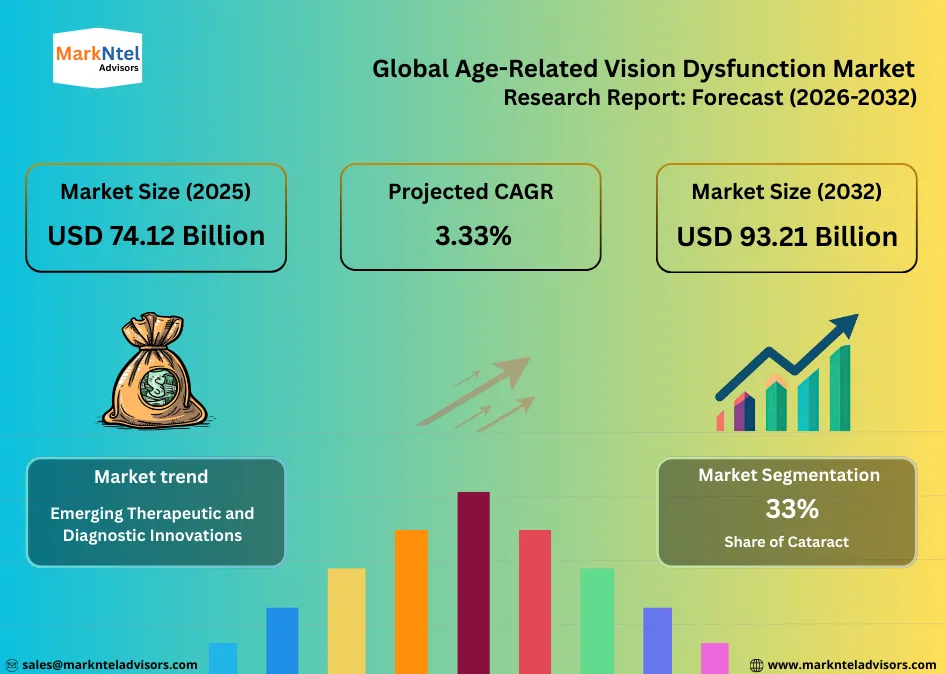
- Market size was valued at around USD 74.12 billion in 2025 and is projected to reach USD 93.21 billion by 2032. The estimated CAGR from 2026 to 2032 is around 3.33%, indicating strong growth.
- North America holds the largest market share of about 40% in the Global Age-Related Vision Dysfunction Market in 2025.
- By dysfunction, the cataract segment represented a significant share of about 33% in the Global Age-Related Vision Dysfunction Market in 2025.
- By treatment, the anti-angiogenic drugs segment presented a significant share of about 23% in the Global Age-Related Vision Dysfunction Market in 2025.
- Leading age-related vision dysfunction companies in the global market are Aerie Pharmaceuticals, Inc., Santen Pharmaceutical Co., Ltd, Sun Pharma Advanced Research Company Limited, AbbVie Inc., Eyenovia, Inc., Orasis Pharmaceuticals, Inc., IVERIC bio, Inc., Novartis AG, Regeneron Pharmaceuticals, Inc., Roche Holding AG, Alcon Inc., Kodiak Sciences Inc., Outlook Therapeutics, Inc., Apellis Pharmaceuticals, Inc., Allegro Ophthalmics LLC, and Others.
Market Insights & Analysis: Global Age-Related Vision Dysfunction Market (2026-32):
The Global Age-Related Vision Dysfunction Market size was valued at around USD 74.12 billion in 2025 and is projected to reach USD 93.21 billion by 2032. Along with this, the market is estimated to grow at a CAGR of around 3.33% during the forecast period, i.e., 2026-32.
The Global Age-Related Vision Dysfunction Market is projected to expand steadily, driven by the rising prevalence of diabetes-related vision disorders and continuous advancements in innovative diagnostic and therapeutic technologies.
According to the World Health Organization (WHO), at least 2.2 billion people worldwide were living with vision loss or impairment, and nearly 1 billion of these cases were either preventable or remain untreated. This unmet need underscores systemic gaps in early diagnosis, equitable access to corrective services, and sustained chronic care pathways across health systems globally. The high scale and breadth of these conditions have elevated vision dysfunction from a specialized clinical concern to a core public health and economic priority.
Age-related eye disorders, including cataract, glaucoma, age-related macular degeneration (AMD), diabetic retinopathy, and uncorrected refractive error, account for the majority of vision impairment burden. These conditions increase sharply with age, particularly in populations aged 50 years and above, directly linking demographic aging trends with long-term demand for diagnostics, therapeutics, and chronic disease management solutions.
Policy and public health surveillance systems in high-income countries are adapting to this epidemiological reality with more data-driven and integrated approaches. In the United States, the Centers for Disease Control and Prevention’s Vision and Eye Health Surveillance System (VEHSS) provides modeled prevalence estimates for key eye diseases, enabling health authorities to align vision care with broader public health planning. VEHSS data indicate that 4.2 million Americans were living with glaucoma in 2022, with approximately 1.5 million experiencing vision-affecting disease, reinforcing structured healthcare demand for chronic intervention and monitoring .
Future government and multilateral plans are expected to accelerate this market trajectory. For instance, the WHO’s Integrated People-Centered Eye Care Action Plan for South-East Asia outlines strategic targets through 2030, including 40 percentage point increases in effective refractive error coverage, 30 percentage point expansion in cataract surgery coverage, and ensuring that at least 80% of people with diabetes receive regular retinopathy screening and timely treatment. These ambitious goals are being embedded into national health policy frameworks, signaling sustained institutional demand for eye care solutions.
At the national level, the Federal Ministry of Health in Nigeria, in October 2025, reaffirmed plans to integrate Primary Eye Care into the national Primary Health Care (PHC) system, aiming to train PHC workers in basic eye care and enhance referral pathways for complex cases. This initiative is supported by data tools and implementation frameworks for universal eye care access, illustrating how policy interventions extend service delivery and broaden market uptake across care settings.
In conclusion, the convergence of rising prevalence, aging demographics, enhanced surveillance systems, and forward-looking government plans positions the age-related vision dysfunction market for sustained expansion over the coming decade. Continued integration of eye care into national and regional health systems is expected to drive long-term demand for diagnostics, therapeutics, and chronic management services worldwide.
Global Age-Related Vision Dysfunction Market Recent Developments:
- 2025: Genentech announced that the U.S. FDA approved Susvimo® (ranibizumab injection) for treating diabetic macular edema, offering a refillable eye implant that continuously delivers medication and reduces the need for frequent injections. The approval highlights progress toward long-acting retinal therapies, improving patient adherence and outcomes.
- 2025: Sight Sciences announced it will introduce the OMNI® Edge Surgical System at the 2025 ASCRS Annual Meeting, expanding its OMNI product portfolio for minimally invasive glaucoma surgery. The new system is designed to improve surgeon control and procedural efficiency while supporting comprehensive canaloplasty and trabeculotomy treatments.
Global Age-Related Vision Dysfunction Market Scope:
| Category | Segments |
|---|---|
| By Dysfunction | Cataract Age-related Macular Degeneration (AMD), Glaucoma, Presbyopia, Diabetic Retinopathy |
| By Treatment | Anti-angiogenic Drugs, {Eylea, Rocklatan, Eybelis Ophthalmic Solution, Xelpros, Rhopressa, Others |
| Assistive Technologies | Low Vision Aids, Retinal Prostheses), Diagnostic Imaging (Optical Coherence Tomography (OCT), Fundus Photography, Tonometry), Surgical (Lens Replacement, Trabeculectomy, Minimally Invasive Glaucoma Surgery |
| By End User | Ophthalmology Clinics, Hospitals & ASCs, Retail Optometry, Home/Tele-Ophthalmology), and others |
Global Age-Related Vision Dysfunction Market Driver:
Escalating Burden of Diabetes-Related Vision Impairment
The rising prevalence of diabetes-associated vision impairment is a key factor driving the growth of the Global Age-related Vision Dysfunction Market. Population-based evidence indicates that diabetic eye diseases now represent a major public health challenge, particularly in high-burden countries with rapidly expanding diabetic populations, such as India.
As longevity improves and diabetes duration increases, the cumulative risk of ocular complications continues to intensify, creating sustained demand for screening, monitoring, and long-term treatment solutions.
According to the SMART-India cross-sectional study published in 2024, which represents one of the largest nationally representative assessments of diabetic eye disease, the prevalence of diabetic retinopathy (DR) among adults aged 40 years and above was estimated at 12.5%. Importantly, the study identified that 4.0% of this population suffered from vision-threatening diabetic retinopathy (VTDR), a severe form of the disease associated with a high risk of irreversible blindness if left untreated . These findings highlight a substantial at-risk population requiring timely diagnosis and continuous ophthalmic care.
Beyond disease classification, the functional burden of vision loss among individuals with diabetes is significant. The same nationwide survey estimated that 21.1% of adults with diabetes experienced vision impairment, while 2.4% were classified as blind, translating to approximately 21 million visually impaired and 2.4 million blind diabetic adults in India as of 2024.
The scale and severity of diabetes-related vision impairment demonstrated by these findings are directly accelerating demand for advanced diagnostics, therapeutic interventions, and structured eye-care programs, positioning disease prevalence as a fundamental driver of long-term market expansion.
Global Age-Related Vision Dysfunction Market Trend:
Emerging Therapeutic and Diagnostic Innovations
The global age-related vision dysfunction industry is undergoing a structural shift driven by novel therapeutic approvals and pioneering technology breakthroughs in 2024–2025, expanding beyond traditional management toward more durable, accessible, and patient-centric solutions.
One of the most significant developments is the first-of-its-kind FDA approval of aceclidine ophthalmic solution (VIZZ) in July 2025 for the treatment of presbyopia in adults. This once-daily topical drop improves near vision through a pupil-selective miotic mechanism without significantly affecting distance vision, addressing a previously unmet need in age-related presbyopia management. Clinical evidence showed a rapid onset of near vision improvement lasting up to 10 hours in the majority of trial participants.
Alongside presbyopia treatments, the FDA also approved acoltremon (TRYPTYR), the first TRPM8 receptor agonist for dry eye disease, demonstrating meaningful improvements in tear production and symptomatic relief in pivotal phase 3 studies. These approvals reflect a trend toward mechanism-driven therapies targeting conditions previously managed with limited options.
In addition to drug innovations, regulatory agencies are recognizing next-generation biologics and cell-based therapies. The FDA’s approval of ENCELTO (revakinagene taroretcel-lwey) for macular telangiectasia type 2 marks the first approved encapsulated cell therapy for a previously untreatable retinal neurodegenerative disease, potentially paving the way for future gene and cell-based ophthalmic treatments .
These therapeutic breakthroughs, validated by regulatory bodies, represent a structural trend in vision care: moving from frequent procedural regimens toward targeted, sustained, and biologically advanced solutions that improve patient adherence and outcomes while shaping long-term market demand.
Global Age-Related Vision Dysfunction Market Opportunity:
AI-Enabled Screening and Decentralized Eye Care Delivery
A significant opportunity in the Global Age-Related Vision Dysfunction Market is emerging from the rapid deployment of artificial intelligence (AI)–enabled diagnostic and screening technologies, which are fundamentally reshaping early detection pathways for age-linked and diabetes-associated eye diseases. These technologies directly address longstanding access gaps by enabling accurate screening beyond specialist-centric hospital environments.
In April 2024, the U.S. Food and Drug Administration (FDA) authorized the AEYE Diagnostic Screening (AEYE-DS) system, marking the first fully autonomous AI-based device approved for diabetic retinopathy detection. The system is designed to operate with portable retinal cameras and does not require real-time ophthalmologist supervision, allowing screening to be conducted in primary care clinics, community health centers, and non-specialist settings. This regulatory milestone validates AI-driven diagnostics as a scalable component of routine preventive eye care.
Building on this momentum, researchers in July 2025 introduced a mobile AI-powered retina tracking platform capable of analyzing retinal images in under one second with accuracy exceeding 99%. The ability to deliver near-instant diagnostic outputs supports large-scale screening in resource-constrained and high-burden regions, signaling a shift from centralized imaging infrastructure toward distributed, point-of-care vision assessment.
Collectively, these advancements create a strong market opportunity by expanding screening coverage, enabling earlier intervention, and reducing dependence on limited specialist capacity, thereby supporting sustainable, volume-driven market expansion.
Global Age-Related Vision Dysfunction Market Challenge:
Workforce Shortages and Access Barriers
A critical challenge constraining the growth of the Global Age-related Vision Dysfunction Market is the persistent shortage of trained eye-care professionals, coupled with their uneven geographic distribution. This structural limitation directly affects timely diagnosis, treatment continuity, and long-term disease management, particularly for chronic, age-linked vision disorders that require repeated clinical monitoring.
Evidence from a 2025 assessment by the All India Institute of Medical Sciences (AIIMS), New Delhi, highlights the severity of this issue in India, one of the world’s fastest-ageing populations. The study estimates that the country has approximately 15 ophthalmologists per million people, a ratio that remains significantly below recommended benchmarks for adequate population-level eye care coverage . The shortfall is further amplified by the urban concentration of specialists, leaving large rural and semi-urban populations underserved.
Similar workforce constraints are evident in advanced healthcare systems. U.S. ophthalmology workforce projections indicate that, without corrective policy and training interventions, the number of full-time equivalent ophthalmologists could decline by around 12% by 2035, while demand for eye-care services is expected to increase by nearly 24%, creating a projected 30% supply-demand gap.
In conclusion, unless workforce capacity expands in parallel with rising disease prevalence, specialist shortages will continue to limit market penetration and effective service delivery.
Global Age-Related Vision Dysfunction Market (2026-32) Segmentation Analysis:
The Global Age-Related Vision Dysfunction Market study of MarkNtel Advisors evaluates & highlights the major trends and influencing factors in each segment. It includes predictions for the period 2026–32 at the global level. Based on the analysis, the market has been further classified as;
Based on Dysfunction:
- Cataract
- Age-related Macular Degeneration (AMD)
- Glaucoma
- Presbyopia
- Diabetic Retinopathy
The cataract segment dominates the global Age-Related Vision Dysfunction Market, holding around 33% market share, due to its widespread prevalence and strong correlation with population ageing.
The World Health Organization (WHO) identifies cataract as the leading cause of blindness worldwide, affecting approximately 94 million people with vision impairment. This makes it the single largest contributor among age-related eye conditions .
The dominance of cataract is further reinforced by the broader scale of global vision impairment. WHO estimates that at least 2.2 billion people live with near or distance vision impairment, of which over 1 billion cases could have been prevented or remain untreated, with cataract accounting for a significant share. The condition typically develops gradually as the eye’s natural lens becomes opaque with age, making it highly prevalent among individuals aged 50 years and above.
Demographic trends are accelerating demand for cataract diagnosis and treatment. The United Nations projects that the population aged 65 will reach 83.7 million by 2050, which will substantially increase the incidence of age-related eye disorders.
Overall, high disease burden, ageing demographics, and strong treatment demand firmly position cataract as the leading segment in the global age-related vision dysfunction market.
Based on Treatment:
- Anti-angiogenic Drugs
- Eylea
- Rocklatan
- Eybelis Ophthalmic Solution
- Xelpros
- Rhopressa
- Others
- Assistive Technologies
- Low Vision Aids
- Retinal Prostheses
- Diagnostic Imaging
- Optical Coherence Tomography (OCT)
- Fundus Photography
- Tonometry
- Surgical
- Lens Replacement
- Trabeculectomy
- Minimally Invasive Glaucoma Surgery
The anti-angiogenic drugs segment dominates the Global Age-Related Vision Dysfunction Market, accounting for about 23% of the total market size, due to its critical role in treating retinal disorders driven by abnormal blood vessel growth.
Diseases such as age-related macular degeneration (AMD) and diabetic retinopathy are among the most common causes of vision impairment worldwide, and both are strongly associated with vascular endothelial growth factor (VEGF). Anti-VEGF therapies have become the primary clinical standard for managing these conditions because they help slow disease progression and preserve vision.
Another major factor supporting this segment’s leadership is the broad regulatory approval and expanding clinical use of anti-VEGF therapies across multiple retinal conditions. Medicines such as aflibercept and other intravitreal therapies are widely prescribed by ophthalmologists and are now used beyond wet AMD, including diabetic macular edema and retinal vein occlusion.
The global rise in aging populations and diabetes prevalence further reinforces market dominance. Older adults face a higher risk of vision loss, while diabetic patients frequently develop retinal complications that require ongoing anti-VEGF treatment.
Proven clinical effectiveness, expanding treatment indications, and strong demographic demand make anti-angiogenic drugs the most influential treatment segment in the global age-related vision dysfunction market.
Global Age-Related Vision Dysfunction Market (2026-32): Regional Projection
North America dominates the Global Age-Related Vision Dysfunction Market with an estimated 40% share, due to the high disease burden supported by strong government-reported statistics and research infrastructure.
Age-related macular degeneration (AMD) represents one of the most significant drivers of treatment demand in the region. A major U.S. study supported by the CDC Vision Health Initiative estimated that 18.34 million Americans have early AMD and 1.49 million have late-stage AMD, the most vision-threatening form . This substantial patient base directly fuels demand for anti-angiogenic drugs, diagnostics, and surgical interventions across the healthcare system.
The broader vision-impairment burden further reinforces regional leadership. According to the CDC, over 3.4 million Americans aged 40+ are blind or visually impaired, and this number is expected to double by 2030 as the population ages .
In addition, federal research support strengthens treatment adoption and innovation. The National Eye Institute reports that AMD already causes visual impairment in approximately 1.7 million Americans aged 65+, demonstrating the significant aging-related treatment pool in the region. Continuous government-funded research programs and clinical advancements accelerate drug development, diagnostics, and surgical innovations.
Overall, the combination of high disease prevalence, aging demographics, and strong federal research funding firmly positions North America as the leading regional market for age-related vision dysfunction treatments.
Gain a Competitive Edge with Our Global Age-Related Vision Dysfunction Market Report:
- Global Age-Related Vision Dysfunction Market Report by MarkNtel Advisors provides a detailed & thorough analysis of market size & share, growth rate, competitive landscape, and key players. This comprehensive analysis helps businesses gain a holistic understanding of the market dynamics & make informed decisions.
- This report also highlights current market trends & future projections, allowing businesses to identify emerging opportunities & potential challenges. By understanding market forecasts, companies can align their strategies & stay ahead of the competition.
- Global Age-Related Vision Dysfunction Market Report aids in assessing & mitigating risks associated with entering or operating in the market. By understanding market dynamics, regulatory frameworks, and potential challenges, businesses can develop strategies to minimize risks & optimize their operations.
*Reports Delivery Format - Market research studies from MarkNtel Advisors are offered in PDF, Excel and PowerPoint formats. Within 24 hours of the payment being successfully received, the report will be sent to your email address.
Frequently Asked Questions
- Market Segmentation
- Introduction
- Product Definition
- Research Process
- Assumptions
- Executive Summary
- Global Age-related Vision Dysfunction Market Epidemiology Study, By Country
- The US
- By Patient Age
- By Gender
- By Type
- By Diagnosed Cases
- By Treated Patient Count
- Canada
- By Patient Age
- By Gender
- By Type
- By Diagnosed Cases
- By Treated Patient Count
- Germany
- By Patient Age
- By Gender
- By Type
- By Diagnosed Cases
- By Treated Patient Count
- The UK
- By Patient Age
- By Gender
- By Type
- By Diagnosed Cases
- By Treated Patient Count
- France
- By Patient Age
- By Gender
- By Type
- By Diagnosed Cases
- By Treated Patient Count
- Italy
- By Patient Age
- By Gender
- By Type
- By Diagnosed Cases
- By Treated Patient Count
- Spain
- By Patient Age
- By Gender
- By Type
- By Diagnosed Cases
- By Treated Patient Count
- China
- By Patient Age
- By Gender
- By Type
- By Diagnosed Cases
- By Treated Patient Count
- India
- By Patient Age
- By Gender
- By Type
- By Diagnosed Cases
- By Treated Patient Count
- Japan
- By Patient Age
- By Gender
- By Type
- By Diagnosed Cases
- By Treated Patient Count
- Global Age-Related Vision Dysfunction Market Policies, Regulations, and Product Standards
- Global Age-Related Vision Dysfunction Market Trends & Developments
- Global Age-Related Vision Dysfunction Market Dynamics
- Growth Factors
- Challenges
- Global Age-Related Vision Dysfunction Market Hotspot & Opportunities
- Global Age-Related Vision Dysfunction Market Outlook, 2022-2032F
- Market Size & Outlook
- By Revenues (USD Million)
- Market Share & Analysis
- By Dysfunction - Market Size & Forecast 2022-2032, USD Million
- Cataract
- Age-related Macular Degeneration (AMD)
- Glaucoma
- Presbyopia
- Diabetic Retinopathy
- By Treatment - Market Size & Forecast 2022-2032, USD Million
- Anti-angiogenic Drugs
- Eylea
- Rocklatan
- Eybelis Ophthalmic Solution
- Xelpros
- Rhopressa
- Others
- Assistive Technologies
- Low Vision Aids
- Retinal Prostheses
- Diagnostic Imaging
- Optical Coherence Tomography (OCT)
- Fundus Photography
- Tonometry
- Surgical
- Lens Replacement
- Trabeculectomy
- Minimally Invasive Glaucoma Surgery
- Anti-angiogenic Drugs
- By End User- Market Size & Forecast 2022-2032, USD Million
- Ophthalmology Clinics
- Hospitals & ASCs
- Retail Optometry
- Home/Tele-Ophthalmology
- By Region
- North America
- South America
- Europe
- The Middle East & Africa
- Asia-Pacific
- By Company
- Competition Characteristics
- Market Share & Analysis
- By Dysfunction - Market Size & Forecast 2022-2032, USD Million
- Market Size & Outlook
- North America Age-Related Vision Dysfunction Market Outlook, 2022-2032F
- Market Size & Outlook
- By Revenues (USD Million)
- Market Share & Analysis
- By Dysfunction - Market Size & Forecast 2022-2032, USD Million
- By Treatment - Market Size & Forecast 2022-2032, USD Million
- By End User- Market Size & Forecast 2022-2032, USD Million
- By Country
- The US
- Canada
- Mexico
- Rest of North America
- The US Age-Related Vision Dysfunction Market Outlook, 2022-2032F
- Market Size & Outlook
- By Revenues (USD Million)
- Market Share & Analysis
- By Dysfunction - Market Size & Forecast 2022-2032, USD Million
- By Treatment - Market Size & Forecast 2022-2032, USD Million
- By End User- Market Size & Forecast 2022-2032, USD Million
- Market Size & Outlook
- Canada Age-Related Vision Dysfunction Market Outlook, 2022-2032F
- Market Size & Outlook
- By Revenues (USD Million)
- Market Share & Analysis
- By Dysfunction - Market Size & Forecast 2022-2032, USD Million
- By Treatment - Market Size & Forecast 2022-2032, USD Million
- By End User- Market Size & Forecast 2022-2032, USD Million
- Market Size & Outlook
- Mexico Age-Related Vision Dysfunction Market Outlook, 2022-2032F
- Market Size & Outlook
- By Revenues (USD Million)
- Market Share & Analysis
- By Dysfunction - Market Size & Forecast 2022-2032, USD Million
- By Treatment - Market Size & Forecast 2022-2032, USD Million
- By End User- Market Size & Forecast 2022-2032, USD Million
- Market Size & Outlook
- Market Size & Outlook
- South America Age-Related Vision Dysfunction Market Outlook, 2022-2032F
- Market Size & Outlook
- By Revenues (USD Million)
- Market Share & Analysis
- By Dysfunction - Market Size & Forecast 2022-2032, USD Million
- By Treatment - Market Size & Forecast 2022-2032, USD Million
- By End User- Market Size & Forecast 2022-2032, USD Million
- By Country
- Brazil
- Argentina
- Rest of South America
- Brazil Age-Related Vision Dysfunction Market Outlook, 2022-2032F
- Market Size & Outlook
- By Revenues (USD Million)
- Market Share & Analysis
- By Dysfunction - Market Size & Forecast 2022-2032, USD Million
- By Treatment - Market Size & Forecast 2022-2032, USD Million
- By End User- Market Size & Forecast 2022-2032, USD Million
- Market Size & Outlook
- Argentina Age-Related Vision Dysfunction Market Outlook, 2022-2032F
- Market Size & Outlook
- By Revenues (USD Million)
- Market Share & Analysis
- By Dysfunction - Market Size & Forecast 2022-2032, USD Million
- By Treatment - Market Size & Forecast 2022-2032, USD Million
- By End User- Market Size & Forecast 2022-2032, USD Million
- Market Size & Outlook
- Market Size & Outlook
- Europe Age-Related Vision Dysfunction Market Outlook, 2022-2032F
- Market Size & Outlook
- By Revenues (USD Million)
- Market Share & Analysis
- By Dysfunction - Market Size & Forecast 2022-2032, USD Million
- By Treatment - Market Size & Forecast 2022-2032, USD Million
- By End User- Market Size & Forecast 2022-2032, USD Million
- By Country
- The UK
- Germany
- France
- Italy
- Spain
- Rest of Europe
- The UK Age-Related Vision Dysfunction Market Outlook, 2022-2032F
- Market Size & Outlook
- By Revenues (USD Million)
- Market Share & Analysis
- By Dysfunction - Market Size & Forecast 2022-2032, USD Million
- By Treatment - Market Size & Forecast 2022-2032, USD Million
- By End User- Market Size & Forecast 2022-2032, USD Million
- Market Size & Outlook
- Germany Age-Related Vision Dysfunction Market Outlook, 2022-2032F
- Market Size & Outlook
- By Revenues (USD Million)
- Market Share & Analysis
- By Dysfunction - Market Size & Forecast 2022-2032, USD Million
- By Treatment - Market Size & Forecast 2022-2032, USD Million
- By End User- Market Size & Forecast 2022-2032, USD Million
- Market Size & Outlook
- France Age-Related Vision Dysfunction Market Outlook, 2022-2032F
- Market Size & Outlook
- By Revenues (USD Million)
- Market Share & Analysis
- By Dysfunction - Market Size & Forecast 2022-2032, USD Million
- By Treatment - Market Size & Forecast 2022-2032, USD Million
- By End User- Market Size & Forecast 2022-2032, USD Million
- Market Size & Outlook
- Italy Age-Related Vision Dysfunction Market Outlook, 2022-2032F
- Market Size & Outlook
- By Revenues (USD Million)
- Market Share & Analysis
- By Dysfunction - Market Size & Forecast 2022-2032, USD Million
- By Treatment - Market Size & Forecast 2022-2032, USD Million
- By End User- Market Size & Forecast 2022-2032, USD Million
- Market Size & Outlook
- Spain Age-Related Vision Dysfunction Market Outlook, 2022-2032F
- Market Size & Outlook
- By Revenues (USD Million)
- Market Share & Analysis
- By Dysfunction - Market Size & Forecast 2022-2032, USD Million
- By Treatment - Market Size & Forecast 2022-2032, USD Million
- By End User- Market Size & Forecast 2022-2032, USD Million
- Market Size & Outlook
- Market Size & Outlook
- The Middle East & Africa Age-Related Vision Dysfunction Market Outlook, 2022-2032F
- Market Size & Outlook
- By Revenues (USD Million)
- Market Share & Analysis
- By Dysfunction - Market Size & Forecast 2022-2032, USD Million
- By Treatment - Market Size & Forecast 2022-2032, USD Million
- By End User- Market Size & Forecast 2022-2032, USD Million
- By Country
- Saudi Arabia
- The UAE
- South Africa
- Egypt
- Rest of Middle East & Africa
- Saudi Arabia Age-Related Vision Dysfunction Market Outlook, 2022-2032F
- Market Size & Outlook
- By Revenues (USD Million)
- Market Share & Analysis
- By Dysfunction - Market Size & Forecast 2022-2032, USD Million
- By Treatment - Market Size & Forecast 2022-2032, USD Million
- By End User- Market Size & Forecast 2022-2032, USD Million
- Market Size & Outlook
- The UAE Age-Related Vision Dysfunction Market Outlook, 2022-2032F
- Market Size & Outlook
- By Revenues (USD Million)
- Market Share & Analysis
- By Dysfunction - Market Size & Forecast 2022-2032, USD Million
- By Treatment - Market Size & Forecast 2022-2032, USD Million
- By End User- Market Size & Forecast 2022-2032, USD Million
- Market Size & Outlook
- South Africa Age-Related Vision Dysfunction Market Outlook, 2022-2032F
- Market Size & Outlook
- By Revenues (USD Million)
- Market Share & Analysis
- By Dysfunction - Market Size & Forecast 2022-2032, USD Million
- By Treatment - Market Size & Forecast 2022-2032, USD Million
- By End User- Market Size & Forecast 2022-2032, USD Million
- Market Size & Outlook
- Egypt Age-Related Vision Dysfunction Market Outlook, 2022-2032F
- Market Size & Outlook
- By Revenues (USD Million)
- Market Share & Analysis
- By Dysfunction - Market Size & Forecast 2022-2032, USD Million
- By Treatment - Market Size & Forecast 2022-2032, USD Million
- By End User- Market Size & Forecast 2022-2032, USD Million
- Market Size & Outlook
- Market Size & Outlook
- Asia-Pacific Age-Related Vision Dysfunction Market Outlook, 2022-2032F
- Market Size & Outlook
- By Revenues (USD Million)
- Market Share & Analysis
- By Dysfunction - Market Size & Forecast 2022-2032, USD Million
- By Treatment - Market Size & Forecast 2022-2032, USD Million
- By End User- Market Size & Forecast 2022-2032, USD Million
- By Country
- China
- Japan
- India
- South Korea
- Australia
- Rest of Asia-Pacific
- China Age-Related Vision Dysfunction Market Outlook, 2022-2032F
- Market Size & Outlook
- By Revenues (USD Million)
- Market Share & Analysis
- By Dysfunction - Market Size & Forecast 2022-2032, USD Million
- By Treatment - Market Size & Forecast 2022-2032, USD Million
- By End User- Market Size & Forecast 2022-2032, USD Million
- Market Size & Outlook
- Japan Age-Related Vision Dysfunction Market Outlook, 2022-2032F
- Market Size & Outlook
- By Revenues (USD Million)
- Market Share & Analysis
- By Dysfunction - Market Size & Forecast 2022-2032, USD Million
- By Treatment - Market Size & Forecast 2022-2032, USD Million
- By End User- Market Size & Forecast 2022-2032, USD Million
- Market Size & Outlook
- India Age-Related Vision Dysfunction Market Outlook, 2022-2032F
- Market Size & Outlook
- By Revenues (USD Million)
- Market Share & Analysis
- By Dysfunction - Market Size & Forecast 2022-2032, USD Million
- By Treatment - Market Size & Forecast 2022-2032, USD Million
- By End User- Market Size & Forecast 2022-2032, USD Million
- Market Size & Outlook
- South Korea Age-Related Vision Dysfunction Market Outlook, 2022-2032F
- Market Size & Outlook
- By Revenues (USD Million)
- Market Share & Analysis
- By Dysfunction - Market Size & Forecast 2022-2032, USD Million
- By Treatment - Market Size & Forecast 2022-2032, USD Million
- By End User- Market Size & Forecast 2022-2032, USD Million
- Market Size & Outlook
- Australia Age-Related Vision Dysfunction Market Outlook, 2022-2032F
- Market Size & Outlook
- By Revenues (USD Million)
- Market Share & Analysis
- By Dysfunction - Market Size & Forecast 2022-2032, USD Million
- By Treatment - Market Size & Forecast 2022-2032, USD Million
- By End User- Market Size & Forecast 2022-2032, USD Million
- Market Size & Outlook
- Market Size & Outlook
- Global Age-Related Vision Dysfunction Market Key Strategic Imperatives for Success & Growth
- Competitive Outlook
- Company Profiles
- Aerie Pharmaceuticals, Inc.
- Business Description
- Product Portfolio
- Collaborations & Alliances
- Recent Developments
- Financial Details
- Others
- Santen Pharmaceutical Co., Ltd.
- Business Description
- Product Portfolio
- Collaborations & Alliances
- Recent Developments
- Financial Details
- Others
- Sun Pharma Advanced Research Company Limited
- Business Description
- Product Portfolio
- Collaborations & Alliances
- Recent Developments
- Financial Details
- Others
- AbbVie Inc.
- Business Description
- Product Portfolio
- Collaborations & Alliances
- Recent Developments
- Financial Details
- Others
- Eyenovia, Inc.
- Business Description
- Product Portfolio
- Collaborations & Alliances
- Recent Developments
- Financial Details
- Others
- Orasis Pharmaceuticals, Inc.
- Business Description
- Product Portfolio
- Collaborations & Alliances
- Recent Developments
- Financial Details
- Others
- IVERIC bio, Inc.
- Business Description
- Product Portfolio
- Collaborations & Alliances
- Recent Developments
- Financial Details
- Others
- Novartis AG
- Business Description
- Product Portfolio
- Collaborations & Alliances
- Recent Developments
- Financial Details
- Others
- Regeneron Pharmaceuticals, Inc.
- Business Description
- Product Portfolio
- Collaborations & Alliances
- Recent Developments
- Financial Details
- Others
- Roche Holding AG
- Business Description
- Product Portfolio
- Collaborations & Alliances
- Recent Developments
- Financial Details
- Others
- Alcon Inc.
- Business Description
- Product Portfolio
- Collaborations & Alliances
- Recent Developments
- Financial Details
- Others
- Kodiak Sciences Inc.
- Business Description
- Product Portfolio
- Collaborations & Alliances
- Recent Developments
- Financial Details
- Others
- Outlook Therapeutics, Inc.
- Business Description
- Product Portfolio
- Collaborations & Alliances
- Recent Developments
- Financial Details
- Others
- Apellis Pharmaceuticals, Inc.
- Business Description
- Product Portfolio
- Collaborations & Alliances
- Recent Developments
- Financial Details
- Others
- Allegro Ophthalmics LLC
- Business Description
- Product Portfolio
- Collaborations & Alliances
- Recent Developments
- Financial Details
- Others
- Others
- Business Description
- Product Portfolio
- Collaborations & Alliances
- Recent Developments
- Financial Details
- Others
- Aerie Pharmaceuticals, Inc.
- Company Profiles
- Disclaimer
MarkNtel Advisors follows a robust and iterative research methodology designed to ensure maximum accuracy and minimize deviation in market estimates and forecasts. Our approach combines both bottom-up and top-down techniques to effectively segment and quantify various aspects of the market. A consistent feature across all our research reports is data triangulation, which examines the market from three distinct perspectives to validate findings. Key components of our research process include:
1. Scope & Research Design At the outset, MarkNtel Advisors define the research objectives and formulate pertinent questions. This phase involves determining the type of research—qualitative or quantitative—and designing a methodology that outlines data collection methods, target demographics, and analytical tools. They also establish timelines and budgets to ensure the research aligns with client goals.
2. Sample Selection and Data Collection In this stage, the firm identifies the target audience and determines the appropriate sample size to ensure representativeness. They employ various sampling methods, such as random or stratified sampling, based on the research objectives. Data collection is carried out using tools like surveys, interviews, and observations, ensuring the gathered data is reliable and relevant.
3. Data Analysis and Validation Once data is collected, MarkNtel Advisors undertake a rigorous analysis process. This includes cleaning the data to remove inconsistencies, employing statistical software for quantitative analysis, and thematic analysis for qualitative data. Validation steps are taken to ensure the accuracy and reliability of the findings, minimizing biases and errors.

4. Data Forecast and FinalizationThe final phase involves forecasting future market trends based on the analyzed data. MarkNtel Advisors utilize predictive modeling and time series analysis to anticipate market behaviors. The insights are then compiled into comprehensive reports, featuring visual aids like charts and graphs, and include strategic recommendations to inform client decision-making
We offer flexible licensing options to cater to varying organizational needs. Choose the pricing pack that best suits your requirements:
Buy Now Inquire Before Buying
 Request Customization
 Talk to our Consultant







