Global ADAS Simulation Market Research Report: Trends & Forecast (2026-2032)
By Simulation Type (Software-in-the-Loop (SiL), Hardware-in-the-Loop (HiL), Driver-in-the-Loop (DiL), Model-in-the-Loop (MiL)), By Offering (Software, Services), By Vehicle Type (P ... assenger Cars, Commercial Vehicles, Autonomous Vehicles), By level of Autonomy (Level 1, Level 2/2+, Level 3, Level 4 & 5), By Application (Autonomous Emergency Braking (AEB), Adaptive Cruise Control (ACC), Lane Departure Warning (LDW) & Lane Keeping Assist (LKA), Traffic Sign Recognition (TSR), Blind Spot Detection (BSD), Parking Assistance, Automated Parking Assist, Other Advanced Safety Functions), By End-User (Automotive OEMs, Tier-1 Suppliers, R&D Institutes/Startups, Others), and others Read more
- Automotive
- Mar 2026
- Pages 495
- Report Format: PDF, Excel, PPT
Global ADAS Simulation Market
Projected 15.92% CAGR from 2026 to 2032
Study Period
2026-2032
Market Size (2026)
USD 3.75 billion
Market Size (2032)
USD 9.1 billion
Largest Region
Asia-Pacific
Projected CAGR
15.92%
Leading Segments
By Vehicle Type: Passenger Cars
Global ADAS Simulation Market Report Key Takeaways:
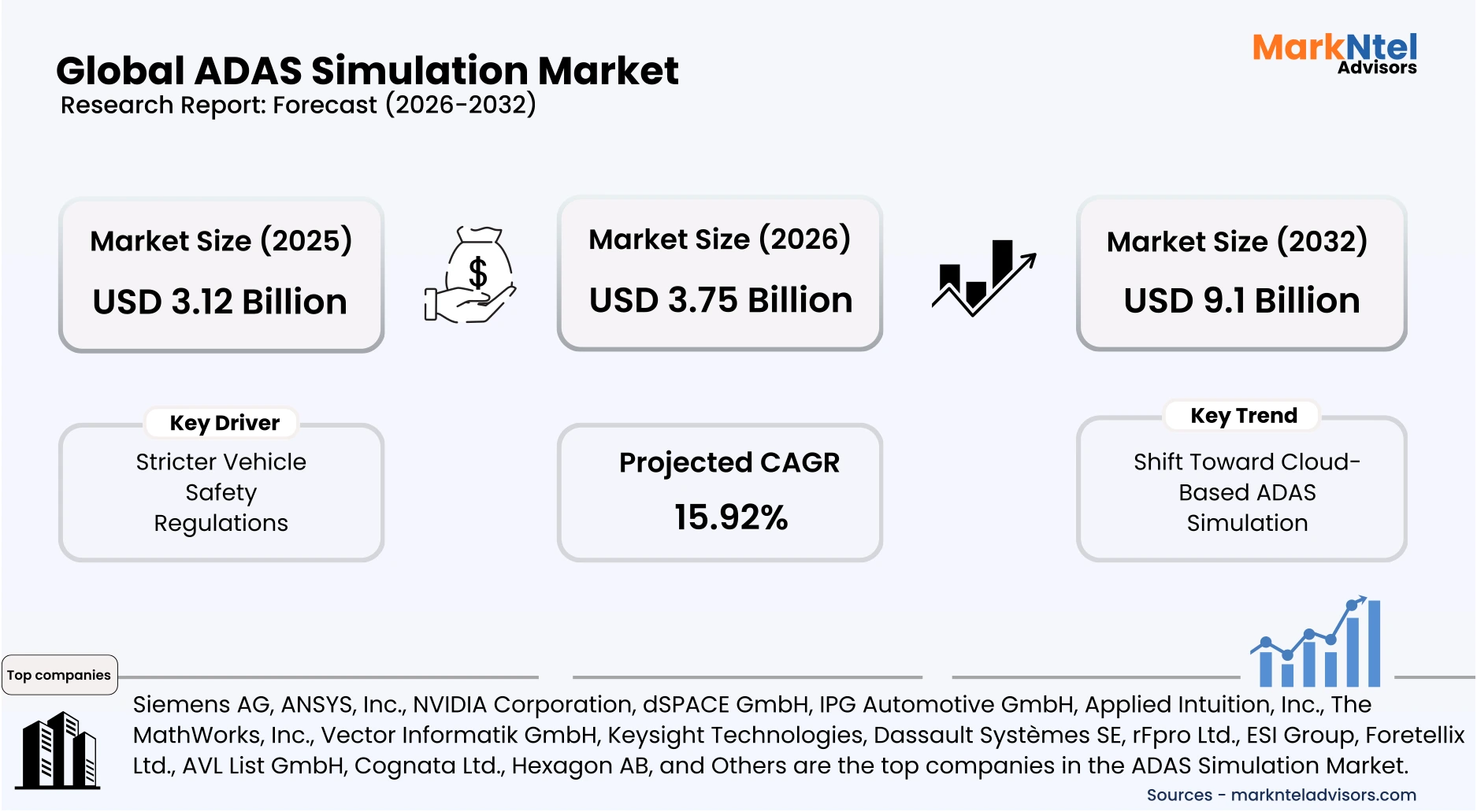
- Market size was valued at around USD 3.12 billion in 2025 and is projected to grow from USD 3.75 billion in 2026 to USD 9.1 billion by 2032, exhibiting a CAGR of 15.92% during the forecast period.
- Asia-Pacific holds the largest market share of about 42% in the Global ADAS Simulation Market in 2026.
- By vehicle type, the passenger cars segment represented a significant share of about 63% in the Global ADAS Simulation Market in 2026.
- By offering, the software segment presented a significant share of about 70% in the Global ADAS Simulation Market in 2026.
- By simulation type, the Software-in-the-Loop (SiL) segment presented a significant share of about 39% in the Global ADAS Simulation Market in 2026.
- Leading ADAS simulation companies in the Global Market are Siemens AG, ANSYS, Inc., NVIDIA Corporation, dSPACE GmbH, IPG Automotive GmbH, Applied Intuition, Inc., The MathWorks, Inc., Vector Informatik GmbH, Keysight Technologies, Dassault Systèmes SE, rFpro Ltd., ESI Group, Foretellix Ltd., AVL List GmbH, Cognata Ltd., Hexagon AB, and Others.
Market Insights & Analysis: Global ADAS Simulation Market (2026-32):
The Global ADAS Simulation Market size was valued at around USD 3.12 billion in 2025 and is projected to grow from USD 3.75 billion in 2026 to USD 9.1 billion by 2032. Along with this, the market is estimated to grow at a CAGR of around 15.92% during the forecast period, i.e., 2026-32.
The ADAS simulation market is entering a decisive growth phase, largely driven by increasingly stringent vehicle safety regulations across major automotive markets. Governments and safety authorities worldwide are mandating the adoption of advanced driver assistance systems (ADAS) while simultaneously tightening validation and compliance requirements. This dual pressure has elevated simulation from a development support tool to a regulatory necessity, enabling large-scale, repeatable, and scenario-based safety testing that would be impractical through physical trials alone.
India represents a significant regulatory inflection point. Beginning in October 2027, all newly manufactured truck and bus models will be required to integrate advanced driver alert systems, including automatic emergency braking, driver drowsiness detection, and lane departure warnings. Existing commercial vehicles must comply by January 2028, reflecting a phased but comprehensive safety mandate. This regulation sharply increases the need for virtual validation environments capable of simulating diverse traffic, road, and behavioral scenarios before real-world deployment.
Similarly, regulatory momentum is building in the United States. The National Highway Traffic Safety Administration (NHTSA) is undertaking a multi-year initiative to modernize vehicle safety standards for automated and semi-automated systems. The agency is reviewing 81 Federal Motor Vehicle Safety Standards (FMVSS) to assess their applicability to automated driving technologies. This signals future regulatory tightening and expanded validation requirements, reinforcing the importance of simulation-based verification.
From a technological perspective, the market is witnessing a clear shift toward earlier-stage virtual testing. Software-in-the-Loop (SiL) has emerged as a foundational simulation approach, accounting for approximately 39% of the global ADAS simulation market. SiL’s dominance reflects OEM and supplier preference for validating control algorithms and decision logic early in the development lifecycle, reducing downstream integration risks and overall testing costs.
Parallel to this, cloud-based ADAS simulation platforms are gaining traction by enabling large-scale parallel testing, faster validation cycles, and global collaboration. These platforms leverage hyperscale computing resources to process complex safety scenarios efficiently. In 2025, Hexagon introduced its cloud-native ADAS testing solution, Virtual Test Drive X, designed to execute thousands of automated simulation scenarios simultaneously, accelerating validation of safety-critical software.
The market is further strengthened by the entry of agile simulation software startups. These firms are introducing AI-driven, cloud-native, and cost-efficient validation tools that complement traditional platforms. For instance, LeddarTech’s LeddarSim™ delivers high-fidelity, multi-sensor simulation environments, with reported validation cost reductions of up to 10×, broadening access to advanced simulation capabilities across vehicle segments.
Overall, as regulatory mandates expand and validation complexity intensifies, ADAS simulation will remain central to compliance, safety assurance, and innovation. The convergence of regulation, SiL-driven early validation, cloud computing, and startup-led innovation positions the market for sustained, structurally driven growth.
Global ADAS Simulation Market Recent Developments:
- 2025: Hexagon introduced a new cloud-native quality test automation solution, Virtual Test Drive X (VTDx). It automates thousands of real-world scenario tests, accelerating ADAS software validation and reducing time-to-market for safe mobility systems.
- 2025: dSPACE teamed up with OmniVision to integrate high-fidelity CMOS image sensor models into its Aurelion simulation platform. This enhances realistic sensor testing for ADAS perception under varied real-world conditions.
Global ADAS Simulation Market Scope:
| Category | Segments |
|---|---|
| By Simulation Type | (Software-in-the-Loop (SiL), Hardware-in-the-Loop (HiL), Driver-in-the-Loop (DiL), Model-in-the-Loop (MiL)), |
| By Offering | (Software, Services), |
| By Vehicle Type | (Passenger Cars, Commercial Vehicles, Autonomous Vehicles), |
| By level of Autonomy | (Level 1, Level 2/2+, Level 3, Level 4 & 5), |
| By Application | (Autonomous Emergency Braking (AEB), Adaptive Cruise Control (ACC), Lane Departure Warning (LDW) & Lane Keeping Assist (LKA), Traffic Sign Recognition (TSR), Blind Spot Detection (BSD), Parking Assistance, Automated Parking Assist, Other Advanced Safety Functions), |
| By End-User | (Automotive OEMs, Tier-1 Suppliers, R&D Institutes/Startups, Others), |
Global ADAS Simulation Market Driver:
Stricter Vehicle Safety Regulations
Stricter vehicle safety regulations are rapidly transforming how advanced driver assistance systems (ADAS) are developed, validated, and deployed, serving as a central driver for the ADAS simulation market. Governments and intergovernmental bodies now mandate rigorous safety requirements for key automated features, effectively making simulation essential for compliance rather than an optional engineering tool. For example, the United Nations Economic Commission for Europe (UNECE) introduced UN Regulation No. 171 on Driver Control Assistance Systems (DCAS), which entered into force in 2025 and defines comprehensive safety and performance requirements for vehicles equipped with ADAS, including detailed validation and performance reporting obligations .
Similarly, the European Union’s General Safety Regulation (GSR2), active since July 2024, has progressively mandated features such as intelligent speed assistance (ISA), autonomous emergency braking (AEB), and lane-keeping systems on all new vehicles. By July 2026, additional systems, such as advanced pedestrian and cyclist AEB, will be required, further expanding the compliance burden. These layered regulations compel OEMs to use high-fidelity simulation to model sensor behaviors, edge traffic scenarios, and complex environment interactions that physical tests alone cannot reliably replicate.
Regulatory evolution continues beyond 2025. In India, the Ministry of Road Transport and Highways (MoRTH) published draft rules in March 2025 mandating ADAS features on commercial buses and trucks beginning April 2026, significantly broadening the vehicle segments subject to safety performance criteria and simulation testing.
Given the expanding regulatory landscape, future safety mandates such as more stringent automated lane change approval criteria and performance metrics for higher levels of autonomy will further increase the volume and complexity of required virtual testing environments. Collectively, these regulatory frameworks ensure that simulation tools remain indispensable for compliance, directly driving market demand as manufacturers invest heavily in robust, repeatable virtual validation capabilities.
Global ADAS Simulation Market Trend:
Shift Toward Cloud-Based ADAS Simulation
The global ADAS simulation market is increasingly shifting toward cloud-based simulation platforms as automotive engineering teams confront the scale and complexity of validating advanced driver assistance systems. Cloud architectures enable distributed processing, allowing multiple high-fidelity test scenarios to run in parallel and significantly shorten development cycles compared with traditional on-premises hardware. For example, industry practitioners have demonstrated that a test suite taking 480 minutes on a local workstation can be completed in just 3 minutes in a cloud environment, illustrating dramatic efficiency gains from scalable cloud compute resources.
Cloud platforms also support collaborative workflows across geographically dispersed teams, essential for global automotive OEMs and suppliers coordinating across regions. Standards efforts such as the ASAM OpenDRIVE and OpenSCENARIO frameworks are being integrated into cloud-native simulation solutions to streamline scenario sharing and interoperability across tools, fostering ecosystem alignment around shared virtual test assets.
Another factor driving this trend is the volume of data involved in modern ADAS development; terabytes of sensor and scenario information must be processed and stored securely. Cloud services allow on-demand scaling of storage and compute, reducing the need for costly dedicated HPC infrastructure.
Overall, the migration to cloud-based ADAS simulation reflects a broader digital transformation in automotive R&D, where elastic infrastructure, remote collaboration, and rapid iteration reduce time-to-market and improve validation coverage for safety-critical systems.
Global ADAS Simulation Market Opportunity:
Entry of New Simulation Software Startups
The entry and growth of new simulation software startups present a compelling opportunity in the ADAS simulation market. Startups are creating specialized, modular, and AI-driven tools that fill niches not fully served by legacy platforms, reducing barriers to entry for automotive OEMs and suppliers focused on cost-efficient validation. In 2025, innovation clusters identified over 79 startups worldwide focused on driving simulation platforms and related tooling, indicating significant diversification and specialization in the ecosystem.
One example is Applied Intuition, a software innovator whose simulation products support AI-powered validation across ADAS and autonomous systems. In June 2025, the company achieved a USD 15 billion valuation following a significant funding round, enabling expanded R&D and broader tooling capabilities for simulation workloads shared across multiple industries .
Despite being newly established relative to legacy engineering software firms, startups often incorporate cutting-edge technologies like neural simulation engines, reinforcement learning for scenario generation, and cloud-native architectures, which appeal to OEMs seeking scalable validation workflows that can adapt to increasingly complex regulatory demands.
Additionally, many governments are fostering innovation ecosystems that indirectly support these startups. For instance, test cities and digital validation centers (e.g., ARAI’s ADAS test facility in Pune, India) provide structured environments where startups can validate simulation outputs against real-world data collected from millions of kilometres of recorded driving conditions .
As regulatory requirements grow and as autonomous and semi-autonomous vehicles diffuse across new segments, the ability of new entrants to offer agile, configurable, and cost-effective simulation technologies positions them to capture share and drive competitive innovation in the global ADAS simulation market.
Global ADAS Simulation Market Challenge:
High Initial Implementation Costs
One of the most significant barriers to greater adoption of ADAS simulation is the high upfront cost of computing infrastructure and software assets required for rigorous virtual vehicle testing. Advanced simulation workloads depend on supercomputers and high-performance computing (HPC) clusters, which are often developed and supported through national initiatives such as the U.S. Department of Energy’s Exascale Computing Project (ECP). The ECP has received federal support and coordination across multiple national laboratories to sustain an exascale-capable ecosystem that accelerates simulation innovation for complex engineering domains.
These HPC systems drive down long-term development costs but require substantial initial capital outlay, including hardware, software, and integration overhead. Government programs like the DOE’s ongoing investment in exascale computing capabilities underline the scale of resources needed to support world-class simulation workloads, which are beyond the financial reach of many smaller automotive suppliers without shared or cloud-based alternatives .
Further, digital transformation in automotive manufacturing and simulation tooling is part of broader national mobility initiatives. For example, the European Digital Vehicle Ecosystem policy promotes collaborative software frameworks and open standards to reduce fragmentation and cost pressures on OEMs and suppliers.
As a result, although simulation reduces long-term physical testing expenses, elevated initial capital expenditure for HPC, software, and skilled personnel continues to restrain broader market entry and innovation, especially among smaller firms and new entrants.
Global ADAS Simulation Market (2026-32) Segmentation Analysis:
The Global ADAS Simulation Market study of MarkNtel Advisors evaluates & highlights the major trends and influencing factors in each segment. It includes predictions for the period 2026–32 at the global level. Based on the analysis, the market has been further classified as;
Based on Vehicle Type:
-
- Passenger Cars
- Commercial Vehicles
- Autonomous Vehicles
Passenger cars account for approximately 63% of the ADAS simulation market, making them the leading vehicle type segment. This dominance is primarily driven by the rapid penetration of ADAS features in mass-market passenger vehicles rather than limited premium adoption. Automakers are increasingly offering safety systems such as automatic emergency braking, lane keeping assist, adaptive cruise control, and parking assistance as standard or mid-range options to meet regulatory requirements and consumer safety expectations.
Passenger cars also face the widest variety of real-world driving conditions, including urban congestion, mixed traffic behavior, pedestrians, cyclists, and complex intersections. Validating ADAS performance across these diverse scenarios requires extensive virtual testing, which significantly boosts demand for simulation tools. Additionally, higher production volumes of passenger cars compared to commercial or autonomous-only vehicles amplify the need for scalable and repeatable validation workflows.
From a development standpoint, passenger car programs typically operate under tighter cost and time constraints. Simulation enables early-stage fault detection and reduces reliance on expensive physical prototypes, making it an essential tool for OEMs aiming to balance safety compliance, cost efficiency, and faster time-to-market. As a result, passenger cars remain the primary driver of ADAS simulation adoption.
Based on Offering:
- Software
- Services
The software segment leads the ADAS simulation market with an estimated 70% share, reflecting the industry’s shift toward digital-first validation approaches. Simulation software forms the backbone of ADAS development, enabling virtual scenario generation, sensor modeling, traffic behavior replication, and algorithm validation across millions of test cases. Unlike services, software platforms are reusable, scalable, and continuously updated, making them a long-term strategic investment for OEMs and suppliers.
ADAS development increasingly relies on iterative testing across Software-in-the-Loop (SiL), Model-in-the-Loop (MiL), and Hardware-in-the-Loop (HiL) environments, all of which are software-centric. This has expanded demand for integrated simulation suites capable of supporting the entire development lifecycle. Furthermore, the rise of cloud-based deployment has strengthened software adoption by allowing parallel testing, remote collaboration, and elastic compute usage without heavy physical infrastructure dependence.
Another key factor is intellectual property control. OEMs and Tier-1 suppliers prefer owning simulation software licenses to protect proprietary algorithms and datasets. As ADAS complexity grows and validation requirements expand, software platforms continue to capture a larger share of spending compared to project-based services.
Global ADAS Simulation Market (2026-32): Regional Projection
The Asia-Pacific region dominates the Global ADAS Simulation Market, holding approximately 42% share, driven by strong automotive production, regulatory push for safety, and rapid technology adoption. Countries such as China, Japan, South Korea, and India are increasingly integrating ADAS into mass-market vehicles due to tightening safety standards and rising consumer demand for advanced safety functionalities like lane departure warning and adaptive cruise control. Recent draft safety rules in China require Level 2 driving assistance systems to detect driver disengagement and enable safe system deactivation, with formal adoption aimed by 2027, reinforcing simulation-based validation needs across development cycles.
Automakers are responding with infrastructure investments; for example, Geely launched a USD 284 million safety testing facility in Ningbo focused on advanced safety and ADAS technologies, underlining the industry’s prioritization of validation and simulation at scale .
Asia Pacific’s leadership also stems from large domestic manufacturing bases that require robust simulation to validate diverse driving scenarios across high production volumes. In June 2025, China showcased intelligent driving technologies at a UNESCAP Road Safety Week event, reflecting strong regional collaboration and technology deployment.
Given this regulatory and manufacturing momentum, Asia Pacific’s dominant share reflects both policy-driven adoption and significant industry investment in simulation capabilities.
Gain a Competitive Edge with Our Global ADAS Simulation Market Report:
- Global ADAS Simulation Market Report by MarkNtel Advisors provides a detailed & thorough analysis of market size & share, growth rate, competitive landscape, and key players. This comprehensive analysis helps businesses gain a holistic understanding of the market dynamics & make informed decisions.
- This report also highlights current market trends & future projections, allowing businesses to identify emerging opportunities & potential challenges. By understanding market forecasts, companies can align their strategies & stay ahead of the competition.
- Global ADAS Simulation Market Report aids in assessing & mitigating risks associated with entering or operating in the market. By understanding market dynamics, regulatory frameworks, and potential challenges, businesses can develop strategies to minimize risks & optimize their operations.
*Reports Delivery Format - Market research studies from MarkNtel Advisors are offered in PDF, Excel and PowerPoint formats. Within 24 hours of the payment being successfully received, the report will be sent to your email address.
Frequently Asked Questions
- Market Segmentation
- Introduction
- Product Definition
- Research Process
- Assumptions
- Executive Summary
- Global ADAS Simulation Market Policies, Regulations, and Product Standards
- Global ADAS Simulation Market Trends & Developments
- Global ADAS Simulation Market Dynamics
- Growth Factors
- Challenges
- Global ADAS Simulation Market Hotspot & Opportunities
- Global ADAS Simulation Market Outlook, 2022-2032F
- Market Size & Outlook
- By Revenues (USD Million)
- Market Share & Analysis
- By Simulation Type- Market Size & Forecast 2022-2032, USD Million
- Software-in-the-Loop (SiL)
- Hardware-in-the-Loop (HiL)
- Driver-in-the-Loop (DiL)
- Model-in-the-Loop (MiL)
- By Offering- Market Size & Forecast 2022-2032, USD Million
- Software
- Services
- By Vehicle Type- Market Size & Forecast 2022-2032, USD Million
- Passenger Cars
- Commercial Vehicles
- Autonomous Vehicles
- By level of Autonomy- Market Size & Forecast 2022-2032, USD Million
- Level 1
- Level 2/2+
- Level 3
- Level 4 & 5
- By Application- Market Size & Forecast 2022-2032, USD Million
- Autonomous Emergency Braking (AEB)
- Adaptive Cruise Control (ACC)
- Lane Departure Warning (LDW) & Lane Keeping Assist (LKA)
- Traffic Sign Recognition (TSR)
- Blind Spot Detection (BSD)
- Parking Assistance
- Automated Parking Assist
- Other Advanced Safety Functions
- By End-User- Market Size & Forecast 2022-2032, USD Million
- Automotive OEMs
- Tier-1 Suppliers
- R&D Institutes/Startups
- Others
- By Region
- North America
- South America
- Europe
- The Middle East & Africa
- Asia-Pacific
- By Company
- Competition Characteristics
- Market Share & Analysis
- By Simulation Type- Market Size & Forecast 2022-2032, USD Million
- Market Size & Outlook
- North America ADAS Simulation Market Outlook, 2022-2032F
- Market Size & Outlook
- By Revenues (USD Million)
- Market Share & Analysis
- By Simulation Type- Market Size & Forecast 2022-2032, USD Million
- By Offering- Market Size & Forecast 2022-2032, USD Million
- By Vehicle Type- Market Size & Forecast 2022-2032, USD Million
- By level of Autonomy- Market Size & Forecast 2022-2032, USD Million
- By Application- Market Size & Forecast 2022-2032, USD Million
- By End-User- Market Size & Forecast 2022-2032, USD Million
- By Country
- The US
- Canada
- Mexico
- Rest of North America
- The US ADAS Simulation Market Outlook, 2022-2032F
- Market Size & Outlook
- By Revenues (USD Million)
- Market Share & Analysis
- By Simulation Type- Market Size & Forecast 2022-2032, USD Million
- By Offering- Market Size & Forecast 2022-2032, USD Million
- By Vehicle Type- Market Size & Forecast 2022-2032, USD Million
- By level of Autonomy- Market Size & Forecast 2022-2032, USD Million
- By Application- Market Size & Forecast 2022-2032, USD Million
- By End-User- Market Size & Forecast 2022-2032, USD Million
- Market Size & Outlook
- Canada ADAS Simulation Market Outlook, 2022-2032F
- Market Size & Outlook
- By Revenues (USD Million)
- Market Share & Analysis
- By Simulation Type- Market Size & Forecast 2022-2032, USD Million
- By Offering- Market Size & Forecast 2022-2032, USD Million
- By Vehicle Type- Market Size & Forecast 2022-2032, USD Million
- By level of Autonomy- Market Size & Forecast 2022-2032, USD Million
- By Application- Market Size & Forecast 2022-2032, USD Million
- By End-User- Market Size & Forecast 2022-2032, USD Million
- Market Size & Outlook
- Mexico ADAS Simulation Market Outlook, 2022-2032F
- Market Size & Outlook
- By Revenues (USD Million)
- Market Share & Analysis
- By Simulation Type- Market Size & Forecast 2022-2032, USD Million
- By Offering- Market Size & Forecast 2022-2032, USD Million
- By Vehicle Type- Market Size & Forecast 2022-2032, USD Million
- By level of Autonomy- Market Size & Forecast 2022-2032, USD Million
- By Application- Market Size & Forecast 2022-2032, USD Million
- By End-User- Market Size & Forecast 2022-2032, USD Million
- Market Size & Outlook
- Market Size & Outlook
- South America ADAS Simulation Market Outlook, 2022-2032F
- Market Size & Outlook
- By Revenues (USD Million)
- Market Share & Analysis
- By Simulation Type- Market Size & Forecast 2022-2032, USD Million
- By Offering- Market Size & Forecast 2022-2032, USD Million
- By Vehicle Type- Market Size & Forecast 2022-2032, USD Million
- By level of Autonomy- Market Size & Forecast 2022-2032, USD Million
- By Application- Market Size & Forecast 2022-2032, USD Million
- By End-User- Market Size & Forecast 2022-2032, USD Million
- By Country
- Brazil
- Argentina
- Rest of South America
- Brazil ADAS Simulation Market Outlook, 2022-2032F
- Market Size & Outlook
- By Revenues (USD Million)
- Market Share & Analysis
- By Simulation Type- Market Size & Forecast 2022-2032, USD Million
- By Offering- Market Size & Forecast 2022-2032, USD Million
- By Vehicle Type- Market Size & Forecast 2022-2032, USD Million
- By level of Autonomy- Market Size & Forecast 2022-2032, USD Million
- By Application- Market Size & Forecast 2022-2032, USD Million
- By End-User- Market Size & Forecast 2022-2032, USD Million
- Market Size & Outlook
- Argentina ADAS Simulation Market Outlook, 2022-2032F
- Market Size & Outlook
- By Revenues (USD Million)
- Market Share & Analysis
- By Simulation Type- Market Size & Forecast 2022-2032, USD Million
- By Offering- Market Size & Forecast 2022-2032, USD Million
- By Vehicle Type- Market Size & Forecast 2022-2032, USD Million
- By level of Autonomy- Market Size & Forecast 2022-2032, USD Million
- By Application- Market Size & Forecast 2022-2032, USD Million
- By End-User- Market Size & Forecast 2022-2032, USD Million
- Market Size & Outlook
- Market Size & Outlook
- Europe ADAS Simulation Market Outlook, 2022-2032F
- Market Size & Outlook
- By Revenues (USD Million)
- Market Share & Analysis
- By Simulation Type- Market Size & Forecast 2022-2032, USD Million
- By Offering- Market Size & Forecast 2022-2032, USD Million
- By Vehicle Type- Market Size & Forecast 2022-2032, USD Million
- By level of Autonomy- Market Size & Forecast 2022-2032, USD Million
- By Application- Market Size & Forecast 2022-2032, USD Million
- By End-User- Market Size & Forecast 2022-2032, USD Million
- By Country
- The UK
- Italy
- Germany
- France
- Spain
- BENELUX
- Rest of Europe
- The UK ADAS Simulation Market Outlook, 2022-2032F
- Market Size & Outlook
- By Revenues (USD Million)
- Market Share & Analysis
- By Simulation Type- Market Size & Forecast 2022-2032, USD Million
- By Offering- Market Size & Forecast 2022-2032, USD Million
- By Vehicle Type- Market Size & Forecast 2022-2032, USD Million
- By level of Autonomy- Market Size & Forecast 2022-2032, USD Million
- By Application- Market Size & Forecast 2022-2032, USD Million
- By End-User- Market Size & Forecast 2022-2032, USD Million
- Market Size & Outlook
- Italy ADAS Simulation Market Outlook, 2022-2032F
- Market Size & Outlook
- By Revenues (USD Million)
- Market Share & Analysis
- By Simulation Type- Market Size & Forecast 2022-2032, USD Million
- By Offering- Market Size & Forecast 2022-2032, USD Million
- By Vehicle Type- Market Size & Forecast 2022-2032, USD Million
- By level of Autonomy- Market Size & Forecast 2022-2032, USD Million
- By Application- Market Size & Forecast 2022-2032, USD Million
- By End-User- Market Size & Forecast 2022-2032, USD Million
- Market Size & Outlook
- Germany ADAS Simulation Market Outlook, 2022-2032F
- Market Size & Outlook
- By Revenues (USD Million)
- Market Share & Analysis
- By Simulation Type- Market Size & Forecast 2022-2032, USD Million
- By Offering- Market Size & Forecast 2022-2032, USD Million
- By Vehicle Type- Market Size & Forecast 2022-2032, USD Million
- By level of Autonomy- Market Size & Forecast 2022-2032, USD Million
- By Application- Market Size & Forecast 2022-2032, USD Million
- By End-User- Market Size & Forecast 2022-2032, USD Million
- Market Size & Outlook
- France ADAS Simulation Market Outlook, 2022-2032F
- Market Size & Outlook
- By Revenues (USD Million)
- Market Share & Analysis
- By Simulation Type- Market Size & Forecast 2022-2032, USD Million
- By Offering- Market Size & Forecast 2022-2032, USD Million
- By Vehicle Type- Market Size & Forecast 2022-2032, USD Million
- By level of Autonomy- Market Size & Forecast 2022-2032, USD Million
- By Application- Market Size & Forecast 2022-2032, USD Million
- By End-User- Market Size & Forecast 2022-2032, USD Million
- Market Size & Outlook
- Spain ADAS Simulation Market Outlook, 2022-2032F
- Market Size & Outlook
- By Revenues (USD Million)
- Market Share & Analysis
- By Simulation Type- Market Size & Forecast 2022-2032, USD Million
- By Offering- Market Size & Forecast 2022-2032, USD Million
- By Vehicle Type- Market Size & Forecast 2022-2032, USD Million
- By level of Autonomy- Market Size & Forecast 2022-2032, USD Million
- By Application- Market Size & Forecast 2022-2032, USD Million
- By End-User- Market Size & Forecast 2022-2032, USD Million
- Market Size & Outlook
- BENELUX ADAS Simulation Market Outlook, 2022-2032F
- Market Size & Outlook
- By Revenues (USD Million)
- Market Share & Analysis
- By Simulation Type- Market Size & Forecast 2022-2032, USD Million
- By Offering- Market Size & Forecast 2022-2032, USD Million
- By Vehicle Type- Market Size & Forecast 2022-2032, USD Million
- By level of Autonomy- Market Size & Forecast 2022-2032, USD Million
- By Application- Market Size & Forecast 2022-2032, USD Million
- By End-User- Market Size & Forecast 2022-2032, USD Million
- Market Size & Outlook
- Market Size & Outlook
- The Middle East & Africa ADAS Simulation Market Outlook, 2022-2032F
- Market Size & Outlook
- By Revenues (USD Million)
- Market Share & Analysis
- By Simulation Type- Market Size & Forecast 2022-2032, USD Million
- By Offering- Market Size & Forecast 2022-2032, USD Million
- By Vehicle Type- Market Size & Forecast 2022-2032, USD Million
- By level of Autonomy- Market Size & Forecast 2022-2032, USD Million
- By Application- Market Size & Forecast 2022-2032, USD Million
- By End-User- Market Size & Forecast 2022-2032, USD Million
- By Country
- Saudi Arabia
- UAE
- South Africa
- Bahrain
- Rest of Middle East & Africa
- Saudi Arabia ADAS Simulation Market Outlook, 2022-2032F
- Market Size & Outlook
- By Revenues (USD Million)
- Market Share & Analysis
- By Simulation Type- Market Size & Forecast 2022-2032, USD Million
- By Offering- Market Size & Forecast 2022-2032, USD Million
- By Vehicle Type- Market Size & Forecast 2022-2032, USD Million
- By level of Autonomy- Market Size & Forecast 2022-2032, USD Million
- By Application- Market Size & Forecast 2022-2032, USD Million
- By End-User- Market Size & Forecast 2022-2032, USD Million
- Market Size & Outlook
- UAE ADAS Simulation Market Outlook, 2022-2032F
- Market Size & Outlook
- By Revenues (USD Million)
- Market Share & Analysis
- By Simulation Type- Market Size & Forecast 2022-2032, USD Million
- By Offering- Market Size & Forecast 2022-2032, USD Million
- By Vehicle Type- Market Size & Forecast 2022-2032, USD Million
- By level of Autonomy- Market Size & Forecast 2022-2032, USD Million
- By Application- Market Size & Forecast 2022-2032, USD Million
- By End-User- Market Size & Forecast 2022-2032, USD Million
- Market Size & Outlook
- South Africa ADAS Simulation Market Outlook, 2022-2032F
- Market Size & Outlook
- By Revenues (USD Million)
- Market Share & Analysis
- By Simulation Type- Market Size & Forecast 2022-2032, USD Million
- By Offering- Market Size & Forecast 2022-2032, USD Million
- By Vehicle Type- Market Size & Forecast 2022-2032, USD Million
- By level of Autonomy- Market Size & Forecast 2022-2032, USD Million
- By Application- Market Size & Forecast 2022-2032, USD Million
- By End-User- Market Size & Forecast 2022-2032, USD Million
- Market Size & Outlook
- Bahrain ADAS Simulation Market Outlook, 2022-2032F
- Market Size & Outlook
- By Revenues (USD Million)
- Market Share & Analysis
- By Simulation Type- Market Size & Forecast 2022-2032, USD Million
- By Offering- Market Size & Forecast 2022-2032, USD Million
- By Vehicle Type- Market Size & Forecast 2022-2032, USD Million
- By level of Autonomy- Market Size & Forecast 2022-2032, USD Million
- By Application- Market Size & Forecast 2022-2032, USD Million
- By End-User- Market Size & Forecast 2022-2032, USD Million
- Market Size & Outlook
- Market Size & Outlook
- Asia-Pacific ADAS Simulation Market Outlook, 2022-2032F
- Market Size & Outlook
- By Revenues (USD Million)
- Market Share & Analysis
- By Simulation Type- Market Size & Forecast 2022-2032, USD Million
- By Offering- Market Size & Forecast 2022-2032, USD Million
- By Vehicle Type- Market Size & Forecast 2022-2032, USD Million
- By level of Autonomy- Market Size & Forecast 2022-2032, USD Million
- By Application- Market Size & Forecast 2022-2032, USD Million
- By End-User- Market Size & Forecast 2022-2032, USD Million
- By Country
- China
- Japan
- India
- South Korea
- Indonesia
- Rest of Asia-Pacific
- China ADAS Simulation Market Outlook, 2022-2032F
- Market Size & Outlook
- By Revenues (USD Million)
- Market Share & Analysis
- By Simulation Type- Market Size & Forecast 2022-2032, USD Million
- By Offering- Market Size & Forecast 2022-2032, USD Million
- By Vehicle Type- Market Size & Forecast 2022-2032, USD Million
- By level of Autonomy- Market Size & Forecast 2022-2032, USD Million
- By Application- Market Size & Forecast 2022-2032, USD Million
- By End-User- Market Size & Forecast 2022-2032, USD Million
- Market Size & Outlook
- Japan ADAS Simulation Market Outlook, 2022-2032F
- Market Size & Outlook
- By Revenues (USD Million)
- Market Share & Analysis
- By Simulation Type- Market Size & Forecast 2022-2032, USD Million
- By Offering- Market Size & Forecast 2022-2032, USD Million
- By Vehicle Type- Market Size & Forecast 2022-2032, USD Million
- By level of Autonomy- Market Size & Forecast 2022-2032, USD Million
- By Application- Market Size & Forecast 2022-2032, USD Million
- By End-User- Market Size & Forecast 2022-2032, USD Million
- Market Size & Outlook
- India ADAS Simulation Market Outlook, 2022-2032F
- Market Size & Outlook
- By Revenues (USD Million)
- Market Share & Analysis
- By Simulation Type- Market Size & Forecast 2022-2032, USD Million
- By Offering- Market Size & Forecast 2022-2032, USD Million
- By Vehicle Type- Market Size & Forecast 2022-2032, USD Million
- By level of Autonomy- Market Size & Forecast 2022-2032, USD Million
- By Application- Market Size & Forecast 2022-2032, USD Million
- By End-User- Market Size & Forecast 2022-2032, USD Million
- Market Size & Outlook
- South Korea ADAS Simulation Market Outlook, 2022-2032F
- Market Size & Outlook
- By Revenues (USD Million)
- Market Share & Analysis
- By Simulation Type- Market Size & Forecast 2022-2032, USD Million
- By Offering- Market Size & Forecast 2022-2032, USD Million
- By Vehicle Type- Market Size & Forecast 2022-2032, USD Million
- By level of Autonomy- Market Size & Forecast 2022-2032, USD Million
- By Application- Market Size & Forecast 2022-2032, USD Million
- By End-User- Market Size & Forecast 2022-2032, USD Million
- Market Size & Outlook
- Indonesia ADAS Simulation Market Outlook, 2022-2032F
- Market Size & Outlook
- By Revenues (USD Million)
- Market Share & Analysis
- By Simulation Type- Market Size & Forecast 2022-2032, USD Million
- By Offering- Market Size & Forecast 2022-2032, USD Million
- By Vehicle Type- Market Size & Forecast 2022-2032, USD Million
- By level of Autonomy- Market Size & Forecast 2022-2032, USD Million
- By Application- Market Size & Forecast 2022-2032, USD Million
- By End-User- Market Size & Forecast 2022-2032, USD Million
- Market Size & Outlook
- Market Size & Outlook
- Global ADAS Simulation Market Key Strategic Imperatives for Success & Growth
- Competitive Outlook
- Company Profiles
- Siemens AG
- Business Description
- Product Portfolio
- Collaborations & Alliances
- Recent Developments
- Financial Details
- Others
- ANSYS, Inc.
- Business Description
- Product Portfolio
- Collaborations & Alliances
- Recent Developments
- Financial Details
- Others
- NVIDIA Corporation
- Business Description
- Product Portfolio
- Collaborations & Alliances
- Recent Developments
- Financial Details
- Others
- dSPACE GmbH
- Business Description
- Product Portfolio
- Collaborations & Alliances
- Recent Developments
- Financial Details
- Others
- IPG Automotive GmbH
- Business Description
- Product Portfolio
- Collaborations & Alliances
- Recent Developments
- Financial Details
- Others
- Applied Intuition, Inc.
- Business Description
- Product Portfolio
- Collaborations & Alliances
- Recent Developments
- Financial Details
- Others
- The MathWorks, Inc.
- Business Description
- Product Portfolio
- Collaborations & Alliances
- Recent Developments
- Financial Details
- Others
- Vector Informatik GmbH
- Business Description
- Product Portfolio
- Collaborations & Alliances
- Recent Developments
- Financial Details
- Others
- Keysight Technologies
- Business Description
- Product Portfolio
- Collaborations & Alliances
- Recent Developments
- Financial Details
- Others
- Dassault Systèmes SE
- Business Description
- Product Portfolio
- Collaborations & Alliances
- Recent Developments
- Financial Details
- Others
- rFpro Ltd.
- Business Description
- Product Portfolio
- Collaborations & Alliances
- Recent Developments
- Financial Details
- Others
- ESI Group
- Business Description
- Product Portfolio
- Collaborations & Alliances
- Recent Developments
- Financial Details
- Others
- Foretellix Ltd.
- Business Description
- Product Portfolio
- Collaborations & Alliances
- Recent Developments
- Financial Details
- Others
- AVL List GmbH
- Business Description
- Product Portfolio
- Collaborations & Alliances
- Recent Developments
- Financial Details
- Others
- Cognata Ltd.
- Business Description
- Product Portfolio
- Collaborations & Alliances
- Recent Developments
- Financial Details
- Others
- Hexagon AB
- Business Description
- Product Portfolio
- Collaborations & Alliances
- Recent Developments
- Financial Details
- Others
- Others
- Business Description
- Product Portfolio
- Collaborations & Alliances
- Recent Developments
- Financial Details
- Others
- Siemens AG
- Company Profiles
- Disclaimer
MarkNtel Advisors follows a robust and iterative research methodology designed to ensure maximum accuracy and minimize deviation in market estimates and forecasts. Our approach combines both bottom-up and top-down techniques to effectively segment and quantify various aspects of the market. A consistent feature across all our research reports is data triangulation, which examines the market from three distinct perspectives to validate findings. Key components of our research process include:
1. Scope & Research Design At the outset, MarkNtel Advisors define the research objectives and formulate pertinent questions. This phase involves determining the type of research—qualitative or quantitative—and designing a methodology that outlines data collection methods, target demographics, and analytical tools. They also establish timelines and budgets to ensure the research aligns with client goals.
2. Sample Selection and Data Collection In this stage, the firm identifies the target audience and determines the appropriate sample size to ensure representativeness. They employ various sampling methods, such as random or stratified sampling, based on the research objectives. Data collection is carried out using tools like surveys, interviews, and observations, ensuring the gathered data is reliable and relevant.
3. Data Analysis and Validation Once data is collected, MarkNtel Advisors undertake a rigorous analysis process. This includes cleaning the data to remove inconsistencies, employing statistical software for quantitative analysis, and thematic analysis for qualitative data. Validation steps are taken to ensure the accuracy and reliability of the findings, minimizing biases and errors.

4. Data Forecast and FinalizationThe final phase involves forecasting future market trends based on the analyzed data. MarkNtel Advisors utilize predictive modeling and time series analysis to anticipate market behaviors. The insights are then compiled into comprehensive reports, featuring visual aids like charts and graphs, and include strategic recommendations to inform client decision-making
We offer flexible licensing options to cater to varying organizational needs. Choose the pricing pack that best suits your requirements:
Buy Now Inquire Before Buying
 Request Customization
 Talk to our Consultant