

By Technology / Equipment Type (Belt Filter Press, Centrifuge Systems, Screw Press, Filter Press, Rotary Drum Thickener, Vacuum Filters, Drying Beds & Lagoons, Electro-dewatering Systems), By Sludge T... ... ystems), By Sludge Type (Primary Sludge, Secondary/Biological Sludge, Mixed Sludge, Industrial Sludge, Chemical Sludge, HazardoThe US Sludge), By Automation Level (Manual Systems, Semi-Automatic Systems, Fully Automatic Systems, Textile Industry, Power & Energy), By Application (Municipal Wastewater Treatment, Industrial Wastewater Treatment, Drinking Water Treatment, Sludge Recycling & Resource Recovery, Septage Treatment), By End-Use Industry (Municipal Corporations & STPs, Food & Beverage, Pulp & Paper, Textile, Chemicals & Petrochemicals, Pharmaceuticals, Oil & Gas, Mining & Metals, Power Generation, Dairy Processing, Sugar Industry, Tanneries), and others Read more
- Environment
- Jun 2026
- 135
- PDF, Excel, PPT
The US Sludge Dewatering System Market Key Takeaways
- The US sludge dewatering system market size was valued at USD 0.750 billion in 2025 and is projected to grow to USD 0.810 billion in 2026, reaching USD 1.204 billion by 2032.
- The market is projected to witness steady growth at a CAGR of 6.83% during the forecast period
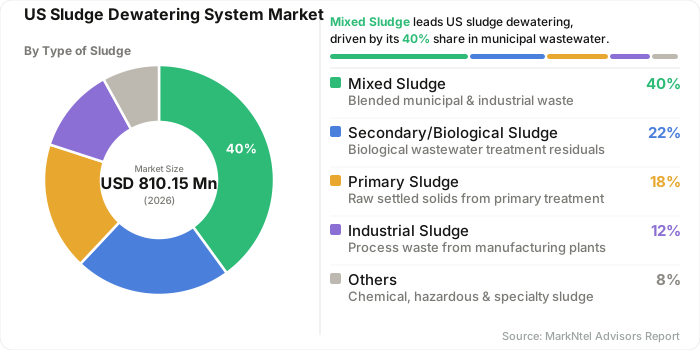
- Mixed Sludge leads by sludge type with approximately 40% share in 2026.
- Belt Filter Press dominates the equipment segment with 39% share in 2026.
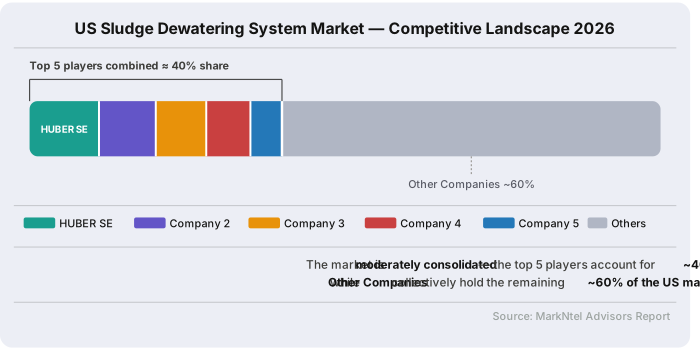
- The market is moderately consolidated, with the top five players collectively holding approximately 40% share.
The US Sludge Dewatering System Market Size and Outlook
The US Sludge Dewatering System Market is projected to witness a steady CAGR of 6.83% during the forecast period. This significant growth rate reflects the simultaneous activation of two demand streams: mandatory municipal infrastructure modernization and accelerating industrial compliance investment that together sustain procurement well beyond cyclical replacement patterns.
On the municipal side, the U.S. EPA's 2024 Clean Watersheds Needs Survey confirmed that national wastewater infrastructure will require USD 630.1 billion over the next 20 years, a figure that grew approximately 70% between 2016 and 2024, directly sustaining multi- year equipment procurement cycles for dewatering systems at both greenfield and rehabilitation projects.
Additionally, the American Biogas Council reported in September 2025 that approximately 3,800 U.S. wastewater treatment facilities are suitable candidates for biogas capture systems but have not yet installed them, each representing a future capital project requiring upstream sludge dewatering equipment as a precondition for digestion. Investment in new U.S. biogas infrastructure surpassed USD 2 billion in 2025, a 40% increase over the prior year, reflecting the scale of the conversion pipeline that dewatering equipment suppliers are positioned to serve.
On the industrial side, tightening EPA effluent guidelines and the growing adoption of zero-liquid-discharge (ZLD) mandates across industries such as food and beverage, pharmaceuticals, and semiconductor manufacturing are increasing the generation of complex and variable sludge streams. These evolving wastewater treatment requirements are driving demand for advanced sludge dewatering technologies capable of handling higher treatment volumes and stricter compliance standards.
At the same time, technology substitution is further supporting market expansion, as end users increasingly replace legacy belt filter presses with energy-efficient centrifuges and IoT-integrated screw presses. The higher average selling prices associated with these advanced systems, combined with rising regulatory compliance needs, are expected to support the market’s growth from USD 0.810 billion in 2026 to USD 1.204 billion by 2032, sustaining above-inflation expansion throughout the forecast period.
The US Sludge Dewatering System Market Key Indicators
- The U.S. EPA's 2022 Clean Watersheds Needs Survey (published May 2024) identified 17,544 publicly owned treatment works (POTWs) collectively serving 270.4 million people; each facility generates sludge requiring mechanical dewatering before disposal or beneficial reuse, making the installed POTW base the primary demand anchor for dewatering systems across the country.
- The U.S. EPA (2024) reported that approximately 34 billion gallons of wastewater are processed daily by domestic treatment facilities; this continuous throughput generates large volumes of biosolids-laden sludge, sustaining year-round, non-cyclical demand for dewatering equipment across municipal treatment operations.
- The U.S. EPA, in its January 2025 Draft Sewage Sludge Risk Assessment for PFOA and PFOS (Docket ID EPA-HQ-OW-2024-0504), initiated the formal regulatory process for setting limits on per- and polyfluoroalkyl substances in biosolids; with approximately a percentage of U.S.-generated biosolids currently land-applied, tightening PFAS standards are expected to mandate advanced sludge treatment and dewatering upgrades at facilities nationwide to comply with emerging discharge requirements.
- The EPA's Clean Water State Revolving Fund (CWSRF), which has provided USD 181.4 billion to communities through 2024, building on a federal base investment of USD 55.7 billion , allocated a further USD 6.2 billion for Fiscal Year 2025 under the Bipartisan Infrastructure Law; this sustained federal financing pipeline funds wastewater plant upgrades, including sludge dewatering system installations across all 50 states and territories.
The US Sludge Dewatering System Market Scope
| Category | Segments |
|---|---|
| By Technology / Equipment Type | Belt Filter Press, Centrifuge Systems, Screw Press, Filter Press, Rotary Drum Thickener, Vacuum Filters, Drying Beds & Lagoons, Electro-dewatering Systems |
| By Sludge Type | Primary Sludge, Secondary/Biological Sludge, Mixed Sludge, Industrial Sludge, Chemical Sludge, HazardoThe US Sludge |
| By Automation Level | Manual Systems, Semi-Automatic Systems, Fully Automatic Systems, Textile Industry, Power & Energy |
| By Application | Municipal Wastewater Treatment, Industrial Wastewater Treatment, Drinking Water Treatment, Sludge Recycling & Resource Recovery, Septage Treatment |
| By End-Use Industry | Municipal Corporations & STPs, Food & Beverage, Pulp & Paper, Textile, Chemicals & Petrochemicals, Pharmaceuticals, Oil & Gas, Mining & Metals, Power Generation, Dairy Processing, Sugar Industry, Tanneries |
The US Sludge Dewatering System Market Growth Drivers
Accelerating Replacement of Aged Wastewater Treatment Infrastructure Across U.S. Municipalities
The physical deterioration of U.S. wastewater treatment plants is directly forcing municipalities to purchase new sludge dewatering systems. A typical wastewater treatment plant has a useful lifespan of 40 to 50 years, while internal dewatering equipment wears out even faster, within just 15 to 20 years. The critical point is that a large share of the country's nearly 17,500 treatment plants were built during the Clean Water Act construction grants era of the 1970s and 1980s. This indicates that thousands of facilities are now at or beyond their operational lifespan, and the dewatering machinery inside them is long overdue for replacement. Every plant that enters rehabilitation triggers a direct procurement order for new dewatering equipment, making aging infrastructure a concrete, recurring source of market demand.
The ASCE's 2025 Infrastructure Report Card confirmed that the sector's renewal and replacement rate for large capital projects fell from 3% to 2% over the past decade, while collection system failures rose from 2 to 3.3 per 100 miles of pipe, a clear sign that deferred investment is now forcing emergency replacements rather than planned upgrades. Additionally, a Congressional Research Service report updated in June 2025 found that estimated U.S. wastewater infrastructure needs grew by approximately 70% between 2016 and 2024, with decentralized treatment needs alone rising 170%.
This expanding geography of replacement reaching smaller towns and rural facilities beyond major cities would lead to an increase in demand for the pipeline of dewatering equipment procurement, which is broadening, sustaining demand growth across the forecast period for the U.S. sludge dewatering industry.
Recent Trends
Shift Toward Energy-Efficient Centrifuges and Advanced Filter Presses Gaining Traction Across U.S. Sludge Dewatering Operations
The U.S. wastewater treatment facilities are steadily replacing older belt filter presses with high-speed decanter centrifuges and advanced filter presses that produce drier sludge cakes while consuming less power. The operational logic is straightforward: a drier cake means less water weight to transport, directly cutting hauling and disposal costs for plant operators managing tight budgets. According to the U.S. EPA's Biosolids Technology Fact Sheet on centrifuge dewatering, mechanical dewatering can achieve 15% to 35% dry solids concentration, compared to just 3% to 6% from thickening alone, a difference that translates into significant annual savings in storage, transport, and disposal expenditure.
This shift is backed by concrete industry investment. In July 2025, Centrisys/CNP, the only U.S.-based manufacturer of decanter centrifuges for municipal wastewater applications opened a new 70,000-square-foot facility in Kenosha, Wisconsin, expanding its total footprint to 300,000 square feet to support production of larger, energy-efficient centrifuge systems and plans to double output over the next five years.
At the RBTT Conference in May 2026, the company further showcased its CS Series dewatering centrifuges, engineered specifically to reduce polymer consumption and lower total cost of ownership, confirming sustained domestic product development aligned with this trend persisting in the U.S. sludge dewatering industry.
The US Sludge Dewatering System Market Opportunities and Challenges
Regulatory Compliance and Odor Opposition Creating Demand for Advanced Sludge Treatment, while Resource Recovery Opens a Parallel Commercial Opportunity
Tightening compliance requirements under the U.S. EPA's 40 CFR Part 503 biosolids regulations, combined with growing public opposition to odor nuisances at dewatering sites, are directly forcing utilities to upgrade their sludge treatment systems. In December 2024, residents in Schuylkill County, Pennsylvania, formally demanded enforcement action against five surrounding biosolids facilities, compelling Pennsylvania DEP to appoint a dedicated Environmental Just ice Coordinator.
The National Association of Clean Water Agencies, in its May–June 2025 regulatory update, identified biosolids odour and PFAS compliance as the top operational concern for the U.S. clean water community, with facilities that fail standards facing permit violations and shutdowns . This compliance pressure directly forces capital spending on enclosed, odour-controlled dewatering systems. That same pressure creates a commercial opening. Utilities are now converting sludge into biosolids for energy generation and agricultural reuse, and high-solids dewatered cake is a prerequisite for both.
The Metropolitan Sewer District of Greater Cincinnati broke ground in December 2024 on a USD 217 million anaerobic digestion facility incorporating advanced dewatering and dedicated odor controls, with full construction funding approved in 2025.
Additionally, the Metropolitan St. Louis Sewer District's USD 900 million Solids Management Upgrades project backed by a USD 330 million EPA WIFIA loan and confirmed on schedule and on budget as of 2025 is actively constructing new biosolids processing facilities at its Bissell Point and Lemay plants, with final design delivered in early 2025 and construction ongoing, targeting a 70% reduction in air and odor emissions while replacing century-old solids handling technology. Both projects confirm that odor compliance and resource recovery are converging into one capital investment wave, with dewatering equipment positioned at its center.
Segmentation Insights
Belt Filter Press Maintains Market Leadership Backed by Cost-Effective Sludge Management Solutions
The Belt Filter Press segment accounted for 39.0% of the U.S. sludge dewatering system market in 2024, making it the leading technology category. Its dominance is primarily driven by the widespread adoption of municipal wastewater treatment facilities, which require cost-effective and continuous sludge processing solutions. Belt filter presses offer high throughput, lower energy consumption, and reduced operating costs compared with several alternative dewatering technologies, making them particularly attractive for publicly funded treatment plants facing budget and efficiency pressures.
Industry investment and product innovation have further strengthened the segment's position. For example, Alfa Laval has introduced advanced belt press systems capa ble of handling high sludge volumes while reducing polymer and power consumption, whereas ANDRITZ has focused on modular, low-maintenance belt press designs that improve throughput and lower lifecycle costs. These innovations align with ongoing U.S. wastewater infrastructure modernization efforts and utilities’ focus on reducing sludge handling and disposal expenses.
The large installed base of belt filter presses across municipal facilities also creates sustained demand for equipment upgrades, retrofits, and replacement projects. Their proven reliability, operational simplicity, and ability to efficiently process municipal biosolids ensure continued preference among wastewater operators. Consequently, infrastructure investments, regulatory compliance requirements, and continuous manufacturer-led technological advancements are expected to maintain the segment's market leadership throughout the forecast period. By technology type, the market is further segmented into the following sub-categories:
- Belt Filter Press
- Centrifuge Systems
- Screw Press
- Filter Press
- Rotary Drum Thickener
- Vacuum Filters
- Drying Beds & Lagoons
- Electro-dewatering Systems
- Thermal Drying Systems
Mixed Sludge Leads the U.S. Sludge Dewatering System Market Due to the High Volume of Combined Municipal Wastewater Residues
The Mixed Sludge segment accounted for approximately 40% of the U.S. Sludge Dewatering System market in 2024, making it the leading sludge type category. Its dominance stems from the widespread practice of combining primary sludge generated during sedimentation with secondary (biological) sludge produced during activated sludge treatment. Most municipal wastewater treatment plants process these streams together before digestion and dewatering to improve operational efficiency, reduce handling complexity, and optimize resource recovery. The prevalence of publicly owned treatment works (POTWs) across the U.S. continues to support high volumes of mixed sludge generation.
Industry operators increasingly invest in dewatering technologies specifically designed for mixed sludge because it represents the largest and most consistent feedstock stream. Utilities utilizing equipment from companies such as PWTech market its Volute™ Dewatering Press for blended and biological sludges, including waste activated sludge (WAS), digested sludge, and mixed municipal sludge. The company emphasizes low-energy operation and the ability to handle changing sludge characteristics, a key requirement for mixed sludge treatment.
The segment's leadership significantly influences demand for high-capacity dewatering systems capable of handling variable sludge characteristics. As municipalities continue upgrading aging wastewater infrastructure and optimizing biosolids management, mixed sludge is expected to remain the primary sludge stream requiring dewatering, reinforcing its market dominance over the forecast period. By the type of sludge, the market is further segmented into the following sub-categories:
- Primary Sludge
- Secondary/Biological Sludge
- Mixed Sludge
- Industrial Sludge
- Chemical Sludge
- Hazardous Sludge
The US Sludge Dewatering System Market Competitive Landscape
The U.S. sludge dewatering system market is moderately consolidated, with a handful of large manufacturers accounting for a significant share of municipal wastewater projects, while numerous regional and niche suppliers compete in industrial applications. The top 5 players HUBER Technology, LLC, Evoqua Water Technologies LLC, Veolia Water Technologies, Inc., Centrisys Corporation, and Komline-Sanderson Corporation, collectively sharing 40% of the market share.
Key Players in Sludge Dewatering System Market in the US
- HUBER Technology, LLC
- WesTech Engineering, LLC
- Komline-Sanderson Corporation
- Evoqua Water Technologies LLC
- Kontek Ecology Systems Inc.
- Phoenix Process Equipment Co.
- Veolia Water Technologies, Inc.
- Beckart Environmental, Inc.
- Schwing Bioset, Inc.
- Centrisys Corporation
- JWC Environmental, LLC
- PWTech Sp. z o.o.
- Ecologix Environmental Systems, LLC
- BDP Industries, Inc.
- Sebright Products, Inc.
- Flo Trend Systems, Inc.
US Sludge Dewatering System Market News and Recent Developments
2024: HUBER Technology Opens USD 40 Million U.S. Manufacturing Facility in Denver, North Carolina, Expanding Domestic Sludge Dewatering Production
In April 2024, HUBER Technology, Inc. celebrated the grand opening of its expanded 205,000-square-foot manufacturing facility in Denver, North Carolina, the largest foreign investment in HUBER SE's company history at approximately USD 40 million. The facility, fully operational from January 2024, brought 100% of HUBER's U.S. sludge treatment equipment production on-site, including its own pickling line, cutting, machining, and final assembly capabilities, enabling direct manufacturing of around 40 product types in 2024 with plans to expand to the full product range in subsequent years.
Impact Analysis: The USD 40 million domestic manufacturing investment materially strengthens HUBER's supply chain responsiveness and BABA compliance positioning for U.S. municipal contract awards, removing a key procurement barrier for federally funded wastewater plant upgrades. The Q-200 system launch extends HUBER's addressable market into the large-plant municipal segment, directly competing with centrifuge-dominated procurement at high-capacity U.S. treatment facilities and increasing competitive pressure on pricing and delivery timelines across the sludge dewatering market.
2025: Xylem Partners with Moleaer to Scale Nanobubble Technology Across U.S. Municipal and Industrial Wastewater Treatment Facilities
In September 2025, Xylem Inc. entered into a US distribution agreement and made a strategic investment in Moleaer, the California-based pioneer in nanobubble technology, to accelerate deployment of its patented systems across municipal and industrial wastewater treatment plants worldwide. The partnership followed a successful installation at the Maple Creek Wastewater Treatment Plant in Greer, South Carolina, where Moleaer's nanobubble generators, deployed in collaboration with Xylem, significantly reduced the need for settling aid and defoaming chemicals, lowering chemical costs and improving compliance with discharge permits without requiring infrastructure upgrades.
Impact Analysis: The agreement strengthens Xylem's position in chemical reduction and compliance-driven wastewater treatment solutions at U.S. municipal facilities, creating a recurring technology platform that complements its existing sludge handling portfolio. By reducing chemical dependency in sludge conditioning processes upstream of dewatering, the partnership directly addresses one of the highest recurring operational costs at treatment plants, reinforcing demand for integrated treatment and dewatering system upgrades across the U.S. market.
2025: Veolia Wins USD 550 Million, 16-Year Semiconductor Wastewater Treatment Contract in the U.S. Midwest, Deploying ANDRITZ Sludge Dewatering Equipment
In Q1 2025, Veolia announced a USD 550 million, 16-year design-build-operate contract to construct and run a state-of-the-art water and wastewater treatment facility for a semiconductor manufacturing plant in the U.S. Midwest, its largest single industrial water contract in North America.
Impact Analysis: The USD 550 million contract establishes a direct, long-term procurement pipeline for advanced industrial sludge dewatering equipment within the U.S. semiconductor sector — a fast-growing industrial sludge source that generates chemically complex waste streams requiring specialized, high-performance dewatering systems. For ANDRITZ, the Veolia partnership on this contract reinforces its position as the preferred sludge dewatering equipment supplier for complex industrial applications in the U.S., differentiating it from municipal-focused competitors and creating a replicable commercial model for semiconductor, advanced manufacturing, and electronics sector clients.
- Market Segmentation
- Introduction
- Product Definition
- Research Process
- Assumptions
- Executive Summary
- US Sludge Dewatering System Market Policies, Regulations, and Product Standards
- US Sludge Dewatering System Market Trends & Developments
- US Sludge Dewatering System Market Dynamics
- Growth Factors
- Challenges
- US Sludge Dewatering System Market Hotspot & Opportunities
- US Sludge Dewatering System Market Outlook, 2022-2032
- Market Size & Outlook
- By Revenues (USD Million)
- Market Share & Outlook
- By Technology / Equipment Type- Market Size & Forecast 2022-2032, USD Million
- Belt Filter Press
- Centrifuge Systems
- Screw Press
- Filter Press
- Rotary Drum Thickener
- Vacuum Filters
- Drying Beds & Lagoons
- Electro-dewatering Systems
- By Sludge Type- Market Size & Forecast 2022-2032, USD Million
- Primary Sludge
- Secondary/Biological Sludge
- Mixed Sludge
- Industrial Sludge
- Chemical Sludge
- Hazardous Sludge
- By Automation Level- Market Size & Forecast 2022-2032, USD Million
- Manual Systems
- Semi-Automatic Systems
- Fully Automatic Systems
- Textile Industry
- Power & Energy
- By Application- Market Size & Forecast 2022-2032, USD Million
- Wastewater Treatment
- Municipal Wastewater Treatment
- Industrial Wastewater Treatment
- Drinking Water Treatment
- Sludge Recycling & Resource Recovery
- Septage Treatment
- Wastewater Treatment
- By End-Use Industry- Market Size & Forecast 2022-2032, USD Million
- Municipal Corporations & STPs
- Food & Beverage
- Pulp & Paper
- Textile
- Chemicals & Petrochemicals
- Pharmaceuticals
- Oil & Gas
- Mining & Metals
- Power Generation
- Dairy Processing
- Sugar Industry
- Tanneries
- By Region- Market Size & Forecast 2022-2032, USD Million
- North
- South
- East
- West
- Central
- By Company
- Competition Characteristics
- Market Share & Analysis
- By Technology / Equipment Type- Market Size & Forecast 2022-2032, USD Million
- Market Size & Outlook
- US Sludge Dewatering System for Wastewater Treatment Market Outlook, 2022-2032
- Market Size & Outlook
- By Revenues (USD Million)
- Market Share & Outlook
- By Sludge Type- Market Size & Forecast 2022-2032, USD Million
- By Automation Level- Market Size & Forecast 2022-2032, USD Million
- By Application- Market Size & Forecast 2022-2032, USD Million
- By End-Use Industry- Market Size & Forecast 2022-2032, USD Million
- By Region- Market Size & Forecast 2022-2032, USD Million
- Market Size & Outlook
- US Sludge Dewatering System for Drinking Water Treatment Market Outlook, 2022-2032
- Market Size & Outlook
- By Revenues (USD Million)
- Market Share & Outlook
- By Sludge Type- Market Size & Forecast 2022-2032, USD Million
- By Automation Level- Market Size & Forecast 2022-2032, USD Million
- By Application- Market Size & Forecast 2022-2032, USD Million
- By End-Use Industry- Market Size & Forecast 2022-2032, USD Million
- By Region- Market Size & Forecast 2022-2032, USD Million
- Market Size & Outlook
- US Sludge Dewatering System for Sludge Recycling & Resource Recovery Market Outlook, 2022-2032
- Market Size & Outlook
- By Revenues (USD Million)
- Market Share & Outlook
- By Sludge Type- Market Size & Forecast 2022-2032, USD Million
- By Automation Level- Market Size & Forecast 2022-2032, USD Million
- By Application- Market Size & Forecast 2022-2032, USD Million
- By End-Use Industry- Market Size & Forecast 2022-2032, USD Million
- By Region- Market Size & Forecast 2022-2032, USD Million
- Market Size & Outlook
- US Sludge Dewatering System for Septage Treatment Market Outlook, 2022-2032
- Market Size & Outlook
- By Revenues (USD Million)
- Market Share & Outlook
- By Sludge Type- Market Size & Forecast 2022-2032, USD Million
- By Automation Level- Market Size & Forecast 2022-2032, USD Million
- By Application- Market Size & Forecast 2022-2032, USD Million
- By End-Use Industry- Market Size & Forecast 2022-2032, USD Million
- By Region- Market Size & Forecast 2022-2032, USD Million
- Market Size & Outlook
- US Sludge Dewatering System Market Key Strategic Imperatives for Success & Growth
- Competitive Outlook
- Company Profiles
- HUBER Technology, LLC
- Business Description
- Product Portfolio
- Collaborations & Alliances
- Recent Developments
- Financial Details
- Others
- WesTech Engineering, LLC
- Business Description
- Product Portfolio
- Collaborations & Alliances
- Recent Developments
- Financial Details
- Others
- Komline-Sanderson Corporation
- Business Description
- Product Portfolio
- Collaborations & Alliances
- Recent Developments
- Financial Details
- Others
- Evoqua Water Technologies LLC
- Business Description
- Product Portfolio
- Collaborations & Alliances
- Recent Developments
- Financial Details
- Others
- Kontek Ecology Systems Inc.
- Business Description
- Product Portfolio
- Collaborations & Alliances
- Recent Developments
- Financial Details
- Others
- Phoenix Process Equipment Co.
- Business Description
- Product Portfolio
- Collaborations & Alliances
- Recent Developments
- Financial Details
- Others
- Veolia Water Technologies, Inc.
- Business Description
- Product Portfolio
- Collaborations & Alliances
- Recent Developments
- Financial Details
- Others
- Beckart Environmental, Inc.
- Business Description
- Product Portfolio
- Collaborations & Alliances
- Recent Developments
- Financial Details
- Others
- Schwing Bioset, Inc.
- Business Description
- Product Portfolio
- Collaborations & Alliances
- Recent Developments
- Financial Details
- Others
- Centrisys Corporation
- Business Description
- Product Portfolio
- Collaborations & Alliances
- Recent Developments
- Financial Details
- Others
- HUBER Technology, LLC
- Company Profiles
- Disclaimer

MarkNtel Advisors follows a robust and iterative research methodology designed to ensure maximum accuracy and minimize deviation in market estimates and forecasts. Our approach combines both bottom-up and top-down techniques to effectively segment and quantify various aspects of the market. A consistent feature across all our research reports is data triangulation, which examines the market from three distinct perspectives to validate findings. Key components of our research process include:
1. Scope & Research Design At the outset, MarkNtel Advisors define the research objectives and formulate pertinent questions. This phase involves determining the type of research—qualitative or quantitative—and designing a methodology that outlines data collection methods, target demographics, and analytical tools. They also establish timelines and budgets to ensure the research aligns with client goals.
2. Sample Selection and Data Collection In this stage, the firm identifies the target audience and determines the appropriate sample size to ensure representativeness. They employ various sampling methods, such as random or stratified sampling, based on the research objectives. Data collection is carried out using tools like surveys, interviews, and observations, ensuring the gathered data is reliable and relevant.
3. Data Analysis and Validation Once data is collected, MarkNtel Advisors undertake a rigorous analysis process. This includes cleaning the data to remove inconsistencies, employing statistical software for quantitative analysis, and thematic analysis for qualitative data. Validation steps are taken to ensure the accuracy and reliability of the findings, minimizing biases and errors.

4. Data Forecast and FinalizationThe final phase involves forecasting future market trends based on the analyzed data. MarkNtel Advisors utilize predictive modeling and time series analysis to anticipate market behaviors. The insights are then compiled into comprehensive reports, featuring visual aids like charts and graphs, and include strategic recommendations to inform client decision-making
We offer flexible licensing options to cater to varying organizational needs. Choose the pricing pack that best suits your requirements:
Buy Now Inquire Before Buying
 Request Customization