

By Detector Type (Hardware (Handheld Detectors, Fixed Detectors, UAV-Based Detectors), Software, Services), By Technology (Optical Gas Imaging (OGI), Acoustic Detection, Laser-Based Detection, IoT-Bas... ... d Detection, IoT-Based Monitoring, AI & Predictive Analytics, Drone-Based Inspection, others), By Equipment Type (Pipelines, Valves, Pumps, Compressors, Storage Tanks, Flanges & Connectors, Pressure Relief Devices), By Leak Type (Gas Leaks, Liquid Leaks, Steam Leaks, Vacuum Leaks), By End Users (Oil & Gas Industry, Chemical Plants, Water Treatment Plants, Power Plants, Mining & Slurry, Commercial, Residential, Others), and others Read more
- Buildings, Construction, Metals & Mining
- Jun 2026
- 280
- PDF, Excel, PPT
Southeast Asia Leak Detection and Repair Market Key Takeaways
- Southeast Asia Leak Detection and Repair (LDAR) market was valued at USD 578 million in 2025.
- The market is estimated at USD 611 million in 2026 and is projected to reach USD 817 million by 2032, registering a CAGR of 4.96% during 2026–2032.
- Optical Gas Imaging (OGI) led the technology segment with 34% market share, driven by its rapid leak identification capabilities, regulatory acceptance, and effectiveness across industrial facilities.
- Pipelines accounted for the largest equipment type share at 31.6%, supported by extensive regional pipeline networks requiring continuous monitoring to reduce product losses.
- Indonesia emerged as the leading regional market, contributing 28% of total revenue, supported by expanding oil and gas infrastructure investments and stricter environmental compliance initiatives.
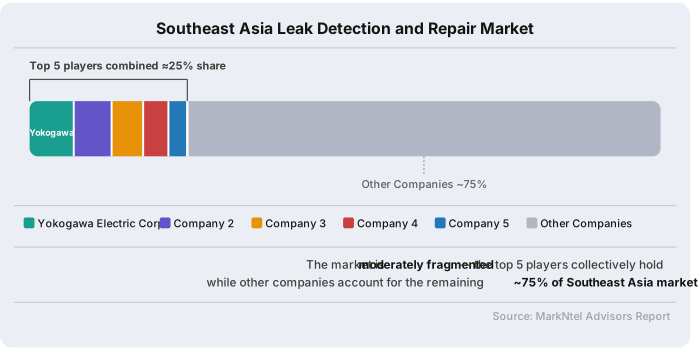
- The competitive landscape remains moderately fragmented, with top five companies collectively account for approximately 25% market share,
Southeast Asia Leak Detection and Repair Market Size and Outlook
The Southeast Asia Leak Detection and Repair Market was valued at USD 578 million in 2025, to USD 611 million in 2026, and is projected to reach USD 817 million by 2032, expanding at a CAGR of 4.96 % over the forecast period.
The Southeast Asia leak detection and repair market has expanded steadily as governments and energy operators intensify methane and greenhouse-gas management across hydrocarbon value chains. Singapore’s carbon pricing framework increased carbon costs for large emitting facilities and strengthened measurement, reporting, and verification requirements, encouraging wider deployment of monitoring technologies. Industrial users in refining, petrochemicals, power generation, and gas processing are consequently investing in advanced detection systems to improve emissions transparency and operational efficiency.
Market growth is also supported by rising industrial activity and expanding energy infrastructure across emerging Southeast Asian economies. National decarbonization programs are increasingly linking emissions accountability with facility-level monitoring, creating demand for continuous inspection services and digital leak-management platforms. Commercial and institutional operators managing large utility networks are adopting preventive maintenance practices to reduce energy losses and improve asset reliability, broadening LDAR applications beyond traditional upstream oil and gas environments.
Industry-led initiatives are reinforcing technology adoption throughout the region. PETRONAS has aligned its methane-management strategy with internationally recognized frameworks and reported substantial reductions in methane emissions across its natural gas value chain, demonstrating the growing importance of systematic leak monitoring. Such corporate sustainability programs are accelerating investment in optical imaging, sensor-based surveillance, analytics software, and integrated inspection services, while encouraging wider implementation of best-practice emissions management across regional operations.
Looking ahead, the market outlook remains favorable as environmental compliance obligations become more stringent and carbon-market mechanisms mature. Vietnam’s 2025 regulatory framework for emissions quotas and carbon-credit trading establishes stronger incentives for accurate emissions measurement and verification, supporting future LDAR deployment. Additionally, continued digitalization of industrial facilities, combined with increasing emphasis on methane abatement, environmental performance reporting, and infrastructure integrity, is expected to sustain long-term demand for leak detection technologies and specialized repair services across Southeast Asia.
Southeast Asia Leak Detection and Repair Market Key Indicators
- According to the IEA (Southeast Asia Energy Outlook 2024), the fossil fuel sector — led by oil, gas, and coal — has met nearly 80% of Southeast Asia's rising energy demand since 2010, with oil and coal each exceeding a quarter of the region's energy mix today. The resulting density of upstream extraction, midstream transmission, and downstream refining infrastructure across the region directly multiplies the number of emission points that require systematic LDAR programmes.
- According to Indonesia's Special Task Force for Upstream Oil and Gas Business Activities (SKK Migas), an annual target of 993 wells set for 2025 an 11% increase year-on-year. Each new well adds pressure vessels, flanges, valves, and pipeline connections that must be included in routine LDAR surveys, directly expanding the asset base requiring monitoring services.
- According to Vietnam's Ministry of Natural Resources and Environment (MONRE), Circular No. 45/2024/TT-BTNMT, covering the National Technical Regulation on Industrial Emissions (QCVN 19:2024/BTNMT), prescribes permissible limits for pollutant parameters discharged from industrial emission sources into the atmosphere. By mandating source-level pollutant controls for investment projects and industrial facilities, the regulation compels operators across Vietnam's petrochemical, refining, and manufacturing sectors to implement verified emission monitoring and leak repair protocols
Southeast Asia Leak Detection and Repair Market Scope
| Category | Segments |
|---|---|
| By Detector Type | Hardware (Handheld Detectors, Fixed Detectors, UAV-Based Detectors), Software, Services |
| By Technology | Optical Gas Imaging (OGI), Acoustic Detection, Laser-Based Detection, IoT-Based Monitoring, AI & Predictive Analytics, Drone-Based Inspection, others |
| By Equipment Type | Pipelines, Valves, Pumps, Compressors, Storage Tanks, Flanges & Connectors, Pressure Relief Devices |
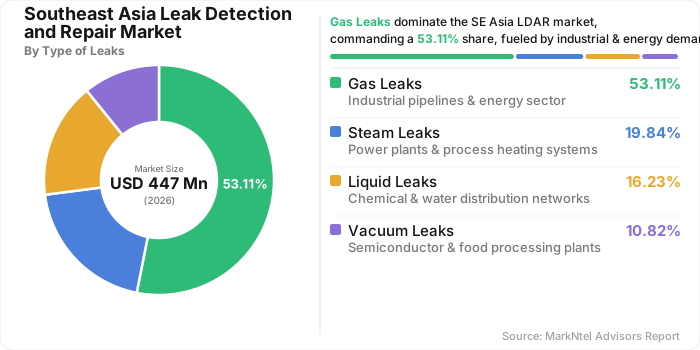
| By Leak Type | Gas Leaks, Liquid Leaks, Steam Leaks, Vacuum Leaks |
| By End Users | Oil & Gas Industry, Chemical Plants, Water Treatment Plants, Power Plants, Mining & Slurry, Commercial, Residential, Others |
Southeast Asia Leak Detection and Repair Market Growth Drivers
Regulatory Push for Emission Control Across ASEAN Energy and Industrial Sectors
The most influential driver supporting the Southeast Asia leak detection and repair market is the strengthening of methane and volatile organic compound emission regulations across ASEAN economies. Growing participation in global climate initiatives and national net-zero commitments has encouraged governments to establish stricter monitoring, reporting, and verification requirements for industrial emitters. This regulatory shift is increasing demand for fugitive emissions management Southeast Asia solutions and expanding deployment of industrial leak detection technologies in Southeast Asia across oil, gas, and manufacturing facilities .
The driver intensified significantly in 2025 when the ASEAN Centre for Energy, together with ASCOPE and the World Bank, launched the Methane Management Roadmap for Oil and Gas in ASEAN. The roadmap prioritizes enhanced monitoring, standardized reporting, certification programs, and abatement measures across member states, creating a structured framework that requires greater adoption of methane leak detection Southeast Asia systems and oil and gas leak detection market Southeast Asia services. Because compliance depends on continuous monitoring rather than one-time investments, the initiative directly expands market volume.
Additional momentum is coming from country-level regulatory implementation. Vietnam launched the pilot phase of its emissions trading scheme in 2025, covering major industrial sectors responsible for around half of national carbon emissions and requiring formal emissions measurement and reporting. Meanwhile, Indonesia initiated a government-supported methane reduction program in late 2025 and expanded technical capacity-building activities through 2026. These developments are accelerating demand for environmental compliance solutions, industrial emission control technologies, and AI-powered leak detection platforms in the Southeast Asia market.
Recent Trends
Accelerating Shift Toward AI-Powered Optical Gas Imaging for Continuous Fugitive Emissions Monitoring
Across the Southeast Asia LDAR market, operators are systematically replacing periodic manual surveys with AI-powered optical gas imaging (OGI) systems capable of continuous, autonomous methane surveillance, a directional shift driven by tightening emissions accountability requirements and the operational limitations of fixed-point sensors in unmanned, outdoor environments.
According to the IEA's Global Methane Tracker 2025, the fossil fuel sector in Southeast Asia was responsible for around 10 million tonnes of methane emissions in 2024, with upstream oil and gas operations contributing approximately half, a scale that periodic human inspections cannot address cost-effectively. This gap is accelerating the adoption of AI-driven continuous monitoring systems across oil and gas production facilities, refineries, and LNG terminals throughout the region.
For instance, FLIR Systems reinforced this pattern in 2025, deploying its GF77a optical gas imaging camera, the first uncooled autonomous OGI device designed specifically for methane visualisation, integrated with an AI-based plume detection engine at the Boryeong LNG Terminal, where real-time OGI video feeds into an automated detection workflow that triggers alarms without human intervention.
The deployment demonstrated that integrating industrial leak monitoring solutions into existing CCTV infrastructure reduces installation complexity while substantially expanding spatial coverage over conventional sensor-only approaches. As export-linked methane reporting obligations take hold from 2027 onward, demand for AI predictive leak detection and IoT-based leak detection solutions across petrochemical and refinery operations in Southeast Asia is expected to intensify significantly, making continuous OGI-AI integration the de facto standard for emissions compliance.
Southeast Asia Leak Detection and Repair Industry Opportunities and Challenges
Inconsistent Regional Emissions Compliance Frameworks Driving Demand for Standardized Industrial Leak Detection Solutions
Across Southeast Asia, the absence of harmonized, mandatory upstream LDAR requirements creates material compliance uncertainty for oil and gas operators. While Singapore's Carbon Pricing Act raised the national carbon tax to SGD 25 per ton of CO₂e in 2024, escalating further to SGD 45 per ton effective 1 January 2026, per the Singapore National Climate Change Secretariat, most neighboring ASEAN member states lack equivalent upstream fugitive emissions standards. Indonesia's Presidential Regulation No. 110 of 2025 formalizes a national carbon trading and levy framework but does not yet prescribe oil and gas sector-specific LDAR thresholds. This regulatory patchwork forces multinational operators managing assets across multiple jurisdictions to bear disproportionate compliance costs, suppressing uniform LDAR technology adoption, particularly among smaller upstream contractors.
The same regulatory pressure is already generating concrete LDAR investment at the national operator level. PT Pertamina, Indonesia's state-owned NOC, partnered with the World Bank's Global Flaring and Methane Reduction Partnership in 2025 to develop a company-wide flaring and methane abatement roadmap, conducting a project identification workshop with over 70 Pertamina staff, with LDAR campaigns formally targeted for implementation in the 2026 financial year.
The World Bank's ASEAN Methane Management Roadmap further identified that over 80% of methane abatement projects across the region, including pipeline leak detection and fugitive emissions monitoring programmes, are executable at net negative cost, confirming a commercially viable and scalable opportunity for LDAR service providers.
As national operators across Indonesia, Malaysia, and Vietnam formalize abatement commitments, demand for standardized industrial leak detection programmes is expected to scale across upstream and midstream assets through 2032.
Segmentation Insights
Optical Gas Imaging Leads the Optical Gas Imaging Market in Southeast Asia as the Dominant Detection Technology
Optical Gas Imaging (OGI) accounts for approximately 34% of the Southeast Asia LDAR market by technology, making it the leading detection method across the region's oil and gas, petrochemical, and refinery operations. OGI leads due to passive infrared cameras that visualize hydrocarbon and methane plumes that are entirely invisible to the naked eye, enabling technicians to scan hundreds of components per shift without process shutdowns, a critical operational requirement for continuously running offshore platforms and onshore processing facilities.
Companies like In 2025, LYNRED launched its PICO640S BB 7-14 infrared sensor, purpose-engineered for 24/7 area-wide OGI monitoring at high-risk industrial sites, signaling active product innovation directly supporting continuous deployment across Southeast Asia's unmanned upstream facilities.
As Southeast Asia's regulatory baseline for emissions measurement advances toward mandatory verification standards, OGI is expected to remain the compliance anchor while AI and IoT layers increasingly automate detection workflows across the full asset base. By technology type, the market is further segmented into the following sub-categories:
- Optical Gas Imaging (OGI)
- Acoustic Detection
- Laser-Based Detection
- IoT-Based Monitoring
- AI & Predictive Analytics
- Drone-Based Inspection
- Others
Pipelines Dominate as the Leading Equipment Type in Pipeline Leak Detection Solutions in Southeast Asia
Pipelines account for approximately 31.6% of the Southeast Asia LDAR market by equipment type, making them the dominant component category across the region's leak surveillance programmes. The Trans-ASEAN Gas Pipeline (TAGP) Project, overseen by the ASEAN Council on Petroleum (ASCOPE), currently connects seven ASEAN member states through 13 bilateral pipeline interconnections with a combined cross-border length of 3,631 km each spanning subsea and onshore corridors across Indonesia, Malaysia, Myanmar, Singapore, and Thailand, where every valve station, compressor tie-in, and flanged joint constitutes a regulated fugitive emission source requiring scheduled LDAR survey intervals.
Additionally, PT Perusahaan Gas Negara (PGN), which operates 13,581 km of gas pipelines covering approximately 92% of Indonesia's domestic gas infrastructure, reduced unaccounted-for gas losses from 3.9% to 2.4% through pipeline monitoring improvements in 2024, while simultaneously advancing a USD 125 million Gas Pipeline Infrastructure project between Tegal and Cilacap scheduled for 2025–2026 each new pipeline corridor requiring integrated acoustic leak detection solutions Southeast Asia from commissioning.
As national operators across the region formalise emissions inventories and align with export-linked verification requirements ahead of 2030 NDC deadlines, systematic equipment-level leak surveillance is expected to become standard across every asset class from upstream wellheads to downstream distribution terminals. By equipment type, the market is further segmented into the following sub-categories
- Pipelines
- Valves
- Pumps
- Compressors
- Storage Tanks
- Flanges & Connectors
- Pressure Relief Devices
Southeast Asia Leak Detection and Repair Industry Geographical Analysis
Indonesia accounts for approximately 28% of the Southeast Asia LDAR market, making it the single largest country contributor, driven by the sheer scale of its upstream and midstream hydrocarbon infrastructure. The country's proven natural gas reserves stood at 33.84 trillion cubic feet in 2024, as reported by Indonesia's Directorate General of Oil and Gas under the Ministry of Energy and Mineral Resources, the largest gas reserve base in Southeast Asia. This generates a proportionally dense concentration of pipelines, compressor stations , LNG facilities, and processing plants across South Sumatra, East Kalimantan, the Natuna Sea, Sulawesi, and West Papua that collectively define energy sector emissions monitoring Southeast Asia demand.
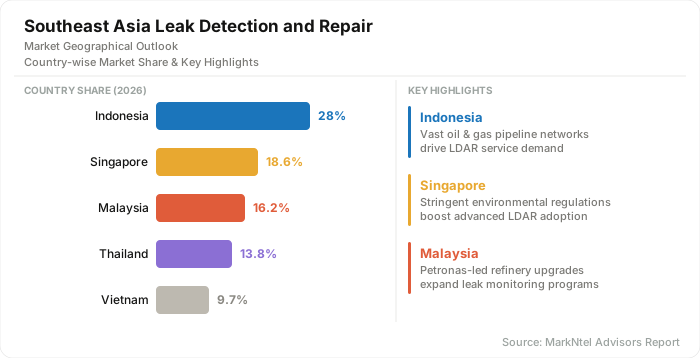
Indonesia’s gas production averaged approximately 1,199,700 barrels of oil equivalent per day in the first half of 2025, sustaining active operation across hundreds of production facilities that require systematic Southeast Asia methane leak detection market coverage at all regulated emission sources. The Ministry of Environment and Forestry's CEMS mandate further reinforces demand for advanced leak detection technologies across Southeast Asia across all major industrial operators connected to the SISPEK monitoring platform.
SKK Migas confirmed in February 2026 that eight upstream oil and gas projects are scheduled to come onstream during the year, carrying a combined CAPEX of USD 478 million and projected to add 214 MMSCFD of gas, with each new facility requiring handheld gas detector market Southeast Asia and fixed gas detector market Southeast Asia solutions from commissioning.
Eni's April 2026 discovery of the Geliga-1 well off East Kalimantan, with preliminary estimates of approximately 5 trillion cubic feet of gas, signals a further expansio n of Indonesia's upstream asset base that will sustain the Southeast Asia LDAR industry outlook through the forecast period
Southeast Asia Leak Detection and Repair Industry Competitive Landscape
The market structure is moderately fragmented, with a mix of global industrial automation providers, gas detection specialists, inspection service companies, and LDAR technology vendors competing across hardware, software, and monitoring services with the top 5 companies combined share of 25% Honeywell International Inc., ABB Ltd., Emerson Electric Co., Siemens AG, and Yokogawa Electric Corporation.
Major Companies in Southeast Asia Leak Detection and Repair Market
- YOKOGAWA ENGINEERING ASIA PTE LTD
- YOKOGAWA ELECTRIC INTERNATIONAL PTE. LTD.
- Atmos International Ltd
- Honeywell International Inc.
- ABB Ltd.
- Emerson Electric Co.
- Siemens AG
- Dräger
- MSA Safety Incorporated
- Teledyne FLIR LLC
- Picarro, Inc.
- Kairos Aerospace, Inc.
- SGS S.A.
- Bureau Veritas S.A.
- TEAM, Inc.
Southeast Asia Leak Detection and Repair Industry News and Recent Developments
2025: PTTEP Reaches Final Investment Decision on Thailand's First CCS Project at Arthit Gas Field with USD 320 Million Five-Year Investment
PTT Exploration and Production Public Company Limited (PTTEP ) reached the final investment decision (FID) on a Carbon Capture and Storage project at the Arthit gas field in the Gulf of Thailand on 8 September 2025. The five-year investment is estimated at approximately THB 10 billion, equivalent to USD 320 million, with carbon storage operations expected to commence in 2028, targeting the capture and storage of up to 1 million tonnes of CO₂ per year. The project utilises reservoir storage at depths of 1,000–2,000 metres and is underpinned by comprehensive Measurement, Monitoring and Verification (MMV) programmes mandated throughout project design and operation. The initiative is formally recognised under Thailand's NDC Action Plan on Mitigation 2021–2030.
Impact analysis: PTTEP's USD 320 million investment at Arthit establishes Thailand's first offshore emissions measurement and verification infrastructure at a producing gas field, creating ongoing demand for continuous monitoring, fugitive emissions detection, and MMV programme services from 2028 onward. NDC recognition of the project signals that Thailand's government will increasingly embed emissions monitoring requirements into upstream licensing conditions, expanding compliance-driven LDAR demand across the Thai oil and gas sector and reinforcing the competitive position of providers capable of delivering integrated MMV solutions in offshore environments.
2025: Crowcon Detection Instruments Launches IQ Range of Connected Portable Gas Detectors, Introducing Cloud-Integrated Safety Technology Across Southeast Asia
Crowcon Detection Instruments, a Halma plc subsidiary with its Asia-Pacific office in Singapore, launched the IQ range of connected portable gas detectors on 23 September 2025, making the range available globally through its distributor network, including Southeast Asia, with full market availability from early 2026. The IQ range comprises three connected products: UnoIQ (single-gas wearable), DuoIQ (dual-gas detector), and DetectiveIQ (area monitor capable of detecting up to seven gases with a 15-week battery life). All devices feature swappable pre-calibrated sensor trays completing bump tests in under 10 seconds and full calibrations in 30 seconds. The DetectiveIQ incorporates mesh networking to link multiple units, while all devices connect to the Crowcon Connect cloud platform for real-time fleet-wide compliance monitoring across oil and gas, chemical, petrochemical, and refinery operations.
Impact analysis: The IQ range introduces cloud-connected, IoT-enabled gas detection targeting petrochemical and oil and gas facilities, the dominant end-use verticals in Southeast Asia, directly addressing the documented 80% industry non-compliance rate in portable detector maintenance. By enabling real-time cloud monitoring across dispersed industrial sites through its Singapore APAC office and regional distributor network covering Indonesia, Malaysia, and Thailand, Crowcon lowers the total cost of compliance management and accelerates adoption of connected gas monitoring solutions across the region's expanding upstream and downstream asset base.
2025: AddGlobe Showcases Advanced Methane Leak Detection Technologies at Oil & Gas Thailand
At Oil & Gas Thailand (OGET) 2025 in Bangkok, AddGlobe unveiled its latest methane leak detection solutions, including the GFM 2.0, GFM 3.0, and TDL 220 systems. The GFM 3.0 incorporates methane-specific laser sensing technology for highly accurate methane quantification, while the TDL 220 enables rapid remote leak screening. The solutions are designed to help oil & gas operators improve fugitive emission monitoring, enhance operational safety, and comply with increasingly stringent environmental regulations. The launch attracted significant interest from regional energy companies and industrial stakeholders.
Impact analysis: This development strengthens the adoption of advanced methane monitoring technologies within Southeast Asia's LDAR market, particularly in Thailand, Malaysia, Indonesia, and Singapore where methane-emission reduction initiatives are gaining momentum. The introduction of laser-based quantification and remote detection capabilities supports the industry's shift toward more accurate and efficient leak detection programs. It also accelerates the adoption of Optical Gas Imaging (OGI) and methane-specific monitoring solutions across oil & gas and petrochemical facilities. As environmental compliance requirements continue to tighten, demand for next-generation LDAR equipment is expected to increase throughout the region.
- Market Segmentation
- Introduction
- Product Definition
- Research Process
- Assumptions
- Executive Summary
- Southeast Asia Leak Detection and Repair Market Policies, Regulations, and Product Standards
- Southeast Asia Leak Detection and Repair Market Trends & Developments
- Southeast Asia Leak Detection and Repair Market Dynamics
- Growth Factors
- Challenges
- Southeast Asia Leak Detection and Repair Market Hotspot & Opportunities
- Southeast Asia Leak Detection and Repair Market Outlook, 2022-2032F
- Market Size & Outlook
- By Revenues (USD Million)
- Market Share & Analysis
- By Detector Type- Market Size & Forecast 2022-2032, USD Million
- Hardware
- Handheld Detectors
- Fixed Detectors
- UAV-Based Detectors
- Software
- Services
- Hardware
- By Technology- Market Size & Forecast 2022-2032, USD Million
- Optical Gas Imaging (OGI)
- Acoustic Detection
- Laser-Based Detection
- IoT-Based Monitoring
- AI & Predictive Analytics
- Drone-Based Inspection
- others
- By Equipment Type- Market Size & Forecast 2022-2032, USD Million
- Pipelines
- Valves
- Pumps
- Compressors
- Storage Tanks
- Flanges & Connectors
- Pressure Relief Devices
- By Leak Type- Market Size & Forecast 2022-2032, USD Million
- Gas Leaks
- Liquid Leaks
- Steam Leaks
- Vacuum Leaks
- By End Users- Market Size & Forecast 2022-2032, USD Million
- Oil & Gas Industry
- Chemical Plants
- Water Treatment Plants
- Power Plants
- Mining & Slurry
- Commercial
- Residential
- Others
- By Country
- Philippines
- Singapore
- Indonesia
- Malaysia
- Thailand
- Vietnam
- Cambodia
- Myanmar
- Others
- By Company
- Competition Characteristics
- Market Share & Analysis
- By Detector Type- Market Size & Forecast 2022-2032, USD Million
- Market Size & Outlook
- Philippines Leak Detection and Repair Market Outlook, 2022-2032F
- Market Size & Outlook
- By Revenues (USD Million)
- Market Share & Analysis
- By Detector Type- Market Size & Forecast 2022-2032, USD Million
- By Technology- Market Size & Forecast 2022-2032, USD Million
- By Equipment Type- Market Size & Forecast 2022-2032, USD Million
- By Leak Type- Market Size & Forecast 2022-2032, USD Million
- By End Users- Market Size & Forecast 2022-2032, USD Million
- Market Size & Outlook
- Singapore Leak Detection and Repair Market Outlook, 2022-2032F
- Market Size & Outlook
- By Revenues (USD Million)
- Market Share & Analysis
- By Detector Type- Market Size & Forecast 2022-2032, USD Million
- By Technology- Market Size & Forecast 2022-2032, USD Million
- By Equipment Type- Market Size & Forecast 2022-2032, USD Million
- By Leak Type- Market Size & Forecast 2022-2032, USD Million
- By End Users- Market Size & Forecast 2022-2032, USD Million
- Market Size & Outlook
- Indonesia Leak Detection and Repair Market Outlook, 2022-2032F
- Market Size & Outlook
- By Revenues (USD Million)
- Market Share & Analysis
- By Detector Type- Market Size & Forecast 2022-2032, USD Million
- By Technology- Market Size & Forecast 2022-2032, USD Million
- By Equipment Type- Market Size & Forecast 2022-2032, USD Million
- By Leak Type- Market Size & Forecast 2022-2032, USD Million
- By End Users- Market Size & Forecast 2022-2032, USD Million
- Market Size & Outlook
- Malaysia Leak Detection and Repair Market Outlook, 2022-2032F
- Market Size & Outlook
- By Revenues (USD Million)
- Market Share & Analysis
- By Detector Type- Market Size & Forecast 2022-2032, USD Million
- By Technology- Market Size & Forecast 2022-2032, USD Million
- By Equipment Type- Market Size & Forecast 2022-2032, USD Million
- By Leak Type- Market Size & Forecast 2022-2032, USD Million
- By End Users- Market Size & Forecast 2022-2032, USD Million
- Market Size & Outlook
- Thailand Leak Detection and Repair Market Outlook, 2022-2032F
- Market Size & Outlook
- By Revenues (USD Million)
- Market Share & Analysis
- By Detector Type- Market Size & Forecast 2022-2032, USD Million
- By Technology- Market Size & Forecast 2022-2032, USD Million
- By Equipment Type- Market Size & Forecast 2022-2032, USD Million
- By Leak Type- Market Size & Forecast 2022-2032, USD Million
- By End Users- Market Size & Forecast 2022-2032, USD Million
- Market Size & Outlook
- Vietnam Leak Detection and Repair Market Outlook, 2022-2032F
- Market Size & Outlook
- By Revenues (USD Million)
- Market Share & Analysis
- By Detector Type- Market Size & Forecast 2022-2032, USD Million
- By Technology- Market Size & Forecast 2022-2032, USD Million
- By Equipment Type- Market Size & Forecast 2022-2032, USD Million
- By Leak Type- Market Size & Forecast 2022-2032, USD Million
- By End Users- Market Size & Forecast 2022-2032, USD Million
- Market Size & Outlook
- Cambodia Leak Detection and Repair Market Outlook, 2022-2032F
- Market Size & Outlook
- By Revenues (USD Million)
- Market Share & Analysis
- By Detector Type- Market Size & Forecast 2022-2032, USD Million
- By Technology- Market Size & Forecast 2022-2032, USD Million
- By Equipment Type- Market Size & Forecast 2022-2032, USD Million
- By Leak Type- Market Size & Forecast 2022-2032, USD Million
- By End Users- Market Size & Forecast 2022-2032, USD Million
- Market Size & Outlook
- Myanmar Leak Detection and Repair Market Outlook, 2022-2032F
- Market Size & Outlook
- By Revenues (USD Million)
- Market Share & Analysis
- By Detector Type- Market Size & Forecast 2022-2032, USD Million
- By Technology- Market Size & Forecast 2022-2032, USD Million
- By Equipment Type- Market Size & Forecast 2022-2032, USD Million
- By Leak Type- Market Size & Forecast 2022-2032, USD Million
- By End Users- Market Size & Forecast 2022-2032, USD Million
- Market Size & Outlook
- Southeast Asia Leak Detection and Repair Market Key Strategic Imperatives for Success & Growth
- Competitive Outlook
- Company Profiles
- YOKOGAWA ENGINEERING ASIA PTE LTD
- Business Description
- Product Portfolio
- Collaborations & Alliances
- Recent Developments
- Financial Details
- Others
- YOKOGAWA ELECTRIC INTERNATIONAL PTE. LTD.
- Business Description
- Product Portfolio
- Collaborations & Alliances
- Recent Developments
- Financial Details
- Others
- Atmos International Ltd
- Business Description
- Product Portfolio
- Collaborations & Alliances
- Recent Developments
- Financial Details
- Others
- Honeywell International Inc.
- Business Description
- Product Portfolio
- Collaborations & Alliances
- Recent Developments
- Financial Details
- Others
- ABB Ltd.
- Business Description
- Product Portfolio
- Collaborations & Alliances
- Recent Developments
- Financial Details
- Others
- Emerson Electric Co.
- Business Description
- Product Portfolio
- Collaborations & Alliances
- Recent Developments
- Financial Details
- Others
- Siemens AG
- Business Description
- Product Portfolio
- Collaborations & Alliances
- Recent Developments
- Financial Details
- Others
- Dräger
- Business Description
- Product Portfolio
- Collaborations & Alliances
- Recent Developments
- Financial Details
- Others
- MSA Safety Incorporated
- Business Description
- Product Portfolio
- Collaborations & Alliances
- Recent Developments
- Financial Details
- Others
- Teledyne FLIR LLC
- Business Description
- Product Portfolio
- Collaborations & Alliances
- Recent Developments
- Financial Details
- Others
- Picarro, Inc.
- Business Description
- Product Portfolio
- Collaborations & Alliances
- Recent Developments
- Financial Details
- Others
- Kairos Aerospace, Inc.
- Business Description
- Product Portfolio
- Collaborations & Alliances
- Recent Developments
- Financial Details
- Others
- SGS S.A.
- Business Description
- Product Portfolio
- Collaborations & Alliances
- Recent Developments
- Financial Details
- Others
- Bureau Veritas S.A.
- Business Description
- Product Portfolio
- Collaborations & Alliances
- Recent Developments
- Financial Details
- Others
- TEAM, Inc.
- Business Description
- Product Portfolio
- Collaborations & Alliances
- Recent Developments
- Financial Details
- Others
- YOKOGAWA ENGINEERING ASIA PTE LTD
- Company Profiles
- Disclaimer

MarkNtel Advisors follows a robust and iterative research methodology designed to ensure maximum accuracy and minimize deviation in market estimates and forecasts. Our approach combines both bottom-up and top-down techniques to effectively segment and quantify various aspects of the market. A consistent feature across all our research reports is data triangulation, which examines the market from three distinct perspectives to validate findings. Key components of our research process include:
1. Scope & Research Design At the outset, MarkNtel Advisors define the research objectives and formulate pertinent questions. This phase involves determining the type of research—qualitative or quantitative—and designing a methodology that outlines data collection methods, target demographics, and analytical tools. They also establish timelines and budgets to ensure the research aligns with client goals.
2. Sample Selection and Data Collection In this stage, the firm identifies the target audience and determines the appropriate sample size to ensure representativeness. They employ various sampling methods, such as random or stratified sampling, based on the research objectives. Data collection is carried out using tools like surveys, interviews, and observations, ensuring the gathered data is reliable and relevant.
3. Data Analysis and Validation Once data is collected, MarkNtel Advisors undertake a rigorous analysis process. This includes cleaning the data to remove inconsistencies, employing statistical software for quantitative analysis, and thematic analysis for qualitative data. Validation steps are taken to ensure the accuracy and reliability of the findings, minimizing biases and errors.

4. Data Forecast and FinalizationThe final phase involves forecasting future market trends based on the analyzed data. MarkNtel Advisors utilize predictive modeling and time series analysis to anticipate market behaviors. The insights are then compiled into comprehensive reports, featuring visual aids like charts and graphs, and include strategic recommendations to inform client decision-making
We offer flexible licensing options to cater to varying organizational needs. Choose the pricing pack that best suits your requirements:
Buy Now Inquire Before Buying
 Request Customization