

By System Type (Mixed-Bed Deionized Water System, Two-Bed Deionized Water System, Electrode ionization (EDI) Systems), By Capacity (Low Capacity (<10 m³/hr), Medium Capacity (10–100 m³/hr), High Capac... ... �100 m³/hr), High Capacity (>100 m³/hr)), By End-use Industry (Electronics & Semiconductor, Secondary Batteries (EV Battery Manufacturing), Pharmaceutical & Biotechnology, Power Generation, Chemical & Petrochemical, Laboratory & Research Institutes, Food & Beverage, Hydrogen Production, Others), and others Read more
- Environment
- Aug 2026
- 140
- PDF, Excel, PPT
South Korea Deionized Water System Market Key Takeaways
- The South Korea deionized water system market was valued at USD 7.9 billion in 2025 and is projected to reach USD 8.5 billion in 2026, further expanding to USD 13.2 billion by 2032, registering a CAGR of 7.61% during the forecast period.
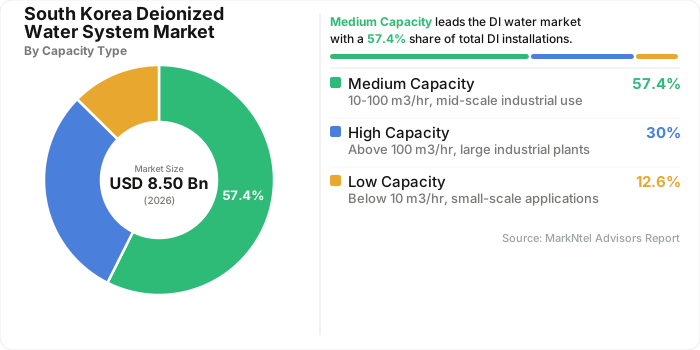
- Medium Capacity (10–100 m³/hr) systems emerged as the leading capacity segment, accounting for approximately 57.4% of the market in 2025.
- Electronics & Semiconductor represented the largest end-use industry, capturing approximately 52.6% of the total market share.
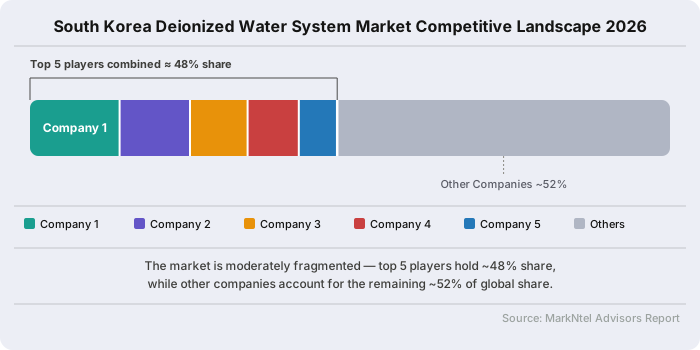
- The market is moderately consolidated, with the top five companies collectively accounting for approximately 48% of the total market revenue.
South Korea Deionized Water System Market Size and Outlook
The South Korea deionized water system market stood at USD 7.9 billion in 2025 and is projected to advance to USD 8.5 billion in 2026, expanding at a CAGR of 7.61% to reach USD 13.2 billion by 2032, propelled by the country's rapidly expanding semiconductor manufacturing base.
This growth is anchored in the government-industry announcement of a USD 517.9 billion commitment by Samsung Electronics and SK Hynix to establish a new memory-chip production cluster in southwestern South Korea, supported by a USD 20.46 billion, 15-year government package covering the entire semiconductor value chain
Electronics manufacturing remains the principal end-user segment driving market demand, as semiconductor wafer cleaning and precision fabrication require a continuous supply of high-resistivity deionized and ultrapure water. According to Invest KOREA, the government has expanded 20–30% tax incentives for semiconductor equipment investments while directing infrastructure support toward reliable water and power supply across the Pyeongtaek and Yongin semiconductor complexes. These initiatives are accelerating investments in advanced deionized water systems.
Regulatory and infrastructure developments are further strengthening market expansion. South Korea's Ministry of Climate, Energy and Environment announced plans in 2026 to secure 650,000 tons of industrial water per day for the new southwest semiconductor cluster, including raising Gwangju's Dongbok Dam by 15 meters through a USD 0.317 billion investment. Complementing these efforts, domestic ion-exchange resin producer Samyang is expanding ultrapure water resin sales to major semiconductor manufacturers, targeting USD 0.082 billion in annual revenue.
Beyond electronics, pharmaceutical manufacturing provides an additional growth avenue. The Ministry of Food and Drug Safety's GMP overhaul, effective January 2025, introduced stricter quality-control timelines for drug manufacturers, reinforcing purified-water compliance requirements. Together, sustained infrastructure investments across electronics and pharmaceutical manufacturing are expected to support continued market expansion throughout the forecast period.
South Korea Deionized Water System Market Key Indicators
- The Ministry of Trade, Industry and Resources reported that South Korea's semiconductor exports increased 22.2% year-over-year to a record USD 173.4 billion in 2025. Rising semiconductor production is significantly increasing demand for ultrapure and deionized water systems, as both existing and newly commissioned fabrication lines require continuous high-purity water for wafer manufacturing and cleaning.
- South Korea's Ministry of Climate, Energy and Environment raised KHNP's nuclear capacity factor target to 89% for 2026, up from 84.6% in 2025. Higher reactor utilization increases feed water treatment cycles, driving greater demand for deionization resins, water treatment consumables, and system maintenance across the country's operating nuclear power plants.
- On January 26, 2026, South Korea's Ministry of Climate, Energy and Environment confirmed the construction of two new large nuclear reactors with a combined capacity of 2.8 GWe under the 11th Basic Plan for Electricity Supply and Demand. The expansion is expected to increase demand for deionized water systems, as nuclear plants require continuously demineralized boiler feedwater for efficient and reliable operations.
South Korea Deionized Water System Market Scope
| Category | Segments |
|---|---|
| By System Type | Mixed-Bed Deionized Water System, Two-Bed Deionized Water System, Electrode ionization (EDI) Systems |
| By Capacity | Low Capacity (<10 m³/hr), Medium Capacity (10–100 m³/hr), High Capacity (>100 m³/hr |
| By End-use Industry | Electronics & Semiconductor, Secondary Batteries (EV Battery Manufacturing), Pharmaceutical & Biotechnology, Power Generation, Chemical & Petrochemical, Laboratory & Research Institutes, Food & Beverage, Hydrogen Production, Others |
South Korea Deionized Water System Market Growth Driver
Large-Scale Semiconductor Fab Expansion Driving Ultrapure Water System Demand
Wafer fabrication is the largest driver of deionized water system demand in South Korea, as every semiconductor cleaning, rinsing, and etching process requires ultrapure water (UPW) with near-zero ionic contamination. This quality is achieved through integrated treatment systems comprising reverse osmosis (RO), deionization (DI), electrode ionization (EDI), and advanced polishing technologies operating at industrial scale. According to South Korea's Ministry of Climate, Energy and Environment, the Yongin semiconductor cluster alone is expected to require approximately 390 million cubic meters of industrial water annually, highlighting the substantial need for high-capacity water treatment infrastructure.
This demand is set to accelerate as semiconductor investments expand. SEMI projects South Korea's fab equipment spending will increase 29% to USD 21.5 billion in 2025 and a further 26% to USD 27 billion in 2026, making the country the world's second-largest semiconductor equipment market, behind China (USD 38 billion) and ahead of Taiwan (USD 21 billion). As investments increasingly focus on high-bandwidth memory (HBM) production, suppliers capable of delivering large-scale, high-purity DI/UPW systems are expected to benefit significantly from this expanding semiconductor investment cycle.
Recent Trends
Rising Deployment of Deionization Technology for High-Salinity Wastewater in Secondary Battery Manufacturing
South Korea's rapidly expanding secondary battery industry is emerging as a key growth driver for the deionized water systems industry. Lithium-ion and EV battery production generates high-salinity wastewater containing valuable metals such as lithium, nickel, cobalt, aluminum, and manganese, creating demand for advanced deionization and brine-concentration technologies that outperform conventional treatment systems. To support sustainable wastewater management, South Korea's Ministry of Climate, Energy and Environment launched a five-year national technology development project in the first half of 2026, backed by approximately 47.5 billion won, including 37 billion won in government funding.
The initiative aims to reduce energy consumption in saline wastewater treatment while recovering critical minerals for reuse. Commercial adoption is also gaining momentum. In March 2026, GS E&C partnered with Aquafortus to introduce non-thermal desalination and brine-concentration technology capable of treating battery wastewater with total dissolved solids (TDS) concentrations of up to 150,000 mg/L, overcoming the limitations of conventional membrane systems. As battery manufacturing capacity expands, demand for advanced deionization systems is expected to increase steadily across industrial wastewater treatment applications.
South Korea Deionized Water System Market Opportunities and Challenges
Water Allocation Constraints Driving Investment in Advanced Water Recycling and Deionized Water Infrastructure
Water availability is emerging as a critical factor shaping South Korea's deionized water system market, particularly in the country's expanding southwestern semiconductor corridor. According to the Ministry of Climate, Energy and Environment, the Yeongsan and Seomjin river basins contain only 11.4 billion cubic meters of annual water resources approximately half the capacity of the Han River basin. In addition, water supply contract rates at the Seomjin Dam and Juam Dam have already reached 100%, leaving no additional capacity for new industrial withdrawals.
As a result, the government is prioritizing water recycling and advanced treatment over new raw water extraction. It has committed up to USD 13.64 billion toward infrastructure development, including water supply for the southwest semiconductor hub. Furthermore, the Korea Water Resources Corporation (K-water) estimates that the Honam region can secure approximately 1 million tons of water per day through integrated recycling and supply projects. These initiatives are expected to accelerate investments in high-capacity deionization, ultrapure water, and industrial water recycling systems, making water reuse a key procurement priority for future semiconductor facilities.
Segmentation Insights
Medium Capacity Systems Emerge as the Preferred Industrial Choice with 57.4% Share
As they provide an optimal balance between production capacity, water purity, and operational flexibility for facilities requiring more than laboratory-scale output but less than continuous large-scale industrial supply. Their adoption is particularly strong across pharmaceutical, biotechnology, and contract manufacturing operations with batch-based production requirements.
Samsung Biologics commenced full operations at its 180,000-liter Plant 5 in April 2025 and also expanded its Songdo Bio Campus with a dedicated antibody-drug conjugate (ADC) manufacturing facility, demonstrating the growing need for modular deionized water systems that support formulation and fill-finish processes rather than uninterrupted production cycles.
Fierce Pharma reports these investments are strengthening demand for medium-capacity installations. The segment is further supported by regulatory expansion within the biologics industry. In April 2026, WuXi Biologics received Ministry of Food and Drug Safety (MFDS) GMP certification for three manufacturing facilities, enabling end-to-end commercial biologics manufacturing in South Korea.
As more pharmaceutical and biotechnology manufacturers expand their domestic production footprint, medium-capacity skid-mounted deionized water systems are expected to remain the preferred solution for meeting stringent water quality requirements while maintaining operational scalability. By capacity, the market is further segmented into the following sub-categories:
- Low Capacity (<10 m³/hr)
- Medium Capacity (10–100 m³/hr)
- High Capacity (>100 m³/hr)
Semiconductor Expansion Strengthens Electronics & Semiconductor Leadership with 52.6% Share
Driven by the industry's need for ultrapure water in wafer cleaning, rinsing, etching, and cooling processes, where even minute ionic or particulate contamination can affect chip quality and production yields. Reflecting this growing demand, Hansung Cleantech secured consecutive ultrapure water and wastewater treatment contracts at Samsung Electronics' Pyeongtaek Campus in early 2026, including the P4 Phase 2 ultrapure water complex building contract awarded in March. The company was subsequently selected in April for the national "Next-Generation Ultrapure Water Production Project," highlighting the extensive purification infrastructure required to support a single semiconductor manufacturing campus.
Demand is further reinforced through national infrastructure investments. Under the Semiconductor Cluster Master Plan, announced in 2024, the South Korean government committed USD 21 billion in public infrastructure investment through 2030, including industrial water supply expansion for fabrication facilities consuming 80,000 to 120,000 tons of ultrapure water per day. As semiconductor fabs across the Yongin and southwest clusters progress from construction to commercial operation, the Electronics & Semiconductor segment is expected to maintain its leading position throughout the forecast period. By end user, the market is further segmented into the following sub-categories:
- Electronics & Semiconductor
- Secondary Batteries (EV Battery Manufacturing)
- Pharmaceutical & Biotechnology
- Power Generation
- Chemical & Petrochemical
- Laboratory & Research Institutes
- Food & Beverage
- Others
South Korea Deionized Water System Market Competitive Landscape
The South Korea deionized water system market is moderately consolidated, with the top five players collectively accounting for approximately 48% of the total market share. The leading companies include Veolia Water Technologies, DuPont Water Solutions, Xylem South Korea, DH Water Corporation, and IONTECH Co., Ltd.
Major Companies in the South Korea Deionized Water System Market
- Veolia Water Technologies
- DuPont Water Solutions
- Xylem South Korea
- Pentair
- DH Water Corporation
- BKT Co., Ltd.
- IONTECH Co., Ltd.
- GnG InTech Co., Ltd.
- Taerang Engineering
- APS Tech Co., Ltd.
South Korea Deionized Water System Market News and Recent Developments
April 2026: Hansung Cleantech Selected for Government-Led Next-Generation Ultrapure Water Technology Development Project
In April 2026, Hansung Cleantech was selected as the implementing agency for the South Korean government's "Next-Generation Ultrapure Water Production Process Design, Operation, and Long-Distance UPW Supply Technology Development" project. The initiative aims to reduce the energy consumption of ultrapure water production while developing long-distance UPW supply technologies, leveraging the company's experience at Samsung Electronics' Pyeongtaek and SK hynix's Yongin semiconductor facilities.
Impact Analysis: The project strengthens Hansung Cleantech's technological leadership in ultrapure water systems, enhances its competitiveness for future semiconductor water infrastructure projects, and supports the expansion of scalable, energy-efficient domestic ultrapure water supply networks.
2025: K-water and Yale University Advance Wastewater-to-Ultrapure Water Reuse Technology
In 2025, Korea Water Resources Corporation (K-water) and Yale University advanced joint research on wastewater-to-ultrapure water (UPW) reuse technology, targeting prototype completion by the end of 2026 and field application assessment by July 2028. The initiative is designed to support the increasing ultrapure water demand driven by semiconductor manufacturing expansion at Samsung Electronics and SK hynix.
ImpactAnalysis:The collaboration supports sustainable deionized water production by enabling wastewater reuse, reducing dependence on freshwater resources, improving water security for semiconductor fabrication facilities, and promoting long-term resilience in South Korea's industrial water infrastructure.
- Market Segmentation
- Introduction
- Product Definition
- Research Process
- Assumptions
- Executive Summary
- South Korea Deionized Water System Market Policies, Regulations, and Product Standards
- South Korea Deionized Water System Market Trends & Developments
- South Korea Deionized Water System Market Dynamics
- Growth Factors
- Challenges
- South Korea Deionized Water System Market Hotspot & Opportunities
- South Korea Deionized Water System Market Outlook, 2022-2032
- Market Size & Outlook
- By Revenues (USD Million)
- Market Segmentation & Outlook
- By System Type- Market Size & Forecast 2022-2032, USD Million
- Mixed-Bed Deionized Water System
- Two-Bed Deionized Water System
- Electrode ionization (EDI) Systems
- By Capacity - Market Size & Forecast 2022-2032, USD Million
- Low Capacity (<10 m³/hr)
- Medium Capacity (10–100 m³/hr)
- High Capacity (>100 m³/hr)
- By End-use Industry- Market Size & Forecast 2022-2032, USD Million
- Electronics & Semiconductor
- Secondary Batteries (EV Battery Manufacturing)
- Pharmaceutical & Biotechnology
- Power Generation
- Chemical & Petrochemical
- Laboratory & Research Institutes
- Food & Beverage
- Hydrogen Production
- Others
- By Region - Market Size & Forecast 2022-2032, USD Million
- North
- South
- East
- West
- Central
- By Company
- Competition Characteristics
- Market Share & Analysis
- By System Type- Market Size & Forecast 2022-2032, USD Million
- Market Size & Outlook
- South Korea Mixed-Bed Deionized Water System Market Outlook, 2022-2032
- Market Size & Outlook
- By Revenues (USD Million)
- Market Segmentation & Outlook
- By Capacity - Market Size & Forecast 2022-2032, USD Million
- By End-use Industry- Market Size & Forecast 2022-2032, USD Million
- By Region - Market Size & Forecast 2022-2032, USD Million
- Market Size & Outlook
- South Korea Two-Bed Deionized Water System Market Outlook, 2022-2032
- Market Size & Outlook
- By Revenues (USD Million)
- Market Segmentation & Outlook
- By Capacity - Market Size & Forecast 2022-2032, USD Million
- By End-use Industry- Market Size & Forecast 2022-2032, USD Million
- By Region - Market Size & Forecast 2022-2032, USD Million
- Market Size & Outlook
- South Korea Electrode ionization (EDI) Market Outlook, 2022-2032
- Market Size & Outlook
- By Revenues (USD Million)
- Market Segmentation & Outlook
- By Capacity - Market Size & Forecast 2022-2032, USD Million
- By End-use Industry- Market Size & Forecast 2022-2032, USD Million
- By Region - Market Size & Forecast 2022-2032, USD Million
- Market Size & Outlook
- South Korea Deionized Water System Market Key Strategic Imperatives for Success & Growth
- Competitive Outlook
- Company Profiles
- Veolia Water Technologies
- Business Description
- Product Portfolio
- Collaborations & Alliances
- Recent Developments
- Financial Details
- Others
- DuPont Water Solutions
- Business Description
- Product Portfolio
- Collaborations & Alliances
- Recent Developments
- Financial Details
- Others
- Xylem South Korea
- Business Description
- Product Portfolio
- Collaborations & Alliances
- Recent Developments
- Financial Details
- Others
- Pentair
- Business Description
- Product Portfolio
- Collaborations & Alliances
- Recent Developments
- Financial Details
- Others
- DH Water Corporation
- Business Description
- Product Portfolio
- Collaborations & Alliances
- Recent Developments
- Financial Details
- Others
- BKT Co., Ltd.
- Business Description
- Product Portfolio
- Collaborations & Alliances
- Recent Developments
- Financial Details
- Others
- IONTECH Co., Ltd.
- Business Description
- Product Portfolio
- Collaborations & Alliances
- Recent Developments
- Financial Details
- Others
- GnG InTech Co., Ltd.
- Business Description
- Product Portfolio
- Collaborations & Alliances
- Recent Developments
- Financial Details
- Others
- Taerang Engineering
- Business Description
- Product Portfolio
- Collaborations & Alliances
- Recent Developments
- Financial Details
- Others
- APS Tech Co., Ltd.
- Business Description
- Product Portfolio
- Collaborations & Alliances
- Recent Developments
- Financial Details
- Others
- Veolia Water Technologies
- Company Profiles
- Disclaimer

MarkNtel Advisors follows a robust and iterative research methodology designed to ensure maximum accuracy and minimize deviation in market estimates and forecasts. Our approach combines both bottom-up and top-down techniques to effectively segment and quantify various aspects of the market. A consistent feature across all our research reports is data triangulation, which examines the market from three distinct perspectives to validate findings. Key components of our research process include:
1. Scope & Research Design At the outset, MarkNtel Advisors define the research objectives and formulate pertinent questions. This phase involves determining the type of research—qualitative or quantitative—and designing a methodology that outlines data collection methods, target demographics, and analytical tools. They also establish timelines and budgets to ensure the research aligns with client goals.
2. Sample Selection and Data Collection In this stage, the firm identifies the target audience and determines the appropriate sample size to ensure representativeness. They employ various sampling methods, such as random or stratified sampling, based on the research objectives. Data collection is carried out using tools like surveys, interviews, and observations, ensuring the gathered data is reliable and relevant.
3. Data Analysis and Validation Once data is collected, MarkNtel Advisors undertake a rigorous analysis process. This includes cleaning the data to remove inconsistencies, employing statistical software for quantitative analysis, and thematic analysis for qualitative data. Validation steps are taken to ensure the accuracy and reliability of the findings, minimizing biases and errors.

4. Data Forecast and FinalizationThe final phase involves forecasting future market trends based on the analyzed data. MarkNtel Advisors utilize predictive modeling and time series analysis to anticipate market behaviors. The insights are then compiled into comprehensive reports, featuring visual aids like charts and graphs, and include strategic recommendations to inform client decision-making
We offer flexible licensing options to cater to varying organizational needs. Choose the pricing pack that best suits your requirements:
Buy Now Inquire Before Buying
 Request Customization