

By Offering (Communication Equipment, Software, Services), By Communication Technology (Satellite Communication, Cellular Communication, Fiber Optic Communication, Microwave Communication, Radio Commu... ... ication, Radio Communication, Wi-Fi & Industrial Wireless Networks), By Network Architecture (Private Networks, Public Networks, Hybrid Networks), By Deployment Site (Onshore Oilfields, Offshore Oilfields), By Operation Stage (Upstream, Midstream, Downstream), By Application (Operational Monitoring & Control, Asset Performance & Lifecycle Management, Workforce Communication & Collaboration, Safety & Emergency Communication, Security & Surveillance, Logistics & Fleet Management), and others Read more
- ICT & Electronics
- Jun 2026
- 265
- PDF, Excel, PPT
Middle East Oilfield Communications Market Key Takeaways
- Middle East oilfield communications market size was valued at USD 717 million in 2025, rising to USD 776 million in 2026 and USD 1052 million by 2032.
- The industry is projected to witness steady growth at a 5.20% CAGR during the forecast period i.e., 2026-32.
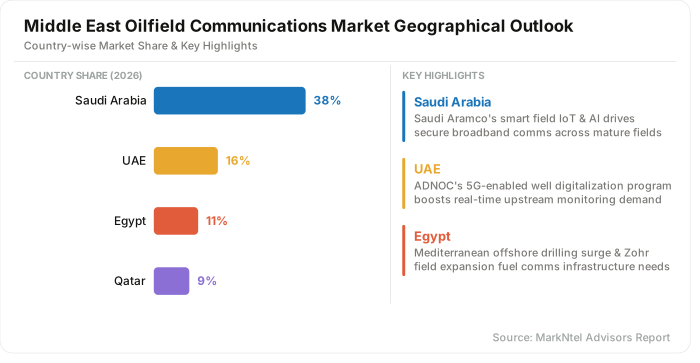
- Saudi Arabia leads regional demand with approximately a 38% share in 2026.
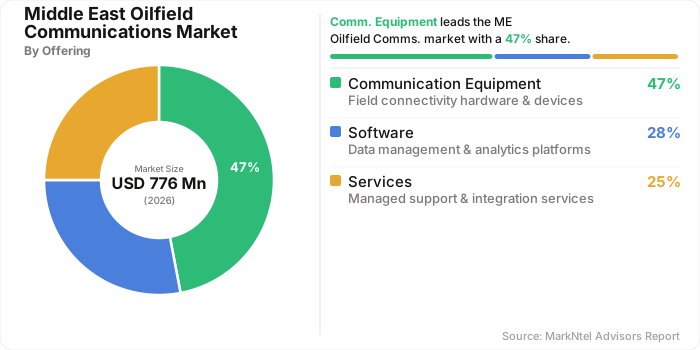
- Communication equipment dominates by offering, capturing nearly 47% share in 2026.
- Operational monitoring & control leads applications with about 28% share in 2026.
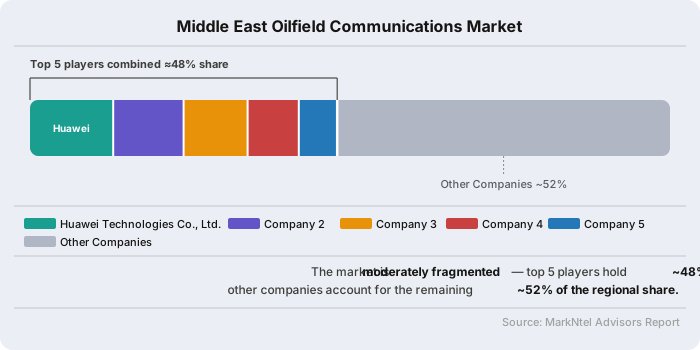
- The market remains moderately fragmented, with top five players collectively holding around 48% share, balancing scale advantages with niche competition.
Middle East Oilfield Communications Market Size and Outlook
The Middle East oilfield communications market size was valued at USD 717 million in 2025 and is projected to grow from USD 776 million in 2026 to USD 1052 million by 2032, registering a CAGR of 5.20% during 2026–2032. This steady expansion is underpinned by large-scale upstream developments led by QatarEnergy, particularly the North Field Expansion, which aims to increase LNG capacity from 77 MTPA to 126 MTPA by 2027, significantly strengthening demand for digital oilfield infrastructure and high-capacity communication networks .
Parallel developments across emerging production hubs are further reinforcing long-term growth prospects. Iraq’s East Baghdad (South) project is expected to reach 120,000 barrels per day by 2027, necessitating integrated communication systems linking wells, facilities, and control centers. In Oman, OQ Exploration & Production plans investments of USD 800–900 million in 2026, alongside pipeline expansion toward Ras Markaz . These developments are accelerating adoption of energy communication systems and offshore communication systems, ensuring seamless coordination across dispersed operational assets within the Middle East oilfield communications industry.
A defining structural trend shaping the outlook is the increasing integration of automation, predictive analytics, and advanced connectivity frameworks across oilfield operations. Private network deployments and real-time data ecosystems are enabling operators to optimize production efficiency and asset utilization. At the same time, rising cybersecurity threats are unlocking new opportunities for secure communication architectures, driving investments in resilient, encrypted networks to safeguard critical infrastructure.
The convergence of upstream expansion, digital transformation, and infrastructure modernization will continue to sustain demand for advanced communication solutions. As operators prioritize operational efficiency, safety, and real-time visibility, communication systems are evolving into a strategic backbone of oilfield operations. Collectively, these dynamics are expected to support stable, long-term growth across the industry, reinforcing its role in enabling next-generation energy production systems.
Middle East Oilfield Communications Market Key Indicators
- The International Energy Agency (IEA) estimates that the Middle East will invest nearly USD 130 billion in oil and gas supply in 2025, accounting for about 15% of global upstream spending. This sustained capital deployment expands the regional asset base, including rigs and processing facilities, thereby intensifying demand for oilfield communication networks to enable real-time monitoring, operational coordination, and safety compliance.
- With the Middle East contributing approximately 30% of global oil output and 17% of natural gas production in 2024, the region hosts a vast concentration of producing assets. Thousands of wells, pipelines, and export terminals require uninterrupted connectivity, strengthening long-term reliance on remote oilfield monitoring systems to ensure efficiency, minimize downtime, and maintain production continuity across complex hydrocarbon operations.
- National oil companies now account for nearly 40% of global upstream investments, with Middle Eastern operators prioritizing digital transformation. Entities such as Saudi Aramco and ADNOC are expanding budgets for integrated and secure systems, accelerating adoption of advanced private 5G oilfield infrastructure. This strategic shift supports automation, data-driven decision-making, and scalable connectivity across large, distributed oilfield environments.
- Iraq’s plan to award 30 new oil and gas projects, supported by approximately 70% foreign investment, is expected to generate significant greenfield infrastructure development. Each new field requires end-to-end communication architecture, from surveillance to workforce connectivity, driving demand for pipeline communication systems and integrated digital networks across emerging production hubs and transportation corridors.
- According to OPEC, global crude oil production averaged 72.58 million barrels per day in 2024, with Middle Eastern producers contributing the largest share . Maintaining such high output levels requires continuous monitoring of wells, pipelines, and flow stations, reinforcing the need for SCADA oil & gas systems and telemetry-based communication solutions to ensure operational efficiency, reliability, and real-time control.
Middle East Oilfield Communications Market Scope
| Category | Segments |
|---|---|
| By Offering | Communication Equipment, Software, Services |
| By Communication Technology | Satellite Communication, Cellular Communication, Fiber Optic Communication, Microwave Communication, Radio Communication, Wi-Fi & Industrial Wireless Networks |
| By Network Architecture | Private Networks, Public Networks, Hybrid Networks |
| By Deployment Site | Onshore Oilfields, Offshore Oilfields |
| By Operation Stage | Upstream, Midstream, Downstream |
| By Application | Operational Monitoring & Control, Asset Performance & Lifecycle Management, Workforce Communication & Collaboration, Safety & Emergency Communication, Security & Surveillance, Logistics & Fleet Management |
Middle East Oilfield Communications Market Growth Drivers
Expansion of Upstream Exploration & Production Activities
The expansion of upstream oil and gas investments across the Gulf is significantly strengthening demand for advanced communication infrastructure. ADNOC reaffirmed a USD 150 billion five-year investment plan, targeting capacity growth through projects such as Hail and Ghasha, expected to deliver 1.8 billion cubic feet per day by 2030. These developments are increasing reliance on real-time monitoring oilfield capabilities and integrated systems to manage distributed production assets efficiently.
Similarly, Saudi Aramco continues to expand its upstream portfolio with USD 50–55 billion capital expenditure guidance for 2026, alongside the Jafurah project targeting 2 billion cubic feet per day by 2030. Such large-scale developments require seamless upstream communication systems to support automation, reservoir optimization, and real-time decision-making across increasingly complex oilfield environments, while also ensuring operational continuity across geographically dispersed production networks and offshore installations.
As upstream assets scale in size and complexity, operators are accelerating adoption of industrial IoT oil & gas technologies and digital platforms to enhance operational visibility and efficiency. This transition is reinforcing demand for high-performance communication systems capable of supporting predictive analytics, remote operations, and centralized control functions. Collectively, these investment trends are structurally strengthening the role of connectivity infrastructure as a core enabler within the Middle East oilfield communications industry.
Recent Trends
Rising Adoption of Private 5G Networks for Autonomous Oilfield Operations
Gulf operators are rapidly transitioning from fragmented legacy systems toward dedicated, carrier-grade wireless infrastructure built for industrial environments. In July 2024, ADNOC and e& initiated the energy sector’s largest private 5G deployment, spanning 11,000 square kilometers with completion targeted in 2025. This large-scale rollout highlights accelerating adoption of private 5G oilfield networks as operators modernize connectivity across complex upstream and offshore environments within the Middle East oilfield communications market.
The scale and economic impact expected to generate approximately USD 1.5 billion over five years demonstrate that private 5G is evolving beyond pilot projects into core operational infrastructure. The network will enable real-time data transmission from sensors across more than 12,000 wells and pipeline assets, supporting centralized and autonomous control room operations . Such capabilities are strengthening the role of smart oilfield tech in enabling data-driven decision-making, improving asset visibility, and enhancing operational efficiency across geographically dispersed production systems.
As operators increasingly adopt predictive analytics, automation, and remote asset management, private 5G is emerging as the backbone for high-bandwidth, low-latency connectivity. Integration with edge oilfield computing further enhances real-time processing capabilities, reducing latency in mission-critical operations. This shift is positioning dedicated wireless networks as a foundational layer for scalable, autonomous oilfield ecosystems across the Middle East oilfield communications industry.
Middle East Oilfield Communications Market Opportunities and Challenges
Escalating Cyber Risks Driving Secure Communication Investments
The rapid expansion of digital oilfield systems across the region has significantly increased exposure to cyber threats targeting operational technology environments. According to Kaspersky ICS CERT, the Middle East ranked first globally for ransomware attacks on the oil and gas sector in 2025, while ICS-related email threats were 1.8 times higher than the global average . These trends highlight growing vulnerabilities in critical infrastructure, intensifying oilfield cybersecurity risk and raising concerns over operational disruptions, data breaches, and safety failures across connected oilfield assets.
In response to these escalating threats, regional operators are prioritizing investments in secure and resilient communication architectures. Saudi Aramco has joined the World Economic Forum’s Cyber Resilience initiative, signaling a strategic shift toward strengthening digital infrastructure security and adopting secure oilfield networks. These initiatives emphasize zero-trust frameworks, encrypted communications, and integrated monitoring systems designed to safeguard increasingly interconnected oilfield environments from evolving cyberattack vectors.
Simultaneously, ADNOC is deploying up to 28,000 connected safety devices, requiring encrypted, real-time communication systems for workforce monitoring and emergency response . Such large-scale implementations are accelerating demand for connected oilfield worker solutions and advanced communication platforms. Collectively, rising cyber risks are not only challenging legacy systems but also unlocking significant growth opportunities for secure, high-performance connectivity solutions across the Middle East oilfield communications industry.
Segmentation Insights
Communication Equipment Dominates Due to Asset-Heavy Infrastructure Requirements
Communication equipment accounts for the largest share of the Middle East oilfield communications industry at approximately 47%, reflecting the hardware-intensive requirements of connecting remote and harsh oilfield environments. Assets such as rigs, wellheads, pipelines, and offshore platforms depend on ruggedized routers, antennas, microwave radios, and satellite terminals to establish baseline connectivity. This structural reliance on oilfield hardware continues to anchor demand, particularly as operators expand production infrastructure.
The dominance of hardware is further reinforced by large-scale upstream expansion programs undertaken by regional operators. ADNOC Drilling projected over USD 1 billion in investment for 2025, alongside plans to expand its fleet to more than 148 rigs by 2026. Each additional rig requires dedicated communication systems to support drilling operations, safety monitoring, and data transmission, strengthening demand for offshore communication systems and robust field-level connectivity infrastructure.
While Communication Equipment leads, software and services segments are steadily evolving to complement hardware deployments. Software platforms enable data integration, analytics, and control functions, while services support installation, maintenance, and system optimization. Increasing integration of mission-critical communication solutions is enhancing the value proposition of these segments, particularly as operators adopt digital oilfield architectures requiring seamless coordination between physical infrastructure and intelligent systems. Based on offering, the market is segmented into the following components:
- Communication Equipment
- Software
- Services
Operational Monitoring & Control Leads Driven by Real-Time Data Requirements
The operational monitoring & control segment accounts for approximately 28% share, making it the largest revenue contributor among applications. This dominance is driven by the need for continuous visibility across wells, pipelines, and processing facilities, where real-time data flows are essential for maintaining efficiency and minimizing downtime. Increasing reliance on remote asset monitoring systems is enabling operators to track performance metrics, detect anomalies, and ensure uninterrupted operations.
Beyond monitoring, applications such as asset performance and lifecycle management are gaining traction as operators prioritize long-term efficiency and cost optimization. These systems leverage predictive analytics and integrated platforms to extend asset life and improve maintenance scheduling. The growing use of pipeline monitoring systems is further strengthening midstream visibility, ensuring leak detection, flow optimization, and regulatory compliance across extensive transportation networks and cross-border energy infrastructure in the region.
Workforce communication, safety, and security applications are also becoming critical as operations expand into more complex and remote environments. Solutions supporting oilfield safety communication enable real-time coordination during emergencies, improve worker tracking, and enhance situational awareness across hazardous sites. Collectively, these applications are reinforcing the importance of integrated communication ecosystems, positioning advanced connectivity solutions as a central component of operational efficiency within the Middle East oilfield communications industry. The key applications identified in the study include:
- Operational Monitoring & Control
- Asset Performance & Lifecycle Management
- Workforce Communication & Collaboration
- Safety & Emergency Communication
- Security & Surveillance
- Logistics & Fleet Management
Middle East Oilfield Communications Market Geographical Outlook
Saudi Arabia accounts for approximately 38% of oilfield communications demand in the Middle East, supported by the scale and density of its upstream and midstream infrastructure. The Kingdom’s dominance is anchored in the strategic direction of Saudi Aramco, which continues to maintain its maximum sustainable crude production capacity at 12 million barrels per day . This level of output requires continuous monitoring across one of the world’s most extensive networks of wells, gas processing facilities, and pipeline systems.
The concentration of such large-scale assets necessitates highly reliable communication systems to ensure operational continuity, safety compliance, and real-time data transmission. Increasing adoption of pipeline monitoring systems and advanced digital platforms is enabling operators to enhance visibility across complex infrastructure networks. These systems support predictive maintenance, flow optimization, and rapid response mechanisms, particularly across long-distance transmission corridors.
As Saudi Arabia continues to prioritize production stability and operational efficiency, demand for integrated communication solutions is expected to remain structurally strong. The scale of infrastructure, combined with ongoing digital transformation initiatives, positions the Kingdom as a central growth hub within the Middle East oilfield communications landscape, reinforcing its leadership in shaping regional connectivity standards.
Middle East Oilfield Communications Market Competitive Analysis
The top five players operating in the Middle East oilfield communications industry include Huawei Technologies Co., Ltd., SLB, Halliburton Company, Baker Hughes Company, and Honeywell International Inc., which collectively account for approximately 48% of the market share, indicating a moderately fragmented market structure. The competitive landscape is characterized by the presence of global oilfield service providers, industrial technology firms, and specialized communication vendors, each focusing on distinct solution layers. While leading players leverage integrated portfolios and long-term contracts with national oil companies, smaller firms compete through niche offerings, regional expertise, and cost-efficient solutions.
Key Players in the Middle East Oilfield Communications Market
- Huawei Technologies Co., Ltd.
- Siemens Energy AG
- ABB Ltd.
- Baker Hughes Company
- SLB
- Halliburton Company
- Cisco Systems, Inc.
- Honeywell International Inc.
- Viasat, Inc.
- Speedcast International Limited
- Ceragon Networks Ltd.
- Hughes Network Systems, LLC
- Others
Middle East Oilfield Communications Industry News and Recent Developments:
November 2025: Nokia and e& UAE Launch MEA’s First Commercial Cloud RAN Deployment
Nokia and e& UAE introduced the Middle East and Africa’s first commercial deployment of Nokia’s Cloud RAN solution powered by HPE carrier-grade servers. The deployment integrates virtualized network functions, AI-enabled capabilities, automation tools, and Nokia’s Habrok Massive MIMO radios operating on a 5G Standalone architecture. The platform is designed to improve network flexibility, scalability, intelligence, and operational efficiency while supporting future AI-RAN applications.
Impact Analysis: Cloud-native network architectures are increasingly relevant to oilfield communications because they enable highly scalable, low-latency, and software-defined connectivity. The deployment strengthens the regional ecosystem for private LTE and 5G networks that support remote drilling operations, autonomous equipment, industrial IoT devices, and real-time asset monitoring. By enabling greater automation and network intelligence, the technology can help oil and gas operators improve operational efficiency.
November 2025: Anton Oilfield Services and Huawei Sign Smart Oilfield Digitalization MoU
Anton Oilfield Services Group and Huawei signed a memorandum of understanding in Abu Dhabi to jointly develop digital and integrated solutions for global oil and gas operators. The partnership focuses on intelligent oil and gas platforms, AI-driven applications, data governance frameworks, and smart oilfield technologies leveraging Huawei’s expertise in 5G, cloud computing, and artificial intelligence. The initiative aims to create benchmark smart oilfield deployments and accelerate digital transformation across the industry.
Impact Analysis: This partnership directly supports the evolution of intelligent oilfield communications by combining oilfield expertise with advanced digital technologies. AI-enabled platforms require robust communications infrastructure capable of supporting high-volume data transmission, real-time analytics, and remote operational control. The collaboration is expected to accelerate adoption of smart oilfield architectures, integrated communications networks, industrial cloud platforms, and AI-powered monitoring systems.
August 2025: ADNOC Deploys Connected Safety and Communication Devices Across Operations
ADNOC placed its first order under a multi-year agreement with Blackline Safety covering up to 28,000 connected safety devices and services. The initial deployment includes approximately 1,000 G6 wearable gas detectors and 1,200 location beacons that provide real-time worker monitoring, location tracking, and emergency communication capabilities across ADNOC facilities. The deployment strengthens connected-worker infrastructure and digital safety communications within one of the Middle East’s largest energy producers.
Impact Analysis: This development demonstrates growing investment in mission-critical communication technologies within Middle Eastern oil and gas operations. Connected wearables generate continuous operational and safety data, requiring reliable wireless networks, cloud connectivity, and real-time monitoring platforms. As ADNOC expands deployment across its facilities, demand for industrial IoT communications, private wireless networks, edge connectivity, and integrated safety communication systems is expected to increase. The project also establishes a benchmark for other regional operators seeking to improve workforce safety, operational visibility, and emergency response capabilities through advanced oilfield communication solutions.
- Market Segmentation
- Introduction
- Product Definition
- Research Process
- Assumptions
- Executive Summary
- Middle East Oilfield Communications Market Policies, Regulations, and Product Standards
- Middle East Oilfield Communications Market Trends & Developments
- Middle East Oilfield Communications Market Dynamics
- Growth Factors
- Challenges
- Middle East Oilfield Communications Market Value Chain Analysis
- Component Suppliers
- Equipment Providers
- Network Operators (Satellite/Telecom)
- System Integrators
- End Users
- Middle East Oilfield Communications Market Geopolitical & Macroeconomic Impact Analysis
- Regional Conflicts & Oil Price Impact
- Infrastructure Security Demand
- Cybersecurity Risks
- Middle East Oilfield Communications Market Import & Export Analysis
- Middle East Oilfield Communications Market Hotspot & Opportunities
- Middle East Oilfield Communications Market Outlook, 2022-2032F
- Market Size & Outlook
- By Revenues (USD Million)
- Market Segmentation & Outlook
- By Offering- Market Size & Forecast 2022-2032, USD Million
- Communication Equipment
- Software
- Services
- By Communication Technology- Market Size & Forecast 2022-2032, USD Million
- Satellite Communication
- Cellular Communication
- Fiber Optic Communication
- Microwave Communication
- Radio Communication
- Wi-Fi & Industrial Wireless Networks
- By Network Architecture- Market Size & Forecast 2022-2032, USD Million
- Private Networks
- Public Networks
- Hybrid Networks
- By Deployment Site- Market Size & Forecast 2022-2032, USD Million
- Onshore Oilfields
- Offshore Oilfields
- By Operation Stage- Market Size & Forecast 2022-2032, USD Million
- Upstream
- Exploration
- Drilling
- Production
- Midstream
- Pipeline Transportation
- Storage Facilities
- Downstream
- Refining
- Petrochemical Processing
- Distribution Terminals
- Upstream
- By Application - Market Size & Forecast 2022-2032, USD Million
- Operational Monitoring & Control
- Asset Performance & Lifecycle Management
- Workforce Communication & Collaboration
- Safety & Emergency Communication
- Security & Surveillance
- Logistics & Fleet Management
- By Country
- Saudi Arabia
- UAE
- Qatar
- Kuwait
- Oman
- Egypt
- Rest of Middle East
- By Company
- Competition Characteristics
- Market Segmentation & Outlook
- By Offering- Market Size & Forecast 2022-2032, USD Million
- Market Size & Outlook
- Saudi Arabia Oilfield Communications Market Outlook, 2022-2032F
- Market Size & Outlook
- By Revenues (USD Million)
- Market Segmentation & Outlook
- By Offering- Market Size & Forecast 2022-2032, USD Million
- By Communication Technology- Market Size & Forecast 2022-2032, USD Million
- By Network Architecture- Market Size & Forecast 2022-2032, USD Million
- By Deployment Site- Market Size & Forecast 2022-2032, USD Million
- By Operation Stage- Market Size & Forecast 2022-2032, USD Million
- By Application - Market Size & Forecast 2022-2032, USD Million
- Market Size & Outlook
- UAE Oilfield Communications Market Outlook, 2022-2032F
- Market Size & Outlook
- By Revenues (USD Million)
- Market Segmentation & Outlook
- By Offering- Market Size & Forecast 2022-2032, USD Million
- By Communication Technology- Market Size & Forecast 2022-2032, USD Million
- By Network Architecture- Market Size & Forecast 2022-2032, USD Million
- By Deployment Site- Market Size & Forecast 2022-2032, USD Million
- By Operation Stage- Market Size & Forecast 2022-2032, USD Million
- By Application - Market Size & Forecast 2022-2032, USD Million
- Market Size & Outlook
- Qatar Oilfield Communications Market Outlook, 2022-2032F
- Market Size & Outlook
- By Revenues (USD Million)
- Market Segmentation & Outlook
- By Offering- Market Size & Forecast 2022-2032, USD Million
- By Communication Technology- Market Size & Forecast 2022-2032, USD Million
- By Network Architecture- Market Size & Forecast 2022-2032, USD Million
- By Deployment Site- Market Size & Forecast 2022-2032, USD Million
- By Operation Stage- Market Size & Forecast 2022-2032, USD Million
- By Application - Market Size & Forecast 2022-2032, USD Million
- Market Size & Outlook
- Kuwait Oilfield Communications Market Outlook, 2022-2032F
- Market Size & Outlook
- By Revenues (USD Million)
- Market Segmentation & Outlook
- By Offering- Market Size & Forecast 2022-2032, USD Million
- By Communication Technology- Market Size & Forecast 2022-2032, USD Million
- By Network Architecture- Market Size & Forecast 2022-2032, USD Million
- By Deployment Site- Market Size & Forecast 2022-2032, USD Million
- By Operation Stage- Market Size & Forecast 2022-2032, USD Million
- By Application - Market Size & Forecast 2022-2032, USD Million
- Market Size & Outlook
- Oman Oilfield Communications Market Outlook, 2022-2032F
- Market Size & Outlook
- By Revenues (USD Million)
- Market Segmentation & Outlook
- By Offering- Market Size & Forecast 2022-2032, USD Million
- By Communication Technology- Market Size & Forecast 2022-2032, USD Million
- By Network Architecture- Market Size & Forecast 2022-2032, USD Million
- By Deployment Site- Market Size & Forecast 2022-2032, USD Million
- By Operation Stage- Market Size & Forecast 2022-2032, USD Million
- By Application - Market Size & Forecast 2022-2032, USD Million
- Market Size & Outlook
- Egypt Oilfield Communications Market Outlook, 2022-2032F
- Market Size & Outlook
- By Revenues (USD Million)
- Market Segmentation & Outlook
- By Offering- Market Size & Forecast 2022-2032, USD Million
- By Communication Technology- Market Size & Forecast 2022-2032, USD Million
- By Network Architecture- Market Size & Forecast 2022-2032, USD Million
- By Deployment Site- Market Size & Forecast 2022-2032, USD Million
- By Operation Stage- Market Size & Forecast 2022-2032, USD Million
- By Application - Market Size & Forecast 2022-2032, USD Million
- Market Size & Outlook
- Middle East Oilfield Communications Market Key Strategic Imperatives for Success & Growth
- Competitive Outlook
- Company Profiles
- Huawei Technologies Co., Ltd.
- Business Description
- Product Portfolio
- Collaborations & Alliances
- Recent Developments
- Financial Details
- Others
- Siemens Energy AG
- Business Description
- Product Portfolio
- Collaborations & Alliances
- Recent Developments
- Financial Details
- Others
- ABB Ltd.
- Business Description
- Product Portfolio
- Collaborations & Alliances
- Recent Developments
- Financial Details
- Others
- Baker Hughes Company
- Business Description
- Product Portfolio
- Collaborations & Alliances
- Recent Developments
- Financial Details
- Others
- SLB
- Business Description
- Product Portfolio
- Collaborations & Alliances
- Recent Developments
- Financial Details
- Others
- Halliburton Company
- Business Description
- Product Portfolio
- Collaborations & Alliances
- Recent Developments
- Financial Details
- Others
- Cisco Systems, Inc.
- Business Description
- Product Portfolio
- Collaborations & Alliances
- Recent Developments
- Financial Details
- Others
- Honeywell International Inc.
- Business Description
- Product Portfolio
- Collaborations & Alliances
- Recent Developments
- Financial Details
- Others
- Viasat, Inc.
- Business Description
- Product Portfolio
- Collaborations & Alliances
- Recent Developments
- Financial Details
- Others
- Speedcast International Limited
- Business Description
- Product Portfolio
- Collaborations & Alliances
- Recent Developments
- Financial Details
- Others
- Ceragon Networks Ltd.
- Business Description
- Product Portfolio
- Collaborations & Alliances
- Recent Developments
- Financial Details
- Others
- Hughes Network Systems, LLC.
- Business Description
- Product Portfolio
- Collaborations & Alliances
- Recent Developments
- Financial Details
- Others
- Others
- Huawei Technologies Co., Ltd.
- Company Profiles
- Disclaimer

MarkNtel Advisors follows a robust and iterative research methodology designed to ensure maximum accuracy and minimize deviation in market estimates and forecasts. Our approach combines both bottom-up and top-down techniques to effectively segment and quantify various aspects of the market. A consistent feature across all our research reports is data triangulation, which examines the market from three distinct perspectives to validate findings. Key components of our research process include:
1. Scope & Research Design At the outset, MarkNtel Advisors define the research objectives and formulate pertinent questions. This phase involves determining the type of research—qualitative or quantitative—and designing a methodology that outlines data collection methods, target demographics, and analytical tools. They also establish timelines and budgets to ensure the research aligns with client goals.
2. Sample Selection and Data Collection In this stage, the firm identifies the target audience and determines the appropriate sample size to ensure representativeness. They employ various sampling methods, such as random or stratified sampling, based on the research objectives. Data collection is carried out using tools like surveys, interviews, and observations, ensuring the gathered data is reliable and relevant.
3. Data Analysis and Validation Once data is collected, MarkNtel Advisors undertake a rigorous analysis process. This includes cleaning the data to remove inconsistencies, employing statistical software for quantitative analysis, and thematic analysis for qualitative data. Validation steps are taken to ensure the accuracy and reliability of the findings, minimizing biases and errors.

4. Data Forecast and FinalizationThe final phase involves forecasting future market trends based on the analyzed data. MarkNtel Advisors utilize predictive modeling and time series analysis to anticipate market behaviors. The insights are then compiled into comprehensive reports, featuring visual aids like charts and graphs, and include strategic recommendations to inform client decision-making
We offer flexible licensing options to cater to varying organizational needs. Choose the pricing pack that best suits your requirements:
Buy Now Inquire Before Buying
 Request Customization