

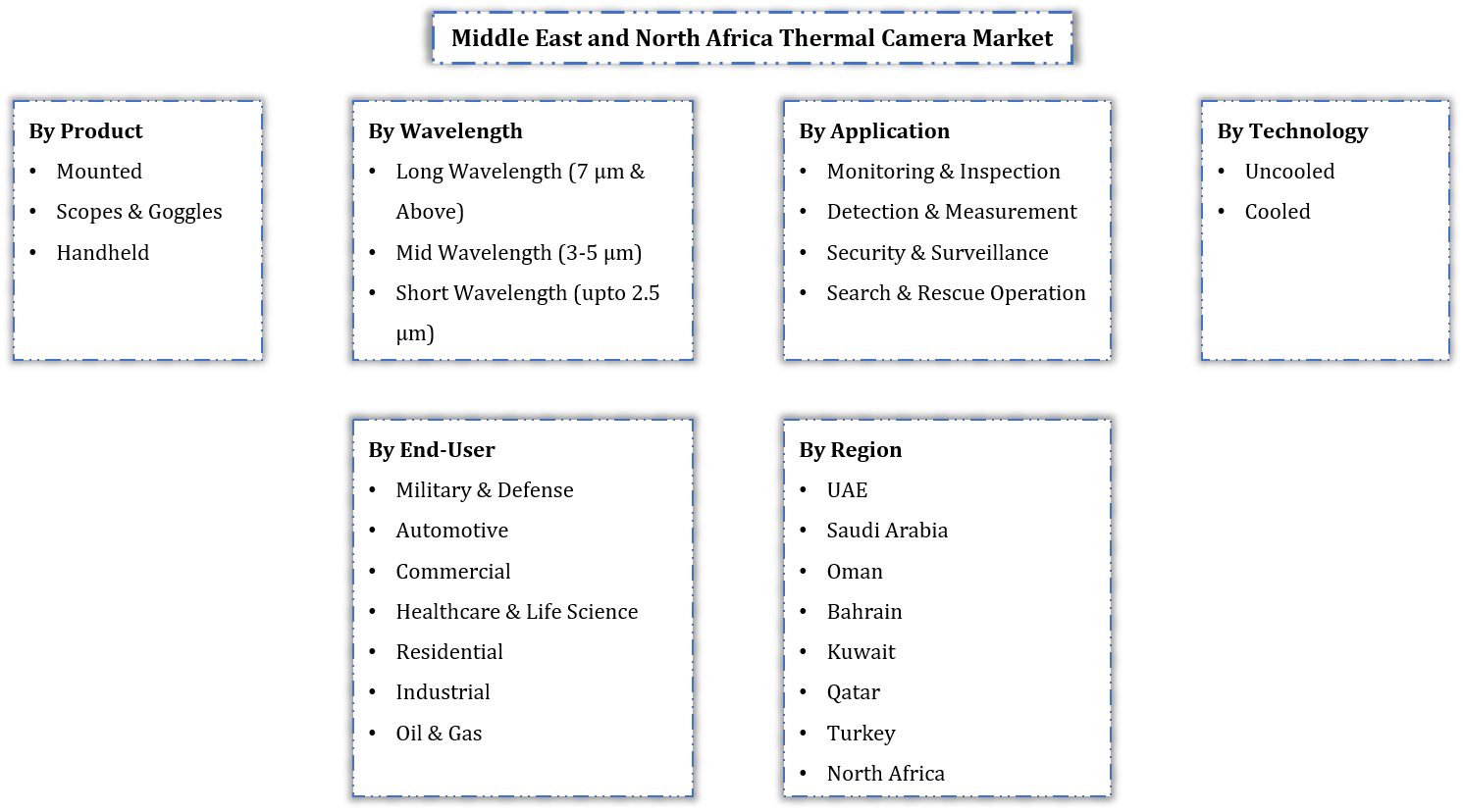
By Product (Mounted, Scopes & Goggles, Handheld), By Wavelength (Long Wavelength (7 µm & Above), Mid Wavelength (3-5 µm), Short Wavelength (up to 2.5 µm)), By Technology (Uncooled, Cooled), By End-Use... ... ed, Cooled), By End-User (Military & Defense, Automotive, Commercial, Healthcare & Life Science, Residential, Industrial, Oil & Gas), By Application (Monitoring & Inspection, Detection & Measurement, Security & Surveillance, Search & Rescue Operation), By Country (UAE, Saudi Arabia, Oman, Bahrain, Kuwait, Qatar, Turkey, North Africa), By Competitors (Flir System, Thermoteknix Systems Ltd., Leonardo S.p.A., Synectics plc, Seek Thermal, InfraTec GmbH Infrarotsensorik, Axis Communications AB, Opgal Optronic Industries Ltd.) Read more
- ICT & Electronics
- Jan 2022
- 165
- PDF, Excel, PPT
Market Definition
A thermal camera is a device that forms an image using infrared radiations as well as the thermal energies of objects. All organisms & objects produce some amount of heat. Thermal cameras act as heat sensor that represents the temperature of the object. The image formed by thermal cameras is a visual capture of the heat. The higher the amount of heat emitted by the object, the brighter the image appears.
Thermal cameras can be used in different environments & situations without the need for any ambient light. Owing to these benefits, these cameras are beneficial in most challenging conditions like smoke, fog, haze, etc., and help respond to accidents immediately. As a result, they are gaining traction across the Middle East & North Africa.
Market insights
The Middle East and North Africa Thermal Camera Market is anticipated to grow at a CAGR of around 13% during the forecast period, i.e., 2021-26. The growth of the market attributes primarily to the burgeoning adoption of thermal cameras in security & surveillance applications. The need for surveillance has increased across various applications, including military & defense, several other public places, etc.
Moreover, the increasing applications of thermal cameras, such as rescue operations, crime investigation, road safety, etc., have also augmented the overall market growth. Thermal cameras are also beneficial for firefighters to locate hotspots and see through smoke, which can help prevent huge accidents. Additionally, the rising preference for Advanced Driver-Assistance Systems (ADAS) and mounting demand for wireless temperature sensors are other crucial factors driving the Thermal Camera Market across the Middle East & North Africa.
Furthermore, the manufacturing sector in the region is also experiencing the increasing adoption of thermal cameras for ensuring product quality. Thermal cameras help detect hotspots of any operational discontinuity or damage of any equipment that could cause massive production losses & manufacturing downtime.
| Report Coverage | Details |
|---|---|
| Study Period | Historical Data: 2016-19 |
| Base Year: 2020 | |
| Forecast Period: 2021-26 | |
| CAGR (2021-2026) | 13% |
| Countries Covered | UAE, Saudi Arabia, Oman, Bahrain, Kuwait, Qatar, Turkey, North Africa |
| Key Companies Profiled | Flir System, Thermoteknix Systems Ltd., Leonardo S.p.A., Synectics plc, Seek Thermal, InfraTec GmbH Infrarotsensorik, Axis Communications AB, Opgal Optronic Industries Ltd. |
| Unit Denominations | USD Million/Billion |
Impact of Covid-19 on the Middle East and North Africa Thermal Camera Market
The Covid-19 pandemic in 2020 resulted in the slowdown of economic growth across the Middle East & North Africa. The rising need to contain the spread of disease led to the closure of international, national, & local borders and other significant travel restrictions. Disruption in the supply chain, production capacities, & customer activity amidst the crisis has negatively influenced the thermal camera market across the region by affecting the sales & deliveries of thermal cameras.
However, thermal cameras have been playing a vital role in detecting the temperature levels of individuals, which is crucial for identifying persons with Covid-19 symptoms. Hence, the demand for thermal cameras gained momentum in the healthcare sector. With the rising adversity of the Covid-19 disease, the need for installing thermal cameras at public places like airports, malls, railway stations, etc., significantly surged. Therefore, with the enforcement of social distancing norms, the demand for such solutions is gaining popularity at public places to trace Covid-19 patients.
- Introduction
- Product Definition
- Research Process
- Market Segmentation
- Assumptions
- Preface
- Executive Summary
- Impact of COVID-19 on Middle East and North Africa Thermal Camera Market
- Middle East and North Africa Thermal Camera Market Outlook, 2016-2026F
- Market Size & Analysis
- Revenues
- Market Share & Analysis
- By Product
- Mounted
- Scopes & Goggles
- Handheld
- By Wavelength
- Long Wavelength (7 µm & Above)
- Mid Wavelength (3-5 µm)
- Short Wavelength (upto 2.5 µm)
- By Technology
- Uncooled
- Cooled
- By End User
- Military & Defense
- Automotive
- Commercial
- Healthcare & Life Science
- Residential
- Industrial
- Oil & Gas
- By Application
- Monitoring & Inspection
- Detection & Measurement
- Security & Surveillance
- Search & Rescue Operation
- By Country
- UAE
- Saudi Arabia
- Oman
- Bahrain
- Kuwait
- Qatar
- Turkey
- North Africa
- By Company
- Competition Characteristics
- Market Share & Analysis
- Competitive Matrix
- By Product
- Market Size & Analysis
- UAE Thermal Camera Market Outlook, 2016-2026F
- Market Size & Analysis
- Revenues
- Market Share & Analysis
- By Product
- By Wavelength
- By Technology
- By End User
- By Application
- Market Size & Analysis
- Saudi Arabia Thermal Camera Market Outlook, 2016-2026F
- Market Size & Analysis
- Revenues
- Market Share & Analysis
- By Product
- By Wavelength
- By Technology
- By End User
- By Application
- Market Size & Analysis
- Oman Thermal Camera Market Outlook, 2016-2026F
- Market Size & Analysis
- Revenues
- Market Share & Analysis
- By Product
- By Wavelength
- By Technology
- By End User
- By Application
- Market Size & Analysis
- Bahrain Thermal Camera Market Outlook, 2016-2026F
- Market Size & Analysis
- Revenues
- Market Share & Analysis
- By Product
- By Wavelength
- By Technology
- By End User
- By Application
- Market Size & Analysis
- Kuwait Thermal Camera Market Outlook, 2016-2026F
- Market Size & Analysis
- Revenues
- Market Share & Analysis
- By Product
- By Wavelength
- By Technology
- By End User
- By Application
- Market Size & Analysis
- Qatar Thermal Camera Market Outlook, 2016-2026F
- Market Size & Analysis
- Revenues
- Market Share & Analysis
- By Product
- By Wavelength
- By Technology
- By End User
- By Application
- Market Size & Analysis
- Turkey Thermal Camera Market Outlook, 2016-2026F
- Market Size & Analysis
- Revenues
- Market Share & Analysis
- By Product
- By Wavelength
- By Technology
- By End User
- By Application
- Market Size & Analysis
- North Africa Thermal Camera Market Outlook, 2016-2026F
- Market Size & Analysis
- Revenues
- Market Share & Analysis
- By Product
- By Wavelength
- By Technology
- By End User
- By Application
- Market Size & Analysis
- Middle East and North Africa Thermal Camera Market Dynamics
- Growth Drivers
- Challenges
- Impact Analysis
- Middle East and North Africa Thermal Camera Market Policies, Regulations, Product Standards
- Middle East and North Africa Thermal Camera Market Trends & Insights
- Middle East and North Africa Thermal Camera Market Hotspot & Opportunities
- Middle East and North Africa Thermal Camera Market Key Strategic Imperatives for Success & Growth
- Competition Outlook
- Competition Matrix
- Product/ Solution Portfolio
- Target Markets
- Target End Users
- Research & Development
- Strategic Alliances
- Strategic Initiatives
- Company Profiles of Top Companies (Business Description, Product Segments, Business Segments, Financials, Strategic Alliances/ Partnerships, Future Plans)
- Flir System
- Thermoteknix Systems Ltd.
- Leonardo S.p.A.
- Synectics plc
- Seek Thermal
- InfraTec GmbH Infrarotsensorik
- Axis Communications AB
- Opgal Optronic Industries Ltd.
- Competition Matrix
- Disclaimer
MarkNtel Advisors follows a robust and iterative research methodology designed to ensure maximum accuracy and minimize deviation in market estimates and forecasts. Our approach combines both bottom-up and top-down techniques to effectively segment and quantify various aspects of the market. A consistent feature across all our research reports is data triangulation, which examines the market from three distinct perspectives to validate findings. Key components of our research process include:
1. Scope & Research Design At the outset, MarkNtel Advisors define the research objectives and formulate pertinent questions. This phase involves determining the type of research—qualitative or quantitative—and designing a methodology that outlines data collection methods, target demographics, and analytical tools. They also establish timelines and budgets to ensure the research aligns with client goals.
2. Sample Selection and Data Collection In this stage, the firm identifies the target audience and determines the appropriate sample size to ensure representativeness. They employ various sampling methods, such as random or stratified sampling, based on the research objectives. Data collection is carried out using tools like surveys, interviews, and observations, ensuring the gathered data is reliable and relevant.
3. Data Analysis and Validation Once data is collected, MarkNtel Advisors undertake a rigorous analysis process. This includes cleaning the data to remove inconsistencies, employing statistical software for quantitative analysis, and thematic analysis for qualitative data. Validation steps are taken to ensure the accuracy and reliability of the findings, minimizing biases and errors.

4. Data Forecast and FinalizationThe final phase involves forecasting future market trends based on the analyzed data. MarkNtel Advisors utilize predictive modeling and time series analysis to anticipate market behaviors. The insights are then compiled into comprehensive reports, featuring visual aids like charts and graphs, and include strategic recommendations to inform client decision-making
We offer flexible licensing options to cater to varying organizational needs. Choose the pricing pack that best suits your requirements:
Buy Now Inquire Before Buying
 Request Customization