

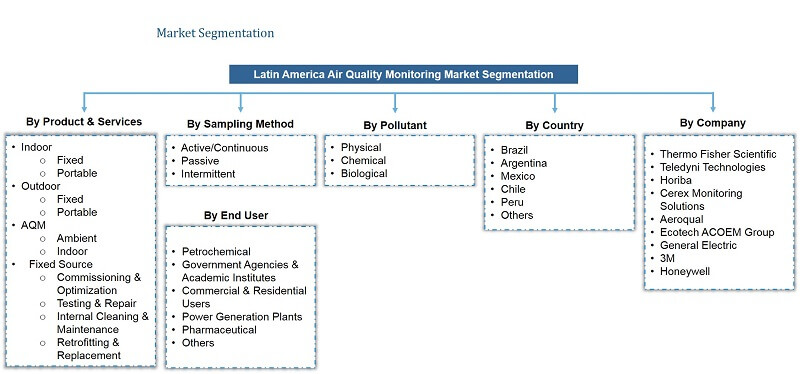
By Products & Services (Indoor (Fixed, Portable), Outdoor (Fixed, Portable), AQM (Ambient, Indoor), Fixed Source (Commissioning & Optimization, Testing & Repairs, Internal Cleaning & Maintenance, Retr... ... & Maintenance, Retrofitting or Replacement Services)), By Sampling Method (Active/Continuous, Passive, Intermittent), By Pollutant (Physical, Chemical, Biological), By End User (Commercial & Residential, Petrochemical Market, Government Agencies & Industries, Power Generation Plants, Pharmaceutical Market), By Country (Brazil, Mexico, Argentina, Peru, Chile), By Competitors (Thermo Fisher Scientific, Teledyne Technologies, Horiba, Cerex Monitoring Solutions, Aeroqual, Ecotech ACOEM Group, General Electric, 3M, Honeywell) Read more
- Environment
- Jan 2022
- 173
- PDF, Excel, PPT
Market Definition
Air quality monitoring systems are used primarily for measuring the level of pollutants, dust, & contaminants present in the air. There are different types of these monitors available, like indoor & outdoor, based on the setting. These devices have applications in various verticals like government agencies, education institutions, the pharmaceutical sector, commercial & residential sectors, etc.
Market Insights
The Latin America Air Quality Monitoring Market is projected to grow at a CAGR of around 6% during the forecast period, i.e., 2022-27. The market is driven primarily by the advent of advanced technologies like the Internet of Things (IoT) & Cloud Computing, along with components like detection sensors & microcontrollers. These advances & components enable Air Quality Monitoring Devices to detect Carbon Monoxide, Carbon Dioxide, Aerosol Concentration, Humidity, etc., present in the air. It, in turn, is soaring the demand for these systems to keep a check on pollution levels and seek ways to enhance the air quality.
In addition, several industries deploying air quality monitors, coupled with governments of different countries across Latin America actively laying out stringent regulations & standards to reduce pollution levels & enhance the air quality in indoor & outdoor settings, are also significantly contributing to the overall market growth. In fact, they are spreading awareness among people through programs & campaigns and encouraging them to install air quality monitoring devices. Moreover, with the Covid-19 pandemic in 2020, the market observed a temporary hike since people got compelled to stay at their homes, which instigated the demand for air quality monitoring devices & purifiers.
| Report Coverage | Details |
|---|---|
| Study Period | Historical Data: 2017-20 |
| Base Year: 2021 | |
| Forecast Period: 2022-27 | |
| CAGR (2022-2027) | 6% |
| Countries Covered | Brazil, Mexico, Argentina, Peru, Chile, Others |
| Key Companies Profiled | Thermo Fisher Scientific, Teledyne Technologies, Horiba, Cerex Monitoring Solutions, Aeroqual, Ecotech ACOEM Group, General Electric, 3M, Honeywell |
| Unit Denominations | USD Million/Billion |
Impact of Covid-19 on the Latin America Air Quality Monitoring Market
The emergence of the Covid-19 pandemic had a decelerating effect on most industries across Latin America, which did fluctuate the dynamics of the Air Quality Monitoring Market. While the governments of different countries in the region imposed stringent movement restrictions & lockdowns to curb the spread of this dreadful disease, most manufacturing units got shut & the entire supply chain got severely hampered.
The industry also witnessed challenges like shortage of labor & raw materials, delays in delivering pre-produced products, cancellation of projects, and no new production, among various others, which, in turn, resulted in massive financial losses to the leading players in the industry.
However, the gradual improvement in the pandemic situation with a gradually reducing number of cases made governments across Latin America uplift restrictions & allow the recommencement of business operations, which enabled the market to regain its usual growth pace & recover from losses slowly. Nonetheless, the market is also displaying remunerative growth opportunities for the leading players and instigating them to introduce innovations in products to drive the market during 2022-27.
- Introduction
- Product Definition
- Research Process
- Glossary
- Market Segmentation
- Executive Summary
- Latin America Air Quality Monitoring Market Outlook, 2017-2027F
- Market Size & Analysis
- Market Revenues
- Market Share & Analysis
- By Product & Services
- By Products
- Indoor
- Fixed
- Portable
- Outdoor
- Fixed
- Portable
- Indoor
- By Services
- AQM
- Ambient
- Indoor
- Fixed Source
- Commissioning & Optimization
- Testing & Repairs
- Internal Cleaning & Maintenance
- Retrofitting or Replacement Services
- AQM
- By Products
- By Sampling Method
- Active/Continuous
- Passive
- Intermittent
- By Pollutant
- Physical
- Chemical
- Biological
- By End User
- Petrochemical
- Government Agencies and Academic Institutes
- Commercial and Residential Users
- Power Generation Plants
- Pharmaceutical
- Others
- By Country
- Brazil
- Argentina
- Mexico
- Chile
- Peru
- Others
- By Company
- Revenue Shares
- Strategic Factorial Indexing
- Competitors Alignment in MarkNtel Competition Quadrants
- By Product & Services
- Market Size & Analysis
- Mexico Air Quality Monitoring Market Outlook, 2017-2027F
- Market Potential & Outlook
- Market Revenues
- Market Segmentation & Outlook
- By Product & Services
- By Sampling Method
- By Pollutant
- By End User
- Market Potential & Outlook
- Chile Air Quality Monitoring Market Outlook, 2017-2027F
- Market Potential & Outlook
- Market Revenues
- Market Segmentation & Outlook
- By Product & Services
- By Sampling Method
- By Pollutant
- By End User
- Market Potential & Outlook
- Brazil Air Quality Monitoring Market Outlook, 2017-2027F
- Market Potential & Outlook
- Market Revenues
- Market Segmentation & Outlook
- By Product & Services
- By Product
- By Services
- By Sampling Method
- By Pollutant
- By End User
- By Product & Services
- Market Potential & Outlook
- Argentina Air Quality Monitoring Market Outlook, 2017-2027F
- Market Potential & Outlook
- Market Revenues
- Market Segmentation & Outlook
- By Product & Services
- By Sampling Method
- By Pollutant
- By End User
- Market Potential & Outlook
- Peru Air Quality Monitoring Market Outlook, 2017-2027F
- Market Potential & Outlook
- Market Revenues
- Market Segmentation & Outlook
- By Product & Services
- By Sampling Method
- By Pollutant
- By End User
- Market Potential & Outlook
- Latin America Air Quality Monitoring Market Dynamics
- Impact Analysis
- Drivers
- Challenges
- Latin America Air Quality Monitoring Market Recent Trends & Developments
- Latin America Air Quality Monitoring Market Regulatory Framework
- Competition Outlook
- Competition Matrix
- Product Portfolio
- Target Markets
- Target End Users
- Research & Development
- Strategic Alliances
- Company Profiles (Business Description, Product Offering, Strategic Alliances or Partnerships, etc)
- Thermo Fisher Scientific
- Teledyne Technologies
- Horiba
- Cerex Monitoring Solutions
- Aeroqual
- Ecotech ACOEM Group
- General Electric
- 3M
- Honeywell
- Competition Matrix
- Disclaimer
MarkNtel Advisors follows a robust and iterative research methodology designed to ensure maximum accuracy and minimize deviation in market estimates and forecasts. Our approach combines both bottom-up and top-down techniques to effectively segment and quantify various aspects of the market. A consistent feature across all our research reports is data triangulation, which examines the market from three distinct perspectives to validate findings. Key components of our research process include:
1. Scope & Research Design At the outset, MarkNtel Advisors define the research objectives and formulate pertinent questions. This phase involves determining the type of research—qualitative or quantitative—and designing a methodology that outlines data collection methods, target demographics, and analytical tools. They also establish timelines and budgets to ensure the research aligns with client goals.
2. Sample Selection and Data Collection In this stage, the firm identifies the target audience and determines the appropriate sample size to ensure representativeness. They employ various sampling methods, such as random or stratified sampling, based on the research objectives. Data collection is carried out using tools like surveys, interviews, and observations, ensuring the gathered data is reliable and relevant.
3. Data Analysis and Validation Once data is collected, MarkNtel Advisors undertake a rigorous analysis process. This includes cleaning the data to remove inconsistencies, employing statistical software for quantitative analysis, and thematic analysis for qualitative data. Validation steps are taken to ensure the accuracy and reliability of the findings, minimizing biases and errors.

4. Data Forecast and FinalizationThe final phase involves forecasting future market trends based on the analyzed data. MarkNtel Advisors utilize predictive modeling and time series analysis to anticipate market behaviors. The insights are then compiled into comprehensive reports, featuring visual aids like charts and graphs, and include strategic recommendations to inform client decision-making
We offer flexible licensing options to cater to varying organizational needs. Choose the pricing pack that best suits your requirements:
Buy Now Inquire Before Buying
 Request Customization