

By Service (Discovery & Chemistry Services (Medicinal Chemistry, Computational Chemistry, Custom Synthesis, Compound Management, Process R&D), Bioanalysis & DMPK Studies (In Vitro ADME, In Vivo PK, Bi... ... ADME, In Vivo PK, Bioanalytical Testing), Toxicology Studies (GLP Toxicology, Non-GLP Toxicology), Safety Pharmacology, Pharmacology & Efficacy Studies, Other Preclinical Services), By Model Type (In Vitro Models, In Vivo Models, Ex Vivo Models, Patient-Derived Organoid (PDO) Models, Patient-Derived Xenograft (PDX) Models), By End User (Biopharmaceutical Companies, Government & Academic Institutes, Medical Device Companies, Others), and others Read more
- Healthcare
- Jun 2026
- 140
- PDF, Excel, PPT
India Preclinical Research Market Key Takeaways
- The India Pre-Clinical Research Market was valued at USD 186 Million in 2025 and is projected to reach USD 213 Million by 2026 and USD 316 Million by 2032.
- The industry is projected to witness steady growth at a CAGR of 6.79% during 2026–2032.
- In Vivo Models lead the market by model type with an estimated 48.5% market share in 2026.
- Toxicology Studies dominate the market by service segment with an estimated 31.2% share in 2026.
- The market remains moderately fragmented, with the top five companies accounting for approximately 25% of total market share.
India Preclinical Research Market Size and Outlook
The India Pre-Clinical Research Market stood at USD 186 Million in 2025 and is projected to reach USD 316 Million by 2032 from USD 213 Million in 2026, growing at a CAGR of 6.79% during 2026–2032.
The India Preclinical Research Market is supported by increasing outsourcing of early-stage drug development activities, rising pipeline complexity, and growing reliance on preclinical services in India. Pharmaceutical and biotechnology companies are increasingly shifting toward external partners for preclinical studies, enabling faster timelines, improved cost efficiency, and access to specialized scientific capabilities. The market is also benefiting from the growing adoption of structured nonclinical research India workflows across discovery and IND-enabling stages.
According to the India BioEconomy Report, India hosts more than 8,500+ biotech startups as of 2024, making it one of the largest startup ecosystems globally. This expansion is creating a strong upstream innovation base that directly supports demand for preclinical research in India, particularly as healthcare and life sciences startups move from discovery to validation and regulatory submission stages. In addition, increasing venture capital inflows into biotech and health-tech segments are accelerating early-stage research activities requiring outsourced toxicology, pharmacology, and DMPK support.
Furthermore, the Indian Council of Medical Research supported research initiatives (2024), India continues to strengthen its translational research ecosystem through structured early-phase development programs and expanding clinical readiness infrastructure. This is reinforcing demand for preclinical drug development in India, especially for IND-enabling packages involving safety pharmacology, bioanalysis, and advanced model-based studies. The increasing integration of GLP-compliant systems and standardized biosafety protocols is further enhancing study quality and improving global acceptance of Indian CRO outputs.
Overall, the preclinical research market in India remains strongly positive, driven by rapid expansion of preclinical services in India, rising adoption of advanced platforms such as organoid and xenograft models, and continuous growth in startup-led innovation. The market is expected to evolve toward higher-value, integrated service models where CROs play a critical role in accelerating translational research and reducing drug development timelines.
India Preclinical Research Market Key Indicators
- According to the Department of Biotechnology (DBT) BioEconomy Report 2024, India’s bioeconomy reached approximately USD 151 billion in 2024, supported by rapid expansion in biotech research, life sciences startups, and R&D outsourcing activity. This growing innovation base is directly strengthening demand for preclinical services such as pharmacology, toxicology, and DMPK studies.
- As per the Indian Pharmaceutical Market (IPM) data reported for FY2024, the domestic pharma industry generated approximately USD 23.5 billion in revenue, with steady mid-to-high single-digit growth. This large-scale formulation and API-driven ecosystem continues to generate consistent demand for toxicology testing, bioanalysis, and DMPK studies.
- The Economic Survey 2024–25 reports that, the India’s total health expenditure in FY22 stood at approximately USD 0.109 trillion, equivalent to 3.8% of GDP, while government health expenditure accounted for 48.0% of total health expenditure. This reflects a strengthening healthcare base and increasing public funding support for research-led and translational healthcare activity.
- As per the Ministry of Health and Family Welfare, India’s pharmaceutical market for FY 2023–24 was valued at USD 50 billion, including domestic consumption of USD 23.5 billion. The size of the domestic pharma base directly supports outsourcing demand for preclinical toxicology, DMPK, pharmacology, and chemistry services.
- According to ICMR’s Phase I Clinical Trial Network, India has 4 dedicated Phase I institutions, and ICMR’s 2024 dengue vaccine program moved into a Phase III trial across 19 sites with more than 10,335 participants. This shows a strengthening clinical development pipeline and supports demand for India-enabling preclinical packages.
India Preclinical Research Market Scope
| Category | Segments |
|---|---|
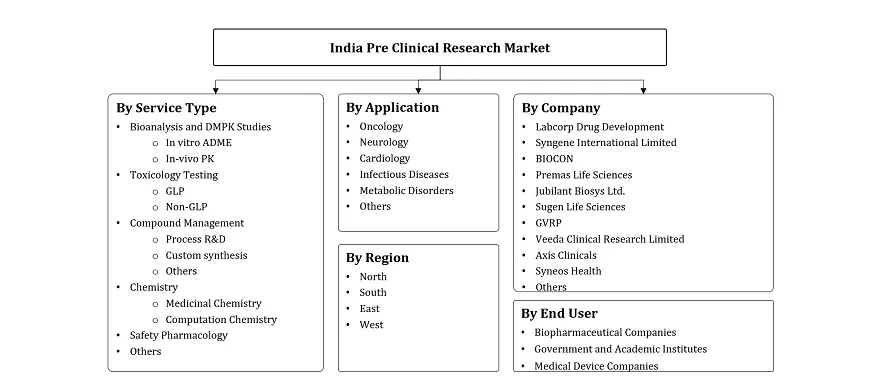
| By Service | Discovery & Chemistry Services (Medicinal Chemistry, Computational Chemistry, Custom Synthesis, Compound Management, Process R&D), Bioanalysis & DMPK Studies (In Vitro ADME, In Vivo PK, Bioanalytical Testing), Toxicology Studies (GLP Toxicology, Non-GLP Toxicology), Safety Pharmacology, Pharmacology & Efficacy Studies, Other Preclinical Services |
| By Model Type | In Vitro Models, In Vivo Models, Ex Vivo Models, Patient-Derived Organoid (PDO) Models, Patient-Derived Xenograft (PDX) Models |
| By End User | Biopharmaceutical Companies, Government & Academic Institutes, Medical Device Companies, Others |
India Preclinical Research Market Growth Driver
Policy and Innovation-Led Drivers in the India Preclinical Research Market
India’s pre-clinical research ecosystem is witnessing strong momentum due to government-led biotechnology and biomanufacturing initiatives. According to PIB, the Bio-RIDE program (2024) has allocated nearly USD 180 million to support biofoundries and biomanufacturing hubs, strengthening early-stage innovation capacity. This is accelerating demand for preclinical studies in India as more discovery-stage programs progress toward structured validation and IND-enabling development supported by institutional frameworks and translational research programs.
In addition, Funding and industrial incentives are significantly boosting India's research infrastructure. Under the Department of Pharmaceuticals, the landmark Production Linked Incentive (PLI) scheme for medical devices provides an outlay of USD 410 million. This initiative is strategically designed to strengthen domestic manufacturing and foster innovation ecosystems. Improving access to advanced infrastructure directly drives higher demand for the country's preclinical research market and early-stage drug development support services.
- Market Segmentation
- Introduction
2.1. Product Definition
2.2. Research Process
2.3. Assumptions
- Executive Summary
- India Preclinical Research Market Trends & Developments
- India Preclinical Research Market Dynamics
5.1. Growth Drivers
5.2. Challenges
- India Preclinical Research Market Hotspot & Opportunities
- India Preclinical Research Market Outlook, 2022-2032F
7.1. Market Size & Outlook
7.1.1. By Revenues (USD Million)
7.2. Market Share & Outlook
7.2.1. By Service- Market Size & Forecast 2022-2032, USD Million
7.2.1.1. Discovery & Chemistry Services
7.2.1.1.1. Medicinal Chemistry
7.2.1.1.2. Computational Chemistry
7.2.1.1.3. Custom Synthesis
7.2.1.1.4. Compound Management
7.2.1.1.5. Process R&D
7.2.1.2. Bioanalysis & DMPK Studies
7.2.1.2.1. In Vitro ADME
7.2.1.2.2. In Vivo PK
7.2.1.2.3. Bioanalytical Testing
7.2.1.3. Toxicology Studies
7.2.1.3.1. GLP Toxicology
7.2.1.3.2. Non-GLP Toxicology
7.2.1.4. Safety Pharmacology
7.2.1.5. Pharmacology & Efficacy Studies
7.2.1.6. Other Preclinical Services
7.2.2. By Model Type- Market Size & Forecast 2022-2032, USD Million
7.2.2.1. In Vitro Models
7.2.2.2. In Vivo Models
7.2.2.3. Ex Vivo Models
7.2.2.4. Patient-Derived Organoid (PDO) Models
7.2.2.5. Patient-Derived Xenograft (PDX) Models
7.2.3. By End User- Market Size & Forecast 2022-2032, USD Million
7.2.3.1. Biopharmaceutical Companies
7.2.3.2. Government & Academic Institutes
7.2.3.3. Medical Device Companies
7.2.3.4. Others
7.2.4. By Region
7.2.4.1. North India
7.2.4.2. East India
7.2.4.3. West India
7.2.4.4. South India
7.2.5. By Company
7.2.5.1. Competition Characteristics
7.2.5.2. Market Share & Analysis
- North India Preclinical Research Market Outlook, 2022-2032F
8.1. Market Size & Outlook
8.1.1. By Revenues (USD Million)
8.2. Market Share & Outlook
8.2.1. By Service- Market Size & Forecast 2022-2032, USD Million
8.2.2. By Model Type- Market Size & Forecast 2022-2032, USD Million
8.2.3. By End User- Market Size & Forecast 2022-2032, USD Million
- South India Preclinical Research Market Outlook, 2022-2032F
9.1. Market Size & Outlook
9.1.1. By Revenues (USD Million)
9.2. Market Share & Outlook
9.2.1. By Service- Market Size & Forecast 2022-2032, USD Million
9.2.2. By Model Type- Market Size & Forecast 2022-2032, USD Million
9.2.3. By End User- Market Size & Forecast 2022-2032, USD Million
- West India Preclinical Research Market Outlook, 2022-2032F
10.1. Market Size & Outlook
10.1.1. By Revenues (USD Million)
10.2. Market Share & Outlook
10.2.1. By Service- Market Size & Forecast 2022-2032, USD Million
10.2.2. By Model Type- Market Size & Forecast 2022-2032, USD Million
10.2.3. By End User- Market Size & Forecast 2022-2032, USD Million
- East India Preclinical Research Market Outlook, 2022-2032F
11.1. Market Size & Outlook
11.1.1. By Revenues (USD Million)
11.2. Market Share & Outlook
11.2.1. By Service- Market Size & Forecast 2022-2032, USD Million
11.2.2. By Model Type- Market Size & Forecast 2022-2032, USD Million
11.2.3. By End User- Market Size & Forecast 2022-2032, USD Million
- India Preclinical Research Market Key Strategic Imperatives for Success & Growth
- Competitive Outlook
13.1. Company Profiles
13.1.1. Syngene International Ltd.
13.1.1.1. Business Description
13.1.1.2. Product Portfolio
13.1.1.3. Strategic Alliances or Partnerships
13.1.1.4. Recent Developments
13.1.1.5. Financial Details
13.1.1.6. Others
13.1.2. Jubilant Biosys Limited
13.1.2.1. Business Description
13.1.2.2. Product Portfolio
13.1.2.3. Strategic Alliances or Partnerships
13.1.2.4. Recent Developments
13.1.2.5. Financial Details
13.1.2.6. Others
13.1.3. Aragen Life Sciences Ltd.
13.1.3.1. Business Description
13.1.3.2. Product Portfolio
13.1.3.3. Strategic Alliances or Partnerships
13.1.3.4. Recent Developments
13.1.3.5. Financial Details
13.1.3.6. Others
13.1.4. Eurofins Advinus Limited
13.1.4.1. Business Description
13.1.4.2. Product Portfolio
13.1.4.3. Strategic Alliances or Partnerships
13.1.4.4. Recent Developments
13.1.4.5. Financial Details
13.1.4.6. Others
13.1.5. Veeda Clinical Research Limited
13.1.5.1. Business Description
13.1.5.2. Product Portfolio
13.1.5.3. Strategic Alliances or Partnerships
13.1.5.4. Recent Developments
13.1.5.5. Financial Details
13.1.5.6. Others
13.1.6. Bioneeds India Private Limited
13.1.6.1. Business Description
13.1.6.2. Product Portfolio
13.1.6.3. Strategic Alliances or Partnerships
13.1.6.4. Recent Developments
13.1.6.5. Financial Details
13.1.6.6. Others
13.1.7. TCG Lifesciences Private Limited
13.1.7.1. Business Description
13.1.7.2. Product Portfolio
13.1.7.3. Strategic Alliances or Partnerships
13.1.7.4. Recent Developments
13.1.7.5. Financial Details
13.1.7.6. Others
13.1.8. TheraIndx Lifesciences Pvt. Ltd.
13.1.8.1. Business Description
13.1.8.2. Product Portfolio
13.1.8.3. Strategic Alliances or Partnerships
13.1.8.4. Recent Developments
13.1.8.5. Financial Details
13.1.8.6. Others
13.1.9. Accutest Research Laboratories Pvt. Ltd.
13.1.9.1. Business Description
13.1.9.2. Product Portfolio
13.1.9.3. Strategic Alliances or Partnerships
13.1.9.4. Recent Developments
13.1.9.5. Financial Details
13.1.9.6. Others
13.1.10. JSS Medical Research Asia Pacific Private Limited
13.1.10.1. Business Description
13.1.10.2. Product Portfolio
13.1.10.3. Strategic Alliances or Partnerships
13.1.10.4. Recent Developments
13.1.10.5. Financial Details
13.1.10.6. Others
13.1.11. Others
- Disclaimer
MarkNtel Advisors follows a robust and iterative research methodology designed to ensure maximum accuracy and minimize deviation in market estimates and forecasts. Our approach combines both bottom-up and top-down techniques to effectively segment and quantify various aspects of the market. A consistent feature across all our research reports is data triangulation, which examines the market from three distinct perspectives to validate findings. Key components of our research process include:
1. Scope & Research Design At the outset, MarkNtel Advisors define the research objectives and formulate pertinent questions. This phase involves determining the type of research—qualitative or quantitative—and designing a methodology that outlines data collection methods, target demographics, and analytical tools. They also establish timelines and budgets to ensure the research aligns with client goals.
2. Sample Selection and Data Collection In this stage, the firm identifies the target audience and determines the appropriate sample size to ensure representativeness. They employ various sampling methods, such as random or stratified sampling, based on the research objectives. Data collection is carried out using tools like surveys, interviews, and observations, ensuring the gathered data is reliable and relevant.
3. Data Analysis and Validation Once data is collected, MarkNtel Advisors undertake a rigorous analysis process. This includes cleaning the data to remove inconsistencies, employing statistical software for quantitative analysis, and thematic analysis for qualitative data. Validation steps are taken to ensure the accuracy and reliability of the findings, minimizing biases and errors.

4. Data Forecast and FinalizationThe final phase involves forecasting future market trends based on the analyzed data. MarkNtel Advisors utilize predictive modeling and time series analysis to anticipate market behaviors. The insights are then compiled into comprehensive reports, featuring visual aids like charts and graphs, and include strategic recommendations to inform client decision-making
We offer flexible licensing options to cater to varying organizational needs. Choose the pricing pack that best suits your requirements:
Buy Now Inquire Before Buying
 Request Customization