

By Satellite Mass (Nanosatellite (1–10 kg), Microsatellite (>10–100 kg)), By Satellite Component (Satellite Bus, Payload), By Application (Earth Observation & Remote Sensing, Communication, Scientific... ... ommunication, Scientific Research & Space Science, Technology Demonstration & Verification, Others), By End User (Government & Civil Space Agencies, Defence, Commercial, Academic & Research Institutions), and others Read more
- Aerospace & Defense
- Aug 2026
- 165
- PDF, Excel, PPT
India Nanosatellite and Microsatellite Market Key Takeaways
- The India nanosatellite and microsatellite market stood at around USD 210 million in 2025 and is anticipated to expand from USD 247.59 million in 2026 to USD 664.99 million by 2032, reflecting a CAGR of 17.9% over the forecast period.
- South India led the market with 48% regional share in 2026.
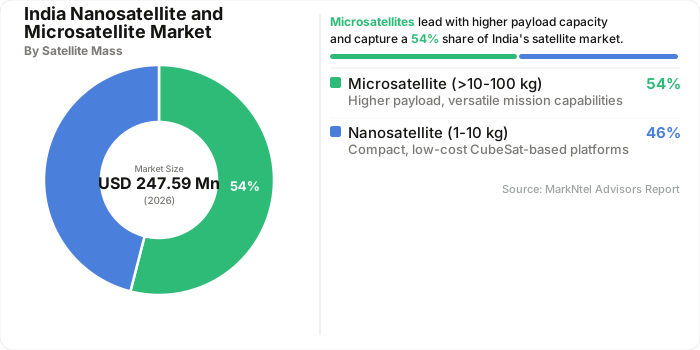
- Microsatellite (>10–100 kg) led the by-satellite-mass segment with 54% share in 2026.
- Earth observation and remote sensing led the application segment with 42% share in 2026.
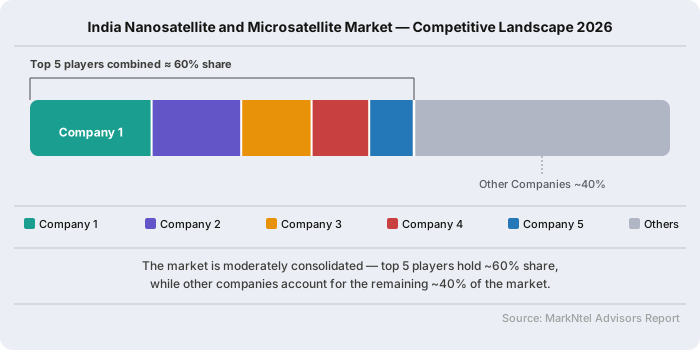
- The industry is moderately consolidated, with the top five leading players accounting for approximately 60% of the total market share.
India Nanosatellite and Microsatellite Market Size and Outlook
India’s growing demand for earth observation, communications, and space situational awareness is increasing the need for satellite architectures that can be deployed more rapidly and cost-effectively than traditional large-satellite systems. This shift is supported by sustained government investment, with the Department of Space’s budget rising from USD 1.41 billion in FY2025–26 to USD 1.44 billion in FY2026–27, according to Ministry of Finance budget documents. Nanosatellites and microsatellites are consequently evolving beyond academic and technology-demonstration missions toward operational applications, including commercial Earth observation, space situational awareness, and defense communications. This transition is creating opportunities for indigenous satellite-bus manufacturing, payload development, and constellation-based services. Supported by these structural developments, the nanosatellite and microsatellite market in India was valued at USD 210 million in 2025, reached USD 247.59 million in 2026, and is projected to reach USD 664.99 million by 2032, registering a CAGR of 17.9% during 2026–2032.
India Nanosatellite and Microsatellite Market Key Indicators
- India's space-sector FDI liberalization is widening access to international capital and technology. The Union Cabinet approved 100% FDI in the space sector in February 2024, including automatic-route investment of up to 74% in satellite manufacturing and operations, which is lowering entry barriers for private satellite companies and supporting capacity expansion in nanosatellite and microsatellite development.
- The Antariksh Venture Capital Fund is strengthening access to growth capital for India's private space ecosystem. Anchored by a USD 105 million commitment from IN-SPACe, the fund closed its first tranche at USD 105.6 million in November 2025, improving financing availability for Indian companies developing satellite platforms, payloads, and associated space technologies.
- Hindustan Aeronautics Limited's September 2025 technology-transfer agreement for Small Satellite Launch Vehicle production is expanding India's indigenous launch ecosystem. The agreement with ISRO, NSIL, and IN-SPACe is expected to support domestic SSLV manufacturing at scale, improving launch availability for nanosatellite and microsatellite missions and reducing dependence on external launch providers.
- India's space economy is projected to expand from approximately USD 8.4 billion to USD 44 billion by 2033, according to the Union Minister of State for Science and Technology. The projected expansion reflects increasing commercial activity across satellite manufacturing, launch services, space applications, and downstream technologies, creating a larger addressable market for nanosatellite and microsatellite developers.
- The National Geospatial Mission received an allocation of approximately USD 10.5 million under India's Union Budget 2025–26, supporting foundational geospatial infrastructure and data development. Expansion of national geospatial capabilities is expected to increase demand for high-resolution and frequently updated Earth observation data, creating additional opportunities for nanosatellite and microsatellite operators and EO payload developers.
India Nanosatellite and Microsatellite Market Scope
| Category | Segments |
|---|---|
| By Satellite Mass | Nanosatellite (1–10 kg), Microsatellite (>10–100 kg |
| By Satellite Component | Satellite Bus, Payload |
| By Application | Earth Observation & Remote Sensing, Communication, Scientific Research & Space Science, Technology Demonstration & Verification, Others |
| By End User | Government & Civil Space Agencies, Defence, Commercial, Academic & Research Institutions |
India Nanosatellite and Microsatellite Market Growth Drivers
Rising Demand for Earth Observation and Remote-Sensing Data
The increasing use of satellite-based earth observation across agriculture, environmental monitoring, infrastructure planning, and resource management is creating stronger demand for timely and high-resolution remote-sensing data in India. Government programs are accelerating this shift by incorporating satellite-derived information into operational activities. India's flagship crop insurance program, the Pradhan Mantri Fasal Bima Yojana (PMFBY), was extended through 2025–26 with a total outlay of USD 730 million, according to a Union Cabinet approval reported by the Press Information Bureau. The scheme uses satellite-based remote sensing through the Yield Estimation System (YES-TECH) for crop-area and yield assessment, highlighting how earth observation satellite adoption is becoming increasingly embedded in government applications.
This growing institutional requirement is encouraging investment in additional satellite capacity. In August 2025, IN-SPACe awarded a USD 126 million contract to a Pixxel-led consortium, comprising Dhruva Space, SatSure, and PierSight, to build, launch, and operate a 12-satellite indigenous Earth Observation constellation. The initiative is expanding India's domestic EO infrastructure and increasing demand for small-satellite platforms and advanced payloads, including hyperspectral and SAR technologies, creating sustained opportunities for India's nanosatellite and microsatellite manufacturing ecosystem.
Recent Trends
Shift from Individual Satellites Toward Multi-Satellite Constellations
Indian nanosatellite and microsatellite operators are increasingly shifting from individual spacecraft toward multi-satellite constellations to achieve wider coverage, higher revisit frequency, and more continuous data availability. This shift reflects satellite constellation trends across India's commercial space sector, where operators are increasingly adopting repeatable spacecraft architectures instead of relying on isolated missions. Pixxel completed the first phase of its Firefly hyperspectral Earth observation constellation in August 2025, expanding its operational fleet to six satellites and advancing development of its next-generation Honeybee constellation. The transition toward multiple spacecraft also enables operators to distribute mission capabilities across satellites, improve redundancy, and scale services as customer requirements increase.
The trend is extending beyond Earth observation into space situational awareness and defense applications. Digantara's SCOT space-surveillance satellite was launched in January 2025, followed by plans to deploy 15 additional surveillance satellites and two dedicated missile-warning satellites during 2026–27. These developments demonstrate the expansion of small satellite constellation development in India, creating recurring requirements for standardized spacecraft platforms, advanced payloads, satellite integration, and repeat manufacturing. As constellation architectures gain wider application, they are expected to strengthen domestic demand for nanosatellite and microsatellite production capabilities.
India Nanosatellite and Microsatellite Market Opportunities and Challenges
Launch Reliability and Access Constraints Leading to Diversified Orbital Launch Opportunities for Small Satellites
Reliable and timely access to orbit remains important for India's nanosatellite and microsatellite industry, particularly as manufacturers move toward more frequent spacecraft deployment and multi-satellite missions. This dependence was highlighted by the PSLV-C61 failure in May 2025 and the PSLV-C62 failure in January 2026, with the latter resulting in the loss of the EOS-N1 satellite and 15 co-passenger spacecraft, according to ISRO statements. Such disruptions can affect deployment schedules and increase the need for alternative launch arrangements, particularly for operators managing multiple spacecraft or time-sensitive missions.
The emergence of private orbital launch vehicles is gradually expanding these options. On 18 July 2026, Skyroot Aerospace's Vikram-1 successfully reached orbit and deployed technology-demonstration payloads, marking a significant milestone for India's private launch sector. With the vehicle designed to carry payloads of up to 350 kg to low Earth orbit, it can support a substantial range of small satellite platforms. Agnikul Cosmos is also advancing its Agnibaan launch vehicle, further diversifying India's emerging launch ecosystem. As additional launch providers become operational, greater deployment flexibility can support India small satellite manufacturing growth by enabling manufacturers and operators to schedule missions more efficiently and reduce dependence on individual launch programs.
Segmentation Insights
Microsatellite (>10–100 kg) Anchors Mass Segmentation with 54% Share Through Greater Payload and Power Capacity
Microsatellites (>10–100 kg) lead India's nanosatellite and microsatellite mass segmentation because this size class provides greater power, volume, structural capacity, and payload flexibility for higher-performance imaging and sensing missions than typical nanosatellite platforms. This is illustrated by Azista BST Aerospace's ABA First Runner, an approximately 80-kg satellite that falls within the microsatellite range and carries panchromatic and multispectral optical remote-sensing payloads capable of 4.6-meter resolution. The mission demonstrates how Indian satellite manufacturing companies are developing compact spacecraft with increasingly capable payload configurations that require greater onboard resources.
As Indian Earth observation and space-surveillance missions increasingly require higher-resolution imaging, multiple sensing capabilities, and greater onboard subsystem capacity, the additional payload and power flexibility of microsatellite platforms is expected to support their leading position within the mass segmentation. Nanosatellites remain attractive for technology demonstrations, academic missions, and applications where lower spacecraft mass and simpler payload configurations are sufficient. Based on satellite mass, the market has been segmented into:
- Microsatellite (>10–100 kg)
- Nanosatellite (1–10 kg)
Earth Observation and Remote Sensing Leads Application Segmentation with 42% Share
Earth observation and remote sensing leads India's application segmentation as satellite-derived data is increasingly incorporated into recurring government activities covering disaster management, agriculture, rural development, water resources, and infrastructure planning. During 2024, approximately 300 flood-inundation maps were generated from satellite data and provided to State and Central disaster-management agencies, while more than 62.4 million assets and activities were geo-tagged through the Geo-MGNREGA platform using satellite and geospatial inputs. These applications demonstrate the growing institutional reliance on Earth observation for operational monitoring and decision-making.
This established government use is complemented by expanding requirements for agricultural assessment, environmental monitoring, infrastructure planning, and disaster response. As these applications require increasingly frequent and specialized satellite-derived information, demand for dedicated EO platforms and advanced payloads is expected to remain strong. communication, scientific research, and technology demonstration continue to serve more specialized mission requirements. Based on application, the market has been segmented into:
- Earth Observation and Remote Sensing
- Communication
- Scientific Research and Space Science
- Technology Demonstration and Verification
- Others
India Nanosatellite and Microsatellite Market Geographical Outlook
South India leads India nanosatellite and microsatellite market by 48% share, supported by Bengaluru's established aerospace and space-technology ecosystem. Karnataka hosts ISRO's headquarters and the U R Rao Satellite Centre, alongside a large network of companies supplying India's space program. This concentration of established suppliers, specialized engineering capabilities, research institutions, and skilled talent provides South India with a mature ecosystem for satellite design, manufacturing, integration, and testing. The resulting industrial base gives the region an advantage in attracting new private-space companies and supporting the expansion of domestic satellite production.
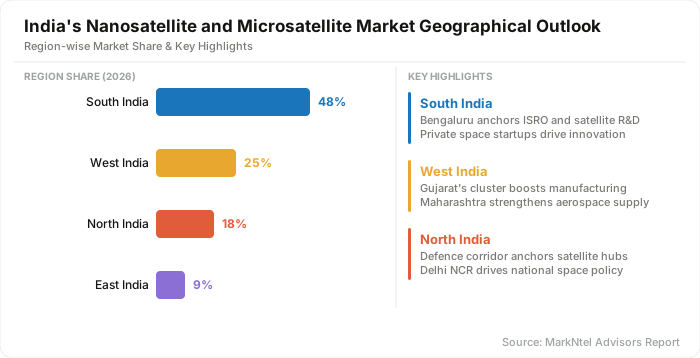
This advantage is being reinforced through state-level space policies and infrastructure investments. Karnataka's Space Technology Policy 2025–30 targets 50% of India's space market and promotes investment in manufacturing, assembly, integration, testing, startups, and space infrastructure. Tamil Nadu's Space Industrial Policy 2025 similarly targets investment in space manufacturing and services, while the upcoming Small Satellite Launch Complex at Kulasekarapattinam is expected to improve launch access for private and commercial operators. Together, these developments are strengthening South India's position as the leading regional hub for India's nanosatellite and microsatellite market.
India Nanosatellite and Microsatellite Market Competitive Analysis
The India nanosatellite and microsatellite market is moderately consolidated, led by Pixxel, Dhruva Space, Digantara, GalaxEye, and Azista Industries, which collectively hold an estimated 60% share, while several specialized competitors continue to compete across SAR, communications, and technology-demonstration niches.
Key Players of Nanosatellite and Microsatellite in India
- Dhruva Space Private Limited
- PixxelSpace India Private Limited
- Azista Industries Private Limited
- XDLINX Space Labs Private Limited
- Exseed Space Innovations Private Limited
- GalaxEye Space Solutions Private Limited
- Digantara Research and Technologies Private Limited
- PierSight Space Private Limited
- Astrome Technologies Private Limited
- Alpha Design Technologies Private Limited
- Others
India Nanosatellite and Microsatellite Industry News and Recent Developments
May 2026: GalaxEye Launches Mission Drishti, India's First OptoSAR Earth Observation Satellite
Bengaluru-based GalaxEye Space launched Mission Drishti aboard a SpaceX Falcon 9 from Vandenberg Space Force Base in May 2026. The approximately 190-kg satellite combines Synthetic Aperture Radar (SAR) and electro-optical imaging on a single platform, enabling fused, all-weather Earth observation for defence, disaster management, and maritime monitoring applications.
Impact Analysis: The mission demonstrates the growing technological capabilities of India's private satellite manufacturers and strengthens domestic expertise in multi-sensor Earth observation. It is expected to support demand for advanced payloads and higher-capability satellite platforms.
February 2026: IN-SPACe Selects Dhruva Space, Astrome Technologies, and Azista Industries for Satellite Bus as a Service Initiative
IN-SPACe selected Dhruva Space, Astrome Technologies, and Azista Industries from 15 proposals to develop indigenous modular small-satellite bus platforms under its Satellite Bus as a Service (SBaaS) initiative. The program promotes standardized satellite-bus architectures that can accommodate different mission requirements.
Impact Analysis: The initiative supports greater standardization in India's small-satellite manufacturing ecosystem, potentially reducing development and integration timelines while strengthening domestic satellite-bus capabilities for future nanosatellite and microsatellite missions.
- Market Segmentation
- Introduction
- Product Definition
- Research Process
- Assumptions
- Executive Summary
- India Nanosatellite and Microsatellite Market Policies, Regulations, and Product Standards
- India Nanosatellite and Microsatellite Market Trends & Developments
- India Nanosatellite and Microsatellite Market Dynamics
- Growth Factors
- Challenges
- India Nanosatellite and Microsatellite Market Hotspot & Opportunities
- India Nanosatellite and Microsatellite Market Outlook, 2022-2032
- Market Size & Outlook
- By Revenues (USD Million)
- Market Segmentation & Outlook
- By Satellite Mass- Market Size & Forecast 2022-2032, USD Million
- Nanosatellite (1–10 kg)
- Microsatellite (>10–100 kg)
- By Satellite Component- Market Size & Forecast 2022-2032, USD Million
- Satellite Bus
- Payload
- By Application- Market Size & Forecast 2022-2032, USD Million
- Earth Observation & Remote Sensing
- Communication
- Scientific Research & Space Science
- Technology Demonstration & Verification
- Others
- By End User- Market Size & Forecast 2022-2032, USD Million
- Government & Civil Space Agencies
- Defence
- Commercial
- Academic & Research Institutions
- By Region- Market Size & Forecast 2022-2032, USD Million
- North India
- South India
- West India
- East India
- By Company
- Competition Characteristics
- Market Share & Analysis
- By Satellite Mass- Market Size & Forecast 2022-2032, USD Million
- Market Size & Outlook
- India Nanosatellite (1–10 kg) Market Outlook, 2022-2032
- Market Size & Outlook
- By Revenues (USD Million)
- Market Segmentation & Outlook
- By Satellite Component- Market Size & Forecast 2022-2032, USD Million
- By Application- Market Size & Forecast 2022-2032, USD Million
- By End User- Market Size & Forecast 2022-2032, USD Million
- By Region- Market Size & Forecast 2022-2032, USD Million
- Market Size & Outlook
- India Microsatellite (>10–100 kg) Market Outlook, 2022-2032
- Market Size & Outlook
- By Revenues (USD Million)
- Market Segmentation & Outlook
- By Satellite Component- Market Size & Forecast 2022-2032, USD Million
- By Application- Market Size & Forecast 2022-2032, USD Million
- By End User- Market Size & Forecast 2022-2032, USD Million
- By Region- Market Size & Forecast 2022-2032, USD Million
- Market Size & Outlook
- India Nanosatellite and Microsatellite Market Key Strategic Imperatives for Success & Growth
- Competitive Outlook
- Company Profiles
- Dhruva Space Private Limited
- Business Description
- Product Portfolio
- Collaborations & Alliances
- Recent Developments
- Financial Details
- Others
- PixxelSpace India Private Limited
- Business Description
- Product Portfolio
- Collaborations & Alliances
- Recent Developments
- Financial Details
- Others
- Azista Industries Private Limited
- Business Description
- Product Portfolio
- Collaborations & Alliances
- Recent Developments
- Financial Details
- Others
- XDLINX Space Labs Private Limited
- Business Description
- Product Portfolio
- Collaborations & Alliances
- Recent Developments
- Financial Details
- Others
- Exseed Space Innovations Private Limited
- Business Description
- Product Portfolio
- Collaborations & Alliances
- Recent Developments
- Financial Details
- Others
- GalaxEye Space Solutions Private Limited
- Business Description
- Product Portfolio
- Collaborations & Alliances
- Recent Developments
- Financial Details
- Others
- Digantara Research and Technologies Private Limited
- Business Description
- Product Portfolio
- Collaborations & Alliances
- Recent Developments
- Financial Details
- Others
- PierSight Space Private Limited
- Business Description
- Product Portfolio
- Collaborations & Alliances
- Recent Developments
- Financial Details
- Others
- Astrome Technologies Private Limited
- Business Description
- Product Portfolio
- Collaborations & Alliances
- Recent Developments
- Financial Details
- Others
- Alpha Design Technologies Private Limited
- Business Description
- Product Portfolio
- Collaborations & Alliances
- Recent Developments
- Financial Details
- Others
- Dhruva Space Private Limited
- Company Profiles
- Disclaimer

MarkNtel Advisors follows a robust and iterative research methodology designed to ensure maximum accuracy and minimize deviation in market estimates and forecasts. Our approach combines both bottom-up and top-down techniques to effectively segment and quantify various aspects of the market. A consistent feature across all our research reports is data triangulation, which examines the market from three distinct perspectives to validate findings. Key components of our research process include:
1. Scope & Research Design At the outset, MarkNtel Advisors define the research objectives and formulate pertinent questions. This phase involves determining the type of research—qualitative or quantitative—and designing a methodology that outlines data collection methods, target demographics, and analytical tools. They also establish timelines and budgets to ensure the research aligns with client goals.
2. Sample Selection and Data Collection In this stage, the firm identifies the target audience and determines the appropriate sample size to ensure representativeness. They employ various sampling methods, such as random or stratified sampling, based on the research objectives. Data collection is carried out using tools like surveys, interviews, and observations, ensuring the gathered data is reliable and relevant.
3. Data Analysis and Validation Once data is collected, MarkNtel Advisors undertake a rigorous analysis process. This includes cleaning the data to remove inconsistencies, employing statistical software for quantitative analysis, and thematic analysis for qualitative data. Validation steps are taken to ensure the accuracy and reliability of the findings, minimizing biases and errors.

4. Data Forecast and FinalizationThe final phase involves forecasting future market trends based on the analyzed data. MarkNtel Advisors utilize predictive modeling and time series analysis to anticipate market behaviors. The insights are then compiled into comprehensive reports, featuring visual aids like charts and graphs, and include strategic recommendations to inform client decision-making
We offer flexible licensing options to cater to varying organizational needs. Choose the pricing pack that best suits your requirements:
Buy Now Inquire Before Buying
 Request Customization