

By Product Type (Mixer Grinder, Juicer Mixer Grinder, Multifunctional Mixer Grinder), By Motor Capacity (Up to 550 Watts, 551–750 Watts, Above 750 Watts), By Price Range (Economy, Mid-Range, Premium),... ... , Mid-Range, Premium), By End User (Residential, Commercial), By Distribution Channel (Online, Offline), and others Read more
- FMCG
- Sep 2026
- 150
- PDF, Excel, PPT
India Mixer Grinders Market Key Takeaways
- The India mixer grinders market size was valued at USD 0.541 billion in 2025 and is projected to grow from USD 0.568 billion in 2026 to USD 0.76 billion by 2032.
- The industry is projected to sustain growth at a steady CAGR of 4.97% during 2026-2032.
- South India holds the largest share of about 30% in 2026.
- By product type, mixer grinder holds a significant share of about 60% in 2026.
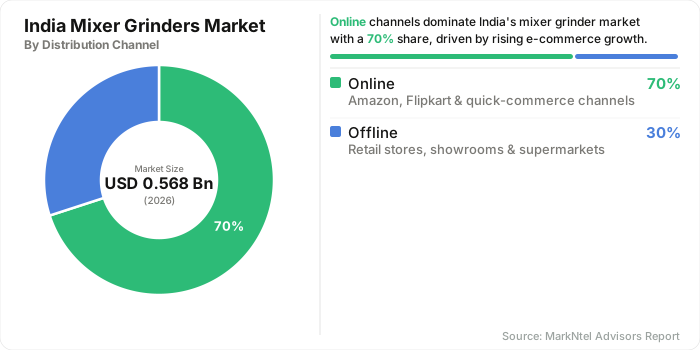
- By distribution channel, online seized a significant share of about 70% in 2026.
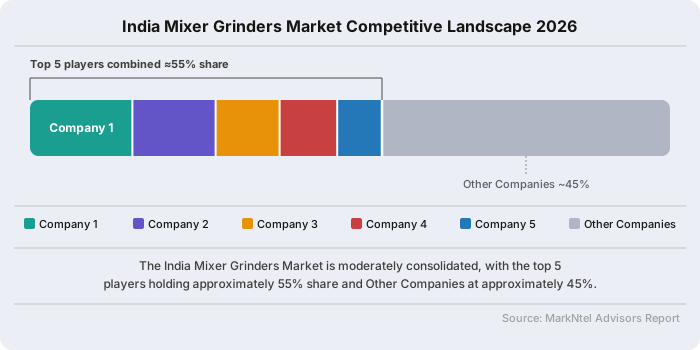
- The industry is moderately consolidated. However, the top five players collectively account for nearly 55% share.
India Mixer Grinders Market Size and Outlook
The India mixer grinders market size was valued at USD 0.541 billion in 2025 and is projected to grow from USD 0.568 billion in 2026 to USD 0.76 billion by 2032. Along with this, the market is estimated to grow at a CAGR of around 4.97% during the forecast period, i.e., 2026-32.
The demand for mixer grinders in India is supported by rising household consumption, urbanization, and growing demand for convenient food-preparation appliances. Average monthly per-capita consumption expenditure reached USD 49 in rural areas and USD 83 in urban areas, supporting spending on non-food and durable goods. Policy support through updated BIS IS 4250:2025 standards is strengthening product quality and safety across all power ratings. Future opportunities include premium, multifunctional, high-wattage, and technologically advanced models. With continued appliance penetration, rising purchasing power, and product innovation, the market is expected to maintain steady long-term growth.
India Mixer Grinders Market Key Indicators
- India’s electricity infrastructure has reached a major milestone, with the Draft National Electricity Policy 2026 stating that universal electrification has been achieved, connecting all villages and willing households. The policy also targets reliable 24×7 power supply and increasing per-capita electricity consumption to 2,000 kWh by 2030. Greater electricity availability supports wider adoption and regular use of powered kitchen appliances such as mixer grinders.
- Housing expansion creates new households that require basic kitchen appliances, supporting first-time mixer-grinder purchases. By October 2025, the government reported 95.51 million urban houses completed and delivered under PMAY-U, while PMAY-U 2.0 targets another 10 million families. Each newly occupied kitchen represents potential demand for food-preparation appliances, particularly affordable mixers used for spices, chutneys, batters and wet grinding across household kitchens.
- Growing participation of women in employment increases the value consumers place on faster food preparation and labor-saving appliances. India’s 2025 PLFS reported female labour-force participation of 40.0% for the usual-status measure among the relevant population, with regular salaried employment also rising to 23.6%. Mixer grinders reduce repetitive grinding and blending work, making them increasingly relevant for time-constrained urban and semi-urban households across India.
- Premiumization is encouraging consumers to consider higher-performance kitchen appliances as India’s home-appliance market expands. The major home-appliances market reached USD 21.24 billion in 2025 and is projected to reach USD 28.82 billion by 2030, reflecting a 6.3% CAGR. Mixer-grinder manufacturers are increasingly offering higher-powered and feature-rich models; Bajaj, for example, offers 750W and 1000W models with multiple jars, advanced blades and extended motor warranties
- Product innovation is stimulating replacement demand by addressing Indian cooking requirements more precisely. Philips’ India portfolio in 2025 included a 750W mixer grinder with a 25-minute continuous-grinding capability, while current products span 500W to 1000W motors. Bajaj also offers 1000W models with multiple jars. Such innovations improve grinding speed, durability and versatility for masalas, chutneys, batters and daily Indian cooking preparations.
- Rapid digital commerce is widening access to mixer grinders across India, including smaller cities. IBEF estimates India’s e-commerce market will surpass USD 140 billion in 2025, with the direct-to-consumer segment projected to reach USD 60 billion by 2030. Wider online assortment, price comparison, reviews, discounts and doorstep delivery make branded mixer grinders more accessible beyond traditional appliance stores and metropolitan retail networks across India.
India Mixer Grinders Market Scope
| Category | Segments |
|---|---|
| By Product Type | Mixer Grinder, Juicer Mixer Grinder, Multifunctional Mixer Grinder |
| By Motor Capacity | Up to 550 Watts, 551–750 Watts, Above 750 Watts |
| By Price Range | Economy, Mid-Range, Premium |
| By End User | Residential, Commercial |
| By Distribution Channel | Online, Offline |
India Mixer Grinders Market Growth Drivers
Rising Household Consumption and Purchasing Power Driving Demand for Mixer Grinders in India
Rising household consumption and purchasing power are driving demand for mixer grinders in India by enabling consumers to invest in convenient kitchen appliances and upgrade existing products. During FY2025–26, the Union Budget provided significant support to household consumption, with the government estimating approximately USD 591 billion in total expenditure, while the new tax regime increased disposable income for the middle class by providing nil income tax on annual income up to approximately USD 14,000.
The broader consumer-durables environment also demonstrates strong purchasing momentum. India's consumer-durables sector is projected to grow at approximately 11% CAGR through FY2029, with the country expected to become the fourth-largest consumer-durables market globally by FY2027. Household appliances alone were valued at USD 22.45 billion in 2024 and are projected to reach USD 33.63 billion by 2030, representing a 7.2% CAGR during 2025–2030.
For mixer grinders, this improving purchasing capacity encourages both first-time adoption and replacement/premiumization, as consumers increasingly opt for higher-wattage motors, multiple jars, multifunctionality, improved safety, and durable designs. Thus, rising disposable income and household consumption are expanding the addressable consumer base and supporting sustained growth of India's mixer grinders industry.
Recent Trends
Growing Adoption of Variable-Speed and Texture-Control Technology
Variable-speed and texture-control technology is emerging as a direct product trend in India's mixer grinders market, as manufacturers increasingly enable consumers to achieve different grinding consistencies rather than relying on conventional fixed-speed operation. This technology is particularly relevant to Indian cooking, where consumers require different textures for chutneys, masalas, batters, spices, and chopped ingredients. Atomberg's Zenova mixer grinder, for instance, incorporates an electronically controlled motor with 2,000 RPM for chopping, 5,000 RPM for coarse grinding, and up to 18,000 RPM for heavy-duty grinding. Its dedicated Coarse Mode is designed to replicate the texture produced by traditional silbatta/ammikallu grinding.
The trend is also reflected in Atomberg's earlier MG1 model, which offers a 2,000–18,000 RPM speed range, allowing users to select different speeds according to the preparation. The company highlights that its BLDC motor enables higher RPM with lower wattage, while the slow mode supports controlled grinding and texture preservation. This trend is making mixer grinders more precision-oriented and versatile, encouraging consumers to upgrade from conventional fixed-speed models and supporting innovation in India's mixer grinders market.
India Mixer Grinders Market Opportunities and Challenges
Durability and Performance Concerns Creating Opportunities for Product Innovation
Durability and performance concerns present a key challenge for the India mixer grinders market because frequent grinding of hard spices, thick batters and other demanding ingredients places substantial stress on motors, couplers, blades and jars. The relevance of this issue is reflected in BIS’s IS 4250:2025, which requires testing for motor and base-assembly endurance, strength of assembly, dry grinding, idli-batter preparation, temperature resistance and safety. The standard became increasingly applicable during 2025–26, with BIS laboratories listing testing under IS 4250:2025 from May 2025 onward, highlighting the importance of product reliability and performance.
This challenge is simultaneously creating an opportunity for durability-focused product innovation and premiumization. For instance, in 2025, TTK Prestige promoted its Endura Pro 1000W mixer grinder with 14 functions and a 5-year motor warranty, while its Endura 1000W model is certified for safety and backed by a 5-year motor and 2-year product warranty. Similarly, Bajaj Electricals' current premium mixer-grinder range incorporates 500W–1,000W Titan motors, double-ball-bearing construction, metal couplers, overload protection and lifetime-warranty DuraCut blades; its Armor 1000W model also carries 5-year motor and jar warranties.
These developments allow manufacturers to address reliability concerns while encouraging consumers to upgrade from basic models to higher-value, longer-lasting appliances, thereby supporting premium segment growth.
Segmentation Insights
Mixer Grinders Lead with Approximately 60% Share Due to Widespread Household Use and Versatile Food-Preparation Applications
Mixer grinder is estimated to lead the India mixer grinders market by product type, accounting for approximately 60% of revenue share in 2026. Its leading position is supported by its broad applicability across everyday Indian cooking, including wet grinding, dry grinding, blending, chutney preparation, and batter making. In 2026, MoSPI’s household-consumption classification continues to separately recognize mixer/grinder, juicer, and food processor within small appliances for cooking and food processing, confirming the relevance of these product categories in household consumption analysis.
Moreover, India’s real GDP is estimated to grow 7.4% in FY2025–26, indicating continued expansion in overall economic activity and household purchasing capacity. Mixer grinders also benefit from their relatively versatile functionality without requiring consumers to purchase multiple appliances. Consequently, their established household usage and broad cooking applications are expected to keep Mixer Grinders ahead of juicer mixer grinders and others in revenue generation in 2026. Based on product type, the scope has been segmented into:
- Mixer Grinder
- Juicer Mixer Grinder
- Multifunctional Mixer Grinder
Online Leads with Approximately 70% Share, Supported by Rapid E-Commerce Expansion and Digital Adoption
Online distribution is estimated to account for approximately 70% of India’s mixer grinders market revenue in 2026, making it the leading channel. The strong position is supported by India’s rapidly expanding digital retail ecosystem, with the online retail market reaching approximately USD 80 billion in FY2025–26, representing 21% year-on-year growth. Growth is increasingly extending beyond major metros, with rising digital adoption across Tier-II and Tier-III cities.
Mixer grinders are particularly suited to online purchasing because consumers can easily compare motor capacity, jar configurations, features, prices, warranties, and customer reviews across multiple brands. In addition, India’s e-commerce ecosystem benefits from widespread digital payments and improving last-mile logistics, supporting convenient doorstep delivery of small kitchen appliances. The increasing presence of brands and appliance retailers on online marketplaces further expands product availability and promotional opportunities, strengthening online sales relative to traditional offline channels. By distribution channel, the scope has been classified into
- Online
- Offline
India Mixer Grinders Market Geographical Outlook
South India Leads with Approximately 30% Share Due to Strong Kitchen-Appliance Demand and Local Manufacturing Presence
South India accounts for approximately 30% of India’s mixer grinders demand, making it the largest regional market in 2026. The region benefits from strong demand for kitchen appliances and established usage of mixer grinders for preparation of batter, chutneys, coconut-based foods, and spice pastes. Recent industry developments also reinforce the region’s importance: in March 2026, Versuni expanded its Chennai manufacturing operations, while its Chennai facility already produces universal motors for mixer grinders and kitchen appliances.
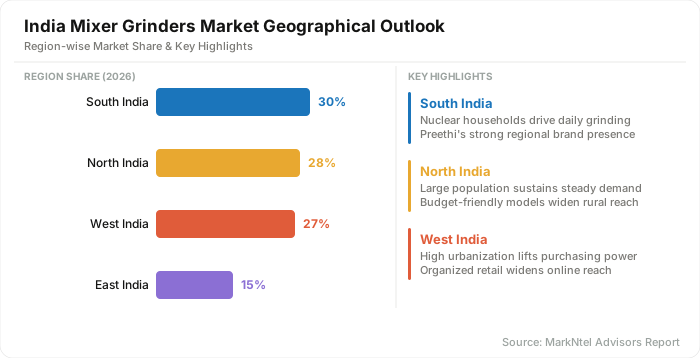
The company also reported that its India portfolio had reached approximately 94–95% localisation, highlighting the depth of domestic appliance manufacturing and supply-chain capabilities. Meanwhile, India’s consumer-durables sector is experiencing continued demand expansion in FY2025–26, supported by rising household incomes, urbanisation, electrification, and increasing demand for convenience-oriented appliances. These factors, combined with strong regional appliance-brand presence and cooking practices requiring frequent grinding, support South India’s leading position.
India Mixer Grinders Market Competitive Analysis
Top 5 Companies Account for Approximately 55% Market Share
The India mixer grinders market is moderately consolidated, with leading companies such as Bajaj Electricals Limited, Versuni India Home Solutions Limited, Groupe SEB India Private Limited, TTK Prestige Limited, and Crompton Greaves Consumer Electricals Limited collectively accounting for an estimated 55% of the market.
Key Players in India Mixer Grinders Market
- Bajaj Electricals Limited
- Versuni India Home Solutions Limited
- TTK Prestige Limited
- Groupe SEB India Private Limited
- Crompton Greaves Consumer Electricals Limited
- Stovekraft Limited
- Havells India Limited
- Usha International Limited
- V-Guard Industries Limited
- Panasonic Life Solutions India Private Limited
- Others
India Mixer Grinders Industry News and Recent Developments
August 2026: INALSA Launches Triton 900 Mixer Grinder
INALSA launched the Triton 900 Mixer Grinder and Food Processor in India in August 2026. The appliance features a 900W copper-wound motor, three-speed control, pulse function, three stainless-steel jars and a 1.5-liter food-processor attachment. It carries an MRP of about USD 174, with an introductory price of approximately USD 99, and includes a seven-year motor warranty.
Impact Analysis: The launch is expected to intensify competition in India’s mid-range mixer-grinder segment by combining a 900W motor with food-processing functionality in a single appliance. Its seven-year motor warranty may strengthen consumer confidence and differentiate the product on value and after-sales assurance. The multifunctional design could also encourage replacement purchases among households seeking greater kitchen convenience and versatility.
2026: TTK Prestige Unveils Endura 6-Jar Mixer Grinder
TTK Prestige unveiled its Endura 6-Jar Mixer Grinder at the HT City Unwind Delhi event in February 2026. The product expands the company's heavy-duty mixer-grinder portfolio with a six-jar configuration designed for multiple kitchen applications. The launch highlights Prestige's focus on multifunctional kitchen appliances and reinforces product innovation as competition intensifies in India's mixer-grinder market
Impact Analysis: The Endura launch strengthens TTK Prestige’s position in India’s premium and heavy-duty mixer-grinder segment by offering six jars for diverse food-preparation requirements. The expanded configuration may encourage consumers to upgrade from conventional models toward multifunctional appliances. It also increases competitive pressure on established brands to introduce higher-capacity, application-specific products and strengthen their premium product portfolios.
2026: Versuni Expands Mixer-Grinder Manufacturing in India
Versuni, which operates the Philips and Preethi brands in India, expanded its Chennai manufacturing operations in 2026. The facility already produces universal motors for mixer grinders and other kitchen appliances. The company's broader manufacturing expansion supports greater localisation and domestic production, strengthening India's position as a manufacturing base for kitchen appliances while supporting the continued development of mixer-grinder products.
Impact Analysis: Versuni’s manufacturing expansion is expected to strengthen domestic supply capabilities for mixer grinders under its Philips and Preethi brands. Increased local production can improve supply-chain efficiency, support faster product availability and reduce dependence on imported components. The development may also enable Versuni to scale its Indian appliance portfolio while intensifying competition among established domestic and multinational mixer-grinder manufacturers.
- Market Segmentation
- Introduction
- Product Definition
- Research Process
- Assumptions
- Executive Summary
- India Mixer Grinders Supply Chain Analysis
- India Mixer Grinders Import/Export Data Analysis
- India Mixer Grinders Market Policies, Regulations, and Product Standards
- India Mixer Grinders Market Production Trend (Units) 2022-2032
- India Mixer Grinders Market Production Trend (Units) By Product Type
- Mixer Grinder
- Juicer Mixer Grinder
- Multifunctional Mixer Grinder
- Company-Wise Production Plants and Statistics
- Installed Production Capacity
- Actual Production
- Planned Production Target
- India Mixer Grinders Market Production Trend (Units) By Product Type
- India Mixer Grinders Market Pricing Analysis 2022-2032
- India Mixer Grinders Market Pricing Trend (USD/Units) 2022-2032
- India Mixer Grinders Market Pricing Trend (USD/Units) By Regions 2022-2032
- North India
- South India
- West India
- East India
- India Mixer Grinders Market Pricing Trend (USD/Units) By Product Type 2022-2032
- Mixer Grinder
- Juicer Mixer Grinder
- Multifunctional Mixer Grinder
- India Mixer Grinders Market Trends & Developments
- India Mixer Grinders Market Dynamics
- Growth Factors
- Challenges
- India Mixer Grinders Market Hotspot & Opportunities
- India Mixer Grinders Market Outlook, 2022-2032
- Market Size & Outlook
- By Revenues (USD Million)
- By Quantity Sold (Thousand Units)
- Market Segmentation & Outlook
- By Product Type- Market Size & Forecast 2022-2032, USD Million & Thousand Units
- Mixer Grinder
- Juicer Mixer Grinder
- Multifunctional Mixer Grinder
- By Motor Capacity- Market Size & Forecast 2022-2032, USD Million & Thousand Units
- Up to 550 Watts
- 551–750 Watts
- Above 750 Watts
- By Price Range- Market Size & Forecast 2022-2032, USD Million & Thousand Units
- Economy
- Mid-Range
- Premium
- By End User- Market Size & Forecast 2022-2032, USD Million & Thousand Units
- Residential
- Commercial
- By Distribution Channel- Market Size & Forecast 2022-2032, USD Million & Thousand Units
- Online
- Offline
- By Region- Market Size & Forecast 2022-2032, USD Million & Thousand Units
- North India
- South India
- West India
- East India
- By Company
- Competition Characteristics
- Market Segmentation & Analysis
- By Product Type- Market Size & Forecast 2022-2032, USD Million & Thousand Units
- Market Size & Outlook
- India Mixer Grinder Market Outlook, 2022-2032
- Market Size & Outlook
- By Revenues (USD Million)
- By Quantity Sold (Thousand Units)
- Market Segmentation & Outlook
- By Motor Capacity- Market Size & Forecast 2022-2032, USD Million & Thousand Units
- By Price Range- Market Size & Forecast 2022-2032, USD Million & Thousand Units
- By End User- Market Size & Forecast 2022-2032, USD Million & Thousand Units
- By Distribution Channel- Market Size & Forecast 2022-2032, USD Million & Thousand Units
- By Region- Market Size & Forecast 2022-2032, USD Million & Thousand Units
- Market Size & Outlook
- India Juicer Mixer Grinder Market Outlook, 2022-2032
- Market Size & Outlook
- By Revenues (USD Million)
- By Quantity Sold (Thousand Units)
- Market Segmentation & Outlook
- By Motor Capacity- Market Size & Forecast 2022-2032, USD Million & Thousand Units
- By Price Range- Market Size & Forecast 2022-2032, USD Million & Thousand Units
- By End User- Market Size & Forecast 2022-2032, USD Million & Thousand Units
- By Distribution Channel- Market Size & Forecast 2022-2032, USD Million & Thousand Units
- By Region- Market Size & Forecast 2022-2032, USD Million & Thousand Units
- Market Size & Outlook
- India Multifunctional Mixer Grinder Market Outlook, 2022-2032
- Market Size & Outlook
- By Revenues (USD Million)
- By Quantity Sold (Thousand Units)
- Market Segmentation & Outlook
- By Motor Capacity- Market Size & Forecast 2022-2032, USD Million & Thousand Units
- By Price Range- Market Size & Forecast 2022-2032, USD Million & Thousand Units
- By End User- Market Size & Forecast 2022-2032, USD Million & Thousand Units
- By Distribution Channel- Market Size & Forecast 2022-2032, USD Million & Thousand Units
- By Region- Market Size & Forecast 2022-2032, USD Million & Thousand Units
- Market Size & Outlook
- India Mixer Grinders Market Key Strategic Imperatives for Success & Growth
- Competitive Outlook
- Company Profiles
- Bajaj Electricals Limited
- Business Description
- Product Portfolio
- Collaborations & Alliances
- Recent Developments
- Financial Details
- Others
- Versuni India Home Solutions Limited
- Business Description
- Product Portfolio
- Collaborations & Alliances
- Recent Developments
- Financial Details
- Others
- TTK Prestige Limited
- Business Description
- Product Portfolio
- Collaborations & Alliances
- Recent Developments
- Financial Details
- Others
- Groupe SEB India Private Limited
- Business Description
- Product Portfolio
- Collaborations & Alliances
- Recent Developments
- Financial Details
- Others
- Crompton Greaves Consumer Electricals Limited
- Business Description
- Product Portfolio
- Collaborations & Alliances
- Recent Developments
- Financial Details
- Others
- Stovekraft Limited
- Business Description
- Product Portfolio
- Collaborations & Alliances
- Recent Developments
- Financial Details
- Others
- Havells India Limited
- Business Description
- Product Portfolio
- Collaborations & Alliances
- Recent Developments
- Financial Details
- Others
- Usha International Limited
- Business Description
- Product Portfolio
- Collaborations & Alliances
- Recent Developments
- Financial Details
- Others
- V-Guard Industries Limited
- Business Description
- Product Portfolio
- Collaborations & Alliances
- Recent Developments
- Financial Details
- Others
- Panasonic Life Solutions India Private Limited
- Business Description
- Product Portfolio
- Collaborations & Alliances
- Recent Developments
- Financial Details
- Others
- Bajaj Electricals Limited
- Company Profiles
- Disclaimer

MarkNtel Advisors follows a robust and iterative research methodology designed to ensure maximum accuracy and minimize deviation in market estimates and forecasts. Our approach combines both bottom-up and top-down techniques to effectively segment and quantify various aspects of the market. A consistent feature across all our research reports is data triangulation, which examines the market from three distinct perspectives to validate findings. Key components of our research process include:
1. Scope & Research Design At the outset, MarkNtel Advisors define the research objectives and formulate pertinent questions. This phase involves determining the type of research—qualitative or quantitative—and designing a methodology that outlines data collection methods, target demographics, and analytical tools. They also establish timelines and budgets to ensure the research aligns with client goals.
2. Sample Selection and Data Collection In this stage, the firm identifies the target audience and determines the appropriate sample size to ensure representativeness. They employ various sampling methods, such as random or stratified sampling, based on the research objectives. Data collection is carried out using tools like surveys, interviews, and observations, ensuring the gathered data is reliable and relevant.
3. Data Analysis and Validation Once data is collected, MarkNtel Advisors undertake a rigorous analysis process. This includes cleaning the data to remove inconsistencies, employing statistical software for quantitative analysis, and thematic analysis for qualitative data. Validation steps are taken to ensure the accuracy and reliability of the findings, minimizing biases and errors.

4. Data Forecast and FinalizationThe final phase involves forecasting future market trends based on the analyzed data. MarkNtel Advisors utilize predictive modeling and time series analysis to anticipate market behaviors. The insights are then compiled into comprehensive reports, featuring visual aids like charts and graphs, and include strategic recommendations to inform client decision-making
We offer flexible licensing options to cater to varying organizational needs. Choose the pricing pack that best suits your requirements:
Buy Now Inquire Before Buying
 Request Customization