

By Raw Material (Carbon Steel, Alloy Steel, Stainless Steel, Aluminum Alloys, Titanium Alloys, Others (Nickel Alloys, Copper Alloys, etc.)), By Forging Type (Closed Die Forging, Open Die Forging, Ring... ... en Die Forging, Ring Rolling, Others), By Process (Hot Forging, Cold Forging, Warm Forging), By Application (Automotive, Industrial Machinery, Oil & Gas, Power Generation, Railways, Aerospace & Defense, Construction & Infrastructure, Others), and others Read more
- Buildings, Construction, Metals & Mining
- May 2026
- 120
- PDF, Excel, PPT
India Forging Market Key Takeaways
- The India Forging market, valued at nearly USD 7.5 billion in 2025, is anticipated to expand steadily, reaching USD 12.95 billion by 2032 from USD 8.90 billion in 2026, reflecting a CAGR of 6.46% over 2026–2032.
- West India accounted for the largest regional share in 2026, contributing approximately 35.64% of the total market.
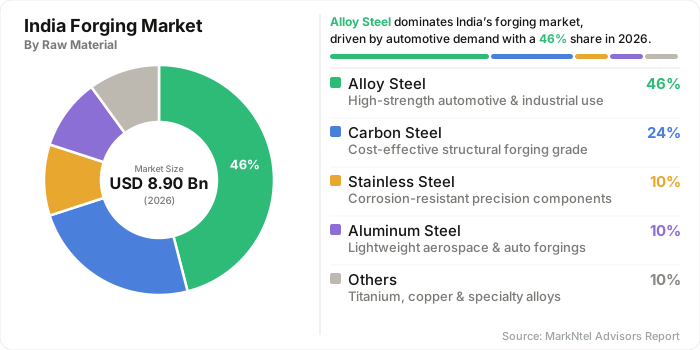
- By raw material, alloy steel remained the leading segment, capturing around 46% of the market share in 2026.
- Based on application, the automotive segment continued to dominate, accounting for nearly 66% of the total market in 2026.
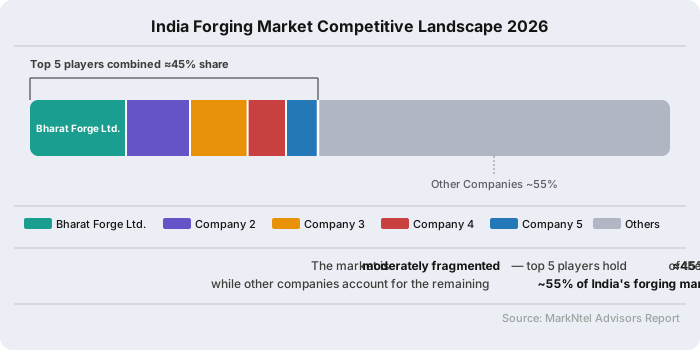
- The India forging market is moderately fragmented, with the top players collectively holding around 45% of the market share, while the presence of numerous smaller manufacturers maintains a degree of fragmentation.
India Forging Market Size and Outlook
The India Forging Market is projected to grow at a CAGR of approximately 6.46% during 2026–2032, driven by sustained industrialization and the expanding scale of automotive manufacturing activities across the country.
According to the Ministry of Steel, India continues to rank among the world’s leading steel producers, ensuring reliable raw material availability for forging operations. In parallel, the Society of Indian Automobile Manufacturers reported total automobile volumes of approximately 26.8 million units in 2025, reinforcing strong and consistent demand for forged components across vehicle categories . This close alignment between upstream steel availability and downstream automotive production has enabled the industry to expand capacity steadily while strengthening its export competitiveness.
In the present scenario, demand conditions remain robust, supported by expanding infrastructure investments and improving industrial output. Capital expenditure outlined in the Union Budget 2025–26 emphasizes infrastructure investment of approximately USD 130 billion, indicating continued public spending momentum . The Ministry of Road Transport and Highways is further expanding highway networks under Bharatmala, supporting demand for heavy machinery and forged components . Consequently, sectors such as oil and gas, railways, and power generation are contributing to a more diversified demand base.
At the policy level, government initiatives continue to reinforce market growth by promoting domestic manufacturing and infrastructure development. Programs such as the Make in India and the Production Linked Incentive Scheme encourage capacity expansion and localization. The Ministry of Heavy Industries is also supporting advanced manufacturing and electric mobility, increasing demand for precision-forged components. In response, industry participants are adopting automation and advanced technologies to improve efficiency and competitiveness.
As the market evolves, a combination of structural strengths, policy backing, and industry-driven efforts will continue to underpin long-term growth. Rising income levels and a growing workforce are expected to sustain automotive demand, while infrastructure expansion will support industrial consumption. Investments in renewable energy, defense manufacturing, and rail modernization will further expand application areas. The market outlook remains favorable, with the industry projected to grow from USD 8.90 billion in 2026 to USD 12.95 billion by 2032, supported by consistent policy initiatives, ongoing technological advancements, and strengthened participation in global value chains.
India Forging Market Key Indicators
- According to the International Energy Agency, India’s electricity demand is projected to grow at around 6.4% annually through 2030, driven by industrial expansion, urbanization, and electrification. This rise in energy demand is increasing investments in power infrastructure and industrial equipment, thereby supporting demand for heavy forged components such as shafts, valves, and flanges.
- Large-scale highway expansion under Bharatmala, with over 26,000 km of projects awarded by the Ministry of Road Transport and Highways, is strengthening infrastructure activity across India. This expansion increases the deployment of construction machinery and transport vehicles, thereby driving demand for forged components used in critical mechanical systems.
- India’s crude steel production reached over 165 million tonnes in 2025–26, as reported by the Ministry of Steel, indicating strong raw material availability. Higher steel output ensures a stable supply of billets and ingots required for forging operations, thereby enabling capacity expansion and supporting forging industry growth.
- India’s railway network spans over 68,000 route kilometers, making it one of the largest globally. Ongoing modernization and expansion initiatives, including track upgrades and rolling stock investments, require forged components such as wheels, axles, and couplings, thereby supporting demand for forging in railway manufacturing and maintenance activities.
- India’s installed power generation capacity exceeded 500 GW in 2025, as reported by the Central Electricity Authority, reflecting significant expansion in energy infrastructure. Construction and maintenance of turbines, generators, and transmission systems require forged components, thereby supporting demand for forging in the power sector.
India Forging Market Scope
| Category | Segments |
|---|---|
| By Raw Material | Carbon Steel, Alloy Steel, Stainless Steel, Aluminum Alloys, Titanium Alloys, Others (Nickel Alloys, Copper Alloys, etc. |
| By Forging Type | Closed Die Forging, Open Die Forging, Ring Rolling, Others |
| By Process | Hot Forging, Cold Forging, Warm Forging |
| By Application | Automotive, Industrial Machinery, Oil & Gas, Power Generation, Railways, Aerospace & Defense, Construction & Infrastructure, Others |
India Forging Market Growth Drivers
Strong Growth in Automotive Production
Rising vehicle production across passenger, two-wheeler, and commercial segments is creating a strong demand base for forged components in India. The Society of Indian Automobile Manufacturers reported strong monthly sales momentum, with passenger vehicles at 399,216 units, two-wheelers at 1,541,036 units, and three-wheelers at 61,924 units in December 2025 . This sustained volume across categories reflects stable production cycles and ongoing mobility demand within the automotive component industry in India. As forged components are integral to engines, transmissions, and structural systems, rising vehicle output continues to translate directly into increased forging demand.
This growth is evident across urban and rural mobility segments, while also supporting logistics and last-mile transportation activities. Government initiatives such as the Production Linked Incentive Scheme for the automotive sector, with an outlay of approximately USD 3.0 billion, are further strengthening domestic manufacturing by encouraging fresh investments and promoting localization of advanced components . At the same time, increasing exports of vehicles and auto components are supporting higher production volumes. Collectively, these factors are reinforcing a broad-based and sustained demand environment for forged products.
As a result, automotive production growth directly influences the volume of forged components required per vehicle, rather than merely affecting pricing dynamics. Each vehicle incorporates multiple forged parts, including crankshafts, gears, and axles, making demand highly sensitive to production output. With manufacturing volumes continuing to expand, forging consumption scales proportionally across the value chain. Consequently, automotive production remains a structural driver that consistently contributes to market size expansion and long-term demand stability.
Recent Trends
Automation & Industry 4.0 Adoption
Automation and Industry 4.0 adoption are emerging as a defining trend in India’s forging sector, driven by the need for higher precision, productivity, and cost efficiency. The Ministry of Heavy Industries is promoting advanced manufacturing through initiatives such as SAMARTH Udyog Bharat 4.0, encouraging the adoption of digital and smart factory technologies . Increasing integration of robotics, CNC machining, and sensor-based systems reflects a transition toward data-driven production environments. This shift has accelerated in response to rising quality standards from automotive and industrial OEMs.
The adoption of automated manufacturing is significantly transforming operational practices across the forging value chain. This is evidenced by industry developments such as the launch of a fully automated forging and machining line by Balu Forge Industries Limited, featuring near 100% automation with unmanned operations and an annual production capacity of around 360,000 units . Such advancements demonstrate the growing deployment of robotics and smart systems, accelerating the shift toward automation and smart manufacturing forging to enhance efficiency, reduce cycle time, and improve product consistency. As a result, manufacturers are increasingly transitioning toward scalable, technology-driven production models.
This trend is expected to persist as companies seek to strengthen competitiveness in both domestic and export markets. Government-backed programs such as Make in India continue to support modernization and industrial digitization across manufacturing sectors. At the same time, increasing global demand for high-performance forged components reinforces the need for advanced production capabilities. The ongoing integration of automation and Industry 4.0 technologies is likely to improve operational performance and support sustained market evolution.
India Forging Market Opportunities and Challenges
Volatility in Raw Material Prices Driving Adoption of Alternative Materials and Efficient Material Utilization
Fluctuations in steel prices are emerging as a significant challenge for forging manufacturers, as raw materials account for a major share of production costs. The World Steel Association highlights ongoing volatility in global steel markets driven by supply disruptions and energy cost fluctuations. In India, import tariffs of approximately 12% on steel products imposed in 2025 have pushed domestic steel prices higher, increasing input costs for industries such as automotive, construction, and engineering. This has directly impacted cost structures, production planning, and profitability across forging operations.
This challenge is simultaneously creating opportunities for the adoption of alternative materials and more efficient material utilization practices. In 2026, Ramkrishna Forgings Limited commenced commercial production at an aluminium forging facility, marking a strategic shift beyond traditional steel forging toward lightweight and EV-oriented applications, reflecting growing adoption of lightweight forging materials in India. In addition, manufacturers are focusing on precision forging and near-net-shape technologies to reduce material wastage and improve yield efficiency. As a result, companies are adopting cost-optimized and resource-efficient production strategies, supporting long-term resilience and competitiveness in the forging market.
Segmentation Insights
Extensive Automotive Usage and Export-Led Demand Establish Alloy Steel as the Dominant Raw Material Segment
Alloy steel dominates the raw material landscape in India’s forging market with an estimated 46% share, supported by its critical role in high-performance automotive and industrial applications. Its superior mechanical properties, including high strength, fatigue resistance, and durability, make it well suited for components such as crankshafts, gears, axles, and connecting rods. The expanding automotive component industry in India continues to drive consistent demand, as manufacturers require materials capable of sustaining heavy loads and demanding operating conditions. This widespread applicability across core applications reinforces the continued preference for alloy steel.
This leadership position is further strengthened by rising export demand and deeper integration into global supply chains. India’s automobile exports grew by approximately 24% in 2025, reflecting strong international demand and increased manufacturing activity . As export-oriented production scales, the requirement for high-quality forged components that meet global performance standards continues to rise, further supporting alloy steel adoption. In addition, sectors such as oil & gas, power generation, and construction equipment forging require materials capable of operating under extreme pressure and temperature conditions. As a result, alloy steel continues to maintain its leading position due to its performance advantages and alignment with evolving industrial requirements. Based on raw material, the study is segmented into:
- Carbon Steel
- Alloy Steel
- Stainless Steel
- Aluminum Alloys
- Titanium Alloys
- Others
Strong Production Volumes and High Forged Component Utilization Make Automotive the Dominant Segment
With a market share of around 66%, the automotive segment represents the largest application in the forging market across India, supported by its extensive reliance on automotive forging in India across vehicle systems. This leadership is closely linked to the high production volumes of passenger vehicles, two-wheelers, and commercial vehicles, each incorporating multiple forged components such as crankshafts, gears, axles, and connecting rods. The consistent requirement for strength, durability, and fatigue resistance further reinforces the preference for forging in critical automotive applications. In addition, the strong presence of OEMs and Tier-1 suppliers ensures steady and large-scale consumption of forged products across manufacturing cycles.
This demand pattern continues to strengthen as mobility needs expand alongside logistics and transportation activities. Increasing vehicle ownership, growth in freight movement, and the rise of last-mile delivery networks are collectively driving higher production volumes. At the same time, growing exports of vehicles and auto components are supporting sustained manufacturing output. Coupled with evolving safety standards and technological advancements, the need for high-strength and precision-forged components remains elevated. As a result, the automotive segment continues to maintain its leading position through consistent demand, high component usage per vehicle, and deep integration within the manufacturing value chain. Based on application, the market is categorized into:
- Automotive
- Industrial Machinery
- Oil & Gas
- Power Generation
- Railways
- Aerospace & Defense
- Construction & Infrastructure
- Others
India Forging Market Geographical Outlook
West India dominates the forging market across India, accounting for approximately 35.64% of total demand, primarily due to its strong industrial base and concentration of automotive and engineering hubs. States such as Maharashtra and Gujarat host major manufacturing clusters supported by advanced infrastructure and strong linkages with the industrial machinery market India. According to the Department for Promotion of Industry and Internal Trade, Maharashtra alone contributed around 32% of total FDI inflows in 2025–26, with Gujarat adding a significant share, highlighting the region’s leadership in industrial investment. This sustained inflow of capital continues to strengthen manufacturing capacity and supports large-scale forging demand.
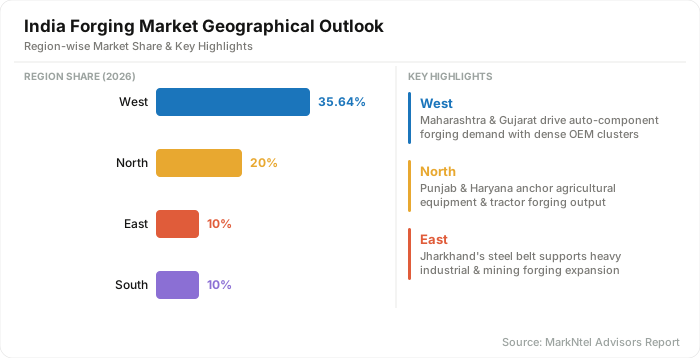
The dominance of West India is further reinforced by its well-developed logistics and export infrastructure. The presence of major ports such as Jawaharlal Nehru Port enables efficient export-oriented manufacturing and seamless supply chain movement. In addition, industrial corridors, special economic zones, and strong connectivity to raw material sources contribute to cost-effective production and distribution. As a result, the combination of high investment inflows, industrial concentration, and infrastructure strength positions West India ahead of other regions in the forging industry.
India Forging Market Competitive Analysis
The India forging market exhibits a moderately fragmented structure, with a few organized players leading high-value segments while a large number of regional and small-scale manufacturers contribute to overall fragmentation. Leading companies such as Bharat Forge Limited, Ramkrishna Forgings Limited, Happy Forgings Limited, MM Forgings Limited, and CIE Automotive India Limited collectively account for around 45% of the market, with stronger concentration in automotive and export-oriented segments.
Forging Companies Operating in India
- Bharat Forge Limited
- Happy Forgings Limited
- Ramkrishna Forgings Limited
- MM Forgings Limited
- Mahindra Forgings Limited
- Balu Forge Industries Limited
- SeForge
- Western Forging
- Vinir Engineering
- CIE Automotive India Limited
- Others
India Forging Industry News and Recent Developments
May 2026: Ramkrishna Forgings Announces USD 240 Million Forged Wheel Manufacturing Facility in Chennai
Ramkrishna Forgings Limited announced a USD 240 million investment to establish a forged wheel manufacturing plant in Chennai, with an annual production capacity of approximately 228,000 wheels. The facility is supported by an order from Indian Railways and marks the company’s entry into the railway components segment.
Impact Analysis: This development reflects increasing diversification within the forging industry toward high-value applications beyond automotive. It is expected to strengthen domestic manufacturing capabilities, support railway infrastructure expansion, and enhance the company’s presence in large-scale, export-oriented forging segments.
- Market Segmentation
- Introduction
- Product Definition
- Research Process
- Assumptions
- Executive Summary
- India Forging Market Policies, Regulations, and Product Standards
- India Forging (Thousand Tons) Trend 2022-2032
- India Forging (Thousand Tons) Trend by Raw Material
- Carbon Steel
- Alloy Steel
- Stainless Steel
- Aluminum Alloys
- Titanium Alloys
- Others
- Company Wise Production Plants and Statistics
- Installed Production Capacity
- Actual Production
- Planned Production Target
- India Forging (Thousand Tons) Trend by Raw Material
- India Forging Market Pricing Analysis 2022-2032
- India Forging Pricing Trend (USD/Tons) 2022-2032
- India Forging Pricing Trend (USD/Tons) By Raw Material 2022-2032
- Carbon Steel
- Alloy Steel
- Stainless Steel
- Aluminum Alloys
- Titanium Alloys
- Others
- India Forging Market Dynamics
- Growth Factors
- Challenges
- India Forging Market Hotspot & Opportunities
- India Forging Market Outlook, 2022-2032F
- Market Size & Outlook
- By Revenues (USD Million)
- By Quantity Sold (Tons)
- Market Share & Outlook
- By Raw Material- Market Size & Forecast 2022-2032, USD Million
- Carbon Steel
- Alloy Steel
- Stainless Steel
- Aluminum Alloys
- Titanium Alloys
- Others (Nickel Alloys, Copper Alloys, etc.)
- By Forging Type- Market Size & Forecast 2022-2032, USD Million
- Closed Die Forging
- Open Die Forging
- Ring Rolling
- Others
- By Process- Market Size & Forecast 2022-2032, USD Million
- Hot Forging
- Cold Forging
- Warm Forging
- By Application- Market Size & Forecast 2022-2032, USD Million
- Automotive
- Industrial Machinery
- Oil & Gas
- Power Generation
- Railways
- Aerospace & Defense
- Construction & Infrastructure
- Others
- By Region- Market Size & Forecast 2022-2032, USD Million
- North India
- East India
- West India
- South India
- By Company
- Competition Characteristics
- Market Share & Analysis
- By Raw Material- Market Size & Forecast 2022-2032, USD Million
- Market Size & Outlook
- India Carbon Steel Market Outlook, 2022-2032
- Market Size & Outlook
- By Revenues (USD Million)
- By Quantity Sold (Tons)
- Market Share & Outlook
- By Forging Type- Market Size & Forecast 2022-2032, USD Million
- By Process- Market Size & Forecast 2022-2032, USD Million
- By Application- Market Size & Forecast 2022-2032, USD Million
- By Region- Market Size & Forecast 2022-2032, USD Million
- Market Size & Outlook
- India Alloy Steel Market Outlook, 2022-2032
- Market Size & Outlook
- By Revenues (USD Million)
- By Quantity Sold (Tons)
- Market Share & Outlook
- By Forging Type- Market Size & Forecast 2022-2032, USD Million
- By Process- Market Size & Forecast 2022-2032, USD Million
- By Application- Market Size & Forecast 2022-2032, USD Million
- By Region- Market Size & Forecast 2022-2032, USD Million
- Market Size & Outlook
- India Stainless Steel Market Outlook, 2022-2032
- Market Size & Outlook
- By Revenues (USD Million)
- By Quantity Sold (Tons)
- Market Share & Outlook
- By Forging Type- Market Size & Forecast 2022-2032, USD Million
- By Process- Market Size & Forecast 2022-2032, USD Million
- By Application- Market Size & Forecast 2022-2032, USD Million
- By Region- Market Size & Forecast 2022-2032, USD Million
- Market Size & Outlook
- India Aluminum Alloys Market Outlook, 2022-2032
- Market Size & Outlook
- By Revenues (USD Million)
- By Quantity Sold (Tons)
- Market Share & Outlook
- By Forging Type- Market Size & Forecast 2022-2032, USD Million
- By Process- Market Size & Forecast 2022-2032, USD Million
- By Application- Market Size & Forecast 2022-2032, USD Million
- By Region- Market Size & Forecast 2022-2032, USD Million
- Market Size & Outlook
- India Titanium Alloys Market Outlook, 2022-2032
- Market Size & Outlook
- By Revenues (USD Million)
- By Quantity Sold (Tons)
- Market Share & Outlook
- By Forging Type- Market Size & Forecast 2022-2032, USD Million
- By Process- Market Size & Forecast 2022-2032, USD Million
- By Application- Market Size & Forecast 2022-2032, USD Million
- By Region- Market Size & Forecast 2022-2032, USD Million
- Market Size & Outlook
- India Forging Market Key Strategic Imperatives for Success & Growth
- Competitive Outlook
- Company Profiles
- Bharat Forge Limited
- Business Description
- Product Portfolio
- Collaborations & Alliances
- Recent Developments
- Financial Details
- Others
- Happy Forgings Limited
- Business Description
- Product Portfolio
- Collaborations & Alliances
- Recent Developments
- Financial Details
- Others
- Ramkrishna Forgings Limited
- Business Description
- Product Portfolio
- Collaborations & Alliances
- Recent Developments
- Financial Details
- Others
- MM Forgings Limited
- Business Description
- Product Portfolio
- Collaborations & Alliances
- Recent Developments
- Financial Details
- Others
- Mahindra Forgings Limited
- Business Description
- Product Portfolio
- Collaborations & Alliances
- Recent Developments
- Financial Details
- Others
- Balu Forge Industries Limited
- Business Description
- Product Portfolio
- Collaborations & Alliances
- Recent Developments
- Financial Details
- Others
- SeForge
- Business Description
- Product Portfolio
- Collaborations & Alliances
- Recent Developments
- Financial Details
- Others
- Western Forging
- Business Description
- Product Portfolio
- Collaborations & Alliances
- Recent Developments
- Financial Details
- Others
- Vinir Engineering
- Business Description
- Product Portfolio
- Collaborations & Alliances
- Recent Developments
- Financial Details
- Others
- CIE Automotive India Limited
- Business Description
- Product Portfolio
- Collaborations & Alliances
- Recent Developments
- Financial Details
- Others
- Bharat Forge Limited
- Company Profiles
- Disclaimer

MarkNtel Advisors follows a robust and iterative research methodology designed to ensure maximum accuracy and minimize deviation in market estimates and forecasts. Our approach combines both bottom-up and top-down techniques to effectively segment and quantify various aspects of the market. A consistent feature across all our research reports is data triangulation, which examines the market from three distinct perspectives to validate findings. Key components of our research process include:
1. Scope & Research Design At the outset, MarkNtel Advisors define the research objectives and formulate pertinent questions. This phase involves determining the type of research—qualitative or quantitative—and designing a methodology that outlines data collection methods, target demographics, and analytical tools. They also establish timelines and budgets to ensure the research aligns with client goals.
2. Sample Selection and Data Collection In this stage, the firm identifies the target audience and determines the appropriate sample size to ensure representativeness. They employ various sampling methods, such as random or stratified sampling, based on the research objectives. Data collection is carried out using tools like surveys, interviews, and observations, ensuring the gathered data is reliable and relevant.
3. Data Analysis and Validation Once data is collected, MarkNtel Advisors undertake a rigorous analysis process. This includes cleaning the data to remove inconsistencies, employing statistical software for quantitative analysis, and thematic analysis for qualitative data. Validation steps are taken to ensure the accuracy and reliability of the findings, minimizing biases and errors.

4. Data Forecast and FinalizationThe final phase involves forecasting future market trends based on the analyzed data. MarkNtel Advisors utilize predictive modeling and time series analysis to anticipate market behaviors. The insights are then compiled into comprehensive reports, featuring visual aids like charts and graphs, and include strategic recommendations to inform client decision-making
We offer flexible licensing options to cater to varying organizational needs. Choose the pricing pack that best suits your requirements:
Buy Now Inquire Before Buying
 Request Customization