

By Pathogen Type (Salmonella, Listeria, Campylobacter, Vibrio, Staphylococcus, Clostridium, Others), By Technology (Rapid testing, Traditional testing), By Food Category (Meat & Poultry, Dairy Product... ... ultry, Dairy Products, Fruits & Vegetables, Seafood, Cereals, Grains & Pulses, Processed Foods, Beverages, Others), By Testing Model (In-House Testing, Outsourced Testing), and others Read more
- Food & Beverages
- Jul 2026
- 140
- PDF, Excel, PPT
India Food Pathogen Testing Market Key Takeaways
- The India food pathogen testing market was valued at USD 0.63 billion in 2025 and is projected to grow from USD 0.71 billion in 2026 to USD 1.11 billion by 2032.
- The industry is projected to witness steady growth at a 7.73% CAGR during 2026–2032.
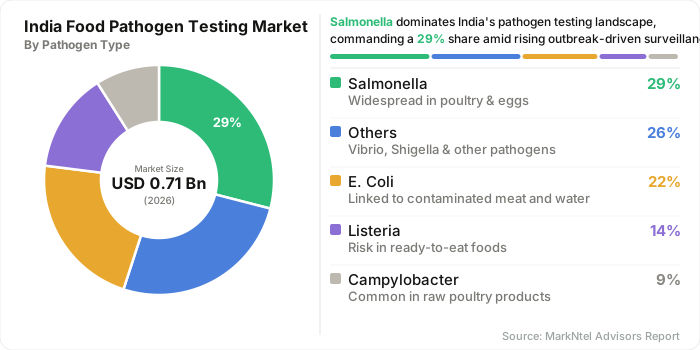
- Salmonella led the pathogen type segment, capturing approximately 29% of the market.
- Meat & poultry dominated the food category segment, securing approximately 32% market share in 2026.
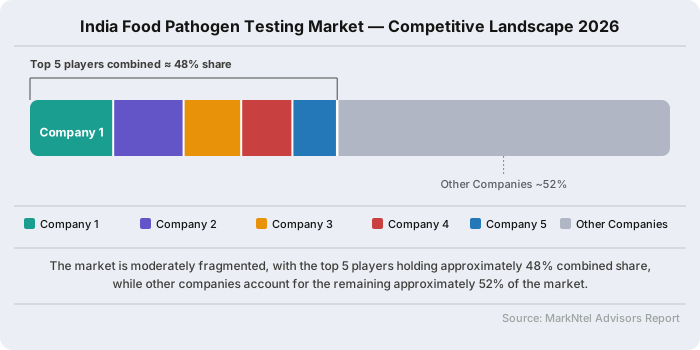
- The market remains moderately fragmented, with the top five companies collectively accounting for nearly 48% of total market revenue through broad testing capabilities and extensive laboratory networks.
India Food Pathogen Testing Market Size and Outlook
The food pathogen testing market size in India was valued at USD 0.63 billion in 2025 and is projected to increase from USD 0.71 billion in 2026 to USD 1.11 billion by 2032, registering a CAGR of 7.73% during 2026–2032. This growth will be supported by growing seafood and marine product exports requiring stringent microbiological compliance, alongside the increasing adoption of genomic and DNA sequencing technologies that enhance testing accuracy, turnaround time, and food safety testing capabilities across commercial laboratories.
The growth outlook is further reinforced by substantial government investments in laboratory infrastructure. The Ministry of Food Processing Industries confirmed financial support for 100 new NABL-accredited food testing laboratories during 2025–26 under the Pradhan Mantri Kisan Sampada Yojana, with approximately USD 52.9 million allocated across 205 laboratory projects. These facilities will support FSSAI, the Export Inspection Council, and APEDA while expanding accredited food quality testing capacity into farm-adjacent processing clusters and improving testing accessibility for smaller food businesses.
State governments are also strengthening food safety infrastructure through investments in modern laboratory facilities and mobile testing capabilities. Haryana approved approximately USD 6.21 million to establish 28 Mobile Food Testing Laboratories, new microbiology laboratories, and advanced analytical equipment, improving surveillance capacity and sample accessibility across key districts. Such initiatives are expected to strengthen the implementation of food safety regulations in India while reducing testing turnaround times and enhancing microbiological monitoring throughout regional food supply chains.
The India food pathogen testing industry is expected to benefit from expanding export-oriented quality assurance requirements. APEDA continues to strengthens food testing laboratories nationwide to support pre-shipment testing, traceability systems, and regulatory compliance. As India's food processing industry attracted cumulative foreign direct investment of USD 13.01 billion between April 2000 and December 2024, exporters are increasingly relying on APEDA-supported laboratories to validate shipments before export, reinforcing sustained demand for accredited pathogen testing services throughout the forecast period.
India Food Pathogen Testing Market Key Indicators
- The Food Safety and Standards Authority of India (FSSAI) conducted 397,009 inspections and tested 165,747 samples during financial year 2025-26, of which 17.16% were non-compliant. This scale of state-led sampling shows formal microbiological screening has become a routine regulatory expectation rather than an occasional check, widening the base of food businesses required to engage accredited pathogen detection services across manufacturing, retail, and export-oriented segments of the supply chain.
- FSSAI notified 18 additional food testing laboratories during 2025-26, including advanced microbiological facilities in Singtam, Sikkim, and Tirumala, Andhra Pradesh, equipped with enhanced contaminant detection systems. Expanding certified laboratory infrastructure across previously underserved states reduces sample transit time for perishable food categories, enabling faster microbial contamination screening. This geographic deepening of accredited capacity supports higher testing frequency among regional processors that once depended on distant metropolitan laboratories.
- India's agricultural and processed food exports totaled USD 51.9 billion in 2024, with processed food accounting for a rising share of shipments subject to importing-country residue and pathogen limits. Every consignment destined for regulated markets such as the European Union, the United States, and the Gulf Cooperation Council must clear destination-specific microbiological thresholds, making pre-shipment compliance testing a non-negotiable cost of market access rather than a discretionary investment.
- The Ministry of Food Processing Industries confirmed that cumulative PLISFPI investment reached approximately USD 1.07 billion (as of December 31, 2025), supporting close to 3.5 million metric tonnes of annual processing capacity. Every incremental tonne of processing capacity added under this incentive-linked expansion carries a parallel quality-assurance obligation, since scaled manufacturing operations must validate output against quality-assurance protocols before goods reach organized retail or export channels.
India Food Pathogen Testing Market Scope
| Category | Segments |
|---|---|
| By Pathogen Type | Salmonella, Listeria, Campylobacter, Vibrio, Staphylococcus, Clostridium, Others |
| By Technology | Rapid testing, Traditional testing |
| By Food Category | Meat & Poultry, Dairy Products, Fruits & Vegetables, Seafood, Cereals, Grains & Pulses, Processed Foods, Beverages, Others |
| By Testing Model | In-House Testing, Outsourced Testing |
India Food Pathogen Testing Market Growth Drivers
Growing Seafood and Marine Product Exports Driving Pathogen Testing Adoption
India's seafood exports reached USD 7.45 billion in 2024, rising from USD 7.38 billion in previous year, with frozen shrimp alone contributing 69.46% of total dollar earnings despite representing 43.67% of export volume, according to the Marine Products Export Development Authority (MPEDA). This expanding export ecosystem strengthens the India food pathogen testing market, as international shipments increasingly depend on robust food export testing to satisfy stringent destination-country quality requirements.
Seafood remains among the most perishable and pathogen-prone food categories, requiring routine screening for Vibrio, Salmonella, and Listeria before export. Every processing unit exporting to the European Union or the United States must first obtain approval from the Export Inspection Council of India (EIC), where microbiological compliance forms an essential certification requirement. This regulatory framework significantly expands demand for food safety compliance across seafood processing facilities.
As MPEDA targets continued export expansion beyond the 2024, processors handling frozen shrimp, fish, squid, and cuttlefish must maintain consistent pathogen-screening capacity to preserve EIC approval and uninterrupted access to international markets. This close relationship between rising seafood exports and mandatory microbiological clearance continues to reinforce long-term demand across the India food pathogen testing industry, particularly among accredited laboratories serving major coastal processing clusters from Andhra Pradesh to Gujarat.
Recent Trends
Rising Adoption of Genomic and DNA-Sequencing-Based Microbiological Testing
Indian food laboratories are steadily transitioning from conventional culture-based methods toward genomic and DNA sequencing-based microbiological analysis to improve testing precision and contamination traceability. This trend gained further momentum with bioMérieux's February 2026 launch of SMARTBIOME, a platform integrating high-resolution DNA sequencing, bioinformatics, and expert consulting to identify spoilage organisms and contamination sources across food production lines. This technological evolution is reshaping the India food pathogen testing industry through advanced PCR food testing capabilities.
Rather than replacing conventional microbiology, laboratories are increasingly integrating molecular and genomic technologies with traditional plate-culture testing to reduce turnaround times and strengthen root-cause investigations. According to bioMérieux, microbial spoilage and related quality assurance requirements account for 15–20% of global food waste after production, encouraging laboratories to adopt higher-resolution food microbiology testing solutions that deliver faster, more accurate identification of foodborne contaminants.
As Indian food manufacturers strengthen export quality standards and organized retail expands nationwide, laboratories are expected to accelerate investments in sequencing-based microbiology platforms, digital bioinformatics, and data-driven diagnostic workflows. Vendor product roadmaps and growing laboratory adoption indicate that genomic testing will become an increasingly important component of the India food pathogen testing industry, supporting faster decision-making, improved contamination control, and enhanced microbiological surveillance throughout the forecast period.
India Food Pathogen Testing Market Opportunities and Challenges
FSSAI's Turnover-Based Licensing Formalization Driving Demand for Affordable In-House Pathogen Testing Kits
The implementation of FSSAI's revised turnover-based licensing framework has broadened the formal regulatory ecosystem by introducing new licensing thresholds: Basic Registration for food businesses with annual turnover up to approximately USD 0.17 million, State Licence for turnover above USD 0.17 million and up to approximately USD 5.83 million, and Central Licence for turnover exceeding approximately USD 5.83 million. These reforms strengthen oversight but challenge the India food pathogen testing market as many small businesses cannot afford accredited food testing laboratories or establish in-house microbiology facilities.
For cottage-scale processors, bakeries, dairy units, local manufacturers, and street-food enterprises entering the formal regulatory framework, recurring microbiological testing expenses, limited laboratory accessibility, shortages of skilled personnel, and inadequate quality assurance infrastructure remain significant barriers. These constraints widen the affordability gap for routine pathogen monitoring and food diagnostics solutions, particularly among businesses operating with restricted technical capabilities and quality-control budgets, making regulatory compliance increasingly difficult despite expanding food safety obligations.
This challenge simultaneously creates a substantial opportunity through government-backed laboratory expansion. Under the Ministry of Food Processing Industries' Food Safety and Quality Assurance Infrastructure (FSQAI) Scheme, financial assistance covering up to 50% of the eligible project cost, subject to a maximum of approximately USD 1.17 million per laboratory, supports establishing and upgrading NABL-accredited Food Testing Laboratories. This investment is expected to strengthen microbiological testing capacity and accelerate long-term growth across the India food pathogen testing industry.
Segmentation Insights
Salmonella Dominates Due to Its High Prevalence Across Major Food Categories
Salmonella is the dominant pathogen type in the India food pathogen testing industry, accounting for an approximate 29% share. Its leadership reflects the bacterium's widespread presence across poultry, dairy, eggs, and processed food categories that constitute a significant portion of India's food consumption. This broad exposure requires continuous microbial contamination testing to safeguard product quality and support regulatory compliance throughout the food production and distribution chain.
The bacterium's ability to survive across diverse food matrices and processing environments makes it one of the most closely monitored foodborne pathogens. Its established role as a leading cause of foodborne gastroenteritis worldwide has encouraged food manufacturers and testing laboratories to prioritize routine microbiological surveillance. Consequently, foodborne pathogen detection remains an essential component of quality assurance programs across multiple food processing industries.
Growing consumption of packaged foods, poultry products, dairy items, and ready-to-eat meals continues to reinforce demand for Salmonella testing across India's food ecosystem. Export-oriented manufacturers and domestic processors increasingly conduct regular pathogen screening to meet regulatory requirements and maintain consumer confidence. These factors collectively sustain Salmonella's leading position within pathogen testing services. Based on pathogen type, the scope has been bifurcated into:
- Salmonella
- E. coli
- Listeria
- Campylobacter
- Vibrio
- Staphylococcus
- Clostridium
- Others
Meat & Poultry Leads Due to High Microbiological Risk and Stringent Safety Requirements
The meat & poultry segment accounts for an approximate 32% share of the India food pathogen testing market, making it the leading food category for pathogen testing. Fresh and processed meat products are highly susceptible to microbial contamination during slaughtering, processing, storage, and transportation, necessitating frequent food contamination testing to ensure product safety and regulatory compliance across the supply chain.
The segment's dominance is reinforced by the mandatory monitoring of pathogens such as Salmonella, Listeria monocytogenes, Escherichia coli, and Campylobacter, which are commonly associated with meat and poultry products. Routine food quality assurance programs require microbiological screening at multiple production stages to minimize contamination risks, extend shelf life, and meet domestic as well as international food safety standards.
Its leadership is further supported by India's expanding poultry processing industry and growing exports of meat products, which require compliance with stringent microbiological standards before entering global markets. Export-oriented processors conduct regular pathogen testing to satisfy importing-country regulations and maintain product quality, reinforcing the Meat & Poultry segment's leading position throughout the forecast period. The key food category mapped in the study involves:
- Meat & Poultry
- Dairy Products
- Fruits & Vegetables
- Seafood
- Cereals, Grains & Pulses
- Processed Foods
- Beverages
- Others
India Food Pathogen Testing Market Competitive Analysis
The India food pathogen testing market is moderately fragmented, with the top five companies collectively accounting for an estimated 48% of total market revenue. Thermo Fisher Scientific India Private Limited, bioMérieux India Private Limited, HiMedia Laboratories Private Limited, Eurofins Analytical Services India Private Limited, and SGS India Private Limited maintain strong positions through extensive molecular diagnostics portfolios, microbiology expertise, accredited laboratory networks, and comprehensive food safety solutions.
Key Players in India Food Pathogen Testing Industry
- Thermo Fisher Scientific India Private Limited
- bioMérieux India Private Limited
- HiMedia Laboratories Private Limited
- SGS India Private Limited
- Eurofins Analytical Services India Private Limited
- Intertek India Private Limited
- QIAGEN India Private Limited
- Bureau Veritas Consumer Products Services (India) Private Limited
- ALS Testing Services India Private Limited
- TÜV India Private Limited
- Others
India Food Pathogen Testing Industry News and Recent Developments
February 2025: bioMérieux Introduced GENE-UP® TYPER LMO for Rapid Listeria Characterization
bioMérieux introduced GENE-UP® TYPER LMO, a real-time PCR-based solution designed to rapidly characterize Listeria monocytogenes strains detected in food production environments. The platform integrates molecular testing with a cloud-enabled analytical application, enabling laboratories to identify contamination sources more efficiently and accelerate root-cause investigations. The launch supports proactive environmental monitoring and strengthens preventive food safety management across food manufacturing facilities.
Impact Analysis: GENE-UP® TYPER LMO enhances laboratory capabilities by reducing the time required to differentiate recurring and unrelated Listeria contamination events. Faster strain characterization enables food manufacturers to implement targeted corrective measures, minimize production disruptions, and reduce the likelihood of costly product recalls. As Indian food processors increasingly adopt molecular diagnostics to meet export and regulatory requirements, the platform is expected to strengthen environmental monitoring programs and accelerate the transition toward data-driven microbiological surveillance across the food pathogen testing ecosystem.
January 2025: Neogen Launched MDA2 Quantitative Salmonella Molecular Detection Assay
Neogen Corporation launched the MDA2 Quantitative Salmonella Molecular Detection Assay, expanding its Molecular Detection System portfolio. The assay combines quantitative pathogen detection with Quantitative Rapid Enrichment Dehydrated (QRED) media, enabling poultry processors to accurately quantify Salmonella contamination while maintaining a simple workflow. The solution is designed to improve intervention verification with enhanced sensitivity, consistency, and operational efficiency across food testing laboratories.
Impact Analysis: The launch strengthens the shift toward rapid molecular diagnostics by enabling food manufacturers and laboratories to quantify Salmonella contamination instead of relying solely on qualitative detection. Faster and more precise results help processors optimize corrective actions, improve microbiological verification, and support compliance with increasingly stringent domestic and international food safety standards. Since the Neogen Molecular Detection System is used in more than 40 countries, including by food processors, government agencies, universities, and contract laboratories, the innovation is expected to support broader adoption of advanced pathogen testing technologies in India.
- Market Segmentation
- Introduction
- Product Definition
- Research Process
- Assumptions
- Executive Summary
- India Food Pathogen Testing Market Supply Chain Analysis
- India Food Pathogen Testing Market Import & Export Analysis
- India Food Pathogen Testing Market Startup & Innovation Ecosystem
- India Food Pathogen Testing Market Policies, Regulations, and Product Standards
- India Food Pathogen Testing Production Trend 2022-2032
- India Food Pathogen Testing Trend by Type of Pathogen Type
- Salmonella
- E. Coli
- Listeria
- Campylobacter
- Vibrio
- Staphylococcus
- Clostridium
- Others
- Company Wise Production Plants and Statistics
- Installed Production Capacity
- Actual Production
- Planned Production Target
- India Food Pathogen Testing Trend by Type of Pathogen Type
- India Food Pathogen Testing Market Dynamics
- Growth Factors
- Challenges
- India Food Pathogen Testing Market Hotspot & Opportunities
- India Food Pathogen Testing Market Outlook, 2022-2032F
- Market Size & Outlook
- By Revenues (USD Million)
- Market Segmentation & Outlook
- By Pathogen Type- Market Size & Forecast 2022-2032, USD Million
- Salmonella
- E. Coli
- Listeria
- Campylobacter
- Vibrio
- Staphylococcus
- Clostridium
- Others
- By Technology- Market Size & Forecast 2022-2032, USD Million
- Rapid testing
- Traditional testing
- By Food Category- Market Size & Forecast 2022-2032, USD Million
- Meat & Poultry
- Dairy Products
- Fruits & Vegetables
- Seafood
- Cereals, Grains & Pulses
- Processed Foods
- Beverages
- Others
- By Testing Model- Market Size & Forecast 2022-2032, USD Million
- In-House Testing
- Outsourced Testing
- By Region- Market Size & Forecast 2022-2032, USD Million
- North
- South
- East
- West
- By Company
- Competition Characteristics
- Market Share & Analysis
- By Pathogen Type- Market Size & Forecast 2022-2032, USD Million
- Market Size & Outlook
- India Foodborne Salmonella Testing Market Outlook, 2022-2032
- Market Size & Outlook
- By Revenues (USD Million)
- Market Segmentation & Outlook
- By Technology- Market Size & Forecast 2022-2032, USD Million
- By Food Category- Market Size & Forecast 2022-2032, USD Million
- By End User- Market Size & Forecast 2022-2032, USD Million
- By Region- Market Size & Forecast 2022-2032, USD Million
- Market Size & Outlook
- India Foodborne E. Coli Testing Market Outlook, 2022-2032
- Market Size & Outlook
- By Revenues (USD Million)
- Market Segmentation & Outlook
- By Technology- Market Size & Forecast 2022-2032, USD Million
- By Food Category- Market Size & Forecast 2022-2032, USD Million
- By End User- Market Size & Forecast 2022-2032, USD Million
- By Region- Market Size & Forecast 2022-2032, USD Million
- Market Size & Outlook
- India Foodborne Listeria Testing Market Outlook, 2022-2032
- Market Size & Outlook
- By Revenues (USD Million)
- Market Segmentation & Outlook
- By Technology- Market Size & Forecast 2022-2032, USD Million
- By Food Category- Market Size & Forecast 2022-2032, USD Million
- By End User- Market Size & Forecast 2022-2032, USD Million
- By Region- Market Size & Forecast 2022-2032, USD Million
- Market Size & Outlook
- India Foodborne Campylobacter Testing Market Outlook, 2022-2032
- Market Size & Outlook
- By Revenues (USD Million)
- Market Segmentation & Outlook
- By Technology- Market Size & Forecast 2022-2032, USD Million
- By Food Category- Market Size & Forecast 2022-2032, USD Million
- By End User- Market Size & Forecast 2022-2032, USD Million
- By Region- Market Size & Forecast 2022-2032, USD Million
- Market Size & Outlook
- India Foodborne Vibrio Testing Market Outlook, 2022-2032
- Market Size & Outlook
- By Revenues (USD Million)
- Market Segmentation & Outlook
- By Technology- Market Size & Forecast 2022-2032, USD Million
- By Food Category- Market Size & Forecast 2022-2032, USD Million
- By End User- Market Size & Forecast 2022-2032, USD Million
- By Region- Market Size & Forecast 2022-2032, USD Million
- Market Size & Outlook
- India Foodborne Staphylococcus Testing Market Outlook, 2022-2032
- Market Size & Outlook
- By Revenues (USD Million)
- Market Segmentation & Outlook
- By Technology- Market Size & Forecast 2022-2032, USD Million
- By Food Category- Market Size & Forecast 2022-2032, USD Million
- By End User- Market Size & Forecast 2022-2032, USD Million
- By Region- Market Size & Forecast 2022-2032, USD Million
- Market Size & Outlook
- India Foodborne Clostridium Testing Market Outlook, 2022-2032
- Market Size & Outlook
- By Revenues (USD Million)
- Market Segmentation & Outlook
- By Technology- Market Size & Forecast 2022-2032, USD Million
- By Food Category- Market Size & Forecast 2022-2032, USD Million
- By End User- Market Size & Forecast 2022-2032, USD Million
- By Region- Market Size & Forecast 2022-2032, USD Million
- Market Size & Outlook
- India Food Pathogen Testing Market Key Strategic Imperatives for Success & Growth
- Competitive Outlook
- Company Profiles
- Thermo Fisher Scientific India Private Limited
- Business Description
- Product Portfolio
- Collaborations & Alliances
- Recent Developments
- Financial Details
- Others
- bioMérieux India Private Limited
- Business Description
- Product Portfolio
- Collaborations & Alliances
- Recent Developments
- Financial Details
- Others
- HiMedia Laboratories Private Limited
- Business Description
- Product Portfolio
- Collaborations & Alliances
- Recent Developments
- Financial Details
- Others
- SGS India Private Limited
- Business Description
- Product Portfolio
- Collaborations & Alliances
- Recent Developments
- Financial Details
- Others
- Eurofins Analytical Services India Private Limited
- Business Description
- Product Portfolio
- Collaborations & Alliances
- Recent Developments
- Financial Details
- Others
- Intertek India Private Limited
- Business Description
- Product Portfolio
- Collaborations & Alliances
- Recent Developments
- Financial Details
- Others
- QIAGEN India Private Limited
- Business Description
- Product Portfolio
- Collaborations & Alliances
- Recent Developments
- Financial Details
- Others
- Bureau Veritas Consumer Products Services (India) Private Limited
- Business Description
- Product Portfolio
- Collaborations & Alliances
- Recent Developments
- Financial Details
- Others
- ALS Testing Services India Private Limited
- Business Description
- Product Portfolio
- Collaborations & Alliances
- Recent Developments
- Financial Details
- Others
- TÜV India Private Limited
- Business Description
- Product Portfolio
- Collaborations & Alliances
- Recent Developments
- Financial Details
- Others
- Others
- Thermo Fisher Scientific India Private Limited
- Company Profiles
- Disclaimer

MarkNtel Advisors follows a robust and iterative research methodology designed to ensure maximum accuracy and minimize deviation in market estimates and forecasts. Our approach combines both bottom-up and top-down techniques to effectively segment and quantify various aspects of the market. A consistent feature across all our research reports is data triangulation, which examines the market from three distinct perspectives to validate findings. Key components of our research process include:
1. Scope & Research Design At the outset, MarkNtel Advisors define the research objectives and formulate pertinent questions. This phase involves determining the type of research—qualitative or quantitative—and designing a methodology that outlines data collection methods, target demographics, and analytical tools. They also establish timelines and budgets to ensure the research aligns with client goals.
2. Sample Selection and Data Collection In this stage, the firm identifies the target audience and determines the appropriate sample size to ensure representativeness. They employ various sampling methods, such as random or stratified sampling, based on the research objectives. Data collection is carried out using tools like surveys, interviews, and observations, ensuring the gathered data is reliable and relevant.
3. Data Analysis and Validation Once data is collected, MarkNtel Advisors undertake a rigorous analysis process. This includes cleaning the data to remove inconsistencies, employing statistical software for quantitative analysis, and thematic analysis for qualitative data. Validation steps are taken to ensure the accuracy and reliability of the findings, minimizing biases and errors.

4. Data Forecast and FinalizationThe final phase involves forecasting future market trends based on the analyzed data. MarkNtel Advisors utilize predictive modeling and time series analysis to anticipate market behaviors. The insights are then compiled into comprehensive reports, featuring visual aids like charts and graphs, and include strategic recommendations to inform client decision-making
We offer flexible licensing options to cater to varying organizational needs. Choose the pricing pack that best suits your requirements:
Buy Now Inquire Before Buying
 Request Customization