

By Compressor Type (Air Compressors, Gas Compressors), By Technology (& Thousand Units, Reciprocating Compressors, Rotary Screw Compressors, Rotary Scroll Compressors, Centrifugal Compressors), By Por... ... Compressors), By Portability (& Thousand Units, Stationary, Portable), By Lubrication (& Thousand Units, Oil-Lubricated, Oil-Free), By End User (Oil & Gas, Chemicals & Petrochemicals, Construction, Manufacturing, Power & Utilities, Mining, Food & Beverage, Pharmaceuticals, Textiles, Others), By Pressure Rating (Low (Upto 20 bar), Medium (21 to 100 bar), High (101 to 300 bar), Ultra-High (Above 300 bar)), and others Read more
- Buildings, Construction, Metals & Mining
- Aug 2026
- 145
- PDF, Excel, PPT
India Compressor Market Key Takeaways
- The India compressor market was valued at approximately USD 2.30 billion in 2025 and is estimated to reach USD 2.46 billion in 2026, expanding to USD 3.65 billion by 2032, at a CAGR of approximately 6.8% during 2026–2032.
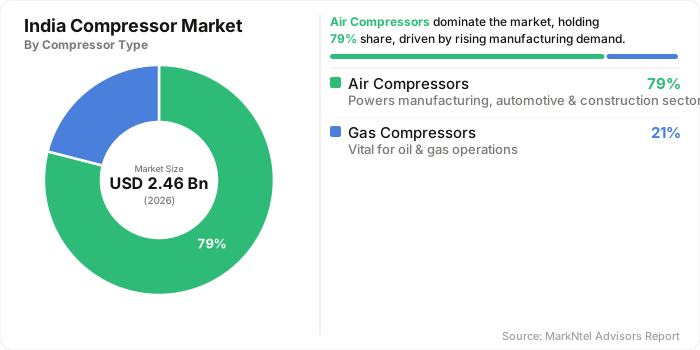
- By compressor type, air compressors dominate with a 79% share.
- By pressure rating, medium-pressure compressors lead with a 49.5% share.
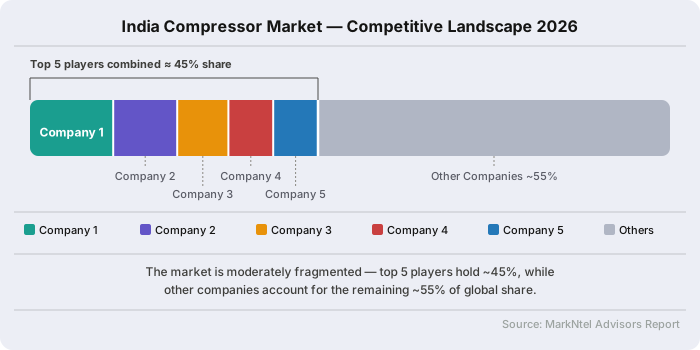
- The market is moderately fragmented, with the top five companies collectively accounting for approximately 45% of the market.
India Compressor Market Size and Outlook
The compressor market in India was valued at approximately USD 2.30 billion in 2025 and is estimated to reach USD 2.46 billion in 2026, advancing to USD 3.65 billion by 2032 at a CAGR of approximately 6.8% during 2026–2032. The 2025 baseline is consistent with estimates placing India’s industrial air-compressor market at around USD 2.3 billion, while the broader compressor market is also projected to expand at a mid-single-digit growth rate.
Market expansion is supported by continued manufacturing capacity additions, increasing automation and pneumatic-equipment deployment, replacement of aging compressor installations, and adoption of energy-efficient systems such as variable-speed and oil-free compressors. Rising demand from automotive, pharmaceuticals, food processing, chemicals, and other industrial applications is expected to sustain compressor procurement and modernization across India.
India Compressor Market Key Indicators
- MoSPI reported 8.1% growth in India’s manufacturing sector in December 2025, reflecting sustained expansion in industrial production. Rising factory output is increasing demand for compressed-air systems across manufacturing facilities, thereby expanding the installed base of industrial air compressors and supporting replacement, capacity addition, and maintenance requirements nationwide.
- The Ministry of Mines reported record iron ore production of 289 million metric tonnes in FY 2024–25, up from 277 MMT in the previous year. Rising extraction volumes are driving greater deployment of industrial compressors across mining operations, particularly high-pressure systems used for drilling, pneumatic conveying, material handling, and other intensive mining applications.
- The Ministry of Petroleum and Natural Gas reported India’s refining capacity at 256.816 MMTPA as of April 2024. Expanding refinery operations sustain demand for industrial air compressors, particularly process and instrument air systems used in catalytic cracking, pneumatic controls, instrumentation, maintenance, and pipeline transfer, supporting compressor deployment across India’s refining infrastructure.
- The Central Electricity Authority reported India’s installed power capacity at 505,023 MW as of October 31, 2025. Continued capacity expansion across thermal and renewable generation is supporting demand for industrial compressors, particularly compressed-air systems used in boiler controls, turbine auxiliaries, pneumatic instrumentation, maintenance, and other critical power-generation operations.
India Compressor Market Scope
| Category | Segments |
|---|---|
| By Compressor Type | Air Compressors, Gas Compressors |
| By Technology | Reciprocating Compressors, Rotary Screw Compressors, Rotary Scroll Compressors, Centrifugal Compressors |
| By Portability | Stationary, Portable |
| By Lubrication | Oil-Lubricated, Oil-Free |
| By End User | Oil & Gas, Chemicals & Petrochemicals, Construction, Manufacturing, Power & Utilities, Mining, Food & Beverage, Pharmaceuticals, Textiles, Others |
| By Pressure Rating | Low (Upto 20 bar), Medium (21 to 100 bar), High (101 to 300 bar), Ultra-High (Above 300 bar |
India Compressor Market Growth Drivers
Semiconductor Fab Construction Driving Demand for Ultra-Pure Oil-Free Compressed Air Systems
The expansion of semiconductor manufacturing facilities in India is creating new demand for high-purity, oil-free compressed-air systems required to maintain contamination-controlled production environments. As compared to conventional industrial applications, semiconductor manufacturing relies on compressed air that meets stringent purity and reliability requirements, making oil-free compressor systems critical to cleanroom operations and sensitive fabrication processes. India’s semiconductor industry is progressing beyond chip assembly toward front-end fabrication, supported by the Semicon India Programme. As of April 1, 2026, the programme had approved 10 semiconductor projects with a combined investment of USD 16.76 billion, while commercial production had commenced at Micron’s and Kaynes’ Gujarat facilities, marking an important expansion of India’s domestic semiconductor manufacturing and packaging capabilities.
Micron’s Sanand ATMP facility, inaugurated on February 28, 2026, represents a USD 2.36 billion investment and includes nearly 500,000 square feet of cleanroom space. In parallel, six additional semiconductor projects are being commissioned across Assam, Uttar Pradesh, Odisha, Punjab, and Andhra Pradesh under the USD 0.84 billion India Semiconductor Mission 2.0. The geographical expansion of these facilities creates new, project-specific requirements for high-specification compressed-air infrastructure.
As this semiconductor project pipeline progresses from construction to commissioning, compressor suppliers offering oil-free systems, cleanroom validation capabilities, and localized service support are positioned to benefit from the resulting demand.
Recent Trends
Rising Demand for High-Pressure Hydrogen-Compatible Compressor Systems Driven by National Green Hydrogen Mission Electrolyzer Deployments
India’s green hydrogen expansion is creating a new demand segment for high-pressure, hydrogen-compatible compressor systems as electrolyzer deployments progress from planned projects toward commercial-scale infrastructure. The National Green Hydrogen Mission, sanctioned with USD 2.27 billion through FY2029–30, is supporting the development of domestic hydrogen production and associated infrastructure. As of May 2026, India’s electrolyzer capacity pipeline had reached 17.93 GW across bidding, awarded, and construction stages, with Gujarat accounting for 10.25 GW, concentrated around Jamnagar, Mundra, and Hazira. This expanding production base directly increases requirements for downstream compression because hydrogen produced by electrolyzer at approximately 30 bar requires multi-stage compression to reach 350–500 bar for tube-trailer storage and fuel-cell vehicle dispensing.
The emerging requirement is already reflected in project-level specifications. NTPC’s hydrogen refueling station tender at Kandla Port specifies a compressor rated at 20 kg/hr, with 500-bar output and 350-bar dispensing pressure. Furthermore, 16 hydrogen refueling stations are planned across Gujarat, Madhya Pradesh, Kerala, and Himachal Pradesh under Phase 1 and Phase 2 mobility corridors.
Reliance Industries is targeting 3 MTPA of green hydrogen production at its Jamnagar giga-complex by 2032, supported by an electrolyzer gigafactory scheduled for commissioning by end-2026. As these projects scale through FY2027–2030, hydrogen hubs, port terminals, storage facilities, and refueling corridors will generate recurring requirements for dedicated 350–500 bar diaphragm and reciprocating compressor systems, establishing a structurally new demand pocket within India’s compressors industry.
India Compressor Market Opportunities and Challenges
Carbon Credit Trading Scheme Creating Demand for Energy-Efficient Compressor Upgrades
India’s Carbon Credit Trading Scheme (CCTS) is creating an indirect, regulation-driven opportunity for energy-efficient compressor upgrades across energy-intensive industries. The scheme covers approximately 490 industrial entities across seven sectors, including 282 plants in aluminium, cement, chlor-alkali, and pulp & paper from October 2025, followed by 208 units in petroleum refining, petrochemicals, textiles, and secondary aluminium from January 2026. Required emission-intensity reductions range from 2.8% in aluminium to 15% in pulp & paper during the FY2025–27 compliance cycle. Entities failing to meet their targets must purchase Carbon Credit Certificates or pay environmental compensation at twice the average traded price, increasing the incentive to reduce energy consumption.
This creates an opportunity for compressor manufacturers because compressed-air systems typically consume 20–30% of a factory’s total electricity. Replacing inefficient fixed-speed compressors with variable-frequency-drive or permanent-magnet compressors can reduce electricity consumption by matching output more closely with actual air demand, supporting emission-intensity reduction. ELGi Equipments’ Demand=Match system, launched in September 2025, delivers up to 17% energy savings on EG and EQ series compressors. However, customers face the challenge of upfront replacement costs and system integration. As iron & steel and fertilizer sectors join the CCTS, expanding coverage to approximately 740 entities, demand for BIS-certified, energy-efficient compressors could increase.
India Compressor Market Segmentation Insights
Air Compressors Dominate with 79% Share, Supported by Broad Manufacturing Deployment and Recurring Replacement Demand
Supported by their broad deployment across individual manufacturing facilities and relatively lower-ticket, repeatable procurement compared with gas compressors. Gas compressors are generally concentrated in a smaller number of large-scale oil & gas, petrochemical, and pipeline installations, where individual orders carry substantially higher transaction values but occur less frequently. In contrast, India had 7.83 crore (78.3 million) enterprises registered on the Udyam MSME platform as of February 2026, creating a large potential industrial customer base. Even a small proportion of these enterprises operating manufacturing facilities that require compressed air for pneumatic actuation can generate a significantly larger number of air-compressor installations than the comparatively limited gas-compression projects.
Demand for air compressors is further supported by both new capacity additions and replacement requirements. India’s automobile sector recorded sales of 4.64 million passenger vehicles and 21.71 million two-wheelers in FY26, with new assembly lines requiring fixed compressed-air capacity for pneumatic tooling. At the same time, compressors installed approximately 10–15 years ago are increasingly entering replacement cycles, while BIS/QCO requirements and energy-efficiency modernization are encouraging equipment upgrades. Consequently, the larger installation base, recurring replacement demand, and expansion of manufacturing capacity reinforce the dominance of air compressors. By compressor type the market is further segmented into the following sub-categories:
- Air Compressors
- Gas Compressors
Medium-Pressure Compressors Lead with 49.5% Share, Supported by Broad Factory Applications
Reflecting their suitability for widely used pneumatic applications such as instrumentation air, tooling, and process automation across India’s organized manufacturing base. In contrast, high- and ultra-high-pressure compressors are more commonly custom-engineered for specialized applications, including CNG and gas-cylinder filling, resulting in lower purchase frequency. India recorded 2,60,061 factories in 2023–24 under the Annual Survey of Industries, providing a substantial industrial base for medium-pressure compressor deployment.
New manufacturing investments are adding to this demand. The PM MITRA textile parks at Lucknow, Uttar Pradesh, and Navsari, Gujarat, cleared for USD 2.10 billion combined investment on June 29, 2026, will support spinning and weaving operations requiring compressed-air systems before production commissioning. In addition, the DPIIT BIS Quality Control Order for stainless-steel pipes and tubes, effective August 1, 2025, is increasing requirements for calibrated pressure-testing systems among general-engineering and pressure-vessel manufacturers.
Meanwhile, pre-2015 compressor installations in Coimbatore’s general-engineering cluster are approaching the typical replacement period. These greenfield, compliance, and replacement requirements reinforce medium-pressure compressors’ segment leadership, although increasing high-pressure requirements from hydrogen and CNG infrastructure could strengthen competing pressure ranges. By pressure rating, the market is further segmented into the following sub-categories:
- Low (Upto 20 bar)
- Medium (21 to 100 bar)
- High (101 to 300 bar)
- Ultra-High (Above 300 bar)
India Compressor Market Competitive Landscape
The India compressor market is moderately fragmented, with both multinational and domestic manufacturers competing across air and gas compressor applications. The top five companies collectively account for approximately 45% of the market, while the remaining share is distributed among regional and specialized compressor manufacturers serving diverse industrial applications.
Major Players in India Compressor Market
- Atlas Copco
- ELGi Equipments Ltd.
- Ingersoll Rand Plc
- Kirloskar Pneumatic Company Limited
- Kaeser Kompressoren SE
- Sullair
- Gardner Denver
- Chicago Pneumatic
- BOGE Compressors
- BURCKHARDT COMPRESSION
- Hitachi Industrial Equipment Systems
- Anest Iwata
- Indo Air Compressor
India Compressor Market News and Recent Developments
2025: Embraco Announces USD 120 Million+ Compressor Manufacturing Facility in Maharashtra
Embraco, part of Nidec Global Appliance, announced a new manufacturing facility in Chhatrapati Sambhaji Nagar, Maharashtra, to produce residential and commercial refrigeration compressors and electronic components. The facility will have 6 million units of annual production capacity, cover 55,000 square meters, and begin operations in the second half of 2026, with investment exceeding USD 120 million. It will also manufacture inverters for variable-speed compressors.
Market Impact: The facility will expand domestic refrigeration-compressor supply, reduce import dependence, and strengthen local production of compressor and inverter technologies for residential and commercial cold-chain applications.
2025: Ingersoll Rand Expands Compressor Manufacturing Capacity in Gujarat
Ingersoll Rand inaugurated a USD 20.4 million manufacturing facility in Sanand, Gujarat, with production expected to begin in the fourth quarter of FY2025. The facility is designed to increase annual manufacturing capacity by 1.5 times by 2028 and up to twice the current capacity by 2030. The existing plant operates at 60,000 units annually. The new facility will initially produce centrifugal, gas, and large reciprocating compressors for pharmaceutical, electronics, semiconductor, and defence applications.
Market Impact: The expansion increases India’s engineered-to-order compressor capacity and strengthens domestic supply for specialized applications.
2025: Atlas Copco Opens Compressor Manufacturing Facility in Pune
Atlas Copco opened a 25,000-square-meter manufacturing facility in Talegaon, Pune, with an investment of approximately USD 17 million and employment for more than 200 people. The plant manufactures air and gas compressors, including CNG, biogas, and hydrogen compressors, alongside air dryers, nitrogen and oxygen generators, and medical filters for domestic and international markets. Approximately 80% of the facility’s energy requirements are met through rooftop solar power.
Market Impact: The facility expands India’s domestic production capacity for alternative-fuel and low-emission gas-compression technologies, supporting demand from emerging hydrogen and biogas infrastructure while strengthening export capabilities.
2026: Kirloskar Pneumatic Launches Indigenous Centrifugal Compressor
Kirloskar Pneumatic launched the Tezcatlipoca A800 in Pune on June 26, 2026, an indigenously designed and manufactured two-stage centrifugal compressor delivering 600–980 CFM of Class 0 oil-free air certified to ISO 8573-1. The system features 45% flow turndown capability and targets textiles, pharmaceuticals, electronics and semiconductors, automotive, chemicals, and food and beverage applications.
Market Impact: The launch expands India’s domestic availability of centrifugal compression technology in this capacity range, strengthening local alternatives to imported equipment and increasing competition in the oil-free compressor segment.
- Market Segmentation
- Introduction
- Product Definition
- Research Process
- Assumptions
- Executive Summary
- India Compressor Supply Chain Analysis
- India Compressor Import-Export Analysis 2022-25
- India Compressor Market Trends & Developments
- India Compressor Market Dynamics
- Growth Drivers
- Challenges
- India Compressor Market Hotspot & Opportunities
- India Compressor Market Porter’s Five Forces Analysis, 2026
- India Compressor Market Policies & Regulations
- India Compressor Market Outlook, 2022-32
- Market Size & Analysis
- By Revenues (USD Million)
- By Unit Sold (Thousand)
- Market Segmentation & Analysis
- By Compressor Type- Market Size & Forecast 2022-2032, USD Million & Thousand Units
- Air Compressors
- Gas Compressors
- By Technology- Market Size & Forecast 2022-2032, USD Million & Thousand Units
- & Thousand Units
- Reciprocating Compressors
- Rotary Screw Compressors
- Rotary Scroll Compressors
- Centrifugal Compressors
- By Portability- Market Size & Forecast 2022-2032, USD Million & Thousand Units
- & Thousand Units
- Stationary
- Portable
- By Lubrication- Market Size & Forecast 2022-2032, USD Million & Thousand Units
- & Thousand Units
- Oil-Lubricated
- Oil-Free
- By End User- Market Size & Forecast 2022-2032, USD Million & Thousand Units
- Oil & Gas
- Chemicals & Petrochemicals
- Construction
- Manufacturing
- Power & Utilities
- Mining
- Food & Beverage
- Pharmaceuticals
- Textiles
- Others
- By Pressure Rating- Market Size & Forecast 2022-2032, USD Million & Thousand Units
- Low (Upto 20 bar)
- Medium (21 to 100 bar)
- High (101 to 300 bar)
- Ultra-High (Above 300 bar)
- By Region
- North
- Uttar Pradesh
- Punjab
- Haryana
- Others
- East
- West Bengal
- Bihar
- Others
- West
- Maharashtra
- Gujarat
- Rajasthan
- Others
- South
- Tamil Nadu
- Karnataka
- Telangana
- Others
- North
- By Competition
- Competition Characteristics
- Air Compressors
- Market Share of Top Companies
- Gas Compressors
- Market Share of Top Companies
- Air Compressors
- Competition Characteristics
- By Compressor Type- Market Size & Forecast 2022-2032, USD Million & Thousand Units
- Market Size & Analysis
- India Air Compressor Market Outlook, 2022-32F
- Market Size & Analysis
- By Revenues (USD Million)
- By Unit Sold (Thousand)
- Market Segmentation & Analysis
- By Technology- Market Size & Forecast 2022-2032, USD Million & Thousand Units
- By Portability- (Market Size & Forecast 2022-2032, USD Million & Thousand Units
- By Lubrication- Market Size & Forecast 2022-2032, USD Million & Thousand Units
- By End User- Market Size & Forecast 2022-2032, USD Million & Thousand Units
- By Pressure Rating- Market Size & Forecast 2022-2032, USD Million & Thousand Units
- By Region -Market Size & Forecast 2022-2032, USD Million & Thousand Units
- Market Size & Analysis
- India Gas Compressor Market Outlook, 2022-32F
- Market Size & Analysis
- By Revenues (USD Million)
- By Unit Sold (Thousand)
- Market Segmentation & Analysis
- By Technology- Market Size & Forecast 2022-2032, USD Million & Thousand Units
- By Portability- (Market Size & Forecast 2022-2032, USD Million & Thousand Units
- By Lubrication- Market Size & Forecast 2022-2032, USD Million & Thousand Units
- By End User- Market Size & Forecast 2022-2032, USD Million & Thousand Units
- By Pressure Rating- Market Size & Forecast 2022-2032, USD Million & Thousand Units
- By Region - Market Size & Forecast 2022-2032, USD Million & Thousand Units
- Market Size & Analysis
- India Compressor Market Key Strategic Imperatives for Success & Growth
- Competitive Outlook
- Company Profiles
- Atlas Copco
- Business Description
- Product Portfolio
- Strategic Alliances or Partnerships
- Recent Developments
- Financial Details
- Others
- ELGi Equipments Ltd.
- Business Description
- Product Portfolio
- Strategic Alliances or Partnerships
- Recent Developments
- Financial Details
- Others
- Ingersoll Rand Plc
- Business Description
- Product Portfolio
- Strategic Alliances or Partnerships
- Recent Developments
- Financial Details
- Others
- Kirloskar Pneumatic Company Limited
- Business Description
- Product Portfolio
- Strategic Alliances or Partnerships
- Recent Developments
- Financial Details
- Others
- Kaeser Kompressoren SE
- Business Description
- Product Portfolio
- Strategic Alliances or Partnerships
- Recent Developments
- Financial Details
- Others
- Sullair
- Business Description
- Product Portfolio
- Strategic Alliances or Partnerships
- Recent Developments
- Financial Details
- Others
- Gardner Denver
- Business Description
- Product Portfolio
- Strategic Alliances or Partnerships
- Recent Developments
- Financial Details
- Others
- Chicago Pneumatic
- Business Description
- Product Portfolio
- Strategic Alliances or Partnerships
- Recent Developments
- Financial Details
- Others
- BOGE Compressors
- Business Description
- Product Portfolio
- Strategic Alliances or Partnerships
- Recent Developments
- Financial Details
- Others
- BURCKHARDT COMPRESSION
- Business Description
- Product Portfolio
- Strategic Alliances or Partnerships
- Recent Developments
- Financial Details
- Others
- Hitachi Industrial Equipment Systems
- Business Description
- Product Portfolio
- Strategic Alliances or Partnerships
- Recent Developments
- Financial Details
- Others
- Anest Iwata
- Business Description
- Product Portfolio
- Strategic Alliances or Partnerships
- Recent Developments
- Financial Details
- Others
- Indo Air Compressor
- Business Description
- Product Portfolio
- Strategic Alliances or Partnerships
- Recent Developments
- Financial Details
- Others
- Others
- Atlas Copco
- Company Profiles
- Disclaimer

MarkNtel Advisors follows a robust and iterative research methodology designed to ensure maximum accuracy and minimize deviation in market estimates and forecasts. Our approach combines both bottom-up and top-down techniques to effectively segment and quantify various aspects of the market. A consistent feature across all our research reports is data triangulation, which examines the market from three distinct perspectives to validate findings. Key components of our research process include:
1. Scope & Research Design At the outset, MarkNtel Advisors define the research objectives and formulate pertinent questions. This phase involves determining the type of research—qualitative or quantitative—and designing a methodology that outlines data collection methods, target demographics, and analytical tools. They also establish timelines and budgets to ensure the research aligns with client goals.
2. Sample Selection and Data Collection In this stage, the firm identifies the target audience and determines the appropriate sample size to ensure representativeness. They employ various sampling methods, such as random or stratified sampling, based on the research objectives. Data collection is carried out using tools like surveys, interviews, and observations, ensuring the gathered data is reliable and relevant.
3. Data Analysis and Validation Once data is collected, MarkNtel Advisors undertake a rigorous analysis process. This includes cleaning the data to remove inconsistencies, employing statistical software for quantitative analysis, and thematic analysis for qualitative data. Validation steps are taken to ensure the accuracy and reliability of the findings, minimizing biases and errors.

4. Data Forecast and FinalizationThe final phase involves forecasting future market trends based on the analyzed data. MarkNtel Advisors utilize predictive modeling and time series analysis to anticipate market behaviors. The insights are then compiled into comprehensive reports, featuring visual aids like charts and graphs, and include strategic recommendations to inform client decision-making
We offer flexible licensing options to cater to varying organizational needs. Choose the pricing pack that best suits your requirements:
Buy Now Inquire Before Buying
 Request Customization