

By Waste Type (Municipal Solid Waste, Plastic Waste, Paper & Cardboard Waste, Metal Waste, Glass Waste, E-Waste, Construction & Demolition Waste, Organic Waste), By Operation Mode (Automatic, Manual,... ... (Automatic, Manual, Semi-Automatic), By Technology (Sensor-Based Sorting, Magnetic Separation, Mechanical Sorting, Robotic Sorting, Others), By End User (Municipal, Recycling Facilities/MRFs, Industrial, Construction & Demolition, E-Waste Recycling), and others Read more
- Environment
- Jul 2026
- 240
- PDF, Excel, PPT
GCC Waste Sorting Equipment Market Key Takeaways
- The GCC Waste Sorting Equipment Market is valued at USD 63 million in 2025, expanding to USD 71 million in 2026, and projected to reach USD 89 million by 2032, growing at a CAGR of 3.84%.
- Based on the operating model, the automatic segment leads with a 65% share in 2026.
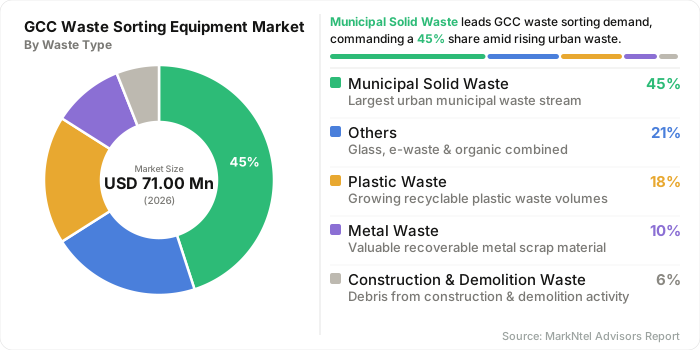
- By waste type, the municipal solid waste holds a 45% market share in 2026.
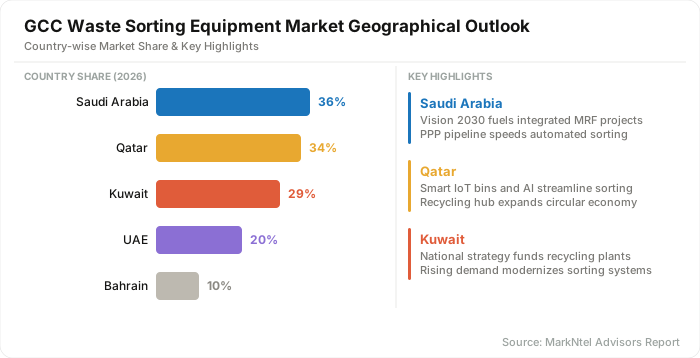
- Saudi Arabia commands the largest country share at 36% in 2026.
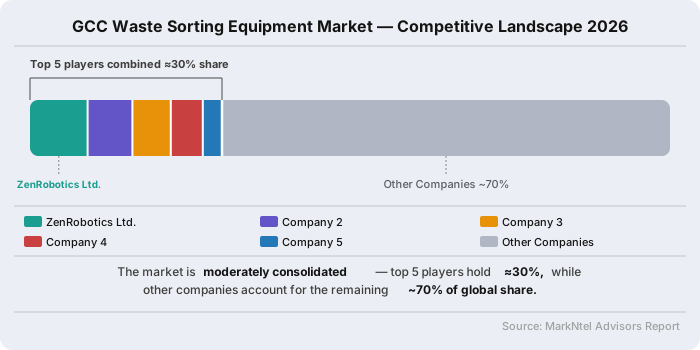
- The market is moderately consolidated, with the top 5 players collectively accounting for approximately 30% of total market share.
GCC Waste Sorting Equipment Market Size and Outlook
The GCC waste sorting equipment market is valued at USD 63 million in 2025, expanding to USD 71 million in 2026, and projected to reach USD 89 million by 2032. The industry is projected to witness steady growth at a CAGR of 3.84%, during the forecast period of 2026-32, supported by accelerating urbanization, rising municipal solid waste generation, and growing government commitment to circular economy development. Countries across the region are implementing long-term waste diversion and recycling strategies to reduce landfill dependence and improve resource recovery rates.
The UAE has strengthened market growth through its Circular Economy Policy and Dubai Integrated Waste Management Strategy 2041, both of which encourage investments in advanced waste processing infrastructure and automated material recovery systems. Increasing waste volumes from residential communities, commercial establishments, and hospitality facilities are further driving demand for efficient sorting technologies capable of improving recycling performance and operational productivity.
Saudi Arabia is emerging as a major contributor to regional market development through large-scale environmental and infrastructure reforms under Vision 2030. The Kingdom continues to prioritize waste management modernization as part of broader sustainability objectives, creating significant opportunities for advanced sorting equipment deployment. Growing industrial diversification, expanding urban populations, and increasing construction activity are generating larger and more complex waste streams that require sophisticated separation and recovery technologies. As municipalities seek to improve recycling efficiency and reduce environmental impacts, investment in automated sorting facilities is increasing across both public and private sectors.
Industry participation is also supporting market expansion through investments in advanced recycling and resource recovery infrastructure. Regional waste management operators are deploying artificial intelligence, optical sensors, and automated separation technologies to enhance material recovery rates and reduce operational costs. Companies such as BEEAH have expanded integrated waste processing capabilities through large-scale recycling facilities designed to improve circular resource utilization. These initiatives are encouraging broader adoption of technologically advanced sorting equipment while supporting national sustainability goals focused on maximizing waste diversion and resource efficiency.
Combined with ongoing infrastructure investments and growing emphasis on circular economy principles, these developments are expected to sustain long-term growth opportunities for waste sorting equipment suppliers across the GCC region.
GCC Waste Sorting Equipment Market Key Indicators
- Saudi Arabia's General Authority for Statistics recorded total waste generation of 135.1 million tonnes in 2024, up from 111.4 million tonnes in 2023, a year-on-year increase of more than 21%, creating sustained operational demand for automated sorting systems capable of processing escalating inbound waste volumes at transfer stations and material recovery facilities.
- Saudi Arabia's Ministry of Environment, Water and Agriculture issued a 2024 waste management plan targeting recycling of up to 95% of generated waste and the creation of over 100,000 jobs a policy mandate that requires large-scale deployment of pre-processing, sorting, and segregation equipment to route materials through formal recovery channels rather than landfill.
GCC Waste Sorting Equipment Market Scope
| Category | Segments |
|---|---|
| By Waste Type | Municipal Solid Waste, Plastic Waste, Paper & Cardboard Waste, Metal Waste, Glass Waste, E-Waste, Construction & Demolition Waste, Organic Waste |
| By Operation Mode | Automatic, Manual, Semi-Automatic |
| By Technology | Sensor-Based Sorting, Magnetic Separation, Mechanical Sorting, Robotic Sorting, Others |
| By End User | Municipal, Recycling Facilities/MRFs, Industrial, Construction & Demolition, E-Waste Recycling |
GCC Waste Sorting Equipment Market Growth Drivers
Mandatory National Sustainability and Waste Diversion Targets Accelerating Demand for Waste Sorting Equipment
National sustainability mandates across GCC countries have become the strongest driver of waste sorting equipment demand by creating legally and strategically required investments in recycling infrastructure. Saudi Arabia's National Environment Strategy targets diverting 90% of municipal waste from landfills by 2040 while increasing recycling rates through projects led by the National Center for Waste Management and the Saudi Investment Recycling Company (SIRC). These objectives require substantial expansion of sorting and material recovery capacity, directly increasing procurement of automated sorting systems.
In 2025, Saudi Arabia's National Center for Waste Management continued advancing private-sector participation in waste infrastructure under the Kingdom's waste management transformation program. The country is targeting treatment and recovery of millions of tonnes of municipal waste annually through new processing facilities, requiring extensive front-end sorting operations.
Similar momentum is emerging in Qatar and Oman through long-term sustainability programs. Qatar National Vision 2030 and Oman Vision 2040 prioritize resource efficiency, landfill reduction, and improved waste treatment practices. As governments establish stricter waste segregation and recovery requirements, municipalities and private operators are investing in modern sorting infrastructure to meet diversion targets, making sustainability-driven regulation a direct contributor to market volume expansion.
Recent Trends
Rapid Adoption of AI-Enabled and Digitally Connected Waste Sorting Equipment
The most significant trend in the GCC waste sorting equipment market is the transition toward AI-enabled, sensor-based, and digitally connected waste sorting infrastructure. This shift has accelerated during 2025–2026 as governments strengthened circular economy programs and landfill diversion targets, requiring higher material recovery rates and improved waste traceability. The UAE expanded implementation of its Integrated Waste Management Agenda and launched the national recyclable-material marketplace “Tahweel” in 2025, increasing demand for automated sorting and digital waste tracking technologies.
The trend is restructuring the value chain by moving waste management operations from collection-focused models toward data-driven resource recovery systems. Operators are increasingly deploying AI-powered sorting, smart bins, automated material identification, and digital monitoring platforms to improve sorting accuracy and operational efficiency. In September 2025, Tadweer Group launched Tajmee’e in Abu Dhabi with AI-enabled collection and optimization technologies, while du and Ericsson introduced a connected recycling platform in the UAE to enhance waste-stream traceability and circularity.
The trend is expected to remain a long-term market driver because it is directly linked to national sustainability commitments and circular economy objectives. In 2025, TOMRA established permanent operations in Saudi Arabia and the UAE to support deployment of advanced sorting technologies, while KEZAD Group and BEEAH formed a joint venture in 2026 to develop integrated waste processing and recycling infrastructure. These investments indicate sustained demand for sophisticated waste sorting equipment across the GCC.
Opportunities and Challenges
High Landfill Dependency Driving Demand for Scalable Waste Sorting and Recovery Infrastructure
Despite growing national sustainability mandates, the GCC's waste management industry remains structurally anchored to disposal-first practices. Saudi Arabia's National Center for Waste Management (MWAN) reported that only 18% of the Kingdom's waste was diverted from landfills in 2024, a figure that exposes the scale of the sorting and recovery infrastructure gap relative to the national target of 90% diversion by 2040. Most landfills across major Saudi cities, including Riyadh, Jeddah, and Dammam, are approaching capacity, and in Jeddah alone, municipal landfills received nearly 5 million tonnes of waste in the first half of 2025. Without upstream sorting systems to intercept and separate recoverable materials before disposal, diversion targets remain structurally unreachable regardless of regulatory intent.
This infrastructure deficit creates a direct commercial opening for waste sorting equipment suppliers across the GCC. Saudi Arabia's MWAN has identified approximately USD 112 billion in sector investment opportunities by 2040, with private-sector participation as the primary delivery mechanism. In December 2024, Veolia signed an MOU with the Saudi Investment Recycling Company (SIRC), a Public Investment Fund subsidiary targeting a regional waste treatment champion by 2027. As governments tighten landfill access and mandate source segregation, suppliers capable of delivering multi-stream sorting systems are positioned to capture the region's most consequential infrastructure procurement cycle in decades.
Segmentation Insights
Municipal Solid Waste Accounts for the Largest Share of the Market Amid Expanding Waste Management Infrastructure
Municipal Solid Waste commands approximately 45% of the GCC Waste Sorting Equipment market because it is the single largest and most complex waste stream the region produces. Unlike construction debris or industrial effluents, which are generated in controlled quantities at defined sites, MSW originates from millions of households and commercial premises daily, arriving at sorting facilities as a mixed, heterogeneous flow of plastics, paper, metals, organics, and glass that cannot be recovered without multi-stage mechanical separation equipment. Saudi Arabia's Ministry of Environment, Water and Agriculture (MEWA) reported in early 2024 that the Kingdom generates more than 110 million tonnes of waste annually, with MSW forming the dominant share of that volume, making it the most equipment-intensive stream in the region.
This volume translates directly into procurement demand for trommel screens, optical sorters, air classifiers, and material recovery infrastructure across the GCC. In June 2026, Tadweer Group, Abu Dhabi's state-owned waste authority, awarded a contract to Bou Chalhoub Metrix General Contracting to upgrade a Material Recovery Facility in Al Ain specifically engineered to process 400,000 tonnes of MSW per year, incorporating advanced mechanical sorting technologies to separate paper, plastics, and metals from mixed municipal streams.
The facility is designed for a 20-year operational lifespan and is targeted to divert approximately 60% of Al Ain's MSW from landfill annually, directly supporting Abu Dhabi's mandate of 80% waste diversion by 2031. As landfill diversion targets tighten across all six GCC states, MSW will continue to anchor equipment demand well ahead of any competing waste category.
Automation-Led Waste Processing Drives Demand for Sorting Equipment Across the GCC
Automatic waste sorting systems hold a 65% share in the GCC market, a dominance built on operational economics that manual and semi-automatic modes cannot replicate at the throughput volumes generated by the region's rapidly expanding urban waste streams. Fully automated systems eliminate labor dependency in sorting environments that are hazardous, high-temperature, and operationally continuous conditions endemic to GCC facilities processing mixed municipal, construction, and industrial waste year-round. The shift toward automation is also being accelerated by national mandates for source segregation, which require processing infrastructure capable of handling pre-sorted waste with consistent accuracy.
In October 2024, Bee'ah inaugurated the Middle East's first AI-powered commercial and industrial waste sorting facility in Sharjah, deploying robotics and AI vision systems capable of processing 500 tonnes of mixed recyclables daily and recovering over ten distinct material categories, including aluminum, PET, HDPE, and ferrous metals, without manual intervention.
The facility's AI-driven approach directly reduced labor requirements at the sorting stage while improving material purity for downstream recycling markets. As GCC governments mandate higher diversion rates and commission new material recovery infrastructure, automatic sorting systems with their throughput scalability, reduced contamination rates, and integration-readiness with AI and sensor technology are positioned to command an expanding share of regional equipment procurement through 2032. By operation mode, the market is further segmented into the following sub-categories:
- Automatic
- Manual
- Semi-Automatic
GCC Waste Sorting Equipment Market Geographical Analysis
Saudi Arabia holds a 36% share of the GCC waste-sorting equipment market, a position anchored in the Kingdom's status as the region's largest waste generator and the most active deployer of sorting and recovery infrastructure under Vision 2030. According to MWAN's licensing database, the number of licensed waste sector entities reached 1,348 in 2024, with an additional 145 permits issued specifically for recycling facilities, bringing the total number of active investing companies to 1,493 and reflecting the scale at which sorting-related procurement is occurring across the Kingdom.
Jeddah Municipality reported that its landfills received nearly 5 million tonnes of waste in the first half of 2025 alone, including 3.9 million tonnes of construction and demolition debris, a throughput volume that demands continuous investment in upstream sorting equipment to separate recoverable materials before disposal.
In March 2025, Aramco Digital partnered with Recykal to deploy AI-backed waste-sorting hardware and digital tracking systems across Saudi businesses, accelerating the installed base of automated sorting technology in the Kingdom's industrial sector. MWAN's 2040 strategy further mandates recycling 40% of all waste and composting 31%, targets that structurally require material-specific sorting at every processing stage and position Saudi Arabia as the GCC's dominant market for sorting equipment procurement through the forecast period.
GCC Waste Sorting Equipment Market Competitive Landscape
The GCC waste sorting equipment market is moderately consolidated, with a few technology-driven international companies controlling a significant share of high-value projects, while regional players compete through system integration, local service support, and government contracts, with the top 5 players: TOMRA Systems, ASABHS-Sonthofen GmbH, CP Manufacturing, Inc., ZenRobotics Ltd., and Pellenc ST SAS collectively holding a share of 30%.
Major Players in the GCC Waste Sorting Equipment Market
- TOMRA Systems ASA
- ZenRobotics Ltd. (Terex Corporation)
- CP Manufacturing, Inc.
- Bühler AG
- Envac AB
- Pellenc ST SAS
- BHS-Sonthofen GmbH
- Al Shirawi Equipment Co. L.L.C.
- Excel Industry Co. L.L.C.
- Wealth Industry Company Ltd.
- Wastech Saudi Arabia
- Envirotec International Co. Ltd.
- AMP Robotics Corp.
- Mil-tek Middle East FZCO
- Solwearth Ecotech Pvt. Ltd.
GCC Waste Sorting Equipment Market News and Recent Developments
2024: SUEZ and Saudi Investment Recycling Company Sign Framework Strategic Partnership to Accelerate Circular Economy Infrastructure in Saudi Arabia
On the occasion of the French President's state visit to Saudi Arabia, SUEZ and the Saudi Investment Recycling Company (SIRC), a wholly owned subsidiary of the Public Investment Fund, formalised a Framework Strategic Partnership to co-develop waste treatment infrastructure across the Kingdom. The agreement targets waste-to-energy infrastructure development and brings SUEZ's operational expertise to bear across municipal, medical, and hazardous waste streams. The partnership also incorporates decarbonisation initiatives, including biochar production through pyrolysis of biomass, supporting carbon sequestration and soil improvement objectives. SIRC, which operates across more than 65 Saudi cities and processes waste under 14 regulated categories, will leverage SUEZ's engineering capabilities to expand treatment capacity across all major waste streams.
Impact Analysis: The SUEZ–SIRC partnership strengthens the upstream waste processing pipeline that directly feeds demand for sorting and separation equipment, as municipal, medical, and hazardous waste streams each require distinct material classification before entering treatment or energy conversion pathways. By committing a global operator with waste-to-energy infrastructure expertise to the Kingdom's processing expansion, the agreement raises the technical specification threshold for incoming sorting equipment and intensifies competitive positioning pressure on suppliers without equivalent project references in the GCC.
2024: Tadweer Group Announces Abu Dhabi's First Greenfield Material Recovery Facility with 1.3 Million Tonne Annual Capacity
Tadweer Group, Abu Dhabi's integrated waste management authority, announced plans for the emirate's first dedicated greenfield Material Recovery Facility (MRF) to be located in the Al Mafraq Industrial Area, 36 kilometres from central Abu Dhabi. The facility will span over 90,000 square metres, one of the largest MRFs in the region, with a designed annual processing capacity of 1.3 million tonnes of municipal solid waste. Contract award and engineering, procurement, and construction works were targeted for the end of 2024, with operations commissioning scheduled for end-2026. The MRF will incorporate optical sorting systems and AI-guided robotics to separate plastics, metals, paper, and glass, and will feed prepared feedstock into the Abu Dhabi Waste-to-Energy facility for non-recyclable residuals.
Impact Analysis: The commissioning of a 1.3 million tonne-per-year automated MRF at the Al Mafraq Industrial Area directly expands sorting equipment demand in Abu Dhabi, establishing a new procurement cycle for optical sorters, conveyor systems, and AI-driven separation units sized for large-scale municipal waste throughput. The facility's integration into Tadweer's circular cluster — designed to achieve 80% landfill diversion by 2030 — creates a replicable infrastructure model that is expected to drive additional MRF commissioning across the UAE's northern emirates, widening the regional addressable market for advanced sorting equipment suppliers.
- Market Segmentation
- Introduction
- Product Definition
- Research Process
- Assumptions
- Executive Summary
- GCC Waste Sorting Equipment Market Policies, Regulations, and Product Standards
- GCC Waste Sorting Equipment Market Trends & Developments
- GCC Waste Sorting Equipment Market Dynamics
- Growth Factors
- Challenges
- GCC Waste Sorting Equipment Market Hotspot & Opportunities
- GCC Waste Sorting Equipment Market Outlook, 2022-2032F
- Market Size & Outlook
- By Revenues (USD Million)
- Market Share & Analysis
- By Waste Type- Market Size & Forecast 2022-2032, USD Million
- Municipal Solid Waste
- Plastic Waste
- Paper & Cardboard Waste
- Metal Waste
- Glass Waste
- E-Waste
- Construction & Demolition Waste
- Organic Waste
- By Operation Mode- Market Size & Forecast 2022-2032, USD Million
- Automatic
- Manual
- Semi-Automatic
- By Technology- Market Size & Forecast 2022-2032, USD Million
- Sensor-Based Sorting
- Magnetic Separation
- Mechanical Sorting
- Robotic Sorting
- Others
- By End User- Market Size & Forecast 2022-2032, USD Million
- Municipal
- Recycling Facilities/MRFs
- Industrial
- Construction & Demolition
- E-Waste Recycling
- By Country
- Saudi Arabia
- The UAE
- Kuwait
- Qatar
- Bahrain
- Oman
- By Company
- Competition Characteristics
- Market Share & Analysis
- By Waste Type- Market Size & Forecast 2022-2032, USD Million
- Market Size & Outlook
- Saudi Arabia Waste Sorting Equipment Market Outlook, 2022-2032F
- Market Size & Outlook
- By Revenues (USD Million)
- Market Share & Analysis
- By Waste Type- Market Size & Forecast 2022-2032, USD Million
- By Operation Mode- Market Size & Forecast 2022-2032, USD Million
- By Technology- Market Size & Forecast 2022-2032, USD Million
- By End User- Market Size & Forecast 2022-2032, USD Million
- Market Size & Outlook
- The UAE Waste Sorting Equipment Market Outlook, 2022-2032F
- Market Size & Outlook
- By Revenues (USD Million)
- Market Share & Analysis
- By Waste Type- Market Size & Forecast 2022-2032, USD Million
- By Operation Mode- Market Size & Forecast 2022-2032, USD Million
- By Technology- Market Size & Forecast 2022-2032, USD Million
- By End User- Market Size & Forecast 2022-2032, USD Million
- Market Size & Outlook
- Kuwait Waste Sorting Equipment Market Outlook, 2022-2032F
- Market Size & Outlook
- By Revenues (USD Million)
- Market Share & Analysis
- By Waste Type- Market Size & Forecast 2022-2032, USD Million
- By Operation Mode- Market Size & Forecast 2022-2032, USD Million
- By Technology- Market Size & Forecast 2022-2032, USD Million
- By End User- Market Size & Forecast 2022-2032, USD Million
- Market Size & Outlook
- Qatar Waste Sorting Equipment Market Outlook, 2022-2032F
- Market Size & Outlook
- By Revenues (USD Million)
- Market Share & Analysis
- By Waste Type- Market Size & Forecast 2022-2032, USD Million
- By Operation Mode- Market Size & Forecast 2022-2032, USD Million
- By Technology- Market Size & Forecast 2022-2032, USD Million
- By End User- Market Size & Forecast 2022-2032, USD Million
- Market Size & Outlook
- Bahrain Waste Sorting Equipment Market Outlook, 2022-2032F
- Market Size & Outlook
- By Revenues (USD Million)
- Market Share & Analysis
- By Waste Type- Market Size & Forecast 2022-2032, USD Million
- By Operation Mode- Market Size & Forecast 2022-2032, USD Million
- By Technology- Market Size & Forecast 2022-2032, USD Million
- By End User- Market Size & Forecast 2022-2032, USD Million
- Market Size & Outlook
- Oman Waste Sorting Equipment Market Outlook, 2022-2032F
- Market Size & Outlook
- By Revenues (USD Million)
- Market Share & Analysis
- By Waste Type- Market Size & Forecast 2022-2032, USD Million
- By Operation Mode- Market Size & Forecast 2022-2032, USD Million
- By Technology- Market Size & Forecast 2022-2032, USD Million
- By End User- Market Size & Forecast 2022-2032, USD Million
- Market Size & Outlook
- GCC Waste Sorting Equipment Market Key Strategic Imperatives for Success & Growth
- Competitive Outlook
- Company Profiles
- TOMRA Systems ASA
- Business Description
- Product Portfolio
- Collaborations & Alliances
- Recent Developments
- Financial Details
- Others
- ZenRobotics Ltd. (subsidiary of Terex Corporation)
- Business Description
- Product Portfolio
- Collaborations & Alliances
- Recent Developments
- Financial Details
- Others
- CP Manufacturing, Inc.
- Business Description
- Product Portfolio
- Collaborations & Alliances
- Recent Developments
- Financial Details
- Others
- Bühler AG
- Business Description
- Product Portfolio
- Collaborations & Alliances
- Recent Developments
- Financial Details
- Others
- Envac AB
- Business Description
- Product Portfolio
- Collaborations & Alliances
- Recent Developments
- Financial Details
- Others
- Pellenc ST SAS
- Business Description
- Product Portfolio
- Collaborations & Alliances
- Recent Developments
- Financial Details
- Others
- BHS-Sonthofen GmbH
- Business Description
- Product Portfolio
- Collaborations & Alliances
- Recent Developments
- Financial Details
- Others
- Al Shirawi Equipment Co. L.L.C.
- Business Description
- Product Portfolio
- Collaborations & Alliances
- Recent Developments
- Financial Details
- Others
- Excel Industry Co. L.L.C.
- Business Description
- Product Portfolio
- Collaborations & Alliances
- Recent Developments
- Financial Details
- Others
- Wealth Industry Company Ltd.
- Business Description
- Product Portfolio
- Collaborations & Alliances
- Recent Developments
- Financial Details
- Others
- Wastech Saudi Arabia
- Business Description
- Product Portfolio
- Collaborations & Alliances
- Recent Developments
- Financial Details
- Others
- Envirotec International Co. Ltd.
- Business Description
- Product Portfolio
- Collaborations & Alliances
- Recent Developments
- Financial Details
- Others
- AMP Robotics Corp.
- Business Description
- Product Portfolio
- Collaborations & Alliances
- Recent Developments
- Financial Details
- Others
- Mil-tek Middle East FZCO
- Business Description
- Product Portfolio
- Collaborations & Alliances
- Recent Developments
- Financial Details
- Others
- Solwearth Ecotech Pvt. Ltd.
- Business Description
- Product Portfolio
- Collaborations & Alliances
- Recent Developments
- Financial Details
- Others
- TOMRA Systems ASA
- Company Profiles
- Disclaimer

MarkNtel Advisors follows a robust and iterative research methodology designed to ensure maximum accuracy and minimize deviation in market estimates and forecasts. Our approach combines both bottom-up and top-down techniques to effectively segment and quantify various aspects of the market. A consistent feature across all our research reports is data triangulation, which examines the market from three distinct perspectives to validate findings. Key components of our research process include:
1. Scope & Research Design At the outset, MarkNtel Advisors define the research objectives and formulate pertinent questions. This phase involves determining the type of research—qualitative or quantitative—and designing a methodology that outlines data collection methods, target demographics, and analytical tools. They also establish timelines and budgets to ensure the research aligns with client goals.
2. Sample Selection and Data Collection In this stage, the firm identifies the target audience and determines the appropriate sample size to ensure representativeness. They employ various sampling methods, such as random or stratified sampling, based on the research objectives. Data collection is carried out using tools like surveys, interviews, and observations, ensuring the gathered data is reliable and relevant.
3. Data Analysis and Validation Once data is collected, MarkNtel Advisors undertake a rigorous analysis process. This includes cleaning the data to remove inconsistencies, employing statistical software for quantitative analysis, and thematic analysis for qualitative data. Validation steps are taken to ensure the accuracy and reliability of the findings, minimizing biases and errors.

4. Data Forecast and FinalizationThe final phase involves forecasting future market trends based on the analyzed data. MarkNtel Advisors utilize predictive modeling and time series analysis to anticipate market behaviors. The insights are then compiled into comprehensive reports, featuring visual aids like charts and graphs, and include strategic recommendations to inform client decision-making
We offer flexible licensing options to cater to varying organizational needs. Choose the pricing pack that best suits your requirements:
Buy Now Inquire Before Buying
 Request Customization