

GCC Fertilizer Market - By Product Type (Nitrogenous Fertilizers Urea, Ammonium Nitrate, Ammonium Sulfate, Phosphatic Fertilizers, Diammonium Phosphate (DAP), Monoammonium Phosphate (MAP), Single Sup... ... te (MAP), Single Super Phosphate (SSP), Potassic Fertilizers, Potassium Chloride, Potassium Sulfate, Potassium Nitrate, Secondary Nutrient Fertilizers, Magnesium, Sulfur, Calcium, Micronutrient Fertilizers, Zinc, Iron, Copper, Boron, Manganese, By Form (Liquid Fertilizers, Dry Fertilizers, Granular Fertilizers, Others), By Application (Grains & Cereals, Pulses & Oilseeds, Fruits & Vegetables, Commercial Crops, Turf & Ornamentals), By End-User (Agriculture, Horticulture, Greenhouse & Controlled Environment Farming, Others), and others Read more
- Environment
- Oct 2025
- 165
- PDF, Excel, PPT
GCC Fertilizer Market Size: Forecast (2026-2032)
The GCC Fertilizer Market size is valued at around USD 13.5 billion in 2025 and is projected to reach USD 18.8 billion by 2032. Along with this, the market is estimated to grow at a CAGR of around 4.84% during the forecast period, i.e., 2026-32.
GCC Fertilizer Market Key Takeaways:
- The GCC governments are emphasizing sustainable agriculture and food security, which has led to policies promoting the use of advanced fertilizers, including organic and specialty variants. Initiatives such as subsidies, strategic partnerships, and funding for agricultural research are being introduced to enhance crop yield and soil health. These efforts aim to boost domestic fertilizer production, reduce dependency on imports, and encourage the adoption of modern agricultural practices across the region.
- To strengthen the regional fertilizer industry, several GCC countries are investing in state-of-the-art manufacturing facilities and R&D centers, often in collaboration with international agritech universities and research institutes. These centers focus on developing efficient, eco-friendly fertilizers tailored to the arid climate and soil conditions of the region. The goal is to position the GCC as a hub for innovative fertilizer solutions while supporting sustainable agricultural growth and regional food security objectives.
GCC Fertilizer Market Key Trends & Developments:
- September 2025: The Gulf Petrochemicals and Chemicals Association (GPCA) reported that GCC fertilizer exports reached historical record levels, as rising market protectionism continues to dominate global markets. The association noted that approximately 11.4% of GCC chemical exports, valued at USD 2.84 billion, are at risk due to potential trade disruptions.
GCC Fertilizer Market Scope:
| Category | Segments |
|---|---|
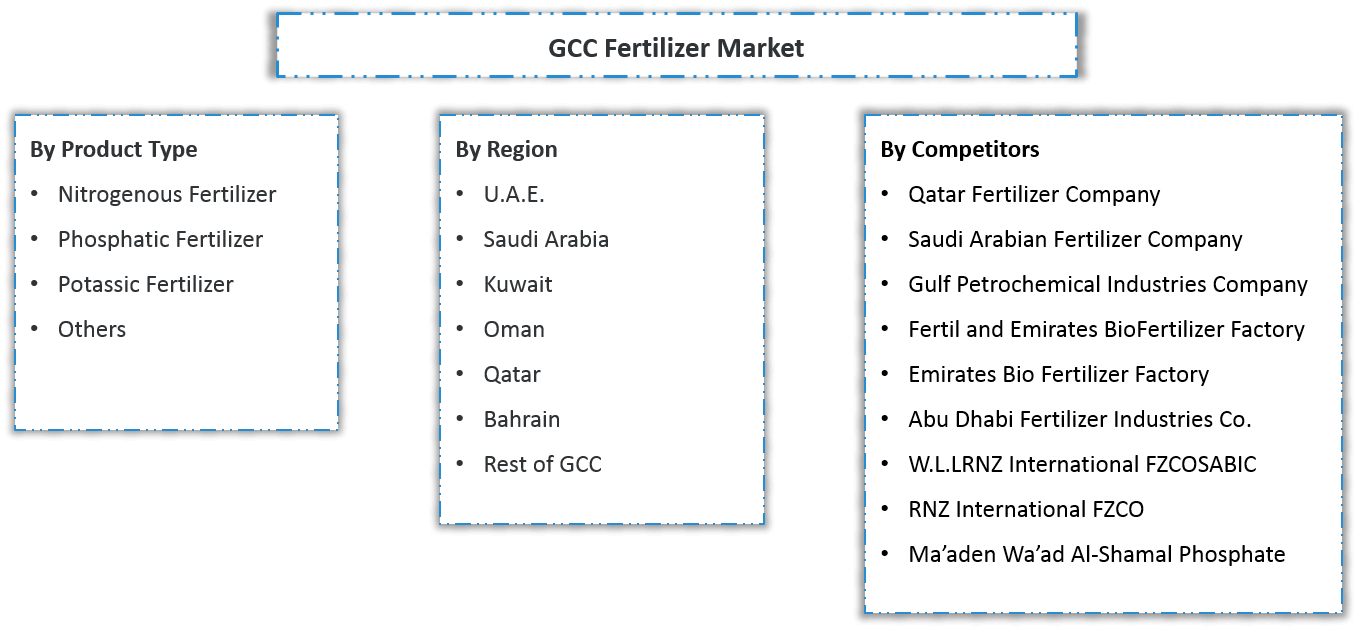
| By Product Type | Nitrogenous Fertilizers Urea, Ammonium Nitrate, Ammonium Sulfate, Phosphatic Fertilizers, Diammonium Phosphate (DAP), Monoammonium Phosphate (MAP), Single Super Phosphate (SSP), Potassic Fertilizers, Potassium Chloride, Potassium Sulfate, Potassium Nitrate, Secondary Nutrient Fertilizers, Magnesium, Sulfur, Calcium, Micronutrient Fertilizers, Zinc, Iron, Copper, Boron, Manganese |
| By Form | Liquid Fertilizers, Dry Fertilizers, Granular Fertilizers, Others), |
| By Application | Grains & Cereals, Pulses & Oilseeds, Fruits & Vegetables, Commercial Crops, Turf & Ornamentals), |
| By End-User | Agriculture, Horticulture, Greenhouse & Controlled Environment Farming, Others), and others |
GCC Fertilizer Market Drivers:
Government Initiatives to Boost Agricultural Productivity
The GCC governments are heavily investing in sustainable agriculture, offering subsidies, tax incentives, and funding programs to promote modern farming practices. These initiatives encourage farmers to adopt high-quality fertilizers to improve crop yields and soil fertility. For instance, Saudi Arabia’s Ministry of Environment, Water, and Agriculture has launched precision agriculture projects integrating nutrient management. Such policies increase fertilizer demand, enabling manufacturers to expand production and distribution, attract foreign investment, and enhance innovation in fertilizer formulations, ultimately driving overall market growth in the region.
Rising Food Demand & Regional Self-Sufficiency Goals
Population growth, urbanization, and changing dietary preferences in the GCC are increasing the demand for higher agricultural output. Countries like the UAE and Oman are aiming for food self-sufficiency, which necessitates the use of efficient fertilizers to boost crop productivity. This trend encourages market players to develop specialized fertilizers suited to arid soils and high-temperature conditions. As a result, local and international manufacturers gain opportunities to expand portfolios, invest in R&D, and form partnerships, directly supporting the expansion and profitability of the GCC Fertilizer Market.
- Market Segmentation
- Introduction
- Product Definition
- Research Process
- Assumptions
- Executive Summary
- GCC Fertilizer Market Policies, Regulations, and Product Standards
- GCC Fertilizer Market Supply Chain Analysis
- GCC Fertilizer Market Trends & Developments
- GCC Fertilizer Market Dynamics
- Growth Drivers
- Challenges
- GCC Fertilizer Market Hotspot & Opportunities
- GCC Fertilizer Market Outlook, 2020-2032
- Market Size & Outlook
- By Revenues (USD Million)
- By Volume (Million Tons)
- Market Share & Outlook
- By Product Type
- Nitrogenous Fertilizers
- Urea – Market Size & Forecast 2020-2032F, USD Million
- Ammonium Nitrate – Market Size & Forecast 2020-2032F, USD Million
- Ammonium Sulfate – Market Size & Forecast 2020-2032F, USD Million
- Phosphatic Fertilizers- Market Size & Forecast 2020-2032F, USD Million
- Diammonium Phosphate (DAP)- Market Size & Forecast 2020-2032F, USD Million
- Monoammonium Phosphate (MAP) – Market Size & Forecast 2020-2032F, USD Million
- Single Super Phosphate (SSP)- Market Size & Forecast 2020-2032F, USD Million
- Potassic Fertilizers- Market Size & Forecast 2020-2032F, USD Million
- Potassium Chloride- Market Size & Forecast 2020-2032F, USD Million
- Potassium Sulfate- Market Size & Forecast 2020-2032F, USD Million
- Potassium Nitrate- Market Size & Forecast 2020-2032F, USD Million
- Secondary Nutrient Fertilizers – Market Size & Forecast 2020-2032F, USD Million
- Magnesium- Market Size & Forecast 2020-2032F, USD Million
- Sulfur - Market Size & Forecast 2020-2032F, USD Million
- Calcium- Market Size & Forecast 2020-2032F, USD Million
- Micronutrient Fertilizers- Market Size & Forecast 2020-2032F, USD Million
- Zinc- Market Size & Forecast 2020-2032F, USD Million
- Iron- Market Size & Forecast 2020-2032F, USD Million
- Copper- Market Size & Forecast 2020-2032F, USD Million
- Boron- Market Size & Forecast 2020-2032F, USD Million
- Manganese- Market Size & Forecast 2020-2032F, USD Million
- Nitrogenous Fertilizers
- By Form
- Liquid Fertilizers- Market Size & Forecast 2020-2032F, USD Million
- Dry Fertilizers- Market Size & Forecast 2020-2032F, USD Million
- Granular Fertilizers- Market Size & Forecast 2020-2032F, USD Million
- Others- Market Size & Forecast 2020-2032F, USD Million
- By Application
- Grains & Cereals- Market Size & Forecast 2020-2032F, USD Million
- Pulses & Oilseeds- Market Size & Forecast 2020-2032F, USD Million
- Fruits & Vegetables- Market Size & Forecast 2020-2032F, USD Million
- Commercial Crops- Market Size & Forecast 2020-2032F, USD Million
- Turf & Ornamentals- Market Size & Forecast 2020-2032F, USD Million
- By End-User
- Agriculture- Market Size & Forecast 2020-2032F, USD Million
- Horticulture- Market Size & Forecast 2020-2032F, USD Million
- Greenhouse & Controlled Environment Farming- Market Size & Forecast 2020-2032F, USD Million
- Others- Market Size & Forecast 2020-2032F, USD Million
- By Region
- Saudi Arabia
- United Arab Emirates
- Qatar
- Oman
- Kuwait
- Bahrain
- By Company
- Company Revenue Shares
- Competitor Characteristics
- By Product Type
- Market Size & Outlook
- GCC Agriculture Fertilizer Market Outlook, 2020-2032
- Market Size & Analysis
- Market Share & Analysis
- By Product Type- Market Size & Forecast 2020-2032, USD Million
- By Form- Market Size & Forecast 2020-2032, USD Million
- By Application- Market Size & Forecast 2020-2032, USD Million
- GCC Horticulture Fertilizer Market Outlook, 2020-2032
- Market Size & Analysis
- Market Revenues (USD Million)
- Market Share & Analysis
- By Product Type- Market Size & Forecast 2020-2032, USD Million
- By Form- Market Size & Forecast 2020-2032, USD Million
- By Application- Market Size & Forecast 2020-2032, USD Million
- Market Size & Analysis
- GCC Greenhouse & Controlled Environment Farming Fertilizer Market Outlook, 2020-2032
- Market Size & Analysis
- Market Revenues (USD Million)
- Market Share & Analysis
- By Product Type- Market Size & Forecast 2020-2032, USD Million
- By Form- Market Size & Forecast 2020-2032, USD Million
- By Application- Market Size & Forecast 2020-2032, USD Million
- Market Size & Analysis
- GCC Fertilizer Market Key Strategic Imperatives for Success & Growth
- Competition Outlook
- Company Profiles
- Saudi Basic Industries Corporation (SABIC Agri-Nutrients)
- Business Description
- Product Portfolio
- Strategic Alliances or Partnerships
- Recent Developments
- Financial Details
- Others
- Qatar Fertilizer Company (QAFCO)
- Business Description
- Product Portfolio
- Strategic Alliances or Partnerships
- Recent Developments
- Financial Details
- Others
- Ma’aden Wa’ad Al Shamal Phosphate Company (MWSPC)
- Business Description
- Product Portfolio
- Strategic Alliances or Partnerships
- Recent Developments
- Financial Details
- Others
- Gulf Petrochemical Industries Company (GPIC)
- Business Description
- Product Portfolio
- Strategic Alliances or Partnerships
- Recent Developments
- Financial Details
- Others
- Abu Dhabi Fertilizer Industries Co. (ADFERT)
- Business Description
- Product Portfolio
- Strategic Alliances or Partnerships
- Recent Developments
- Financial Details
- Others
- Emirates Bio Fertilizer Factory
- Business Description
- Product Portfolio
- Strategic Alliances or Partnerships
- Recent Developments
- Financial Details
- Others
- RNZ International FZCO
- Business Description
- Product Portfolio
- Strategic Alliances or Partnerships
- Recent Developments
- Financial Details
- Others
- Union Chemicals Company LLC
- Business Description
- Product Portfolio
- Strategic Alliances or Partnerships
- Recent Developments
- Financial Details
- Others
- Desert Oasis Fertilizers Packaging LLC
- Business Description
- Product Portfolio
- Strategic Alliances or Partnerships
- Recent Developments
- Financial Details
- Others
- Fujairah Chemical Industries
- Business Description
- Product Portfolio
- Strategic Alliances or Partnerships
- Recent Developments
- Financial Details
- Others
- Oman India Fertilizer Company (OMIFCO)
- Business Description
- Product Portfolio
- Strategic Alliances or Partnerships
- Recent Developments
- Financial Details
- Others
- Al-Kem Industries
- Business Description
- Product Portfolio
- Strategic Alliances or Partnerships
- Recent Developments
- Financial Details
- Others
- Al-Akhawain (Saudi Arabia)
- Business Description
- Product Portfolio
- Strategic Alliances or Partnerships
- Recent Developments
- Financial Details
- Others
- MITSUI & Co., Ltd.
- Business Description
- Product Portfolio
- Strategic Alliances or Partnerships
- Recent Developments
- Financial Details
- Others
- Others
- Saudi Basic Industries Corporation (SABIC Agri-Nutrients)
- Company Profiles
- Disclaimer
MarkNtel Advisors follows a robust and iterative research methodology designed to ensure maximum accuracy and minimize deviation in market estimates and forecasts. Our approach combines both bottom-up and top-down techniques to effectively segment and quantify various aspects of the market. A consistent feature across all our research reports is data triangulation, which examines the market from three distinct perspectives to validate findings. Key components of our research process include:
1. Scope & Research Design At the outset, MarkNtel Advisors define the research objectives and formulate pertinent questions. This phase involves determining the type of research—qualitative or quantitative—and designing a methodology that outlines data collection methods, target demographics, and analytical tools. They also establish timelines and budgets to ensure the research aligns with client goals.
2. Sample Selection and Data Collection In this stage, the firm identifies the target audience and determines the appropriate sample size to ensure representativeness. They employ various sampling methods, such as random or stratified sampling, based on the research objectives. Data collection is carried out using tools like surveys, interviews, and observations, ensuring the gathered data is reliable and relevant.
3. Data Analysis and Validation Once data is collected, MarkNtel Advisors undertake a rigorous analysis process. This includes cleaning the data to remove inconsistencies, employing statistical software for quantitative analysis, and thematic analysis for qualitative data. Validation steps are taken to ensure the accuracy and reliability of the findings, minimizing biases and errors.

4. Data Forecast and FinalizationThe final phase involves forecasting future market trends based on the analyzed data. MarkNtel Advisors utilize predictive modeling and time series analysis to anticipate market behaviors. The insights are then compiled into comprehensive reports, featuring visual aids like charts and graphs, and include strategic recommendations to inform client decision-making
We offer flexible licensing options to cater to varying organizational needs. Choose the pricing pack that best suits your requirements:
Buy Now Inquire Before Buying
 Request Customization