

By Grade (Feed Grade, Malt Grade, Food Grade), By Form (Feed Grade, Malt Grade, Food Grade), By Application (Feed Grade Forms, Malt Grade Forms, Food Grade Forms), By Nature (Conventional, Organic), B... ... ntional, Organic), By Distribution Channel (B2B, B2C), and others Read more
- Food & Beverages
- Jul 2026
- 270
- PDF, Excel, PPT
GCC Barley Market Key Takeaways
- The GCC barley market was valued at USD 321 million in 2025 and is projected to grow from USD 362 million in 2026 to USD 598 million by 2032.
- The industry is projected to witness steady growth at 8.73% CAGR (2026–2032).
- Saudi Arabia dominates the regional landscape, accounting for approximately 66% of total market demand.
- Feed grade barley leads the market by grade with a 67% share.
- Animal feed represents the largest application segment, capturing 67% of the market in 2026.
- The industry remains moderately consolidated, with the top five companies collectively holding nearly 55% of the market, reflecting a balance between global traders and regional feed enterprises.
GCC Barley Market Size and Outlook
The GCC barley market size was valued at USD 321 million in 2025 and is projected to reach USD 362 million in 2026 before expanding to USD 598 million by 2032, registering a CAGR of 8.73% during 2026–2032. Future growth will be supported by the vertical integration of poultry and dairy production alongside the reformulation of non-alcoholic malt beverages toward malt-forward, lower-sugar recipes. These developments are strengthening long-term demand across the commercial livestock farming ecosystem while reinforcing stable consumption patterns.
Global supply conditions are also expected to support favorable market expansion. As per the U.S. Department of Agriculture's Foreign Agricultural Service, global barley production reached 154.2 million metric tons in the 2025/26 marketing year, representing an 8% increase over the previous season following weather-related volatility across the European Union, Russia, and Australia. Higher global availability is expected to improve sourcing flexibility, enhance feed grain procurement, and support relatively stable landed prices for imports entering Red Sea and Arabian Gulf ports.
Government-led food security strategies continue to create favorable long-term demand fundamentals. The UAE's National Food Security Strategy 2051 aims to position the country among the world's top ten nations in the Global Food Security Index while ensuring three to five alternative supply origins for major food categories, including feed grains . As domestic livestock, poultry, and dairy production expand under this strategy, diversified sourcing policies are expected to strengthen the GCC barley industry by encouraging reliable import channels and enhancing Grain Trading Companies participation.
Private-sector investments are further reinforcing long-term market prospects. Modern Mills announced plans to establish a new animal feed facility in Saudi Arabia with an annual production capacity of 422,000 metric tons through an investment of approximately USD 40 million, with commercial operations expected during Q4 2026. The project will expand domestic feed manufacturing capacity, improve feed availability for livestock producers, and strengthen regional resilience by supporting sustained demand for imported barley throughout the forecast period.
GCC Barley Market Key Indicators
- Saudi Arabia's barley imports reached an estimated 4.2 million metric tons in marketing year 2025/26, up sharply from 1.9 million metric tons the year prior, according to the U.S. Department of Agriculture . This barley import volume surge reflects rebuilt strategic reserves and opportunistic buying when barley undercuts corn in feed formulations. As the GCC's largest livestock base, Saudi Arabia's purchasing alone substantially lifts aggregate regional barley import volumes.
- Top barley suppliers to Saudi Arabia now include Argentina, Russia, Romania, Australia, and Turkey, per the U.S. Department of Agriculture . This supplier diversification marks a shift from earlier heavier reliance on Black Sea-only origination. Spreading procurement across five exporting nations reduces exposure to any single harvest failure, port disruption, or export restriction, giving GCC feed processors greater negotiating leverage and more resilient, multi-sourced supply lines.
- Saudi Arabia's General Authority for Statistics recorded 7.3 million goats and 2.24 million camels in the Kingdom's Livestock Statistics 2024, alongside broiler chicken production of 1.3 million tons . This scale of livestock feed demand, spanning ruminants, camels, and poultry, sustains continuous baseline barley consumption, since sheep, goats, and camels remain the primary consumers of imported barley whenever it is priced competitively against alternative feed sources.
- The Saudi Agricultural and Livestock Investment Company, wholly owned by Saudi Arabia's Public Investment Fund, states it now manages more than 8% of global grain trade through its portfolio of agrifood investments . This scale of sovereign agrifood investment gives the Kingdom, and by extension the GCC, direct influence over international grain origination and logistics assets, improving long-term barley supply security for regional feed and food manufacturers.
GCC Barley Market Scope
| Category | Segments |
|---|---|
| By Grade | Feed Grade, Malt Grade, Food Grade |
| By Form | Feed Grade, Malt Grade, Food Grade |
| By Application | Feed Grade Forms, Malt Grade Forms, Food Grade Forms |
| By Nature | Conventional, Organic |
| By Distribution Channel | B2B, B2C |
GCC Barley Market Growth Drivers
Vertical Integration of Poultry and Dairy Production Expanding Gulf Compound Feed Demand
The consolidation of poultry, dairy, and egg businesses into integrated production platforms is strengthening long-term demand across the GCC barley industry. On May 20, 2025, Al Ain Farms Group (AAFG) was launched at the "Make it in the Emirates" Forum, bringing together Al Ain Farms, Marmum Dairy, Al Ajban Chicken, Saha Arabian Farms, and Golden Eggs under Ghitha Holding and Yas Holding, supporting the UAE National Food Security Strategy 2051 . This expansion is increasing feed manufacturing industry requirements.
The growth trajectory extends beyond the UAE into Qatar. According to Qatar's Ministry of Municipality, the country's livestock population reached 1,139,578 animals by the end of 2024, including 681,293 sheep, 325,233 goats, 94,299 camels, and 38,753 cattle. The expanding livestock base demonstrates rising feed requirements across multiple GCC economies, creating sustained opportunities for suppliers engaged in grain supply chain operations and regional feed procurement.
As governments continue strengthening domestic food security through larger, integrated livestock enterprises, demand for feed grains is expected to remain structurally resilient. Feed formulators, grain importers, and commodity suppliers capable of supporting large-scale production platforms are likely to secure long-term procurement contracts. These developments reinforce sustained consumption within the GCC barley industry, supporting stable industry growth through 2030 and beyond as poultry and dairy production capacities continue expanding.
Recent Trends
Reformulation of Non-Alcoholic Malt Beverages Toward Malt-Forward, Lower-Sugar Recipes
Growing regulatory emphasis on sugar reduction is encouraging beverage manufacturers to reformulate products across the GCC barley industry. In October 2025, the GCC Financial and Economic Cooperation Committee approved replacing the region's flat 50% excise tax on sweetened beverages with a tiered taxation model based on total sugar content. The policy is encouraging innovation in the animal nutrition market, related to barley processing and value-added malt ingredient utilization for beverage production.
Saudi Arabia's Zakat, Tax and Customs Authority confirmed that the new four-tier excise structure will take effect on 1 January 2026, taxing ready-to-drink beverages according to grams of sugar per 100 milliliters rather than a fixed percentage of retail price. Products with little or no sugar receive minimal or no levy, encouraging manufacturers to rely more on barley malt to maintain flavor, texture, and product differentiation while strengthening agricultural commodity trade opportunities.
Barbican, the region's leading non-alcoholic malt beverage brand, is manufactured using barley malt at facilities in Dammam, Saudi Arabia, and Dubai, UAE, highlighting the category's strong dependence on malt-based formulations. As producers increasingly prioritize lower-sugar recipes while preserving beverage quality, demand for barley-derived ingredients is expected to strengthen, reinforcing long-term growth across the GCC barley market through 2026 and beyond.
GCC Barley Market Opportunities and Challenges
International Disruption Restricting Gulf Port Deliveries Driving Investment in Alternative Omani Port Infrastructure
The disruption in the Strait of Hormuz has created significant logistical challenges for the GCC barley market. The maritime corridor, which carries around one-fifth of global oil and substantial agricultural cargo, experienced severe restrictions following escalating regional conflict. CMA CGM suspended normal transits, while Maersk confirmed the strait remained closed and explored alternative routing solutions, increasing uncertainty for import-dependent grain shipments destined for Gulf terminals.
The disruption has simultaneously accelerated investment opportunities in Oman, whose deep-water ports at Salalah and Duqm are located outside the Strait of Hormuz. In April 2026, Oman introduced more than USD 243 million in food security investment opportunities through the Invest Oman platform while strengthening resilient agrifood systems under a five-year FAO Country Programming Framework. These initiatives enhance bulk grain logistics capabilities and improve regional supply resilience.
As supply chains adapt, grain traders, logistics providers, and infrastructure developers capable of establishing Hormuz-independent transport corridors into Saudi Arabia and the UAE are positioned to secure long-term advantages. Continued investment in resilient transportation networks and port connectivity is expected to reduce future trade disruptions while strengthening the GCC barley industry. This evolving landscape also creates new opportunities across the strategic grain reserves value chain through diversified import infrastructure.
Segmentation Insights
Feed Grade Barley Dominates Due to Strong Livestock Feed Demand and Cost Efficiency
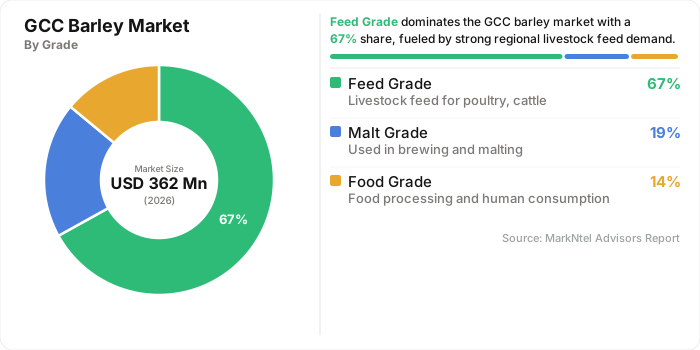
Feed-grade barley accounted for the largest 67% share of the GCC barley industry, primarily supported by the region's extensive livestock sector and its widespread use as an economical energy source in compound feed formulations. Saudi Arabia's General Authority for Statistics reported 29.4 million sheep in its latest national livestock census, representing the Kingdom's largest consumer base for imported feed barley. This strong demand underpins the growth of the livestock feed market.
Barley continues to play an essential role in feeding sheep, goats, and camels because of its nutritional profile, availability, and competitive pricing relative to other feed grains. Feed-grade barley can be readily incorporated into compound feed formulations and efficiently distributed through established bulk import and storage systems. These operational advantages enhance procurement efficiency while supporting consistent feed availability for commercial livestock producers throughout the region.
The segment also benefits from lower processing requirements compared with value-added barley products, enabling cost-effective handling from import terminals to feed manufacturers. Efficient bulk logistics, combined with stable demand from the ruminant sector, reinforces its long-term market leadership. Continued expansion of regional animal husbandry and investments in the feed barley supplier ecosystem are expected to sustain the segment's dominance. Based on grade, the scope has been bifurcated into:
- Feed Grade
- Malt Grade
- Food Grade
Animal Feed Leads the Due to Expanding Poultry Self-Sufficiency and Livestock Feed Consumption
Animal Feed held the largest 67% share by application, supported by expanding poultry production, dairy farming, and livestock development across GCC countries. Qatar's Ministry of Municipality reported that the country's poultry meat production reached 26,376 tonnes in 2025, achieving 99% self-sufficiency, reflecting sustained government efforts to strengthen domestic protein production. These initiatives continue to increase demand for feed grain industry products used in commercial feed manufacturing.
Growing investments in poultry and dairy production have reinforced barley's importance as a key energy ingredient in compound feed formulations for poultry, sheep, goats, cattle, and camels. The expansion of integrated livestock operations and higher domestic meat production are driving consistent feed requirements throughout the region. This broad consumption base strengthens demand across the cereal grain imports value chain while supporting stable procurement by feed manufacturers.
The application segment also benefits from continuous government support for food security and livestock modernization programs, which encourage higher domestic production and reduce reliance on imported animal protein. As poultry self-sufficiency initiatives expand across multiple GCC economies, demand for feed barley is expected to remain resilient, reinforcing animal feed as the dominant application despite the gradual growth of food processing and beverage applications. The key application analyzed in the study include:
- Feed Grade Forms
- Malt Grade Forms
- Food Grade Forms
GCC Barley Market Geographical Outlook
Saudi Arabia accounted for the largest 66% share of the GCC barley industry, supported by its extensive livestock sector and substantial domestic demand for feed grains. According to the General Authority for Statistics, the Kingdom's population reached 35.3 million in 2024, providing a strong consumption base for livestock products. The country's large-scale animal production ecosystem continues to strengthen the agricultural commodity outlook across the regional grain industry.
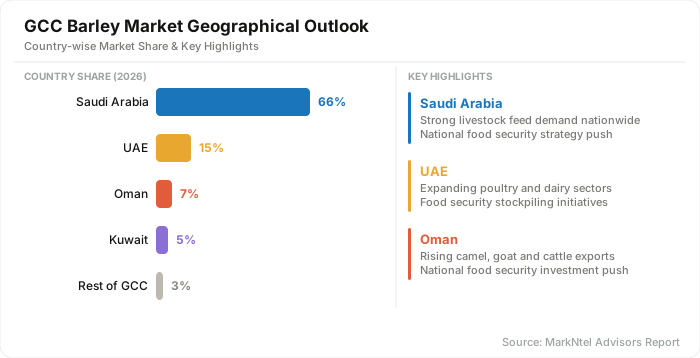
The Kingdom also maintains the GCC's largest poultry and livestock population, creating sustained demand for imported barley used in compound feed production. High feed requirements from sheep, goats, cattle, camels, and poultry reinforce Saudi Arabia's position as the region's principal grain-consuming market. This broad livestock base supports consistent import volumes while encouraging long-term investments throughout the GCC grain import market value chain.
Saudi Arabia's leadership is further reinforced by government initiatives aimed at strengthening food security, expanding domestic livestock production, and improving grain supply resilience. Continuous investments in feed manufacturing capacity, grain logistics, and strategic sourcing are expected to sustain the country's dominant position throughout the forecast period. These structural advantages place Saudi Arabia well ahead of neighboring GCC economies in regional barley demand and long-term market development.
GCC Barley Market Competitive Analysis
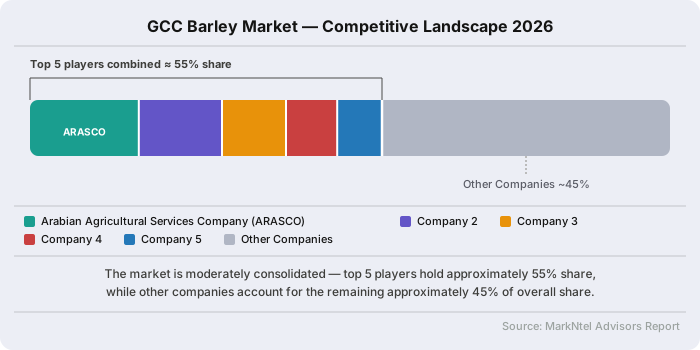
The GCC barley sector is moderately consolidated, with the top five companies collectively accounting for approximately 55% of total market revenue. The competitive landscape is characterized by a combination of global agricultural commodity traders and regional feed manufacturers and grain logistics operators. International firms leverage diversified sourcing networks and established trading capabilities, while regional companies benefit from strategic storage infrastructure, long-term procurement agreements, and close relationships with livestock producers. Competition is driven by supply reliability, import diversification, logistics efficiency, and feed industry partnerships, with continued investments in grain infrastructure and food security initiatives.
Key Players in GCC Barley Industry
- Arabian Agricultural Services Company (ARASCO)
- United Feed Company
- National Grains Company (NGC)
- Gulf Agri Trade FZCO
- Cargill Incorporated
- Archer Daniels Midland Company (ADM)
- Louis Dreyfus Company B.V.
- Bunge Global SA
- COFCO International Ltd.
- Dario General Trading LLC
- Agro Ventures FZCO
- Saudi Grain Company
- Others
GCC Barley Industry News and Recent Developments
October 2025: ARASCO Signs MoU with SABIL to Modernize Agricultural Logistics in Saudi Arabia
Arabian Agricultural Services Company (ARASCO) signed a Memorandum of Understanding with SABIL, the National Grain Supply Company operated by the Saudi Agricultural and Livestock Investment Company (SALIC), to build an integrated logistics model linking ports, storage, and distribution networks across Saudi Arabia's grains and feed sector. The agreement was announced during the 42nd Saudi Agriculture Exhibition, held in Riyadh from October 20 to 23, 2025, and covers smart tracking technologies and unified transport planning systems.
Impact Analysis: The partnership targets faster, lower-cost movement of feed grains, including barley, from port of entry to inland feed mills, addressing a persistent cost driver for the GCC Barley Industry. By combining ARASCO's feed-milling network with SABIL's silo and strategic reserve management mandate, the collaboration improves distribution reach and positions both companies to respond more efficiently to seasonal barley demand swings tied to Saudi Arabia's poultry and ruminant feed production cycles.
- Market Segmentation
- Introduction
- Product Definition
- Research Process
- Assumptions
- Executive Summary
- GCC Barley Market Import & Export Analysis
- GCC Barley Market Supply Chain & Value Chain Analysis
- GCC Barley Market Policies, Regulations, and Product Standards
- GCC Barley Production Trend 2022-2032
- GCC Barley Trend by Type of Grade
- Feed Grade
- Malt Grade
- Food Grade
- Company Wise Production Plants and Statistics
- Installed Production Capacity
- Actual Production
- Planned Production Target
- GCC Barley Trend by Type of Grade
- GCC Barley Pricing Analysis 2022-2032
- GCC Barley Pricing Trend 2022-2032
- GCC Barley Pricing Trend by Grade 2022-2032
- Feed Grade
- Malt Grade
- Food Grade
- GCC Barley Market Dynamics
- Growth Factors
- Challenges
- GCC Barley Market Hotspot & Opportunities
- GCC Barley Market Outlook, 2022-2032
- Market Size & Outlook
- By Revenues (USD Million)
- By Quantity (Thousand Tons)
- Market Share & Outlook
- By Grade- Market Size & Forecast 2022-2032, USD Million & Thousand Tons
- Feed Grade
- Malt Grade
- Food Grade
- By Form - Market Size & Forecast 2022-2032, USD Million & Thousand Tons
- Feed Grade
- Whole Barley
- Barley Grits
- Barley Bran
- Malt Grade
- Malted Barley
- Barley Extract
- Food Grade
- Pearled Barley
- Barley Flour
- Barley Flakes
- Hull-less (Naked) Barley
- Feed Grade
- By Application - Market Size & Forecast 2022-2032, USD Million & Thousand Tons
- Feed Grade Forms
- Animal Feed
- Malt Grade Forms
- Brewing & Alcoholic Beverages
- Food Grade Forms
- Food & Non-Alcoholic Beverages
- Nutraceuticals & Dietary Supplements
- Pharmaceuticals
- Personal Care & Cosmetics
- Industrial Applications
- Feed Grade Forms
- By Nature- Market Size & Forecast 2022-2032, USD Million & Thousand Tons
- Conventional
- Organic
- By Distribution Channel- Market Size & Forecast 2022-2032, USD Million & Thousand Tons
- B2B
- Direct Sales
- Distributors & Wholesalers
- B2C
- Supermarkets & Hypermarkets
- Convenience Stores
- Specialty Stores
- Online Retail
- B2B
- By Country
- Saudi Arabia
- The UAE
- Qatar
- Kuwait
- Oman
- Bahrain
- By Company
- Competition Characteristics
- Market Share & Analysis
- By Grade- Market Size & Forecast 2022-2032, USD Million & Thousand Tons
- Market Size & Outlook
- Saudi Arabia Barley Market Outlook, 2022-2032
- Market Size & Outlook
- By Revenues (USD Million)
- By Quantity (Thousand Tons)
- Market Segmentation & Outlook
- By Grade- Market Size & Forecast 2022-2032, USD Million & Thousand Tons
- By Form - Market Size & Forecast 2022-2032, USD Million & Thousand Tons
- By Application - Market Size & Forecast 2022-2032, USD Million & Thousand Tons
- By Nature- Market Size & Forecast 2022-2032, USD Million & Thousand Tons
- By Distribution Channel- Market Size & Forecast 2022-2032, USD Million & Thousand Tons
- Market Size & Outlook
- The UAE Barley Market Outlook, 2022-2032
- Market Size & Outlook
- By Revenues (USD Million)
- By Quantity (Thousand Tons)
- Market Segmentation & Outlook
- By Grade- Market Size & Forecast 2022-2032, USD Million & Thousand Tons
- By Form - Market Size & Forecast 2022-2032, USD Million & Thousand Tons
- By Application - Market Size & Forecast 2022-2032, USD Million & Thousand Tons
- By Nature- Market Size & Forecast 2022-2032, USD Million & Thousand Tons
- By Distribution Channel- Market Size & Forecast 2022-2032, USD Million & Thousand Tons
- Market Size & Outlook
- Qatar Barley Market Outlook, 2022-2032
- Market Size & Outlook
- By Revenues (USD Million)
- By Quantity (Thousand Tons)
- Market Segmentation & Outlook
- By Grade- Market Size & Forecast 2022-2032, USD Million & Thousand Tons
- By Form - Market Size & Forecast 2022-2032, USD Million & Thousand Tons
- By Application - Market Size & Forecast 2022-2032, USD Million & Thousand Tons
- By Nature- Market Size & Forecast 2022-2032, USD Million & Thousand Tons
- By Distribution Channel- Market Size & Forecast 2022-2032, USD Million & Thousand Tons
- Market Size & Outlook
- Kuwait Barley Market Outlook, 2022-2032
- Market Size & Outlook
- By Revenues (USD Million)
- By Quantity (Thousand Tons)
- Market Segmentation & Outlook
- By Grade- Market Size & Forecast 2022-2032, USD Million & Thousand Tons
- By Form - Market Size & Forecast 2022-2032, USD Million & Thousand Tons
- By Application - Market Size & Forecast 2022-2032, USD Million & Thousand Tons
- By Nature- Market Size & Forecast 2022-2032, USD Million & Thousand Tons
- By Distribution Channel- Market Size & Forecast 2022-2032, USD Million & Thousand Tons
- Market Size & Outlook
- Oman Barley Market Outlook, 2022-2032
- Market Size & Outlook
- By Revenues (USD Million)
- By Quantity (Thousand Tons)
- Market Segmentation & Outlook
- By Grade- Market Size & Forecast 2022-2032, USD Million & Thousand Tons
- By Form - Market Size & Forecast 2022-2032, USD Million & Thousand Tons
- By Application - Market Size & Forecast 2022-2032, USD Million & Thousand Tons
- By Nature- Market Size & Forecast 2022-2032, USD Million & Thousand Tons
- By Distribution Channel- Market Size & Forecast 2022-2032, USD Million & Thousand Tons
- Market Size & Outlook
- GCC Barley Market Key Strategic Imperatives for Success & Growth
- Competitive Outlook
- Company Profiles
- Arabian Agricultural Services Company (ARASCO)
- Business Description
- Product Portfolio
- Collaborations & Alliances
- Recent Developments
- Financial Details
- Others
- United Feed Company
- Business Description
- Product Portfolio
- Collaborations & Alliances
- Recent Developments
- Financial Details
- Others
- National Grains Company (NGC)
- Business Description
- Product Portfolio
- Collaborations & Alliances
- Recent Developments
- Financial Details
- Others
- Gulf Agri Trade FZCO
- Business Description
- Product Portfolio
- Collaborations & Alliances
- Recent Developments
- Financial Details
- Others
- Cargill Incorporated
- Business Description
- Product Portfolio
- Collaborations & Alliances
- Recent Developments
- Financial Details
- Others
- Archer Daniels Midland Company (ADM)
- Business Description
- Product Portfolio
- Collaborations & Alliances
- Recent Developments
- Financial Details
- Others
- Louis Dreyfus Company B.V.
- Business Description
- Product Portfolio
- Collaborations & Alliances
- Recent Developments
- Financial Details
- Others
- Bunge Global SA
- Business Description
- Product Portfolio
- Collaborations & Alliances
- Recent Developments
- Financial Details
- Others
- COFCO International Ltd.
- Business Description
- Product Portfolio
- Collaborations & Alliances
- Recent Developments
- Financial Details
- Others
- Dario General Trading LLC
- Business Description
- Product Portfolio
- Collaborations & Alliances
- Recent Developments
- Financial Details
- Others
- Agro Ventures FZCO
- Business Description
- Product Portfolio
- Collaborations & Alliances
- Recent Developments
- Financial Details
- Others
- Saudi Grain Company
- Business Description
- Product Portfolio
- Collaborations & Alliances
- Recent Developments
- Financial Details
- Others
- Others
- Arabian Agricultural Services Company (ARASCO)
- Company Profiles
- Disclaimer

MarkNtel Advisors follows a robust and iterative research methodology designed to ensure maximum accuracy and minimize deviation in market estimates and forecasts. Our approach combines both bottom-up and top-down techniques to effectively segment and quantify various aspects of the market. A consistent feature across all our research reports is data triangulation, which examines the market from three distinct perspectives to validate findings. Key components of our research process include:
1. Scope & Research Design At the outset, MarkNtel Advisors define the research objectives and formulate pertinent questions. This phase involves determining the type of research—qualitative or quantitative—and designing a methodology that outlines data collection methods, target demographics, and analytical tools. They also establish timelines and budgets to ensure the research aligns with client goals.
2. Sample Selection and Data Collection In this stage, the firm identifies the target audience and determines the appropriate sample size to ensure representativeness. They employ various sampling methods, such as random or stratified sampling, based on the research objectives. Data collection is carried out using tools like surveys, interviews, and observations, ensuring the gathered data is reliable and relevant.
3. Data Analysis and Validation Once data is collected, MarkNtel Advisors undertake a rigorous analysis process. This includes cleaning the data to remove inconsistencies, employing statistical software for quantitative analysis, and thematic analysis for qualitative data. Validation steps are taken to ensure the accuracy and reliability of the findings, minimizing biases and errors.

4. Data Forecast and FinalizationThe final phase involves forecasting future market trends based on the analyzed data. MarkNtel Advisors utilize predictive modeling and time series analysis to anticipate market behaviors. The insights are then compiled into comprehensive reports, featuring visual aids like charts and graphs, and include strategic recommendations to inform client decision-making
We offer flexible licensing options to cater to varying organizational needs. Choose the pricing pack that best suits your requirements:
Buy Now Inquire Before Buying
 Request Customization