

By Product Type (Room Air Conditioners (Window AC (Upto 1 Ton, 1 Ton to 2 Ton, Above 2 Ton), Split AC (Upto 1 Ton, 1 Ton to 1.5 Ton, Above 1.6 to 2 Ton, Above 2 Ton), VRF Systems), Chillers (Air-coole... ... Chillers (Air-cooled chillers, Water-cooled chillers, Others), Packaged Air Conditioners (Upto 5 Tons, 6 to 10 Tons, 11 to 20 Tons, Above 20 Tons), Cassette Air Conditioners (Upto 2 Tons, 2.1 to 4 Tons, 4.1 to 5 Tons, Above 5 Tons), Ducted Split Systems (Upto 5 Tons, 6 to 10 Tons, 11 to 20 Tons, Above 20 Tons, Others (Air Handling Units (AHU) / Fan Coil Units (FCU), etc.))), By Refrigerant Type (R32, R410A, R134a, R290, R1234ze / R1234yf, Others), By Distribution Channel (Direct Sales, Authorized Dealers & Distributors, Multi-Brand Stores, Online), By End User (Residential, Offices, Retail & Malls, Hotels & Hospitality, Hospitals & Healthcare, Educational Institutions, Manufacturing, Pharmaceuticals, Food & Beverage, Data Centers, Others), and others Read more
- Environment
- Jun 2026
- 157
- PDF, Excel, PPT
GCC Air Conditioner Market Key Takeaways
- The GCC air conditioner market size was valued at USD 4.29 billion in 2025 and is projected to grow from USD 4.51 billion in 2026 to USD 6.05 billion by 2032.
- The industry is projected to reflect sustained growth at a steady CAGR of 5.02% during 2026-2032.
- Saudi Arabia holds the largest share of about 40% in 2026.
- By product type, room air conditioners hold a significant share of about 50% in 2026.
- By end user, residential seized a significant share of about 43% in 2026.
- The industry is highly fragmented. However, the top five players collectively account for nearly 50% share.
GCC Air Conditioner Market Size and Outlook
The GCC air conditioner market size was valued at USD 4.29 billion in 2025 and is projected to grow from USD 4.51 billion in 2026 to USD 6.05 billion by 2032. Along with this, the market is estimated to grow at a CAGR of around 5.02% during the forecast period, i.e., 2026-32, driven by rising income levels, rapid urbanization, and evolving consumer lifestyles across the region. Economic expansion supported by non-oil sector diversification has contributed to improved per capita income in countries such as Saudi Arabia and the UAE, strengthening household purchasing power.
According to the World Bank, GCC economies have demonstrated steady post-pandemic growth, driven by infrastructure development, tourism expansion, and policy-led diversification initiatives, which collectively support higher consumption of durable goods, including air conditioners. Urban development remains a key demand driver, with large-scale construction of residential communities, commercial complexes, and public infrastructure such as metro systems and airports. Moreover, Saudi Arabia’s Vision 2030 program and associated giga-projects, including NEOM, are significantly expanding built-up areas, thereby increasing HVAC penetration across new building.
Climate conditions further reinforce structural demand. Cooling systems account for nearly 70% of peak residential electricity demand in GCC countries, underlining the region’s heavy dependence on air conditioning systems for thermal reports, IRENA GCC Energy Report. In addition, environmental regulations are shaping product replacement cycles. Under the UNEP Montreal Protocol, GCC countries are progressively phasing out ozone-depleting refrigerants, encouraging the adoption of energy-efficient and environmentally friendly air conditioning systems.
Overall, the GCC air conditioner market is supported by strong macroeconomic fundamentals, infrastructure expansion, climatic necessity, and tightening environmental standards, ensuring sustained long-term demand growth.
GCC Air Conditioner Market Key Indicators
- According to the World Bank (2024), urban populations account for 100% of Kuwait's population, 99.35% in Qatar, 89.87% in Bahrain, 87.78% in the UAE, and 84.95% in Saudi Arabia, making the GCC one of the world's most urbanized regions. Urban growth remains strong, with the GCC's urban population growing by approximately 3.94% annually in 2024. Furthermore, regional projections indicate that urban populations across the GCC are expected to increase by 30% between 2020 and 2030, while around 90% of residents are projected to live in cities by 2050. This sustained urban expansion is driving construction of new housing, offices, retail centers, and mixed-use developments, all of which require air-conditioning systems, thereby supporting long-term market growth.
- Large-scale infrastructure and urban development projects significantly influence HVAC demand because cooling systems are essential components of modern developments. Saudi Arabia's NEOM project alone represents an investment of approximately USD 500 billion, while broader Vision 2030 developments, including Diriyah, Qiddiya, ROSHN, and Red Sea Global, contribute to a construction pipeline exceeding USD 1 trillion, according to the Saudi Ministry of Investment. These projects include hotels, residential communities, entertainment facilities, offices, and transportation hubs, all requiring substantial air-conditioning capacity during both construction and operational phases.
- According to the IMF, GCC output is forecast to accelerate to an average of 3.3% in 2025, up from 1.7% in 2024, as members unwind oil-production cuts and non-hydrocarbon activity remains robust. The World Bank projects GCC growth at 3.2% in 2025 and 4.5% in 2026, driven by the non-hydrocarbon sector which expanded by 3.7% in 2024, fueled by private consumption, investment, and structural reforms. This growing affluence is increasing demand for smart, feature-rich, and high-performance air conditioners across residential and commercial sectors in the GCC.
GCC Air Conditioner Market Scope
| Category | Segments |
|---|---|
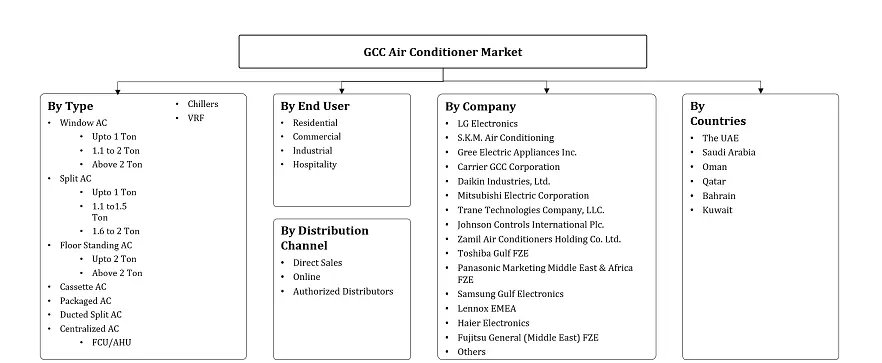
| By Product Type | Room Air Conditioners (Window AC (Upto 1 Ton, 1 Ton to 2 Ton, Above 2 Ton), Split AC (Upto 1 Ton, 1 Ton to 1.5 Ton, Above 1.6 to 2 Ton, Above 2 Ton), VRF Systems), Chillers (Air-cooled chillers, Water-cooled chillers, Others), Packaged Air Conditioners (Upto 5 Tons, 6 to 10 Tons, 11 to 20 Tons, Above 20 Tons), Cassette Air Conditioners (Upto 2 Tons, 2.1 to 4 Tons, 4.1 to 5 Tons, Above 5 Tons), Ducted Split Systems (Upto 5 Tons, 6 to 10 Tons, 11 to 20 Tons, Above 20 Tons, Others (Air Handling Units (AHU) / Fan Coil Units (FCU), etc. |
| By Refrigerant Type | R32, R410A, R134a, R290, R1234ze / R1234yf, Others |
| By Distribution Channel | Direct Sales, Authorized Dealers & Distributors, Multi-Brand Stores, Online |
| By End User | Residential, Offices, Retail & Malls, Hotels & Hospitality, Hospitals & Healthcare, Educational Institutions, Manufacturing, Pharmaceuticals, Food & Beverage, Data Centers, Others |
GCC Air Conditioner Market Growth Drivers
Rising Temperature Extremes Fueling Air Conditioner Adoption Across the GCC
Extreme heat is the fundamental driver of air-conditioner demand across the GCC, where cooling is an essential requirement for households, offices, retail facilities, hotels, and public infrastructure. According to the World Meteorological Organization, 2024 was the warmest year ever recorded globally, with temperatures around 1.55°C above the pre-industrial average, intensifying heat stress across already hot Gulf countries.
The GCC is experiencing increasingly severe temperature extremes. In May 2024, the UAE’s National Center of Meteorology recorded temperatures above 50°C on consecutive days, including 51.6°C in Abu Dhabi’s Al Ain region, highlighting the growing cooling burden on buildings and infrastructure. Additionally, the WMO’s 2024 State of the Climate in the Arab Region reported that parts of the southeastern Arab region, which includes GCC countries, experienced temperatures above 50°C for up to 12 days during the year.
Rising temperatures are increasing air-conditioning operating hours, cooling loads, and replacement cycles across the GCC. Combined with over USD 1 trillion of future urban development projects, extreme heat will remain a primary catalyst for sustained air-conditioner industry expansion over the coming decade.
- Market Segmentation
- Introduction
- Product Definition
- Research Process
- Assumptions
- Executive Summary
- GCC Air Conditioner Market Policies, Regulations, and Product Standards
- GCC Air Conditioners Market Supply Chain Analysis
- GCC Air Conditioners Market Import/ Export
- GCC Air Conditioner Market Trends & Developments
- GCC Air Conditioner Market Dynamics
- Growth Factors
- Challenges
- GCC Air Conditioner Market Hotspot & Opportunities
- GCC Air Conditioner Market Outlook, 2022-2032F
- Market Size & Outlook
- By Revenues (USD Million)
- By Units Sold (Thousand Units)
- Market Share & Analysis
- By Product Type- Market Size & Forecast 2022-2032, USD Million & Thousand Units
- Room Air Conditioners
- Window AC
- Upto 1 Ton
- 1 Ton to 2 Ton
- Above 2 Ton
- Split AC
- Upto 1 Ton
- 1 Ton to 1.5 Ton
- Above 1.6 to 2 Ton
- Above 2 Ton
- VRF Systems
- Window AC
- Chillers
- Air-cooled chillers
- Water-cooled chillers
- Others
- Packaged Air Conditioners
- Upto 5 Tons
- 6 to 10 Tons
- 11 to 20 Tons
- Above 20 Tons
- Cassette Air Conditioners
- Upto 2 Tons
- 2.1 to 4 Tons
- 4.1 to 5 Tons
- Above 5 Tons
- Ducted Split Systems
- Upto 5 Tons
- 6 to 10 Tons
- 11 to 20 Tons
- Above 20 Tons
- Others (Air Handling Units (AHU) / Fan Coil Units (FCU), etc.)
- Room Air Conditioners
- By Refrigerant Type - Market Size & Forecast 2022-2032, USD Million & Thousand Units
- R32
- R410A
- R134a
- R290
- R1234ze / R1234yf
- Others
- By Distribution Channel - Market Size & Forecast 2022-2032, USD Million & Thousand Units
- Direct Sales
- Authorized Dealers & Distributors
- Multi-Brand Stores
- Online
- By End User - Market Size & Forecast 2022-2032, USD Million & Thousand Units
- Residential
- Offices
- Retail & Malls
- Hotels & Hospitality
- Hospitals & Healthcare
- Educational Institutions
- Manufacturing
- Pharmaceuticals
- Food & Beverage
- Data Centers
- Others
- By Country
- Saudi Arabia
- UAE
- Qatar
- Kuwait
- Oman
- Bahrain
- By Company
- Competition Characteristics
- Market Share & Analysis
- By Product Type- Market Size & Forecast 2022-2032, USD Million & Thousand Units
- Market Size & Outlook
- Saudi Arabia Air Conditioner Market Outlook, 2022-2032F
- Market Size & Outlook
- By Revenues (USD Million)
- By Units Sold (Thousand Units)
- Market Share & Analysis
- By Product Type- Market Size & Forecast 2022-2032, USD Million & Thousand Units
- By Refrigerant Type - Market Size & Forecast 2022-2032, USD Million & Thousand Units
- By Distribution Channel - Market Size & Forecast 2022-2032, USD Million & Thousand Units
- By End User - Market Size & Forecast 2022-2032, USD Million & Thousand Units
- Market Size & Outlook
- UAE Air Conditioner Market Outlook, 2022-2032F
- Market Size & Outlook
- By Revenues (USD Million)
- By Units Sold (Thousand Units)
- Market Share & Analysis
- By Product Type- Market Size & Forecast 2022-2032, USD Million & Thousand Units
- By Refrigerant Type - Market Size & Forecast 2022-2032, USD Million & Thousand Units
- By Distribution Channel - Market Size & Forecast 2022-2032, USD Million & Thousand Units
- By End User - Market Size & Forecast 2022-2032, USD Million & Thousand Units
- Market Size & Outlook
- Qatar Air Conditioner Market Outlook, 2022-2032F
- Market Size & Outlook
- By Revenues (USD Million)
- By Units Sold (Thousand Units)
- Market Share & Analysis
- By Product Type- Market Size & Forecast 2022-2032, USD Million & Thousand Units
- By Refrigerant Type - Market Size & Forecast 2022-2032, USD Million & Thousand Units
- By Distribution Channel - Market Size & Forecast 2022-2032, USD Million & Thousand Units
- By End User - Market Size & Forecast 2022-2032, USD Million & Thousand Units
- Market Size & Outlook
- Kuwait Air Conditioner Market Outlook, 2022-2032F
- Market Size & Outlook
- By Revenues (USD Million)
- By Units Sold (Thousand Units)
- Market Share & Analysis
- By Product Type- Market Size & Forecast 2022-2032, USD Million & Thousand Units
- By Refrigerant Type - Market Size & Forecast 2022-2032, USD Million & Thousand Units
- By Distribution Channel - Market Size & Forecast 2022-2032, USD Million & Thousand Units
- By End User - Market Size & Forecast 2022-2032, USD Million & Thousand Units
- Market Size & Outlook
- Oman Air Conditioner Market Outlook, 2022-2032F
- Market Size & Outlook
- By Revenues (USD Million)
- By Units Sold (Thousand Units)
- Market Share & Analysis
- By Product Type- Market Size & Forecast 2022-2032, USD Million & Thousand Units
- By Refrigerant Type - Market Size & Forecast 2022-2032, USD Million & Thousand Units
- By Distribution Channel - Market Size & Forecast 2022-2032, USD Million & Thousand Units
- By End User - Market Size & Forecast 2022-2032, USD Million & Thousand Units
- Market Size & Outlook
- GCC Air Conditioner Market Key Strategic Imperatives for Success & Growth
- Competitive Outlook
- Company Profiles
- Daikin Industries, Ltd.
- Business Description
- Product Portfolio
- Collaborations & Alliances
- Recent Developments
- Financial Details
- Others
- LG Electronics Inc.
- Business Description
- Product Portfolio
- Collaborations & Alliances
- Recent Developments
- Financial Details
- Others
- Samsung Electronics Co., Ltd.
- Business Description
- Product Portfolio
- Collaborations & Alliances
- Recent Developments
- Financial Details
- Others
- Carrier Global Corporation
- Business Description
- Product Portfolio
- Collaborations & Alliances
- Recent Developments
- Financial Details
- Others
- Johnson Controls-Hitachi Air Conditioning, Inc.
- Business Description
- Product Portfolio
- Collaborations & Alliances
- Recent Developments
- Financial Details
- Others
- Trane Technologies plc
- Business Description
- Product Portfolio
- Collaborations & Alliances
- Recent Developments
- Financial Details
- Others
- Midea Group Co., Ltd.
- Business Description
- Product Portfolio
- Collaborations & Alliances
- Recent Developments
- Financial Details
- Others
- Gree Electric Appliances, Inc. of Zhuhai
- Business Description
- Product Portfolio
- Collaborations & Alliances
- Recent Developments
- Financial Details
- Others
- Panasonic Holdings Corporation
- Business Description
- Product Portfolio
- Collaborations & Alliances
- Recent Developments
- Financial Details
- Others
- TCL Industries Holdings Co., Ltd.
- Business Description
- Product Portfolio
- Collaborations & Alliances
- Recent Developments
- Financial Details
- Others
- Zamil Air Conditioners Holding Company Ltd.
- Business Description
- Product Portfolio
- Collaborations & Alliances
- Recent Developments
- Financial Details
- Others
- SKM Air Conditioning LLC
- Business Description
- Product Portfolio
- Collaborations & Alliances
- Recent Developments
- Financial Details
- Others
- Daikin Industries, Ltd.
- Company Profiles
- Disclaimer
MarkNtel Advisors follows a robust and iterative research methodology designed to ensure maximum accuracy and minimize deviation in market estimates and forecasts. Our approach combines both bottom-up and top-down techniques to effectively segment and quantify various aspects of the market. A consistent feature across all our research reports is data triangulation, which examines the market from three distinct perspectives to validate findings. Key components of our research process include:
1. Scope & Research Design At the outset, MarkNtel Advisors define the research objectives and formulate pertinent questions. This phase involves determining the type of research—qualitative or quantitative—and designing a methodology that outlines data collection methods, target demographics, and analytical tools. They also establish timelines and budgets to ensure the research aligns with client goals.
2. Sample Selection and Data Collection In this stage, the firm identifies the target audience and determines the appropriate sample size to ensure representativeness. They employ various sampling methods, such as random or stratified sampling, based on the research objectives. Data collection is carried out using tools like surveys, interviews, and observations, ensuring the gathered data is reliable and relevant.
3. Data Analysis and Validation Once data is collected, MarkNtel Advisors undertake a rigorous analysis process. This includes cleaning the data to remove inconsistencies, employing statistical software for quantitative analysis, and thematic analysis for qualitative data. Validation steps are taken to ensure the accuracy and reliability of the findings, minimizing biases and errors.

4. Data Forecast and FinalizationThe final phase involves forecasting future market trends based on the analyzed data. MarkNtel Advisors utilize predictive modeling and time series analysis to anticipate market behaviors. The insights are then compiled into comprehensive reports, featuring visual aids like charts and graphs, and include strategic recommendations to inform client decision-making
We offer flexible licensing options to cater to varying organizational needs. Choose the pricing pack that best suits your requirements:
Buy Now Inquire Before Buying
 Request Customization