

By Battery Type (Flooded Lead-Acid Batteries, Enhanced Flooded Batteries (EFB), Absorbent Glass Mat (AGM), Other Lead-Acid Batteries), By Vehicle Type (Passenger Cars, Light Commercial Vehicles, Heavy... ... cial Vehicles, Heavy Commercial Vehicles, Two-Wheelers), By Application (Starting, Lighting & Ignition (SLI), Start-Stop Systems, Auxiliary/Low-Voltage, Other Automotive Applications), By Sales Channel (OEM, Aftermarket/Replacement), By Voltage (12V, 24V, Other Voltages), and others Read more
- Automotive
- Aug 2026
- 130
- PDF, Excel, PPT
China Automotive Lead-Acid Battery Market Key Takeaways
- The China automotive lead-acid battery market size was valued at USD 5.28 billion in 2025 and is projected to grow from USD 5.88 billion in 2026 to USD 11.29 billion by 2032.
- The industry is projected to sustain growth at a steady CAGR of 11.49% during 2026-2032.
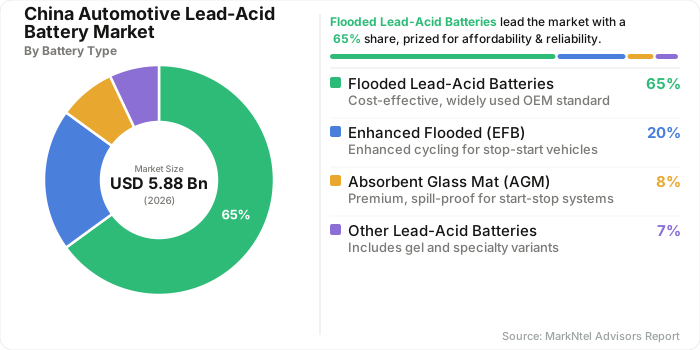
- By battery type, flooded lead-acid batteries hold a significant share of about 65% in 2026.
- By vehicle type, passenger cars seized a significant share of about 60% in 2026.
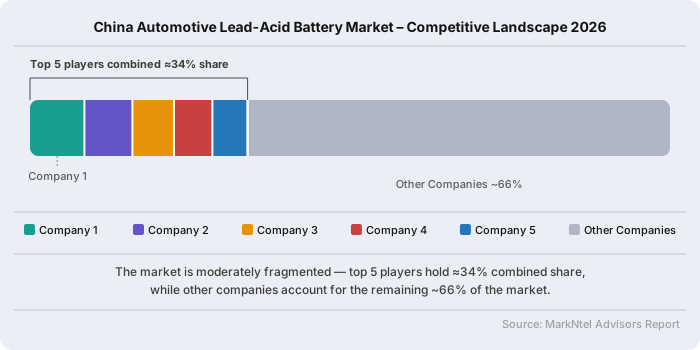
- The industry is moderately fragmented. However, the top five players collectively account for nearly a 34% share.
China Automotive Lead-Acid Battery Market Size and Outlook
The automotive lead-acid battery market size in China was valued at USD 5.28 billion in 2025 and is projected to grow from USD 5.88 billion in 2026 to USD 11.29 billion by 2032. Along with this, the market is estimated to grow at a CAGR of around 11.49% during the forecast period, i.e., 2026-32.
The demand for automotive lead-acid batteries in China is supported by the country’s large and expanding vehicle fleet, replacement demand, start-stop applications, and continued automotive production. China produced 34.53 million vehicles and sold 34.40 million in 2025, up 10.4% and 9.4%, respectively, sustaining a substantial replacement-battery base. Additionally, government trade-in programs are also supporting vehicle consumption, while rapid NEV adoption is encouraging manufacturers to develop AGM, EFB and low-voltage auxiliary batteries. NEV sales reached 16.49 million in 2025, accounting for 47.9% of new-vehicle sales.
Meanwhile, tighter battery recycling and traceability policies are encouraging formal collection and resource recovery. Over the long term, growth is expected to increasingly depend on advanced lead-acid technologies, auxiliary applications, replacement demand, and recycling-driven circularity.
China Automotive Lead-Acid Battery Market Key Indicators
- China's motor vehicle fleet reached 469 million units by the end of 2025, including 366 million automobiles, per the Ministry of Public Security, with 35.35 million new registrations in 2025. This large, aging installed base drives replacement-cycle demand for automotive lead-acid batteries, since SLI batteries typically need swapping every two to four years. The sheer stock of vehicles, far exceeding annual new-vehicle sales, makes the parc the dominant driver of aftermarket battery growth.
- China produced 34.531 million vehicles and sold 34.4 million in 2025, up 10.4% and 9.4% year-on-year, according to the China Association of Automobile Manufacturers, marking a 17th straight year as the world's largest auto market. Every new vehicle built requires at least one OEM-fitted starter battery, so this output figure directly sets first-fit lead-acid battery volumes, even as OEM sourcing shifts toward higher-spec AGM and EFB variants.
- China exported 219 million lead-acid battery units in 2025, down 12.79% year-on-year, per customs data cited by Shanghai Metals Market. December alone saw 17.24 million units shipped, down 33.86% year-on-year. Top destinations weakened broadly: India fell 33.39%, the United States dropped 48.59%, and Singapore declined 43.49%. This contraction, driven by tariff pressure and an earlier export rush, signals softening overseas automotive and replacement battery demand for Chinese producers.
- Secondary refined lead output reached 2.886 million tonnes in the first eleven months of 2025, down 1.4% year-on-year, while secondary crude lead rose 4% to 3.609 million tonnes, per Shanghai Metals Market. Since recycled lead feeds roughly half of China's battery-grade lead supply, this divergence crude output rising while refined output stalls signals margin and environmental-compliance pressure on smelters, even amid rising scrap-battery supply from the growing vehicle parc.
China Automotive Lead-Acid Battery Market Scope
| Category | Segments |
|---|---|
| By Battery Type | Flooded Lead-Acid Batteries, Enhanced Flooded Batteries (EFB), Absorbent Glass Mat (AGM), Other Lead-Acid Batteries |
| By Vehicle Type | Passenger Cars, Light Commercial Vehicles, Heavy Commercial Vehicles, Two-Wheelers |
| By Application | Starting, Lighting & Ignition (SLI), Start-Stop Systems, Auxiliary/Low-Voltage, Other Automotive Applications |
| By Sales Channel | OEM, Aftermarket/Replacement |
| By Voltage | 12V, 24V, Other Voltages |
China Automotive Lead-Acid Battery Market Growth Drivers
Expanding Vehicle Fleet and Rising Vehicle Registrations Driving Recurring Lead-Acid Battery Demand
The expansion of China’s vehicle fleet is a key demand driver for the automotive lead-acid battery industry because a larger installed vehicle base generates recurring requirements for starting, lighting and ignition (SLI), as well as auxiliary batteries. China’s automotive industry reached record levels in 2025, with total vehicle production reaching 34.53 million units, up 10.4% year on year, while sales increased 9.4% to 34.40 million units, according to the China Association of Automobile Manufacturers (CAAM). Automotive production and sales have remained above 30 million units for three consecutive years, demonstrating the scale of the country's vehicle ecosystem.
This expanding installed base is particularly important for the aftermarket because automotive batteries have a shorter operating life than vehicles and therefore require periodic replacement. Consequently, every additional vehicle entering China’s fleet creates future replacement opportunities for battery manufacturers. The country's substantial conventional-vehicle population also continues to support demand for cost-effective flooded lead-acid batteries, while newer vehicles are increasing requirements for AGM and EFB technologies with improved cycling and charge-acceptance capabilities.
Therefore, sustained vehicle production, a large installed base, and recurring replacement requirements provide a durable foundation for China's automotive lead-acid battery market.
Recent Trends
Growing Adoption of AGM and EFB Batteries for Start-Stop Applications
A key trend in China’s automotive lead-acid battery industry is the increasing emphasis on Enhanced Flooded Battery (EFB) and Absorbent Glass Mat (AGM) technologies to meet the higher cycling, charge-acceptance and power requirements of start-stop vehicles. This trend is supported by developments among Chinese battery manufacturers. In its 2025 annual report, Tianneng reported that its automotive battery business focuses on new technologies and materials and that its AGM/EFB batteries for start-stop vehicles received market recognition during the reporting period.
The company also developed EFB+ new-energy auxiliary batteries specifically for mainstream NEVs, showing that advanced lead-acid technologies are expanding beyond conventional starter applications. A further Chinese industry instance is Jinzhou Chengguang Power, which currently manufactures both EFB lead-acid batteries for start-stop applications and AGM batteries. Its AGM products are designed for frequent starting and stopping and provide three times the cycling life of ordinary batteries, while offering faster recharge and higher starting current.
The trend therefore represents a premiumization of China's automotive lead-acid battery market, as manufacturers increasingly move toward higher-performance EFB and AGM products to serve start-stop, high-electrical-load and new-energy vehicle applications.
China Automotive Lead-Acid Battery Market Opportunities and Challenges
Rapid NEV Penetration Creates Technology Substitution Pressure and Drives Low-Voltage Auxiliary Battery Opportunities
Rapid adoption of new-energy vehicles (NEVs) is a major structural challenge for China’s automotive lead-acid battery market because it reduces the conventional internal-combustion-engine vehicle base that traditionally depends on lead-acid starting, lighting and ignition (SLI) batteries. China sold 16.49 million NEVs in 2025, up 28.2% year on year, meaning NEVs accounted for approximately 48% of total vehicle sales. This rapid transition is increasing competition from lithium-ion technologies.
The challenge is particularly evident in China, where BYD has adopted LFP batteries for low-voltage/starting applications in some NEVs, demonstrating that electrification can directly substitute lead-acid batteries rather than simply eliminate the engine-starting requirement. CRU has identified this shift toward LFP starter batteries as a growing technology transition in China's NEV market.
However, the same electrification trend creates an opportunity for lead-acid manufacturers to shift from conventional engine-starting applications toward low-voltage auxiliary battery systems. The Battery Council International (BCI), in its 2026 automotive battery assessment, states that vehicles across different powertrain types require low-voltage 12V batteries for auxiliary functions, including safety and security systems.
t also highlights continued growth in advanced AGM and EFB technologies as automotive electrical requirements increase. A concrete industry example is Chuanxi Battery, a Chinese battery manufacturer that markets a dedicated 12V lead-acid NEV auxiliary battery, with CCA ratings of 264–400 A and reported annual production capacity of 2 million kVAh. This demonstrates that Chinese manufacturers are already developing lead-acid products specifically for the electrified-vehicle auxiliary segment.
Therefore, NEV penetration is both a structural threat to conventional SLI demand and a catalyst for technological repositioning. Manufacturers that develop high-cycle AGM/EFB and other advanced 12V auxiliary solutions can capture applications that remain necessary even as vehicle powertrains become increasingly electrified.
Segmentation Insights
Flooded Lead-Acid Batteries Account for Approximately 65% of the China Automotive Lead-Acid Battery Demand
Flooded lead-acid batteries remain the leading battery type in China’s automotive lead-acid battery industry, accounting for approximately 65% of revenue. Their strong position is supported by their lower cost, mature manufacturing ecosystem, reliable starting performance, and broad compatibility with conventional passenger and commercial vehicles. China’s automotive demand provides a substantial installed base: the country’s vehicle sales remained above 30 million units in 2025, supporting ongoing OEM and replacement-battery demand.
In addition, LEOCH maintained a broad portfolio of flooded maintenance-free automotive batteries in 2025, with products designed for automobiles, tractors, mining trucks and construction vehicles. Its flooded batteries offer CCA ratings of up to 610 A, demonstrating their suitability for demanding starting applications. Although AGM and EFB technologies are gaining importance in start-stop applications, LEOCH continues to position flooded batteries for vehicles without start-stop systems, particularly where affordability and dependable starting performance are priorities. Based on battery type, the scope has been segmented into
- Flooded Lead-Acid Batteries
- Enhanced Flooded Batteries (EFB)
- Absorbent Glass Mat (AGM)
- Other Lead-Acid Batteries
Passenger Cars Account for Approximately 60% of Market Revenue
Passenger cars represent the largest vehicle-type segment in China’s automotive lead-acid battery market, accounting for approximately 60% of total market revenue. Their dominance is supported by China’s extensive passenger-vehicle fleet, high annual sales, frequent replacement requirements, and widespread use of lead-acid batteries for starting and low-voltage electrical systems. China’s passenger-vehicle sales reached approximately 27.6 million units in 2025, according to the China Association of Automobile Manufacturers, providing a substantial installed base for OEM and replacement battery demand.
In addition, the replacement cycle of conventional vehicles sustains aftermarket demand even as NEV penetration increases. Camel Group, one of China’s major automotive battery manufacturers, supplies lead-acid batteries for passenger vehicles and continues to offer conventional, AGM and EFB products. This broad passenger-car application base, combined with recurring replacement demand and extensive aftermarket distribution, enables passenger cars to maintain their leading revenue position. By vehicle type, the scope has been classified into
- Passenger Cars
- Light Commercial Vehicles
- Heavy Commercial Vehicles
- Two-Wheelers
China Automotive Lead-Acid Battery Market Competitive Analysis
Top 5 Companies Account for Approximately 34% Market Share
The China automotive lead-acid battery market is moderately fragmented, with leading companies such as Chaowei Power Holdings Limited, Tianneng Battery Group Co., Ltd., Camel Group Co., Ltd., Fengfan Co., Ltd., and Leoch International Technology Limited collectively accounting for an estimated 34% of the market share.
Key Players in China Automotive Lead-Acid Battery Market
- Chaowei Power Holdings Limited
- Tianneng Power International Limited
- Camel Group Co., Ltd.
- Fengfan Co., Ltd.
- Leoch International Technology Limited
- Shandong Sacred Sun Power Sources Co., Ltd.
- Shuangdeng Group Co., Ltd.
- Zhejiang Narada Power Source Co., Ltd.
- Jujiang Power Source Co., Ltd.
- CSIC Power (Chuanxi) Co., Ltd.
- Others
China Automotive Lead-Acid Battery Industry News and Recent Developments
2026: Tianneng Advances EFB+ Batteries for NEV Auxiliary Applications
Tianneng's recent business developments highlight the expansion of advanced lead-acid technology into new-energy vehicle auxiliary applications, including EFB+ battery solutions. This reflects manufacturers' efforts to reposition automotive lead-acid batteries beyond conventional engine-starting functions as China's vehicle fleet becomes increasingly electrified. Advanced auxiliary applications could help offset some demand pressure caused by rapid NEV penetration.
Impact Analysis: The development of EFB+ auxiliary batteries strengthens Tianneng’s ability to address the changing requirements of China’s increasingly electrified vehicle fleet. By extending lead-acid technology into low-voltage auxiliary applications, manufacturers can partially offset declining conventional starting-battery demand from NEVs. Tianneng already offers EFB and AGM start-stop solutions for passenger and commercial vehicles, supporting broader automotive applications. The trend could therefore create new revenue opportunities for advanced lead-acid batteries while intensifying competition with lithium-based auxiliary technologies.
- Market Segmentation
- Introduction
- Product Definition
- Research Process
- Assumptions
- Executive Summary
- China Automotive Lead-Acid Battery Market Policies, Regulations, and Product Standards
- China Automotive Lead-Acid Battery Supply Chain Analysis
- China Automotive Lead-Acid Battery Import/Export Analysis
- China Automotive Lead-Acid Battery Market Production Trend 2022-2032
- China Automotive Lead-Acid Battery Market Production Trend By Battery Type
- Flooded Lead-Acid Batteries
- Enhanced Flooded Batteries (EFB)
- Absorbent Glass Mat (AGM)
- Other Lead-Acid Batteries
- Company-Wise Production Plants and Statistics
- Installed Production Capacity
- Actual Production
- Planned Production Target
- China Automotive Lead-Acid Battery Market Production Trend By Battery Type
- China Automotive Lead-Acid Battery Market Pricing Analysis 2022-2032
- China Automotive Lead-Acid Battery Market Pricing Trend (USD) 2022-2032
- China Automotive Lead-Acid Battery Market Pricing Trend (USD) By Regions 2022-2032
- East China
- North China
- South China
- Central China
- Southwest China
- Northwest China
- Northeast China
- China Automotive Lead-Acid Battery Market Pricing Trend (USD/Units) By Battery Type 2022-2032
- Flooded Lead-Acid Batteries
- Enhanced Flooded Batteries (EFB)
- Absorbent Glass Mat (AGM)
- Other Lead-Acid Batteries
- China Automotive Lead-Acid Battery Market Trends & Developments
- China Automotive Lead-Acid Battery Market Dynamics
- Growth Factors
- Challenges
- China Automotive Lead-Acid Battery Market Hotspot & Opportunities
- China Automotive Lead-Acid Battery Market Outlook, 2022-2032
- Market Size & Outlook
- By Revenues (USD Million)
- By Quantity Sold (Thousand Units)
- Market Segmentation & Outlook
- By Battery Type- Market Size & Forecast 2022-2032, USD Million & Thousand Units
- Flooded Lead-Acid Batteries
- Enhanced Flooded Batteries (EFB)
- Absorbent Glass Mat (AGM)
- Other Lead-Acid Batteries
- By Vehicle Type- Market Size & Forecast 2022-2032, USD Million & Thousand Units
- Passenger Cars
- Light Commercial Vehicles
- Heavy Commercial Vehicles
- Two-Wheelers
- By Application- Market Size & Forecast 2022-2032, USD Million & Thousand Units
- Starting, Lighting & Ignition (SLI)
- Start-Stop Systems
- Auxiliary/Low-Voltage
- Other Automotive Applications
- By Sales Channel- Market Size & Forecast 2022-2032, USD Million & Thousand Units
- OEM
- Aftermarket/Replacement
- By Voltage- Market Size & Forecast 2022-2032, USD Million & Thousand Units
- 12V
- 24V
- Other Voltages
- By Region- Market Size & Forecast 2022-2032, USD Million & Thousand Units
- East China
- North China
- South China
- Central China
- Southwest China
- Northwest China
- Northeast China
- By Company
- Competition Characteristics
- Market Share & Analysis
- By Battery Type- Market Size & Forecast 2022-2032, USD Million & Thousand Units
- Market Size & Outlook
- China Automotive Flooded Lead-Acid Batteries Market Outlook, 2022-2032
- Market Size & Outlook
- By Revenues (USD Million)
- By Quantity Sold (Thousand Units)
- Market Segmentation & Outlook
- By Vehicle Type- Market Size & Forecast 2022-2032, USD Million & Thousand Units
- By Application- Market Size & Forecast 2022-2032, USD Million & Thousand Units
- By Sales Channel- Market Size & Forecast 2022-2032, USD Million & Thousand Units
- By Voltage- Market Size & Forecast 2022-2032, USD Million & Thousand Units
- By Region- Market Size & Forecast 2022-2032, USD Million & Thousand Units
- Market Size & Outlook
- China Automotive Enhanced Flooded Batteries (EFB) Market Outlook, 2022-2032
- Market Size & Outlook
- By Revenues (USD Million)
- By Quantity Sold (Thousand Units)
- Market Segmentation & Outlook
- By Vehicle Type- Market Size & Forecast 2022-2032, USD Million & Thousand Units
- By Application- Market Size & Forecast 2022-2032, USD Million & Thousand Units
- By Sales Channel- Market Size & Forecast 2022-2032, USD Million & Thousand Units
- By Voltage- Market Size & Forecast 2022-2032, USD Million & Thousand Units
- By Region- Market Size & Forecast 2022-2032, USD Million & Thousand Units
- Market Size & Outlook
- China Automotive Absorbent Glass Mat (AGM) Market Outlook, 2022-2032
- Market Size & Outlook
- By Revenues (USD Million)
- By Quantity Sold (Thousand Units)
- Market Segmentation & Outlook
- By Vehicle Type- Market Size & Forecast 2022-2032, USD Million & Thousand Units
- By Application- Market Size & Forecast 2022-2032, USD Million & Thousand Units
- By Sales Channel- Market Size & Forecast 2022-2032, USD Million & Thousand Units
- By Voltage- Market Size & Forecast 2022-2032, USD Million & Thousand Units
- By Region- Market Size & Forecast 2022-2032, USD Million & Thousand Units
- Market Size & Outlook
- China Automotive Lead-Acid Battery Market Key Strategic Imperatives for Success & Growth
- Competitive Outlook
- Company Profiles
- Chaowei Power Holdings Limited
- Business Description
- Product Portfolio
- Collaborations & Alliances
- Recent Developments
- Financial Details
- Others
- Tianneng Power International Limited
- Business Description
- Product Portfolio
- Collaborations & Alliances
- Recent Developments
- Financial Details
- Others
- Camel Group Co., Ltd.
- Business Description
- Product Portfolio
- Collaborations & Alliances
- Recent Developments
- Financial Details
- Others
- Fengfan Co., Ltd.
- Business Description
- Product Portfolio
- Collaborations & Alliances
- Recent Developments
- Financial Details
- Others
- Leoch International Technology Limited
- Business Description
- Product Portfolio
- Collaborations & Alliances
- Recent Developments
- Financial Details
- Others
- Shandong Sacred Sun Power Sources Co., Ltd.
- Business Description
- Product Portfolio
- Collaborations & Alliances
- Recent Developments
- Financial Details
- Others
- Shuangdeng Group Co., Ltd.
- Business Description
- Product Portfolio
- Collaborations & Alliances
- Recent Developments
- Financial Details
- Others
- Zhejiang Narada Power Source Co., Ltd.
- Business Description
- Product Portfolio
- Collaborations & Alliances
- Recent Developments
- Financial Details
- Others
- Jujiang Power Source Co., Ltd.
- Business Description
- Product Portfolio
- Collaborations & Alliances
- Recent Developments
- Financial Details
- Others
- CSIC Power (Chuanxi) Co., Ltd.
- Business Description
- Product Portfolio
- Collaborations & Alliances
- Recent Developments
- Financial Details
- Others
- Chaowei Power Holdings Limited
- Company Profiles
- Disclaimer

MarkNtel Advisors follows a robust and iterative research methodology designed to ensure maximum accuracy and minimize deviation in market estimates and forecasts. Our approach combines both bottom-up and top-down techniques to effectively segment and quantify various aspects of the market. A consistent feature across all our research reports is data triangulation, which examines the market from three distinct perspectives to validate findings. Key components of our research process include:
1. Scope & Research Design At the outset, MarkNtel Advisors define the research objectives and formulate pertinent questions. This phase involves determining the type of research—qualitative or quantitative—and designing a methodology that outlines data collection methods, target demographics, and analytical tools. They also establish timelines and budgets to ensure the research aligns with client goals.
2. Sample Selection and Data Collection In this stage, the firm identifies the target audience and determines the appropriate sample size to ensure representativeness. They employ various sampling methods, such as random or stratified sampling, based on the research objectives. Data collection is carried out using tools like surveys, interviews, and observations, ensuring the gathered data is reliable and relevant.
3. Data Analysis and Validation Once data is collected, MarkNtel Advisors undertake a rigorous analysis process. This includes cleaning the data to remove inconsistencies, employing statistical software for quantitative analysis, and thematic analysis for qualitative data. Validation steps are taken to ensure the accuracy and reliability of the findings, minimizing biases and errors.

4. Data Forecast and FinalizationThe final phase involves forecasting future market trends based on the analyzed data. MarkNtel Advisors utilize predictive modeling and time series analysis to anticipate market behaviors. The insights are then compiled into comprehensive reports, featuring visual aids like charts and graphs, and include strategic recommendations to inform client decision-making
We offer flexible licensing options to cater to varying organizational needs. Choose the pricing pack that best suits your requirements:
Buy Now Inquire Before Buying
 Request Customization