

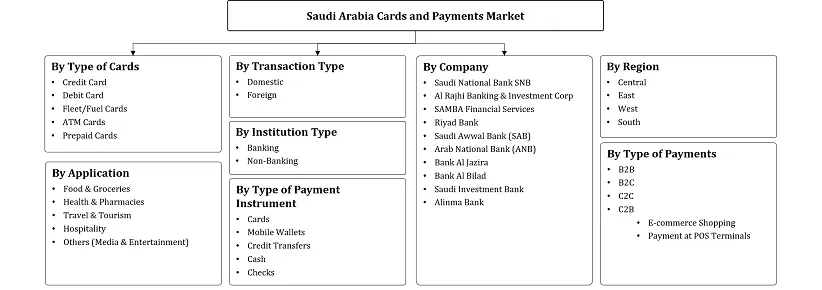
By Type of Cards (Debit Cards, Fleet/Fuel Cards, ATM Cards, Prepaid Cards, Credit Cards), By Type of Payment Instrument (Cards, Mobile Wallets, Credit Transfers, Cash, Debit Cards, Checks), By Type of... ... Checks), By Type of Payments (B2B, B2C, C2C, C2B, E-Commerce Payments, Payments at POS Terminals), By Transaction Type (Domestic, Foreign), By Application (Food & Groceries, Health & Pharmacies, Travel & Tourism, Hospitality, Others (Media & Entertainment, etc.)), By Institution Type (Financial, Non-Financial), and others Read more
- FinTech
- Jul 2026
- 145
- PDF, Excel, PPT
Saudi Arabia Cards and Payments Market Key Takeaways
- The Saudi Arabia cards and payments Market was valued at USD 335 billion in 2025 and is projected to grow from USD 346 billion in 2026 to USD 498 billion in 2032.
- The industry is projected to witness steady growth at a CAGR of 6.3% during 2026–2032.
- The debit cards segment continues to dominate the industry with 74% in 2026.
- By payment instrument, card type dominates the market with 64% market share in 2026.
- The market is highly concentrated, with the top 5 leading companies collectively holding 76% market share.
Saudi Arabia Cards and Payments Market Size & Outlook
The Saudi Arabia cards and payments market is valued at USD 335 billion in 2025, increases to USD 346 billion in 2026, and is projected to reach USD 498 billion by 2032. The market is forecast to grow at 6.3 % CAGR during 2026–2032
Supported by strong policy-driven digital transformation under Vision 2030. According to SAMA (2024), electronic payments already account for 79% of total . This shift is enabled by national infrastructure such as mada (domestic card network) and SARIE (instant payment system), which together process billions of transactions annually and form the backbone of the Kingdom’s payment technology ecosystem.
Government-led initiatives are further accelerating market expansion through regulatory modernization and fintech enablement programs. The Financial Sector Development Program (FSDP) under Vision 2030 continues to push digital adoption, while SAMA’s Open Banking framework and fintech sandbox initiatives are expanding competition in the Saudi Arabia Fintech Payments Market. Additionally, large-scale events such as Money20/20 Middle East 2025 have strengthened investor participation and accelerated product innovation in digital wallets, BNPL, and merchant acquiring solutions, reinforcing ecosystem-wide modernization.
Merchant and consumer behavior is also evolving rapidly, driven by contactless and mobile-first payment adoption. SAMA data shows strong growth in POS infrastructure exceeding 1.4–2 million acceptance points and 8+ billion annual mada transactions, highlighting deep penetration of card-based payments across retail, hospitality, and e-commerce sectors. Leading players such as Saudi National Bank and Al Rajhi Bank are expanding card issuance programs, while fintech firms like Tamara and Tabby are embedding installment-based checkout solutions into merchant ecosystems, further strengthening transaction volume growth across the Saudi Arabia digital payments market.
The outlook remains strongly positive as cash usage continues to decline sharply, falling to below 15% of POS transactions by 2025, while digital payments scale toward full dominance. Increasing adoption of tokenized cards, NFC-enabled payments, and embedded finance solutions is expected to sustain high growth momentum. Combined with regulatory backing and expanding digital infrastructure, these factors are positioning the Kingdom as one of the fastest-transforming payment ecosystems in the region, with sustained expansion across both card-based and alternative digital payment channels.
Saudi Arabia Cards and Payments Market Key Indicators
- According to the Saudi Central Bank (SAMA), the Kingdom operated approximately 2.0 million Point-of-Sale (POS) terminals by Q4 2024, while POS transactions reached nearly 2.76 billion transactions with a total transaction value of USD 45.68 billion during the quarter. The continuous expansion of merchant acceptance infrastructure supports wider card usage across retail, hospitality, healthcare, transportation, and government sectors, reinforcing the country's transition toward a cashless economy.
- As per the SAMA, around 50.2 million ATM/payment cards had been issued by domestic banks as of Q4 2024. The steadily expanding payment card base reflects increasing financial inclusion, rising bank account penetration, and growing consumer adoption of debit, prepaid, and credit cards. The expanding issuance pipeline continues to provide a strong foundation for transaction volume growth across both physical and digital commerce channels.
- By the report of (SAMA), the Saudi Arabian Riyal Interbank Express (SARIE) system processed customer payments worth approximately USD 1.11 trillion during Q4 2024, while the total SARIE transaction value reached USD 3.91 trillion. The continued expansion of Saudi Arabia's real-time payment infrastructure demonstrates increasing institutional and corporate reliance on digital payment rails, supporting greater interoperability between banking systems, payment service providers, and fintech platforms.
- The Financial Sector Development Program Annual Report 2024, Saudi Arabia had 261 fintech companies operating by the end of 2024, exceeding the program's 2025 target of 230 companies. During the same period, SAMA introduced the second release of the Open Banking Framework, covering Payment Initiation Services (PIS) and enabling Samsung Pay through the national payment network mada, strengthening competition, payment innovation, and digital wallet interoperability across the Kingdom's payments ecosystem.
- According to the Saudi Central Bank (SAMA), banking sector assets reached USD 1.20 trillion by the end of 2024, while private-sector credit expanded to USD 741.3 billion, with prudential indicators remaining above Basel Committee on Banking Supervision (BCBS) regulatory requirements. The resilience and capitalization of Saudi Arabia's banking system provide the financial capacity required for continued investment in payment infrastructure, card issuance, cybersecurity, open banking, and digital financial services supporting the cards and payments market.
Saudi Arabia Cards and Payments Market Scope
| Category | Segments |
|---|---|
| By Type of Cards | Debit Cards, Fleet/Fuel Cards, ATM Cards, Prepaid Cards, Credit Cards |
| By Type of Payment Instrument | Cards, Mobile Wallets, Credit Transfers, Cash, Debit Cards, Checks |
| By Type of Payments | B2B, B2C, C2C, C2B, E-Commerce Payments, Payments at POS Terminals |
| By Transaction Type | Domestic, Foreign |
| By Application | Food & Groceries, Health & Pharmacies, Travel & Tourism, Hospitality, Others (Media & Entertainment, etc. |
| By Institution Type | Financial, Non-Financial |
Saudi Arabia Cards and Payments Market Growth Drivers
Vision 2030 Cashless Initiatives Driving Instant Payments
Saudi Arabia continues to strengthen its digital payment ecosystem by expanding its regulatory environment for fintech innovation and digital banking. According to the Saudi Central Bank (SAMA), four new financial technology licenses covering debt-based crowdfunding, payment services, SME financing, finance leasing, and consumer financing were granted during Q1 2024. Additionally, SAMA authorized a company to provide term deposit aggregation services, broadening digital financial offerings and encouraging innovation in Saudi Arabia's digital payments market.
Furthermore, SAMA continues to accelerate the development of the payment technology ecosystem through its Regulatory Sandbox. As of 2024, 19 fintech companies are actively testing innovative financial solutions under SAMA's sandbox, while 50 fintech firms have participated since the initiative was launched. The controlled regulatory framework enables payment providers to validate new products before commercial deployment, reducing market entry barriers and supporting the expansion of secure payment gateway services, digital wallets, and next-generation payment solutions across the Kingdom.
- Market Segmentation
- Introduction
- Product Definition
- Research Process
- Assumptions
- Executive Summary
- Saudi Arabia Cards & Payments Market Customer Survey
- By Type of Transaction
- By Banking Experience
- By Frequency of Transactions from Card
- By Purpose of Transaction
- Key Benefits of Using Card to the Customer
- Saudi Arabia Financial Cards & Payments Market Outlook
- Key Issuers of Cards
- Penetration of Cards
- Digital Development
- ATM Expansion
- POS Terminals
- Alternate Payments Solutions
- Saudi Arabia Cards and Payments Market Regulations, Policies & Industry Standards
- Saudi Arabia Cards and Payments Market Trends & Developments
- Saudi Arabia Cards and Payments Market Dynamics
- Growth Drivers
- Challenges
- Saudi Arabia Cards and Payments Market Hotspots & Opportunities
- Saudi Arabia Cards and Payments Market Outlook, 2022-2032
- Market Size & Outlook
- By Transactions Value (USD Million)
- By Total Number of Cards (Thousand Units)
- Number of Transactions (Units)
- Market Segmentation & Outlook
- By Type of Cards
- Debit Cards
- Fleet/Fuel Cards
- ATM Cards
- Prepaid Cards
- Credit Cards
- By Type of Payment Instrument
- Cards
- Mobile Wallets
- Credit Transfers
- Cash
- Debit Cards
- Checks
- By Type of Payments
- B2B
- B2C
- C2C
- C2B
- E-Commerce Payments
- Payments at POS Terminals
- By Transaction Type
- Domestic
- Foreign
- By Application
- Food & Groceries
- Health & Pharmacies
- Travel & Tourism
- Hospitality
- Others (Media & Entertainment, etc.)
- By Institution Type
- Financial
- Non-Financial
- By Region
- Central
- East
- West
- South
- By Company
- Competition Characteristics
- Market Share of Leading Companies, By Revenues
- By Type of Cards
- Market Size & Outlook
- Central Saudi Arabia Cards and Payments Market Outlook, 2022-2032
- Market Size & Outlook
- By Transactions Value (USD)
- By Number Cards (Thousand Units)
- Number of Transactions (Units)
- Market Segmentation & Outlook
- By Card Type- Market Size & Forecast 2022-2032, USD & Thousand Units
- By Payment Type- Market Size & Forecast 2022-2032, USD & Thousand Units
- By End User- Market Size & Forecast 2022-2032, USD & Thousand Units
- By Transaction Type- Market Size & Forecast 2022-2032, USD & Thousand Units
- Market Size & Outlook
- Eastern Saudi Arabia Cards and Payments Market Outlook, 2022-2032
- Market Size & Outlook
- By Transactions Value (USD)
- By Cards in Circulation (Thousand Units)
- Number of Transactions (Units)
- Market Segmentation & Outlook
- By Card Type- Market Size & Forecast 2022-2032, USD & Thousand Units
- By Payment Type- Market Size & Forecast 2022-2032, USD & Thousand Units
- By End User- Market Size & Forecast 2022-2032, USD & Thousand Units
- By Transaction Type- Market Size & Forecast 2022-2032, USD & Thousand Units
- Market Size & Outlook
- Western Saudi Arabia Cards and Payments Market Outlook, 2022-2032
- Market Size & Outlook
- By Transactions Value (USD)
- By Cards in Circulation (Thousand Units)
- Number of Transactions (Units)
- Market Segmentation & Outlook
- By Card Type- Market Size & Forecast 2022-2032, USD & Thousand Units
- By Payment Type- Market Size & Forecast 2022-2032, USD & Thousand Units
- By End User- Market Size & Forecast 2022-2032, USD & Thousand Units
- By Transaction Type- Market Size & Forecast 2022-2032, USD & Thousand Units
- Market Size & Outlook
- Southern Saudi Arabia Cards and Payments Market Outlook, 2022-2032
- Market Size & Outlook
- By Transactions Value (USD)
- By Cards in Circulation (Thousand Units)
- Number of Transactions (Units)
- Market Segmentation & Outlook
- By Card Type- Market Size & Forecast 2022-2032, USD & Thousand Units
- By Payment Type- Market Size & Forecast 2022-2032, USD & Thousand Units
- By End User- Market Size & Forecast 2022-2032, USD & Thousand Units
- By Transaction Type- Market Size & Forecast 2022-2032, USD & Thousand Units
- Market Size & Outlook
- Saudi Arabia Cards and Payments Market Key Strategic Imperatives for Success & Growth
- Competitive Outlook
- Company Profiles
- Saudi National Bank (SNB)
- Business Description
- Product Portfolio
- Strategic Alliances or Partnerships
- Recent Developments
- Financial Details
- Others
- Al Rajhi Bank
- Business Description
- Product Portfolio
- Strategic Alliances or Partnerships
- Recent Developments
- Financial Details
- Others
- Riyad Bank
- Business Description
- Product Portfolio
- Strategic Alliances or Partnerships
- Recent Developments
- Financial Details
- Others
- Arab National Bank
- Business Description
- Product Portfolio
- Strategic Alliances or Partnerships
- Recent Developments
- Financial Details
- Others
- Alinma Bank
- Business Description
- Product Portfolio
- Strategic Alliances or Partnerships
- Recent Developments
- Financial Details
- Others
- Saudi Investment Bank
- Business Description
- Product Portfolio
- Strategic Alliances or Partnerships
- Recent Developments
- Financial Details
- Others
- Bank Al Jazira
- Business Description
- Product Portfolio
- Strategic Alliances or Partnerships
- Recent Developments
- Financial Details
- Others
- Bank Albilad
- Business Description
- Product Portfolio
- Strategic Alliances or Partnerships
- Recent Developments
- Financial Details
- Others
- Banque Saudi Fransi
- Business Description
- Product Portfolio
- Strategic Alliances or Partnerships
- Recent Developments
- Financial Details
- Others
- Saudi Awwal Bank
- Business Description
- Product Portfolio
- Strategic Alliances or Partnerships
- Recent Developments
- Financial Details
- Others
- Others
- Saudi National Bank (SNB)
- Company Profiles
- Disclaimer
MarkNtel Advisors follows a robust and iterative research methodology designed to ensure maximum accuracy and minimize deviation in market estimates and forecasts. Our approach combines both bottom-up and top-down techniques to effectively segment and quantify various aspects of the market. A consistent feature across all our research reports is data triangulation, which examines the market from three distinct perspectives to validate findings. Key components of our research process include:
1. Scope & Research Design At the outset, MarkNtel Advisors define the research objectives and formulate pertinent questions. This phase involves determining the type of research—qualitative or quantitative—and designing a methodology that outlines data collection methods, target demographics, and analytical tools. They also establish timelines and budgets to ensure the research aligns with client goals.
2. Sample Selection and Data Collection In this stage, the firm identifies the target audience and determines the appropriate sample size to ensure representativeness. They employ various sampling methods, such as random or stratified sampling, based on the research objectives. Data collection is carried out using tools like surveys, interviews, and observations, ensuring the gathered data is reliable and relevant.
3. Data Analysis and Validation Once data is collected, MarkNtel Advisors undertake a rigorous analysis process. This includes cleaning the data to remove inconsistencies, employing statistical software for quantitative analysis, and thematic analysis for qualitative data. Validation steps are taken to ensure the accuracy and reliability of the findings, minimizing biases and errors.

4. Data Forecast and FinalizationThe final phase involves forecasting future market trends based on the analyzed data. MarkNtel Advisors utilize predictive modeling and time series analysis to anticipate market behaviors. The insights are then compiled into comprehensive reports, featuring visual aids like charts and graphs, and include strategic recommendations to inform client decision-making
We offer flexible licensing options to cater to varying organizational needs. Choose the pricing pack that best suits your requirements:
Buy Now Inquire Before Buying
 Request Customization