

By Offering (Software (AI-Driven IC Design Software, AI-Based Verification Software, Physical Design & Layout Software, Circuit Simulation Software, Timing & Power Analysis Softwar......e, PCB Design Software, Generative Design & Optimization Tools), Services (Consulting Services, Integration & Deployment, Support & Maintenance)), By AI Integration Level (AI-Augmented, AI-Accelerated, AI-Automated, AI-Native), By Deployment Mode (On-Premises, Cloud-Based, Hybrid), By Enterprise Size (Large Enterprises, Small & Medium Enterprises (SMEs)), By Technology (Machine Learning (ML), Deep Learning (DL), Reinforcement Learning, Generative AI, Natural Language Processing (NLP)), By Design Stage (Front-End Design, Back-End Design, Verification & Validation, System-Level Design), By Tool Type (Computer-Aided Engineering (CAE), IC Physical Design & Verification, PCB & Multi-Chip Module (MCM) Design, Simulation & Analysis Tools), By Application (Microprocessors & Controllers, Memory Management Units, AI Accelerators & HPC Chips, RF & Communication ICs, ASICs & SoCs), By End User (Consumer Electronics, Automotive, Aerospace & Defense, Healthcare, Telecom & Data Centers, Industrial, Others), and others Read more
- ICT & Electronics
- Jun 2026
- 120
- PDF, Excel, PPT
United States Electronic Design Automation AI Market Key Takeaways
- The US electronic design automation AI market reached USD 1.8 billion in 2025, rising from USD 2.1 billion in 2026 to USD 5.6 billion by 2032, at a CAGR of 17.76% during 2026-32.
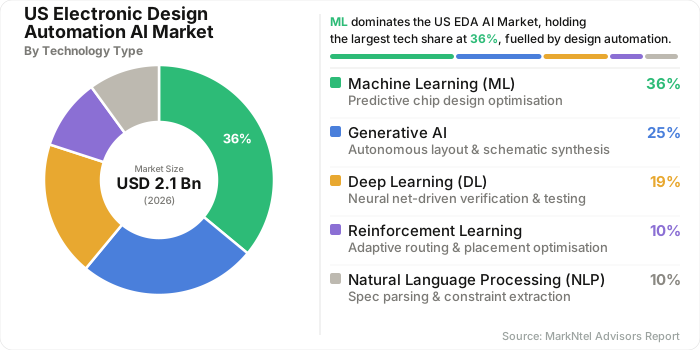
- Machine learning (ML) leads the technology landscape, capturing nearly a 36% share in 2026.
- IC physical design and verification tools dominate by tool type, accounting for around a 33% share in 2026.
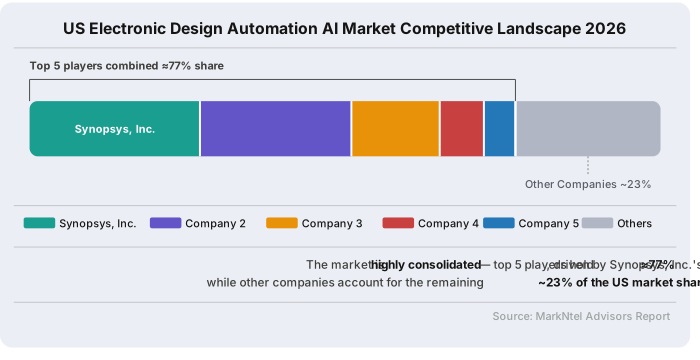
- The competitive landscape remains highly consolidated, with the top five companies collectively controlling approximately 77% of the overall market share.
United States Electronic Design Automation AI Market Size and Outlook
The US electronic design automation AI market is projected to witness sustained growth at a CAGR of 17.76% during 2026–2032. This steady expansion reflects rising adoption of AI-powered circuit design and intelligent EDA workflows to manage increasing chip complexity. Growth is further supported by domestic semiconductor investments and the accelerating integration of AI into advanced-node design environments across US chip development ecosystems.
A critical structural foundation lies in the dominance of US semiconductor firms. According to the Semiconductor Industry Association, US companies accounted for 50.4% of the global semiconductor market share in 2024, generating USD 318.2 billion in sales . This scale creates sustained demand for AI-enabled RTL design tools and advanced EDA platforms across the entire design lifecycle, particularly as firms expand investments in high-performance computing, artificial intelligence chip architectures, and next-generation semiconductor innovation.
Government-backed defense initiatives are further strengthening the long-term outlook, as in September 2024, Intel Corporation secured up to USD 3 billion from the US Department of Defense for its Secure Enclave program, focused on trusted semiconductor manufacturing . These programs require advanced computer aided engineering tools and AI-driven EDA platforms to ensure secure verification, hardware validation, and supply-chain integrity across classified and dual-use semiconductor design environments.
Additionally, innovation-led investments are accelerating design-side transformation. In late 2024, the SMART USA institute announced a USD 285 million federal investment within a USD 1 billion public-private partnership targeting semiconductor design and packaging efficiency through digital twin technologies . These initiatives are expected to enhance simulation accuracy, optimize design workflows, and strengthen AI integration across semiconductor ecosystems. Collectively, policy support, defense funding, and technological advancements will sustain long-term growth momentum across the US electronic design automation AI industry.
United States Electronic Design Automation AI Market Key Indicators
- According to the Semiconductor Industry Association, US semiconductor firms invested USD 119.5 billion in R&D and capital expenditure in 2024, reinforcing the scale of advanced-node innovation. This investment surge directly increases reliance on AI-driven chip design tools, as sub-5nm architectures demand higher simulation accuracy, faster verification cycles, and optimized performance-power-area outcomes across increasingly complex ASIC and SoC development pipelines.
- A joint study by the Semiconductor Industry Association and Oxford Economics projects a shortage of 67,000 semiconductor workers in the US by 2030, with 41% in engineering roles. This widening gap is accelerating adoption of AI-assisted chip verification tools, enabling companies to automate testing, debugging, and validation tasks traditionally dependent on highly specialized engineering talent.
- Analysis by the Semiconductor Industry Association and Boston Consulting Group indicates that US semiconductor manufacturing capacity is projected to grow by 203% by 2032. As domestic production scales, demand for semiconductor design automation platforms rises proportionally, as each new fabrication facility requires a parallel increase in advanced chip design, simulation, and verification workflows.
- The National Institute of Standards and Technology is administering USD 11 billion in microelectronics R&D funding under the CHIPS and Science Act, with new funding calls released in 2025. This initiative is fostering the development of next-generation computer aided engineering solutions, particularly AI-integrated EDA tools that enhance design automation, accelerate prototyping, and support commercialization of advanced semiconductor technologies.
- Research indicates that over 53% of US semiconductor workers were likely to leave the industry in 2024. This rising attrition is increasing dependence on generative AI in semiconductor design tools that automate RTL development, debugging, and validation, allowing firms to sustain productivity while reducing reliance on scarce senior engineering talent.
United States Electronic Design Automation AI Market Scope
| Category | Segments |
|---|---|
| By Offering | Software (AI-Driven IC Design Software, AI-Based Verification Software, Physical Design & Layout Software, Circuit Simulation Software, Timing & Power Analysis Software, PCB Design Software, Generative Design & Optimization Tools), Services (Consulting Services, Integration & Deployment, Support & Maintenance |
| By AI Integration Level | AI-Augmented, AI-Accelerated, AI-Automated, AI-Native |
| By Deployment Mode | On-Premises, Cloud-Based, Hybrid |
| By Enterprise Size | Large Enterprises, Small & Medium Enterprises (SMEs |
| By Technology | Machine Learning (ML), Deep Learning (DL), Reinforcement Learning, Generative AI, Natural Language Processing (NLP |
| By Design Stage | Front-End Design, Back-End Design, Verification & Validation, System-Level Design |
| By Tool Type | Computer-Aided Engineering (CAE), IC Physical Design & Verification, PCB & Multi-Chip Module (MCM) Design, Simulation & Analysis Tools |
| By Application | Microprocessors & Controllers, Memory Management Units, AI Accelerators & HPC Chips, RF & Communication ICs, ASICs & SoCs |
| By End User | Consumer Electronics, Automotive, Aerospace & Defense, Healthcare, Telecom & Data Centers, Industrial, Others |
United States Electronic Design Automation AI Market Growth Drivers
CHIPS Act Investments Driving AI-Powered EDA Expansion
The US government’s semiconductor industrial policy is emerging as a core structural driver for the US electronic design automation AI landscape. By January 2025, the CHIPS Program Office under the U.S. Department of Commerce had proposed over USD 33.7 billion in funding across more than 20 agreements, accelerating fabrication cluster expansion and strengthening domestic chip design ecosystems.
As fabrication facilities progress toward production, demand rises for AI-enabled RTL design tools and design rule checking (DRC) automation solutions. Each fab generates parallel requirements for process design kits, place-and-route optimization, and verification workflows, all increasingly powered by AI to handle advanced-node complexity and reduce design cycle timelines across ASIC and SoC pipelines.
The expansion of semiconductor manufacturing equipment infrastructure is also amplifying design-side demand. As fabrication capacity scales, chipmakers must process higher volumes of designs, requiring computer aided engineering platforms to enhance simulation accuracy, optimize performance, and improve tape-out efficiency for increasingly complex AI chips.
Collectively, these investment flows are structurally reinforcing the US electronic design automation AI industry, as fabrication growth directly translates into higher design intensity. This tight coupling between manufacturing expansion and AI-driven design adoption will sustain long-term demand for EDA AI platforms.
Recent Trends
Integration of Generative AI in Chip Design
The integration of generative AI into semiconductor workflows is a defining trend in the US electronic design automation AI industry, transforming how chips are designed and validated. Synopsys reported over 300 AI-driven commercial tape-outs by early 2024, indicating that generative AI has transitioned from experimental use to production-scale deployment across advanced chip development programs.
This shift enables companies to deploy AI-powered circuit design and intelligent EDA workflows that automate layout optimization, verification, and debugging. As chip complexity increases, particularly for HPC and AI workloads, generative AI is being embedded across design stages to improve productivity and reduce dependence on manual engineering processes.
The growing sophistication of artificial intelligence chip architectures further reinforces this trend. Generative AI models rapidly evaluate design alternatives, optimize performance-power-area metrics, and compress development timelines, allowing firms to manage complexity more efficiently while improving design accuracy across advanced-node semiconductor projects.
These developments are accelerating the transition toward AI-native design ecosystems within the US electronic design automation AI market, where generative AI is becoming foundational. This trend will continue to redefine semiconductor engineering by enabling scalable, automated, and high-efficiency chip design workflows.
United States Electronic Design Automation AI Market Opportunities and Challenges
Regulatory Pressures Driving Secure Design Innovation
Export control regulations are creating operational challenges for the US electronic design automation AI sector, particularly affecting global revenue exposure and compliance complexity. In December 2024, the Bureau of Industry and Security expanded restrictions by adding 140 Chinese entities and tightening controls on advanced semiconductor technologies, directly impacting EDA vendors’ ability to serve international markets.
These measures have intensified EDA software licensing restrictions and increased compliance burdens across global operations. Vendors must now navigate stricter approval processes, limiting deployment of advanced tools and creating uncertainty in long-term contracts, especially in regions historically contributing significant demand for AI-driven semiconductor design solutions.
However, this regulatory pressure is simultaneously unlocking new opportunities. Demand for secure AI EDA platforms is rising, particularly among defense agencies and regulated industries requiring controlled, air-gapped environments. This shift is encouraging vendors to develop secure, compliant solutions aligned with national security and data governance requirements.
In December 2025, Keysight Technologies introduced secure AI-powered assistants for its Advanced Design System, reflecting early commercialization of this opportunit y. As geopolitical dynamics evolve, the US electronic design automation AI industry is expected to pivot toward secure, domestically aligned growth models, creating resilient revenue streams insulated from global trade volatility.
Segmentation Insights
Machine Learning (ML) as the Foundational Layer of EDA AI Technology Evolution
Machine Learning (ML) holds a leading position in the US Electronic Design Automation AI Market, accounting for approximately 36% of total revenue due to its broad applicability across semiconductor design workflows. ML algorithms are extensively integrated into AI-based IC design automation and physical design automation AI, enabling faster pattern recognition, predictive modeling, and design optimization.
The dominance of ML is further reinforced by its critical role in improving simulation accuracy and reducing development timelines. ML models analyze large datasets generated during chip design cycles, enabling faster convergence in layout optimization and verification processes. It offers more stable deployment across existing EDA infrastructures, making it highly compatible with legacy systems.
A notable example is Keysight Technologies, which launched its EDA 2025 software suite in November 2024, integrating machine learning-driven modeling capabilities . The platform enhances RF device modeling and accelerates simulation workflows, demonstrating how machine learning in EDA software improves predictive accuracy and engineering productivity in real-world semiconductor applications.
ML’s scalability, integration flexibility, and immediate performance benefits position it as the dominant technology within the US Electronic Design Automation AI Industry, while also serving as a foundational layer for more advanced AI techniques such as generative and reinforcement learning. Based on technology, the scope has been divided into:
- Machine Learning (ML)
- Deep Learning (DL)
- Reinforcement Learning
- Generative AI
- Natural Language Processing (NLP)
IC Physical Design & Verification Leading EDA AI Tool Demand
The IC physical design and verification segment holds approximately a 33% share within the US electronic design automation AI market, reflecting its central role in semiconductor development workflows. This segment encompasses placement, routing, timing analysis, and validation processes that are critical for ensuring chip functionality at advanced nodes.
The segment’s leadership is driven by the growing complexity of modern semiconductor architectures, where errors at the physical design stage can lead to costly tape-out failures. As a result, chipmakers are prioritizing advanced verification and layout optimization capabilities supported by AI-enhanced computer aided engineering tools.
Compared to other tool categories such as PCB design or simulation tools, IC physical design and verification remain the most resource-intensive and technically demanding stages, requiring continuous innovation. The integration of AI into these workflows enhances precision, accelerates closure timelines, and improves performance-power-area optimization across increasingly complex chip designs.
In conclusion, the criticality of physical design accuracy and verification rigor ensures sustained dominance of this segment, positioning it as a foundational pillar within the US electronic design automation AI industry. The study identifies the following primary tool type within the market:
- Computer-Aided Engineering (CAE)
- IC Physical Design & Verification
- PCB & Multi-Chip Module (MCM) Design
- Simulation & Analysis Tools
United States Electronic Design Automation AI Market Competitive Analysis
The top five players in the US electronic design automation AI market include Synopsys, Cadence Design Systems, Siemens EDA, Ansys, and Keysight Technologies, which collectively account for approximately 77% of the total market share. This indicates a highly consolidated market structure, dominated by a few large, technologically advanced vendors. The competitive landscape is characterized by high entry barriers, driven by deep R&D intensity, long product development cycles, and strong integration with semiconductor ecosystems.
Leading Companies in the US Electronic Design Automation AI Industry
- Synopsys
- Cadence Design Systems
- Siemens EDA
- Ansys
- Keysight Technologies
- Silvaco
- Agnisys
- Zuken
- Altium Limited
- Altair Engineering
- Others
United States Electronic Design Automation AI Industry News and Recent Developments:
March 2026: Siemens Launches Autonomous Fuse EDA AI Agent
Siemens EDA introduced the Fuse EDA AI Agent, designed to autonomously orchestrate semiconductor, 3D IC, and PCB workflows across the entire design lifecycle. The platform integrates retrieval-augmented generation (RAG), multimodal EDA data processing, and NVIDIA AI infrastructure to automate verification, RTL coding, debugging, and manufacturing sign-off activities within a unified agentic framework.
Impact Analysis: The launch reflects the industry’s transition from AI-assisted engineering toward fully agentic semiconductor design environments. By enabling multi-tool orchestration and autonomous workflow execution, Siemens is positioning itself competitively in next-generation EDA automation. The development is expected to reduce engineering bottlenecks, accelerate design closure, and improve productivity across advanced-node semiconductor programs. Additionally, the integration of secure enterprise AI infrastructure strengthens demand for scalable AI-native EDA ecosystems supporting increasingly complex chip architectures.
February 2026: Cadence Introduces Chip Stack AI Super Agent for Agentic Chip Design
Cadence Design Systems unveiled the Chip Stack AI Super Agent to automate front-end silicon design and verification tasks. The AI-powered virtual engineering platform leverages multi-agent orchestration to generate RTL code, create testbenches, run simulations, and debug failures autonomously. Early deployments reportedly demonstrated up to 10x productivity improvements in semiconductor design workflows.
Impact Analysis: The introduction of agentic AI workflows represents a major shift in semiconductor engineering economics, particularly as chip complexity and engineering shortages intensify. Cadence’s move signals the growing commercialization of autonomous AI “virtual engineers” capable of reducing manual intervention in verification-heavy design stages. The platform also strengthens the company’s strategic positioning in AI-native EDA infrastructure, while reinforcing broader industry momentum toward scalable automation for AI chips, hyperscale computing processors, and advanced ASIC development.
September 2025: Synopsys Expands Generative AI Capabilities Across EDA Portfolio
Synopsys expanded its Synopsys.ai Copilot capabilities in September 2025, adding generative AI-powered workflow assistants and advanced engineering automation across semiconductor design solutions. The company reported that customers achieved significantly faster documentation searches, automated script generation, and improved formal verification efficiency, while early-career engineers experienced approximately 30% faster onboarding and productivity ramp-up.
Impact Analysis: The expansion strengthens Synopsys’ leadership in AI-integrated EDA platforms by embedding generative and agentic AI deeper into production-grade semiconductor workflows. The technology reduces engineering cycle times from days to hours while improving design quality and operational scalability. As semiconductor firms confront rising design complexity and workforce shortages, Synopsys’ AI-centric approach is expected to accelerate enterprise adoption of intelligent EDA ecosystems and reinforce the competitive shift toward autonomous semiconductor engineering platforms.
- Market Segmentation
- Introduction
- Product Definition
- Research Process
- Assumptions
- Executive Summary
- United States Electronic Design Automation (EDA) AI Market Policies, Regulations, and Product Standards
- United States Electronic Design Automation (EDA) AI Market Trends & Developments
- United States Electronic Design Automation (EDA) AI Market Dynamics
- Growth Factors
- Challenges
- United States Electronic Design Automation (EDA) AI Market Hotspot & Opportunities
- United States Electronic Design Automation (EDA) AI Market Outlook, 2022-2032F
- Market Size & Outlook
- By Revenues (USD Million)
- Market Share & Outlook
- By Offering- Market Size & Forecast 2022-2032, USD Million
- Software
- AI-Driven IC Design Software
- AI-Based Verification Software
- Physical Design & Layout Software
- Circuit Simulation Software
- Timing & Power Analysis Software
- PCB Design Software
- Generative Design & Optimization Tools
- Services
- Consulting Services
- Integration & Deployment
- Support & Maintenance
- Software
- By AI Integration Level- Market Size & Forecast 2022-2032, USD Million
- AI-Augmented
- AI-Accelerated
- AI-Automated
- AI-Native
- By Deployment Mode- Market Size & Forecast 2022-2032, USD Million
- On-Premises
- Cloud-Based
- Hybrid
- By Enterprise Size- Market Size & Forecast 2022-2032, USD Million
- Large Enterprises
- Small & Medium Enterprises (SMEs)
- By Technology- Market Size & Forecast 2022-2032, USD Million
- Machine Learning (ML)
- Deep Learning (DL)
- Reinforcement Learning
- Generative AI
- Natural Language Processing (NLP)
- By Design Stage- Market Size & Forecast 2022-2032, USD Million
- Front-End Design
- Back-End Design
- Verification & Validation
- System-Level Design
- By Tool Type- Market Size & Forecast 2022-2032, USD Million
- Computer-Aided Engineering (CAE)
- IC Physical Design & Verification
- PCB & Multi-Chip Module (MCM) Design
- Simulation & Analysis Tools
- By Application- Market Size & Forecast 2022-2032, USD Million
- Microprocessors & Controllers
- Memory Management Units
- AI Accelerators & HPC Chips
- RF & Communication ICs
- ASICs & SoCs
- By End User- Market Size & Forecast 2022-2032, USD Million
- Consumer Electronics
- Automotive
- Aerospace & Defense
- Healthcare
- Telecom & Data Centers
- Industrial
- Others
- By Region - Market Size & Forecast 2022-2032, USD Million
- Northeast
- Midwest
- South
- West
- By Company
- Competition Characteristics
- Market Share & Analysis
- By Offering- Market Size & Forecast 2022-2032, USD Million
- Market Size & Outlook
- United States AI-Augmented Market Outlook, 2022-2032
- Market Size & Outlook
- By Revenues (USD Million)
- Market Share & Outlook
- By AI Integration Level- Market Size & Forecast 2022-2032, USD Million
- By Deployment Mode- Market Size & Forecast 2022-2032, USD Million
- By Enterprise Size- Market Size & Forecast 2022-2032, USD Million
- By Technology- Market Size & Forecast 2022-2032, USD Million
- By Design Stage- Market Size & Forecast 2022-2032, USD Million
- By Tool Type- Market Size & Forecast 2022-2032, USD Million
- By Application- Market Size & Forecast 2022-2032, USD Million
- By End User- Market Size & Forecast 2022-2032, USD Million
- By Region - Market Size & Forecast 2022-2032, USD Million
- Market Size & Outlook
- United States AI-Accelerated Market Outlook, 2022-2032
- Market Size & Outlook
- By Revenues (USD Million)
- Market Share & Outlook
- By AI Integration Level- Market Size & Forecast 2022-2032, USD Million
- By Deployment Mode- Market Size & Forecast 2022-2032, USD Million
- By Enterprise Size- Market Size & Forecast 2022-2032, USD Million
- By Technology- Market Size & Forecast 2022-2032, USD Million
- By Design Stage- Market Size & Forecast 2022-2032, USD Million
- By Tool Type- Market Size & Forecast 2022-2032, USD Million
- By Application- Market Size & Forecast 2022-2032, USD Million
- By End User- Market Size & Forecast 2022-2032, USD Million
- By Region - Market Size & Forecast 2022-2032, USD Million
- Market Size & Outlook
- United States AI-Automated Market Outlook, 2022-2032
- Market Size & Outlook
- By Revenues (USD Million)
- Market Share & Outlook
- By AI Integration Level- Market Size & Forecast 2022-2032, USD Million
- By Deployment Mode- Market Size & Forecast 2022-2032, USD Million
- By Enterprise Size- Market Size & Forecast 2022-2032, USD Million
- By Technology- Market Size & Forecast 2022-2032, USD Million
- By Design Stage- Market Size & Forecast 2022-2032, USD Million
- By Tool Type- Market Size & Forecast 2022-2032, USD Million
- By Application- Market Size & Forecast 2022-2032, USD Million
- By End User- Market Size & Forecast 2022-2032, USD Million
- By Region - Market Size & Forecast 2022-2032, USD Million
- Market Size & Outlook
- United States AI-Native Market Outlook, 2022-2032
- Market Size & Outlook
- By Revenues (USD Million)
- Market Share & Outlook
- By AI Integration Level- Market Size & Forecast 2022-2032, USD Million
- By Deployment Mode- Market Size & Forecast 2022-2032, USD Million
- By Enterprise Size- Market Size & Forecast 2022-2032, USD Million
- By Technology- Market Size & Forecast 2022-2032, USD Million
- By Design Stage- Market Size & Forecast 2022-2032, USD Million
- By Tool Type- Market Size & Forecast 2022-2032, USD Million
- By Application- Market Size & Forecast 2022-2032, USD Million
- By End User- Market Size & Forecast 2022-2032, USD Million
- By Region - Market Size & Forecast 2022-2032, USD Million
- Market Size & Outlook
- United States Electronic Design Automation (EDA) AI Market Key Strategic Imperatives for Success & Growth
- Competitive Outlook
- Company Profiles
- Synopsys
- Business Description
- Product Portfolio
- Collaborations & Alliances
- Recent Developments
- Financial Details
- Others
- Cadence Design Systems
- Business Description
- Product Portfolio
- Collaborations & Alliances
- Recent Developments
- Financial Details
- Others
- Siemens EDA
- Business Description
- Product Portfolio
- Collaborations & Alliances
- Recent Developments
- Financial Details
- Others
- Ansys
- Business Description
- Product Portfolio
- Collaborations & Alliances
- Recent Developments
- Financial Details
- Others
- Keysight Technologies
- Business Description
- Product Portfolio
- Collaborations & Alliances
- Recent Developments
- Financial Details
- Others
- Silvaco
- Business Description
- Product Portfolio
- Collaborations & Alliances
- Recent Developments
- Financial Details
- Others
- Agnisys
- Business Description
- Product Portfolio
- Collaborations & Alliances
- Recent Developments
- Financial Details
- Others
- Zuken
- Business Description
- Product Portfolio
- Collaborations & Alliances
- Recent Developments
- Financial Details
- Others
- Altium Limited
- Business Description
- Product Portfolio
- Collaborations & Alliances
- Recent Developments
- Financial Details
- Others
- Altair Engineering
- Business Description
- Product Portfolio
- Collaborations & Alliances
- Recent Developments
- Financial Details
- Others
- Others
- Synopsys
- Company Profiles
- Disclaimer

MarkNtel Advisors follows a robust and iterative research methodology designed to ensure maximum accuracy and minimize deviation in market estimates and forecasts. Our approach combines both bottom-up and top-down techniques to effectively segment and quantify various aspects of the market. A consistent feature across all our research reports is data triangulation, which examines the market from three distinct perspectives to validate findings. Key components of our research process include:
1. Scope & Research Design At the outset, MarkNtel Advisors define the research objectives and formulate pertinent questions. This phase involves determining the type of research—qualitative or quantitative—and designing a methodology that outlines data collection methods, target demographics, and analytical tools. They also establish timelines and budgets to ensure the research aligns with client goals.
2. Sample Selection and Data Collection In this stage, the firm identifies the target audience and determines the appropriate sample size to ensure representativeness. They employ various sampling methods, such as random or stratified sampling, based on the research objectives. Data collection is carried out using tools like surveys, interviews, and observations, ensuring the gathered data is reliable and relevant.
3. Data Analysis and Validation Once data is collected, MarkNtel Advisors undertake a rigorous analysis process. This includes cleaning the data to remove inconsistencies, employing statistical software for quantitative analysis, and thematic analysis for qualitative data. Validation steps are taken to ensure the accuracy and reliability of the findings, minimizing biases and errors.

4. Data Forecast and FinalizationThe final phase involves forecasting future market trends based on the analyzed data. MarkNtel Advisors utilize predictive modeling and time series analysis to anticipate market behaviors. The insights are then compiled into comprehensive reports, featuring visual aids like charts and graphs, and include strategic recommendations to inform client decision-making
FILL THE FORM TO GET THE FREE SAMPLE PAGES
We offer flexible licensing options to cater to varying organizational needs. Choose the pricing pack that best suits your requirements:
Buy Now Inquire Before Buying
 Talk to our Consultant
 Request Customization