

By Component (Services (Environmental Risk Assessment, Environmental Due Diligence, Environmental Auditing & Compliance, Site Investigation, Environmental Testing & Laboratory Serv......ices, Environmental Monitoring, Remediation & Mitigation Planning, Environmental Consulting & Engineering, ESG Advisory), Software & Platforms (Environmental Risk Analytics, Environmental Monitoring Platforms, Environmental Compliance Software, ESG Software with Environmental Risk Modules, Climate Risk Analytics, Environmental Reporting Platforms)), By Risk Type (Environmental Contamination Risk, Climate & Physical Risk, Natural Resources & Biodiversity Risk, Regulatory & Compliance Risk, Water Resource Risk), By Deployment Mode (On-Premises, Cloud-Based), By Enterprise Size (Large Enterprises, Small & Medium Enterprises (SMEs)), By Application (Environmental Risk Management Impact Assessment, Environmental Risk Management Monitoring & Reporting, Climate Risk Assessment, Waste Management Risk, Water Resource Risk, Site Contamination Assessment & Remediation), By End-Use Industry (Energy & Utilities, Oil & Gas, Chemicals & Petrochemicals, Manufacturing, Mining & Metals, Construction & Infrastructure, Transportation & Logistics, Agriculture & Forestry, Government & Public Sector, Other Industries), and others Read more
- Environment
- Jul 2026
- 275
- PDF, Excel, PPT
South America Environmental Risk Management Market Key Takeaways
- The South America Environmental Risk Management Market was valued at USD 3.22 billion in 2025, to USD 3.45 billion projected to reach USD 5.23 billion by 2032 at a 7.18% CAGR.
- Brazil leads the region with approximately 38% market share in 2026.
- Regulatory & compliance risk is the leading risk-type segment at approximately 30% share in 2026.
- Oil & gas leads end-use verticals at approximately 22% share in 2026.
- The competitive landscape is consolidated: the top five players collectively hold approximately 55% share.
South America Environmental Risk Management Market Size and Outlook
The environmental risk management market in South America was valued at USD 3.22 billion in 2025 and is projected to reach USD 3.45 billion in 2026, advancing to USD 5.23 billion by 2032 at a CAGR of 7.18% during the forecast period.
Growth in the industry is being supported by tightening environmental licensing requirements, rising adoption of ESG risk management practices, and stronger regulatory enforcement across mining, oil and gas, infrastructure, and manufacturing sectors. National policy reforms are increasingly addressing historical gaps that allowed unlicensed extraction and inadequately monitored industrial discharges, shifting environmental compliance from a one-time procedural requirement toward a continuous operational obligation.
Industrial operators, particularly mining and infrastructure companies, remain major demand generators as environmental risk assessment becomes integral to project approvals and ongoing operations. In Brazil, General Environmental Licensing Law No. 15,190/2025 restructured the national licensing framework by introducing self-declared licensing mechanisms, automatic renewals, and greater decentralization of authorization to state agencies. These changes are increasing the need for third-party environmental due diligence, compliance monitoring, and risk assessment as companies navigate evolving regulatory responsibilities.
Regulatory clearance is also increasingly influencing capital deployment. In Mexico, the Ministry of Economy reported that it inherited 176 stalled mining projects in October 2024 and subsequently resolved 110 through accelerated interagency reviews coordinated with SEMARNAT. Meanwhile, Southern Copper's El Pilar project forms part of a USD 10.2 billion investment pipeline disclosed in its second-quarter 2025 reporting, illustrating how environmental approvals can directly affect the timing and execution of major industrial investments.
Enforcement activity further strengthens demand for proactive environmental risk management. Chile's Superintendency of the Environment launched a digital extended producer responsibility reporting platform in January 2025 and initiated proceedings against non-compliant producers. In January 2026, the regulator fined Antofagasta approximately USD 775,000 for water-management violations at its Centinela copper operation, following a nearly USD 340,000 penalty against Albemarle in September 2025 for exceeding approved water-extraction limits at its Atacama lithium operations. These developments are encouraging industrial operators to invest in continuous monitoring, environmental audits, regulatory intelligence, and preventive risk management, thereby accelerating the growth of environmental risk management market in South America.
South America Environmental Risk Management Market Key Indicators
- Brazil's National Institute for Space Research (INPE) reported that Amazon deforestation declined by 11% year-on-year to 5,796 square kilometers in the 12 months ending July 2025 under its PRODES monitoring system. Despite this improvement, continuous satellite-based monitoring and stricter land-use compliance requirements have increased the need for environmental risk assessments, particularly among agribusiness, mining, energy, and infrastructure developers operating near protected forests and ecologically sensitive areas.
- According to the U.S. Geological Survey's Mineral Commodity Summaries 2026, Chile produced 5.3 million metric tons of copper in 2025, accounting for approximately 23% of global output. The country's large-scale mining activity has increased demand for continuous environmental risk monitoring, as operators must comply with stringent permit conditions and environmental oversight enforced by Chile's Superintendency of the Environment, particularly for water management, tailings facilities, and emissions monitoring.
- Colombia's state-owned Ecopetrol reported record oil production of 751,000 barrels per day in 2025 and announced a COP 22–27 trillion investment plan for 2026. As upstream exploration and production activities continue to expand, oil and gas operators are increasingly relying on environmental risk assessments and due diligence services to meet spill prevention, emissions reporting, and environmental compliance requirements across exploration, drilling, and production sites.
South America Environmental Risk Management Market Scope
| Category | Segments |
|---|---|
| By Component | Services (Environmental Risk Assessment, Environmental Due Diligence, Environmental Auditing & Compliance, Site Investigation, Environmental Testing & Laboratory Services, Environmental Monitoring, Remediation & Mitigation Planning, Environmental Consulting & Engineering, ESG Advisory), Software & Platforms (Environmental Risk Analytics, Environmental Monitoring Platforms, Environmental Compliance Software, ESG Software with Environmental Risk Modules, Climate Risk Analytics, Environmental Reporting Platforms |
| By Risk Type | Environmental Contamination Risk, Climate & Physical Risk, Natural Resources & Biodiversity Risk, Regulatory & Compliance Risk, Water Resource Risk |
| By Deployment Mode | On-Premises, Cloud-Based |
| By Enterprise Size | Large Enterprises, Small & Medium Enterprises (SMEs |
| By Application | Environmental Risk Management Impact Assessment, Environmental Risk Management Monitoring & Reporting, Climate Risk Assessment, Waste Management Risk, Water Resource Risk, Site Contamination Assessment & Remediation |
| By End-Use Industry | Energy & Utilities, Oil & Gas, Chemicals & Petrochemicals, Manufacturing, Mining & Metals, Construction & Infrastructure, Transportation & Logistics, Agriculture & Forestry, Government & Public Sector, Other Industries |
South America Environmental Risk Management Market Growth Drivers
Surging Foreign Investment in Critical Minerals Mining Necessitates Environmental Risk Compliance
Rising foreign direct investment into South America's mining sector is the most significant force expanding demand for environmental risk management services. Between 2005 and 2024, the region recorded 1,152 FDI project announcements in the minerals and metals sectors worth USD 230.065 billion, with 84% of that value concentrated in Chile, Peru, Brazil, and Argentina, and 24% of projects tied specifically to critical minerals such as copper and lithium. Each new mining project entering this pipeline requires environmental impact assessment, permitting advisory, and ongoing compliance monitoring before extraction can begin, directly expanding the addressable client base for risk management providers.
Total FDI inflows into South America and the Caribbean reached USD 188.962 billion in 2024, up 7.1% from 2023, equivalent to 13.7% of the region's gross fixed capital formation. As capital continues flowing into resource-intensive sectors across multiple economies rather than concentrating in a single market, mining and industrial operators face compounding pressure to embed environmental risk assessment into project financing structures , since lenders and joint-venture partners increasingly condition capital deployment on demonstrated compliance capacity rather than treating it as a post-approval formality.
Recent Trends
Cloud-Based Monitoring Platforms Gaining Share Over On-Premises Systems Across South American Industrial Operators
Environmental risk data management industry in South America is shifting away from site-by-site, on-premises recordkeeping toward centralized, cloud-based SaaS platforms that consolidate multi-site data and shorten the time between data capture and risk decision-making. Argentina's YPF now runs its environmental data on Sphera Cloud, a SaaS-based risk-analytics platform that aggregates data across 150 operating sites into a single repository, cutting data collection time from 15 days to one and freeing technical staff to focus on analysis rather than manual consolidation, a centralization gain that on-premises, site-siloed systems structurally cannot replicate.
Regulators are moving in the same direction: Brazil's National Mining Agency is developing SIGBM 2.0, incorporating artificial-intelligence-based data analysis tools and new inspection-support modules into its centralized dam-safety monitoring system rather than continuing to rely on facility-level paper and spreadsheet reporting. As multi-site operators in mining, oil and gas, and energy face growing pressure to consolidate environmental data across jurisdictions with differing reporting formats, cloud platforms that offer faster implementation and unified data centralization are positioned to displace on-premises deployments as the default architecture for environmental risk analytics across the region.
South America Environmental Risk Management Market Opportunities and Challenges
Industrial Water Scarcity Driving Corporate Investment in Water Risk Resilience
According to Mexico's National Water Commission (CONAGUA), over 40% of the country is experiencing some level of drought, and approximately 52.5% of the urban population has regular access to potable water, according to INEGI data. Industrial water consumption has increased 30% over the past decade, exacerbating aquifer overexploitation, with 105 of Mexico's 653 aquifers now experiencing significant pressure on their recharge capacity, and groundwater levels in regions such as Mexico City and the Yucatán Peninsula falling by up to 10 meters over 20 years. This constrains industrial operators' ability to secure reliable water access without independent risk assessment and monitoring capacity.
The same pressure is prompting direct corporate investment: Holcim Mexico will invest approximately USD 20.6 million by 2027 in infrastructure, technology, and water resilience projects, having already achieved a 58% reduction in freshwater withdrawal across its operations since 2020, with 71% of its plants now incorporating recycled or non-conventional water into their processes. As other industrial water users in water-stressed states face comparable exposure, environmental risk providers offering water-use auditing, recycling system design, and continuous consumption monitoring are positioned to capture recurring advisory demand tied directly to operators' resilience investment cycles.
Segmentation Insights
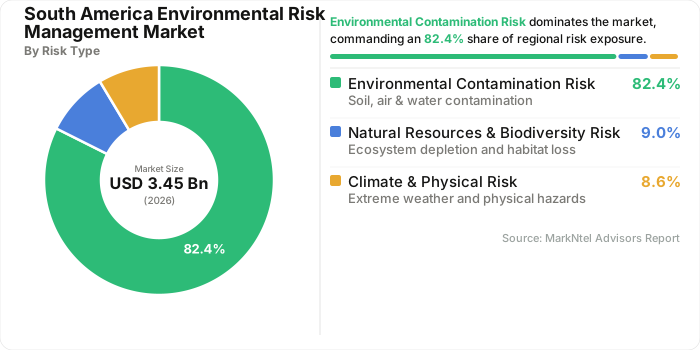
Regulatory & Compliance Risk Leads as the Dominant Risk Type Requiring Environmental Risk Management Services
Regulatory & Compliance Risk contributes approximately 30% share of the South America environmental risk management industry, making it the leading risk type as mandatory disclosure regimes proliferate across the region's largest economies. Chile's NCG 461 mandates listed companies to disclose governance, strategy, risk management, and metrics aligned with TCFD and SASB, while Brazil's CVM Resolution 193 has driven third-party verification of sustainability disclosures from 65% to 81% of covered companies between 2022 and 2025, pushing operators toward continuous compliance monitoring rather than annual, static reporting cycles.
Climate & Physical Risk represents the fastest-growing risk type, underpinned by climate-related economic losses across South America totalling nearly USD 19.2 billion in 2024, 0.3% of regional GDP, of which less than 5% was insured, leaving most physical-risk exposure uncovered and driving demand for quantified risk assessment ahead of the next loss event rather than after it. As disclosure mandates converge with rising physical exposure, providers spanning both compliance monitoring and climate risk quantification are best positioned to serve multi-risk enterprise mandates. By service type, the market is further segmented into the following sub-categories:
- Environmental Contamination Risk
- Climate & Physical Risk
- Natural Resources & Biodiversity Risk
- Regulatory & Compliance Risk
- Water Resource Risk
High Environmental Compliance Requirements Position Oil & Gas as the Leading End-Use Sector
Oil & Gas accounts for approximately 22% of the South America environmental risk management market, making it the largest end-use industry. The sector's leadership is driven by the high environmental risks associated with upstream exploration, offshore production, refining, and transportation activities, which require continuous environmental monitoring, regulatory compliance, and risk assessment to manage potential spills, emissions, and ecosystem impacts. Unlike periodic compliance inspections, oil and gas operations demand ongoing environmental risk management throughout the project lifecycle.
A key example is Petrobras, which approved its 2026–2030 Business Plan with USD 109 billion in planned investments, including USD 13 billion dedicated to energy transition initiatives such as operational decarbonization and emissions reduction across its business segments. The company also aims to achieve 80 million tonnes of cumulative CO₂ reinjection through its CCUS projects by 2025 while working toward zero routine flaring by 2030. These long-term environmental commitments require continuous emissions monitoring, environmental performance tracking, and risk management solutions. As other South American energy companies pursue similar decarbonization and environmental compliance strategies, demand for advanced environmental risk management services is expected to grow steadily across the region. By end – user industry, the market is further segmented into the following sub-segments:
- Oil & Gas
- Chemicals & Petrochemicals
- Manufacturing
- Mining & Metals
- Construction & Infrastructure
- Transportation & Logistics
- Agriculture & Forestry
- Government & Public Sector
- Other Industries
South America Environmental Risk Management Market Geographical Analysis
Brazil accounts for approximately 37% of the South America Environmental Risk Management Market, representing the largest regional share. This leadership is supported by the country's position as South America's largest economy and its extensive concentration of mining, agribusiness, oil and gas, and industrial activities across major states including Minas Gerais, São Paulo, and Rio de Janeiro. The scale and environmental exposure of these industries create sustained demand for environmental risk assessments, compliance monitoring, climate resilience planning, and remediation services.
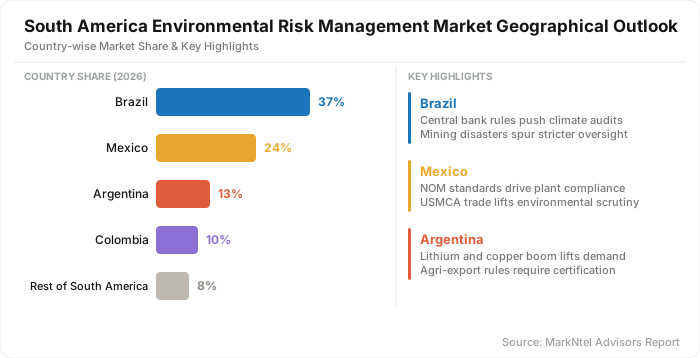
Dedicated climate financing is further strengthening the country's environmental risk management ecosystem. At COP30 in November 2025, the Inter-American Development Bank, Brazil's Ministry of Environment and Climate Change, and BNDES announced a USD 500 million contribution to Brazil's National Climate Fund. Managed by BNDES, the fund supports sustainable and climate-resilient projects, strengthening financing availability for environmental assessment, risk mitigation, and resilience initiatives.
Brazil's vulnerability to extreme weather events further reinforces the need for advanced environmental risk management solutions. In 2024, severe flooding in Rio Grande do Sul became one of the country's most damaging climate-related disasters, causing approximately BRL 8.5 billion in agricultural losses and intensifying the need for early-warning systems, climate-risk assessments, and disaster-resilience planning. With Brazil hosting COP30 in Belém and climate financing increasingly directed toward measurable risk-reduction outcomes, demand for environmental consulting, continuous monitoring, regulatory compliance, and climate-risk advisory services is expected to strengthen across disaster-exposed and industrially intensive regions.
South America Environmental Risk Management Market Competitive Landscape
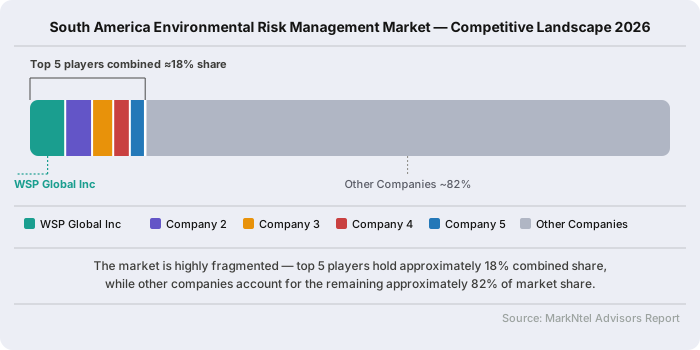
The South America Environmental Risk Management Market is moderately consolidated, with a combination of global environmental consulting firms and established regional service providers competing across environmental risk assessment, regulatory compliance, remediation, and sustainability advisory services. The market is led by AECOM, Environmental Resources Management (ERM), WSP Global Inc., Tetra Tech, Inc., and Arcadis N.V., which collectively account for approximately 18% of the total market share.
- AECOM
- Environmental Resources Management (ERM)
- WSP Global Inc.
- Tetra Tech, Inc.
- Arcadis N.V.
- Jacobs Solutions Inc.
- Stantec Inc.
- Ramboll Group A/S
- SLR Consulting
- Geoambiente S.A.
- Wood plc
- Ambipar Group
South America Environmental Risk Management Market News and Recent Developments
2026: Amazon Conservation Launches AI-Based Quarterly Monitoring Report for Illegal Mining Across the Amazon
In March 2026, Amazon Conservation published the first issue of its Amazon Mining Watch Panorama report, built on an AI platform trained to recognize mining scars in satellite imagery across all nine Amazonian countries. The report found that 6,000 hectares of new mining scars, presumed illegal, appeared across protected areas and Indigenous territories in the final quarter of 2025 alone, with Brazil accounting for roughly 2,000 hectares, Peru 1,700 hectares, and Guyana 900 hectares. A separate tool embedded in the platform estimates the socioenvironmental cost of detected mining in U.S. dollars, covering deforestation, mercury pollution, and river erosion.
Impact Analysis: The platform's standardized, cross-border monitoring methodology gives authorities and civil society a shared early-warning tool that fills gaps left by fragmented national systems, directly supporting enforcement actions such as joint Brazil-Colombia operations already conducted on the Puré River. Its built-in cost-estimation function additionally positions the platform to supply quantified evidence for prosecutions and community legal claims, expanding environmental monitoring software's role from corporate compliance into public enforcement use cases.
2026: Agrotools Secures Brazilian Government Backing to Build World's Largest Environmental Services Payment Platform
Brazil's Eco Invest program, which aims to attract investment into the country's ecological transition, contributed BRL 80 million (approximately USD 15.4 million) in catalytic capital to two Agrotools projects: a two-sided Payment for Environmental Services (PES) platform and a national platform for low-carbon projects. Agrotools has committed to raising 3.75x the government's initial financing — at least BRL 300 million (USD 57.8 million) — through a dedicated special purpose vehicle, with both platforms to be independently audited by a Big Four accounting firm. The PES platform will let farmers receive market-rate lease payments for keeping native vegetation intact, drawing capital from businesses and governments obligated to neutralize their carbon footprints; Agrotools estimates 280 million hectares of native vegetation sit inside Brazilian private farms, of which roughly 30 million hectares carry high agricultural aptitude and are most exposed to future clearing.
Impact Analysis: By channelling government catalytic capital into an audited, market-rate payment mechanism, Agrotools is positioning environmental-services intermediation as an investable asset class rather than a voluntary offset, directly competing with land clearing as the more attractive economic choice for landholders. The company estimates the platform could attract USD 15 billion in investment over five years, which would materially expand demand for the underlying environmental risk data, land-monitoring, and compliance verification services needed to price and audit each participating property.
- Market Segmentation
- Introduction
- Product Definition
- Research Process
- Assumptions
- Executive Summary
- South America Environmental Risk Management Market Policies, Regulations, and Product Standards
- South America Environmental Risk Management Market Trends & Developments
- South America Environmental Risk Management Market Dynamics
- Growth Factors
- Challenges
- South America Environmental Risk Management Market Hotspot & Opportunities
- South America Environmental Risk Management Market Outlook, 2022-2032
- Market Size & Outlook
- By Revenues (USD Million)
- Market Share & Analysis
- By Component- Market Size & Forecast 2022-2032, USD Million
- Services
- Environmental Risk Assessment
- Environmental Due Diligence
- Environmental Auditing & Compliance
- Site Investigation
- Environmental Testing & Laboratory Services
- Environmental Monitoring
- Remediation & Mitigation Planning
- Environmental Consulting & Engineering
- ESG Advisory
- Software & Platforms
- Environmental Risk Analytics
- Environmental Monitoring Platforms
- Environmental Compliance Software
- ESG Software with Environmental Risk Modules
- Climate Risk Analytics
- Environmental Reporting Platforms
- Services
- By Risk Type- Market Size & Forecast 2022-2032, USD Million
- Environmental Contamination Risk
- Climate & Physical Risk
- Natural Resources & Biodiversity Risk
- Regulatory & Compliance Risk
- Water Resource Risk
- By Deployment Mode- Market Size & Forecast 2022-2032, USD Million
- On-Premises
- Cloud-Based
- By Enterprise Size- Market Size & Forecast 2022-2032, USD Million
- Large Enterprises
- Small & Medium Enterprises (SMEs)
- By Application- Market Size & Forecast 2022-2032, USD Million
- Environmental Risk Management Impact Assessment
- Environmental Risk Management Monitoring & Reporting
- Climate Risk Assessment
- Waste Management Risk
- Water Resource Risk
- Site Contamination Assessment & Remediation
- By End-Use Industry- Market Size & Forecast 2022-2032, USD Million
- Energy & Utilities
- Oil & Gas
- Chemicals & Petrochemicals
- Manufacturing
- Mining & Metals
- Construction & Infrastructure
- Transportation & Logistics
- Agriculture & Forestry
- Government & Public Sector
- Other Industries
- By Country
- Brazil
- Mexico
- Argentina
- Chile
- Peru
- Colombia
- By Company
- Competition Characteristics
- Market Share & Analysis
- By Component- Market Size & Forecast 2022-2032, USD Million
- Market Size & Outlook
- Brazil Environmental Risk Management Market Outlook, 2022-2032
- Market Size & Outlook
- By Revenues (USD Million)
- Market Share & Analysis
- By Component- Market Size & Forecast 2022-2032, USD Million
- By Risk Type- Market Size & Forecast 2022-2032, USD Million
- By Deployment Mode- Market Size & Forecast 2022-2032, USD Million
- By Enterprise Size- Market Size & Forecast 2022-2032, USD Million
- By Application- Market Size & Forecast 2022-2032, USD Million
- By End-Use Industry- Market Size & Forecast 2022-2032, USD Million
- Market Size & Outlook
- Mexico Environmental Risk Management Market Outlook, 2022-2032
- Market Size & Outlook
- By Revenues (USD Million)
- Market Share & Analysis
- By Component- Market Size & Forecast 2022-2032, USD Million
- By Risk Type- Market Size & Forecast 2022-2032, USD Million
- By Deployment Mode- Market Size & Forecast 2022-2032, USD Million
- By Enterprise Size- Market Size & Forecast 2022-2032, USD Million
- By Application- Market Size & Forecast 2022-2032, USD Million
- By End-Use Industry- Market Size & Forecast 2022-2032, USD Million
- Market Size & Outlook
- Argentina Environmental Risk Management Market Outlook, 2022-2032
- Market Size & Outlook
- By Revenues (USD Million)
- Market Share & Analysis
- By Component- Market Size & Forecast 2022-2032, USD Million
- By Risk Type- Market Size & Forecast 2022-2032, USD Million
- By Deployment Mode- Market Size & Forecast 2022-2032, USD Million
- By Enterprise Size- Market Size & Forecast 2022-2032, USD Million
- By Application- Market Size & Forecast 2022-2032, USD Million
- By End-Use Industry- Market Size & Forecast 2022-2032, USD Million
- Market Size & Outlook
- Chile Environmental Risk Management Market Outlook, 2022-2032
- Market Size & Outlook
- By Revenues (USD Million)
- Market Share & Analysis
- By Component- Market Size & Forecast 2022-2032, USD Million
- By Risk Type- Market Size & Forecast 2022-2032, USD Million
- By Deployment Mode- Market Size & Forecast 2022-2032, USD Million
- By Enterprise Size- Market Size & Forecast 2022-2032, USD Million
- By Application- Market Size & Forecast 2022-2032, USD Million
- By End-Use Industry- Market Size & Forecast 2022-2032, USD Million
- Market Size & Outlook
- Peru Environmental Risk Management Market Outlook, 2022-2032
- Market Size & Outlook
- By Revenues (USD Million)
- Market Share & Analysis
- By Component- Market Size & Forecast 2022-2032, USD Million
- By Risk Type- Market Size & Forecast 2022-2032, USD Million
- By Deployment Mode- Market Size & Forecast 2022-2032, USD Million
- By Enterprise Size- Market Size & Forecast 2022-2032, USD Million
- By Application- Market Size & Forecast 2022-2032, USD Million
- By End-Use Industry- Market Size & Forecast 2022-2032, USD Million
- Market Size & Outlook
- South America Environmental Risk Management Market Key Strategic Imperatives for Success & Growth
- Competitive Outlook
- Company Profiles
- AECOM
- Business Description
- Product Portfolio
- Collaborations & Alliances
- Recent Developments
- Financial Details
- Others
- Environmental Resources Management (ERM)
- Business Description
- Product Portfolio
- Collaborations & Alliances
- Recent Developments
- Financial Details
- Others
- WSP Global Inc.
- Business Description
- Product Portfolio
- Collaborations & Alliances
- Recent Developments
- Financial Details
- Others
- Tetra Tech, Inc.
- Business Description
- Product Portfolio
- Collaborations & Alliances
- Recent Developments
- Financial Details
- Others
- Arcadis N.V.
- Business Description
- Product Portfolio
- Collaborations & Alliances
- Recent Developments
- Financial Details
- Others
- Jacobs Solutions Inc.
- Business Description
- Product Portfolio
- Collaborations & Alliances
- Recent Developments
- Financial Details
- Others
- Stantec Inc.
- Business Description
- Product Portfolio
- Collaborations & Alliances
- Recent Developments
- Financial Details
- Others
- Ramboll Group A/S
- Business Description
- Product Portfolio
- Collaborations & Alliances
- Recent Developments
- Financial Details
- Others
- SLR Consulting
- Business Description
- Product Portfolio
- Collaborations & Alliances
- Recent Developments
- Financial Details
- Others
- Wood plc
- Business Description
- Product Portfolio
- Collaborations & Alliances
- Recent Developments
- Financial Details
- Others
- Geoambiente S.A.
- Business Description
- Product Portfolio
- Collaborations & Alliances
- Recent Developments
- Financial Details
- Others
- Ambipar Group
- Business Description
- Product Portfolio
- Collaborations & Alliances
- Recent Developments
- Financial Details
- Others
- Others
- AECOM
- Company Profiles
- Disclaimer

MarkNtel Advisors follows a robust and iterative research methodology designed to ensure maximum accuracy and minimize deviation in market estimates and forecasts. Our approach combines both bottom-up and top-down techniques to effectively segment and quantify various aspects of the market. A consistent feature across all our research reports is data triangulation, which examines the market from three distinct perspectives to validate findings. Key components of our research process include:
1. Scope & Research Design At the outset, MarkNtel Advisors define the research objectives and formulate pertinent questions. This phase involves determining the type of research—qualitative or quantitative—and designing a methodology that outlines data collection methods, target demographics, and analytical tools. They also establish timelines and budgets to ensure the research aligns with client goals.
2. Sample Selection and Data Collection In this stage, the firm identifies the target audience and determines the appropriate sample size to ensure representativeness. They employ various sampling methods, such as random or stratified sampling, based on the research objectives. Data collection is carried out using tools like surveys, interviews, and observations, ensuring the gathered data is reliable and relevant.
3. Data Analysis and Validation Once data is collected, MarkNtel Advisors undertake a rigorous analysis process. This includes cleaning the data to remove inconsistencies, employing statistical software for quantitative analysis, and thematic analysis for qualitative data. Validation steps are taken to ensure the accuracy and reliability of the findings, minimizing biases and errors.

4. Data Forecast and FinalizationThe final phase involves forecasting future market trends based on the analyzed data. MarkNtel Advisors utilize predictive modeling and time series analysis to anticipate market behaviors. The insights are then compiled into comprehensive reports, featuring visual aids like charts and graphs, and include strategic recommendations to inform client decision-making
FILL THE FORM TO GET THE FREE SAMPLE PAGES
We offer flexible licensing options to cater to varying organizational needs. Choose the pricing pack that best suits your requirements:
Buy Now Inquire Before Buying
 Talk to our Consultant
 Request Customization